warning FIAT BARCHETTA 2003 1.G Repair Manual
[x] Cancel search | Manufacturer: FIAT, Model Year: 2003, Model line: BARCHETTA, Model: FIAT BARCHETTA 2003 1.GPages: 170, PDF Size: 3.55 MB
Page 123 of 170
122
IMPORTANT Brake fluid is hy-
groscopic (meaning it absorbs humid-
ity). This is why the fluid should be
changed more frequently than shown
in the Service Schedule if the car is
mainly driven in areas with a high per-
centage of humidity in the air.AIR CLEANER
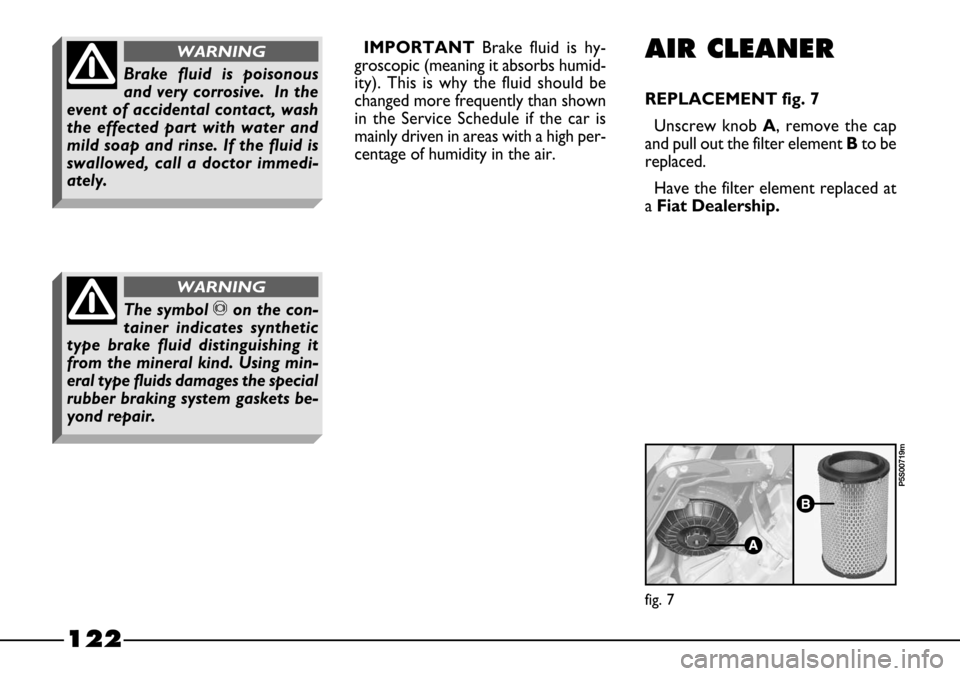
REPLACEMENT fig. 7
Unscrew knob A, remove the cap
and pull out the filter element Bto be
replaced.
Have the filter element replaced at
a Fiat Dealership.
fig. 7
P5S00719m
Brake fluid is poisonous
and very corrosive. In the
event of accidental contact, wash
the effected part with water and
mild soap and rinse. If the fluid is
swallowed, call a doctor immedi-
ately.
WARNING
The symbol πon the con-
tainer indicates synthetic
type brake fluid distinguishing it
from the mineral kind. Using min-
eral type fluids damages the special
rubber braking system gaskets be-
yond repair.
WARNING
Page 124 of 170
123
If the vehicle is to stand
for a long time in the cold,
remove the battery and
store it in a warm place to avoid
it freezing.
BATTERY
The Fiat barchetta’s battery is of the
“Limited Maintenance” type: under
normal conditions, it requires no top-
ping up with distilled water.
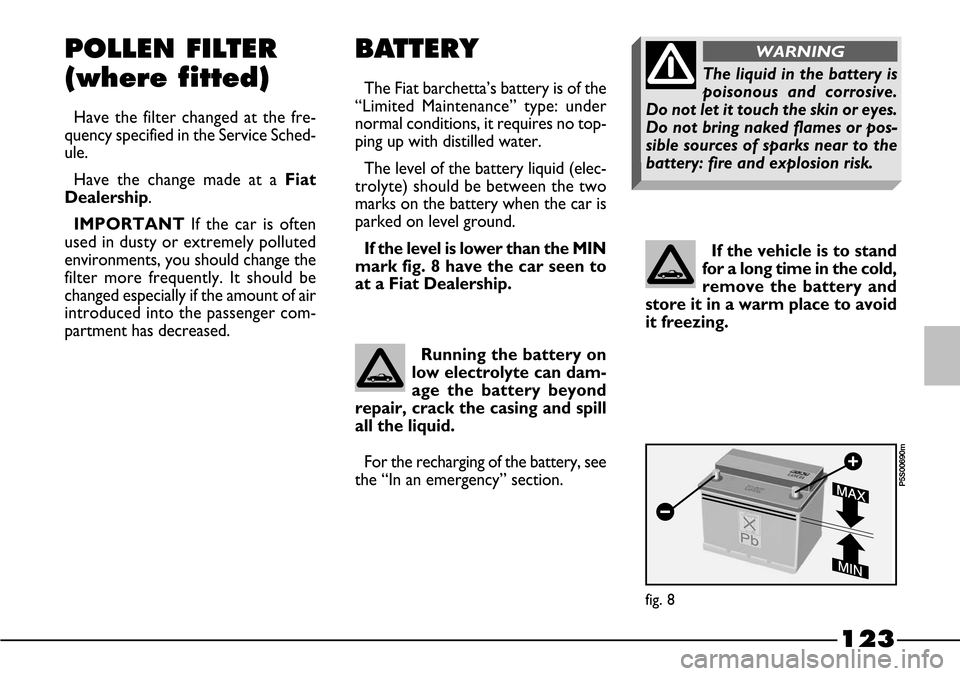
The level of the battery liquid (elec-
trolyte) should be between the two
marks on the battery when the car is
parked on level ground.
If the level is lower than the MIN
mark fig. 8 have the car seen to
at a Fiat Dealership.
Running the battery on
low electrolyte can dam-
age the battery beyond
repair, crack the casing and spill
all the liquid.
For the recharging of the battery, see
the “In an emergency” section.
fig. 8
P5S00690m
POLLEN FILTER
(where fitted)
Have the filter changed at the fre-
quency specified in the Service Sched-
ule.
Have the change made at a Fiat
Dealership.
IMPORTANTIf the car is often
used in dusty or extremely polluted
environments, you should change the
filter more frequently. It should be
changed especially if the amount of air
introduced into the passenger com-
partment has decreased.
The liquid in the battery is
poisonous and corrosive.
Do not let it touch the skin or eyes.
Do not bring naked flames or pos-
sible sources of sparks near to the
battery: fire and explosion risk.
WARNING
Page 125 of 170
124
USEFUL ADVICE
FOR LENGTHENING THE
LIFE OF YOUR BATTERY
When you park the car, ensure the
doors, boot and bonnet are closed
properly. The courtesy light must be
off.
Do not keep accessories (e.g. radio,
hazard lights etc.) switched on for a
long time when the engine is not run-
ning.
IMPORTANT A battery which is
kept at a charge of less than 50% for
any length of time will be damaged by
sulphation leading to a reduction in
cranking power and a higher risk of
the battery electrolyte freezing (this
may even occur at –10°C).
If the car is inactive for a long peri-
od of time, refer to “Storing the car”
in the “Driving your car” chapter.If, after purchasing your car you
would like to add electrical accessories
that require a permanent power sup-
ply (alarm systems, hands-free phone,
radio navigator with satellite anti-theft
system, etc.), visit a Fiat Dealership.
The staff of experts, besides suggest-
ing the most suitable accessories in the
Lineaccessori range, will also check
whether the car electrical system can
support the required load or if a larg-
er size battery needs to be installed.
These devices will, in fact, run off the
battery even when the key is not in-
serted (car parked) and can deploy the
battery.
Incorrect fitting of elec-
trical and electronic ac-
cessories can seriously
damage the car.Batteries contain sub-
stances that are very
harmful for the environ-
ment. You are advised to have the
battery changed at a Fiat Dealer-
ship. It is properly equipped for
disposing of used batteries in an
environmentally-friendly way that
complies with the law.
Do not attempt to recharge
a frozen battery. Thaw it
first otherwise it could explode. If
the battery froze, make sure the in-
ternal elements are not broken
(short-circuit risk) and that the cas-
ing is not cracked (risk of spilling
the poisonous and corrosive fluid).
WARNING
Page 126 of 170
125
– Do not connect or disconnect the
terminals of the electronic units while
the ignition key is at MAR.
– Do not check polarity through
sparking.
– Disconnect the electronic units if
you are electrically welding the car
body. Remove the units if tempera-
tures exceed 80°C. (special operations
on the bodywork etc.)
IMPORTANTIf the radio or car
alarm systems are not installed cor-
rectly, they can interfere with the
working of the electronic control
units.ELECTRONIC
CONTROL UNITS
When the car is being used normal-
ly, special measures are not necessary.
The following instructions must be
followed very carefully however, if you
work on the electrical system or in
cases where starting with another bat-
tery is necessary:
– Never disconnect the battery from
the electrical system while the engine
is running.
– When recharging, disconnect the
battery from the wiring system. The
latest battery chargers can, in fact, gen-
erate voltages of up to 20V.
– Never start the engine with a bat-
tery charger. Always use another bat-
tery.
– Be particularly careful when con-
necting the battery to the electrical
system. Ensure the battery posts are
connected up to the right leads (the
polarity is correct) and check that the
connection has been made properly.
Battery Maximum admitted
stand-by intake
50Ah 30 mA
Furthermore, remember that high in-
take electric devices (such as baby bot-
tle warmers, vacuum cleaners, cellular
phones, mini-fridges, etc.) powered
when the engine is off can run the
battery down.
IMPORTANT If you need to install
added systems to the car, improper
wiring connections, in particular if they
affect safety devices, are dangerous.The total intake of these systems
(factory and after-market) must be less
than 0.6 mA x Ah (of the battery) as
shown in the following table:
Modifications or repairs to
the electrical system car-
ried out incorrectly and without
bearing the features of the system
in mind can cause malfunctions
with the risk of fire.
WARNING
Page 127 of 170
126
WHEELS
AND TYRES
TYRES PRESSURE
Every two weeks and before long
journeys, check the pressure of each
tyre including the spare.
The pressure must be checked when
the tyre is rested and cold.
It is normal for the pressure to rise
when you are driving. If you have to
check or restore the pressure when
the tyres are warm remember that the
pressure value must be 0.3 bar above
the specified value.
SPARK PLUGS
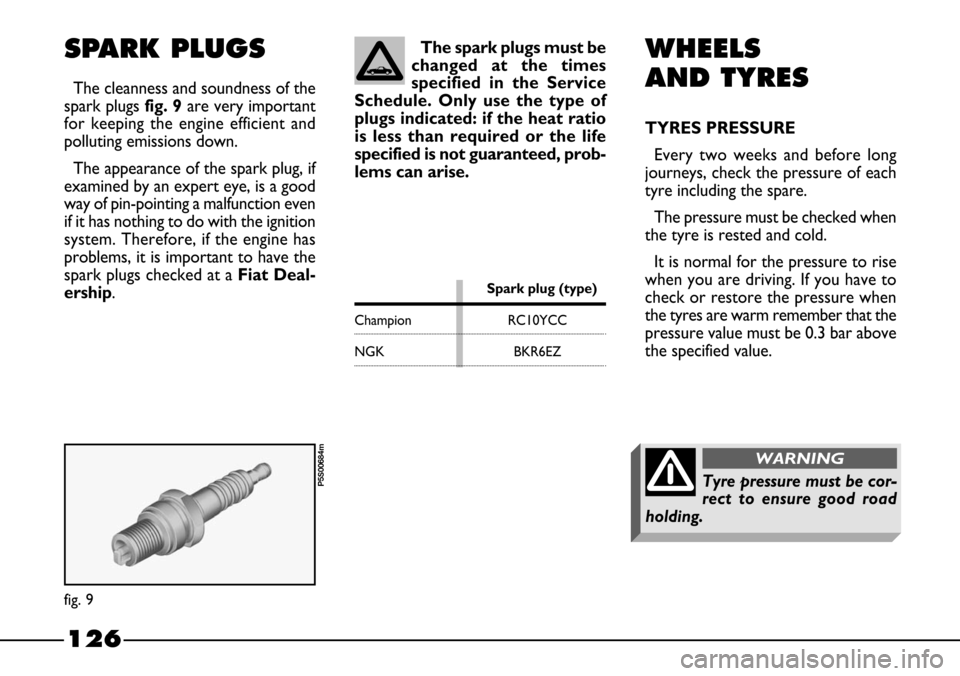
The cleanness and soundness of the
spark plugs fig. 9are very important
for keeping the engine efficient and
polluting emissions down.
The appearance of the spark plug, if
examined by an expert eye, is a good
way of pin-pointing a malfunction even
if it has nothing to do with the ignition
system. Therefore, if the engine has
problems, it is important to have the
spark plugs checked at a Fiat Deal-
ership.The spark plugs must be
changed at the times
specified in the Service
Schedule. Only use the type of
plugs indicated: if the heat ratio
is less than required or the life
specified is not guaranteed, prob-
lems can arise.
fig. 9
P5S00684m
Spark plug (type)
Champion RC10YCC
NGK BKR6EZ
Tyre pressure must be cor-
rect to ensure good road
holding.
WARNING
Page 128 of 170
127
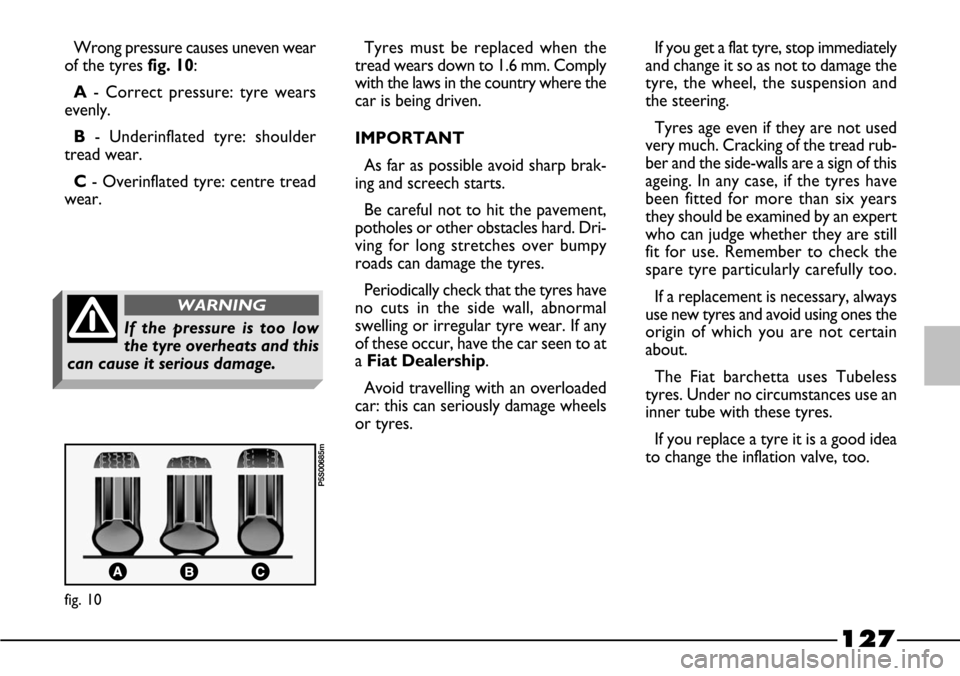
Wrong pressure causes uneven wear
of the tyresfig. 10:
A- Correct pressure: tyre wears
evenly.
B- Underinflated tyre: shoulder
tread wear.
C- Overinflated tyre: centre tread
wear.If you get a flat tyre, stop immediately
and change it so as not to damage the
tyre, the wheel, the suspension and
the steering.
Tyres age even if they are not used
very much. Cracking of the tread rub-
ber and the side-walls are a sign of this
ageing. In any case, if the tyres have
been fitted for more than six years
they should be examined by an expert
who can judge whether they are still
fit for use. Remember to check the
spare tyre particularly carefully too.
If a replacement is necessary, always
use new tyres and avoid using ones the
origin of which you are not certain
about.
The Fiat barchetta uses Tubeless
tyres. Under no circumstances use an
inner tube with these tyres.
If you replace a tyre it is a good idea
to change the inflation valve, too. Tyres must be replaced when the
tread wears down to 1.6 mm. Comply
with the laws in the country where the
car is being driven.
IMPORTANT
As far as possible avoid sharp brak-
ing and screech starts.
Be careful not to hit the pavement,
potholes or other obstacles hard. Dri-
ving for long stretches over bumpy
roads can damage the tyres.
Periodically check that the tyres have
no cuts in the side wall, abnormal
swelling or irregular tyre wear. If any
of these occur, have the car seen to at
a Fiat Dealership.
Avoid travelling with an overloaded
car: this can seriously damage wheels
or tyres.
fig. 10
P5S00685m
If the pressure is too low
the tyre overheats and this
can cause it serious damage.
WARNING
Page 129 of 170
128
RUBBER TUBING
Follow the Service Schedule careful-
ly in the case of the braking, power
steering and fuel supply systems' rub-
ber hoses. Ozone, high temperatures
and long absence of liquid in the sys-
tem can in fact cause the hardening
and cracking of the hoses with possi-
ble losses of fluid. A careful check is
therefore essential.
WINDSCREEN
WIPER
BLADES
Periodically clean the rubber part
with suitable liquid; TUTELA PRO-
FESSIONAL SC 35is recommend-
ed.
Change the blades if the rubber edge
is warped or worn out. You should in
any case change them approximately
once a year. To ensure the front and rear tyres all
wear evenly, you are advised to change
the tyres over every 10-15 thousand
kilometres (6-10 thousand miles)
keeping them on the same side of the
car so as not to reverse the direction
of rotation.
Do not change the tyres
over in criss-cross fashion
by moving a tyre from the left hand
side of the car to the right and vice
versa.
WARNING
Travelling with worn wiper
blades is dangerous be-
cause it reduces visibility in bad
weather.
WARNING
Page 134 of 170
133
HOOD
Normal maintenance of the hood
consists in washing it.
Dust the hood off before washing it.
Dirt must be removed using an ap-
propriate cleaning compound; then
rinse thoroughly using a low pressure
hose.
INTERIORS
From time to time, check that wa-
ter has not collected under the mats
(from dripping shoes, umbrellas etc.)
which could cause the steel to rust.
You are advised to wash
the hood by hand. When
washing a car in an auto-
matic car wash, the rotating
brushes exert a strong pressure
on the surface of the hood that
could damage it and scratch the
rear window. In addition, the
cleaning compounds and addi-
tives could have a negative effect
and spoil the hood's appearance.IMPORTANT Do not use petrol,
stain removers, benzol, paint thinners
or solvents to remove dirt marks; on-
ly use products designed for the pur-
pose. If the marks still will not come
out, see a Fiat Dealership.
REAR WINDOW
This window can be replaced; con-
tact a Fiat Dealershipto have this
done.
When cleaning the rear window be
particularly careful to avoid scratches
or scuffs that could spoil its appear-
ance.
Never use flammable prod-
ucts (petroleum ether or
petrol) to clean the inside of the
car. Electrostatic charges generat-
ed by rubbing while cleaning could
cause fires.
WARNING
Page 135 of 170
134
If the stain does not come out, use
a special cleaning compound being par-
ticularly careful to follow the instruc-
tions for use.
IMPORTANTNever use alcohol
or alcohol-base products.
PLASTIC PARTS INSIDE
THE CAR
Use special products designed not to
alter the appearance of the compo-
nents.
IMPORTANT Do not use alcohol
or petrol for cleaning the glass of the
instrument panel. CLEANING THE SEATS AND
FABRIC UPHOLSTERY
– Remove the dust with a soft brush
or a vacuum cleaner.
– Rub the seats with a rag moistened
in a solution of water and neutral de-
tergent.
CLEANING LEATHER SEATS
– Remove the dry dirt with a buck-
skin or very slightly moist cloth with-
out exerting too much pressure.
– Remove liquid or grease stains with
a dry absorbent cloth without rubbing.
Then wipe with a buckskin or soft
cloth moistened with water and neu-
tral soap.
Do not keep aerosol cans in
the car. There is the risk
they might explode. Aerosol cans
must never be exposed to a tem-
perature above 50°C. The temper-
ature inside the car might go well
beyond that figure if the car is ex-
posed to the sun.
WARNING
Page 139 of 170
138
FUEL SUPPLY/IGNITION
Integrated electronic injection and ig-
nition system: a single electronic con-
trol unit controls both functions. It
processes both the time the injection
lasts (for fuel metering) and the igni-
tion’s advance angle.
Type: Sequential in phase Multipoint
Air cleaner: dry-type with paper fil-
ter element; thermostatically con-
trolled intake.
Petrol pump: in-tank.
Injection pressure: 3 bar
Method of measuring the amount of
aspirated air by directly measuring the
maximum rate of flow with a hot wire
air flow meter.
“Closed loop” petrol metering (in-
formation about combustion provid-
ed by the Lambda sensor).Firing order: 1-3-4-2
Spark plugs:
– Champion RC10YCC
– NGK BKR6EZLUBRICATION
Forced-fed with gear pump with
pressure relief valve incorporated.
Oil purification by means of full-flow-
cartridge filter.
COOLING
Cooling system with radiator, cen-
trifugal pump and expansion tank.
“Controlled” by-pass type thermo-
stat on the secondary circuit for the
recirculation of water from the engine
to the radiator.
Electric fan for radiator cooling with
thermostatically-controlled on/off
switch on the radiator.
Modifications or repairs to
the fuel feed system that
are not carried out properly or do
not take the system’s technical
specifications into account can
cause malfunctions with the risk of
fire.
WARNING