warning FIAT BARCHETTA 2003 1.G Owner's Manual
[x] Cancel search | Manufacturer: FIAT, Model Year: 2003, Model line: BARCHETTA, Model: FIAT BARCHETTA 2003 1.GPages: 170, PDF Size: 3.55 MB
Page 43 of 170
42
INTERIOR
EQUIPMENT
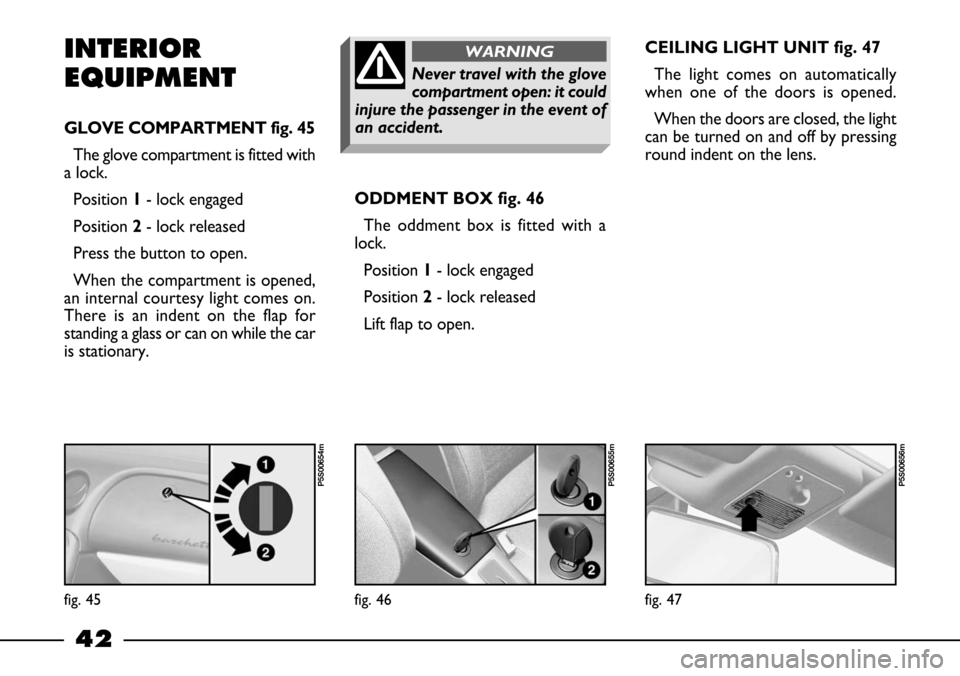
GLOVE COMPARTMENT fig. 45
The glove compartment is fitted with
a lock.
Position1- lock engaged
Position2- lock released
Press the button to open.
When the compartment is opened,
an internal courtesy light comes on.
There is an indent on the flap for
standing a glass or can on while the car
is stationary.ODDMENT BOX fig. 46
The oddment box is fitted with a
lock.
Position 1- lock engaged
Position 2- lock released
Lift flap to open. CEILING LIGHT UNIT fig. 47
The light comes on automatically
when one of the doors is opened.
When the doors are closed, the light
can be turned on and off by pressing
round indent on the lens.
fig. 45
P5S00654m
fig. 46
P5S00655m
fig. 47
P5S00656m
Never travel with the glove
compartment open: it could
injure the passenger in the event of
an accident.
WARNING
Page 44 of 170
43
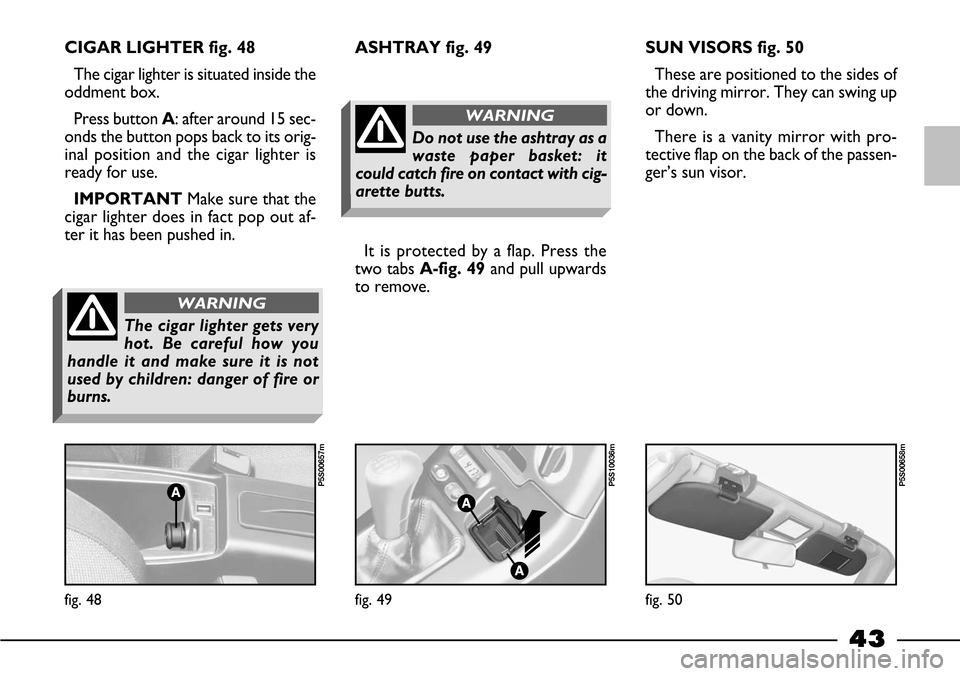
CIGAR LIGHTER fig. 48
The cigar lighter is situated inside the
oddment box.
Press button A: after around 15 sec-
onds the button pops back to its orig-
inal position and the cigar lighter is
ready for use.
IMPORTANTMake sure that the
cigar lighter does in fact pop out af-
ter it has been pushed in.ASHTRAY fig. 49
It is protected by a flap. Press the
two tabs A-fig. 49 and pull upwards
to remove. SUN VISORS fig. 50
These are positioned to the sides of
the driving mirror. They can swing up
or down.
There is a vanity mirror with pro-
tective flap on the back of the passen-
ger’s sun visor.
The cigar lighter gets very
hot. Be careful how you
handle it and make sure it is not
used by children: danger of fire or
burns.
WARNING
Do not use the ashtray as a
waste paper basket: it
could catch fire on contact with cig-
arette butts.
WARNING
fig. 48
P5S00657m
fig. 49
P5S10036m
fig. 50
P5S00658m
Page 45 of 170
44
DOORSClosing by hand
from the outside
Turn the key to position 2to engage
the lock.
Manual locking/opening
from the the inside
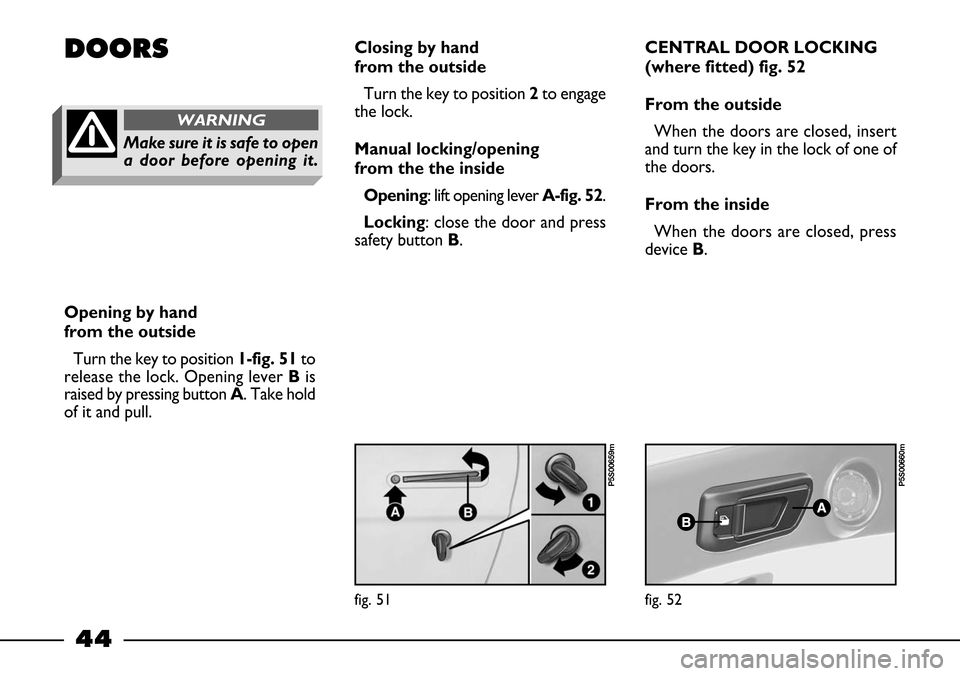
Opening: lift opening lever A-fig. 52.
Locking: close the door and press
safety button B.CENTRAL DOOR LOCKING
(where fitted) fig. 52
From the outside
When the doors are closed, insert
and turn the key in the lock of one of
the doors.
From the inside
When the doors are closed, press
device B.
Opening by hand
from the outside
Turn the key to position 1-fig. 51to
release the lock. Opening lever Bis
raised by pressing button A. Take hold
of it and pull.
fig. 51
P5S00659m
fig. 52
P5S00660m
Make sure it is safe to open
a door before opening it.
WARNING
Page 46 of 170
45
IMPORTANT If one of the doors
is not shut properly or there is a fail-
ure in the system, the central locking
feature will not work and, after some
attempts, the device stops working for
around two minutes. In these two
minutes the doors can be locked or
unlocked manually without the elec-
trical system coming into play. After
the two minutes the control unit is
ready to receive commands once
more.
If the reason for the malfunction has
been removed, the device will start to
work properly again. If not it will cut
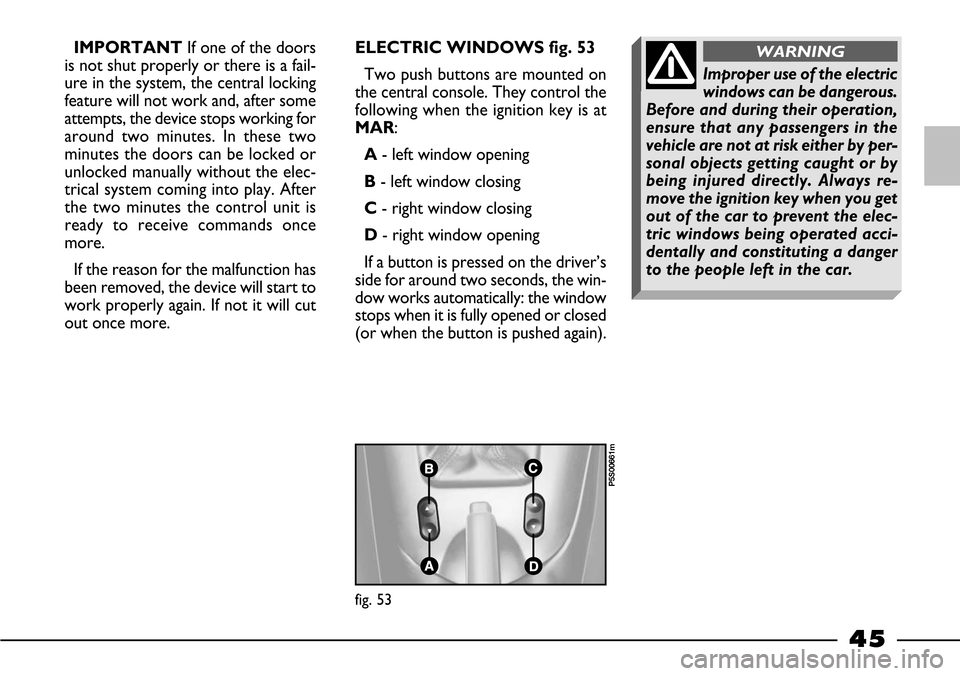
out once more.ELECTRIC WINDOWS fig. 53
Two push buttons are mounted on
the central console. They control the
following when the ignition key is at
MAR:
A- left window opening
B- left window closing
C- right window closing
D- right window opening
If a button is pressed on the driver’s
side for around two seconds, the win-
dow works automatically: the window
stops when it is fully opened or closed
(or when the button is pushed again).
fig. 53
P5S00661m
Improper use of the electric
windows can be dangerous.
Before and during their operation,
ensure that any passengers in the
vehicle are not at risk either by per-
sonal objects getting caught or by
being injured directly. Always re-
move the ignition key when you get
out of the car to prevent the elec-
tric windows being operated acci-
dentally and constituting a danger
to the people left in the car.
WARNING
Page 47 of 170
46
HOOD
USEFUL TIPS
Before opening the hood, make sure
its housing is not obstructed by any-
thing.
To prevent damage to the window
seals, open and close the hood either
with the windows right down or with
the doors open.
Do not fold the hood when it is wet:
it may get damaged if it is left in its
housing for a long period.
Do not rest weights on the open or
closed hood: the canvas and the frame
could get damaged.
Do not open or close the hood
when the outside temperature is very
low.
Snow or ice must be removed with
objects that do not leave scratches.
Take the car to a Fiat Dealership
for any repairs or maintenance.OPENING
1) Lower the sun visors.
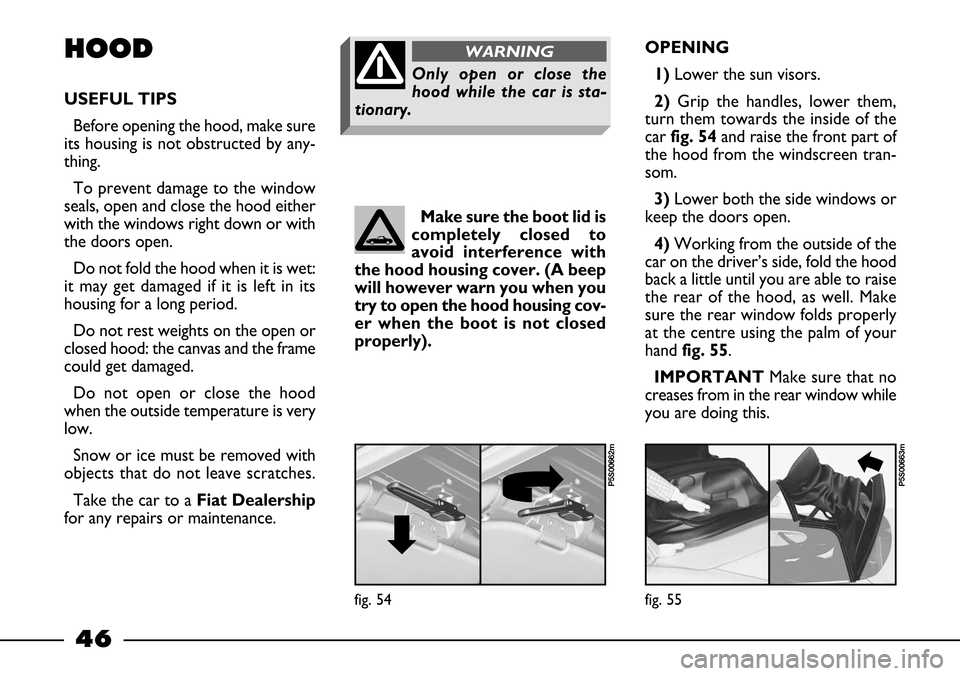
2) Grip the handles, lower them,
turn them towards the inside of the
car fig. 54and raise the front part of
the hood from the windscreen tran-
som.
3)Lower both the side windows or
keep the doors open.
4) Working from the outside of the
car on the driver’s side, fold the hood
back a little until you are able to raise
the rear of the hood, as well. Make
sure the rear window folds properly
at the centre using the palm of your
hand fig. 55.
IMPORTANTMake sure that no
creases from in the rear window while
you are doing this. Make sure the boot lid is
completely closed to
avoid interference with
the hood housing cover. (A beep
will however warn you when you
try to open the hood housing cov-
er when the boot is not closed
properly).
Only open or close the
hood while the car is sta-
tionary.
WARNING
fig. 55
P5S00663m
fig. 54
P5S00662m
Page 53 of 170
52
It allows to prolong the “open hood”
season.
FITTING THE WIND STOP
(1
stfitting)
1)Fit the side brackets Aand B
fig. 69in the holes on the internal
sides of the car, on the right and on
the left.
2)Fasten the side brackets Aand B
to the body with the nuts and screws
provided. Insert the screws and the
washers from the outside of the body
side and fasten the brackets from the
inside with the nuts, fig. 69.3)Fit the ends of the wind spot C
and D fig. 70inside the previously fit-
ted brackets. Make sure that the wind
stop cover is facing the rear part of the
car.
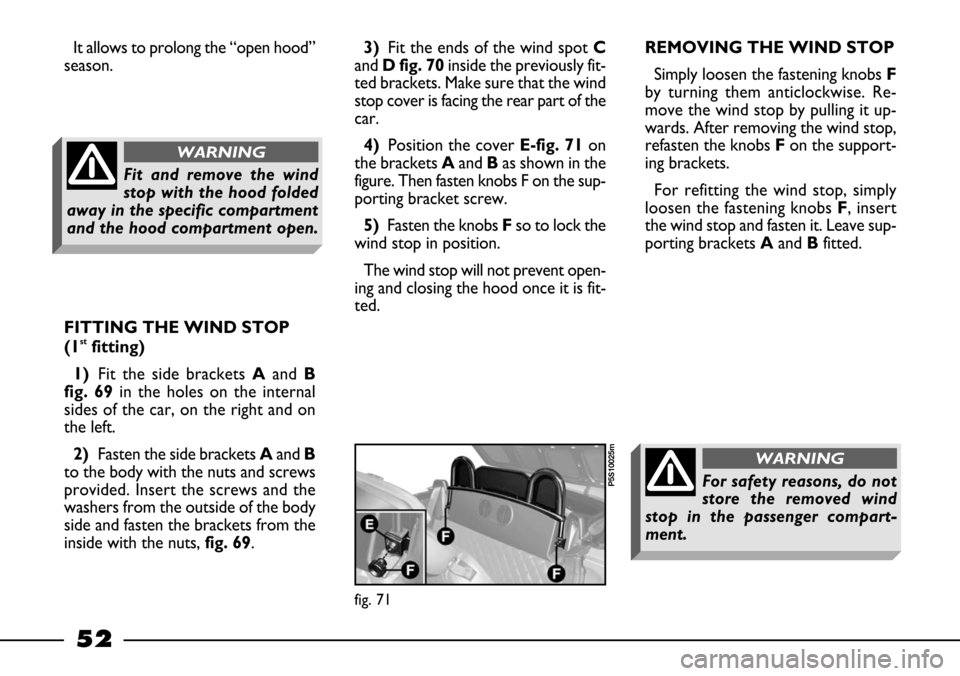
4)Position the coverE-fig. 71on
the brackets Aand Bas shown in the
figure. Then fasten knobs F on the sup-
porting bracket screw.
5)Fasten the knobs Fso to lock the
wind stop in position.
The wind stop will not prevent open-
ing and closing the hood once it is fit-
ted.REMOVING THE WIND STOP
Simply loosen the fastening knobs F
by turning them anticlockwise. Re-
move the wind stop by pulling it up-
wards. After removing the wind stop,
refasten the knobs Fon the support-
ing brackets.
For refitting the wind stop, simply
loosen the fastening knobs F, insert
the wind stop and fasten it. Leave sup-
porting brackets Aand Bfitted.
For safety reasons, do not
store the removed wind
stop in the passenger compart-
ment.
WARNING
fig. 71
P5S10025m
Fit and remove the wind
stop with the hood folded
away in the specific compartment
and the hood compartment open.
WARNING
Page 54 of 170
53
BONNET
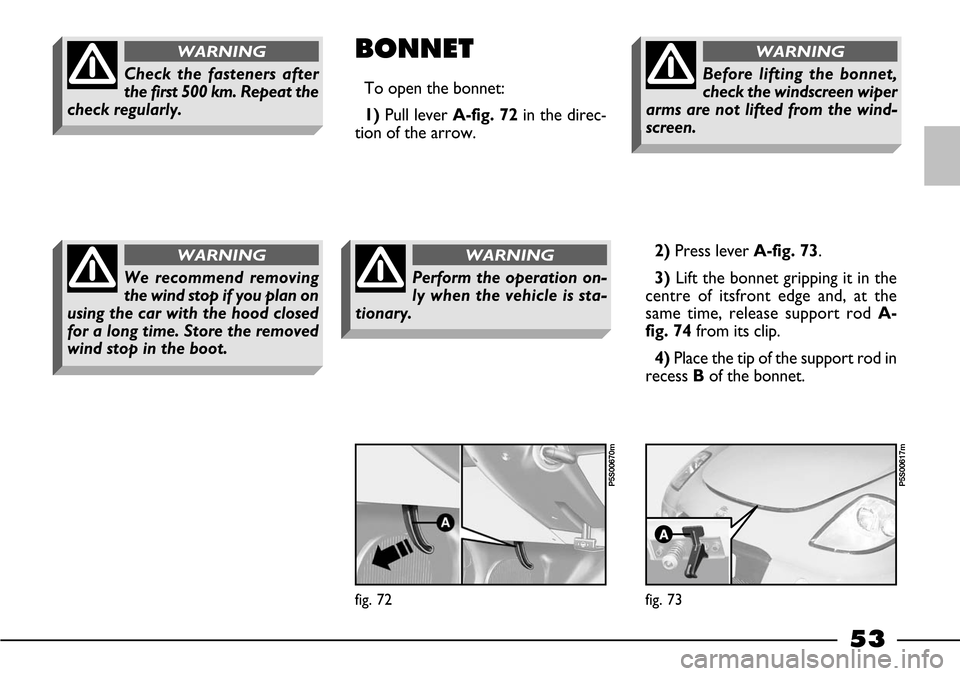
To open the bonnet:
1) Pull lever A-fig. 72in the direc-
tion of the arrow.Before lifting the bonnet,
check the windscreen wiper
arms are not lifted from the wind-
screen.
WARNING
2)Press leverA-fig. 73.
3)Lift the bonnet gripping it in the
centre of itsfront edge and, at the
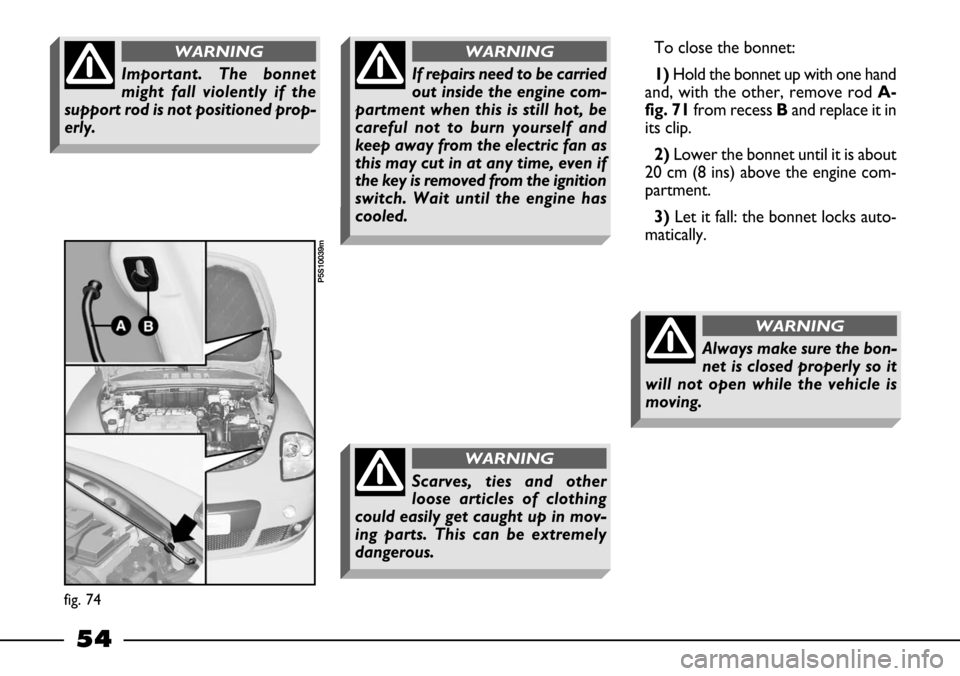
same time, release support rod A-
fig. 74from its clip.
4) Place the tip of the support rod in
recess Bof the bonnet.
fig. 73
P5S00617m
fig. 72
P5S00670m
Check the fasteners after
the first 500 km. Repeat the
check regularly.
WARNING
We recommend removing
the wind stop if you plan on
using the car with the hood closed
for a long time. Store the removed
wind stop in the boot.
WARNING
Perform the operation on-
ly when the vehicle is sta-
tionary.
WARNING
Page 55 of 170
54
Important. The bonnet
might fall violently if the
support rod is not positioned prop-
erly.
WARNINGTo close the bonnet:
1) Hold the bonnet up with one hand
and, with the other, remove rod A-
fig. 71from recess Band replace it in
its clip.
2)Lower the bonnet until it is about
20 cm (8 ins) above the engine com-
partment.
3)Let it fall: the bonnet locks auto-
matically.
Always make sure the bon-
net is closed properly so it
will not open while the vehicle is
moving.
WARNING
fig. 74
P5S10039m
If repairs need to be carried
out inside the engine com-
partment when this is still hot, be
careful not to burn yourself and
keep away from the electric fan as
this may cut in at any time, even if
the key is removed from the ignition
switch. Wait until the engine has
cooled.
WARNING
Scarves, ties and other
loose articles of clothing
could easily get caught up in mov-
ing parts. This can be extremely
dangerous.
WARNING
Page 56 of 170
55
BOOT
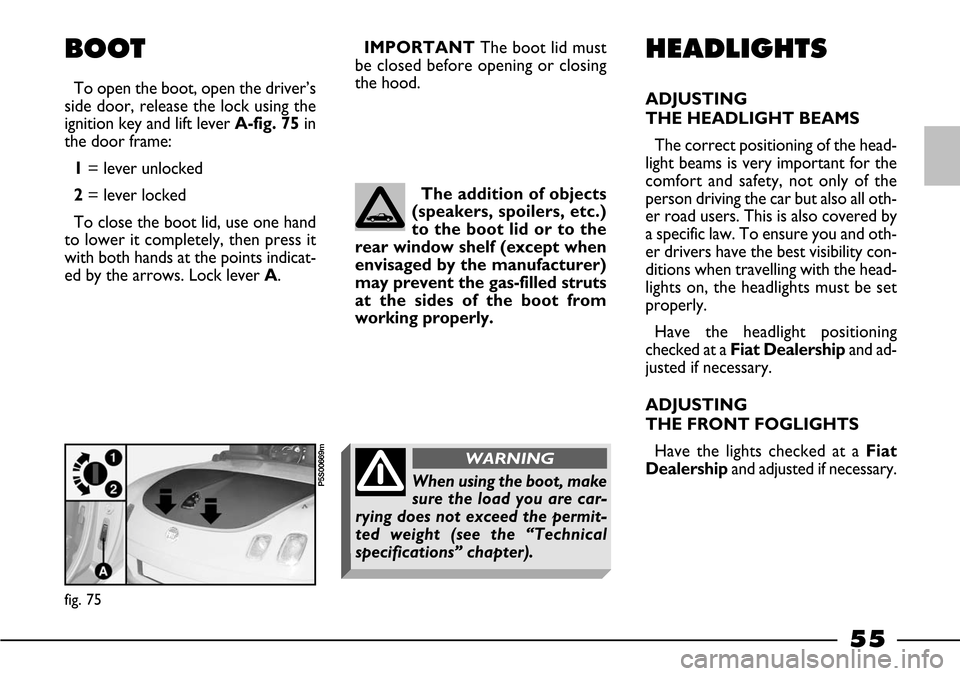
To open the boot, open the driver’s
side door, release the lock using the
ignition key and lift lever A-fig. 75in
the door frame:
1= lever unlocked
2= lever locked
To close the boot lid, use one hand
to lower it completely, then press it
with both hands at the points indicat-
ed by the arrows. Lock lever A.IMPORTANTThe boot lid must
be closed before opening or closing
the hood.
HEADLIGHTS
ADJUSTING
THE HEADLIGHT BEAMS
The correct positioning of the head-
light beams is very important for the
comfort and safety, not only of the
person driving the car but also all oth-
er road users. This is also covered by
a specific law. To ensure you and oth-
er drivers have the best visibility con-
ditions when travelling with the head-
lights on, the headlights must be set
properly.
Have the headlight positioning
checked at a Fiat Dealershipand ad-
justed if necessary.
ADJUSTING
THE FRONT FOGLIGHTS
Have the lights checked at a Fiat
Dealershipand adjusted if necessary. The addition of objects
(speakers, spoilers, etc.)
to the boot lid or to the
rear window shelf (except when
envisaged by the manufacturer)
may prevent the gas-filled struts
at the sides of the boot from
working properly.
fig. 75
P5S00669mWhen using the boot, make
sure the load you are car-
rying does not exceed the permit-
ted weight (see the “Technical
specifications” chapter).
WARNING
Page 57 of 170
56
ABS
(where fitted)
The vehicle is fitted with an ABS
braking system, which prevents the
wheels from locking when braking,
makes the most of road grip and gives
the best control when emergency
braking under difficult road conditions.
The driver can tell the ABS system
has come into play when he feels the
brake pedal pulsating slightly and the
system gets noisier.
This should not be interpreted as a
fault in the brakes; on the contrary it
is a sign that the ABS system is work-
ing: it tells the driver that the vehicle
is travelling at the limit of its road grip
and that he should alter his speed to
fit the type of road surface.
The ABS system is an addition to the
basic braking system. If there is a mal-
function, the system turns off auto-
matically and only the ordinary brakes
continue to work.If a failure occurs, and consequently
the anti-lock function is not effective,
the braking system will continue to
work as usual.
If you have never driven a vehicle
with ABS before, you should practice
using the system on slippery terrain,
obviously with the necessary safety
precautions and keeping to the High-
way Code of the country you are in.
It is also a good idea to read the fol-
lowing information carefully.
The advantage in using the ABS sys-
tem is that it continues to give you
maximum manoeuvrability even when
braking hard in conditions of poor grip
by preventing the wheels locking.
You should, however, not expect the
braking distance to always decrease:
for example surfaces with gravel or
fresh snow on a slippery road will in
fact increase the braking distance.To exploit the ABS system to the full
in the event of necessity, you should
take heed of the following advice:
The ABS exploits the tyre-
road grip available to the
full, but it cannot improve it; you
should therefore take every care
when driving on slippery surfaces,
and not take unnecessary risks.
WARNING
If the ABS system cuts in it
is a sign that the grip be-
tween the tyre and the road surface
has reached the limit: you must
slow down to match the speed to
the road grip available.
WARNING