headlight FIAT CROMA 2009 2.G User Guide
[x] Cancel search | Manufacturer: FIAT, Model Year: 2009, Model line: CROMA, Model: FIAT CROMA 2009 2.GPages: 258, PDF Size: 5.69 MB
Page 95 of 258
94
SAFETY
DEVICES
CORRECT USE
OF THE CAR
WARNING
LIGHTS AND
MESSAGES
IN AN
EMERGENCY
CAR
MAINTENANCE
TECHNICAL
SPECIFICATIONS
INDEX
DASHBOARD
AND CONTROLS
FRONT FOG LIGHT
ADJUSTMENT
Contact Fiat Dealership to have the head-
lights properly adjusted.HEADLIGHT BEAM
ADJUSTMENT ABROAD
The dipped beam headlights are adjusted
for circulation in the country in which the
car is marketed. In countries with oppo-
site circulation, to avoid glaring oncom-
ing vehicles, it is necessary to cover the
areas of the headlight using a special stick-
er tape provided for the purpose and avail-
able at Lineaccessori Fiat. Contact Fiat
Dealership.ABS SYSTEM
The car is fitted with an ABS braking sys-
tem, which prevents the wheels from lock-
ing when braking, makes the most of road
grip and gives the best control when emer-
gency braking under difficulty road condi-
tions.
System is completed by EBD (Electronic
Braking Force Distribution), which dis-
tributes the braking action between front
and rear wheels.
IMPORTANT To have the maximum ef-
ficiency of the braking system, it is neces-
sary a setting period of about 500 km
(with new car after replacing brake
pads/discs): during this period it is better
to avoid sharp, repeated and prolonged
brakes.
ESP SYSTEM INTERVENTION
When the ABS cuts in, you will feel the
brake pedal pulsating slightly and the sys-
tem get noisier: it means that the speed
should be altered to fit the type of road sur-
face.
If the ABS system cuts in, it is a sign that
the grip between tyre and the road sur-
face has reached the limit: you must slow
down to match the speed to the road grip
available.
070-106 Croma TRW GB 19-02-2009 15:03 Pagina 94
Page 139 of 258
Roof rack/ski rack
Remove the roof rack or the ski rack from
the roof as soon as they are no longer
used. These accessories lower air pene-
tration and adversely affect consumption
levels. When needing to carry particular-
ly voluminous objects, preferably use a
trailer.
Electric devices
Use electric devices only for the amount
of time needed. Rear heated window, ad-
ditional headlights, windscreen wipers and
heater fan need a considerable amount of
energy, therefore increasing the require-
ment of current increases fuel consump-
tion (up to +25% in the urban cycle).
Climate control
The air conditioner is an additional load
which greatly affects the engine leading to
higher consumption (on average up to
+20%). When the temperature outside
the car permits it, use the air vents where
possible.
Spoilers
The use of non-certified aerodynamic
items may adversely affect air drag and
consumption levels.DRIVING STYLE
Starting
Do not warm the engine with the car at
a standstill or at idle or high speed: under
these conditions the engine warms up
much more slowly, increasing electrical
consumption and emissions. It is therefore
advisable to move off immediately, slow-
ly, avoiding high speeds. This way the en-
gine will warm faster.
Unnecessary actions
Avoid accelerating when waiting at traffic
lights or before switching off the engine.
This and also double declutching is ab-
solutely pointless on modern cars and al-
so increase consumption and pollution.
Gear selection
As soon as the conditions of the traffic and
road allow, use a higher gear. Using a low
gear to obtain brilliant performance in-
creases consumption.
In the same way improper use of a high
gear increases consumption, emissions an
engine wear.CONTAINING
RUNNING COSTS
Here are some suggestions which may
help you to keep the running costs of your
car down and lower the amount of toxic
emissions released into the atmosphere.
GENERAL CONSIDERATIONS
Car maintenance
Have checks and adjustments carried out
in accordance with the “Service schedule”.
Tyres
Check the pressure of the tyres routine-
ly at an interval of no more than 4 weeks:
if the pressure is too low, consumption
levels increase as resistance to rolling is
higher.
Unnecessary loads
Do not travel with too much luggage
stowed in the boot. The weight of the car
(especially when driving in town) and its
trim greatly affects consumption and sta-
bility.
138
WARNING
LIGHTS AND
MESSAGES
IN AN
EMERGENCY
CAR
MAINTENANCE
TECHNICAL
SPECIFICATIONS
INDEX
DASHBOARD
AND CONTROLS
SAFETY
DEVICES
CORRECT USE
OF THE CAR
127-144 Croma TRW GB 28-05-2008 16:33 Pagina 138
Page 154 of 258
153
IN AN
EMERGENCY
CAR
MAINTENANCE
TECHNICAL
SPECIFICATIONS
INDEX
DASHBOARD
AND CONTROLS
SAFETY
DEVICES
CORRECT USE
OF THE CAR
WARNING
LIGHTS AND
MESSAGES
Parking sensor failure
(where provided)
The warning light on the dial turns on to-
gether with the message on the display
when failure is detected in parking sensors.
Contact Fiat Dealership.
Antipinch system failure
(where provided)
The warning light on the dial turns on to-
gether with the message on the display
when failure is detected in the antipinch
system.
Contact Fiat Dealership.
Twilight sensor failure
(where provided)
The warning light on the dial turns on (to-
gether with the message on the display)
when failure is detected in twilight sen-
sor (adjusting headlight sensitivity).Check tyre pressure
(where provided)
Warning light in the panel comes on (to-
gether with the message in the display)
when the tyre inflation pressure is too
low.
In this case, inflate tyres to the specified
pressure values (see paragraph “Inflating
pressures” in section “Technical Specifi-
cations”).
Flat tyres (where provided)
The warning light on the dial turns on (to-
gether with message on the display and
the buzzer), when there is a pressure drop
in one or more tyres. In this way the
T.P.M.S. system warns the driver that one
or more tyre/s is/are flat (i.e. punctured).
IMPORTANT Stop travelling with one or
more flat tyre/s since road holding could
be jeopardised. Stop the car without brak-
ing or steering sharply. Change immedi-
ately punctured wheel with space-saver
spare wheel (where provided - see sec-
tion “In an emergency”) and contact Fiat
Dealership as soon as possible.Tyre pressure monitoring system
failure (where provided)
The warning light on the dial turns on (to-
gether with the message on the display)
when a failure is detected in the T.P.M.S.
system (where provided).
Contact Fiat Dealership as soon as possi-
ble.
Should one or more wheels without sen-
sor be fitted, the instrument panel warn-
ing light will come on (together with the
message on the display) and stay on until
fitting again the four wheels with sensors.
145-156 Croma TRW GB 28-05-2008 15:18 Pagina 153
Page 171 of 258
170
WARNING
LIGHTS AND
MESSAGES
CAR
MAINTENANCE
TECHNICAL
SPECIFICATIONS
INDEX
DASHBOARD
AND CONTROLS
SAFETY
DEVICES
CORRECT USE
OF THE CAR
IN AN
EMERGENCY
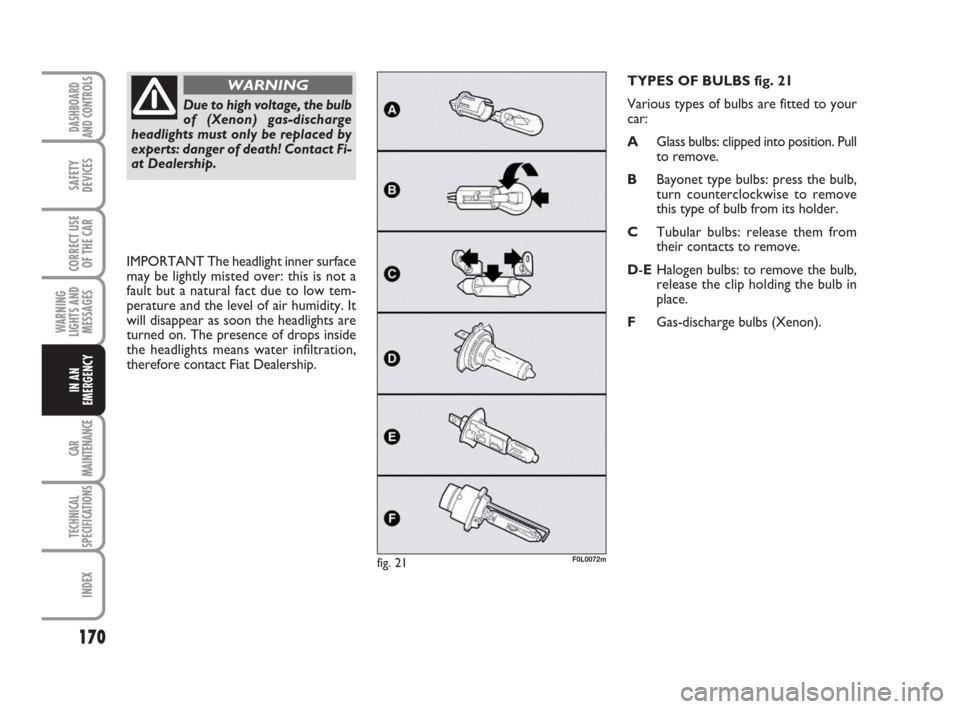
TYPES OF BULBS fig. 21
Various types of bulbs are fitted to your
car:
AGlass bulbs: clipped into position. Pull
to remove.
BBayonet type bulbs: press the bulb,
turn counterclockwise to remove
this type of bulb from its holder.
CTubular bulbs: release them from
their contacts to remove.
D-EHalogen bulbs: to remove the bulb,
release the clip holding the bulb in
place.
FGas-discharge bulbs (Xenon).
F0L0072mfig. 21
Due to high voltage, the bulb
of (Xenon) gas-discharge
headlights must only be replaced by
experts: danger of death! Contact Fi-
at Dealership.
WARNING
IMPORTANT The headlight inner surface
may be lightly misted over: this is not a
fault but a natural fact due to low tem-
perature and the level of air humidity. It
will disappear as soon the headlights are
turned on. The presence of drops inside
the headlights means water infiltration,
therefore contact Fiat Dealership.
157-192 Croma TRW GB 19-02-2009 14:58 Pagina 170
Page 172 of 258
171
WARNING
LIGHTS AND
MESSAGES
CAR
MAINTENANCE
TECHNICAL
SPECIFICATIONS
INDEX
DASHBOARD
AND CONTROLS
SAFETY
DEVICES
CORRECT USE
OF THE CAR
IN AN
EMERGENCY
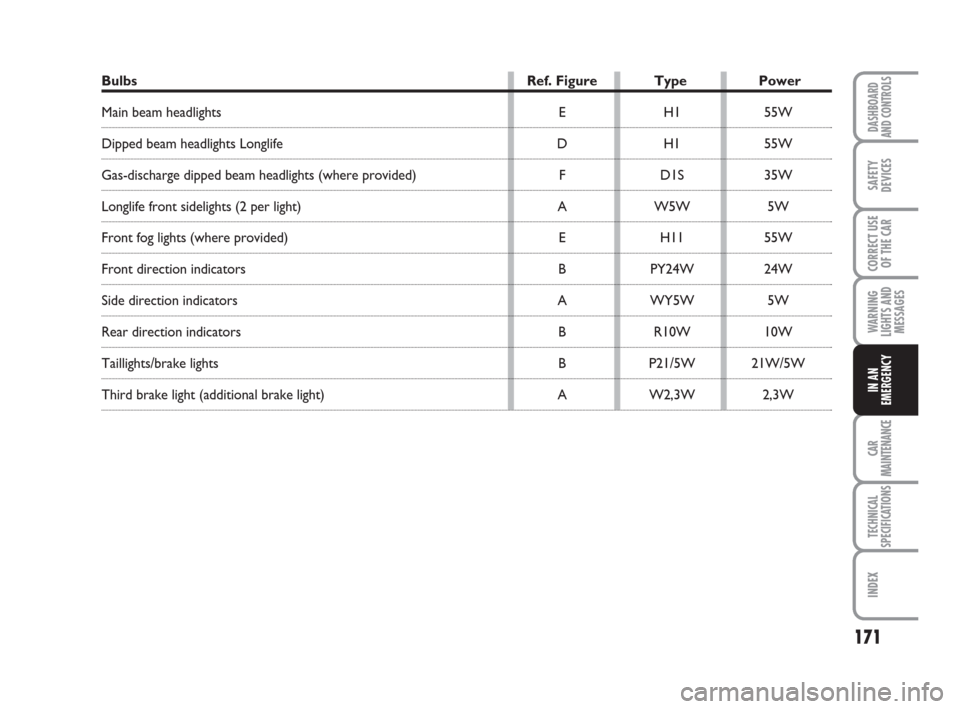
Bulbs Ref. Figure Type Power
Main beam headlights E H1 55W
Dipped beam headlights Longlife D H1 55W
Gas-discharge dipped beam headlights (where provided) F D1S 35W
Longlife front sidelights (2 per light) A W5W 5W
Front fog lights (where provided) E H11 55W
Front direction indicators B PY24W 24W
Side direction indicators A WY5W 5W
Rear direction indicators B R10W 10W
Taillights/brake lights B P21/5W 21W/5W
Third brake light (additional brake light) A W2,3W 2,3W
157-192 Croma TRW GB 19-02-2009 14:58 Pagina 171
Page 174 of 258
173
WARNING
LIGHTS AND
MESSAGES
CAR
MAINTENANCE
TECHNICAL
SPECIFICATIONS
INDEX
DASHBOARD
AND CONTROLS
SAFETY
DEVICES
CORRECT USE
OF THE CAR
IN AN
EMERGENCY
IF AN EXTERIOR LIGHT
BURNS OUT
For the type of bulb and power rating, see
“When needing to change a bulb”.
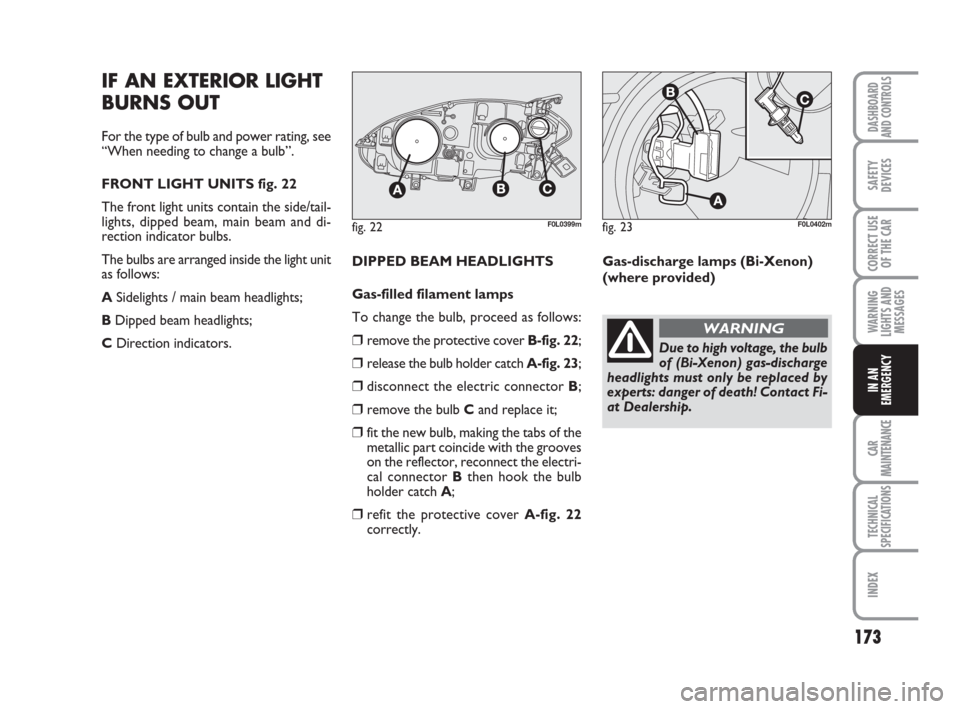
FRONT LIGHT UNITS fig. 22
The front light units contain the side/tail-
lights, dipped beam, main beam and di-
rection indicator bulbs.
The bulbs are arranged inside the light unit
as follows:
ASidelights / main beam headlights;
BDipped beam headlights;
CDirection indicators.DIPPED BEAM HEADLIGHTS
Gas-filled filament lamps
To change the bulb, proceed as follows:
❒remove the protective cover B-fig. 22;
❒release the bulb holder catch A-fig. 23;
❒disconnect the electric connector B;
❒remove the bulb Cand replace it;
❒fit the new bulb, making the tabs of the
metallic part coincide with the grooves
on the reflector, reconnect the electri-
cal connector Bthen hook the bulb
holder catch A;
❒refit the protective cover A-fig. 22
correctly.Gas-discharge lamps (Bi-Xenon)
(where provided)
Due to high voltage, the bulb
of (Bi-Xenon) gas-discharge
headlights must only be replaced by
experts: danger of death! Contact Fi-
at Dealership.
WARNING
fig. 22F0L0399mfig. 23F0L0402m
157-192 Croma TRW GB 19-02-2009 14:58 Pagina 173
Page 175 of 258
174
WARNING
LIGHTS AND
MESSAGES
CAR
MAINTENANCE
TECHNICAL
SPECIFICATIONS
INDEX
DASHBOARD
AND CONTROLS
SAFETY
DEVICES
CORRECT USE
OF THE CAR
IN AN
EMERGENCY
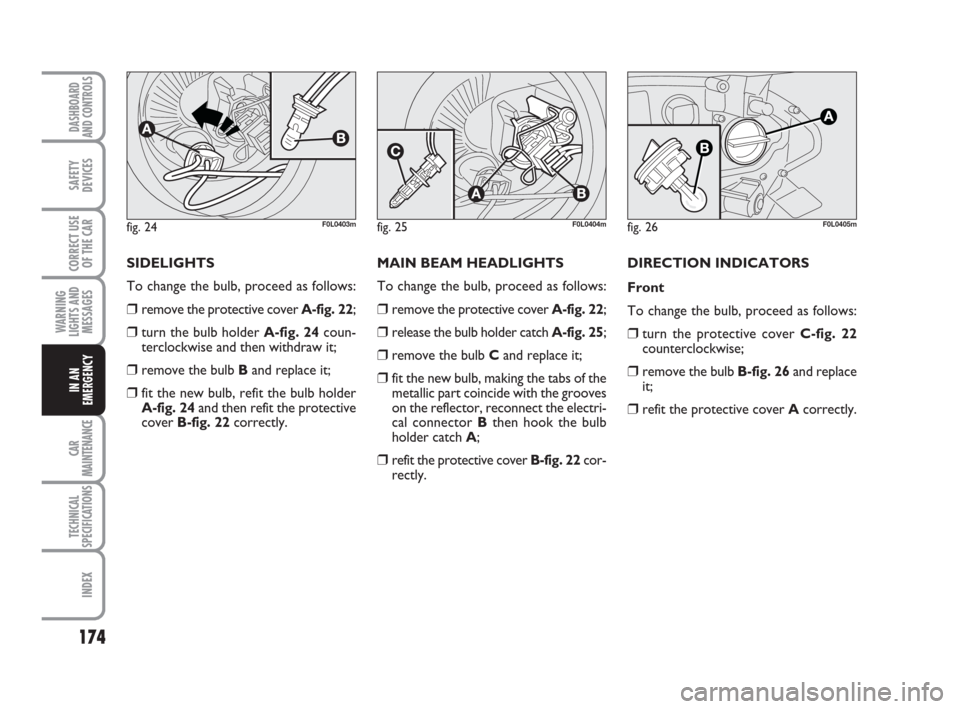
SIDELIGHTS
To change the bulb, proceed as follows:
❒remove the protective cover A-fig. 22;
❒turn the bulb holder A-fig. 24coun-
terclockwise and then withdraw it;
❒remove the bulb Band replace it;
❒fit the new bulb, refit the bulb holder
A-fig. 24 and then refit the protective
coverB-fig. 22correctly.MAIN BEAM HEADLIGHTS
To change the bulb, proceed as follows:
❒remove the protective cover A-fig. 22;
❒release the bulb holder catch A-fig. 25;
❒remove the bulb Cand replace it;
❒fit the new bulb, making the tabs of the
metallic part coincide with the grooves
on the reflector, reconnect the electri-
cal connector Bthen hook the bulb
holder catch A;
❒refit the protective cover B-fig. 22cor-
rectly.DIRECTION INDICATORS
Front
To change the bulb, proceed as follows:
❒turn the protective cover C-fig. 22
counterclockwise;
❒remove the bulb B-fig. 26and replace
it;
❒refit the protective cover Acorrectly.
fig. 24F0L0403mfig. 26F0L0405mfig. 25F0L0404m
157-192 Croma TRW GB 19-02-2009 14:58 Pagina 174
Page 196 of 258
195
WARNING
LIGHTS AND
MESSAGES
TECHNICAL
SPECIFICATIONS
INDEX
DASHBOARD
AND CONTROLS
SAFETY
DEVICES
CORRECT USE
OF THE CAR
IN AN
EMERGENCY
CAR
MAINTENANCE
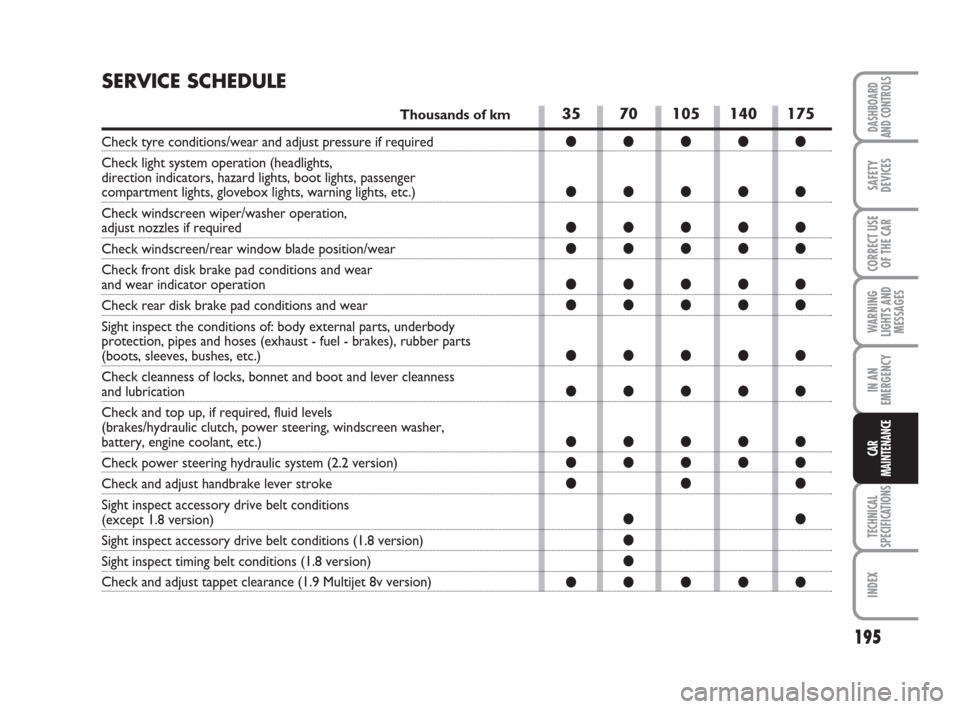
35 70 105 140 175
●●●●●
●●●●●
●●●●●
●●●●●
●●●●●
●●●●●
●●●●●
●●●●●
●●●●●
●●●●●
●●●
●●
●
●
●●●●●
SERVICE SCHEDULE
Thousands of km
Check tyre conditions/wear and adjust pressure if required
Check light system operation (headlights,
direction indicators, hazard lights, boot lights, passenger
compartment lights, glovebox lights, warning lights, etc.)
Check windscreen wiper/washer operation,
adjust nozzles if required
Check windscreen/rear window blade position/wear
Check front disk brake pad conditions and wear
and wear indicator operation
Check rear disk brake pad conditions and wear
Sight inspect the conditions of: body external parts, underbody
protection, pipes and hoses (exhaust - fuel - brakes), rubber parts
(boots, sleeves, bushes, etc.)
Check cleanness of locks, bonnet and boot and lever cleanness
and lubrication
Check and top up, if required, fluid levels
(brakes/hydraulic clutch, power steering, windscreen washer,
battery, engine coolant, etc.)
Check power steering hydraulic system (2.2 version)
Check and adjust handbrake lever stroke
Sight inspect accessory drive belt conditions
(except 1.8 version)
Sight inspect accessory drive belt conditions (1.8 version)
Sight inspect timing belt conditions (1.8 version)
Check and adjust tappet clearance (1.9 Multijet 8v version)
193-216 Croma TRW GB 28-07-2009 12:15 Pagina 195
Page 198 of 258
197
WARNING
LIGHTS AND
MESSAGES
TECHNICAL
SPECIFICATIONS
INDEX
DASHBOARD
AND CONTROLS
SAFETY
DEVICES
CORRECT USE
OF THE CAR
IN AN
EMERGENCY
CAR
MAINTENANCE
HEAVY-DUTY
Should prevailing use of the car be under
one of the following specially heavy con-
ditions:
❒trailer or caravan towing;
❒dusty roads;
❒short distances (less than 7-8 km) re-
peated and with external tempera-
tures below zero;
❒frequently idling engines or long dis-
tance low speed driving (e.g. door-to-
door deliveries) or in case of a long
term inactivity;
❒driving in the city;
carry out the following checks more fre-
quently than required in the Service
Schedule:
❒check front disk brake pad conditions
and wear;
❒check cleanness of locks, bonnet and
boot and lever cleanness and lubrica-
tion;
❒sight inspect the conditions of: engine,
gearbox, transmission, pipes and hoses
(exhaust - fuel - brakes), rubber parts
(boots, sleeves, bushes, etc.);
❒check battery charge and fluid level
(electrolyte) (only to be carried out by
skilled personnel or at Fiat Dealership
– see also paragraph “Battery” in this
section);
❒visual check on various drive belt con-
ditions;
❒check and replace pollen filter, if re-
quired;
❒check and replace air cleaner, if re-
quired.
ROUTINE
MAINTENANCE
Every 1,000 km or before long journeys,
check and top up if required:
❒engine coolant fluid level;
❒brake fluid level;
❒windscreen washer fluid level;
❒tyre pressure and conditions;
❒light system operation (headlights, di-
rection indicators, hazard lights, etc.);
❒windscreen wiper/washer operation
and windscreen/rear window blade
position/wear;
Every 3,000 km check and top up if re-
quired: engine oil level.
You are recommended to use FL
Selenia, products, designed and pro-
duced specifically for Fiat cars (see table
“Capacities” in section “Technical speci-
fications”).
193-216 Croma TRW GB 28-07-2009 12:15 Pagina 197
Page 206 of 258
205
WARNING
LIGHTS AND
MESSAGES
TECHNICAL
SPECIFICATIONS
INDEX
DASHBOARD
AND CONTROLS
SAFETY
DEVICES
CORRECT USE
OF THE CAR
IN AN
EMERGENCY
CAR
MAINTENANCE
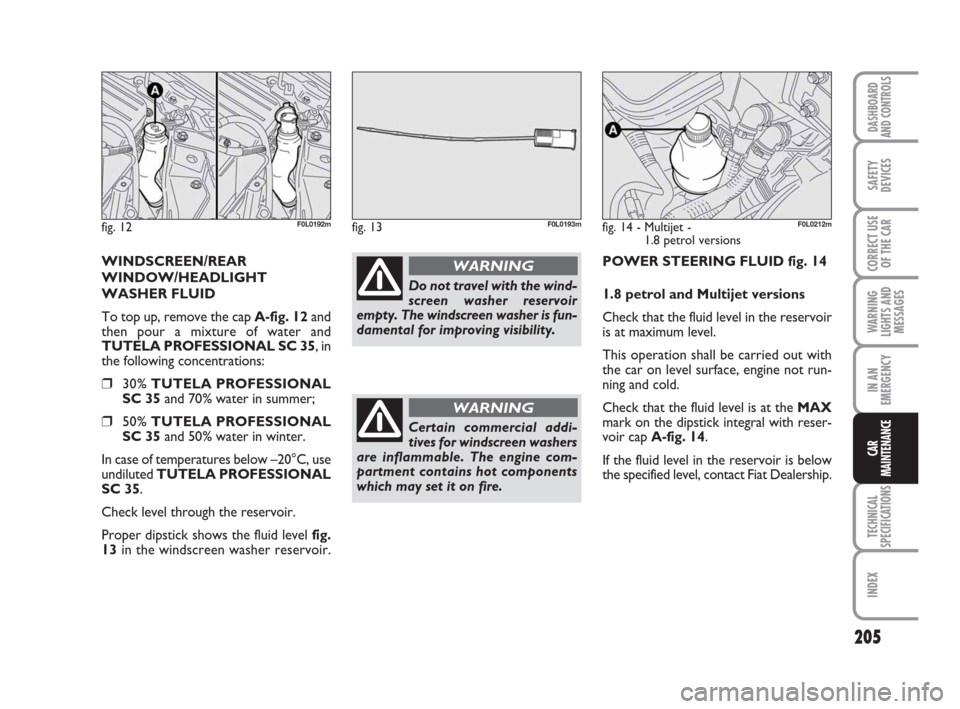
POWER STEERING FLUID fig. 14
1.8 petrol and Multijet versions
Check that the fluid level in the reservoir
is at maximum level.
This operation shall be carried out with
the car on level surface, engine not run-
ning and cold.
Check that the fluid level is at the MAX
mark on the dipstick integral with reser-
voir cap A-fig. 14.
If the fluid level in the reservoir is below
the specified level, contact Fiat Dealership. WINDSCREEN/REAR
WINDOW/HEADLIGHT
WASHER FLUID
To top up, remove the cap A-fig. 12and
then pour a mixture of water and
TUTELA PROFESSIONAL SC 35, in
the following concentrations:
❒30% TUTELA PROFESSIONAL
SC 35 and 70% water in summer;
❒50% TUTELA PROFESSIONAL
SC 35 and 50% water in winter.
In case of temperatures below –20°C, use
undiluted TUTELA PROFESSIONAL
SC 35.
Check level through the reservoir.
Proper dipstick shows the fluid level fig.
13in the windscreen washer reservoir.
fig. 12F0L0192mfig. 13F0L0193m
Do not travel with the wind-
screen washer reservoir
empty. The windscreen washer is fun-
damental for improving visibility.
WARNING
Certain commercial addi-
tives for windscreen washers
are inflammable. The engine com-
partment contains hot components
which may set it on fire.
WARNING
fig. 14 - Multijet -
1.8 petrol versionsF0L0212m
193-216 Croma TRW GB 28-07-2009 12:16 Pagina 205