control FIAT DOBLO 2009 2.G Workshop Manual
[x] Cancel search | Manufacturer: FIAT, Model Year: 2009, Model line: DOBLO, Model: FIAT DOBLO 2009 2.GPages: 274, PDF Size: 6.6 MB
Page 121 of 274
120
KNOW
YOUR
VEHICLE
SAFETY
STARTING
AND
DRIVING
WARNING
LIGHTS AND
MESSAGES
IN AN
EMERGENCY
SERVICING
AND
MAINTENANCE
TECHNICAL
SPECIFICATIONS
INDEX
SEAT BELT MAINTENANCE
Observe the following precautions for correct seat belt
maintenance:
❒always make sure the belt is well stretched and never
twisted; make sure that it is free to run without ob-
structions;
❒replace the belt after a serious accident, even if it does
not appear damaged. Always replace the seat belt if the
pretensioners were deployed;
❒To clean the belt, wash by hand with water and mild
soap, rinse and leave to dry in the shade. Do not use
strong detergents, bleach, paints or any other chemi-
cals which could damage the belt fibres;
❒prevent the reels from getting wet: their correct op-
eration is guaranteed only if water does not get inside;
❒replace the seat belt if it shows significant signs of wear
and tear.
If the belt has been subjected to heavy
stress, for example after an accident, it
should be changed completely together with the
anchors, anchor fastening screws and the preten-
sioner. In fact, even if the belt has no visible de-
fects, it could have lost its resilience.
WARNINGCARRYING CHILDREN SAFELY
For optimum protection in the event of a crash, all pas-
sengers must be seated and wearing adequate restraint
systems.
This is even more important for children.
This prescription is compulsory in all EU countries ac-
cording to EC Directive 2003/20/EC.
Compared with an adult, a child’s head is larger and heav-
ier in proportion to his/her body and the child’s muscu-
lar and bone structures are not fully developed. For this
reason, they require restraint systems which are differ-
ent from those used by adults to protect them in the event
of an accident.
The result of research in relation to the best protection
for children is illustrated in European Regulation ECE-R44,
which divides the restraint systems into five groups in ad-
dition to making their use compulsory:
Group 0 up to 10 kg
Group 0+ up to 13 kg
Group 1 9-18 kg
Group 2 15-25 kg
Group 3 22-36 kg
As you can see, the groups overlap partly and, in fact, there
are devices on sale that cover more than one weight group.
All restraint devices must bear the type-approval data along
with the control mark on a label firmly secured to the
child seat which must never be removed.
Page 129 of 274
128
KNOW
YOUR
VEHICLE
SAFETY
STARTING
AND
DRIVING
WARNING
LIGHTS AND
MESSAGES
IN AN
EMERGENCY
SERVICING
AND
MAINTENANCE
TECHNICAL
SPECIFICATIONS
INDEXFRONT AIRBAGS
The vehicle is fitted with front airbags for the driver and,
for versions/markets where provided, front airbags for
the passenger.
FRONT AIRBAGS
The front driver/passenger airbags (for versions/markets
where provided) have been designed to protect the front-
seat occupants in the event of head-on crashes of medi-
um-high severity, by placing the bag between the occu-
pant and the steering wheel or dashboard.
Non-activation in other types of crash (side-on collisions,
rear shunts, roll-overs, etc.) is therefore not a sign of sys-
tem malfunction.
An electronic control unit causes the bag to inflate, if nec-
essary, in the event of a head-on crash.
The bag will inflate instantaneously, placing itself between
the front occupant’s body and the structures which could
cause injury. It will deflate immediately afterwards.
Front driver/passenger airbags (for versions/markets
where provided) are not a replacement for, but rather
a complement to, the seat belts, which should be worn
at all times as specified by law in Europe and most non-
European countries.
In the event of an impact, someone not wearing a seat
belt could move forward and come into contact with a bag
which is still in the opening phase. The protection offered
by the bag is reduced in such a case. The front airbags may not be activated in the following
situations:❒head-on impacts against highly deformable objects that
do not affect the vehicle’s front surface (e.g. front wing
hitting the guard rail);
❒car getting wedged under other vehicles or protective
barriers (e.g. trucks or guard rails);
they could not provide any additional protection com-
pared with seat belts, so their activation would not be
worthwhile. In these cases, non-deployment of the airbag
does not necessarily indicate a system malfunction.
Do not apply stickers or other objects to
the steering wheel, the dashboard in the
passenger side airbag area and the seats. Do not
place objects (e.g. mobile phones) on the passen-
ger side dashboard because these could interfere
with the correct opening of the airbag and cause
severe injury to occupants.
WARNING
The front driver and passenger airbags are designed and
calibrated to best protect front-seat passengers wearing
seat belts.
The volume of the front airbags at maximum inflation fills
most of the space between the steering wheel and the
driver and between the dashboard and the passenger.
Page 131 of 274
130
KNOW
YOUR
VEHICLE
SAFETY
STARTING
AND
DRIVING
WARNING
LIGHTS AND
MESSAGES
IN AN
EMERGENCY
SERVICING
AND
MAINTENANCE
TECHNICAL
SPECIFICATIONS
INDEXMANUAL DEACTIVATION OF FRONT AND
SIDE PASSENGER AIRBAGS FOR HEAD AND
TORSE PROTECTION
(for versions/markets where provided)
On Doblò M1 versions, whenever a child needs to be car-
ried on the front seat, the passenger’s front airbags and
side bags for head and chest protection (for versions/mar-
kets where provided) can be deactivated.
The warning light
“on the instrument panel stays on un-
til the passenger’s front and side airbags for head and torse
protection (for versions/markets where provided) are re-
activated.
On Doblò Cargo versions with foldaway passenger seat
and split, revolving partition or ladder, the passenger front
airbags and the side bags for chest/head protection (for
versions/markets where provided) need to be deactivat-
ed if a load is carried with the seat folded down.
IMPORTANT To manually deactivate the passenger’s front
and side airbags for head and torse protection (for ver-
sions/markets where provided), refer to “Digital display”
and “Multifunction display” in the “Know your vehicle”
section.
SIDE BAGS
(for versions/markets where provided)
On some versions, the vehicle may be fitted with driver
and passenger front side airbags for head and torse pro-
tection.
Side bags protect occupants from side-on crashes of medi-
um/high severity by placing the bag between the occu-
pant and the internal parts of the side structure of the
vehicle.
Non-activation of side bags in other types of collisions
(head-on collisions, rear shunts, roll-overs, etc...) is not
an indication of system malfunction.
An electronic control unit causes the bags to inflate in
the event of a side-on collision. The bags inflate instanta-
neously, placing themselves between the occupant’s body
and the structures which could cause injury. They deflate
immediately afterwards.
Side bags are not a replacement of, but rather a comple-
ment to, seat belts, which you are recommended to wear
at all times, as specified by law in Europe and most non-
European countries.
For this reason, the seat belt must be worn at all times.
In the case of side-on collisions, the seat belts hold occu-
pants in the correct position and prevent them from be-
ing thrown out of the car by a very violent collision.
Page 134 of 274
133
KNOW
YOUR
VEHICLE
SAFETY
STARTING
AND
DRIVING
WARNING
LIGHTS AND
MESSAGES
IN AN
EMERGENCY
SERVICING
AND
MAINTENANCE
TECHNICAL
SPECIFICATIONS
INDEX
STARTING PROCEDURE FOR PETROL
VERSIONS
Proceed as follows:
❒ensure that the handbrake is on;
❒put the gear lever into neutral;
❒fully depress the clutch pedal without touching the ac-
celerator;
❒turn the ignition key to AVV and let it go the moment
the engine starts.
If the engine does not start at the first attempt, return
the ignition key to STOP before repeating the procedure.
If, when the ignition key is at MAR, the instrument panel
warning light
Yremains on together with warning light
U, turn the key to STOP and then back to MAR; if the
warning light remains on, try the other keys provided with
the vehicle. If you still cannot start the engine, perform
an emergency start (see “Emergency starting” in the “In
an emergency” section) and go to a Fiat Dealership.
STARTING THE ENGINE
The vehicle is fitted with an immobiliser: if the engine fails
to start, see the paragraph on “The Fiat CODE system”
in the “Dashboard and controls” section.
The engine may be noisier during the first few seconds of
operation, particularly after a long period of inactivity. This
is due to the hydraulic tappets, the timing system chosen
for petrol engine versions to reduce the number of ser-
vicing interventions, and affects neither functionality nor
reliability.
STARTING AND DRIVING
It is advisable not to demand maximum
performance from your vehicle (e.g. exces-
sive acceleration, long distances at high
speeds, excessive intense braking, etc.) during the
initial period of use.
To avoid draining the battery, do not leave
the ignition key in the MAR position when
the engine is off.
It is dangerous to run the engine in closed
environments. The engine takes in oxygen
and discharges carbon dioxide, carbon monox-
ide and other toxic gases.
WARNING
Page 138 of 274
137
KNOW
YOUR
VEHICLE
SAFETY
STARTING
AND
DRIVING
WARNING
LIGHTS AND
MESSAGES
IN AN
EMERGENCY
SERVICING
AND
MAINTENANCE
TECHNICAL
SPECIFICATIONS
INDEXDepress the clutch pedal fully to change
gear correctly. Therefore, the floor area
under the pedals should be clear: ensure that any
rubber mats are flat and do not interfere with the
pedals.
WARNING
Do not drive with your hand resting on the
gear lever, because this pressure, even if
light, can wear out the inner components
of the gearbox over time. The clutch pedal should
be used only for gear changes. Do not drive with
your foot resting on the clutch pedal, however
slightly. For versions/markets where provided, the
electronic clutch control could cut in by interpret-
ing the incorrect driving style as a fault.
SAVING FUEL
Here are some useful tips to save fuel and minimise harm-
ful emissions of CO
2and other pollutants (nitric oxides,
unburnt hydrocarbons, fine dusts etc…).
PRACTICAL ADVICE FOR REDUCING FUEL
CONSUMPTION AND HARMFUL EMISSIONS
Vehicle conditions
1. Have checks and adjustments carried out in
accordance with the “Scheduled Servicing Plan”.
2. Check tyre pressures regularly, at least once every
four weeks. Excessively low pressures will increase
consumption because rolling resistance will be high-
er. In addition, this wears the tyre more quickly and
impairs performance.
3. Only use snow tyreswhen the weather conditions
make them absolutely necessary. They increase con-
sumption and noise.
4. Do not travel with a heavy load: the weight of the
vehicle (especially when driving in town) and its trim
greatly affect fuel consumption and stability.
Page 139 of 274
138
KNOW
YOUR
VEHICLE
SAFETY
STARTING
AND
DRIVING
WARNING
LIGHTS AND
MESSAGES
IN AN
EMERGENCY
SERVICING
AND
MAINTENANCE
TECHNICAL
SPECIFICATIONS
INDEX2. Avoid pointless actions such as revving up when at
traffic lights or before stopping the engine. The latter
action, like double-declutching, is unnecessary and
causes increased fuel consumption and pollution.
3.Gear selection: select a high gear as soon as possi-
ble (taking into account normal engine operation and
traffic conditions) without pushing the engine to high
revs during the intermediate gears. Using low gears
at high revs to get lively acceleration increases fuel
consumption, harmful emissions and engine wear.
4.Vehicle speed: fuel consumption increases expo-
nentially as the speed of the vehicle increases. Keep
your speed moderate and as even as possible, avoid-
ing unnecessary braking and acceleration, which
cause excessive fuel consumption and increased
emissions. Keeping a safe distance from the vehicle in
front helps to maintain a steady speed.
5.Acceleration: accelerating violently severely affects
consumption and emissions. Acceleration should be
gradual and should not exceed the maximum engine
torque rate. 5. Remove roof racks or ski racksafter use. These
accessories reduce the vehicle’s aerodynamic pene-
tration and have a negative effect on fuel consump-
tion.
6. It is better to use a trailer to transport particularly
bulky objects.
7. Use the vehicle’s air vents if possible: travelling with
the windows open impairs the aerodynamics.
8. Only use electrical devices for the amount of time
needed. The heated rear window, auxiliary head-
lights, windscreen wipers and fan heater use up
a considerable amount of current, causing increased
fuel consumption (up to +25% in the urban cycle).
9. Using the climate control leads to higher fuel con-
sumption (on average up to +30%). If the tempera-
ture outside is not too extreme, try and use the air
vents.
Driving style
1. After starting the engineyou should drive away
immediately and slowly, avoiding high revs. Do not
warm up the engine at low or high revs when the
vehicle is stationary; this causes the engine to warm
up more slowly, thereby increasing fuel consumption,
emissions and mechanical component wear.
Page 141 of 274
140
KNOW
YOUR
VEHICLE
SAFETY
STARTING
AND
DRIVING
WARNING
LIGHTS AND
MESSAGES
IN AN
EMERGENCY
SERVICING
AND
MAINTENANCE
TECHNICAL
SPECIFICATIONS
INDEXSNOW TYRES
A Fiat Dealership will be happy to provide advice con-
cerning the most suitable type of tyre for the customer’s
requirements.
For the type, pressures and specifications of the snow
tyre to be used, follow carefully the instructions given in
the “Wheels” paragraph of the “Technical specifications”
section.
The winter performance of these tyres is considerably
reduced when the tread thickness is less than 4 mm. If
this is the case, replace them.
Due to their specific features, the performance of snow
tyres is much lower than that of standard tyres in normal
conditions or on long motorway stretches. You should
therefore use them only in the conditions for which they
were designed.
IMPORTANT When using snow tyres with a maximum
speed index below the one that can be reached by the
vehicle (increased by 5%), place a notice in the passenger
compartment, plainly in view, which states the maximum
speed allowed by the snow tyres (as per EC Directive).
All four tyres should be the same (brand and profile) to
ensure greater safety when driving and braking as well as
making the car more responsive.
Remember that you should not change the rotation di-
rection of the tyres.The ABS with which the vehicle may be
equipped will not control the braking sys-
tem of the trailer. Particular caution is therefore
required on slippery roads.
WARNING
Never modify the braking system of the
vehicle to control the trailer brake. The
trailer braking system must be fully independent
from the hydraulic system of the vehicle.
WARNING
Page 150 of 274
149
KNOW
YOUR
VEHICLE
SAFETY
STARTING
AND
DRIVING
WARNING
LIGHTS AND
MESSAGES
IN AN
EMERGENCY
SERVICING
AND
MAINTENANCE
TECHNICAL
SPECIFICATIONS
INDEXA specific message is displayed on certain versions.
Under these conditions, the vehicle can continue trav-
elling at moderate speed without demanding exces-
sive effort from the engine. Prolonged use of the ve-
hicle with the warning light on may cause damage. Go
to a Fiat Dealership as soon as possible.
The warning light goes out after the fault disappears,
but the notification is stored in the system.
❒flashing: this indicates possible damage to the catalytic
converter (see “EOBD system” in the “Dashboard and
controls” section).
If the light flashes, come off the accelerator pedal to
reduce engine revs until the warning light stops flash-
ing; continue the journey at moderate speed, trying
to avoid driving conditions that may cause further flash-
ing, and get to a Fiat Dealership as soon as possible. INJECTION SYSTEM FAILURE
(Multijet versions – amber)
EOBD ENGINE MANAGEMENT
SYSTEM FAILURE
(petrol versions – amber)
Injection system failure
Under normal conditions, turning the ignition key to MAR,
the warning light turns on but it should go off after the
engine starts. If the warning light stays on or comes on
when travelling, it means there is a fault in the injection
system which could cause loss of performance, poor han-
dling and high fuel consumption levels.
A specific message is displayed on certain versions.
Under these conditions, the vehicle can continue travel-
ling at moderate speed without demanding excessive ef-
fort from the engine. In any case, you should go to a Fiat
Dealership as soon as possible.
EOBD engine management system failure
Under normal conditions, turning the ignition key to MAR,
the warning light turns on but it should go off after the
engine starts.
This indicates that the warning light is working correctly.
If the warning light either stays on or comes on during
your journey:
❒on permanently: this means there is a fault in the sup-
ply/ignition system which could cause high exhaust
emissions, loss of performance, poor handling and high
fuel consumption levels.
U
Go to a Fiat Dealership as soon as possi-
ble if warning light
Udoes not light up
when the key is turned to MAR or if, while
travelling, the warning light comes on either per-
manently or flashing (along with a message on the
display on certain versions). The operation of the
Uwarning light may be checked by traffic police
using appropriate equipment. Respect the regula-
tions in force in the country where you are driving.
Page 154 of 274
153
KNOW
YOUR
VEHICLE
SAFETY
STARTING
AND
DRIVING
WARNING
LIGHTS AND
MESSAGES
IN AN
EMERGENCY
SERVICING
AND
MAINTENANCE
TECHNICAL
SPECIFICATIONS
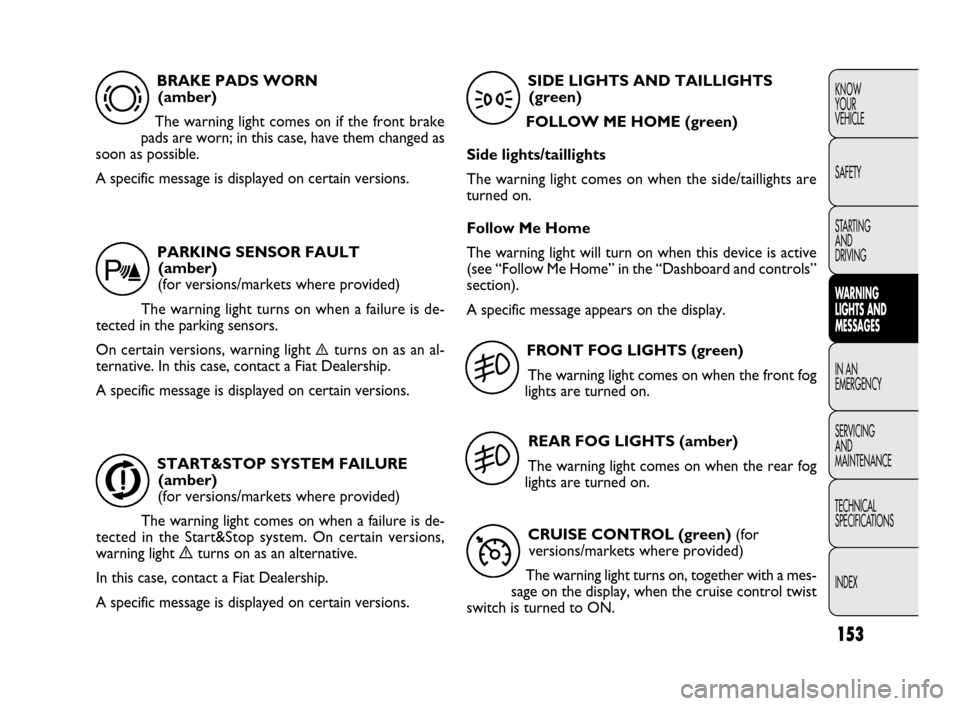
INDEXBRAKE PADS WORN
(amber)
The warning light comes on if the front brake
pads are worn; in this case, have them changed as
soon as possible.
A specific message is displayed on certain versions.
d
PARKING SENSOR FAULT
(amber)
(for versions/markets where provided)
The warning light turns on when a failure is de-
tected in the parking sensors.
On certain versions, warning light
èturns on as an al-
ternative. In this case, contact a Fiat Dealership.
A specific message is displayed on certain versions.
t
START&STOP SYSTEM FAILURE
(amber)
(for versions/markets where provided)
The warning light comes on when a failure is de-
tected in the Start&Stop system. On certain versions,
warning light èturns on as an alternative.
In this case, contact a Fiat Dealership.
A specific message is displayed on certain versions.
j
SIDE LIGHTS AND TAILLIGHTS
(green)
FOLLOW ME HOME (green)
Side lights/taillights
The warning light comes on when the side/taillights are
turned on.
Follow Me Home
The warning light will turn on when this device is active
(see “Follow Me Home” in the “Dashboard and controls”
section).
A specific message appears on the display.
3
FRONT FOG LIGHTS (green)
The warning light comes on when the front fog
lights are turned on.
5
REAR FOG LIGHTS (amber)
The warning light comes on when the rear fog
lights are turned on.
5
CRUISE CONTROL (green) (for
versions/markets where provided)
The warning light turns on, together with a mes-
sage on the display, when the cruise control twist
switch is turned to ON.
Ü
Page 155 of 274
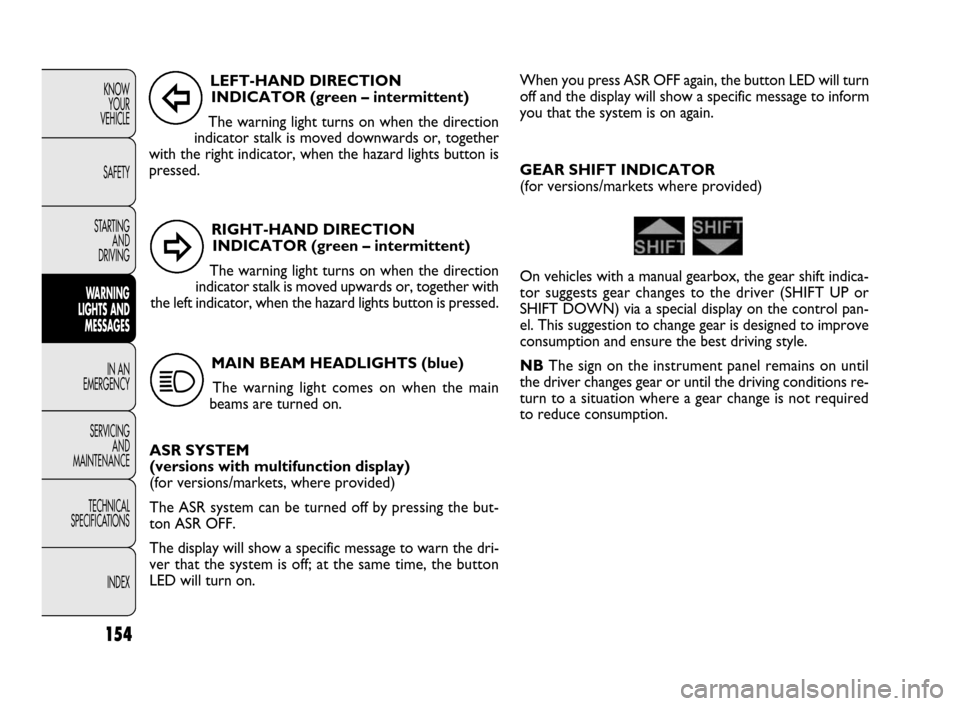
RIGHT-HAND DIRECTION
INDICATOR (green – intermittent)
The warning light turns on when the direction
indicator stalk is moved upwards or, together with
the left indicator, when the hazard lights button is pressed.
154
KNOW
YOUR
VEHICLE
SAFETY
STARTING
AND
DRIVING
WARNING
LIGHTS AND
MESSAGES
IN AN
EMERGENCY
SERVICING
AND
MAINTENANCE
TECHNICAL
SPECIFICATIONS
INDEXLEFT-HAND DIRECTION
INDICATOR (green – intermittent)
The warning light turns on when the direction
indicator stalk is moved downwards or, together
with the right indicator, when the hazard lights button is
pressed.
MAIN BEAM HEADLIGHTS (blue)
The warning light comes on when the main
beams are turned on.
ASR SYSTEM
(versions with multifunction display)
(for versions/markets, where provided)
The ASR system can be turned off by pressing the but-
ton ASR OFF.
The display will show a specific message to warn the dri-
ver that the system is off; at the same time, the button
LED will turn on.
Î
¥
1
When you press ASR OFF again, the button LED will turn
off and the display will show a specific message to inform
you that the system is on again.
GEAR SHIFT INDICATOR
(for versions/markets where provided)
On vehicles with a manual gearbox, the gear shift indica-
tor suggests gear changes to the driver (SHIFT UP or
SHIFT DOWN) via a special display on the control pan-
el. This suggestion to change gear is designed to improve
consumption and ensure the best driving style.
NBThe sign on the instrument panel remains on until
the driver changes gear or until the driving conditions re-
turn to a situation where a gear change is not required
to reduce consumption.