wheel FIAT DUCATO 2012 Owner handbook (in English)
[x] Cancel search | Manufacturer: FIAT, Model Year: 2012, Model line: DUCATO, Model: FIAT DUCATO 2012Pages: 287, PDF Size: 4.5 MB
Page 110 of 287
106
KNOWING
YOUR CAR
SAFETY
STARTING
AND
DRIVING
WARNING
LIGHTS AND
MESSAGES
IN AN
EMERGENCY
MAINTENANCE
AND CARE
TECHNICAL
SPECIFICATIONS
INDEX
F0N0066mfig. 126F0N0138mfig. 127
ROOF RACK/SKI RACK
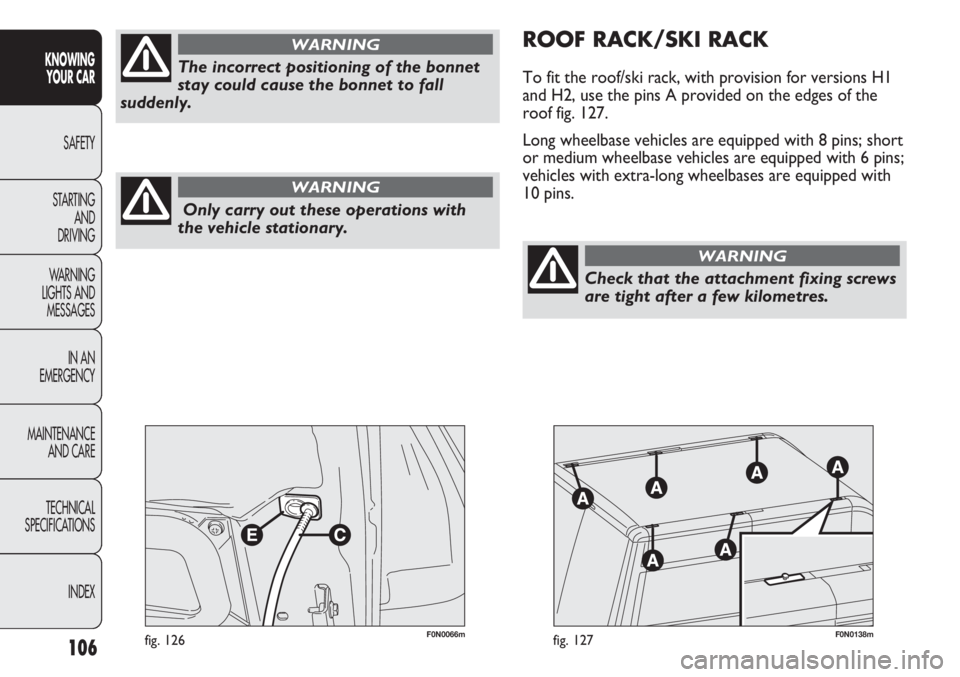
To fit the roof/ski rack, with provision for versions H1
and H2, use the pins A provided on the edges of the
roof fig. 127.
Long wheelbase vehicles are equipped with 8 pins; short
or medium wheelbase vehicles are equipped with 6 pins;
vehicles with extra-long wheelbases are equipped with
10 pins.
Only carry out these operations with
the vehicle stationary.
WARNING
The incorrect positioning of the bonnet
stay could cause the bonnet to fall
suddenly.
WARNING
Check that the attachment fixing screws
are tight after a few kilometres.
WARNING
Page 112 of 287
108
KNOWING
YOUR CAR
SAFETY
STARTING
AND
DRIVING
WARNING
LIGHTS AND
MESSAGES
IN AN
EMERGENCY
MAINTENANCE
AND CARE
TECHNICAL
SPECIFICATIONS
INDEX
ABS SYSTEM
If you have never driven a vehicle with ABS before, it is
advisable to perform a few tests on slippery ground,
always in safe conditions and respecting the highway
code of the country where you are driving. Read the
following information carefully.
This is an integral part of the braking system, which
prevents one or more wheels from locking or slipping
regardless of the road surface conditions and braking
intensity, ensuring control of the vehicle even during
emergency braking.
The system is completed by EBD (Electronic Braking
Force Distribution), which distributes the braking action
between the front and rear wheels.
IMPORTANT For the maximum efficiency of the
braking system, a bedding in period of about 500 km is
needed (with the vehicle new or after having replaced
the brake pads/discs): during this period it is better to
avoid sharp, repeated and prolonged braking. Headlight alignment adjustment fig. 128
Press buttons Òand in the control panel to adjust.
The display located on the instrument panel provides
a visual indication of the adjusted position.
IMPORTANT Check the beam alignment every time the
weight of the load transported changes.
FRONT FOG LIGHTS ALIGNMENT
(for versions/markets where provided)
Contact a Fiat Dealership to have the headlights
properly adjusted.
ADJUSTING THE HEADLIGHTS WHEN
ABROAD
The dipped headlights are adjusted to work in the
country where the vehicle was originally purchased.
In countries where vehicles are driven on the other side
of the road, the beams are aligned by applying a specially
designed adhesive film in order not to dazzle the
vehicles travelling in the opposite direction.
The ABS system gets the most out of the
available grip but it cannot improve it.
Therefore, you should take great care when
driving on slippery surfaces: don’t take
unnecessary risks.
WARNING
Page 113 of 287
109
KNOWING
YOUR CAR
SAFETY
STARTING
AND
DRIVING
WARNING
LIGHTS AND
MESSAGES
IN AN
EMERGENCY
MAINTENANCE
AND CARE
TECHNICAL
SPECIFICATIONS
INDEX
FAILURE WARNING
ABS failure
ABS Failure is indicated by the
>warning light in the
instrument panel together with the dedicated message
in the multifunction display (for versions/markets where
provided) coming on (see “Warning lights and
messages” section).
In this case, the braking system will still be effective,
although without the extra capacity offered by the ABS
system. Drive carefully to the nearest Fiat Dealership to
have the system checked. SYSTEM INTERVENTION
The driver can tell the ABS system has come into action
because the brake pedal pulsates slightly and the system
gets noisier: it means that the vehicle speed should be
altered to suit the type of road surface.
If the ABS cuts in, it is a sign that the
grip between tyre and the road surface
has reached the limit: you must slow down to
match the speed to the road grip available.
WARNING
EBD failure
ABS Failure is indicated by the
>and xwarning lights
in the instrument panel together with the dedicated
message in the multifunction display (for versions/
markets where provided) coming on (see “Warning
lights and messages” section).
In this case, the rear wheels may suddenly lock and the
vehicle may swerve when braking sharply. Drive
carefully to the nearest Fiat Dealership to have the
system checked.
If only the xwarning light in the
instrument panel lights up (together with
a message in the multifunction display, for
versions/markets where provided) stop the
vehicle immediately and contact the nearest Fiat
Dealership. Fluid leaking from the hydraulic
system will compromise the operation of the
braking system, whether it is of the conventional
type or with ABS.
WARNING
Page 115 of 287
111
KNOWING
YOUR CAR
SAFETY
STARTING
AND
DRIVING
WARNING
LIGHTS AND
MESSAGES
IN AN
EMERGENCY
MAINTENANCE
AND CARE
TECHNICAL
SPECIFICATIONS
INDEX
❒downhill: vehicle stationary on a road with a gradient
higher than 5%, engine running, clutch and brake
pedal pressed and reverse gear engaged.
At pickup the
ESPsystem control unit will maintain the
braking pressure at the wheels until the necessary torque
for starting is reached or, in any case, for a maximum of
2 seconds in order to move easily from the brake pedal
to the accelerator pedal. When two seconds have
elapsed, without starting, the system is automatically
deactivated, gradually releasing the braking pressure.
During this release stage, the typical brake
disengagement noise indicating that the vehicle is going
to move imminently will be heard.
Failure warning
The
áwarning light in the instrument panel will come
on in the event of a failure (see “Warning lights and
messages” section).
IMPORTANT The Hill Holder system is not a parking
brake; therefore, never leave the vehicle without having
engaged the handbrake, turned the engine off and
engaged first gear. FAILURE WARNING
In the event of a failure, the ESP will be automatically
switched off and the áwarning light will come on
constantly in the instrument panel along with a message
in the multifunction display (for versions/markets where
provided) (see “Warning lights and messages” section).
The LED in the ASR OFF button will light up. Contact
a Fiat Dealership as soon as possible if this happens.
Do not take unnecessary risks, even if
your vehicle is fitted with an ESP system.
Your driving style must always be suited to the
road conditions, visibility and traffic. The driver
is ultimately responsible for road safety.
WARNING
HILL HOLDER SYSTEM
This system is an integral part of the
ESPsystem and it is
provided to facilitate starting on hills.
It is automatically activated in the following conditions:
❒uphill: vehicle stationary on a road with a gradient
higher than 5%, engine running, clutch and brake
pedal pressed, gearbox in neutral or gear other than
reverse engaged;
For the correct operation of the ESP and
ASR systems, the tyres must absolutely be
the same make and type on all wheels, in perfect
condition and, above all, of the type, make and
size specified.
WARNING
Page 116 of 287
112
KNOWING
YOUR CAR
SAFETY
STARTING
AND
DRIVING
WARNING
LIGHTS AND
MESSAGES
IN AN
EMERGENCY
MAINTENANCE
AND CARE
TECHNICAL
SPECIFICATIONS
INDEX
MSR system
(engine braking torque control)
This is an integral part of the ASR system that, in the
event of a sudden gear down shift, cuts in and provides
torque to the engine thus preventing excessive drive
wheel drive which, especially in poor grip conditions,
can lead to a loss of stability. ASR SYSTEM (Antislip Regulator)
This is a traction control system that cuts in
automatically every time one or both drive wheels slip.
Depending on the slipping conditions, two different
control systems are activated:
❒if the slipping involves both drive wheels, the ASR
function intervenes by reducing the power
transmitted by the engine;
❒if the slipping only involves only one driving wheel,
the ASR system cuts in by automatically braking the
wheel that is slipping.
The action of the
ASRis particularly helpful in the
following circumstances:
❒slipping of the inner wheel when cornering due to
the effect of dynamic load changes or excessive
acceleration;
❒too much power transmitted to the wheels also in
relation to the conditions of the road surface;
❒acceleration on slippery, snowy or icy surfaces;
❒loss of grip on a wet surface (aquaplaning).
For the correct operation of the ESP and
ASR systems, the tyres must absolutely be
the same make and type on all wheels, in perfect
condition and, above all, of the type, make and
size specified.
WARNING
Page 117 of 287
113
KNOWING
YOUR CAR
SAFETY
STARTING
AND
DRIVING
WARNING
LIGHTS AND
MESSAGES
IN AN
EMERGENCY
MAINTENANCE
AND CARE
TECHNICAL
SPECIFICATIONS
INDEX
FAILURE WARNING
In the event of a failure, the ASR will be automatically
switched off and the áwarning light will come on
constantly in the instrument panel along with a message
in the multifunction display (for versions/markets where
provided) (see “Warning lights and messages” section).
The LED in the ASR OFF button will light up. Contact
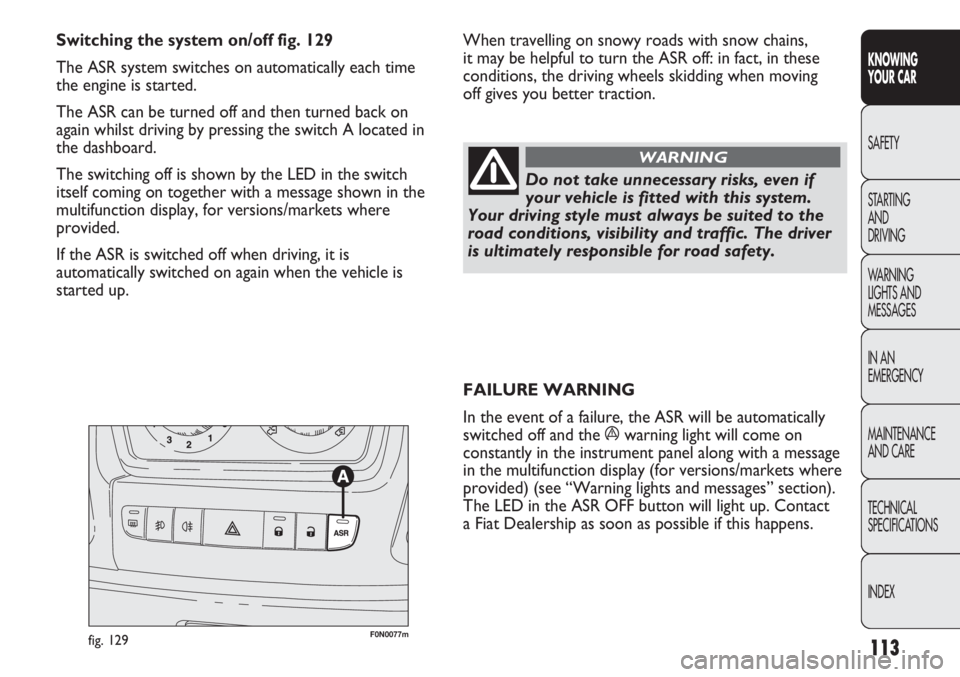
a Fiat Dealership as soon as possible if this happens. Switching the system on/off fig. 129
The ASR system switches on automatically each time
the engine is started.
The ASR can be turned off and then turned back on
again whilst driving by pressing the switch A located in
the dashboard.
The switching off is shown by the LED in the switch
itself coming on together with a message shown in the
multifunction display, for versions/markets where
provided.
If the ASR is switched off when driving, it is
automatically switched on again when the vehicle is
started up.
F0N0077mfig. 129
Do not take unnecessary risks, even if
your vehicle is fitted with this system.
Your driving style must always be suited to the
road conditions, visibility and traffic. The driver
is ultimately responsible for road safety.
WARNING
When travelling on snowy roads with snow chains,
it may be helpful to turn the ASR off: in fact, in these
conditions, the driving wheels skidding when moving
off gives you better traction.
Page 118 of 287
114
KNOWING
YOUR CAR
SAFETY
STARTING
AND
DRIVING
WARNING
LIGHTS AND
MESSAGES
IN AN
EMERGENCY
MAINTENANCE
AND CARE
TECHNICAL
SPECIFICATIONS
INDEX
TRACTION PLUS SYSTEM
(for versions/markets, where provided)
Traction Plus is a help with driving and setting off in
poor grip conditions (snow, ice, mud, etc.) which allows
the drive force to be evenly distributed over the same
axle when both wheels are slipping.
In effect, Traction Plus acts by braking the wheels with
poor grip (or those slipping more than the others),
thereby transferring the drive force to those which have
more grip on the ground.
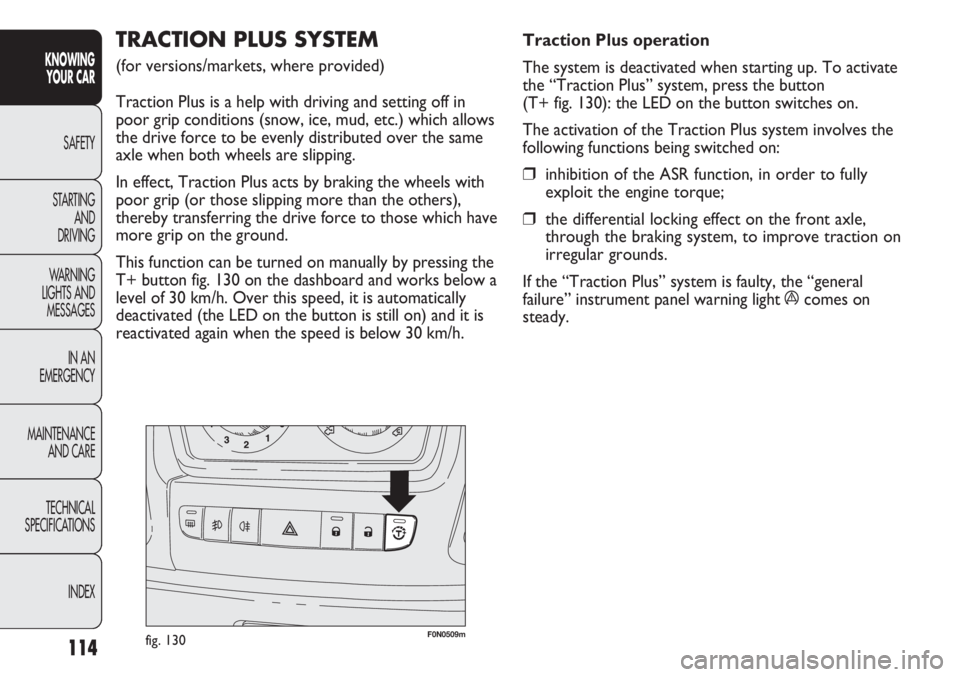
This function can be turned on manually by pressing the
T+ button fig. 130 on the dashboard and works below a
level of 30 km/h. Over this speed, it is automatically
deactivated (the LED on the button is still on) and it is
reactivated again when the speed is below 30 km/h.Traction Plus operation
The system is deactivated when starting up. To activate
the “Traction Plus” system, press the button
(T+ fig. 130): the LED on the button switches on.
The activation of the Traction Plus system involves the
following functions being switched on:
❒inhibition of the ASR function, in order to fully
exploit the engine torque;
❒the differential locking effect on the front axle,
through the braking system, to improve traction on
irregular grounds.
If the “Traction Plus” system is faulty, the “general
failure” instrument panel warning light ácomes on
steady.
F0N0509mfig. 130
Page 124 of 287
120
KNOWING
YOUR CAR
SAFETY
STARTING
AND
DRIVING
WARNING
LIGHTS AND
MESSAGES
IN AN
EMERGENCY
MAINTENANCE
AND CARE
TECHNICAL
SPECIFICATIONS
INDEX
F0N0158mfig. 133
ACCESSORIES PURCHASED
BY THE OWNER
If after buying the vehicle, you decide to install electrical
accessories that require a permanent electric supply
(alarm, satellite anti-theft system, etc.) or accessories
that in any case burden the electric supply, contact
a Fiat Dealership, whose qualified personnel, besides
suggesting the most suitable devices from Lineaccessori
Fiat, will also evaluate the overall electric absorption,
checking whether the vehicle’s electric system is able to
withstand the load required, or whether it needs to be
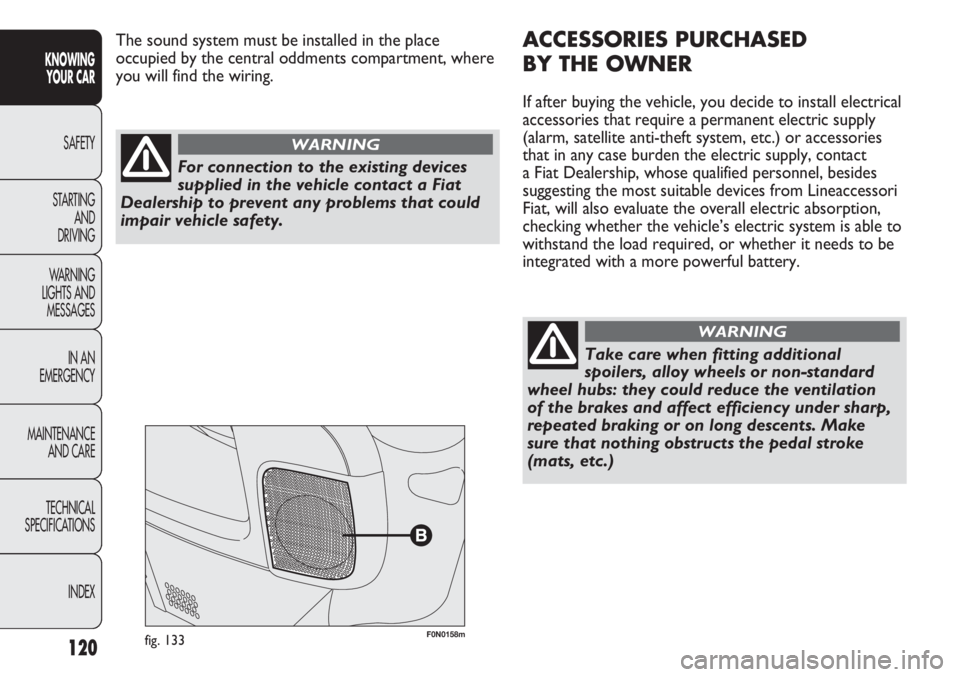
integrated with a more powerful battery. The sound system must be installed in the place
occupied by the central oddments compartment, where
you will find the wiring.
For connection to the existing devices
supplied in the vehicle contact a Fiat
Dealership to prevent any problems that could
impair vehicle safety.
WARNING
Take care when fitting additional
spoilers, alloy wheels or non-standard
wheel hubs: they could reduce the ventilation
of the brakes and affect efficiency under sharp,
repeated braking or on long descents. Make
sure that nothing obstructs the pedal stroke
(mats, etc.)
WARNING
Page 141 of 287
137
KNOWING
YOUR CAR
SAFETY
STARTING
AND
DRIVING
WARNING
LIGHTS AND
MESSAGES
IN AN
EMERGENCY
MAINTENANCE
AND CARE
TECHNICAL
SPECIFICATIONS
INDEX
The front air bags may not be activated in the following
situations:
❒during collisions against highly deformable objects
that do not affect the vehicle front surface (e.g.
bumper collision against guard rail, heaps of gravel,
etc.);
❒jamming of the vehicle underneath other vehicles or
protective barriers (e.g. underneath a truck or
a guard rail); in this case, the bags would offer no
additional protection with respect to the seat belt
and their deployment is unnecessary. Failure to
deploy in such cases does not consequently indicate
a system fault.
FRONT AIR BAGS
The vehicle is provided with front airbags for the driver
and the passenger.
The front driver/passenger air bags have been designed
to protect the occupants in the event of head-on
crashes of medium-high severity, by placing the cushion
between the occupant and the steering wheel or
dashboard.
Therefore non-activation in other types of collisions
(side collisions, rear shunts, roll-overs, etc.) is not
a system malfunction.
An electronic control unit causes the bag to inflate in
the event of a head-on crash. The bag will inflate
instantaneously placing itself between the front
occupants body and the structures which could cause
injury. It will deflate immediately afterwards.
Driver and passenger front airbags are not
a replacement of but complementary to the belts, which
you are recommended to always wear, as specified by
law in Europe and most non-European countries.
The volume of the front airbags at maximum inflation
fills most of the space between the steering wheel and
the driver and between the dashboard and the
passenger.
In the event of an impact, someone not wearing a seat
belt could move forward and come into contact with
a bag which is still in the opening phase. The protection
offered by the bag is reduced in such a case.
Do not apply stickers or other objects to
the steering wheel, to the passenger’s
side air bag cover or on the roof side lining.
Do not place objects on the passenger side
dashboard because these could interfere with
the correct opening of the airbag (e.g. mobile
phones) and cause severe injury to occupants.
WARNING
The airbags are not deployed in the event of minor
collisions (for which the restraining action of the seat
belts is sufficient). For this reason, the seat belt must be
worn at all times. In the event of side collisions, the seat
belts hold occupants in the correct position and prevent
them being thrown out of the car by a very violent
collision.
Page 142 of 287
138
KNOWING
YOUR CAR
SAFETY
STARTING
AND
DRIVING
WARNING
LIGHTS AND
MESSAGES
IN AN
EMERGENCY
MAINTENANCE
AND CARE
TECHNICAL
SPECIFICATIONS
INDEX
F0N0072mfig. 151
F0N0324mfig. 150
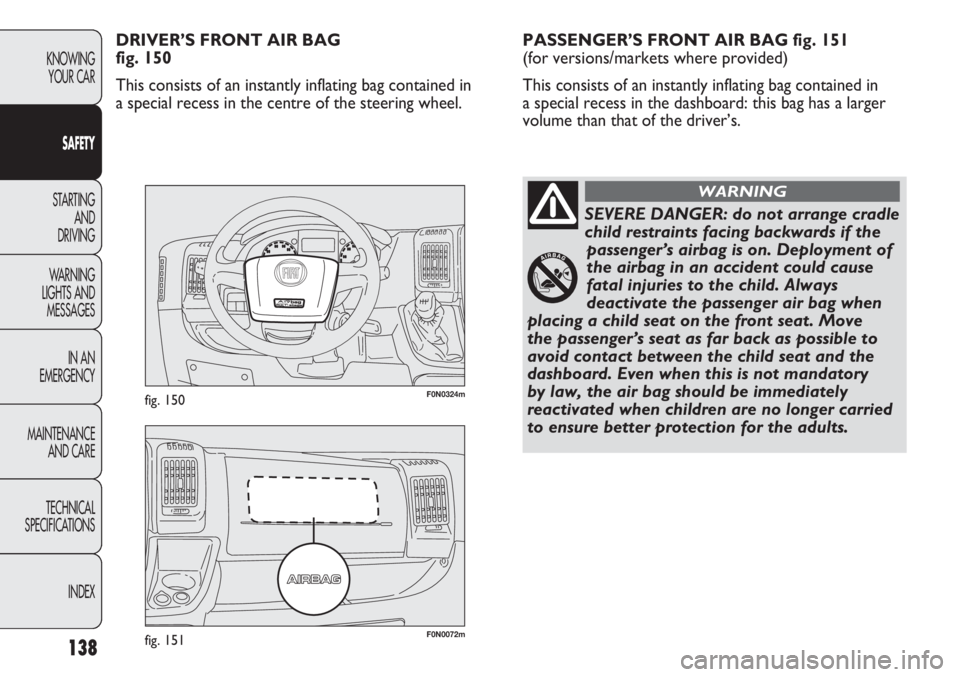
PASSENGER’S FRONT AIR BAG fig. 151
(for versions/markets where provided)
This consists of an instantly inflating bag contained in
a special recess in the dashboard: this bag has a larger
volume than that of the driver’s. DRIVER’S FRONT AIR BAG
fig. 150
This consists of an instantly inflating bag contained in
a special recess in the centre of the steering wheel.
SEVERE DANGER: do not arrange cradle
child restraints facing backwards if the
passenger’s airbag is on. Deployment of
the airbag in an accident could cause
fatal injuries to the child. Always
deactivate the passenger air bag when
placing a child seat on the front seat. Move
the passenger’s seat as far back as possible to
avoid contact between the child seat and the
dashboard. Even when this is not mandatory
by law, the air bag should be immediately
reactivated when children are no longer carried
to ensure better protection for the adults.
WARNING