Main FIAT DUCATO 2017 Owner handbook (in English)
[x] Cancel search | Manufacturer: FIAT, Model Year: 2017, Model line: DUCATO, Model: FIAT DUCATO 2017Pages: 296, PDF Size: 14.44 MB
Page 2 of 296
This Owner Handbook is intended to show the vehicle's operating conditions.
For the enthusiast user who wants to have insights, curiosities and detailed information about the characteristics and functions
of the vehicle, Fiat Professional gives the opportunity to consult a dedicated section which is available in electronic format.
ONLINE VEHICLE OWNER HANDBOOK
The following symbol is reported within the text of the Owner Handbook, next to the subjects for which details are provided.
Go to the www.mopar.eu/owner
website and access your personal area.
The “Maintenance and care” page includes all the information about your vehicle and the link to access eLUM, where you will find
all the details of the Owner Handbook.
Alternatively, to access this information, go to the Internet website at http://aftersales.fiat.com/elum/
.
The eLUMwebsite is free and will allow you, among many other things, to easily consult the on-board documents
of all the other vehicles of the Group.
Have a nice reading and happy motoring!
Page 3 of 296

Dear Customer,
We would like to congratulate and thank you for choosing a Fiat Ducato.
We have written this handbook to help you get to know all the features of your vehicle and use it in the best possible way.
Here you will find information, advice and important warnings regarding vehicle use and how to achieve the best performance from the
technical features of your Fiat Ducato.
You are advised to read it right through before taking to the road for the first time, to become familiar with the controls and above all
with those concerning brakes, steering and transmission; at the same time, you can understand the vehicle behaviour on different road
surfaces.
This document also provides a description of special features and tips, as well as essential information for the safe driving, care and
servicing of your Fiat Ducato over time.
After reading it, you are advised to keep the handbook inside the vehicle, for an easy reference and for making sure it remains on
board the vehicle should it be sold.
In the attached Warranty Booklet you will also find a description of the Services that Fiat offers to its customers, the Warranty
Certificate and the detail of the terms and conditions for maintaining its validity.
We are sure that these will help you to get in touch with and appreciate your new vehicle and the service provided by the people at
Fiat.
Enjoy reading. Happy motoring!
IMPORTANT
This Owner Handbook describes all Fiat Ducato versions. As a consequence, you should only consider the information
related to the trim level, engine and version that you have purchased. All data contained in this publication are purely
indicative. FCA Italy S.p.A. can modify the specifications of the vehicle model described in this publication at any time, for
technical or marketing purposes. For further information, contact a Fiat Dealership.
Page 4 of 296
READ THIS CAREFULLY
REFUELLING
Only refuel with automotive diesel conforming to the European specification EN590. The use of other products or mixtures may damage the
engine beyond repair and consequently invalidate the warranty, due to the damage caused.
STARTING THE ENGINE
Make sure that the handbrake is engaged; set the gear lever to neutral; fully depress the clutch pedal without pressing the accelerator, then
turn the ignition key to MAR-ON and wait for the warning lightsandto switch off; turn the ignition key to AVV and release it as soon
as the engine has started.
PARKING ON FLAMMABLE MATERIAL
The catalytic converter develops high temperatures during operation. Do not park on grass, dry leaves, pine needles or other flammable
material: fire hazard.
RESPECTING THE ENVIRONMENT
The vehicle is fitted with a system that allows continuous diagnosis of the emission-related components in order to help protect the
environment.
ELECTRICAL ACCESSORIES
If, after buying the vehicle, you decide to add electrical accessories (with the risk of gradually draining the battery), visit a Fiat Dealership. They
can calculate the overall electrical requirement and check that the vehicle's electrical system can support the required load.
SCHEDULED SERVICING
Correct maintenance enables the vehicle to perfectly maintain performance and safety characteristics, its environmental friendliness and low
running costs over time.
THE OWNER HANDBOOK CONTAINS
... important information, advice and warnings for correct use, driving safety and maintenance of your vehicle over time. Special attention
must be paid to the symbols
(safety of persons)(environmental protection)(vehicle integrity).
Page 16 of 296
The dead lock device therefore offers
the best possible protection against
break in attempts. We recommend
engaging it whenever the vehicle is
parked and left unattended.
6)
Device activation
The device turns on automatically on all
the doors when you press the
button
on the key with remote control fig. 4
twice rapidly.
The direction indicators flash 3 times
and the LED on the button A fig. 7
among the dashboard controls flashes
to indicate that the device has been
turned on.
If one or more of the doors is not
perfectly shut, the dead lock device will
not be activated, thus preventing a
person getting into the vehicle through
the open door and, on shutting, it,
remaining stuck inside the passenger
compartment.
Device deactivation
The system is disabled automatically on
every door in the following cases:
if the mechanical key is turned to the
opening position in the driver's door;
by unlocking the doors using the
remote control;
by turning the ignition key to the
MAR position.
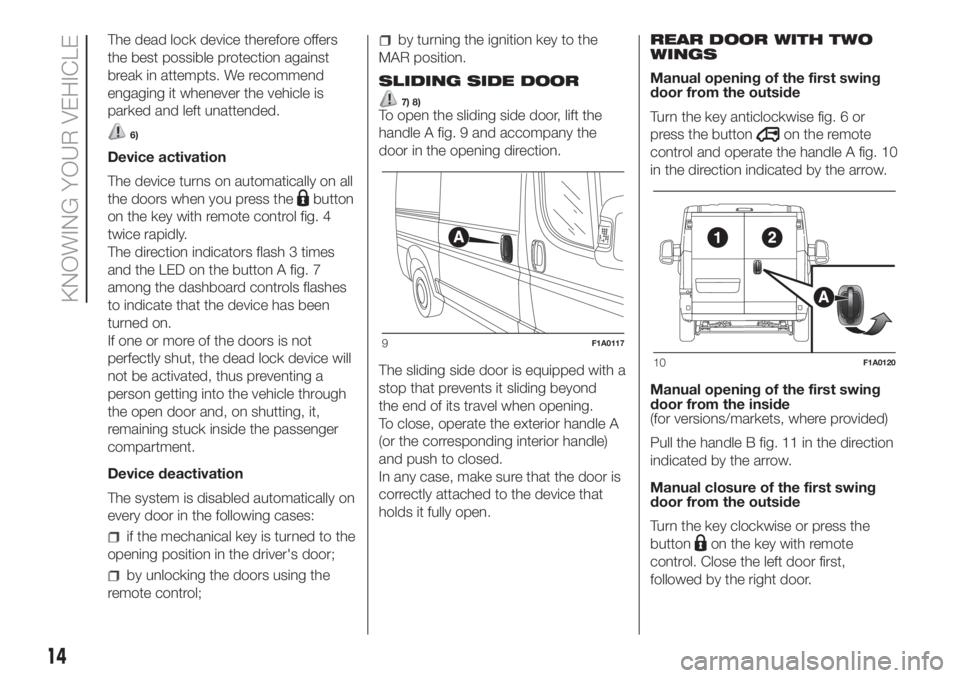
SLIDING SIDE DOOR
7) 8)To open the sliding side door, lift the
handle A fig. 9 and accompany the
door in the opening direction.
The sliding side door is equipped with a
stop that prevents it sliding beyond
the end of its travel when opening.
To close, operate the exterior handle A
(or the corresponding interior handle)
and push to closed.
In any case, make sure that the door is
correctly attached to the device that
holds it fully open.REAR DOOR WITH TWO
WINGS
Manual opening of the first swing
door from the outside
Turn the key anticlockwise fig. 6 or
press the button
on the remote
control and operate the handle A fig. 10
in the direction indicated by the arrow.
Manual opening of the first swing
door from the inside
(for versions/markets, where provided)
Pull the handle B fig. 11 in the direction
indicated by the arrow.
Manual closure of the first swing
door from the outside
Turn the key clockwise or press the
button
on the key with remote
control. Close the left door first,
followed by the right door.
9F1A0117
10F1A0120
14
KNOWING YOUR VEHICLE
Page 17 of 296
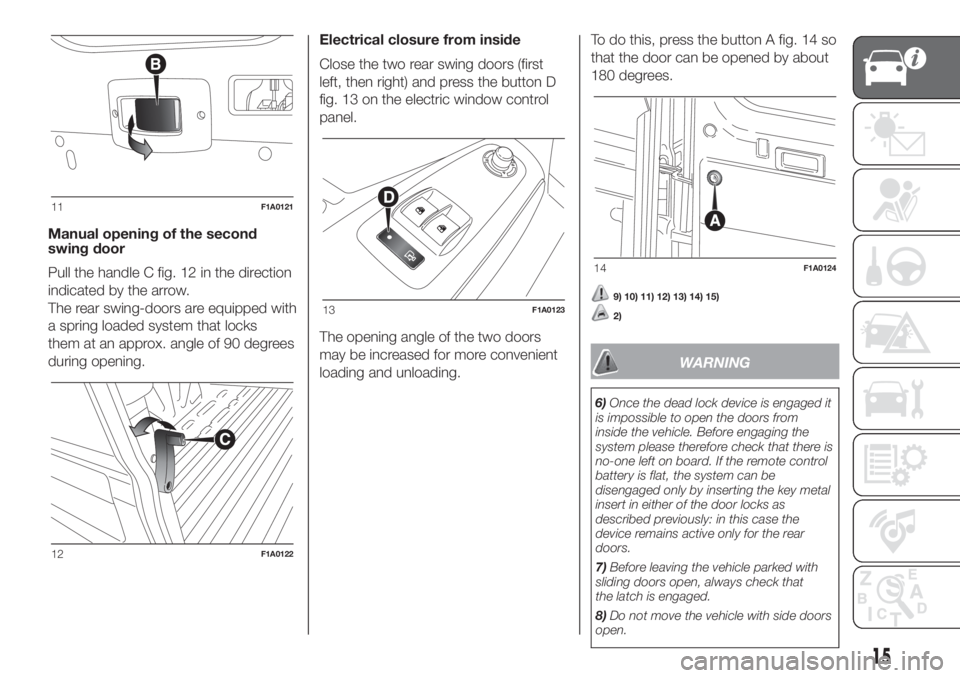
Manual opening of the second
swing door
Pull the handle C fig. 12 in the direction
indicated by the arrow.
The rear swing-doors are equipped with
a spring loaded system that locks
them at an approx. angle of 90 degrees
during opening.Electrical closure from inside
Close the two rear swing doors (first
left, then right) and press the button D
fig. 13 on the electric window control
panel.
The opening angle of the two doors
may be increased for more convenient
loading and unloading.To do this, press the button A fig. 14 so
that the door can be opened by about
180 degrees.
9) 10) 11) 12) 13) 14) 15)
2)
WARNING
6)Once the dead lock device is engaged it
is impossible to open the doors from
inside the vehicle. Before engaging the
system please therefore check that there is
no-one left on board. If the remote control
battery is flat, the system can be
disengaged only by inserting the key metal
insert in either of the door locks as
described previously: in this case the
device remains active only for the rear
doors.
7)Before leaving the vehicle parked with
sliding doors open, always check that
the latch is engaged.
8)Do not move the vehicle with side doors
open.
11F1A0121
12F1A0122
13F1A0123
14F1A0124
15
Page 26 of 296
WARNING
28)As the driver's exterior mirror is curved,
it may slightly alter the perception of
distance of the reflected image. Further,
the reflective surface of the lower part
of the exterior mirrors is parabolic to
increase the field of view. The reflected
image size is thus reduced and gives the
impression that the reflected item is further
away than it actually is.
29)When driving the mirrors should always
remain in position 1.
EXTERNAL LIGHTS
IN BRIEF
The left stalk includes the controls for
the exterior lights.
The exterior lights can only be
switched on when the ignition key is
in the ON position.
LIGHTS OFF
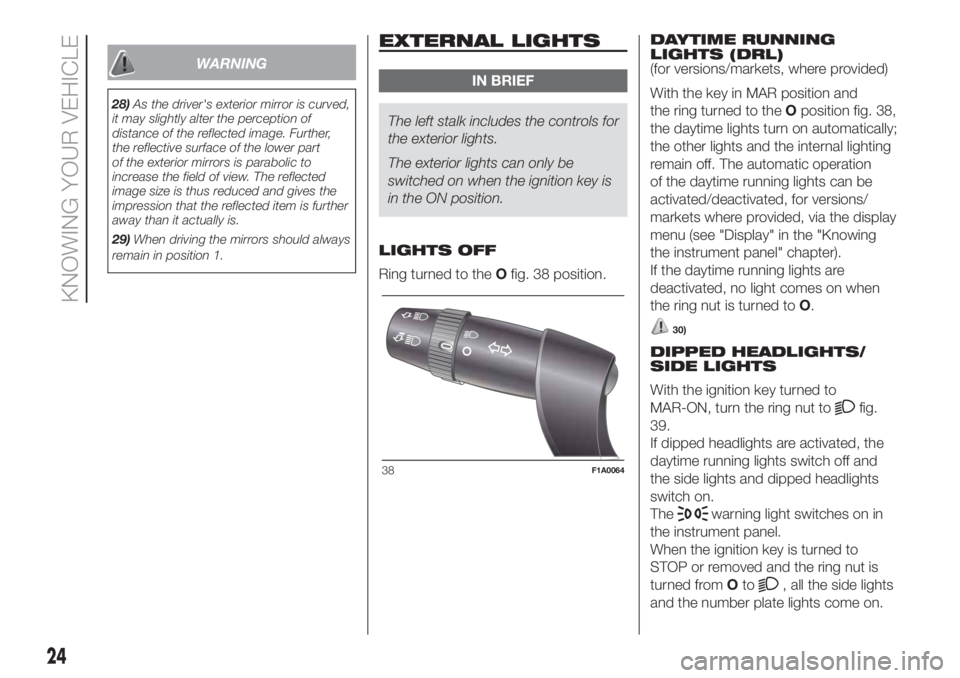
Ring turned to theOfig. 38 position.DAYTIME RUNNING
LIGHTS (DRL)
(for versions/markets, where provided)
With the key in MAR position and
the ring turned to theOposition fig. 38,
the daytime lights turn on automatically;
the other lights and the internal lighting
remain off. The automatic operation
of the daytime running lights can be
activated/deactivated, for versions/
markets where provided, via the display
menu (see "Display" in the "Knowing
the instrument panel" chapter).
If the daytime running lights are
deactivated, no light comes on when
the ring nut is turned toO.
30)
DIPPED HEADLIGHTS/
SIDE LIGHTS
With the ignition key turned to
MAR-ON, turn the ring nut to
fig.
39.
If dipped headlights are activated, the
daytime running lights switch off and
the side lights and dipped headlights
switch on.
The
warning light switches on in
the instrument panel.
When the ignition key is turned to
STOP or removed and the ring nut is
turned fromOto
, all the side lights
and the number plate lights come on.
38F1A0064
24
KNOWING YOUR VEHICLE
Page 27 of 296
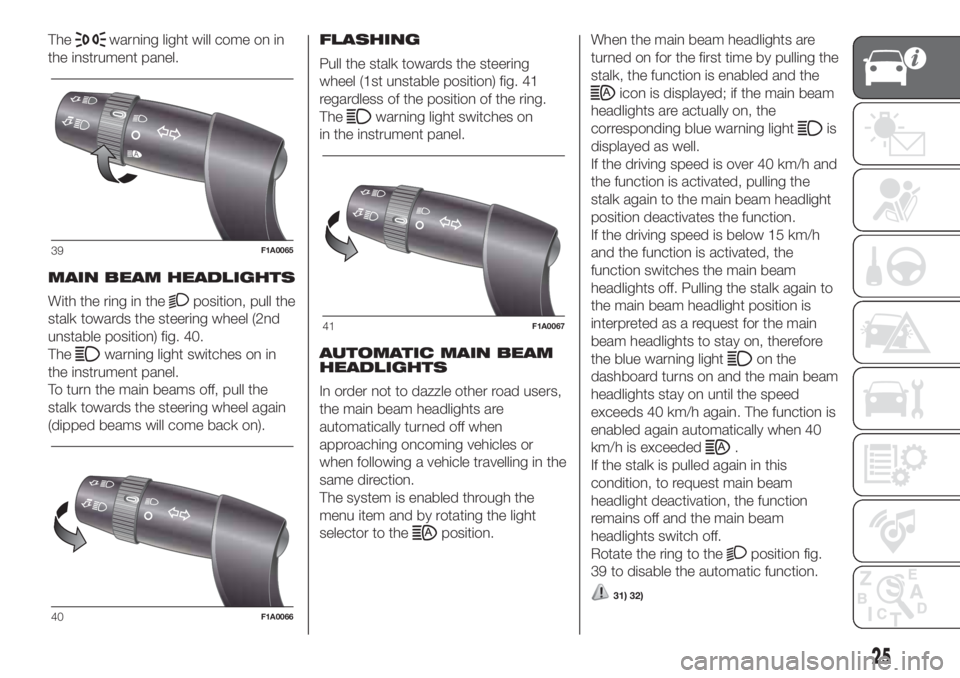
Thewarning light will come on in
the instrument panel.
MAIN BEAM HEADLIGHTS
With the ring in the
position, pull the
stalk towards the steering wheel (2nd
unstable position) fig. 40.
The
warning light switches on in
the instrument panel.
To turn the main beams off, pull the
stalk towards the steering wheel again
(dipped beams will come back on).FLASHING
Pull the stalk towards the steering
wheel (1st unstable position) fig. 41
regardless of the position of the ring.
The
warning light switches on
in the instrument panel.
AUTOMATIC MAIN BEAM
HEADLIGHTS
In order not to dazzle other road users,
the main beam headlights are
automatically turned off when
approaching oncoming vehicles or
when following a vehicle travelling in the
same direction.
The system is enabled through the
menu item and by rotating the light
selector to the
position.When the main beam headlights are
turned on for the first time by pulling the
stalk, the function is enabled and the
icon is displayed; if the main beam
headlights are actually on, the
corresponding blue warning light
is
displayed as well.
If the driving speed is over 40 km/h and
the function is activated, pulling the
stalk again to the main beam headlight
position deactivates the function.
If the driving speed is below 15 km/h
and the function is activated, the
function switches the main beam
headlights off. Pulling the stalk again to
the main beam headlight position is
interpreted as a request for the main
beam headlights to stay on, therefore
the blue warning light
on the
dashboard turns on and the main beam
headlights stay on until the speed
exceeds 40 km/h again. The function is
enabled again automatically when 40
km/h is exceeded
.
If the stalk is pulled again in this
condition, to request main beam
headlight deactivation, the function
remains off and the main beam
headlights switch off.
Rotate the ring to the
position fig.
39 to disable the automatic function.
31) 32)
39F1A0065
40F1A0066
41F1A0067
25
Page 28 of 296
PARKING LIGHTS
These lights can only be turned on with
ignition key in the STOP position or
removed, by moving the left stalk ring
first to theOposition and then to the
orposition.
The
warning light switches on in
the instrument panel.
DIRECTION INDICATORS
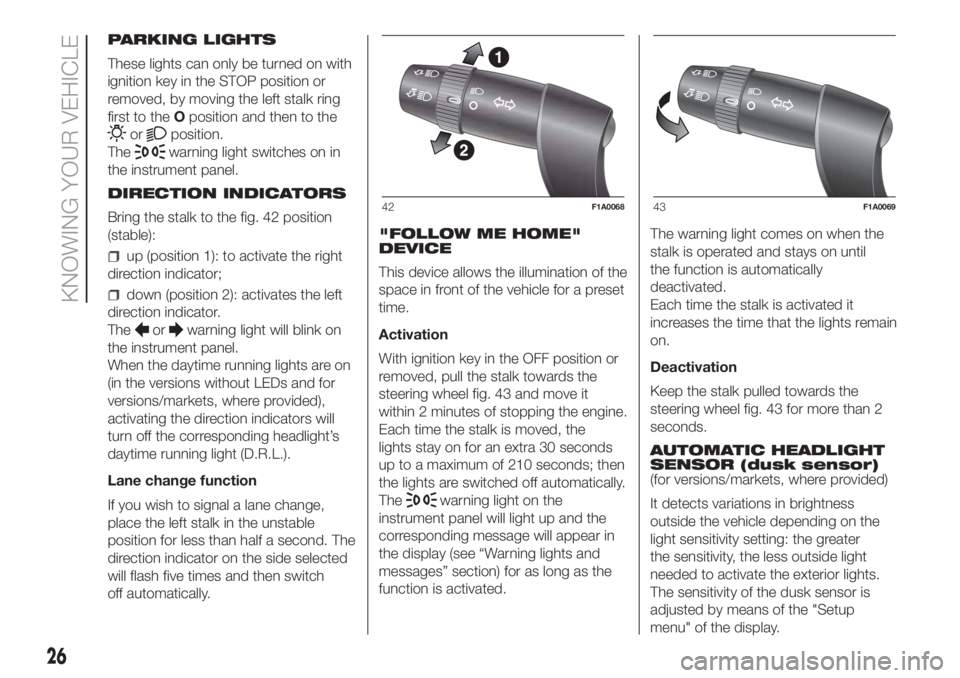
Bring the stalk to the fig. 42 position
(stable):
up (position 1): to activate the right
direction indicator;
down (position 2): activates the left
direction indicator.
The
orwarning light will blink on
the instrument panel.
When the daytime running lights are on
(in the versions without LEDs and for
versions/markets, where provided),
activating the direction indicators will
turn off the corresponding headlight’s
daytime running light (D.R.L.).
Lane change function
If you wish to signal a lane change,
place the left stalk in the unstable
position for less than half a second. The
direction indicator on the side selected
will flash five times and then switch
off automatically."FOLLOW ME HOME"
DEVICE
This device allows the illumination of the
space in front of the vehicle for a preset
time.
Activation
With ignition key in the OFF position or
removed, pull the stalk towards the
steering wheel fig. 43 and move it
within 2 minutes of stopping the engine.
Each time the stalk is moved, the
lights stay on for an extra 30 seconds
up to a maximum of 210 seconds; then
the lights are switched off automatically.
The
warning light on the
instrument panel will light up and the
corresponding message will appear in
the display (see “Warning lights and
messages” section) for as long as the
function is activated.The warning light comes on when the
stalk is operated and stays on until
the function is automatically
deactivated.
Each time the stalk is activated it
increases the time that the lights remain
on.
Deactivation
Keep the stalk pulled towards the
steering wheel fig. 43 for more than 2
seconds.
AUTOMATIC HEADLIGHT
SENSOR (dusk sensor)
(for versions/markets, where provided)
It detects variations in brightness
outside the vehicle depending on the
light sensitivity setting: the greater
the sensitivity, the less outside light
needed to activate the exterior lights.
The sensitivity of the dusk sensor is
adjusted by means of the "Setup
menu" of the display.
42F1A006843F1A0069
26
KNOWING YOUR VEHICLE
Page 29 of 296
Activation
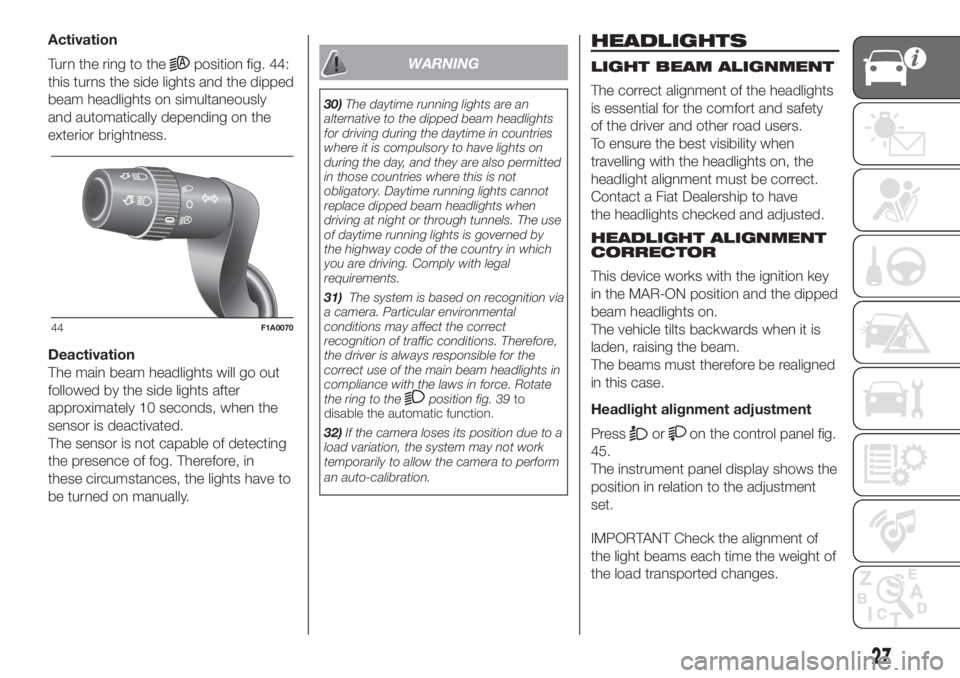
Turn the ring to the
position fig. 44:
this turns the side lights and the dipped
beam headlights on simultaneously
and automatically depending on the
exterior brightness.
Deactivation
The main beam headlights will go out
followed by the side lights after
approximately 10 seconds, when the
sensor is deactivated.
The sensor is not capable of detecting
the presence of fog. Therefore, in
these circumstances, the lights have to
be turned on manually.WARNING
30)The daytime running lights are an
alternative to the dipped beam headlights
for driving during the daytime in countries
where it is compulsory to have lights on
during the day, and they are also permitted
in those countries where this is not
obligatory. Daytime running lights cannot
replace dipped beam headlights when
driving at night or through tunnels. The use
of daytime running lights is governed by
the highway code of the country in which
you are driving. Comply with legal
requirements.
31)The system is based on recognition via
a camera. Particular environmental
conditions may affect the correct
recognition of traffic conditions. Therefore,
the driver is always responsible for the
correct use of the main beam headlights in
compliance with the laws in force. Rotate
the ring to the
position fig. 39to
disable the automatic function.
32)If the camera loses its position due to a
load variation, the system may not work
temporarily to allow the camera to perform
an auto-calibration.
HEADLIGHTS
LIGHT BEAM ALIGNMENT
The correct alignment of the headlights
is essential for the comfort and safety
of the driver and other road users.
To ensure the best visibility when
travelling with the headlights on, the
headlight alignment must be correct.
Contact a Fiat Dealership to have
the headlights checked and adjusted.
HEADLIGHT ALIGNMENT
CORRECTOR
This device works with the ignition key
in the MAR-ON position and the dipped
beam headlights on.
The vehicle tilts backwards when it is
laden, raising the beam.
The beams must therefore be realigned
in this case.
Headlight alignment adjustment
Press
oron the control panel fig.
45.
The instrument panel display shows the
position in relation to the adjustment
set.
IMPORTANT Check the alignment of
the light beams each time the weight of
the load transported changes.
44F1A0070
27
Page 34 of 296
WINDOW WASHING
IN BRIEF
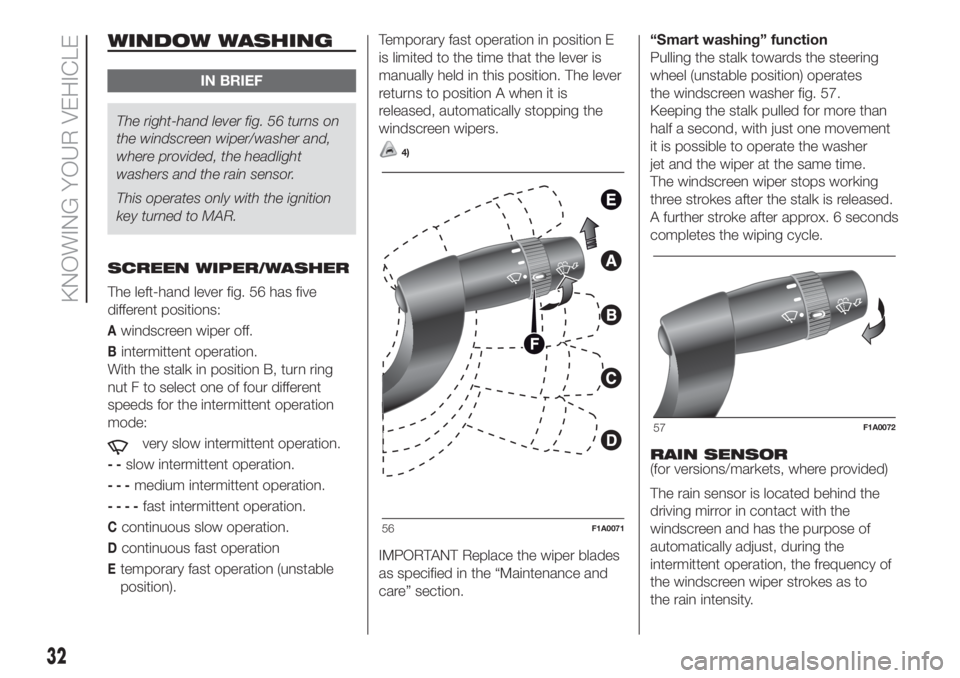
The right-hand lever fig. 56 turns on
the windscreen wiper/washer and,
where provided, the headlight
washers and the rain sensor.
This operates only with the ignition
key turned to MAR.
SCREEN WIPER/WASHER
The left-hand lever fig. 56 has five
different positions:
Awindscreen wiper off.
Bintermittent operation.
With the stalk in position B, turn ring
nut F to select one of four different
speeds for the intermittent operation
mode:
very slow intermittent operation.
--slow intermittent operation.
---medium intermittent operation.
----fast intermittent operation.
Ccontinuous slow operation.
Dcontinuous fast operation
Etemporary fast operation (unstable
position).Temporary fast operation in position E
is limited to the time that the lever is
manually held in this position. The lever
returns to position A when it is
released, automatically stopping the
windscreen wipers.
4)
IMPORTANT Replace the wiper blades
as specified in the “Maintenance and
care” section.“Smart washing” function
Pulling the stalk towards the steering
wheel (unstable position) operates
the windscreen washer fig. 57.
Keeping the stalk pulled for more than
half a second, with just one movement
it is possible to operate the washer
jet and the wiper at the same time.
The windscreen wiper stops working
three strokes after the stalk is released.
A further stroke after approx. 6 seconds
completes the wiping cycle.
RAIN SENSOR
(for versions/markets, where provided)
The rain sensor is located behind the
driving mirror in contact with the
windscreen and has the purpose of
automatically adjust, during the
intermittent operation, the frequency of
the windscreen wiper strokes as to
the rain intensity.
56F1A0071
57F1A0072
32
KNOWING YOUR VEHICLE