load FIAT DUCATO 244 2005 3.G User Guide
[x] Cancel search | Manufacturer: FIAT, Model Year: 2005, Model line: DUCATO 244, Model: FIAT DUCATO 244 2005 3.GPages: 258, PDF Size: 4.05 MB
Page 83 of 258
82GETTING TO KNOW YOUR VEHICLE
It is possible to increase the open-
ing angle of the two doors to facilitate
loading and unloading operations. Re-
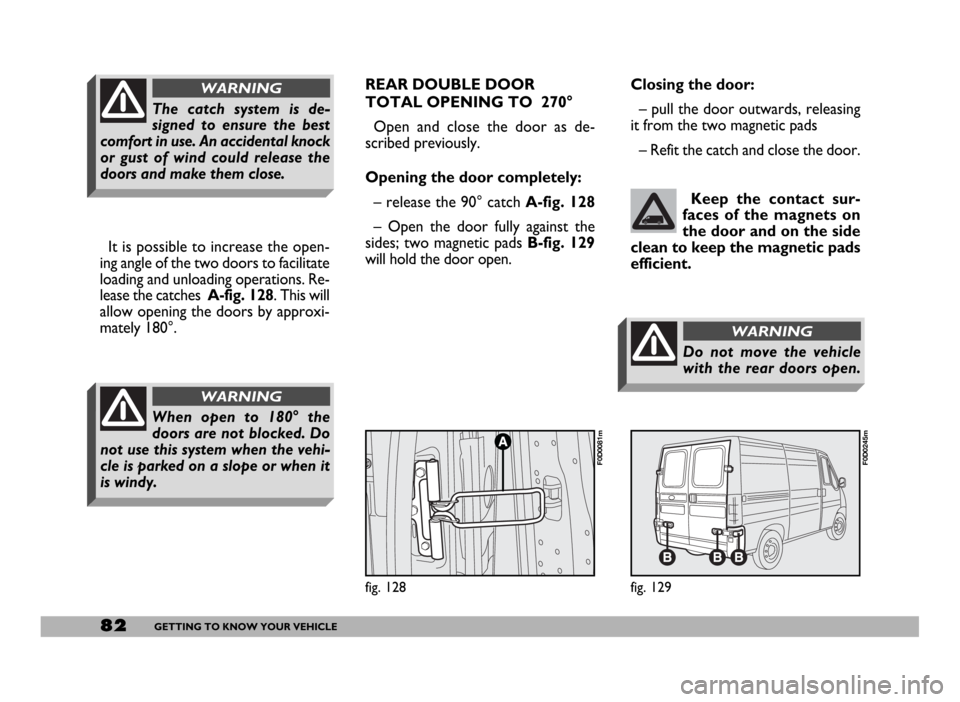
lease the catches A-fig. 128. This will
allow opening the doors by approxi-
mately 180°.
When open to 180° the
doors are not blocked. Do
not use this system when the vehi-
cle is parked on a slope or when it
is windy.
WARNING
The catch system is de-
signed to ensure the best
comfort in use. An accidental knock
or gust of wind could release the
doors and make them close.
WARNINGREAR DOUBLE DOOR
TOTAL OPENING TO 270°
Open and close the door as de-
scribed previously.
Opening the door completely:
– release the 90° catch A-fig. 128
– Open the door fully against the
sides; two magnetic pads B-fig. 129
will hold the door open. Closing the door:
– pull the door outwards, releasing
it from the two magnetic pads
– Refit the catch and close the door.
Keep the contact sur-
faces of the magnets on
the door and on the side
clean to keep the magnetic pads
efficient.
fig. 129
F0D0245m
fig. 128
F0D0081m
Do not move the vehicle
with the rear doors open.
WARNING
Page 87 of 258
86GETTING TO KNOW YOUR VEHICLE
HEADLIGHTS
ADJUSTING THE FRONT
HEADLIGHT BEAM
The correct positioning of the head-
light beams is very important for the
comfort and safety, not only of the
person driving the vehicle but also all
other road users.
This is also covered by a specific law.
To ensure you and other drivers
have the best visibility conditions when
travelling with the headlights on, the
headlights must be set properly.
fig. 136
F0D00043m
Check the positioning of
the headlight beams every
time you change the load to be car-
ried.
WARNINGHave the headlight positioning
checked at aFiat Dealership and
adjusted if necessary.
When the vehicle is loaded, it
“slopes” backwards. This means that
the headlight beam rises. In this case,
it is necessary to return it to the cor-
rect position.
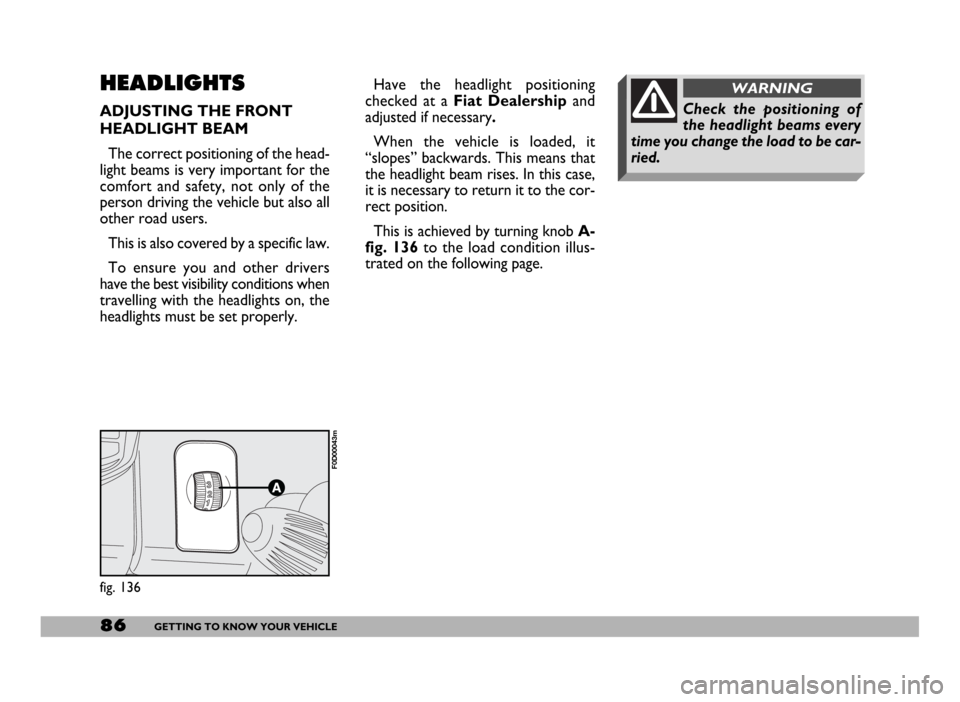
This is achieved by turning knob A-
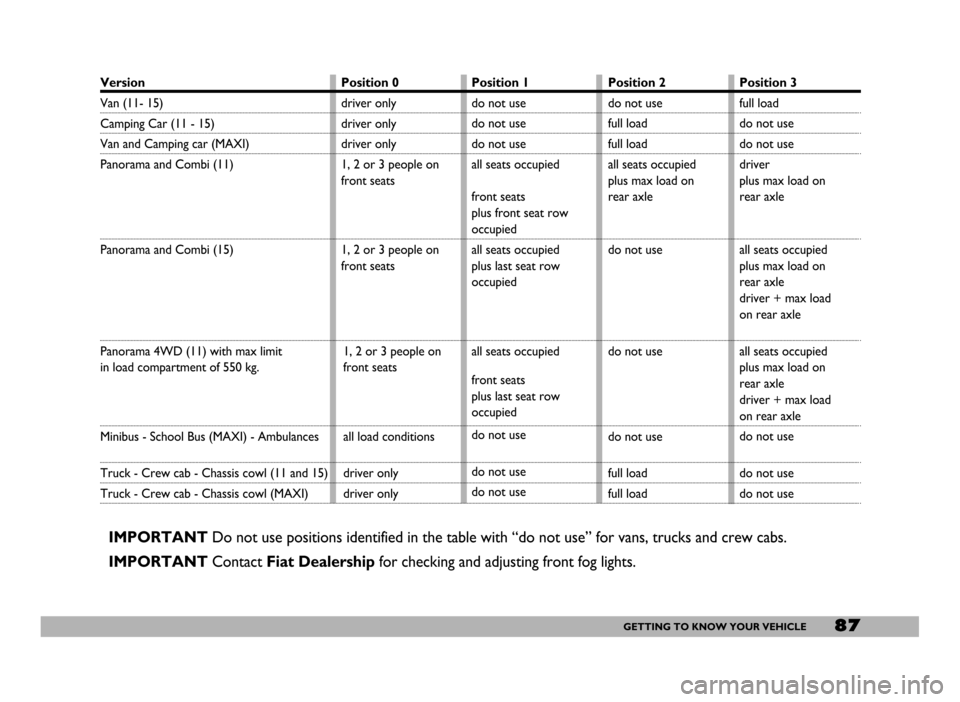
fig. 136to the load condition illus-
trated on the following page.
Page 88 of 258
87GETTING TO KNOW YOUR VEHICLE
Version
Van (11- 15)
Camping Car (11 - 15)
Van and Camping car (MAXI)
Panorama and Combi (11)
Panorama and Combi (15)
Panorama 4WD (11) with max limit
in load compartment of 550 kg.
Minibus - School Bus (MAXI) - Ambulances
Truck - Crew cab - Chassis cowl (11 and 15)
Truck - Crew cab - Chassis cowl (MAXI)Position 0
driver only
driver only
driver only
1, 2 or 3 people on
front seats
1, 2 or 3 people on
front seats
1, 2 or 3 people on
front seats
all load conditions
driver only
driver onlyPosition 1
do not use
do not use
do not use
all seats occupied
front seats
plus front seat row
occupied
all seats occupied
plus last seat row
occupied
all seats occupied
front seats
plus last seat row
occupied
do not use
do not use
do not usePosition 2
do not use
full load
full load
all seats occupied
plus max load on
rear axle
do not use
do not use
do not use
full load
full loadPosition 3
full load
do not use
do not use
driver
plus max load on
rear axle
all seats occupied
plus max load on
rear axle
driver + max load
on rear axle
all seats occupied
plus max load on
rear axle
driver + max load
on rear axle
do not use
do not use
do not use
IMPORTANTDo not use positions identified in the table with “do not use” for vans, trucks and crew cabs.
IMPORTANTContact Fiat Dealershipfor checking and adjusting front fog lights.
Page 96 of 258
95GETTING TO KNOW YOUR VEHICLE
The correct operation of
front and side airbags and
pretensioners is only ensured if the
vehicle is not overloaded.
WARNINGEOBD SYSTEM
(petrol versions only)
The EOBD (European On Board Di-
agnosis) system fitted on the vehicle
complies with Directive 98/69/CE
(EURO 3).
This system continuously monitors
the engine emission system compo-
nents. Furthermore, the system warns
the driver of deterioration concerning
the emission system components by
means of the Uwarning light on the
instrument panel.
The objective is to:
– monitor system efficiency;
– warn when failures can increase
emissions over the threshold estab-
lished by the European regulations;
– warn of the need to replace dete-
riorated components.
Remember that with the
key engaged and in the
MAR position, even with the en-
gine not running, the airbags may
be triggered on a stationary vehi-
cle if it is bumped by another mov-
ing vehicle. Therefore, never seat
children on the front seat even
when the vehicle is stationary. On
the other hand, remember that
with the vehicle stationary, with-
out the key engaged and turned,
the airbags are not triggered in the
event of an impact; in these cases,
failure to come into action of the
airbags cannot be considered as a
sign that the system is not working
properly.
WARNING
On vehicles equipped with
side bags, do not cover the
backrest of the front seats with
trims or covers.
WARNING
The airbag does not substi-
tute the seat belts, but on-
ly increases their effectiveness.
Moreover, since the front airbags
do not come into operation in the
event of front impact at low speed,
side collisions, bumps from behind
or overturning, in these circum-
stances the occupants would only
be protected by the seat belts which
must therefore always be fastened.
WARNING
Do not wash the seat back
in vehicles with side bags
with pressurised steam or water in
automatic seat washing station.
WARNING
Page 97 of 258
96GETTING TO KNOW YOUR VEHICLE
The action of the ASR is particularly
helpful in the following circumstances:
– slipping of the inner wheel due to
the effect of dynamic load changes or
excessive acceleration.
– too much power transmitted to
the wheels also in relation to the con-
ditions of the road surface.
– acceleration on slippery, snowy or
frozen surfaces.
– in the case of loss of grip on a wet
surface (aquaplaning). Furthermore, the system is equipped
with a connector for interfacing with
specific tools used to read the error
codes stored in the control unit mem-
ory along with a set of diagnostic and
engine specific parameters.ASR SYSTEM
(Antislip Regulation)
The ASR system controls the vehicle
drive and cuts in automatically every
time one or both driving wheels slip.
In slipping conditions, two different
control systems are activated:
– if the slipping involves both the dri-
ving wheels, the ASR function inter-
venes reducing the power transmitted
by the engine;
– if slipping involves only one driving
wheel, the ASR system cuts in auto-
matically braking the wheel that is slip-
ping.
IMPORTANTAfter eliminating the
problem, your Fiat Dealershipwill
run a bench test to fully check the sys-
tem. In some cases, a long road test
may be required.Contact a Fiat Dealer-
ship as soon as possible if
the Uwarning light ei-
ther does not come on when the
key is turned to MAR or comes
on, with fixed or flashing light,
when travelling. Warning light U
operation can be checked by
means of special equipment by
traffic agents. Always comply
with the road traffic regulations
in force in the Country where you
are travelling.
The performance of the
system, in terms of active
safety should not induce the driver
to take pointless and unnecessary
risks. The style of driving must in
any case always be adapted to the
conditions of the road surface, vis-
ibility and traffic. Road safety is al-
ways the driver’s responsibility.
WARNING
Page 109 of 258
108GETTING THE BEST OUT OF YOUR VEHICLE
SWITCHING OFF
THE ENGINE
Turn the ignition key to STOPwhile
the engine is idling.
IMPORTANTAfter a taxing drive
you should allow the engine to “catch
its breath” before turning it off by let-
ting it idle to allow temperature in the
engine compartment to fall.PARKING
Switch off the engine, pull up the
handbrake and engage a gear (1st gear
or reverse, according to whether the
vehicle is facing up or downhill) and
leave the wheels turned. If the vehi-
cle is left on a steep slope, wedges or
a rock should be used to lock the
wheels.
Do not leave the ignition key at
MAR to prevent running the battery
down. Always remove the key when
you leave the vehicle.HANDBRAKE
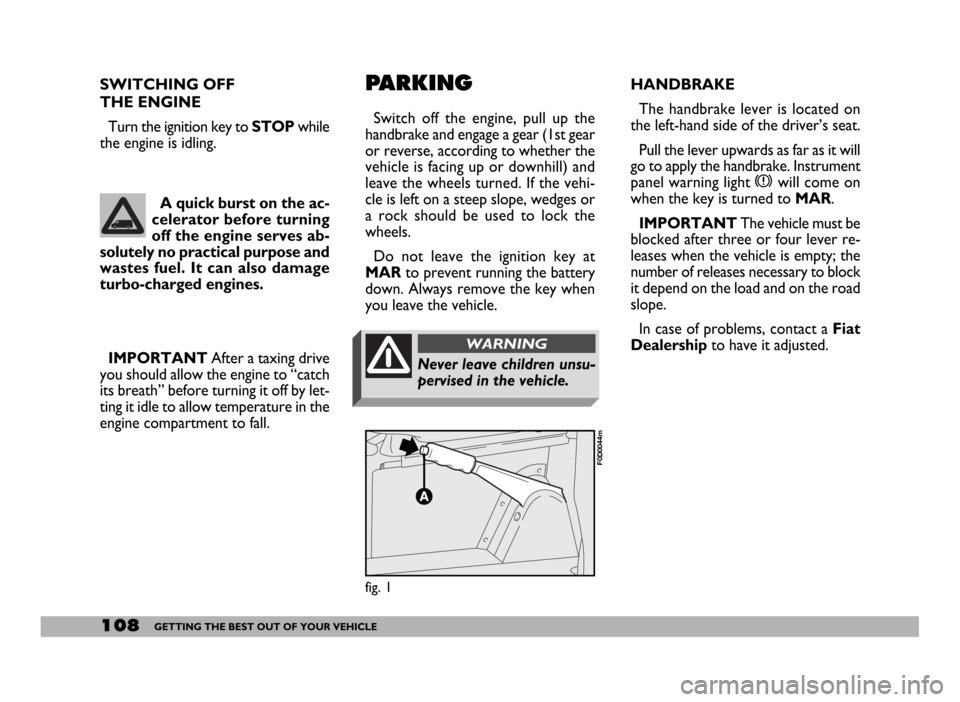
The handbrake lever is located on
the left-hand side of the driver’s seat.
Pull the lever upwards as far as it will
go to apply the handbrake. Instrument
panel warning light xwill come on
when the key is turned to MAR.
IMPORTANTThe vehicle must be
blocked after three or four lever re-
leases when the vehicle is empty; the
number of releases necessary to block
it depend on the load and on the road
slope.
In case of problems, contact a Fiat
Dealershipto have it adjusted. A quick burst on the ac-
celerator before turning
off the engine serves ab-
solutely no practical purpose and
wastes fuel. It can also damage
turbo-charged engines.
fig. 1
F0D0044m
Never leave children unsu-
pervised in the vehicle.
WARNING
Page 118 of 258

117GETTING THE BEST OUT OF YOUR VEHICLE
CONSTRUCTION FEATURES
DUCATO automatic gearbox is con-
trolled electronically with four for-
ward gears and reverse.
It is controlled by an electronic con-
trol unit which handles:
– the torque distributor;
– gearshifting;
– specific programmes.
The gearbox is coupled with a flow
power torque distributor with piloted
antislip device which makes it possible
to obtain demultiplication ratios.
The characteristic of this gearbox
which works without idle gear enables:
– higher compactness and weight re-
duction;
– improved output due to less fric-
tion;
– lower stress of transmission com-
ponents.GENERAL FEATURES
Electronic gearbox control makes it
possible to obtain gearshifting suited
to momentary engine characteristics
with a certain elasticity.
The electronic control unit has the
following task:
– adapting the oil pressure for
gearshifting to the engine torque;
– activating safety functions;
– defining the manual gearshifting
programme;
– system diagnostics.
For controlling these operating log-
ics the control unit uses the follow-
ing signals:
– engine rpm;
– engine temperature;
– engine torque;
– vehicle speed;
– gearbox oil temperature;– gearshift lever position;
– accelerator pedal position;
– brake pedal position.
The control unit also communicates
with the injection system electronic
control unit.
Conditions of use analysed by
the control unit
The control unit analyses each single
condition of use of the vehicle, dis-
criminating it on the basis of the sig-
nals received from the various sensors.
Analysed conditions are the follow-
ing:
– starting (position/accelerator ped-
al changing speed);
– acceleration (accelerator pedal
completely pushing down speed);
– full load (number of engine full load
kickdown signals or position mainte-
nance time);
Page 121 of 258
120GETTING THE BEST OUT OF YOUR VEHICLE
BEFORE GETTING BEHIND
THE WHEEL
– Make sure all light, including the
headlights, are working properly;
– adjust the position of seats and dri-
ving and door mirrors properly for the
best driving position;
– make sure that nothing (mats, etc.)
gets in the way of the pedals when
they are pushed down;
– make sure that any child restraint
systems (child seats, cradles, etc.) are
properly fixed;
– place any objects in the load com-
partment in such a way that they can-
not be thrown forwards in the event
of an accident;
– light eating will help keep your re-
flexes prompt. Above all, do not have
anything alcoholic to drink.
Remember to periodically check:
– tyre pressure,
– engine oil level,
– engine coolant level and cooling
system conditions,– brake fluid level,
– windscreen washer fluid level.
WHEN TRAVELLING
– The first rule of safe driving is pru-
dence;
– prudence also means putting your-
self into a position where you can pre-
dict wrong or imprudent behaviour
from other drivers;
– stick closely to the rules of the
road in the particular country where
the vehicle is being driven and, above
all, do not exceed speed limits;
– ensure that, besides yourself, all the
other passengers in the vehicle have
their seat belts fastened, that children
are sitting in the appropriate child
seats and any animals in the vehicle are
placed in suitable compartment;
– you should be physically fit and
mentally alert before setting out on
long journeys.
Always fasten both front
and back seat belts
(Panorama, Minibus, Combi and
Crew Cab versions). Travelling with
the seat belts unfastened increas-
es the risk of injury or death if you
are in a collision.
WARNING
Driving while drunk or un-
der the influence of drugs
or certain medicines is dangerous
for both you and other road users.
WARNING
Page 122 of 258
121GETTING THE BEST OUT OF YOUR VEHICLE
– Do not drive too many hours at a
time but stop at intervals to stretch
your legs and recoup your energy;
– make sure the air in the passenger’s
compartment is being changed
continuously;
– never coast downhill (i.e. with the
engine off): if you do, you lose the aid
of engine braking, power brakes and
power steering so that braking re-
quires greater effort on the pedal and
steering requires greater effort on the
steering wheel.DRIVING AT NIGHT
These are the main rules to follow
when you are driving at night:
– drive especially carefully: it is hard-
er to drive at night;
– slow down especially if the road is
not lit;
– at the first signs of sleepiness, stop:
continuing would be a risk for yourself
and everybody else. Only start driving
again when you have had enough rest;
– keep a greater safety distance from
the vehicles in front of you than dur-
ing daylight hours: it is hard to judge
how fast other vehicles are going when
all you can see are their lights;
– make sure the headlights beams are
properly positioned: if they are too
low, they reduce visibility and strain
your eyes. If they are too high they can
dazzle other drivers. Adjust headlight
beam according to transported load;
– only use main beam headlights
when you are driving outside town
and when you are sure they do not an-
noy other drivers. dip your headlights
Water, ice or salt sprinkled
on the road can deposit on
the brake discs and reduce effi-
ciency of the first braking.
WARNING
Do not drive with objects
on the floor in front of the
driver’s seat: they could caught un-
der the pedals making braking or
accelerating impossible.
WARNING
Pay attention to the mats:
even a small problem to the
braking system may require in-
creased brake pedal stroke with re-
spect to normal.
WARNING
Page 125 of 258

124GETTING THE BEST OUT OF YOUR VEHICLE
To get the most out of ABS:
– During emergency stops or when
grip conditions are poor, you will feel
a slight pulsation on the brake pedal.
This is the sign that the ABS is work-
ing. Do not release the brake pedal but
continue to press so as not to inter-
rupt the braking action;
– ABS enables you to brake and steer
at the same time. If you meet an un-
expected obstacle you can therefore
steer around it;
– the ABS prevents the wheels from
locking but it does not increase actu-
al grip conditions between tyre and
road. Therefore, even if your vehicle
is fitted with ABS, keep a safe distance
from the vehicle in front of you and
keep your speed down when driving
into bends.
ABS serves to increase your control
over the vehicle, not to enable you to
go faster.Some suggestions which may help
you to keep the running costs of the
vehicle down and lower the amount
of toxic emissions released into the at-
mosphere are given below.
GENERAL
CONSIDERATIONS
Vehicle maintenance
Carry out the checks and adjust-
ments/regulations specified in the
“Service Schedule”.
Tyres
Check tyre inflation pressure regu-
larly. Tyres should be checked at least
once every four weeks: if the pressure
is too low, fuel consumption increas-
es as the resistance to the rolling
movement of the tyre is greater.Unnecessary loads
Do not travel with too much load.
The weight of the vehicle (specially in
urban traffic) and its trim greatly ef-
fects consumption and stability.
Roof rack/ski rack
Remove the roof or ski racks from
the vehicle as soon as they are no
longer needed. These accessories re-
duce the aerodynamic penetration of
the vehicle and will increase con-
sumption. When transporting partic-
ularly large objects, use a trailer,
where possible.CONTAINING RUNNING COSTS