warning FIAT FULLBACK 2016 1.G Service Manual
[x] Cancel search | Manufacturer: FIAT, Model Year: 2016, Model line: FULLBACK, Model: FIAT FULLBACK 2016 1.GPages: 312, PDF Size: 13.67 MB
Page 107 of 312
SBR SYSTEM
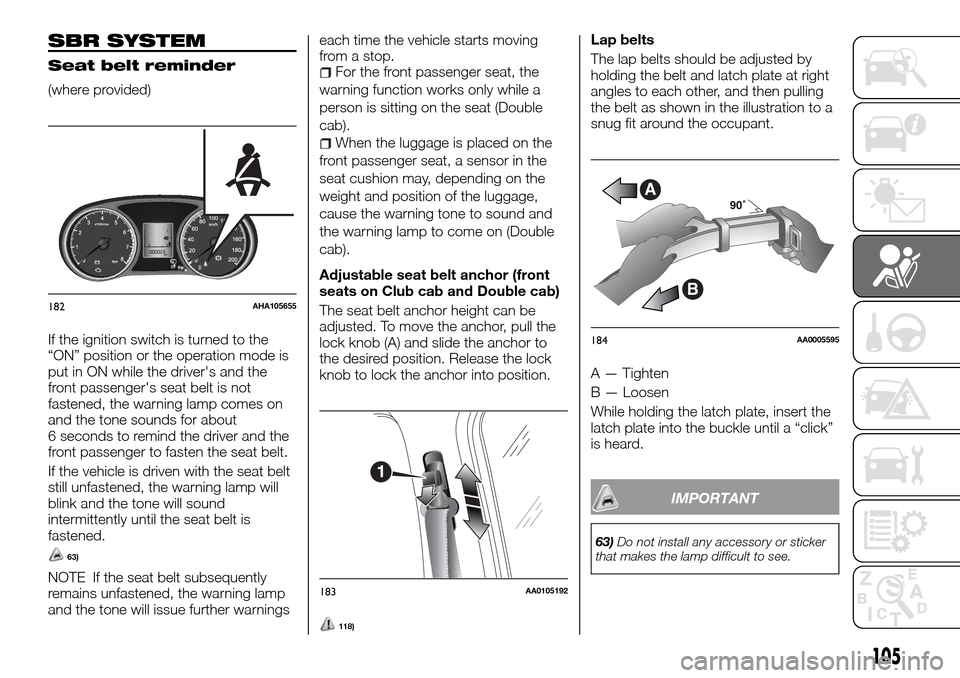
Seat belt reminder
(where provided)
If the ignition switch is turned to the
“ON” position or the operation mode is
put in ON while the driver's and the
front passenger's seat belt is not
fastened, the warning lamp comes on
and the tone sounds for about
6 seconds to remind the driver and the
front passenger to fasten the seat belt.
If the vehicle is driven with the seat belt
still unfastened, the warning lamp will
blink and the tone will sound
intermittently until the seat belt is
fastened.
63)
NOTE If the seat belt subsequently
remains unfastened, the warning lamp
and the tone will issue further warningseach time the vehicle starts moving
from a stop.
For the front passenger seat, the
warning function works only while a
person is sitting on the seat (Double
cab).
When the luggage is placed on the
front passenger seat, a sensor in the
seat cushion may, depending on the
weight and position of the luggage,
cause the warning tone to sound and
the warning lamp to come on (Double
cab).
Adjustable seat belt anchor (front
seats on Club cab and Double cab)
The seat belt anchor height can be
adjusted. To move the anchor, pull the
lock knob (A) and slide the anchor to
the desired position. Release the lock
knob to lock the anchor into position.
118)
Lap belts
The lap belts should be adjusted by
holding the belt and latch plate at right
angles to each other, and then pulling
the belt as shown in the illustration to a
snug fit around the occupant.
A — Tighten
B — Loosen
While holding the latch plate, insert the
latch plate into the buckle until a “click”
is heard.
IMPORTANT
63)Do not install any accessory or sticker
that makes the lamp difficult to see.
182AHA105655
183AA0105192
B
A
184AA0005595
105
Page 108 of 312
WARNING
118)When adjusting the seat belt anchor,
set it at a position that is sufficiently high so
that the belt will make full contact with your
shoulder but will not touch your neck.
PRETENSIONERS
AND FORCE LIMITER
SYSTEM
(where provided)
119) 120) 121) 122)
64) 65) 66) 67)
The driver’s and front passenger’s seat
equipped with airbags each have a
pretensioner seat belt and force limiter
system.
Pretensioner system
When the ignition switch or the
operation mode is under the following
conditions, if there is a frontal impact or
a side impact (vehicles equipped with
SRS side airbags and SRS curtain
airbags) severe enough to injure the
driver and/or front passenger, the
pretensioner system will retract their
respective seat belts instantaneously,
thus maximizing the seat belt’s
effectiveness.
Except for vehicles equipped with the
keyless operation system: the ignition
switch is in the “ON” or “START”
position.
Vehicles equipped with the keyless
operation system: the operation mode
is in ON.
NOTE The pretensioner seat belts will
be activated if the vehicle suffers a
severe impact, even if the seat belts are
not worn.NOTE The pretensioner seat belts are
designed to work only once. After the
pretensioner seat belts have been
activated, we recommend you to have
them replaced by a Fiat Dealership.
SRS warning lamp (where provided)
This warning lamp is shared by the SRS
airbags and the pre-tensioner seat
belts. Refer to “SRS warning lamp”.
Force limiter system
In the event of a collision, each force
limiter system will effectively absorb the
load applied to the seat belt so as to
minimize the impact to the passenger.
WARNING
119)The pretensioner may be used only
once. After it is triggered, have it replaced
at a Fiat Dealership.
120)Removing or otherwise tampering
with pretensioner and seat belt
components is strictly prohibited. Any
intervention on these components must be
performed by qualified and authorised
technicians. Always go to a Fiat Dealership.
121)For maximum safety, keep the
backrest upright, lean back into it and
make sure the seat belt fits closely across
your chest and pelvis. Always fasten the
seat belts for both the front and rear seats!
Travelling without wearing seat belts will
increase the risk of serious injury and even
death in the event of an accident.
106
SAFETY
Page 110 of 312
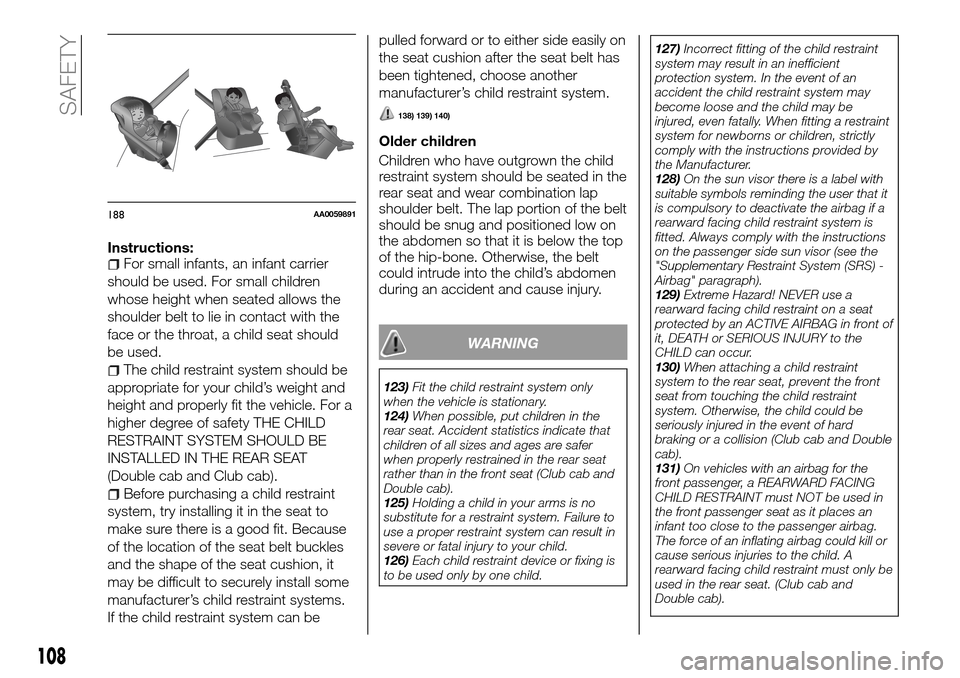
Instructions:For small infants, an infant carrier
should be used. For small children
whose height when seated allows the
shoulder belt to lie in contact with the
face or the throat, a child seat should
be used.
The child restraint system should be
appropriate for your child’s weight and
height and properly fit the vehicle. For a
higher degree of safety THE CHILD
RESTRAINT SYSTEM SHOULD BE
INSTALLED IN THE REAR SEAT
(Double cab and Club cab).
Before purchasing a child restraint
system, try installing it in the seat to
make sure there is a good fit. Because
of the location of the seat belt buckles
and the shape of the seat cushion, it
may be difficult to securely install some
manufacturer’s child restraint systems.
If the child restraint system can bepulled forward or to either side easily on
the seat cushion after the seat belt has
been tightened, choose another
manufacturer’s child restraint system.
138) 139) 140)
Older children
Children who have outgrown the child
restraint system should be seated in the
rear seat and wear combination lap
shoulder belt. The lap portion of the belt
should be snug and positioned low on
the abdomen so that it is below the top
of the hip-bone. Otherwise, the belt
could intrude into the child’s abdomen
during an accident and cause injury.
WARNING
123)Fit the child restraint system only
when the vehicle is stationary.
124)When possible, put children in the
rear seat. Accident statistics indicate that
children of all sizes and ages are safer
when properly restrained in the rear seat
rather than in the front seat (Club cab and
Double cab).
125)Holding a child in your arms is no
substitute for a restraint system. Failure to
use a proper restraint system can result in
severe or fatal injury to your child.
126)Each child restraint device or fixing is
to be used only by one child.127)Incorrect fitting of the child restraint
system may result in an inefficient
protection system. In the event of an
accident the child restraint system may
become loose and the child may be
injured, even fatally. When fitting a restraint
system for newborns or children, strictly
comply with the instructions provided by
the Manufacturer.
128)On the sun visor there is a label with
suitable symbols reminding the user that it
is compulsory to deactivate the airbag if a
rearward facing child restraint system is
fitted. Always comply with the instructions
on the passenger side sun visor (see the
"Supplementary Restraint System (SRS) -
Airbag" paragraph).
129)Extreme Hazard! NEVER use a
rearward facing child restraint on a seat
protected by an ACTIVE AIRBAG in front of
it, DEATH or SERIOUS INJURY to the
CHILD can occur.
130)When attaching a child restraint
system to the rear seat, prevent the front
seat from touching the child restraint
system. Otherwise, the child could be
seriously injured in the event of hard
braking or a collision (Club cab and Double
cab).
131)On vehicles with an airbag for the
front passenger, a REARWARD FACING
CHILD RESTRAINT must NOT be used in
the front passenger seat as it places an
infant too close to the passenger airbag.
The force of an inflating airbag could kill or
cause serious injuries to the child. A
rearward facing child restraint must only be
used in the rear seat. (Club cab and
Double cab).
188AA0059891
108
SAFETY
Page 119 of 312
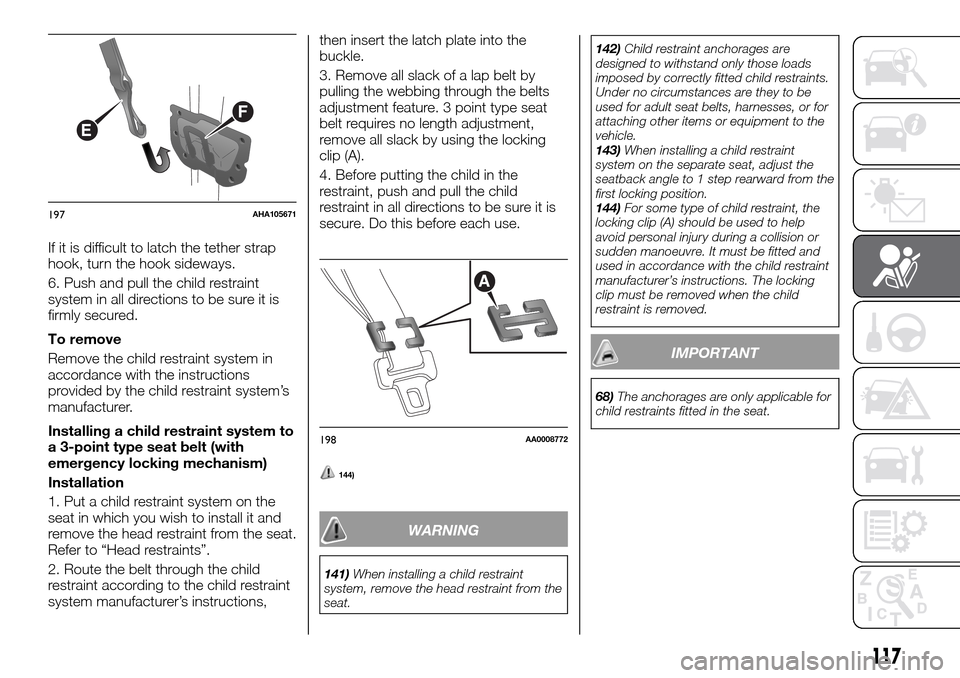
If it is difficult to latch the tether strap
hook, turn the hook sideways.
6. Push and pull the child restraint
system in all directions to be sure it is
firmly secured.
To remove
Remove the child restraint system in
accordance with the instructions
provided by the child restraint system’s
manufacturer.
Installing a child restraint system to
a 3-point type seat belt (with
emergency locking mechanism)
Installation
1. Put a child restraint system on the
seat in which you wish to install it and
remove the head restraint from the seat.
Refer to “Head restraints”.
2. Route the belt through the child
restraint according to the child restraint
system manufacturer’s instructions,then insert the latch plate into the
buckle.
3. Remove all slack of a lap belt by
pulling the webbing through the belts
adjustment feature. 3 point type seat
belt requires no length adjustment,
remove all slack by using the locking
clip (A).
4. Before putting the child in the
restraint, push and pull the child
restraint in all directions to be sure it is
secure. Do this before each use.
144)
WARNING
141)When installing a child restraint
system, remove the head restraint from the
seat.142)Child restraint anchorages are
designed to withstand only those loads
imposed by correctly fitted child restraints.
Under no circumstances are they to be
used for adult seat belts, harnesses, or for
attaching other items or equipment to the
vehicle.
143)When installing a child restraint
system on the separate seat, adjust the
seatback angle to 1 step rearward from the
first locking position.
144)For some type of child restraint, the
locking clip (A) should be used to help
avoid personal injury during a collision or
sudden manoeuvre. It must be fitted and
used in accordance with the child restraint
manufacturer’s instructions. The locking
clip must be removed when the child
restraint is removed.
IMPORTANT
68)The anchorages are only applicable for
child restraints fitted in the seat.
F
E
197AHA105671
A
198AA0008772
117
Page 126 of 312
WARNING
145)Airbags inflate at an extremely rapid
speed. In certain situations, contact with
inflating airbags can result in abrasions,
bruises, light cuts, and the like.
146)IT IS VERY IMPORTANT TO BE
PROPERLY SEATED. A driver or front
passenger too close to the steering wheel
or instrument panel during airbag
deployment can be killed or seriously
injured. Airbags inflate very fast, and with
great force. If the driver and front
passenger are not properly seated and
restrained, the airbags may not protect you
properly, and could cause serious or fatal
injuries when they inflate.
147)Do not sit on the edge of the seat, or
sit with your lower legs too close to the
instrument panel, or lean head or chest
close to the steering wheel or instrument
panel. Do not put feet or legs on or against
the instrument panel.
148)Always drive with your hands on the
rim of the steering wheel so that the airbag
can inflate freely if required. Do not drive
with your body bent forward. Keep your
back straight against the backrest.149)Place all infants and small children in
the rear seat and properly restrained using
an appropriate child restraint system. The
rear seat is the safest for infants and
children.
150)Infants and small children should
never be unrestrained, stand up against
the instrument panel or held in your arms
or on your lap. They could be seriously
injured or killed in a collision, including
when the airbag inflates. They should be
properly seated in an appropriate child
restraint system. See the “Child restraint”
section of this owner’s manual.
151)When there is an active passenger
airbag, DO NOT install rearward facing
child restraint systems on the front seat.
Deployment of the airbag in an accident
could cause fatal injuries to the child
regardless of the severity of the impact.
Therefore, always deactivate the passenger
side airbag when a rearward facing child
restraint system is installed on the front
passenger seat. The front passenger seat
must also be positioned back as far as
possible in order to prevent the child
restraint system from coming into contact
with the dashboard. Immediately reactivate
the passenger airbag as soon as the child
restraint system has been removed.
152)Older children should be seated,
properly wearing the seat belt, with an
appropriate booster seat if needed.
153)Extreme Hazard! NEVER use a
rearward facing child restraint on a seat
protected by an ACTIVE AIRBAG in front of
it, DEATH or SERIOUS INJURY to the
CHILD can occur.154)Do not fit any accessory that makes
the indicator impossible to see, and do not
cover the indicator with a sticker. You
would not be able to verify the status of the
passenger airbag system.
155)To reduce risk of serious or fatal
injury: always turn the ignition switch to the
“LOCK” position or put the operation mode
in OFF, before operating the front
passenger’s airbag ON-OFF switch. Failure
to do so could adversely affect the airbag
performance; Wait at least 60 seconds to
operate the front passenger’s airbag
ON-OFF switch after turning the ignition
switch to the “LOCK” position or putting
the operation mode in OFF. The SRS
airbag system is designed to retain enough
voltage to deploy the airbag; Always
remove the key from the front passenger’s
airbag ON-OFF switch after operating that
switch. Failure to do so could lead to
improper position of the front passenger’s
airbag ON-OFF switch; Do not turn OFF
the front passenger’s airbag ON-OFF
switch except when a child restraint
system is fitted to the front passenger seat;
If the OFF indicator does not come on
when the front passenger’s airbag ONOFF
switch is turned OFF, do not fit a child
restraint system to the front passenger
seat. We recommend you to have the
system inspected by a Fiat Dealership; if
the OFF indicator remains on when the
front passenger’s airbag ON-OFF switch is
turned ON, do not allow anyone to sit on
the front passenger seat. We recommend
you to have the system inspected by a Fiat
Dealership.
124
SAFETY
Page 129 of 312
An operation noise is emitted from the
engine compartment or feel a shock
from the brake pedal when start driving
immediately after starting the engine.
These are normal sound or operation
that the ABS makes when performing a
self-check. It does not indicate a
malfunction.
The ABS can be used after the vehicle
has reached a speed over
approximately 10 km/h. It stops
working when the vehicle slows below
7 km/h.
181) 182) 183) 184) 185) 186) 187) 188) 189)
After driving on icy roads
After driving on snow or icy roads,
remove any snow and ice which may
have be left around the wheels. On
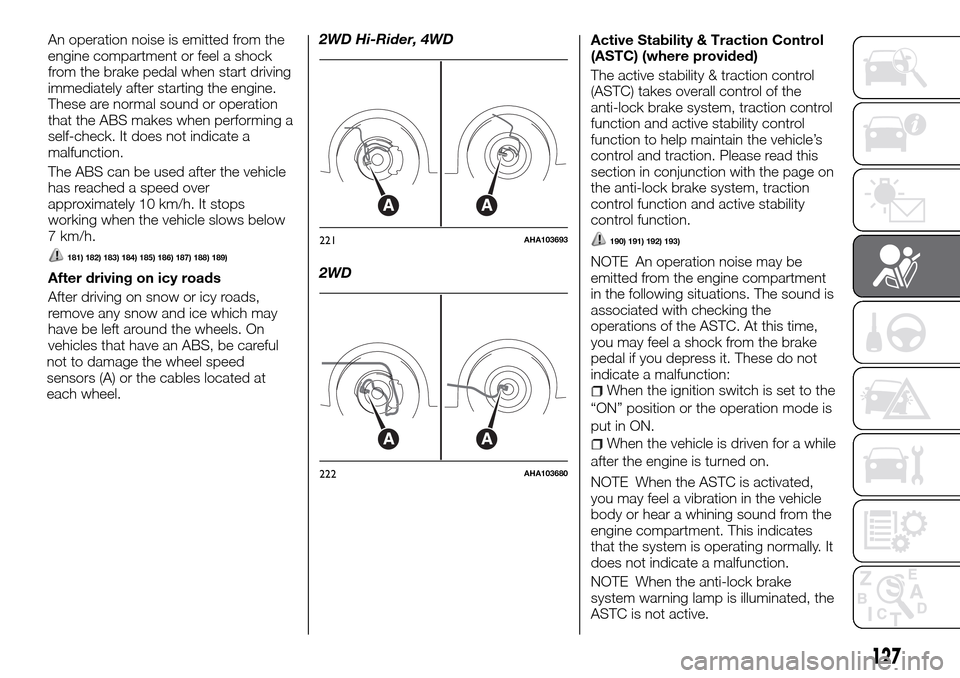
vehicles that have an ABS, be careful
not to damage the wheel speed
sensors (A) or the cables located at
each wheel.2WD Hi-Rider, 4WD
2WDActive Stability & Traction Control
(ASTC) (where provided)
The active stability & traction control
(ASTC) takes overall control of the
anti-lock brake system, traction control
function and active stability control
function to help maintain the vehicle’s
control and traction. Please read this
section in conjunction with the page on
the anti-lock brake system, traction
control function and active stability
control function.
190) 191) 192) 193)
NOTE An operation noise may be
emitted from the engine compartment
in the following situations. The sound is
associated with checking the
operations of the ASTC. At this time,
you may feel a shock from the brake
pedal if you depress it. These do not
indicate a malfunction:
When the ignition switch is set to the
“ON” position or the operation mode is
put in ON.
When the vehicle is driven for a while
after the engine is turned on.
NOTE When the ASTC is activated,
you may feel a vibration in the vehicle
body or hear a whining sound from the
engine compartment. This indicates
that the system is operating normally. It
does not indicate a malfunction.
NOTE When the anti-lock brake
system warning lamp is illuminated, the
ASTC is not active.
AA
221AHA103693
AA
222AHA103680
127
Page 130 of 312
NOTE On vehicles with the rear
differential lock, the ASTC and ABS
functions are suspended while the rear
differential lock is activated. ASTC
indicator lamp, ASTC OFF indicator
lamp and ABS warning lamp are
illuminated while these functions are
suspended. It does not indicate a
problem. When the rear differential lock
is disengaged, these lamps go out and
function again. Refer to “ABS warning
lamp” and “ASTC indicator lamp, ASTC
OFF indicator lamp”.
Active Stability Control function
The active stability control function is
designed to help the driver maintain
control of the vehicle on slippery roads
or during rapid steering maneuvers. It
works by controlling the engine output
and the brake on each wheel.
NOTE The active stability control
function does not operate when the
drive mode-selector is in the “4L”
position (Easy select 4WD), “4LLc”
position (Super select 4WD II). When
the active stability control function is
operating with the drive mode-selector
in the “2H” or “4H” position (Easy select
4WD), “2H”, “4H” or “4HLc” position
(Super select 4WD II), setting the drive
mode-selector to the “4L” (Easy select
4WD), “4LLc” position (Super select
4WD II) position makes the active
stability control function deactivate
automatically.
NOTE The active stability controlfunction operates at speeds of about
15 km/h or higher.
NOTE On vehicles with the rear
differential lock, the active stability
control function does not operate when
the rear differential lock is activated.
“ASC OFF” switch
The active stability control function is
automatically activated when the
ignition switch is turned to the “ON”
position or the operation mode is put in
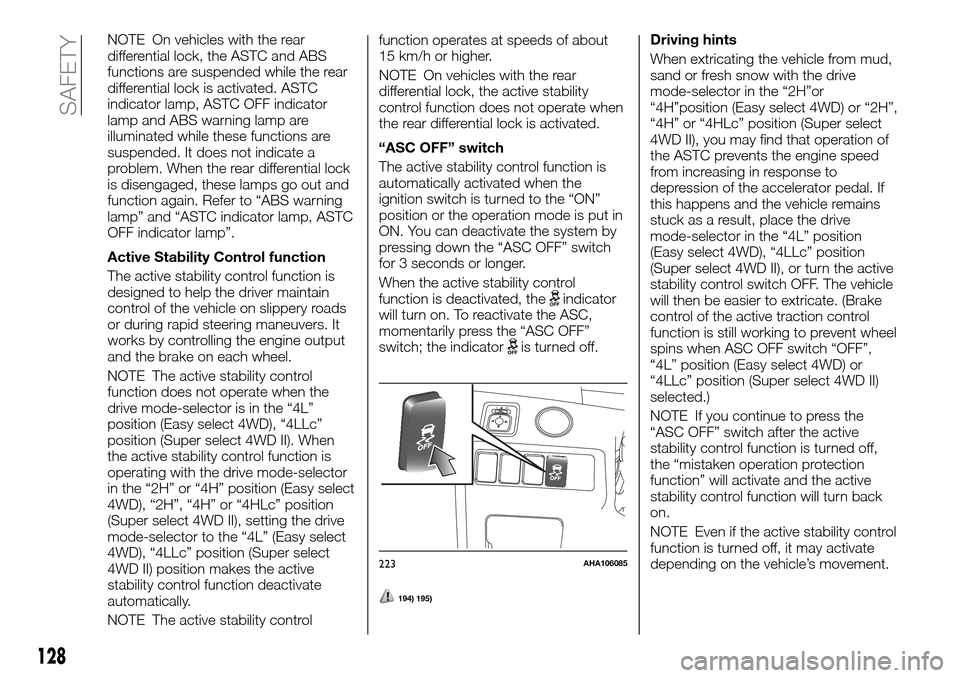
ON. You can deactivate the system by
pressing down the “ASC OFF” switch
for 3 seconds or longer.
When the active stability control
function is deactivated, the
indicator
will turn on. To reactivate the ASC,
momentarily press the “ASC OFF”
switch; the indicator
is turned off.
194) 195)
Driving hints
When extricating the vehicle from mud,
sand or fresh snow with the drive
mode-selector in the “2H”or
“4H”position (Easy select 4WD) or “2H”,
“4H” or “4HLc” position (Super select
4WD II), you may find that operation of
the ASTC prevents the engine speed
from increasing in response to
depression of the accelerator pedal. If
this happens and the vehicle remains
stuck as a result, place the drive
mode-selector in the “4L” position
(Easy select 4WD), “4LLc” position
(Super select 4WD II), or turn the active
stability control switch OFF. The vehicle
will then be easier to extricate. (Brake
control of the active traction control
function is still working to prevent wheel
spins when ASC OFF switch “OFF”,
“4L” position (Easy select 4WD) or
“4LLc” position (Super select 4WD II)
selected.)
NOTE If you continue to press the
“ASC OFF” switch after the active
stability control function is turned off,
the “mistaken operation protection
function” will activate and the active
stability control function will turn back
on.
NOTE Even if the active stability control
function is turned off, it may activate
depending on the vehicle’s movement.
LR
223AHA106085
128
SAFETY
Page 131 of 312
Active Traction Control function
On slippery surfaces, the active traction
control function prevents the drive
wheels from spinning excessive, thus
helping the vehicle to start moving from
a stopped condition. It also provides
sufficient driving force and steering
performance as the vehicle turns while
pressing the acceleration pedal.
196)
WARNING
180)The brake assist system is not a
device designed to exercise braking force
greater than its capacity. Make sure to
always keep a sufficient distance between
vehicles in front of you without relying too
much on the brake assist system.
181)The ABS cannot prevent accidents. It
is your responsibility to take safety
precautions and to drive carefully.
182)To prevent failure of the ABS, be sure
all 4 wheels and tyres are the same size
and the same type.
183)Do not install any aftermarket limited
slip differential (LSD) on your vehicle. The
ABS may stop functioning properly.
184)The ABS exploits the grip available to
the full, but it cannot improve it. Therefore,
you should take great care when driving on
slippery surfaces, without taking
unnecessary risks.185)When the ABS intervenes and you
notice the brake pedal pulsating, keep the
pedal pushed down and don’t be alarmed.
This will help you to stop in the shortest
distance possible, depending on the road
conditions.
186)If the ABS intervenes, it means you
have almost reached the grip limit between
the tyres and the road surface: slow down
to make sure that you drive in accordance
with the available grip.
187)The ABS cannot overrule the natural
laws of physics, and can’t increase the grip
available according to the condition of the
road.
188)The ABS cannot prevent accidents,
including those due to excessive speed on
corners, driving on low-grip surfaces or
aquaplaning.
189)The capability of the ABS must never
be tested irresponsibly and dangerously, in
such a way as to compromise personal
safety and the safety of others.
190)Do not over-rely on the ASTC. Even
the ASTC cannot prevent the natural laws
of physics from acting on the vehicle. This
system, like any other system, has limits
and cannot help you to maintain traction
and control of the vehicle in all
circumstances. Reckless driving can lead
to accidents. It is the driver’s responsibility
to drive carefully. This means into account
the traffic, road and environmental
conditions.
191)The ASTC system cannot prevent
accidents, including those due to excessive
speed on corners, driving on low-grip
surfaces or aquaplaning.192)Be sure to use the same specified
type and size of tyre on all 4 wheels.
Otherwise, the ASTC may not work
correctly.
193)Do not install any aftermarket limited
slip differential (LSD) on your vehicle. The
active stability control function may stop
functioning properly.
194)For safety reasons, the “ASC OFF”
switch should only be operated when the
vehicle is stopped.
195)Be sure to keep the active stability
control function on while driving in normal
circumstances.
196)When driving a vehicle on a snowy or
icy road, be sure to install snow tyres and
drive the vehicle at moderate speeds.
129
Page 132 of 312
AUXILIARY DRIVING
SYSTEMS
Hill Start Assist (where provided)
The hill start assist makes it easy to
start off on a steep uphill slope by
preventing the vehicle from moving
backwards. It keeps the braking force
for about 2 seconds when you move
your foot from the brake pedal to the
accelerator pedal.
69) 70)
197) 198)
To operate
1. Stop the vehicle completely using the
brake pedal.
2. On vehicles equipped with M/T,
place the gearshift lever into the 1st
position. On vehicles equipped with
A/T, place the selector lever into the “D”
position.
NOTE When reversing on an uphill
slope, place the selector lever or
gearshift lever into the “R” position.
3. Release the brake pedal and the hill
start assist will maintain the braking
force applied while stopping for
approximately 2 seconds.
4. Depress the accelerator pedal and
the hill start assist gradually will
decrease the braking force as the
vehicle starts moving.NOTE The hill start assist is activated
when all of the following conditions are
met.
The engine is running (the hill start
assist will not be activated while the
engine is starting or immediately after
the engine is started).
On vehicles equipped with M/T, the
gearshift lever is in the following
position: When starting an uphill slope
forwards > The gearshift lever is in any
position other than “R” (the hill start
assist will operate, even if the gearshift
lever is in the “N” position). When
starting an uphill slope backwards >
The gearshift lever is in the “R” position
(the hill start assist will not operate
when the gearshift lever is in the “N”
position).
On vehicles equipped with A/T, the
selector lever is in any position other
than “P” or “N”.
The vehicle is completely stationary,
with the brake pedal depressed.
The parking brake is released.
NOTE The hill start assist will not
operate if the accelerator pedal is
depressed before the brake pedal is
released.
NOTE The hill start assist also operates
when reversing on an uphill slope.NOTE When the hill start assist is
activated, you may feel the operating
sound. This is a normal result of the hill
start assist operation, and does not
indicate a problem.
Warning indicator
If an abnormal condition occurs in the
system, the indicator lamp will turn on.
ASC indicator
71) 72)
Power Steering System
The power steering system operates
while the engine is running. It helps
reduce the effort needed to turn the
steering wheel.
The power steering system has
mechanical steering capability in case
the power assist is lost. If the power
assist is lost for some reason, you will
still be able to steer your vehicle, but
you will notice it takes much more effort
to steer. If this happens, have your
vehicle inspected at a Fiat Dealership.
73) 74)
WARNING
197)When facing uphill, do not rely on
using the hill start assist to maintain a
stopped position as an alternative to
depressing the brake pedal. Doing so
could cause an accident.
130
SAFETY
Page 133 of 312
198)Do not turn the ignition switch to the
“LOCK” or “ACC” position or the operation
mode in ACC or OFF while the hill start
assist is operating. The hill start assist
could stop operating, which could result in
an accident.
IMPORTANT
69)Do not over-rely on the hill start assist
to prevent backwards movement of the
vehicle. Under certain circumstances, even
when hill start assist is activated, the
vehicle may move backwards if the brake
pedal is not sufficiently depressed, if the
vehicle is heavily loaded, if the road is very
steep or slippery or if the vehicle tows a
trailer, etc.
70)The hill start assist is not designed to
keep the vehicle stopped in place on uphill
slopes for more than 2 seconds.
71)If the warning is turn on, the hill start
assist will not operate. Start off carefully.
72)Park your vehicle in a safe place and
stop the engine. Restart the engine and
check whether the warning indicator went
out, in which case the hill start assist is
again working normally. If they warning
remains displayed or reappear frequently, it
is not necessary to stop the vehicle
immediately, but the vehicle should be
inspected by a Fiat Dealership.
73)Do not stop the engine while the
vehicle is moving. Stopping the engine
would make the steering wheel extremely
hard to turn, possibly resulting in an
accident.74)Do not leave the steering wheel turned
all the way in one direction. This can cause
damage to the power steering system.
131