warning FIAT FULLBACK 2016 1.G Manual Online
[x] Cancel search | Manufacturer: FIAT, Model Year: 2016, Model line: FULLBACK, Model: FIAT FULLBACK 2016 1.GPages: 312, PDF Size: 13.67 MB
Page 212 of 312
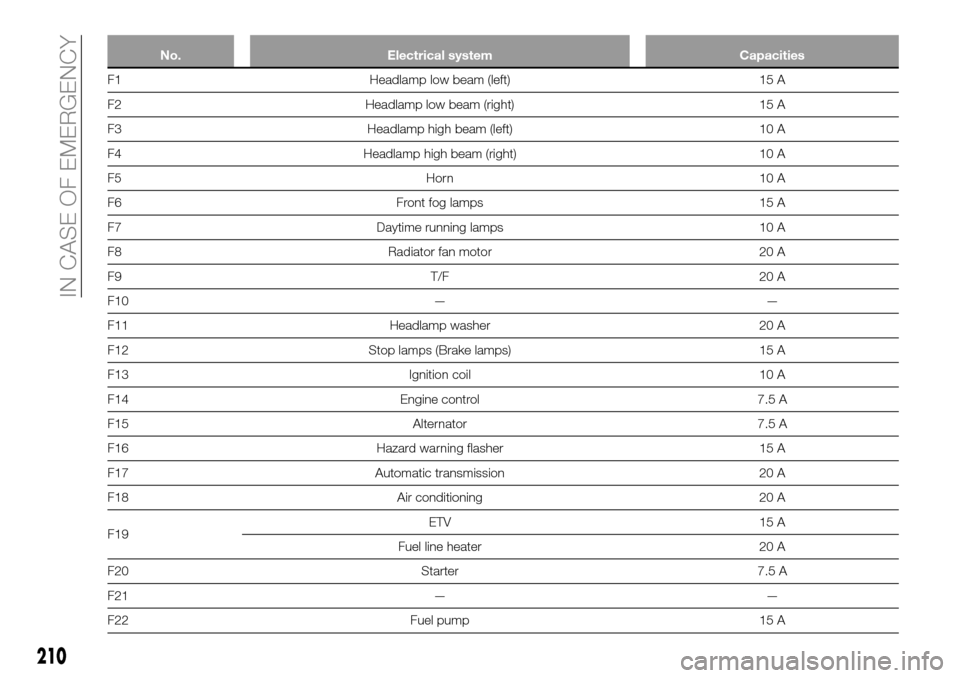
No. Electrical system Capacities
F1 Headlamp low beam (left) 15 A
F2 Headlamp low beam (right) 15 A
F3 Headlamp high beam (left) 10 A
F4 Headlamp high beam (right) 10 A
F5 Horn 10 A
F6 Front fog lamps 15 A
F7 Daytime running lamps 10 A
F8 Radiator fan motor 20 A
F9 T/F 20 A
F10 — —
F11 Headlamp washer 20 A
F12 Stop lamps (Brake lamps) 15 A
F13 Ignition coil 10 A
F14 Engine control 7.5 A
F15 Alternator 7.5 A
F16 Hazard warning flasher 15 A
F17 Automatic transmission 20 A
F18 Air conditioning 20 A
F19ETV 15 A
Fuel line heater 20 A
F20 Starter 7.5 A
F21 — —
F22 Fuel pump 15 A
210
IN CASE OF EMERGENCY
Page 214 of 312
Fuse replacement
294) 295) 296) 297) 298)
147)
1. Before replacing a fuse, always turn
off the electrical circuit concerned and
place the ignition switch in the “LOCK”
position or put the operation mode in
OFF.
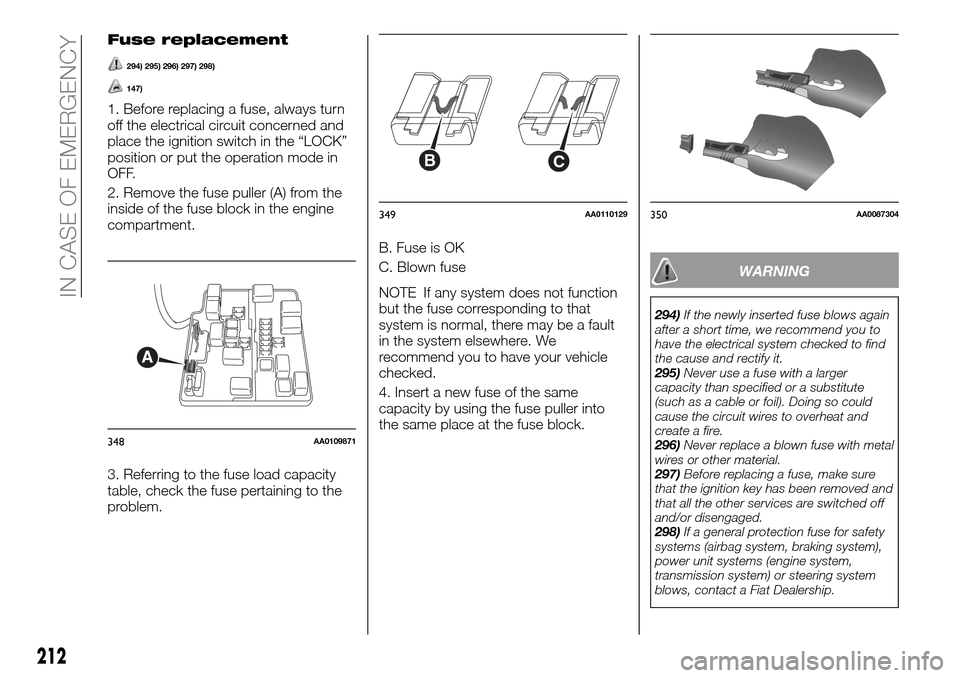
2. Remove the fuse puller (A) from the
inside of the fuse block in the engine
compartment.
3. Referring to the fuse load capacity
table, check the fuse pertaining to the
problem.B. Fuse is OK
C. Blown fuse
NOTE If any system does not function
but the fuse corresponding to that
system is normal, there may be a fault
in the system elsewhere. We
recommend you to have your vehicle
checked.
4. Insert a new fuse of the same
capacity by using the fuse puller into
the same place at the fuse block.
WARNING
294)If the newly inserted fuse blows again
after a short time, we recommend you to
have the electrical system checked to find
the cause and rectify it.
295)Never use a fuse with a larger
capacity than specified or a substitute
(such as a cable or foil). Doing so could
cause the circuit wires to overheat and
create a fire.
296)Never replace a blown fuse with metal
wires or other material.
297)Before replacing a fuse, make sure
that the ignition key has been removed and
that all the other services are switched off
and/or disengaged.
298)If a general protection fuse for safety
systems (airbag system, braking system),
power unit systems (engine system,
transmission system) or steering system
blows, contact a Fiat Dealership.
A
348AA0109871
BC
349AA0110129350AA0087304
212
IN CASE OF EMERGENCY
Page 224 of 312
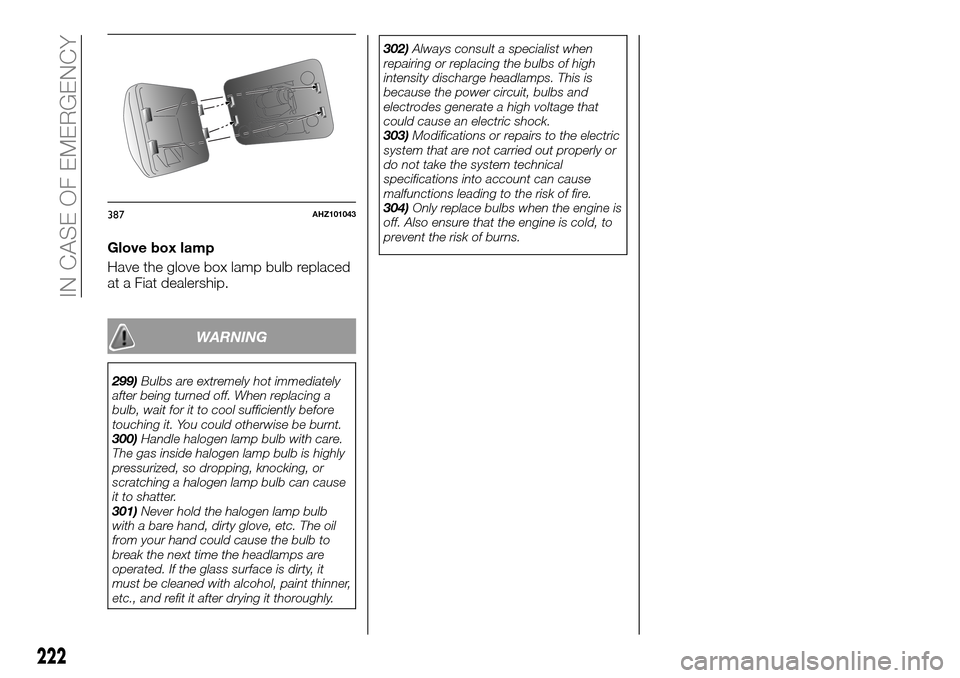
Glove box lamp
Have the glove box lamp bulb replaced
at a Fiat dealership.
WARNING
299)Bulbs are extremely hot immediately
after being turned off. When replacing a
bulb, wait for it to cool sufficiently before
touching it. You could otherwise be burnt.
300)Handle halogen lamp bulb with care.
The gas inside halogen lamp bulb is highly
pressurized, so dropping, knocking, or
scratching a halogen lamp bulb can cause
it to shatter.
301)Never hold the halogen lamp bulb
with a bare hand, dirty glove, etc. The oil
from your hand could cause the bulb to
break the next time the headlamps are
operated. If the glass surface is dirty, it
must be cleaned with alcohol, paint thinner,
etc., and refit it after drying it thoroughly.302)Always consult a specialist when
repairing or replacing the bulbs of high
intensity discharge headlamps. This is
because the power circuit, bulbs and
electrodes generate a high voltage that
could cause an electric shock.
303)Modifications or repairs to the electric
system that are not carried out properly or
do not take the system technical
specifications into account can cause
malfunctions leading to the risk of fire.
304)Only replace bulbs when the engine is
off. Also ensure that the engine is cold, to
prevent the risk of burns.
387AHZ101043
222
IN CASE OF EMERGENCY
Page 226 of 312
SERVICE
PRECAUTIONS
305) 306) 307) 308) 309) 310) 311)
Adequate care of your vehicle at regular
intervals serves to preserve the value
and appearance as long as possible.
Maintenance items as described in this
owner’s manual can be performed by
the owner.
We recommend you to have the
periodic inspection and maintenance
performed by a Fiat dealership or
another specialist.
In the event a malfunction or a problem
is discovered, we recommend you to
have it checked and repaired. This
section contains information on
inspection maintenance procedures
that you can do yourself. Follow the
instructions and cautions for each of
the various procedures.
WARNING
305)When checking or servicing the inside
of the engine compartment, make sure the
engine is switched off and has had a
chance to cool down.
306)If it is necessary to do work in the
engine compartment with the engine
running, be especially careful that your
clothing, hair, etc., does not become
caught by the cooling fan, drive belts, or
other moving parts.307)The cooling fan can turn on
automatically even if the engine is not
running. Turn the ignition switch to “LOCK”
position or put the operation mode in OFF
to be safe while you work in the engine
compartment.
308)Do not smoke, cause sparks or allow
open flames around fuel or battery. The
fumes are flammable.
309)Be extremely cautious when working
around the battery. It contains poisonous
and corrosive sulphuric acid.
310)Do not get under your vehicle with
just the body jack supporting it. Always use
automotive jack stands.
311)Improper handling of components
and materials used in the vehicle can
endanger your personal safety. We
recommend you to consult a specialist for
necessary information.
224
SERVICING AND MAINTENANCE
Page 227 of 312
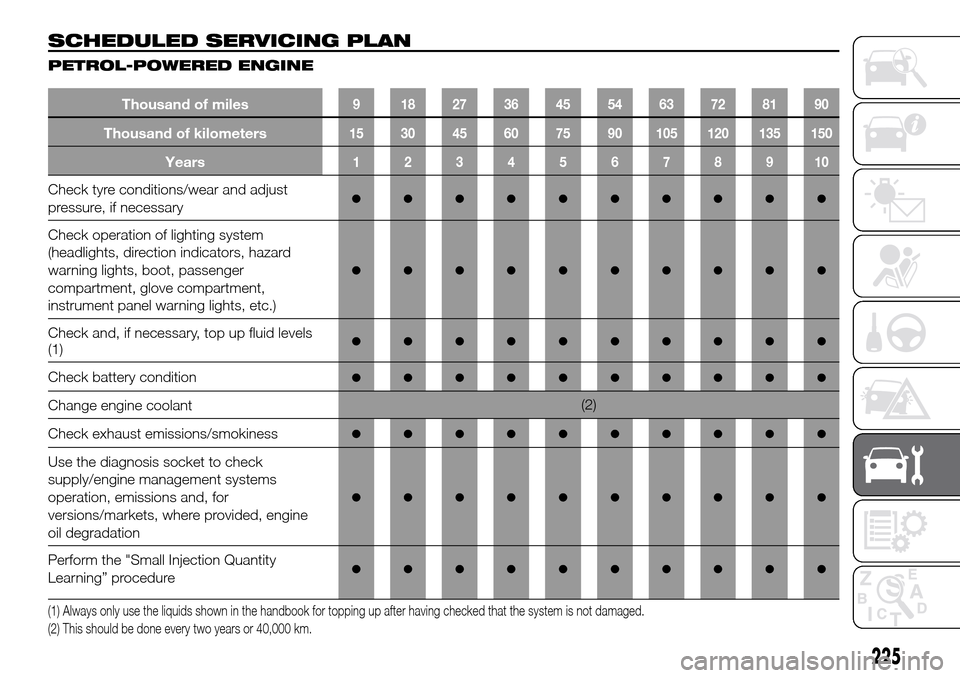
SCHEDULED SERVICING PLAN
PETROL-POWERED ENGINE
Thousand of miles9 182736455463728190
Thousand of kilometers15 30 45 60 75 90 105 120 135 150
Years12345678910
Check tyre conditions/wear and adjust
pressure, if necessary●●●●●●●●●●
Check operation of lighting system
(headlights, direction indicators, hazard
warning lights, boot, passenger
compartment, glove compartment,
instrument panel warning lights, etc.)
●●●●●●●●●●
Check and, if necessary, top up fluid levels
(1)●●●●●●●●●●
Check battery condition●●●●●●●●●●
Change engine coolant(2)
Check exhaust emissions/smokiness
●●●●●●●●●●
Use the diagnosis socket to check
supply/engine management systems
operation, emissions and, for
versions/markets, where provided, engine
oil degradation
●●●●●●●●●●
Perform the "Small Injection Quantity
Learning” procedure●●●●●●●●●●
(1) Always only use the liquids shown in the handbook for topping up after having checked that the system is not damaged.
(2) This should be done every two years or 40,000 km.
225
Page 232 of 312
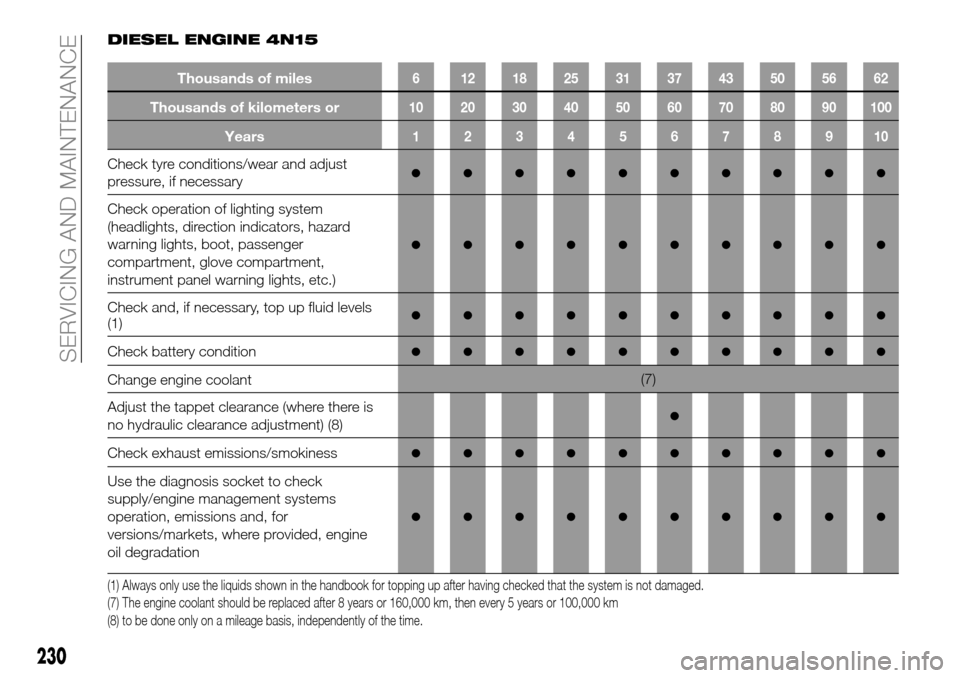
DIESEL ENGINE 4N15
Thousands of miles6 121825313743505662
Thousands of kilometers or10 20 30 40 50 60 70 80 90 100
Years12345678910
Check tyre conditions/wear and adjust
pressure, if necessary●●●●●●●●●●
Check operation of lighting system
(headlights, direction indicators, hazard
warning lights, boot, passenger
compartment, glove compartment,
instrument panel warning lights, etc.)
●●●●●●●●●●
Check and, if necessary, top up fluid levels
(1)●●●●●●●●●●
Check battery condition●●●●●●●●●●
Change engine coolant(7)
Adjust the tappet clearance (where there is
no hydraulic clearance adjustment) (8)
●
Check exhaust emissions/smokiness●●●●●●●●●●
Use the diagnosis socket to check
supply/engine management systems
operation, emissions and, for
versions/markets, where provided, engine
oil degradation
●●●●●●●●●●
(1) Always only use the liquids shown in the handbook for topping up after having checked that the system is not damaged.
(7) The engine coolant should be replaced after 8 years or 160,000 km, then every 5 years or 100,000 km
(8) to be done only on a mileage basis, independently of the time.
230
SERVICING AND MAINTENANCE
Page 237 of 312
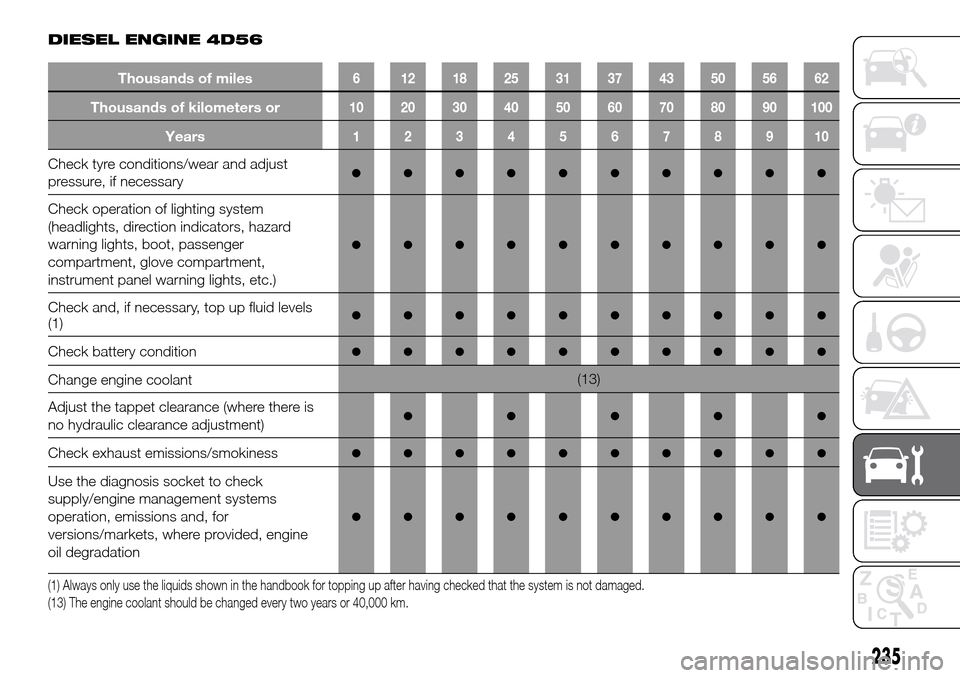
DIESEL ENGINE 4D56
Thousands of miles6 121825313743505662
Thousands of kilometers or10 20 30 40 50 60 70 80 90 100
Years12345678910
Check tyre conditions/wear and adjust
pressure, if necessary●●●●●●●●●●
Check operation of lighting system
(headlights, direction indicators, hazard
warning lights, boot, passenger
compartment, glove compartment,
instrument panel warning lights, etc.)
●●●●●●●●●●
Check and, if necessary, top up fluid levels
(1)●●●●●●●●●●
Check battery condition●●●●●●●●●●
Change engine coolant(13)
Adjust the tappet clearance (where there is
no hydraulic clearance adjustment)
●●●●●
Check exhaust emissions/smokiness●●●●●●●●●●
Use the diagnosis socket to check
supply/engine management systems
operation, emissions and, for
versions/markets, where provided, engine
oil degradation
●●●●●●●●●●
(1) Always only use the liquids shown in the handbook for topping up after having checked that the system is not damaged.
(13) The engine coolant should be changed every two years or 40,000 km.
235
Page 242 of 312
PERIODIC CHECKS
Before long journeys, check and, if
necessary, restore:
engine coolant level;
brake fluid level;
windscreen washer fluid level;
operation of lighting system
(headlamps, direction indicators, hazard
warning lights, etc.);
tyre inflation pressure and condition;
tyre alignment;
operation of screen washer/wiper
system and positioning/wear of
windscreen/rear window wiper blades.
To ensure that the vehicle is always
efficient and well maintained, it is
advisable to make sure that you carry
out the above operations regularly
(approximately every 1000 km and
every 3000 km for checking and
topping up engine oil is advisable).
DEMANDING
VEHICLE USE
If the vehicle is mostly used in one of
the following conditions:
towing a trailer or caravan;
dusty roads;
short, repeated journeys (less than
7-8 km) at sub-zero outside
temperatures;
engine often idling or driving long
distances at low speeds or long periods
of inactivity;
the following checks must be carried
out more often than indicated in the
Scheduled Servicing Plan:
check front disc brake pad
conditions and wear;
check cleanliness of bonnet and
boot locks, cleanliness and lubrication
of linkage;
visually inspect conditions of: engine,
gearbox, transmission, pipes and hoses
(exhaust - fuel system - brakes) and
rubber elements (boots - sleeves -
bushes - etc.);
check battery charge and battery
fluid level (electrolyte);
visually inspect condition of the
accessory drive belts;
check and, if necessary, change
engine oil and replace oil filter;
check and, if necessary, replace
pollen filter.
240
SERVICING AND MAINTENANCE
Page 246 of 312
WARNING
312)Never smoke when performing operations in the engine compartment. Flammable gases and fumes may be present and risk igniting.
313)Be very careful when working in the engine compartment when the engine is hot: you may get burned. Remember that the fan may start
up if the engine is hot: this could injure you. Scarves, ties and other loose clothing might be pulled by moving parts.
244
SERVICING AND MAINTENANCE
Page 247 of 312
CATALYTIC
CONVERTER
314)
The exhaust gas scavenging devices
used with catalytic converter are
extremely efficient for the reduction of
noxious gases. The catalytic converter
is installed in the exhaust system.
It is important to keep the engine
properly tuned to ensure proper catalyst
operation and prevent possible catalyst
damage.
NOTE Use fuel of the type
recommended in “Fuel selection”.
WARNING
314)As with any vehicle, do not park or
operate this vehicle in areas where
combustible materials such as dry grass or
leaves can come in contact with a hot
exhaust since a fire could occur.
ENGINE OIL
315)
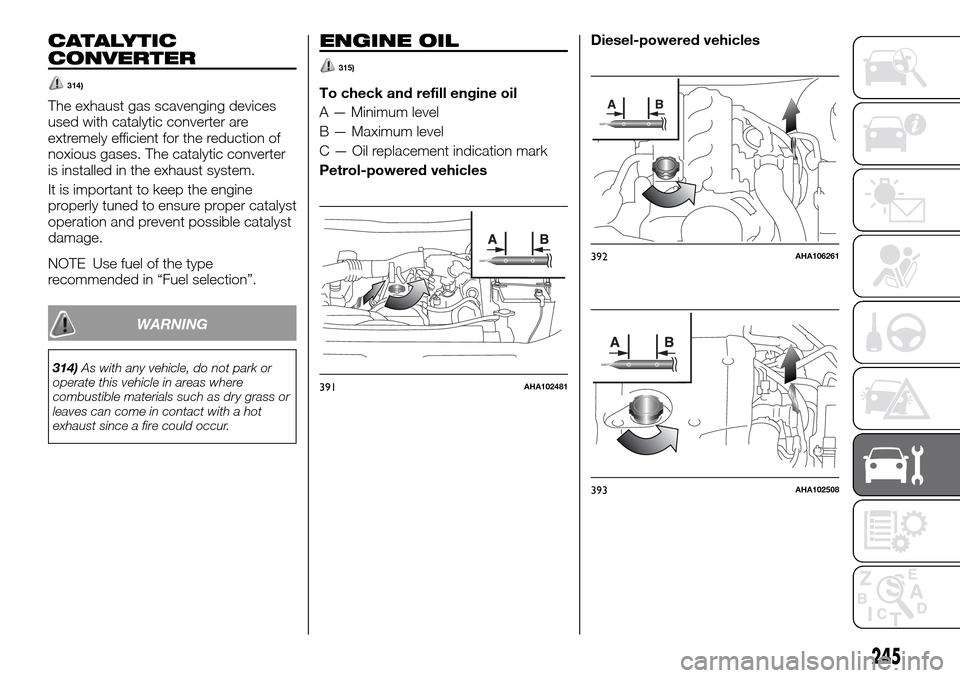
To check and refill engine oil
A — Minimum level
B — Maximum level
C — Oil replacement indication mark
Petrol-powered vehiclesDiesel-powered vehicles
391AHA102481
392AHA106261
393AHA102508
245