warning FIAT FULLBACK 2016 1.G Workshop Manual
[x] Cancel search | Manufacturer: FIAT, Model Year: 2016, Model line: FULLBACK, Model: FIAT FULLBACK 2016 1.GPages: 312, PDF Size: 13.67 MB
Page 136 of 312
DRIVING, ALCOHOL
AND DRUGS
Drunk driving is one of the most
frequent causes of accidents.
Your driving ability can be seriously
impaired even with blood alcohol levels
far below the legal minimum. If you
have been drinking, don’t drive. Ride
with a designated non-drinking driver,
call a cab or a friend, or use public
transportation. Drinking coffee or taking
a cold shower will not make you sober.
Similarly, prescription and
non-prescription drugs affect your
alertness, perception and reaction time.
Consult with your doctor or pharmacist
before driving while under the influence
of any of these medications.
199)
WARNING
199)NEVER DRINK AND DRIVE. Your
perceptions are less accurate, your reflexes
are slower and your judgment is impaired.
SAFE DRIVING
TECHNIQUES
Driving safety and protection against
injury cannot be fully ensured. However,
we recommend that you pay extra
attention to the following:
Seat belts
Before starting the vehicle, make sure
that you and your passengers have
fastened your seat belts.
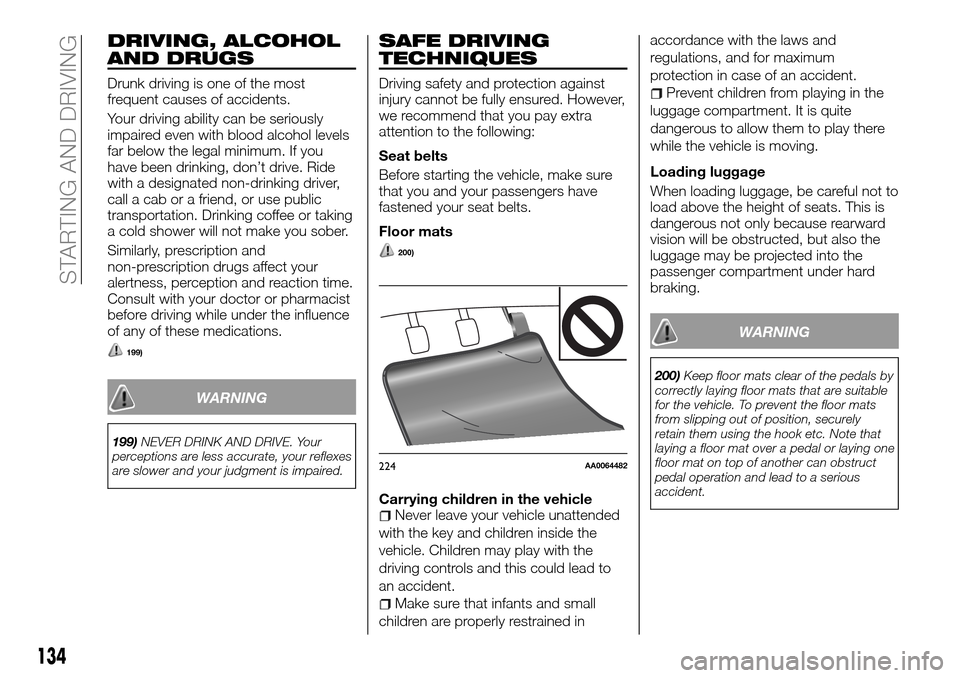
Floor mats
200)
Carrying children in the vehicleNever leave your vehicle unattended
with the key and children inside the
vehicle. Children may play with the
driving controls and this could lead to
an accident.
Make sure that infants and small
children are properly restrained inaccordance with the laws and
regulations, and for maximum
protection in case of an accident.
Prevent children from playing in the
luggage compartment. It is quite
dangerous to allow them to play there
while the vehicle is moving.
Loading luggage
When loading luggage, be careful not to
load above the height of seats. This is
dangerous not only because rearward
vision will be obstructed, but also the
luggage may be projected into the
passenger compartment under hard
braking.
WARNING
200)Keep floor mats clear of the pedals by
correctly laying floor mats that are suitable
for the vehicle. To prevent the floor mats
from slipping out of position, securely
retain them using the hook etc. Note that
laying a floor mat over a pedal or laying one
floor mat on top of another can obstruct
pedal operation and lead to a serious
accident.
224AA0064482
134
STARTING AND DRIVING
Page 141 of 312
PARKING BRAKE
To park the vehicle, first bring it to a
complete stop, fully apply the parking
brake sufficiently to hold the vehicle.
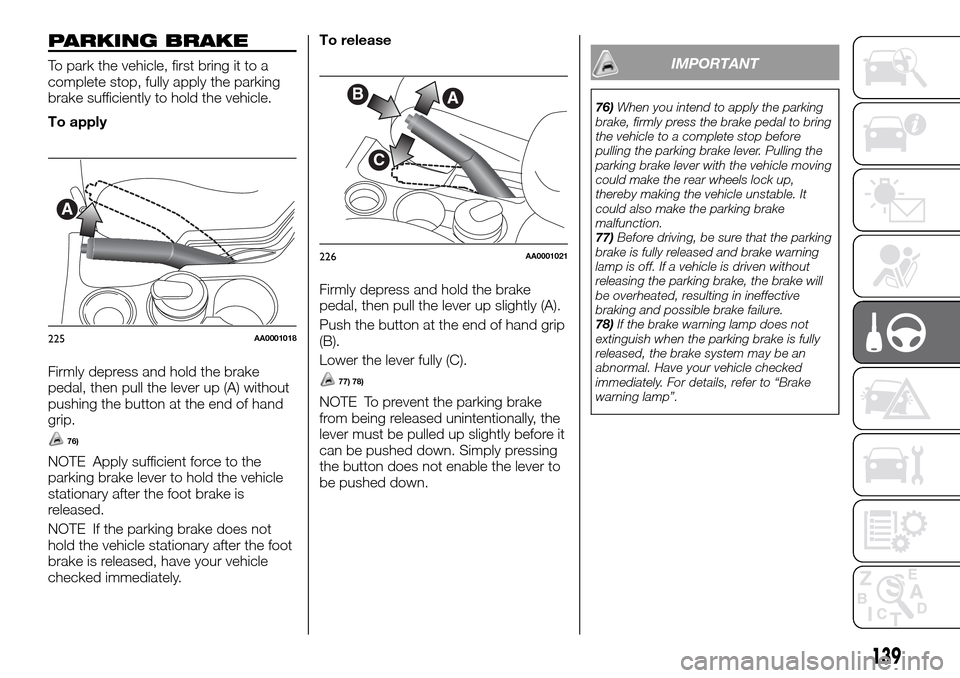
To apply
Firmly depress and hold the brake
pedal, then pull the lever up (A) without
pushing the button at the end of hand
grip.
76)
NOTE Apply sufficient force to the
parking brake lever to hold the vehicle
stationary after the foot brake is
released.
NOTE If the parking brake does not
hold the vehicle stationary after the foot
brake is released, have your vehicle
checked immediately.To release
Firmly depress and hold the brake
pedal, then pull the lever up slightly (A).
Push the button at the end of hand grip
(B).
Lower the lever fully (C).
77) 78)
NOTE To prevent the parking brake
from being released unintentionally, the
lever must be pulled up slightly before it
can be pushed down. Simply pressing
the button does not enable the lever to
be pushed down.
IMPORTANT
76)When you intend to apply the parking
brake, firmly press the brake pedal to bring
the vehicle to a complete stop before
pulling the parking brake lever. Pulling the
parking brake lever with the vehicle moving
could make the rear wheels lock up,
thereby making the vehicle unstable. It
could also make the parking brake
malfunction.
77)Before driving, be sure that the parking
brake is fully released and brake warning
lamp is off. If a vehicle is driven without
releasing the parking brake, the brake will
be overheated, resulting in ineffective
braking and possible brake failure.
78)If the brake warning lamp does not
extinguish when the parking brake is fully
released, the brake system may be an
abnormal. Have your vehicle checked
immediately. For details, refer to “Brake
warning lamp”.
A
225AA0001018
AB
C
226AA0001021
139
Page 142 of 312
PARKING
To park the vehicle, fully engage the
parking brake, and then move the
gearshift lever to 1st or “R” (Reverse)
position for vehicles equipped with M/T,
or set the selector lever to “P” (PARK)
position for vehicles equipped with A/T.
Parking on a hill
To prevent the vehicle from rolling,
follow these procedures:
Parking on a downhill slope
Turn the front wheels towards the kerb
and move the vehicle forward until the
kerb side wheel gently touches the
kerb.
On vehicles equipped with M/T, apply
the parking brake and place the
gearshift lever into the “R” (Reverse)
position.
On vehicles equipped with A/T, apply
the parking brake and place the
selector lever into the “P” (PARK)
position. If necessary, apply chocks to
wheels.
Parking on a uphill slope
Turn the front wheels away from the
kerb and move the vehicle back until
the kerb side wheel gently touches the
kerb.
On vehicles equipped with M/T, apply
the parking brake and place the
gearshift lever into the 1st position.
On vehicles equipped with A/T, apply
the parking brake and place theselector lever into the “P” (PARK)
position. If necessary, apply chocks to
wheels.
If your vehicle is equipped with A/T, be
sure to apply the parking brake before
moving selector lever to the “P” (PARK)
position. If you move selector lever to
the “P” (PARK) position before applying
the parking brake, it may be difficult to
disengage selector lever from the “P”
(PARK) position when next you drive the
vehicle, requiring application of a strong
force the selector lever to move from
the “P” (PARK) position.
Parking with the engine running
Never leave the engine running while
you take a short sleep/rest. Also, never
leave the engine running in a closed or
poorly ventilated place.
When leaving the vehicle
Always carry the key and lock all doors
when leaving the vehicle unattended.
Always try to park your vehicle in a well
lit area.
201) 202)
WARNING
201)Leaving the engine running risks injury
or death from accidentally moving the
gearshift lever (with M/T) or the selector
lever (with A/T) or the accumulation of toxic
exhaust fumes on the passenger
compartment.202)Do not park your vehicle in areas
where combustible materials such as dry
grass or leaves can come in contact with a
hot exhaust, since a fire could occur.
140
STARTING AND DRIVING
Page 143 of 312
STARTING AND
STOPPING THE
ENGINE
Tips for starting
Except for vehicles equipped with
the keyless operation system
Do not operate the starter motor
continuously longer than 10 seconds;
doing so could run down the battery. If
the engine does not start, turn the
ignition switch back to “LOCK”, wait a
few seconds, and then try again. Trying
repeatedly with the starter motor still
turning will damage the starter
mechanism.
203)
79) 80) 81) 82) 83) 84)
For vehicles equipped with the
keyless operation system
The operation mode can be in any
mode to start the engine.
The starter motor will be turning for up
to approximately 15 seconds if the
engine switch is released at once.
Pressing the engine switch again while
the starter motor is still turning will stop
the starter motor. The starter motor will
be turning for up to approximately
30 seconds while the engine switch is
pressed. If the engine does not start,
wait for a while and then attempt to
start the engine again. Trying repeatedly
with the starter motor still turning will
damage the starter mechanism.
203)
80) 81) 82)
Starting the engine (petrol-powered
vehicles)
Except for vehicles equipped with
the keyless operation system
Your vehicles equipped with an
electronically controlled fuel injection
system. When starting the engine, do
not depress the accelerator pedal.
The starting procedure is as follows:
Insert the ignition key and fasten the
seat belt.
Make sure the parking brake is
applied.
Depress and hold the brake pedal.
Depress the clutch pedal all the way
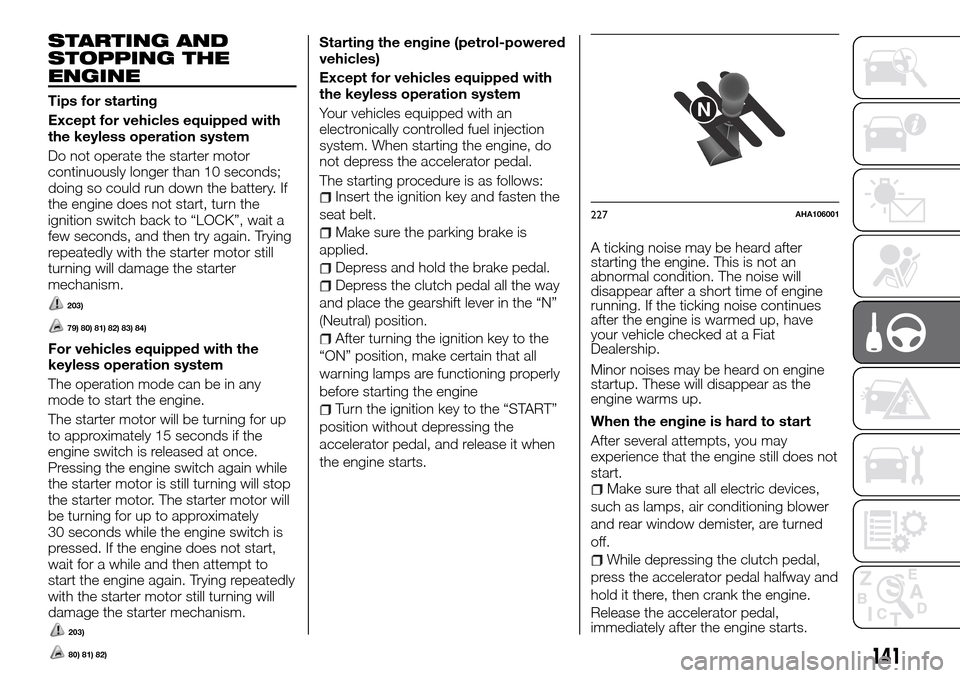
and place the gearshift lever in the “N”
(Neutral) position.
After turning the ignition key to the
“ON” position, make certain that all
warning lamps are functioning properly
before starting the engine
Turn the ignition key to the “START”
position without depressing the
accelerator pedal, and release it when
the engine starts.A ticking noise may be heard after
starting the engine. This is not an
abnormal condition. The noise will
disappear after a short time of engine
running. If the ticking noise continues
after the engine is warmed up, have
your vehicle checked at a Fiat
Dealership.
Minor noises may be heard on engine
startup. These will disappear as the
engine warms up.
When the engine is hard to start
After several attempts, you may
experience that the engine still does not
start.
Make sure that all electric devices,
such as lamps, air conditioning blower
and rear window demister, are turned
off.
While depressing the clutch pedal,
press the accelerator pedal halfway and
hold it there, then crank the engine.
Release the accelerator pedal,
N
227AHA106001
141
immediately after the engine starts.
Page 144 of 312
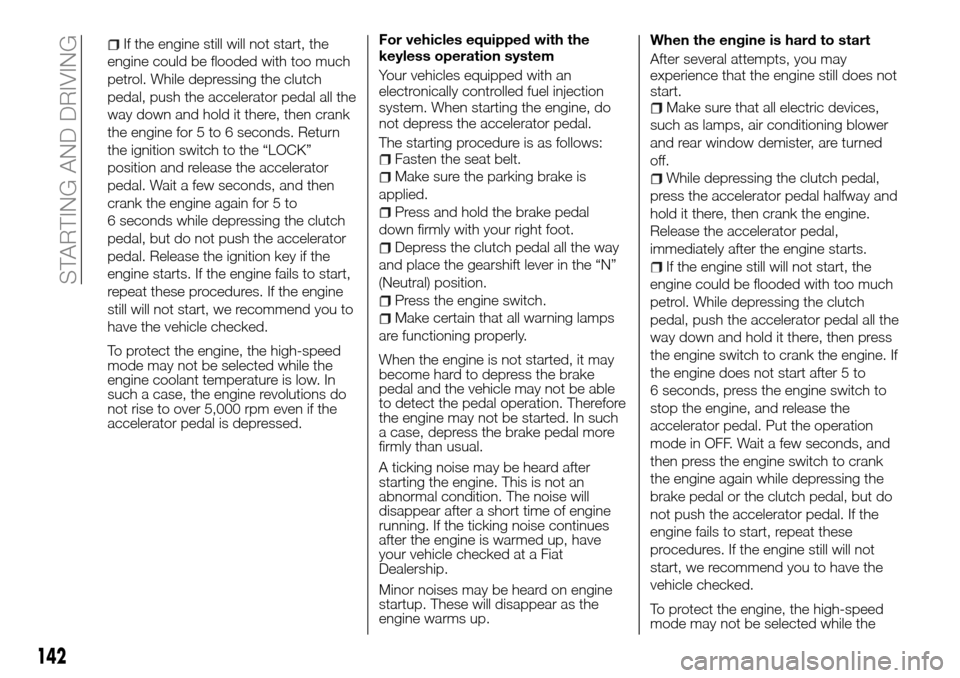
If the engine still will not start, the
engine could be flooded with too much
petrol. While depressing the clutch
pedal, push the accelerator pedal all the
way down and hold it there, then crank
the engine for 5 to 6 seconds. Return
the ignition switch to the “LOCK”
position and release the accelerator
pedal. Wait a few seconds, and then
crank the engine again for 5 to
6 seconds while depressing the clutch
pedal, but do not push the accelerator
pedal. Release the ignition key if the
engine starts. If the engine fails to start,
repeat these procedures. If the engine
still will not start, we recommend you to
have the vehicle checked.
To protect the engine, the high-speed
mode may not be selected while the
engine coolant temperature is low. In
such a case, the engine revolutions do
not rise to over 5,000 rpm even if the
accelerator pedal is depressed.For vehicles equipped with the
keyless operation system
Your vehicles equipped with an
electronically controlled fuel injection
system. When starting the engine, do
not depress the accelerator pedal.
The starting procedure is as follows:
Fasten the seat belt.
Make sure the parking brake is
applied.
Press and hold the brake pedal
down firmly with your right foot.
Depress the clutch pedal all the way
and place the gearshift lever in the “N”
(Neutral) position.
Press the engine switch.
Make certain that all warning lamps
are functioning properly.
When the engine is not started, it may
become hard to depress the brake
pedal and the vehicle may not be able
to detect the pedal operation. Therefore
the engine may not be started. In such
a case, depress the brake pedal more
firmly than usual.
A ticking noise may be heard after
starting the engine. This is not an
abnormal condition. The noise will
disappear after a short time of engine
running. If the ticking noise continues
after the engine is warmed up, have
your vehicle checked at a Fiat
Dealership.
Minor noises may be heard on engine
startup. These will disappear as the
engine warms up.When the engine is hard to start
After several attempts, you may
experience that the engine still does not
start.
Make sure that all electric devices,
such as lamps, air conditioning blower
and rear window demister, are turned
off.
While depressing the clutch pedal,
press the accelerator pedal halfway and
hold it there, then crank the engine.
Release the accelerator pedal,
immediately after the engine starts.
If the engine still will not start, the
engine could be flooded with too much
petrol. While depressing the clutch
pedal, push the accelerator pedal all the
way down and hold it there, then press
the engine switch to crank the engine. If
the engine does not start after 5 to
6 seconds, press the engine switch to
stop the engine, and release the
accelerator pedal. Put the operation
mode in OFF. Wait a few seconds, and
then press the engine switch to crank
the engine again while depressing the
brake pedal or the clutch pedal, but do
not push the accelerator pedal. If the
engine fails to start, repeat these
procedures. If the engine still will not
start, we recommend you to have the
vehicle checked.
To protect the engine, the high-speed
mode may not be selected while the
142
STARTING AND DRIVING
Page 147 of 312
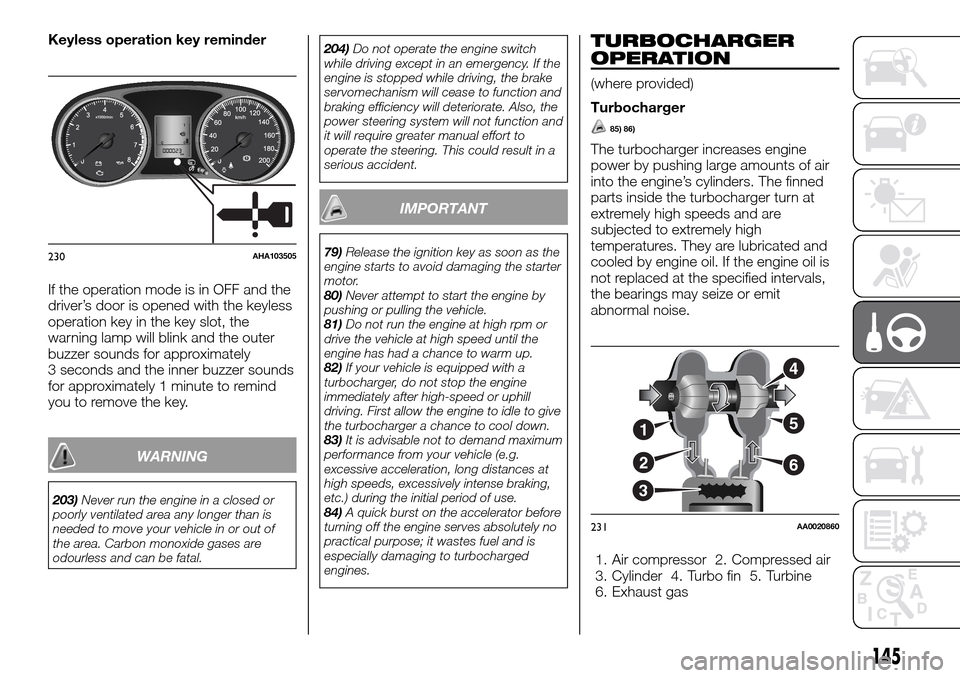
Keyless operation key reminder
If the operation mode is in OFF and the
driver’s door is opened with the keyless
operation key in the key slot, the
warning lamp will blink and the outer
buzzer sounds for approximately
3 seconds and the inner buzzer sounds
for approximately 1 minute to remind
you to remove the key.
WARNING
203)Never run the engine in a closed or
poorly ventilated area any longer than is
needed to move your vehicle in or out of
the area. Carbon monoxide gases are
odourless and can be fatal.204)Do not operate the engine switch
while driving except in an emergency. If the
engine is stopped while driving, the brake
servomechanism will cease to function and
braking efficiency will deteriorate. Also, the
power steering system will not function and
it will require greater manual effort to
operate the steering. This could result in a
serious accident.
IMPORTANT
79)Release the ignition key as soon as the
engine starts to avoid damaging the starter
motor.
80)Never attempt to start the engine by
pushing or pulling the vehicle.
81)Do not run the engine at high rpm or
drive the vehicle at high speed until the
engine has had a chance to warm up.
82)If your vehicle is equipped with a
turbocharger, do not stop the engine
immediately after high-speed or uphill
driving. First allow the engine to idle to give
the turbocharger a chance to cool down.
83)It is advisable not to demand maximum
performance from your vehicle (e.g.
excessive acceleration, long distances at
high speeds, excessively intense braking,
etc.) during the initial period of use.
84)A quick burst on the accelerator before
turning off the engine serves absolutely no
practical purpose; it wastes fuel and is
especially damaging to turbocharged
engines.
TURBOCHARGER
OPERATION
(where provided)
Turbocharger
85) 86)
The turbocharger increases engine
power by pushing large amounts of air
into the engine’s cylinders. The finned
parts inside the turbocharger turn at
extremely high speeds and are
subjected to extremely high
temperatures. They are lubricated and
cooled by engine oil. If the engine oil is
not replaced at the specified intervals,
the bearings may seize or emit
abnormal noise.
1. Air compressor 2. Compressed air
3. Cylinder 4. Turbo fin 5. Turbine
6. Exhaust gas
230AHA103505
4
5
6
1
2
3
231AA0020860
145
Page 150 of 312
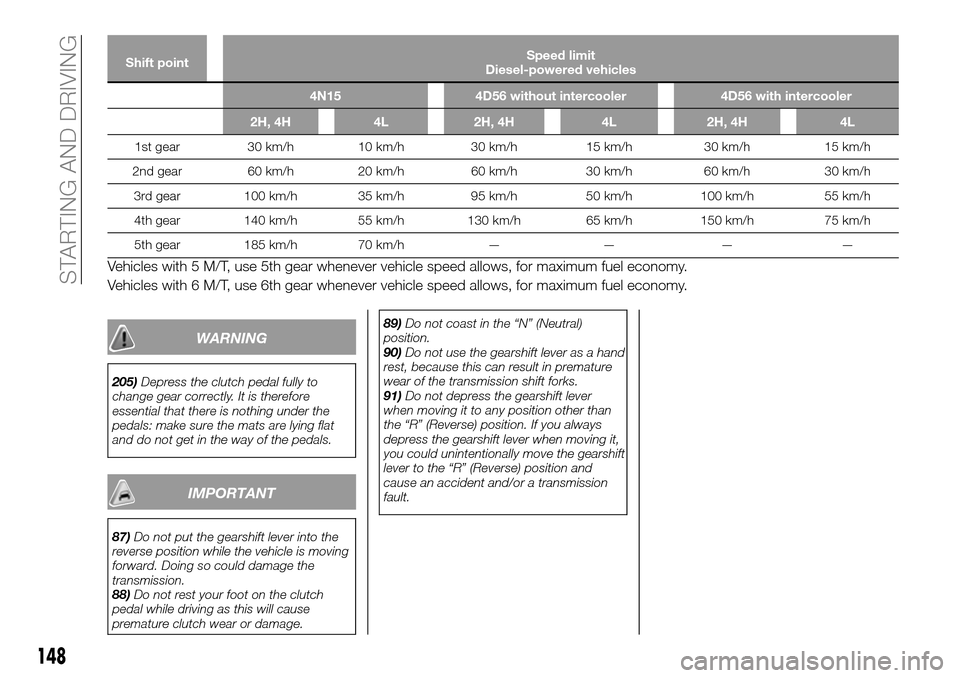
Shift pointSpeed limit
Diesel-powered vehicles
4N15 4D56 without intercooler 4D56 with intercooler
2H, 4H 4L 2H, 4H 4L 2H, 4H 4L
1st gear 30 km/h 10 km/h 30 km/h 15 km/h 30 km/h 15 km/h
2nd gear 60 km/h 20 km/h 60 km/h 30 km/h 60 km/h 30 km/h
3rd gear 100 km/h 35 km/h 95 km/h 50 km/h 100 km/h 55 km/h
4th gear 140 km/h 55 km/h 130 km/h 65 km/h 150 km/h 75 km/h
5th gear 185 km/h 70 km/h — — — —
Vehicles with 5 M/T, use 5th gear whenever vehicle speed allows, for maximum fuel economy.
Vehicles with 6 M/T, use 6th gear whenever vehicle speed allows, for maximum fuel economy.
WARNING
205)Depress the clutch pedal fully to
change gear correctly. It is therefore
essential that there is nothing under the
pedals: make sure the mats are lying flat
and do not get in the way of the pedals.
IMPORTANT
87)Do not put the gearshift lever into the
reverse position while the vehicle is moving
forward. Doing so could damage the
transmission.
88)Do not rest your foot on the clutch
pedal while driving as this will cause
premature clutch wear or damage.89)Do not coast in the “N” (Neutral)
position.
90)Do not use the gearshift lever as a hand
rest, because this can result in premature
wear of the transmission shift forks.
91)Do not depress the gearshift lever
when moving it to any position other than
the “R” (Reverse) position. If you always
depress the gearshift lever when moving it,
you could unintentionally move the gearshift
lever to the “R” (Reverse) position and
cause an accident and/or a transmission
fault.
148
STARTING AND DRIVING
Page 154 of 312
perform a downshift when the selector
lever or the shift paddles is moved to
the “— (SHIFT DOWN)” position at
certain vehicle speeds.
Downward shifts are made
automatically when the vehicle slows
down. When the vehicle stops, 1st gear
is automatically selected.
When driving away on a slippery road,
push the selector lever forward into the
“+ (SHIFT UP)” position. This cause the
transmission to shift into the 2nd gear
which is better for smooth driving away
on a slippery road. Push the selector
lever to the “— (SHIFT DOWN)” side to
shift back to the 1st gear.
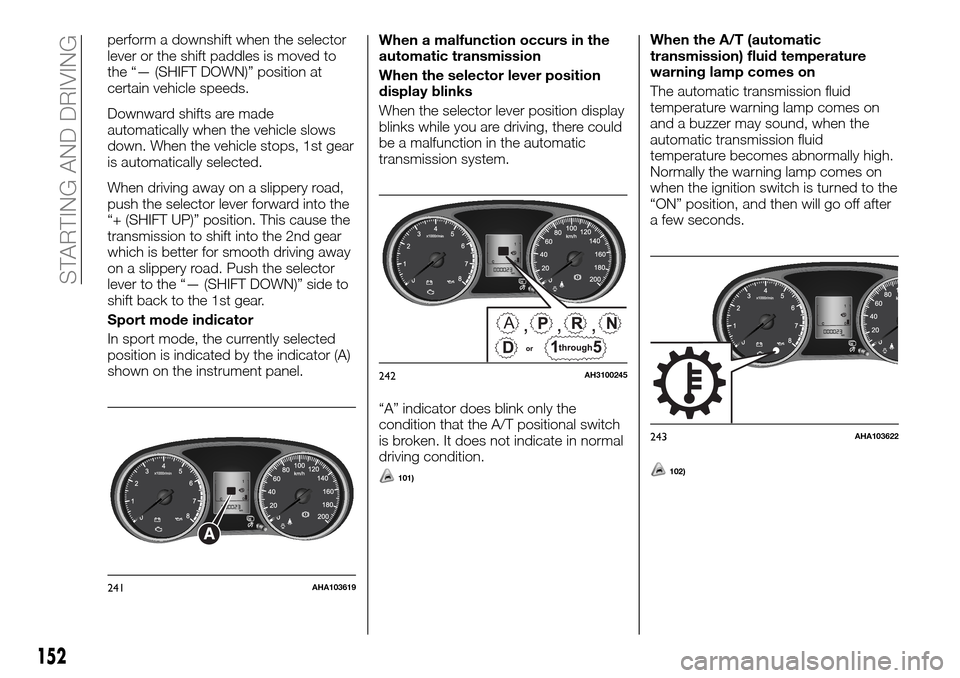
Sport mode indicator
In sport mode, the currently selected
position is indicated by the indicator (A)
shown on the instrument panel.When a malfunction occurs in the
automatic transmission
When the selector lever position
display blinks
When the selector lever position display
blinks while you are driving, there could
be a malfunction in the automatic
transmission system.
“A” indicator does blink only the
condition that the A/T positional switch
is broken. It does not indicate in normal
driving condition.
101)
When the A/T (automatic
transmission) fluid temperature
warning lamp comes on
The automatic transmission fluid
temperature warning lamp comes on
and a buzzer may sound, when the
automatic transmission fluid
temperature becomes abnormally high.
Normally the warning lamp comes on
when the ignition switch is turned to the
“ON” position, and then will go off after
a few seconds.
102)
A
241AHA103619
,,,A
242AH3100245
243AHA103622
152
STARTING AND DRIVING
Page 156 of 312
100)For vehicles equipped with the shift
paddles, do not use the left- and right-hand
shift paddles at the same time. Doing so
could cause a shift of gear ratio that you do
not expect.
101)If the selector lever position display
blinks while you are driving, it is likely that a
safety device is operating because of a
malfunction in the automatic transmission.
Have the vehicle inspected by a Fiat
Dealership as soon as possible.
102)If the lamp comes on, reduce the
engine speed and stop the vehicle in a safe
area. Then set the selector lever to “P”
(PARK) position and idle the engine until the
warning lamp goes off. When the warning
lamp goes off, resume normal driving. If the
warning lamp does not go off, we
recommend you to have your vehicle
inspected.
103)Before selecting a gear with the
engine running and the vehicle stationary,
fully depress the brake pedal to prevent the
vehicle from creeping. The vehicle will begin
to move as soon as the gear is engaged,
especially when the engine speed is high,
at fast idle or with the air conditioner
operating, the brakes should only be
released when you are ready to drive away.
104)Depress the brake pedal with the right
foot at all times. Using the left foot could
cause driver movement delay in case of an
emergency.
105)To prevent sudden acceleration, never
race the engine when shifting from the “P”
(PARK) or “N” (NEUTRAL) position.
106)Operating the accelerator pedal while
the other foot is resting on the brake pedal
will affect braking efficiency and may cause
premature wear of brake pads.107)Use the selector lever in the correct
shift position in accordance with driving
conditions. Never coast downhill backward
with the selector lever in the {“D” (DRIVE) or
sports mode} or coast forward with the
selector lever in the “R” (REVERSE)
position. The engine may stop and the
unexpected increase in brake pedal effort
and steering wheel weight could lead to an
accident.
108)Do not race the engine with brake
pedal pressed when the vehicle is
stationary. This can damage the A/T. Also,
when you depress the accelerator pedal
while holding down the brake pedal with
the selector lever in the “P” (PARK), “N”
(NEUTRAL) or “D” (DRIVE) position, the
engine revolutions may not rise as high as
when performing the same operation with
the selector lever in the “N” (NEUTRAL)
position.
109)Never hold the vehicle stationary on a
hill using the accelerator pedal (without
using the brake pedal). Always apply the
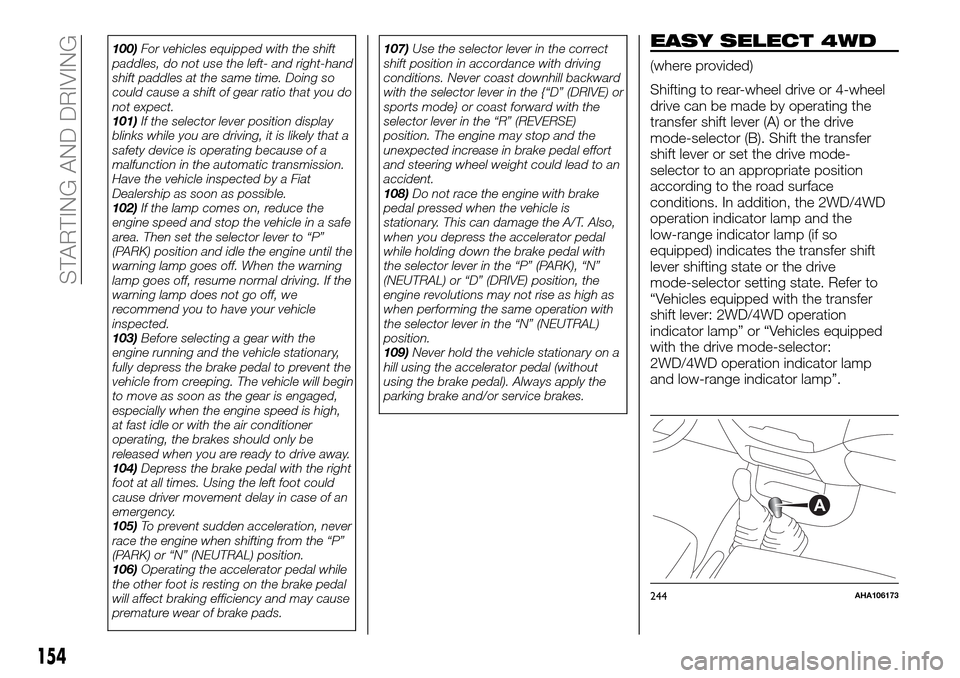
parking brake and/or service brakes.EASY SELECT 4WD
(where provided)
Shifting to rear-wheel drive or 4-wheel
drive can be made by operating the
transfer shift lever (A) or the drive
mode-selector (B). Shift the transfer
shift lever or set the drive mode-
selector to an appropriate position
according to the road surface
conditions. In addition, the 2WD/4WD
operation indicator lamp and the
low-range indicator lamp (if so
equipped) indicates the transfer shift
lever shifting state or the drive
mode-selector setting state. Refer to
“Vehicles equipped with the transfer
shift lever: 2WD/4WD operation
indicator lamp” or “Vehicles equipped
with the drive mode-selector:
2WD/4WD operation indicator lamp
and low-range indicator lamp”.
A
244AHA106173
154
STARTING AND DRIVING
Page 163 of 312
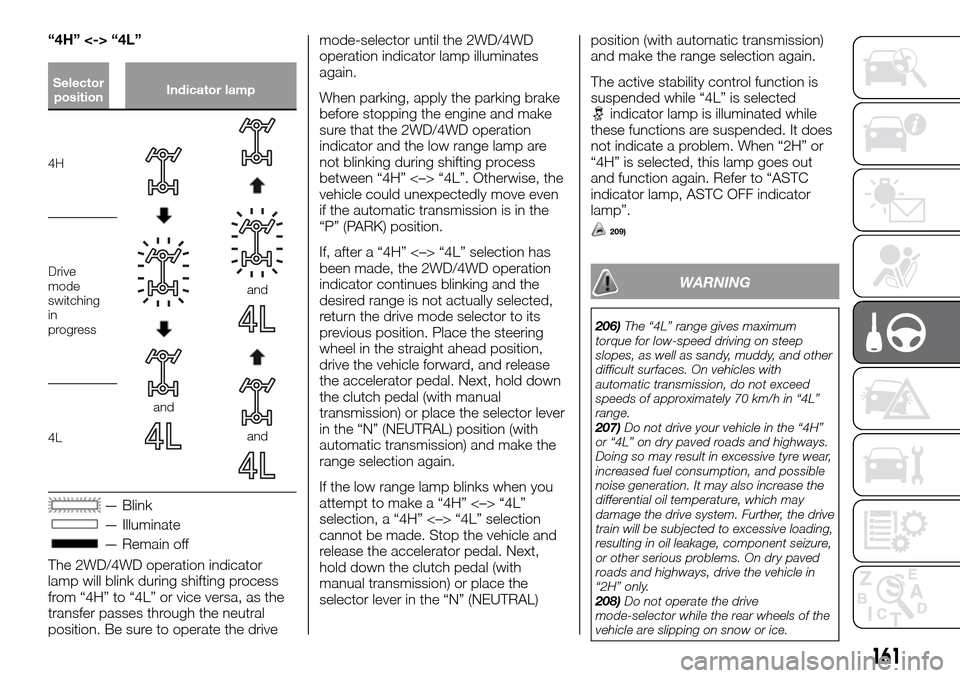
“4H” <-> “4L”
Selector
positionIndicator lamp
4H
and
and
and
Drive
mode
switching
in
progress
4L
— Blink
— Illuminate
— Remain off
The 2WD/4WD operation indicator
lamp will blink during shifting process
from “4H” to “4L” or vice versa, as the
transfer passes through the neutral
position. Be sure to operate the drivemode-selector until the 2WD/4WD
operation indicator lamp illuminates
again.
When parking, apply the parking brake
before stopping the engine and make
sure that the 2WD/4WD operation
indicator and the low range lamp are
not blinking during shifting process
between “4H” <–> “4L”. Otherwise, the
vehicle could unexpectedly move even
if the automatic transmission is in the
“P” (PARK) position.
If, after a “4H” <–> “4L” selection has
been made, the 2WD/4WD operation
indicator continues blinking and the
desired range is not actually selected,
return the drive mode selector to its
previous position. Place the steering
wheel in the straight ahead position,
drive the vehicle forward, and release
the accelerator pedal. Next, hold down
the clutch pedal (with manual
transmission) or place the selector lever
in the “N” (NEUTRAL) position (with
automatic transmission) and make the
range selection again.
If the low range lamp blinks when you
attempt to make a “4H” <–> “4L”
selection, a “4H” <–> “4L” selection
cannot be made. Stop the vehicle and
release the accelerator pedal. Next,
hold down the clutch pedal (with
manual transmission) or place the
selector lever in the “N” (NEUTRAL)position (with automatic transmission)
and make the range selection again.
The active stability control function is
suspended while “4L” is selected
indicator lamp is illuminated while
these functions are suspended. It does
not indicate a problem. When “2H” or
“4H” is selected, this lamp goes out
and function again. Refer to “ASTC
indicator lamp, ASTC OFF indicator
lamp”.
209)
WARNING
206)The “4L” range gives maximum
torque for low-speed driving on steep
slopes, as well as sandy, muddy, and other
difficult surfaces. On vehicles with
automatic transmission, do not exceed
speeds of approximately 70 km/h in “4L”
range.
207)Do not drive your vehicle in the “4H”
or “4L” on dry paved roads and highways.
Doing so may result in excessive tyre wear,
increased fuel consumption, and possible
noise generation. It may also increase the
differential oil temperature, which may
damage the drive system. Further, the drive
train will be subjected to excessive loading,
resulting in oil leakage, component seizure,
or other serious problems. On dry paved
roads and highways, drive the vehicle in
“2H” only.
208)Do not operate the drive
mode-selector while the rear wheels of the
vehicle are slipping on snow or ice.
161