warning FIAT FULLBACK 2016 1.G Manual PDF
[x] Cancel search | Manufacturer: FIAT, Model Year: 2016, Model line: FULLBACK, Model: FIAT FULLBACK 2016 1.GPages: 312, PDF Size: 13.67 MB
Page 187 of 312
IF THE VEHICLE
BREAKS DOWN
If the vehicle breaks down on the road,
move it to the shoulder and use the
hazard warning flashers and/or the
warning triangle etc. Refer to “Hazard
warning flasher switch”.
If the engine stops/fails
Vehicle operation and control are
affected if the engine stops. Before
moving the vehicle to a safe area, be
aware of the following:
The brake booster becomes
inoperative and the pedal effort will
increase. Press down the brake pedal
harder than usual.
Since the power steering system is
no longer operative, the steering wheel
feels heavy when turning it.
EMERGENCY
STARTING
231) 232) 233) 234) 235) 236) 237) 238) 239) 240) 241) 242)
243) 244) 245) 246) 247)
If the engine cannot be started because
the battery is weak or dead, the battery
from another vehicle can be used with
jumper cables to start the engine.
1. Get the vehicles close enough so the
jumper cables can reach, but be sure
the vehicles aren’t touching each other.
2. Turn off all lamps, heater and other
electrical loads.
3. Set the parking brake firmly on each
vehicle. Put an automatic transmission
in “P” (PARK) or a manual transmission
in “N” (Neutral). Stop the engine.
4. Make sure battery electrolyte is at the
proper level. Refer to “Battery”.
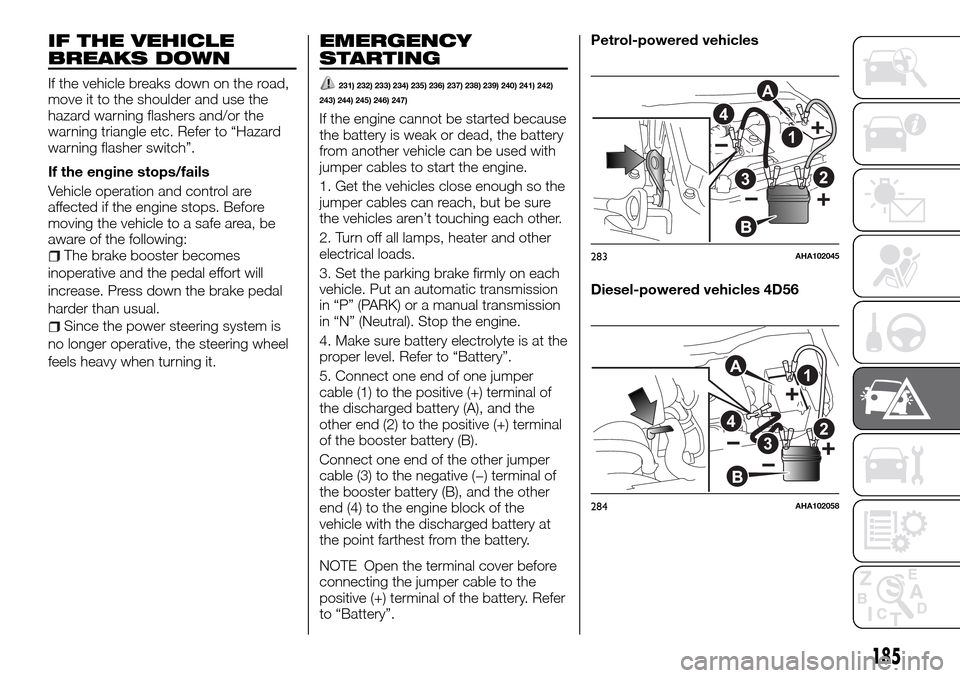
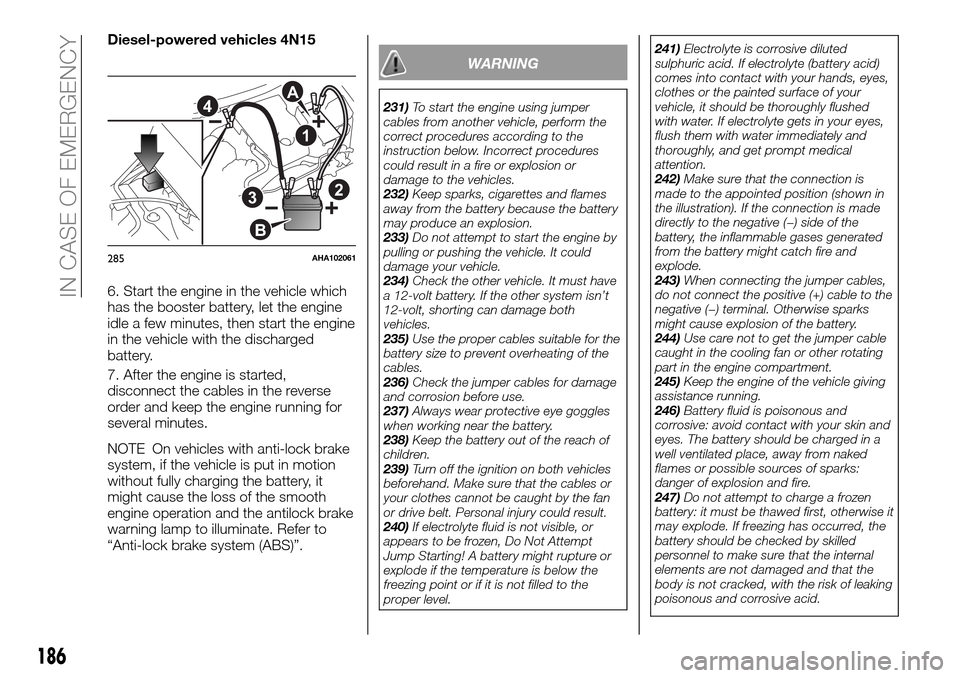
5. Connect one end of one jumper
cable (1) to the positive (+) terminal of
the discharged battery (A), and the
other end (2) to the positive (+) terminal
of the booster battery (B).
Connect one end of the other jumper
cable (3) to the negative (−) terminal of
the booster battery (B), and the other
end (4) to the engine block of the
vehicle with the discharged battery at
the point farthest from the battery.
NOTE Open the terminal cover before
connecting the jumper cable to the
positive (+) terminal of the battery. Refer
to “Battery”.Petrol-powered vehicles
Diesel-powered vehicles 4D56
A
B
1
4
23
283AHA102045
A
B
1
423
284AHA102058
185
Page 188 of 312
Diesel-powered vehicles 4N15
6. Start the engine in the vehicle which
has the booster battery, let the engine
idle a few minutes, then start the engine
in the vehicle with the discharged
battery.
7. After the engine is started,
disconnect the cables in the reverse
order and keep the engine running for
several minutes.
NOTE On vehicles with anti-lock brake
system, if the vehicle is put in motion
without fully charging the battery, it
might cause the loss of the smooth
engine operation and the antilock brake
warning lamp to illuminate. Refer to
“Anti-lock brake system (ABS)”.
WARNING
231)To start the engine using jumper
cables from another vehicle, perform the
correct procedures according to the
instruction below. Incorrect procedures
could result in a fire or explosion or
damage to the vehicles.
232)Keep sparks, cigarettes and flames
away from the battery because the battery
may produce an explosion.
233)Do not attempt to start the engine by
pulling or pushing the vehicle. It could
damage your vehicle.
234)Check the other vehicle. It must have
a 12-volt battery. If the other system isn’t
12-volt, shorting can damage both
vehicles.
235)Use the proper cables suitable for the
battery size to prevent overheating of the
cables.
236)Check the jumper cables for damage
and corrosion before use.
237)Always wear protective eye goggles
when working near the battery.
238)Keep the battery out of the reach of
children.
239)Turn off the ignition on both vehicles
beforehand. Make sure that the cables or
your clothes cannot be caught by the fan
or drive belt. Personal injury could result.
240)If electrolyte fluid is not visible, or
appears to be frozen, Do Not Attempt
Jump Starting! A battery might rupture or
explode if the temperature is below the
freezing point or if it is not filled to the
proper level.241)Electrolyte is corrosive diluted
sulphuric acid. If electrolyte (battery acid)
comes into contact with your hands, eyes,
clothes or the painted surface of your
vehicle, it should be thoroughly flushed
with water. If electrolyte gets in your eyes,
flush them with water immediately and
thoroughly, and get prompt medical
attention.
242)Make sure that the connection is
made to the appointed position (shown in
the illustration). If the connection is made
directly to the negative (−) side of the
battery, the inflammable gases generated
from the battery might catch fire and
explode.
243)When connecting the jumper cables,
do not connect the positive (+) cable to the
negative (−) terminal. Otherwise sparks
might cause explosion of the battery.
244)Use care not to get the jumper cable
caught in the cooling fan or other rotating
part in the engine compartment.
245)Keep the engine of the vehicle giving
assistance running.
246)Battery fluid is poisonous and
corrosive: avoid contact with your skin and
eyes. The battery should be charged in a
well ventilated place, away from naked
flames or possible sources of sparks:
danger of explosion and fire.
247)Do not attempt to charge a frozen
battery: it must be thawed first, otherwise it
may explode. If freezing has occurred, the
battery should be checked by skilled
personnel to make sure that the internal
elements are not damaged and that the
body is not cracked, with the risk of leaking
poisonous and corrosive acid.A
B
1
4
23
285AHA102061
186
IN CASE OF EMERGENCY
Page 189 of 312
ENGINE
OVERHEATING
When the engine is overheating,will
blink. If this occurs, take the following
corrective measures:
1. Stop the vehicle in a safe place.
2. Check whether steam is coming from
the engine compartment.
If steam does not come from the engine
compartment: with the engine still
running, raise the bonnet to ventilate
the engine compartment.
If steam is coming from the engine
compartment: stop the engine, and
when the steam stops, raise the bonnet
to ventilate the engine compartment.
Restart the engine.
248) 249) 250)
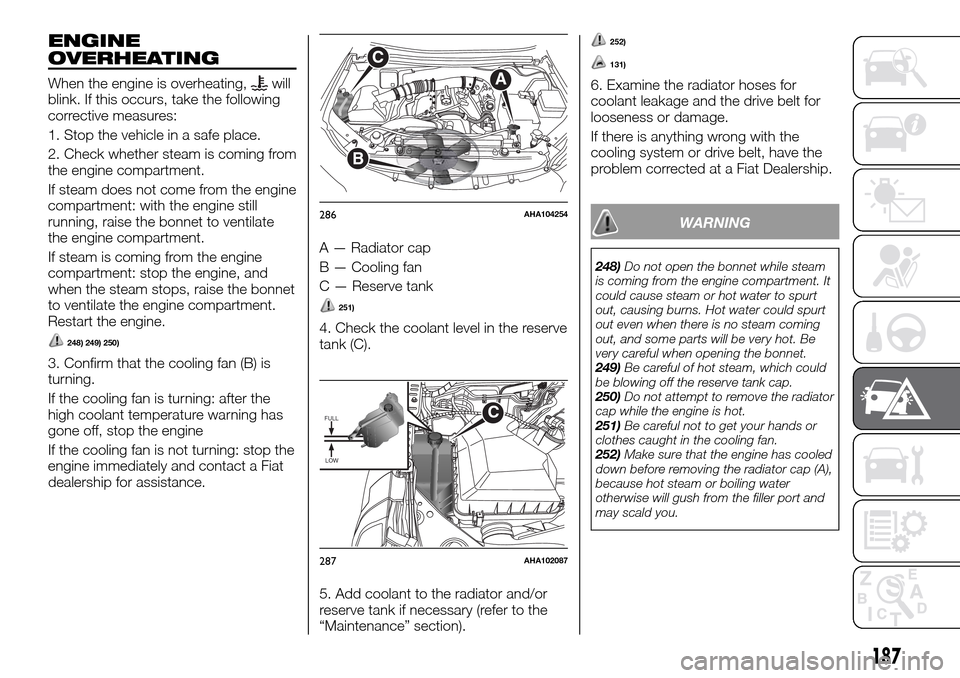
3. Confirm that the cooling fan (B) is
turning.
If the cooling fan is turning: after the
high coolant temperature warning has
gone off, stop the engine
If the cooling fan is not turning: stop the
engine immediately and contact a Fiat
dealership for assistance.A — Radiator cap
B — Cooling fan
C — Reserve tank
251)
4. Check the coolant level in the reserve
tank (C).
5. Add coolant to the radiator and/or
reserve tank if necessary (refer to the
“Maintenance” section).
252)
131)
6. Examine the radiator hoses for
coolant leakage and the drive belt for
looseness or damage.
If there is anything wrong with the
cooling system or drive belt, have the
problem corrected at a Fiat Dealership.
WARNING
248)Do not open the bonnet while steam
is coming from the engine compartment. It
could cause steam or hot water to spurt
out, causing burns. Hot water could spurt
out even when there is no steam coming
out, and some parts will be very hot. Be
very careful when opening the bonnet.
249)Be careful of hot steam, which could
be blowing off the reserve tank cap.
250)Do not attempt to remove the radiator
cap while the engine is hot.
251)Be careful not to get your hands or
clothes caught in the cooling fan.
252)Make sure that the engine has cooled
down before removing the radiator cap (A),
because hot steam or boiling water
otherwise will gush from the filler port and
may scald you.
A
C
B
286AHA104254
FULL
LOW
C
287AHA102087
187
Page 190 of 312
IMPORTANT
131)Do not add coolant while the engine is
hot. Suddenly adding cold coolant could
damage the engine. Wait for the engine to
cool down, then add coolant a little at a
time.
BLEEDING THE FUEL
SYSTEM
The fuel system should be bled to
remove air as described below if the
fuel supply is exhausted during travel.
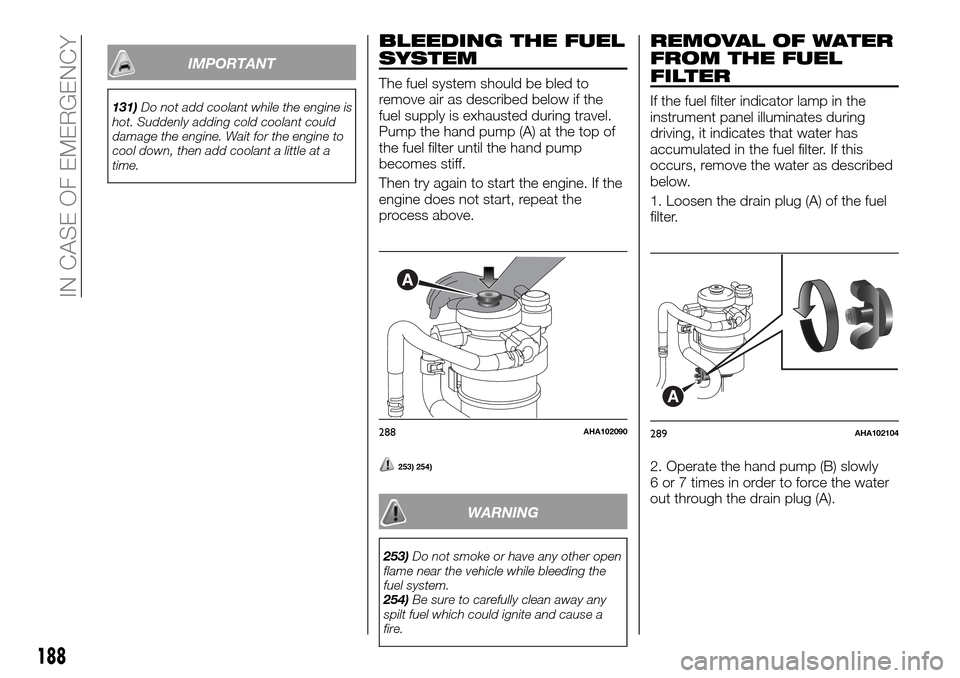
Pump the hand pump (A) at the top of
the fuel filter until the hand pump
becomes stiff.
Then try again to start the engine. If the
engine does not start, repeat the
process above.
253) 254)
WARNING
253)Do not smoke or have any other open
flame near the vehicle while bleeding the
fuel system.
254)Be sure to carefully clean away any
spilt fuel which could ignite and cause a
fire.
REMOVAL OF WATER
FROM THE FUEL
FILTER
If the fuel filter indicator lamp in the
instrument panel illuminates during
driving, it indicates that water has
accumulated in the fuel filter. If this
occurs, remove the water as described
below.
1. Loosen the drain plug (A) of the fuel
filter.
2. Operate the hand pump (B) slowly
6 or 7 times in order to force the water
out through the drain plug (A).
A
288AHA102090
A
289AHA102104
188
IN CASE OF EMERGENCY
Page 191 of 312
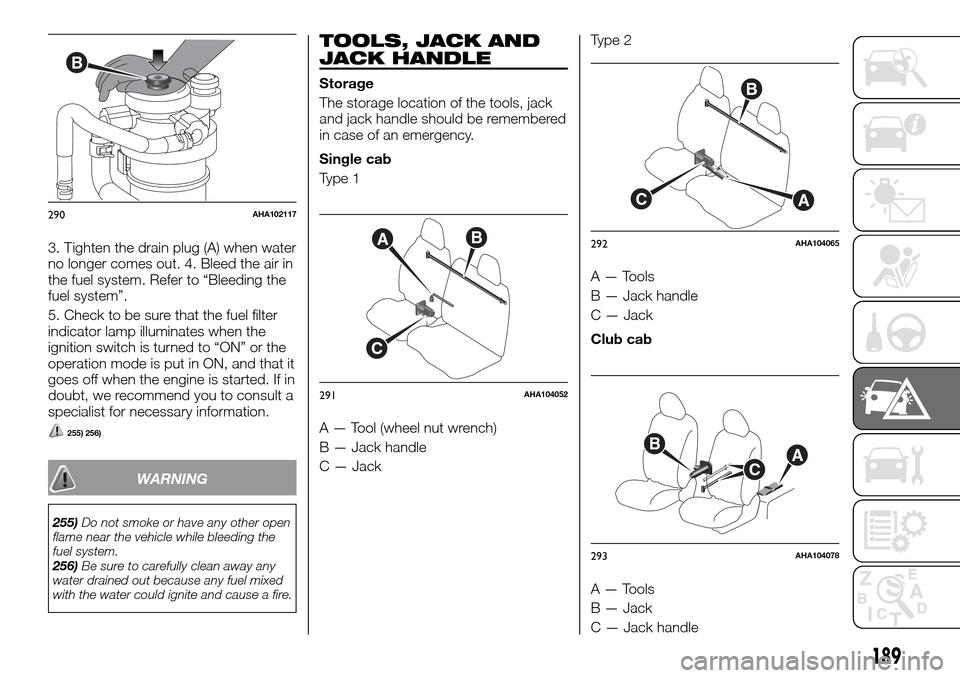
3. Tighten the drain plug (A) when water
no longer comes out. 4. Bleed the air in
the fuel system. Refer to “Bleeding the
fuel system”.
5. Check to be sure that the fuel filter
indicator lamp illuminates when the
ignition switch is turned to “ON” or the
operation mode is put in ON, and that it
goes off when the engine is started. If in
doubt, we recommend you to consult a
specialist for necessary information.
255) 256)
WARNING
255)Do not smoke or have any other open
flame near the vehicle while bleeding the
fuel system.
256)Be sure to carefully clean away any
water drained out because any fuel mixed
with the water could ignite and cause a fire.
TOOLS, JACK AND
JACK HANDLE
Storage
The storage location of the tools, jack
and jack handle should be remembered
in case of an emergency.
Single cab
Type 1
A — Tool (wheel nut wrench)
B — Jack handle
C — JackType 2
A — Tools
B — Jack handle
C — Jack
Club cab
A — Tools
B — Jack
C — Jack handle
B
290AHA102117
AB
C
291AHA104052
B
CA
292AHA104065
BAC
293AHA104078
189
Page 196 of 312
HOW TO CHANGE A
TYRE
132) 133)
Before changing a tyre, first stop your
vehicle in a safe, flat location.
1. Park the vehicle on level and stable
ground, free of loose pebbles, etc.
2. Set the parking brake firmly.
3. On vehicles with manual
transmission, turn the ignition switch to
the “LOCK” position or put the
operation mode in OFF, and move the
gearshift lever to the “R” (Reverse)
position. On vehicles with automatic
transmission, move the selector lever to
the “P” (PARK) position, and turn the
ignition switch to the “LOCK” position
or put the operation mode in OFF.
4. Turn on the hazard flashers and set
up a warning triangle, flashing signal
lamp, etc., at an adequate distance
from the vehicle, and have all your
passengers leave the vehicle.
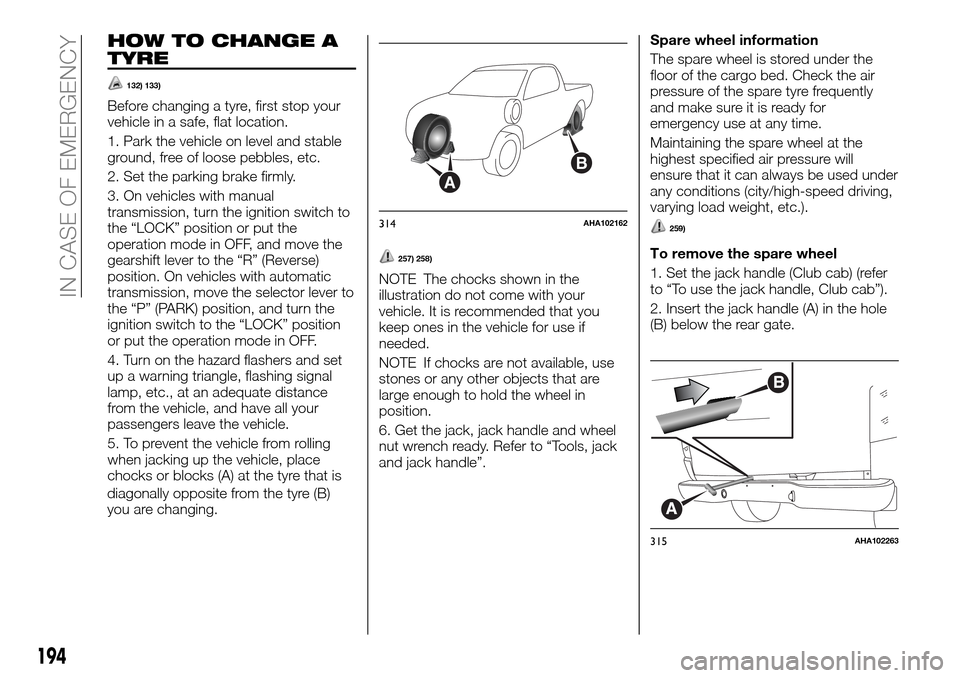
5. To prevent the vehicle from rolling
when jacking up the vehicle, place
chocks or blocks (A) at the tyre that is
diagonally opposite from the tyre (B)
you are changing.
257) 258)
NOTE The chocks shown in the
illustration do not come with your
vehicle. It is recommended that you
keep ones in the vehicle for use if
needed.
NOTE If chocks are not available, use
stones or any other objects that are
large enough to hold the wheel in
position.
6. Get the jack, jack handle and wheel
nut wrench ready. Refer to “Tools, jack
and jack handle”.Spare wheel information
The spare wheel is stored under the
floor of the cargo bed. Check the air
pressure of the spare tyre frequently
and make sure it is ready for
emergency use at any time.
Maintaining the spare wheel at the
highest specified air pressure will
ensure that it can always be used under
any conditions (city/high-speed driving,
varying load weight, etc.).
259)
To remove the spare wheel
1. Set the jack handle (Club cab) (refer
to “To use the jack handle, Club cab”).
2. Insert the jack handle (A) in the hole
(B) below the rear gate.
A
B
314AHA102162
A
B
315AHA102263
194
IN CASE OF EMERGENCY
Page 201 of 312
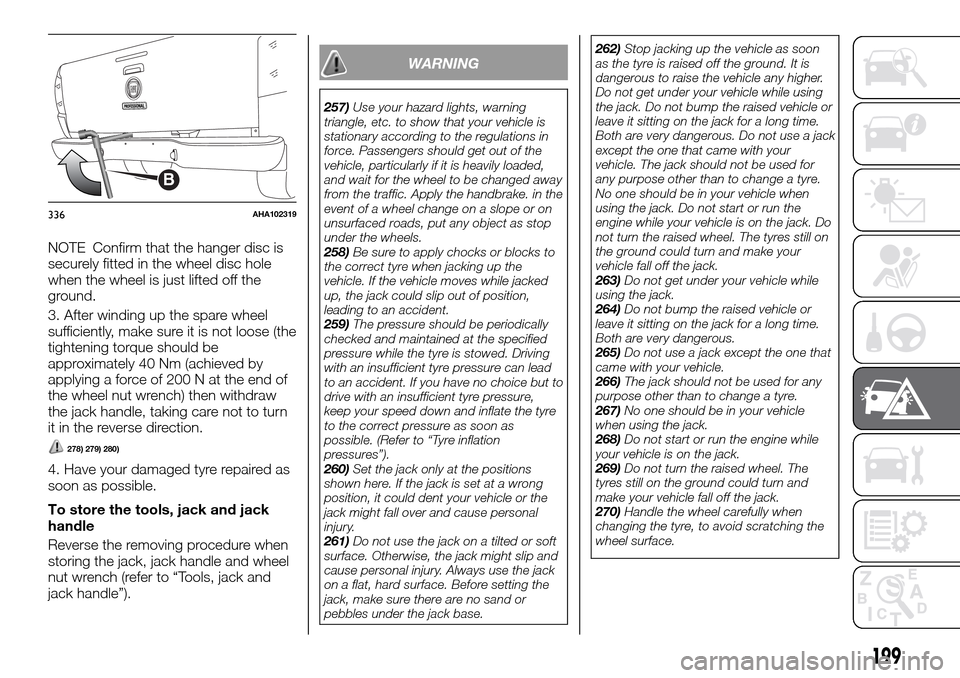
NOTE Confirm that the hanger disc is
securely fitted in the wheel disc hole
when the wheel is just lifted off the
ground.
3. After winding up the spare wheel
sufficiently, make sure it is not loose (the
tightening torque should be
approximately 40 Nm (achieved by
applying a force of 200 N at the end of
the wheel nut wrench) then withdraw
the jack handle, taking care not to turn
it in the reverse direction.
278) 279) 280)
4. Have your damaged tyre repaired as
soon as possible.
To store the tools, jack and jack
handle
Reverse the removing procedure when
storing the jack, jack handle and wheel
nut wrench (refer to “Tools, jack and
jack handle”).
WARNING
257)Use your hazard lights, warning
triangle, etc. to show that your vehicle is
stationary according to the regulations in
force. Passengers should get out of the
vehicle, particularly if it is heavily loaded,
and wait for the wheel to be changed away
from the traffic. Apply the handbrake. in the
event of a wheel change on a slope or on
unsurfaced roads, put any object as stop
under the wheels.
258)Be sure to apply chocks or blocks to
the correct tyre when jacking up the
vehicle. If the vehicle moves while jacked
up, the jack could slip out of position,
leading to an accident.
259)The pressure should be periodically
checked and maintained at the specified
pressure while the tyre is stowed. Driving
with an insufficient tyre pressure can lead
to an accident. If you have no choice but to
drive with an insufficient tyre pressure,
keep your speed down and inflate the tyre
to the correct pressure as soon as
possible. (Refer to “Tyre inflation
pressures”).
260)Set the jack only at the positions
shown here. If the jack is set at a wrong
position, it could dent your vehicle or the
jack might fall over and cause personal
injury.
261)Do not use the jack on a tilted or soft
surface. Otherwise, the jack might slip and
cause personal injury. Always use the jack
on a flat, hard surface. Before setting the
jack, make sure there are no sand or
pebbles under the jack base.262)Stop jacking up the vehicle as soon
as the tyre is raised off the ground. It is
dangerous to raise the vehicle any higher.
Do not get under your vehicle while using
the jack. Do not bump the raised vehicle or
leave it sitting on the jack for a long time.
Both are very dangerous. Do not use a jack
except the one that came with your
vehicle. The jack should not be used for
any purpose other than to change a tyre.
No one should be in your vehicle when
using the jack. Do not start or run the
engine while your vehicle is on the jack. Do
not turn the raised wheel. The tyres still on
the ground could turn and make your
vehicle fall off the jack.
263)Do not get under your vehicle while
using the jack.
264)Do not bump the raised vehicle or
leave it sitting on the jack for a long time.
Both are very dangerous.
265)Do not use a jack except the one that
came with your vehicle.
266)The jack should not be used for any
purpose other than to change a tyre.
267)No one should be in your vehicle
when using the jack.
268)Do not start or run the engine while
your vehicle is on the jack.
269)Do not turn the raised wheel. The
tyres still on the ground could turn and
make your vehicle fall off the jack.
270)Handle the wheel carefully when
changing the tyre, to avoid scratching the
wheel surface.
B
336AHA102319
199
Page 204 of 312
If your vehicle is to be towed by
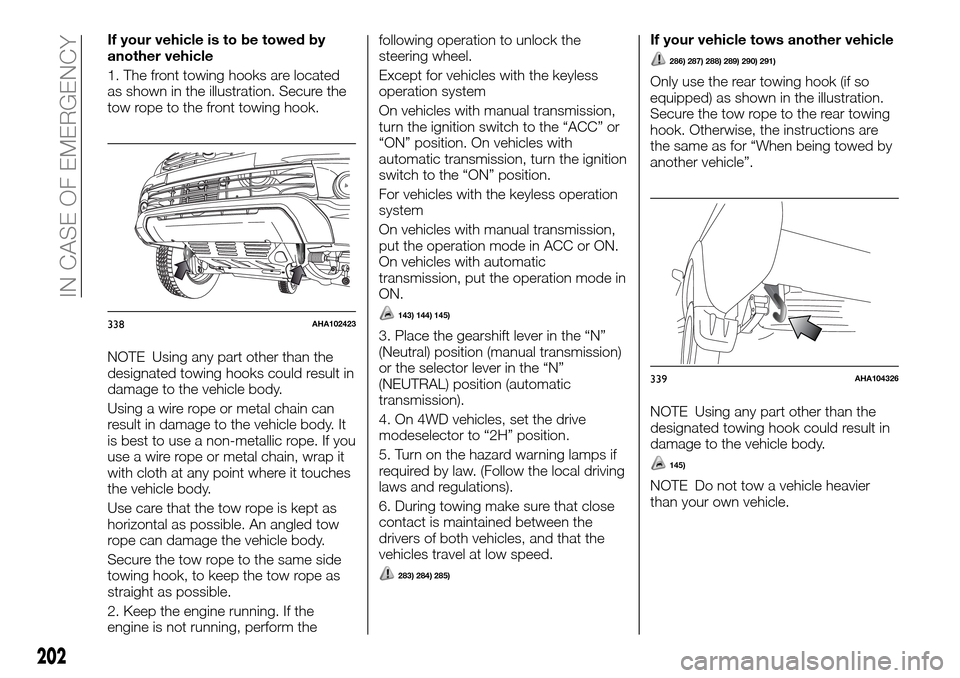
another vehicle
1. The front towing hooks are located
as shown in the illustration. Secure the
tow rope to the front towing hook.
NOTE Using any part other than the
designated towing hooks could result in
damage to the vehicle body.
Using a wire rope or metal chain can
result in damage to the vehicle body. It
is best to use a non-metallic rope. If you
use a wire rope or metal chain, wrap it
with cloth at any point where it touches
the vehicle body.
Use care that the tow rope is kept as
horizontal as possible. An angled tow
rope can damage the vehicle body.
Secure the tow rope to the same side
towing hook, to keep the tow rope as
straight as possible.
2. Keep the engine running. If the
engine is not running, perform thefollowing operation to unlock the
steering wheel.
Except for vehicles with the keyless
operation system
On vehicles with manual transmission,
turn the ignition switch to the “ACC” or
“ON” position. On vehicles with
automatic transmission, turn the ignition
switch to the “ON” position.
For vehicles with the keyless operation
system
On vehicles with manual transmission,
put the operation mode in ACC or ON.
On vehicles with automatic
transmission, put the operation mode in
ON.
143) 144) 145)
3. Place the gearshift lever in the “N”
(Neutral) position (manual transmission)
or the selector lever in the “N”
(NEUTRAL) position (automatic
transmission).
4. On 4WD vehicles, set the drive
modeselector to “2H” position.
5. Turn on the hazard warning lamps if
required by law. (Follow the local driving
laws and regulations).
6. During towing make sure that close
contact is maintained between the
drivers of both vehicles, and that the
vehicles travel at low speed.
283) 284) 285)
If your vehicle tows another vehicle
286) 287) 288) 289) 290) 291)
Only use the rear towing hook (if so
equipped) as shown in the illustration.
Secure the tow rope to the rear towing
hook. Otherwise, the instructions are
the same as for “When being towed by
another vehicle”.
NOTE Using any part other than the
designated towing hook could result in
damage to the vehicle body.
145)
NOTE Do not tow a vehicle heavier
than your own vehicle.
338AHA102423
339AHA104326
202
IN CASE OF EMERGENCY
Page 205 of 312
WARNING
281)If the vehicle is towed with the ignition
switch in the “ON” position or the operation
mode in ON and only the front wheels or
only the rear wheels raised off the ground,
the active traction control system may
operate, resulting in an accident.
282)If your vehicle equipped with the
Active Stability & Traction Control system
(ASTC), if the vehicle is towed with the
ignition switch in the “ON” position or the
operation mode in ON and only the front
wheels or only the rear wheels raised off
the ground, the active traction control
system may operate, resulting in an
accident.
283)Avoid sudden braking, acceleration
and steering wheel movements; such
driving operation could cause damage to
the towing hook or towing rope. People in
the vicinity could be injured as a result.284)When going down a long slope, the
brakes may overheat, reducing
effectiveness. Have your vehicle transport
by a tow truck.
285)The person in the vehicle being towed
must pay attention to the brake lamps of
the towing vehicle and make sure the rope
never becomes slack.
286)Do not use flexible cables for towing
and avoid jerking. During towing
operations, make sure that the fastened
joint does not damage adjoining
components.
287)When towing the vehicle comply with
the specific rules of the Highway Code
regarding the towing device and the
behaviour on the road.
288)Do not start the engine while towing
the vehicle.
289)Towing must be made exclusively on
roads/streets; the device must not be used
to recover the vehicle if it got off the road.
290)Towing must not be made for getting
past significant obstacles on the road (e.g.
heaps of snow or material on the road
surface).
291)Towing must take place with the two
vehicles (one towing, the other towed)
aligned as much as possible; towing by
roadside assistance vehicles, too, must
take place with the two vehicles aligned as
much as possible.
IMPORTANT
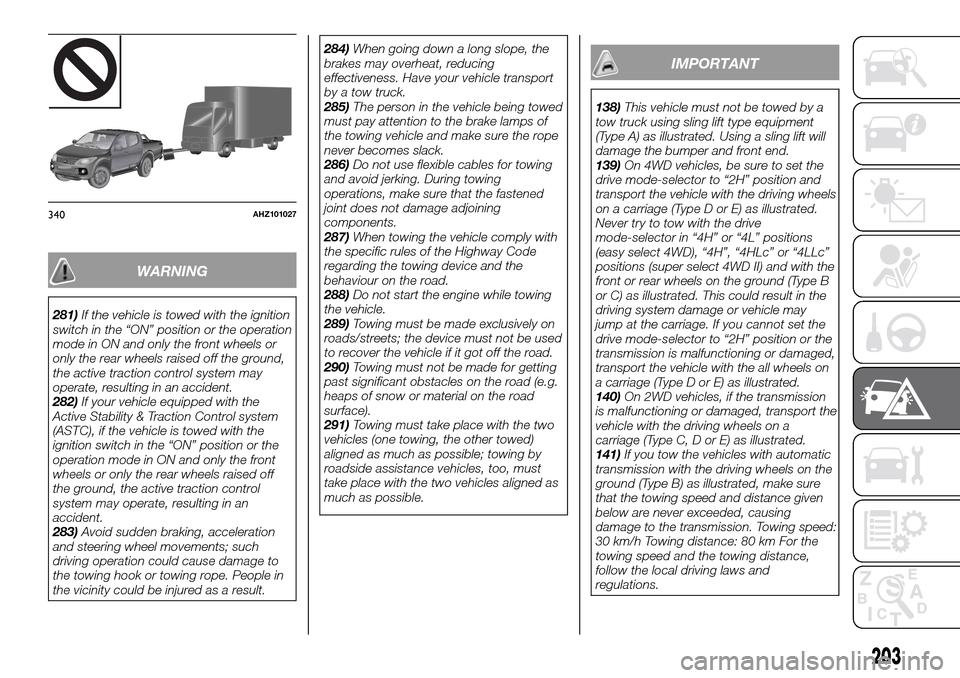
138)This vehicle must not be towed by a
tow truck using sling lift type equipment
(Type A) as illustrated. Using a sling lift will
damage the bumper and front end.
139)On 4WD vehicles, be sure to set the
drive mode-selector to “2H” position and
transport the vehicle with the driving wheels
on a carriage (Type D or E) as illustrated.
Never try to tow with the drive
mode-selector in “4H” or “4L” positions
(easy select 4WD), “4H”, “4HLc” or “4LLc”
positions (super select 4WD II) and with the
front or rear wheels on the ground (Type B
or C) as illustrated. This could result in the
driving system damage or vehicle may
jump at the carriage. If you cannot set the
drive mode-selector to “2H” position or the
transmission is malfunctioning or damaged,
transport the vehicle with the all wheels on
a carriage (Type D or E) as illustrated.
140)On 2WD vehicles, if the transmission
is malfunctioning or damaged, transport the
vehicle with the driving wheels on a
carriage (Type C, D or E) as illustrated.
141)If you tow the vehicles with automatic
transmission with the driving wheels on the
ground (Type B) as illustrated, make sure
that the towing speed and distance given
below are never exceeded, causing
damage to the transmission. Towing speed:
30 km/h Towing distance: 80 km For the
towing speed and the towing distance,
follow the local driving laws and
regulations.
340AHZ101027
203
Page 207 of 312
On a bumpy or rutted road
Drive as slow as possible when driving
on bumpy or rutted roads.
146)
WARNING
292)Do not press the accelerator pedal
rapidly. If the wheels break free of the ice,
the vehicle could suddenly start moving
and possibly cause an accident.
IMPORTANT
146)The impact on tyres and/or wheels
when driving on a bumpy or rutted road
can damage the tyre and/or wheel.
FUSIBLE LINKS
The fusible links will melt to prevent a
fire if a large current attempts to flow
through certain electrical systems. In
case of a melted fuse link, we
recommend you to have your vehicle
inspected. For the fusible links, please
refer to “Passenger compartment fuse
location table” and “Engine
compartment fuse location table”.
293)
WARNING
293)Fusible links must not be replaced by
any other device. Failing to fit the correct
fusible link may result in fire in the vehicle,
property destruction and serious or fatal
injuries at any time.
FUSES
Fuse block location
To prevent damage to the electrical
system due to short-circuiting or
overloading, each individual circuit is
provided with a fuse. There are fuse
blocks in the passenger compartment
and in the engine compartment.
Passenger compartment (LHD
vehicles)
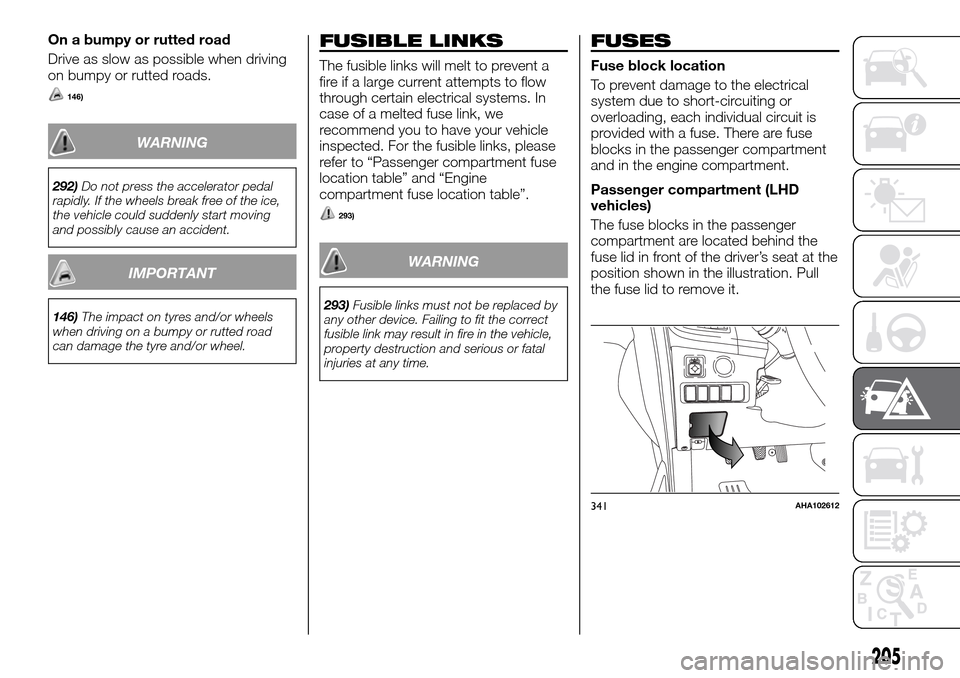
The fuse blocks in the passenger
compartment are located behind the
fuse lid in front of the driver’s seat at the
position shown in the illustration. Pull
the fuse lid to remove it.
R L
341AHA102612
205