instrument panel FIAT FULLBACK 2017 Owner handbook (in English)
[x] Cancel search | Manufacturer: FIAT, Model Year: 2017, Model line: FULLBACK, Model: FIAT FULLBACK 2017Pages: 312, PDF Size: 12.31 MB
Page 96 of 312
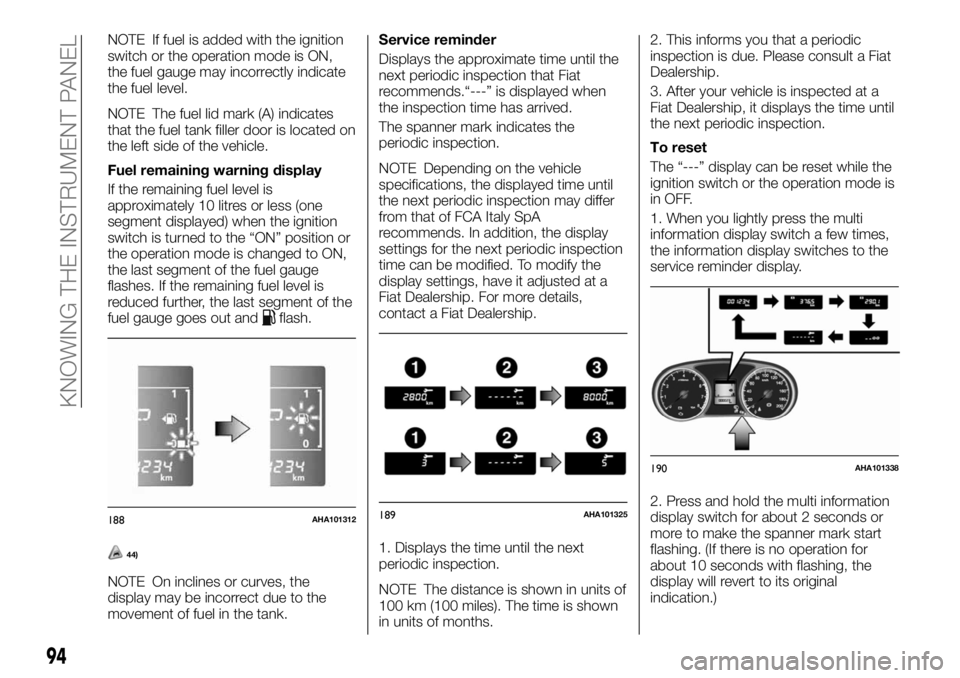
NOTE If fuel is added with the ignition
switch or the operation mode is ON,
the fuel gauge may incorrectly indicate
the fuel level.
NOTE The fuel lid mark (A) indicates
that the fuel tank filler door is located on
the left side of the vehicle.
Fuel remaining warning display
If the remaining fuel level is
approximately 10 litres or less (one
segment displayed) when the ignition
switch is turned to the “ON” position or
the operation mode is changed to ON,
the last segment of the fuel gauge
flashes. If the remaining fuel level is
reduced further, the last segment of the
fuel gauge goes out and
flash.
44)
NOTE On inclines or curves, the
display may be incorrect due to the
movement of fuel in the tank.Service reminder
Displays the approximate time until the
next periodic inspection that Fiat
recommends.“---” is displayed when
the inspection time has arrived.
The spanner mark indicates the
periodic inspection.
NOTE Depending on the vehicle
specifications, the displayed time until
the next periodic inspection may differ
from that of FCA Italy SpA
recommends. In addition, the display
settings for the next periodic inspection
time can be modified. To modify the
display settings, have it adjusted at a
Fiat Dealership. For more details,
contact a Fiat Dealership.
1. Displays the time until the next
periodic inspection.
NOTE The distance is shown in units of
100 km (100 miles). The time is shown
in units of months.2. This informs you that a periodic
inspection is due. Please consult a Fiat
Dealership.
3. After your vehicle is inspected at a
Fiat Dealership, it displays the time until
the next periodic inspection.
To reset
The “---” display can be reset while the
ignition switch or the operation mode is
in OFF.
1. When you lightly press the multi
information display switch a few times,
the information display switches to the
service reminder display.
2. Press and hold the multi information
display switch for about 2 seconds or
more to make the spanner mark start
flashing. (If there is no operation for
about 10 seconds with flashing, the
display will revert to its original
indication.)
188AHA101312189AHA101325
190AHA101338
94
KNOWING THE INSTRUMENT PANEL
Page 98 of 312
longer. For vehicles equipped with the
keyless operation system: the operation
mode is in ACC or OFF for about
4 hours or longer.
IMPORTANT The average fuel
consumption display can be reset
separately for the auto reset mode and
for the manual reset mode.
IMPORTANT The memory of the
manual reset mode or auto reset mode
for the average fuel consumption
display is erased if the battery is
disconnected.
The initial (default) setting is “Auto reset
mode”.
Changing the fuel consumption
display unit
The display unit for fuel consumption
can be switched. The distance and
amount units are also switched to
match the selected fuel consumption
unit.
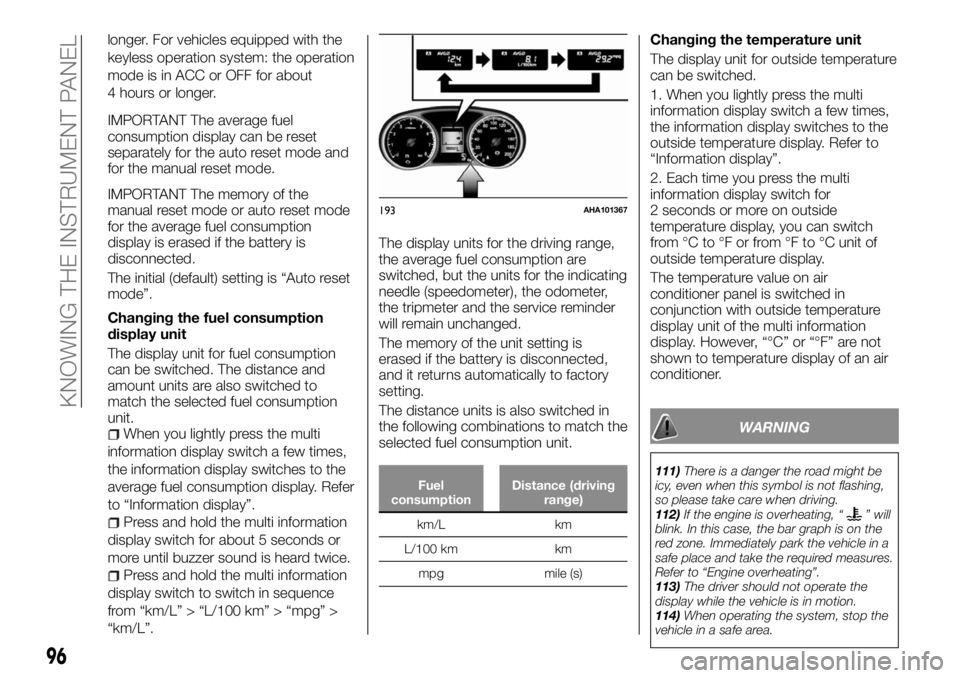
When you lightly press the multi
information display switch a few times,
the information display switches to the
average fuel consumption display. Refer
to “Information display”.
Press and hold the multi information
display switch for about 5 seconds or
more until buzzer sound is heard twice.
Press and hold the multi information
display switch to switch in sequence
from “km/L” > “L/100 km” > “mpg” >
“km/L”.The display units for the driving range,
the average fuel consumption are
switched, but the units for the indicating
needle (speedometer), the odometer,
the tripmeter and the service reminder
will remain unchanged.
The memory of the unit setting is
erased if the battery is disconnected,
and it returns automatically to factory
setting.
The distance units is also switched in
the following combinations to match the
selected fuel consumption unit.
Fuel
consumptionDistance (driving
range)
km/L km
L/100 km km
mpg mile (s)
Changing the temperature unit
The display unit for outside temperature
can be switched.
1. When you lightly press the multi
information display switch a few times,
the information display switches to the
outside temperature display. Refer to
“Information display”.
2. Each time you press the multi
information display switch for
2 seconds or more on outside
temperature display, you can switch
from °C to °F or from °F to °C unit of
outside temperature display.
The temperature value on air
conditioner panel is switched in
conjunction with outside temperature
display unit of the multi information
display. However, “°C” or “°F” are not
shown to temperature display of an air
conditioner.
WARNING
111)There is a danger the road might be
icy, even when this symbol is not flashing,
so please take care when driving.
112)If the engine is overheating, “
” will
blink. In this case, the bar graph is on the
red zone. Immediately park the vehicle in a
safe place and take the required measures.
Refer to “Engine overheating”.
113)The driver should not operate the
display while the vehicle is in motion.
114)When operating the system, stop the
vehicle in a safe area.
193AHA101367
96
KNOWING THE INSTRUMENT PANEL
Page 100 of 312
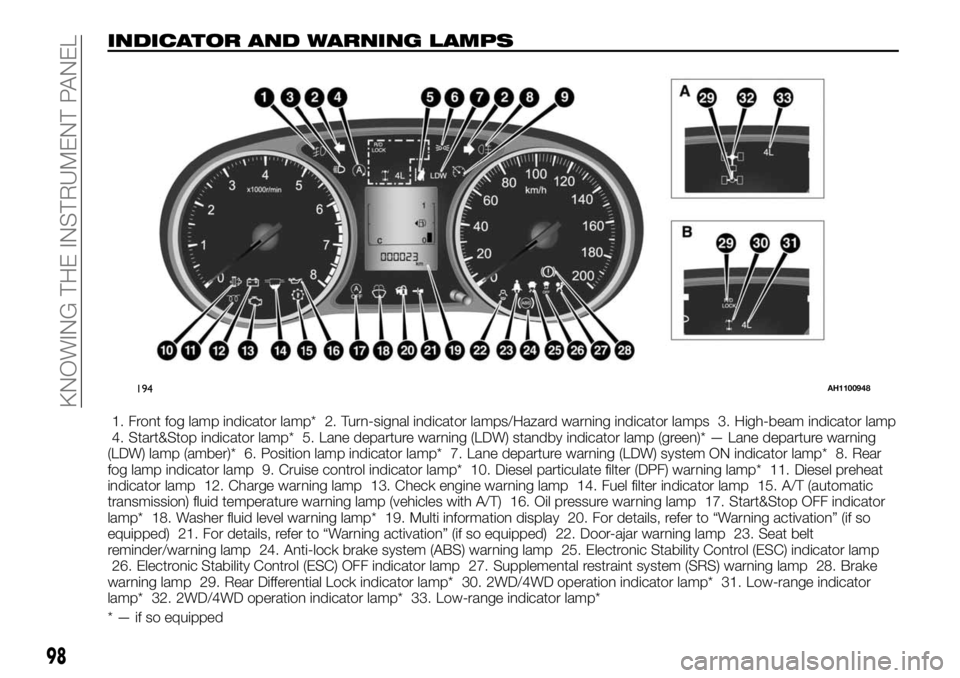
INDICATOR AND WARNING LAMPS
1. Front fog lamp indicator lamp* 2. Turn-signal indicator lamps/Hazard warning indicator lamps 3. High-beam indicator lamp
4. Start&Stop indicator lamp* 5. Lane departure warning (LDW) standby indicator lamp (green)* — Lane departure warning
(LDW) lamp (amber)* 6. Position lamp indicator lamp* 7. Lane departure warning (LDW) system ON indicator lamp* 8. Rear
fog lamp indicator lamp 9. Cruise control indicator lamp* 10. Diesel particulate filter (DPF) warning lamp* 11. Diesel preheat
indicator lamp 12. Charge warning lamp 13. Check engine warning lamp 14. Fuel filter indicator lamp 15. A/T (automatic
transmission) fluid temperature warning lamp (vehicles with A/T) 16. Oil pressure warning lamp 17. Start&Stop OFF indicator
lamp* 18. Washer fluid level warning lamp* 19. Multi information display 20. For details, refer to “Warning activation” (if so
equipped) 21. For details, refer to “Warning activation” (if so equipped) 22. Door-ajar warning lamp 23. Seat belt
reminder/warning lamp 24. Anti-lock brake system (ABS) warning lamp 25. Electronic Stability Control (ESC) indicator lamp
26. Electronic Stability Control (ESC) OFF indicator lamp 27. Supplemental restraint system (SRS) warning lamp 28. Brake
warning lamp 29. Rear Differential Lock indicator lamp* 30. 2WD/4WD operation indicator lamp* 31. Low-range indicator
lamp* 32. 2WD/4WD operation indicator lamp* 33. Low-range indicator lamp*
* — if so equipped
194AH1100948
98
KNOWING THE INSTRUMENT PANEL
Page 102 of 312
Indicator lamps What it means
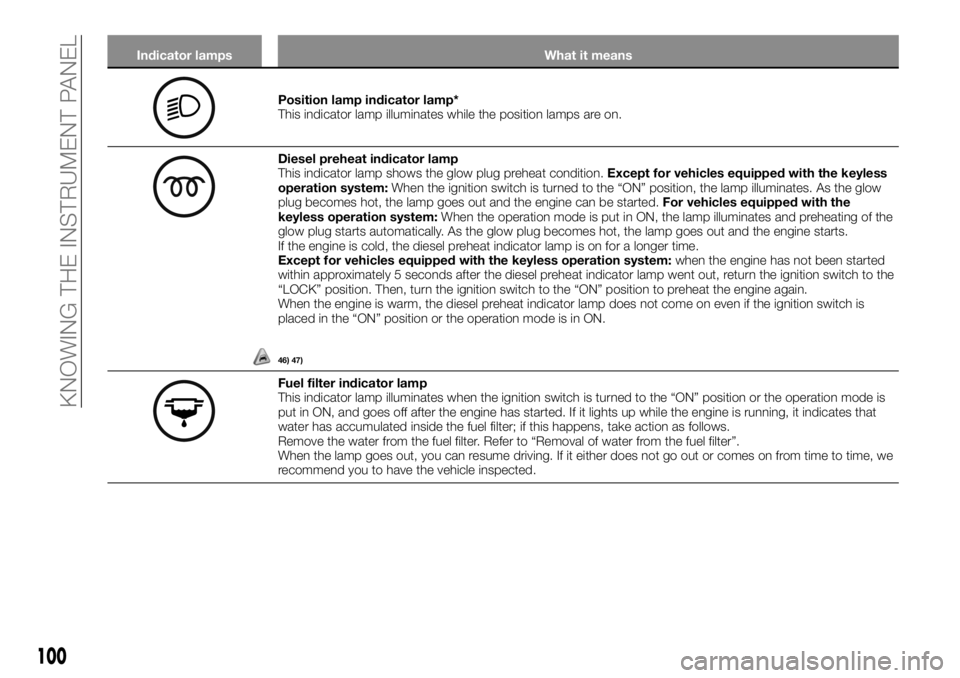
Position lamp indicator lamp*
This indicator lamp illuminates while the position lamps are on.
Diesel preheat indicator lamp
This indicator lamp shows the glow plug preheat condition.Except for vehicles equipped with the keyless
operation system:When the ignition switch is turned to the “ON” position, the lamp illuminates. As the glow
plug becomes hot, the lamp goes out and the engine can be started.For vehicles equipped with the
keyless operation system:When the operation mode is put in ON, the lamp illuminates and preheating of the
glow plug starts automatically. As the glow plug becomes hot, the lamp goes out and the engine starts.
If the engine is cold, the diesel preheat indicator lamp is on for a longer time.
Except for vehicles equipped with the keyless operation system:when the engine has not been started
within approximately 5 seconds after the diesel preheat indicator lamp went out, return the ignition switch to the
“LOCK” position. Then, turn the ignition switch to the “ON” position to preheat the engine again.
When the engine is warm, the diesel preheat indicator lamp does not come on even if the ignition switch is
placed in the “ON” position or the operation mode is in ON.
46) 47)
Fuel filter indicator lamp
This indicator lamp illuminates when the ignition switch is turned to the “ON” position or the operation mode is
put in ON, and goes off after the engine has started. If it lights up while the engine is running, it indicates that
water has accumulated inside the fuel filter; if this happens, take action as follows.
Remove the water from the fuel filter. Refer to “Removal of water from the fuel filter”.
When the lamp goes out, you can resume driving. If it either does not go out or comes on from time to time, we
recommend you to have the vehicle inspected.
100
KNOWING THE INSTRUMENT PANEL
Page 104 of 312
Warning lamps
Warning lamps What it means
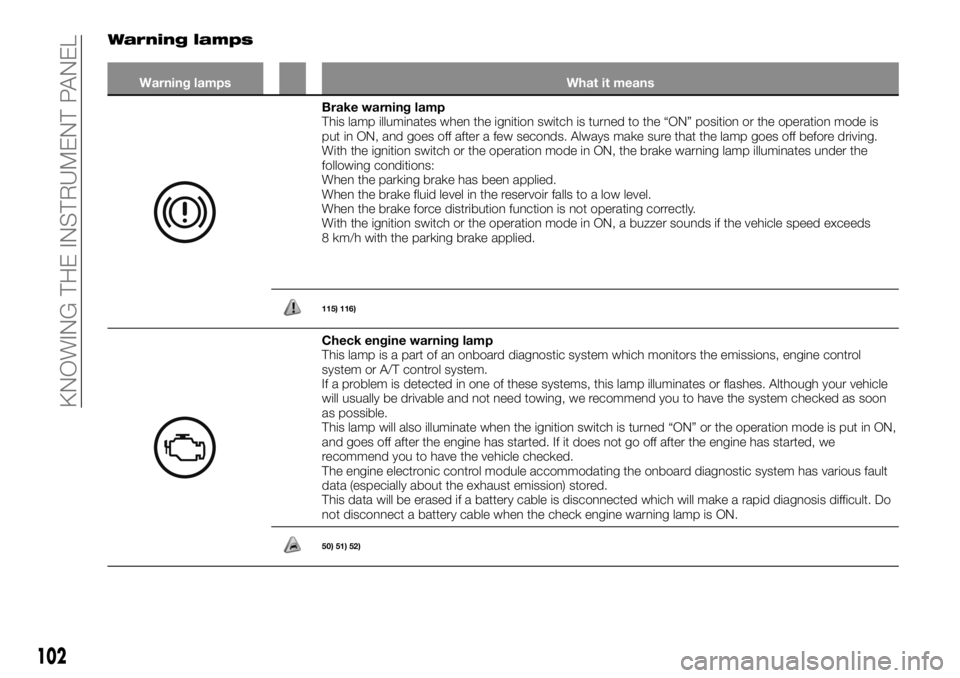
Brake warning lamp
This lamp illuminates when the ignition switch is turned to the “ON” position or the operation mode is
put in ON, and goes off after a few seconds. Always make sure that the lamp goes off before driving.
With the ignition switch or the operation mode in ON, the brake warning lamp illuminates under the
following conditions:
When the parking brake has been applied.
When the brake fluid level in the reservoir falls to a low level.
When the brake force distribution function is not operating correctly.
With the ignition switch or the operation mode in ON, a buzzer sounds if the vehicle speed exceeds
8 km/h with the parking brake applied.
115) 116)
Check engine warning lamp
This lamp is a part of an onboard diagnostic system which monitors the emissions, engine control
system or A/T control system.
If a problem is detected in one of these systems, this lamp illuminates or flashes. Although your vehicle
will usually be drivable and not need towing, we recommend you to have the system checked as soon
as possible.
This lamp will also illuminate when the ignition switch is turned “ON” or the operation mode is put in ON,
and goes off after the engine has started. If it does not go off after the engine has started, we
recommend you to have the vehicle checked.
The engine electronic control module accommodating the onboard diagnostic system has various fault
data (especially about the exhaust emission) stored.
This data will be erased if a battery cable is disconnected which will make a rapid diagnosis difficult. Do
not disconnect a battery cable when the check engine warning lamp is ON.
50) 51) 52)
102
KNOWING THE INSTRUMENT PANEL
Page 106 of 312
Warning lamps What it means
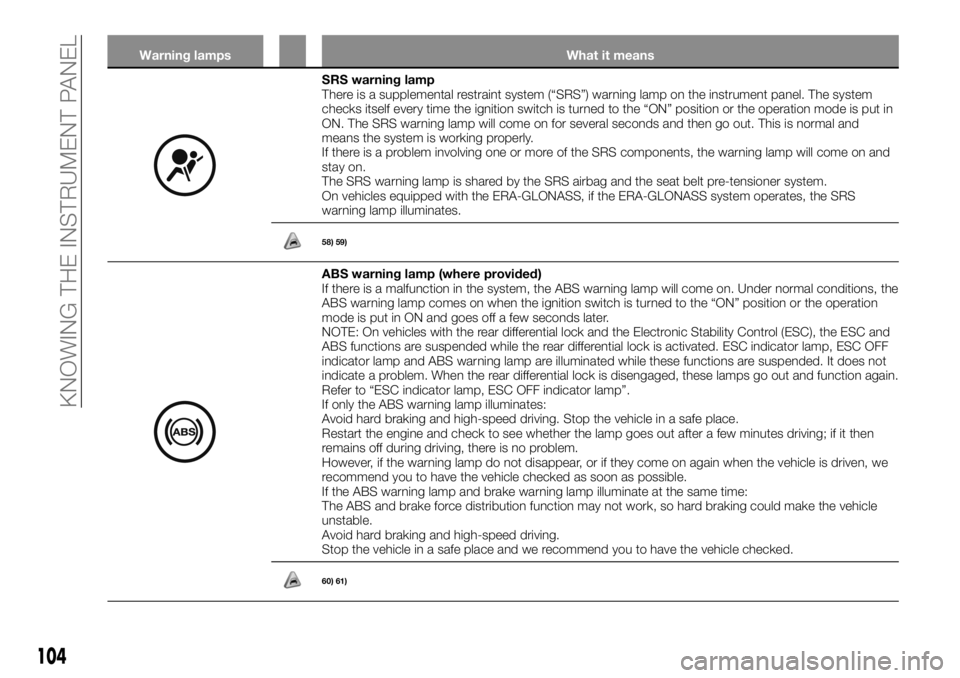
SRS warning lamp
There is a supplemental restraint system (“SRS”) warning lamp on the instrument panel. The system
checks itself every time the ignition switch is turned to the “ON” position or the operation mode is put in
ON. The SRS warning lamp will come on for several seconds and then go out. This is normal and
means the system is working properly.
If there is a problem involving one or more of the SRS components, the warning lamp will come on and
stay on.
The SRS warning lamp is shared by the SRS airbag and the seat belt pre-tensioner system.
On vehicles equipped with the ERA-GLONASS, if the ERA-GLONASS system operates, the SRS
warning lamp illuminates.
58) 59)
ABS warning lamp (where provided)
If there is a malfunction in the system, the ABS warning lamp will come on. Under normal conditions, the
ABS warning lamp comes on when the ignition switch is turned to the “ON” position or the operation
mode is put in ON and goes off a few seconds later.
NOTE: On vehicles with the rear differential lock and the Electronic Stability Control (ESC), the ESC and
ABS functions are suspended while the rear differential lock is activated. ESC indicator lamp, ESC OFF
indicator lamp and ABS warning lamp are illuminated while these functions are suspended. It does not
indicate a problem. When the rear differential lock is disengaged, these lamps go out and function again.
Refer to “ESC indicator lamp, ESC OFF indicator lamp”.
If only the ABS warning lamp illuminates:
Avoid hard braking and high-speed driving. Stop the vehicle in a safe place.
Restart the engine and check to see whether the lamp goes out after a few minutes driving; if it then
remains off during driving, there is no problem.
However, if the warning lamp do not disappear, or if they come on again when the vehicle is driven, we
recommend you to have the vehicle checked as soon as possible.
If the ABS warning lamp and brake warning lamp illuminate at the same time:
The ABS and brake force distribution function may not work, so hard braking could make the vehicle
unstable.
Avoid hard braking and high-speed driving.
Stop the vehicle in a safe place and we recommend you to have the vehicle checked.
60) 61)
104
KNOWING THE INSTRUMENT PANEL
Page 108 of 312
52)If the lamp illuminates while the engine
is running, avoid driving at high speeds and
have the system inspected by a Fiat
Dealership as soon as possible. Accelerator
pedal and brake pedal response may be
negatively influenced under these
conditions.
53)If it illuminates while the engine is
running, there is a problem in the charging
system. Immediately park your vehicle in a
safe place and we recommend you to have
it checked.
54)If this lamp illuminates when the engine
oil level is not low, have it inspected.
55)This warning lamp does not indicate
the amount of oil in the crankcase. This
must be determined by checking the oil
level on the dipstick, while the engine is
switched off.
56)If you continue driving with low engine
oil level or with this warning lamp
illuminated, engine seizure may occur.
57)Before moving your vehicle, check that
the warning lamp is OFF.
58)If any of the following conditions occur,
there may be a problem with the SRS
airbags and/or seat belt pre-tensioners,
and they may not function properly in a
collision or may suddenly activate without a
collision: 1 – Even when the ignition switch
or the operation mode is in ON, the SRS
warning lamp does not come on or it
remains on. 2 – The SRS warning lamp
comes on while driving.
59)The SRS airbags and seat belt
pre-tensioners are designed to help reduce
the risk of serious injury or death in certain
collisions. If either of the above conditions
occurs, immediately have your vehicle
checked by a Fiat Dealership.60)Any of the following indicates that the
ABS is not functioning and only the
standard brake system is working. (The
standard brake system is functioning
normally.) If this happens, take your vehicle
to a Fiat Dealership.
61)When the ignition switch is turned to
the “ON” position or the operation mode is
put in ON, the warning lamp does not
come on or it remains on and does not go
off . The warning lamp comes on while
driving.
106
KNOWING THE INSTRUMENT PANEL
Page 111 of 312
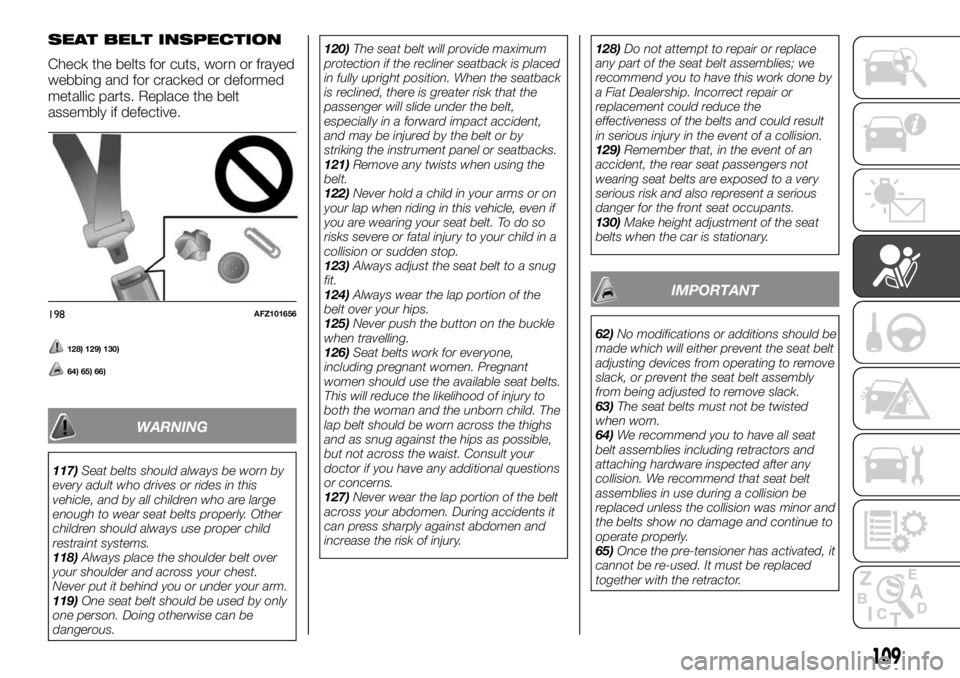
SEAT BELT INSPECTION
Check the belts for cuts, worn or frayed
webbing and for cracked or deformed
metallic parts. Replace the belt
assembly if defective.
128) 129) 130)
64) 65) 66)
WARNING
117)Seat belts should always be worn by
every adult who drives or rides in this
vehicle, and by all children who are large
enough to wear seat belts properly. Other
children should always use proper child
restraint systems.
118)Always place the shoulder belt over
your shoulder and across your chest.
Never put it behind you or under your arm.
119)One seat belt should be used by only
one person. Doing otherwise can be
dangerous.120)The seat belt will provide maximum
protection if the recliner seatback is placed
in fully upright position. When the seatback
is reclined, there is greater risk that the
passenger will slide under the belt,
especially in a forward impact accident,
and may be injured by the belt or by
striking the instrument panel or seatbacks.
121)Remove any twists when using the
belt.
122)Never hold a child in your arms or on
your lap when riding in this vehicle, even if
you are wearing your seat belt. To do so
risks severe or fatal injury to your child in a
collision or sudden stop.
123)Always adjust the seat belt to a snug
fit.
124)Always wear the lap portion of the
belt over your hips.
125)Never push the button on the buckle
when travelling.
126)Seat belts work for everyone,
including pregnant women. Pregnant
women should use the available seat belts.
This will reduce the likelihood of injury to
both the woman and the unborn child. The
lap belt should be worn across the thighs
and as snug against the hips as possible,
but not across the waist. Consult your
doctor if you have any additional questions
or concerns.
127)Never wear the lap portion of the belt
across your abdomen. During accidents it
can press sharply against abdomen and
increase the risk of injury.128)Do not attempt to repair or replace
any part of the seat belt assemblies; we
recommend you to have this work done by
a Fiat Dealership. Incorrect repair or
replacement could reduce the
effectiveness of the belts and could result
in serious injury in the event of a collision.
129)Remember that, in the event of an
accident, the rear seat passengers not
wearing seat belts are exposed to a very
serious risk and also represent a serious
danger for the front seat occupants.
130)Make height adjustment of the seat
belts when the car is stationary.
IMPORTANT
62)No modifications or additions should be
made which will either prevent the seat belt
adjusting devices from operating to remove
slack, or prevent the seat belt assembly
from being adjusted to remove slack.
63)The seat belts must not be twisted
when worn.
64)We recommend you to have all seat
belt assemblies including retractors and
attaching hardware inspected after any
collision. We recommend that seat belt
assemblies in use during a collision be
replaced unless the collision was minor and
the belts show no damage and continue to
operate properly.
65)Once the pre-tensioner has activated, it
cannot be re-used. It must be replaced
together with the retractor.
198AFZ101656
109
Page 116 of 312
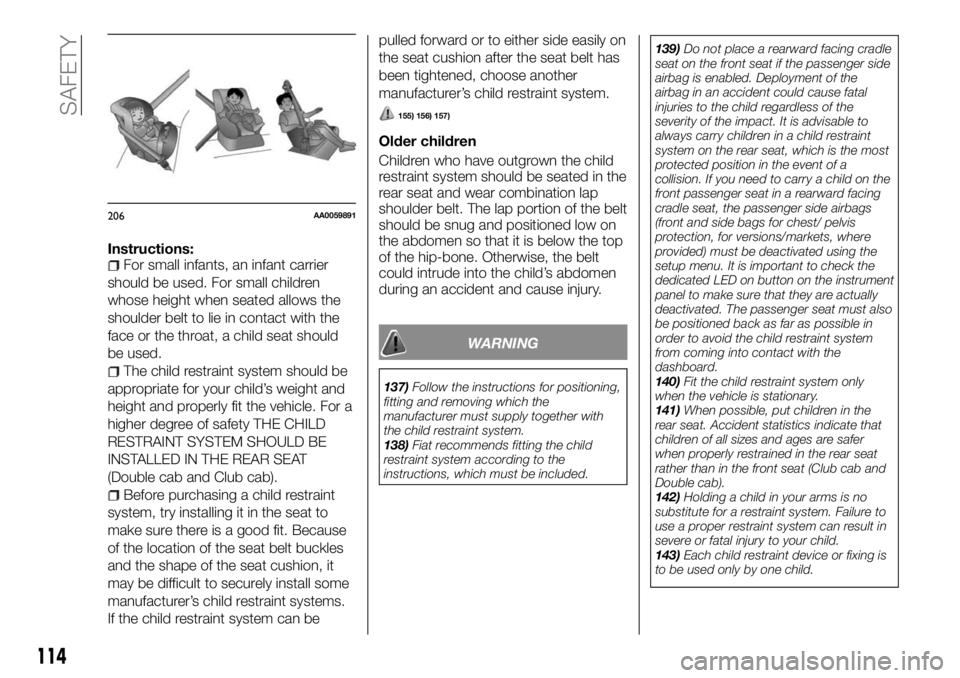
Instructions:For small infants, an infant carrier
should be used. For small children
whose height when seated allows the
shoulder belt to lie in contact with the
face or the throat, a child seat should
be used.
The child restraint system should be
appropriate for your child’s weight and
height and properly fit the vehicle. For a
higher degree of safety THE CHILD
RESTRAINT SYSTEM SHOULD BE
INSTALLED IN THE REAR SEAT
(Double cab and Club cab).
Before purchasing a child restraint
system, try installing it in the seat to
make sure there is a good fit. Because
of the location of the seat belt buckles
and the shape of the seat cushion, it
may be difficult to securely install some
manufacturer’s child restraint systems.
If the child restraint system can bepulled forward or to either side easily on
the seat cushion after the seat belt has
been tightened, choose another
manufacturer’s child restraint system.
155) 156) 157)
Older children
Children who have outgrown the child
restraint system should be seated in the
rear seat and wear combination lap
shoulder belt. The lap portion of the belt
should be snug and positioned low on
the abdomen so that it is below the top
of the hip-bone. Otherwise, the belt
could intrude into the child’s abdomen
during an accident and cause injury.
WARNING
137)Follow the instructions for positioning,
fitting and removing which the
manufacturer must supply together with
the child restraint system.
138)Fiat recommends fitting the child
restraint system according to the
instructions, which must be included.139)Do not place a rearward facing cradle
seat on the front seat if the passenger side
airbag is enabled. Deployment of the
airbag in an accident could cause fatal
injuries to the child regardless of the
severity of the impact. It is advisable to
always carry children in a child restraint
system on the rear seat, which is the most
protected position in the event of a
collision. If you need to carry a child on the
front passenger seat in a rearward facing
cradle seat, the passenger side airbags
(front and side bags for chest/ pelvis
protection, for versions/markets, where
provided) must be deactivated using the
setup menu. It is important to check the
dedicated LED on button on the instrument
panel to make sure that they are actually
deactivated. The passenger seat must also
be positioned back as far as possible in
order to avoid the child restraint system
from coming into contact with the
dashboard.
140)Fit the child restraint system only
when the vehicle is stationary.
141)When possible, put children in the
rear seat. Accident statistics indicate that
children of all sizes and ages are safer
when properly restrained in the rear seat
rather than in the front seat (Club cab and
Double cab).
142)Holding a child in your arms is no
substitute for a restraint system. Failure to
use a proper restraint system can result in
severe or fatal injury to your child.
143)Each child restraint device or fixing is
to be used only by one child.
206AA0059891
114
SAFETY
Page 131 of 312
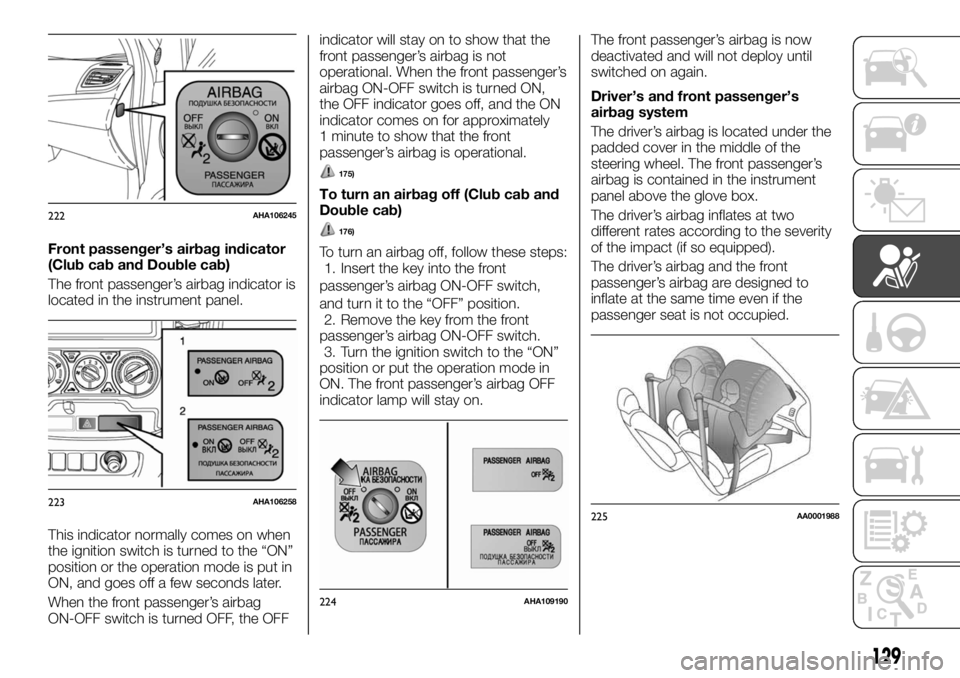
Front passenger’s airbag indicator
(Club cab and Double cab)
The front passenger’s airbag indicator is
located in the instrument panel.
This indicator normally comes on when
the ignition switch is turned to the “ON”
position or the operation mode is put in
ON, and goes off a few seconds later.
When the front passenger’s airbag
ON-OFF switch is turned OFF, the OFFindicator will stay on to show that the
front passenger’s airbag is not
operational. When the front passenger’s
airbag ON-OFF switch is turned ON,
the OFF indicator goes off, and the ON
indicator comes on for approximately
1 minute to show that the front
passenger’s airbag is operational.
175)
To turn an airbag off (Club cab and
Double cab)
176)
To turn an airbag off, follow these steps:
1. Insert the key into the front
passenger’s airbag ON-OFF switch,
and turn it to the “OFF” position.
2. Remove the key from the front
passenger’s airbag ON-OFF switch.
3. Turn the ignition switch to the “ON”
position or put the operation mode in
ON. The front passenger’s airbag OFF
indicator lamp will stay on.The front passenger’s airbag is now
deactivated and will not deploy until
switched on again.
Driver’s and front passenger’s
airbag system
The driver’s airbag is located under the
padded cover in the middle of the
steering wheel. The front passenger’s
airbag is contained in the instrument
panel above the glove box.
The driver’s airbag inflates at two
different rates according to the severity
of the impact (if so equipped).
The driver’s airbag and the front
passenger’s airbag are designed to
inflate at the same time even if the
passenger seat is not occupied.
222AHA106245
223AHA106258
224AHA109190
225AA0001988
129