seats FIAT FULLBACK 2017 Owner handbook (in English)
[x] Cancel search | Manufacturer: FIAT, Model Year: 2017, Model line: FULLBACK, Model: FIAT FULLBACK 2017Pages: 312, PDF Size: 12.31 MB
Page 136 of 312
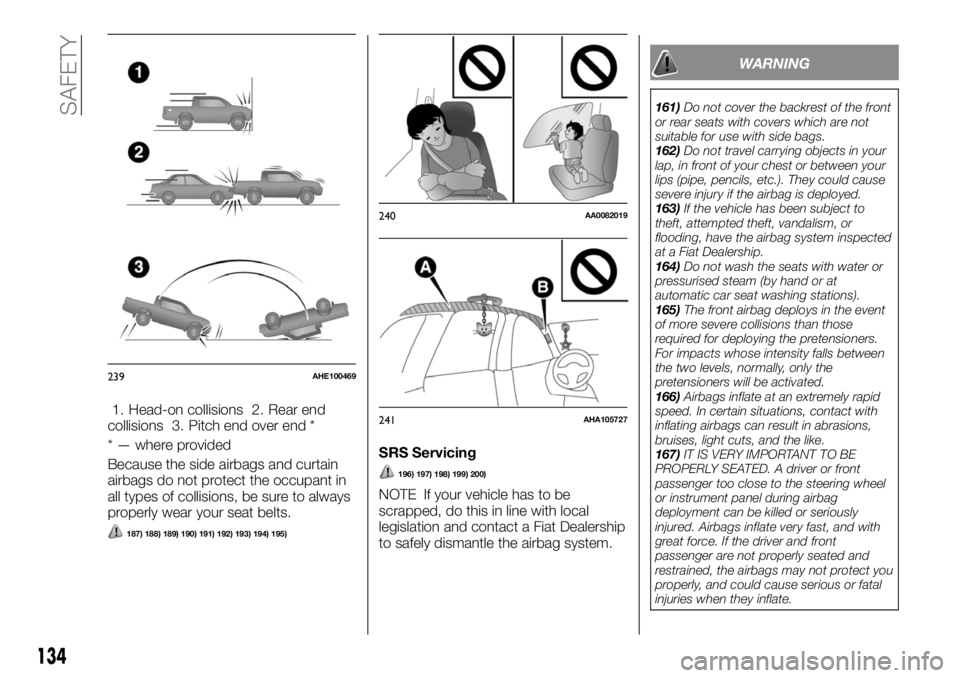
1. Head-on collisions 2. Rear end
collisions 3. Pitch end over end *
* — where provided
Because the side airbags and curtain
airbags do not protect the occupant in
all types of collisions, be sure to always
properly wear your seat belts.
187) 188) 189) 190) 191) 192) 193) 194) 195)
SRS Servicing
196) 197) 198) 199) 200)
NOTE If your vehicle has to be
scrapped, do this in line with local
legislation and contact a Fiat Dealership
to safely dismantle the airbag system.
WARNING
161)Do not cover the backrest of the front
or rear seats with covers which are not
suitable for use with side bags.
162)Do not travel carrying objects in your
lap, in front of your chest or between your
lips (pipe, pencils, etc.). They could cause
severe injury if the airbag is deployed.
163)If the vehicle has been subject to
theft, attempted theft, vandalism, or
flooding, have the airbag system inspected
at a Fiat Dealership.
164)Do not wash the seats with water or
pressurised steam (by hand or at
automatic car seat washing stations).
165)The front airbag deploys in the event
of more severe collisions than those
required for deploying the pretensioners.
For impacts whose intensity falls between
the two levels, normally, only the
pretensioners will be activated.
166)Airbags inflate at an extremely rapid
speed. In certain situations, contact with
inflating airbags can result in abrasions,
bruises, light cuts, and the like.
167)IT IS VERY IMPORTANT TO BE
PROPERLY SEATED. A driver or front
passenger too close to the steering wheel
or instrument panel during airbag
deployment can be killed or seriously
injured. Airbags inflate very fast, and with
great force. If the driver and front
passenger are not properly seated and
restrained, the airbags may not protect you
properly, and could cause serious or fatal
injuries when they inflate.
239AHE100469
240AA0082019
241AHA105727
134
SAFETY
Page 137 of 312
168)Do not sit on the edge of the seat, or
sit with your lower legs too close to the
instrument panel, or lean head or chest
close to the steering wheel or instrument
panel. Do not put feet or legs on or against
the instrument panel.
169)Always drive with your hands on the
rim of the steering wheel so that the airbag
can inflate freely if required. Do not drive
with your body bent forward. Keep your
back straight against the backrest.
170)Place all infants and small children in
the rear seat and properly restrained using
an appropriate child restraint system. The
rear seat is the safest for infants and
children.
171)Infants and small children should
never be unrestrained, stand up against
the instrument panel or held in your arms
or on your lap. They could be seriously
injured or killed in a collision, including
when the airbag inflates. They should be
properly seated in an appropriate child
restraint system. See the “Child restraint”
section of this owner’s manual.
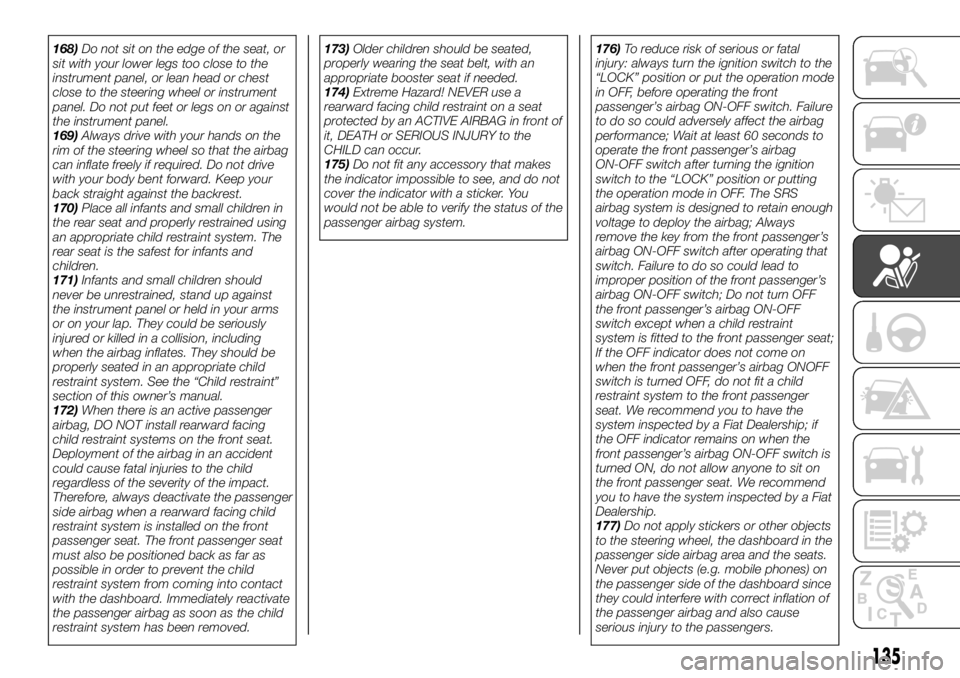
172)When there is an active passenger
airbag, DO NOT install rearward facing
child restraint systems on the front seat.
Deployment of the airbag in an accident
could cause fatal injuries to the child
regardless of the severity of the impact.
Therefore, always deactivate the passenger
side airbag when a rearward facing child
restraint system is installed on the front
passenger seat. The front passenger seat
must also be positioned back as far as
possible in order to prevent the child
restraint system from coming into contact
with the dashboard. Immediately reactivate
the passenger airbag as soon as the child
restraint system has been removed.173)Older children should be seated,
properly wearing the seat belt, with an
appropriate booster seat if needed.
174)Extreme Hazard! NEVER use a
rearward facing child restraint on a seat
protected by an ACTIVE AIRBAG in front of
it, DEATH or SERIOUS INJURY to the
CHILD can occur.
175)Do not fit any accessory that makes
the indicator impossible to see, and do not
cover the indicator with a sticker. You
would not be able to verify the status of the
passenger airbag system.176)To reduce risk of serious or fatal
injury: always turn the ignition switch to the
“LOCK” position or put the operation mode
in OFF, before operating the front
passenger’s airbag ON-OFF switch. Failure
to do so could adversely affect the airbag
performance; Wait at least 60 seconds to
operate the front passenger’s airbag
ON-OFF switch after turning the ignition
switch to the “LOCK” position or putting
the operation mode in OFF. The SRS
airbag system is designed to retain enough
voltage to deploy the airbag; Always
remove the key from the front passenger’s
airbag ON-OFF switch after operating that
switch. Failure to do so could lead to
improper position of the front passenger’s
airbag ON-OFF switch; Do not turn OFF
the front passenger’s airbag ON-OFF
switch except when a child restraint
system is fitted to the front passenger seat;
If the OFF indicator does not come on
when the front passenger’s airbag ONOFF
switch is turned OFF, do not fit a child
restraint system to the front passenger
seat. We recommend you to have the
system inspected by a Fiat Dealership; if
the OFF indicator remains on when the
front passenger’s airbag ON-OFF switch is
turned ON, do not allow anyone to sit on
the front passenger seat. We recommend
you to have the system inspected by a Fiat
Dealership.
177)Do not apply stickers or other objects
to the steering wheel, the dashboard in the
passenger side airbag area and the seats.
Never put objects (e.g. mobile phones) on
the passenger side of the dashboard since
they could interfere with correct inflation of
the passenger airbag and also cause
serious injury to the passengers.
135
Page 138 of 312
178)Do not set anything on, or attach
anything to, the instrument panel above the
glove box. It might strike and injure an
occupant if the airbag inflates.
179)Do not attach accessories to, or put
them in front of, the windscreen. These
objects could restrict the airbag inflation, or
strike and injure an occupant if the airbags
inflate.
180)Do not attach additional keys or
accessories (hard, pointed or heavy
objects) to the ignition key. Such objects
could prevent the driver’s knee airbag from
inflating normally or could be propelled to
cause serious injury if the airbag inflates.
181)Do not attach accessories to the
lower portion of the driver’s side instrument
panel. Such objects could prevent the
driver’s knee airbag from inflating normally
or could be propelled to cause serious
injury if the airbag inflates.
182)Do not put packages, pets or other
objects between the airbags and the driver
or front passenger. It could affect airbag
performance, or could cause injury when
the airbag inflates.
183)Right after the airbag inflation, several
airbag system components will be hot. Do
not touch these components. There is a
danger of being burnt.
184)The airbag system is designed to
work only once. Once the airbags have
deployed, they will not work again. They
must promptly be replaced and we
recommend you to have the entire airbag
system inspected by a Fiat Dealership.
185)Do not affix rigid objects to the
garment hooks or support handles.186)Do not rest your head, arms or
elbows on the door, windows or the area in
which the Window bag is located to avoid
possible injury during airbag inflation.
187)The airbag does not replace seat
belts but increases their efficiency.
Furthermore, since front airbags are not
deployed in low-speed frontal impacts,
side impacts, rear shunts or roll-overs, the
passengers are protected only by the seat
belts which must therefore be fastened at
all times.
188)The side airbags and curtain airbags
are designed to supplement the driver and
passenger seat belts in certain side
impacts. Seat belts should always be worn
properly, and the driver and passenger
should sit well back and upright without
leaning against the window or door.
189)The side airbag and curtain airbag
inflate with great force. The driver and
passenger should not put their arms out
the window, and should not lean against
the door, in order to reduce risk of serious
or possible fatal injury from the deploying
side airbag and curtain airbag.
190)Do not allow any rear seat occupant
to hold onto the seatback of either front
seat, in order to reduce risk of injury from
the deploying side airbag. Special care
should be taken with children.
191)Do not place any objects near or in
front of the seatback of either front seat.
They could interfere with proper side airbag
inflation, and also could cause injury if
thrown free by side airbag deployment.
192)Do not install seat covers on seats
with side airbags. Do not re-cover seats
that have side airbags. This could interfere
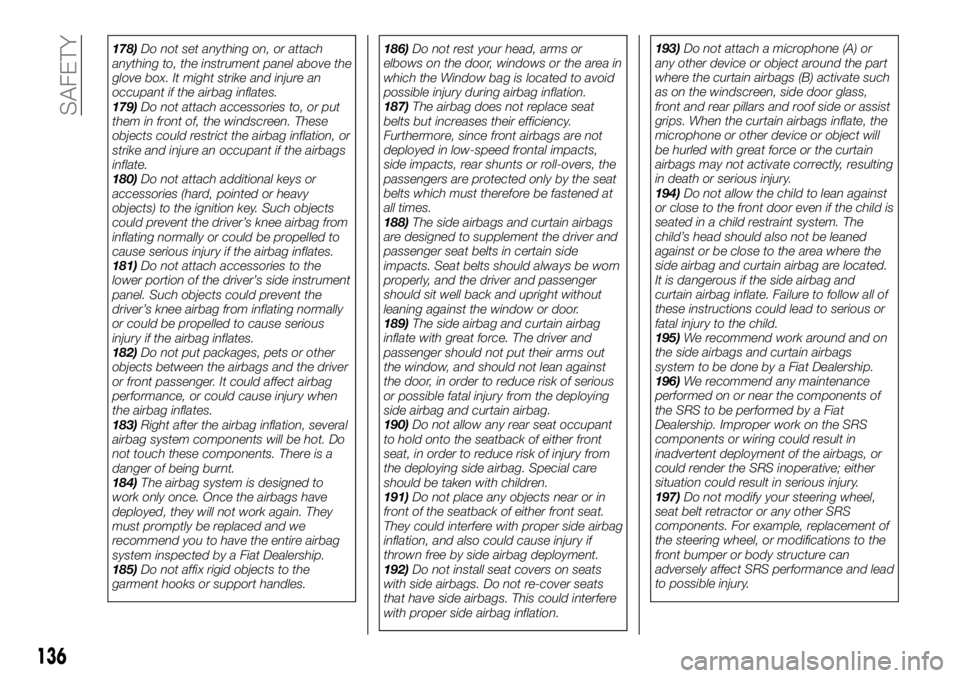
with proper side airbag inflation.193)Do not attach a microphone (A) or
any other device or object around the part
where the curtain airbags (B) activate such
as on the windscreen, side door glass,
front and rear pillars and roof side or assist
grips. When the curtain airbags inflate, the
microphone or other device or object will
be hurled with great force or the curtain
airbags may not activate correctly, resulting
in death or serious injury.
194)Do not allow the child to lean against
or close to the front door even if the child is
seated in a child restraint system. The
child’s head should also not be leaned
against or be close to the area where the
side airbag and curtain airbag are located.
It is dangerous if the side airbag and
curtain airbag inflate. Failure to follow all of
these instructions could lead to serious or
fatal injury to the child.
195)We recommend work around and on
the side airbags and curtain airbags
system to be done by a Fiat Dealership.
196)We recommend any maintenance
performed on or near the components of
the SRS to be performed by a Fiat
Dealership. Improper work on the SRS
components or wiring could result in
inadvertent deployment of the airbags, or
could render the SRS inoperative; either
situation could result in serious injury.
197)Do not modify your steering wheel,
seat belt retractor or any other SRS
components. For example, replacement of
the steering wheel, or modifications to the
front bumper or body structure can
adversely affect SRS performance and lead
to possible injury.
136
SAFETY
Page 139 of 312
198)If your vehicle has received any
damage, we recommend you to have the
SRS inspected to ensure it is in proper
working order.
199)On vehicles with the side airbag, do
not modify your front seats, centre pillar
and centre console. It can adversely affect
SRS performance and lead to possible
injury.
200)If you found any tear, scratch, crack
or damage to the portion where the airbag
is stored, you should have the SRS
inspected by a Fiat Dealership.ACTIVE SAFETY
SYSTEMS
Brake assist system (where
provided)
The brake assist system is a device
assisting drivers who cannot depress
the brake pedal firmly such as in
emergency stop situations and provides
greater braking force.
If the brake pedal is depressed
suddenly, the brakes will be applied
with more force than usual.
201)
NOTE Once the brake assist system is
operational, it maintains great braking
force even if the brake pedal is lightly
released. To stop its operation,
completely remove your foot from the
brake pedal.
NOTE When the brake assist system is
in use while driving, you may feel the
brake pedal attempt to resist, the pedal
moves in small motions in conjunction
with the operation noise, or the vehicle
body and the steering wheel vibrate.
This occurs when the brake assist
system is operating normally and does
not indicate faulty operation. Continue
to depress the brake pedal.
NOTE When the Electronic Stability
Control (ESC) indicator lamp is
illuminated, the brake assist system
may not function.Emergency stop signal system
(where provided)
This is a device that reduces the
possibility of rear end collisions by the
rapid and automatic blinking of the
hazard warning lamps to alert vehicles
approaching from behind during
sudden braking. When the emergency
brake system operates, the hazard
warning indicator lamp in the
instrument cluster blinks rapidly at the
same time.
NOTE Activating condition for the
emergency brake system > It activates
when all of the following conditions are
met.
The vehicle speed is approximately
55 km/h or higher.
The brake pedal has been
depressed, and the system judges that
it was sudden braking from the vehicle
deceleration and the operating
condition of the anti-lock brake system
(ABS).
Deactivating condition for the
emergency brake system > It
deactivates when one of the following
conditions is met.
The brake pedal is released.
The hazard warning flasher switch is
pressed.
The system judges that it was not
sudden braking from the vehicle
deceleration and the operating
137
condition of the anti-lock brake system
(ABS).
Page 147 of 312
DRIVING, ALCOHOL
AND DRUGS
Drunk driving is one of the most
frequent causes of accidents.
Your driving ability can be seriously
impaired even with blood alcohol levels
far below the legal minimum. If you
have been drinking, don’t drive. Ride
with a designated non-drinking driver,
call a cab or a friend, or use public
transportation. Drinking coffee or taking
a cold shower will not make you sober.
Similarly, prescription and
non-prescription drugs affect your
alertness, perception and reaction time.
Consult with your doctor or pharmacist
before driving while under the influence
of any of these medications.
220)
WARNING
220)NEVER DRINK AND DRIVE. Your
perceptions are less accurate, your reflexes
are slower and your judgment is impaired.
SAFE DRIVING
TECHNIQUES
Driving safety and protection against
injury cannot be fully ensured. However,
we recommend that you pay extra
attention to the following:
Seat belts
Before starting the vehicle, make sure
that you and your passengers have
fastened your seat belts.
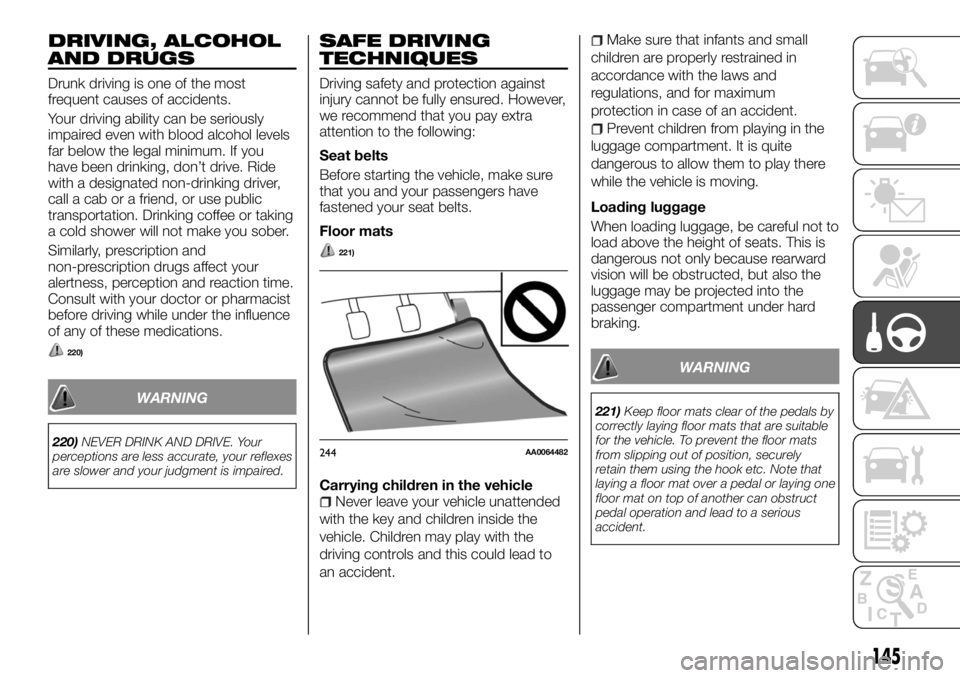
Floor mats
221)
Carrying children in the vehicleNever leave your vehicle unattended
with the key and children inside the
vehicle. Children may play with the
driving controls and this could lead to
an accident.
Make sure that infants and small
children are properly restrained in
accordance with the laws and
regulations, and for maximum
protection in case of an accident.
Prevent children from playing in the
luggage compartment. It is quite
dangerous to allow them to play there
while the vehicle is moving.
Loading luggage
When loading luggage, be careful not to
load above the height of seats. This is
dangerous not only because rearward
vision will be obstructed, but also the
luggage may be projected into the
passenger compartment under hard
braking.
WARNING
221)Keep floor mats clear of the pedals by
correctly laying floor mats that are suitable
for the vehicle. To prevent the floor mats
from slipping out of position, securely
retain them using the hook etc. Note that
laying a floor mat over a pedal or laying one
floor mat on top of another can obstruct
pedal operation and lead to a serious
accident.
244AA0064482
145
Page 215 of 312
Jack
The jack is used only for the purpose of
changing a tyre when a tyre is
punctured.
NOTE The jack is maintenance-free.
NOTE The jack is in conformity with EC
law as approximated by the Machinery
Directive 2006/42/EC.
NOTE The EC declaration of conformity
is attached to the section “Declaration
of Conformity” in the end of this
owner's manual. The business name,
full address of the manufacturer and of
his authorised representative and the
designation of the jack are described in
the EC declaration of conformity.
Removing and storing the tools,
jack and jack handle
Single cab
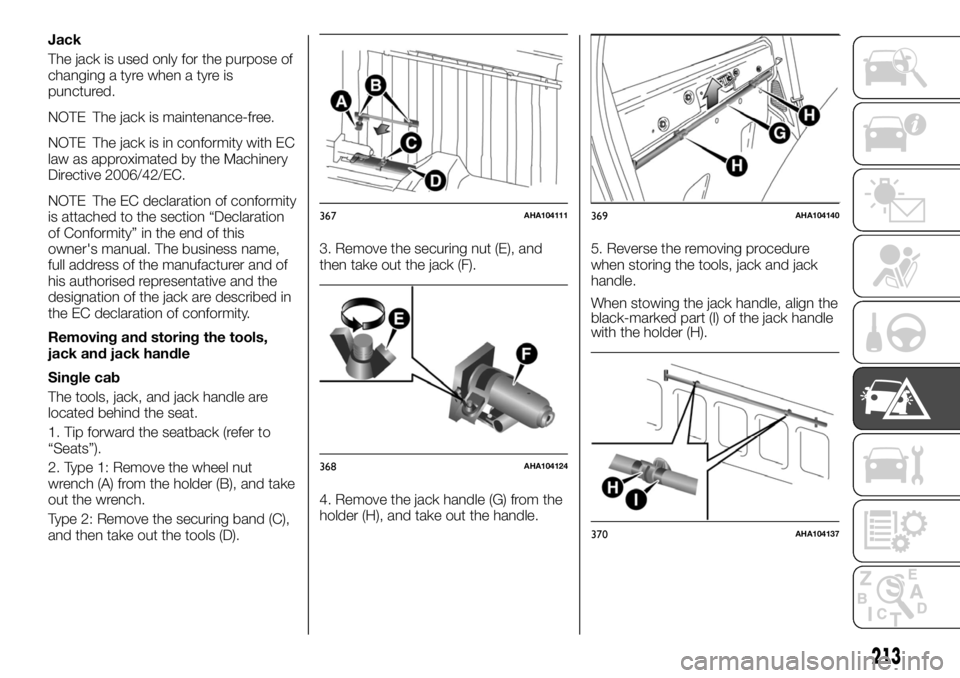
The tools, jack, and jack handle are
located behind the seat.
1. Tip forward the seatback (refer to
“Seats”).
2. Type 1: Remove the wheel nut
wrench (A) from the holder (B), and take
out the wrench.
Type 2: Remove the securing band (C),
and then take out the tools (D).3. Remove the securing nut (E), and
then take out the jack (F).
4. Remove the jack handle (G) from the
holder (H), and take out the handle.5. Reverse the removing procedure
when storing the tools, jack and jack
handle.
When stowing the jack handle, align the
black-marked part (I) of the jack handle
with the holder (H).
367AHA104111
368AHA104124
369AHA104140
370AHA104137
213
Page 221 of 312
308)
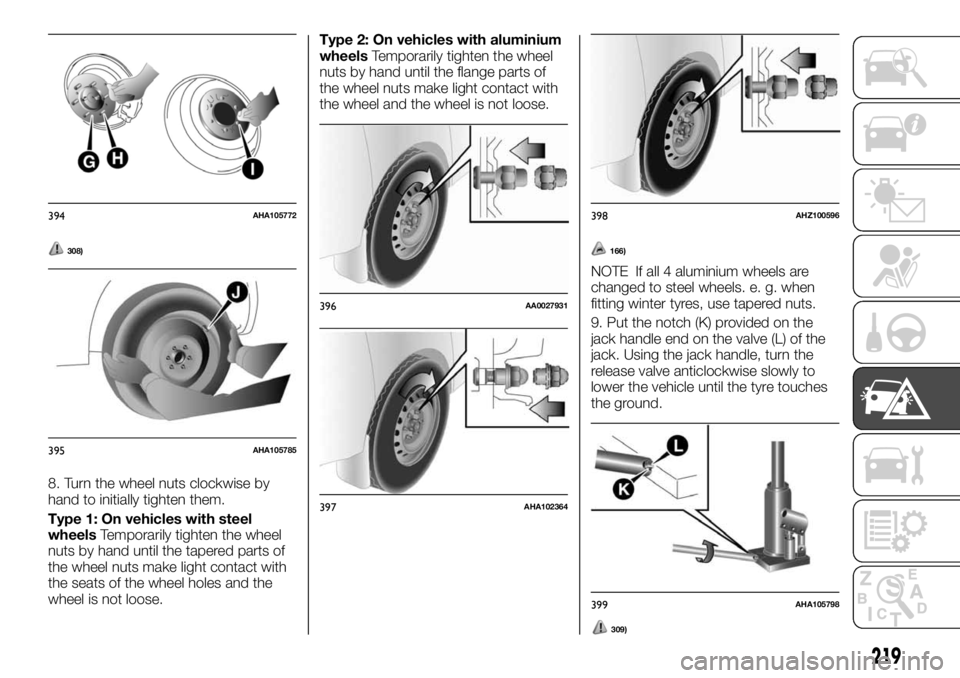
8. Turn the wheel nuts clockwise by
hand to initially tighten them.
Type 1: On vehicles with steel
wheelsTemporarily tighten the wheel
nuts by hand until the tapered parts of
the wheel nuts make light contact with
the seats of the wheel holes and the
wheel is not loose.Type 2: On vehicles with aluminium
wheelsTemporarily tighten the wheel
nuts by hand until the flange parts of
the wheel nuts make light contact with
the wheel and the wheel is not loose.
166)
NOTE If all 4 aluminium wheels are
changed to steel wheels. e. g. when
fitting winter tyres, use tapered nuts.
9. Put the notch (K) provided on the
jack handle end on the valve (L) of the
jack. Using the jack handle, turn the
release valve anticlockwise slowly to
lower the vehicle until the tyre touches
the ground.
394AHA105772
395AHA105785
396AA0027931
397AHA102364
398AHZ100596
399AHA105798
219
309)
Page 264 of 312
CLEANING THE
INTERIOR OF YOUR
VEHICLE
After cleaning the interior of your vehicle
with water, cleaner or similar, wipe and
dry in a shady, well-ventilated area.
NOTE If your vehicle has the demister
heater element of the rear window, to
clean the inside of the rear window,
always use a soft cloth and wipe the
window glass along the demister heater
element so as not to cause damage.
385) 386)
198)
Plastic, fabric and flocked parts
1. Lightly wipe these off with a soft
cloth soaked in a mild soap and water
solution.
2. Dip cloth in fresh water and wring it
out well. Using this cloth, wipe off the
detergent thoroughly.
NOTE Do not use cleaners,
conditioners, and protectants
containing silicones or wax. Such
products, when applied to the
instrument panels or other parts, may
cause reflections on the windscreen
and obscure vision. Also, if such
products get on the switches of the
electrical accessories, it may lead to
failure of these accessories.NOTE Do not use synthetic fiber or dry
cloth. They can cause discolouring or
damaging the surface.
NOTE Do not place a deodorizer on
the instrument panel or near lamps and
instruments. The ingredients for
deodorizer can cause discolouring or
cracking.
Upholstery
1. To maintain the value of your new
vehicle, handle the upholstery carefully
and keep the interior clean. Use a
vacuum cleaner and brush to clean the
seats. If stained, synthetic leather
should be cleaned with an appropriate
cleaner. Cloth fabrics can be cleaned
with either upholstery cleaner or a mild
soap and water solution.
2. Clean the carpeting with a vacuum
cleaner and remove any stains with
carpet cleaner. Oil and grease can be
removed by lightly dabbing with a clean
colourfast cloth and stain remover.
Genuine leather
1. To clean, lightly wipe the leather with
a soft cloth soaked in a mild soap and
water solution.
2. Dip cloth in fresh water and wring it
out well. Using this cloth, wipe off the
detergent thoroughly.
3. Apply leather protecting agent to the
genuine leather surface.NOTE If genuine leather is wet with
water or is washed in water, wipe off
water as quickly as possible with a dry,
soft cloth. If left damp, mildew may
grow.
NOTE Organic solvents such as
benzine, kerosene, alcohol and petrol,
acid or alkaline solvents may discolour
the genuine leather surface. Be sure to
use neutral detergents.
NOTE Remove oil substances quickly
as they can stain genuine leather.
NOTE The genuine leather surface may
harden and shrink if it is exposed to
direct rays of the sun for long hours.
When your vehicle is parked, place it in
the shade as much as possible.
NOTE When the temperature of the
vehicle interior rises in summer, vinyl
products left on the genuine leather
seat may deteriorate and stick to the
seat.
WARNING
385)Do not keep aerosol cans in the
vehicle: they might explode. Aerosol cans
must not be exposed to a temperature
exceeding 50°C. When the vehicle is
exposed to sunlight, the internal
temperature can greatly exceed this value.
262
SERVICING AND MAINTENANCE
Page 309 of 312
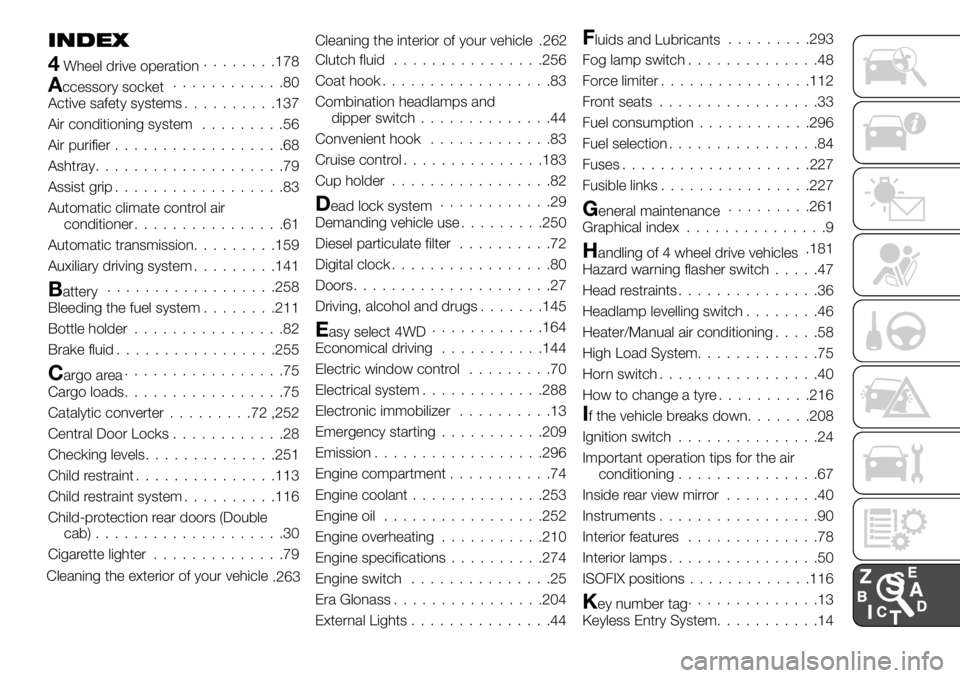
INDEX
4Wheel drive operation........178
Accessory socket............80
Active safety systems..........137
Air conditioning system.........56
Air purifier..................68
Ashtray....................79
Assist grip..................83
Automatic climate control air
conditioner................61
Automatic transmission.........159
Auxiliary driving system.........141
Battery..................258
Bleeding the fuel system........211
Bottle holder................82
Brake fluid.................255
Cargo area.................75
Cargo loads.................75
Catalytic converter.........72,252
Central Door Locks............28
Checking levels..............251
Child restraint...............113
Child restraint system..........116
Child-protection rear doors (Double
cab)....................30
Cigarette lighter..............79
Cleaning the exterior of your vehicle
.263Cleaning the interior of your vehicle .262
Clutch fluid................256
Coat hook..................83
Combination headlamps and
dipper switch..............44
Convenient hook.............83
Cruise control...............183
Cup holder.................82
Dead lock system............29
Demanding vehicle use.........250
Diesel particulate filter..........72
Digital clock.................80
Doors.....................27
Driving, alcohol and drugs.......145
Easy select 4WD............164
Economical driving...........144
Electric window control.........70
Electrical system.............288
Electronic immobilizer..........13
Emergency starting...........209
Emission..................296
Engine compartment...........74
Engine coolant..............253
Engine oil.................252
Engine overheating...........210
Engine specifications..........274
Engine switch...............25
Era Glonass................204
External Lights...............44
Fluids and Lubricants.........293
Fog lamp switch..............48
Force limiter................112
Front seats.................33
Fuel consumption............296
Fuel selection................84
Fuses....................227
Fusible links................227
General maintenance.........261
Graphical index...............9
Handling of 4 wheel drive vehicles.181
Hazard warning flasher switch.....47
Head restraints...............36
Headlamp levelling switch........46
Heater/Manual air conditioning.....58
High Load System.............75
Horn switch.................40
How to change a tyre..........216
If the vehicle breaks down.......208
Ignition switch...............24
Important operation tips for the air
conditioning...............67
Inside rear view mirror..........40
Instruments.................90
Interior features..............78
Interior lamps................50
ISOFIX positions.............116
Key number tag..............13
Keyless Entry System...........14
Page 310 of 312
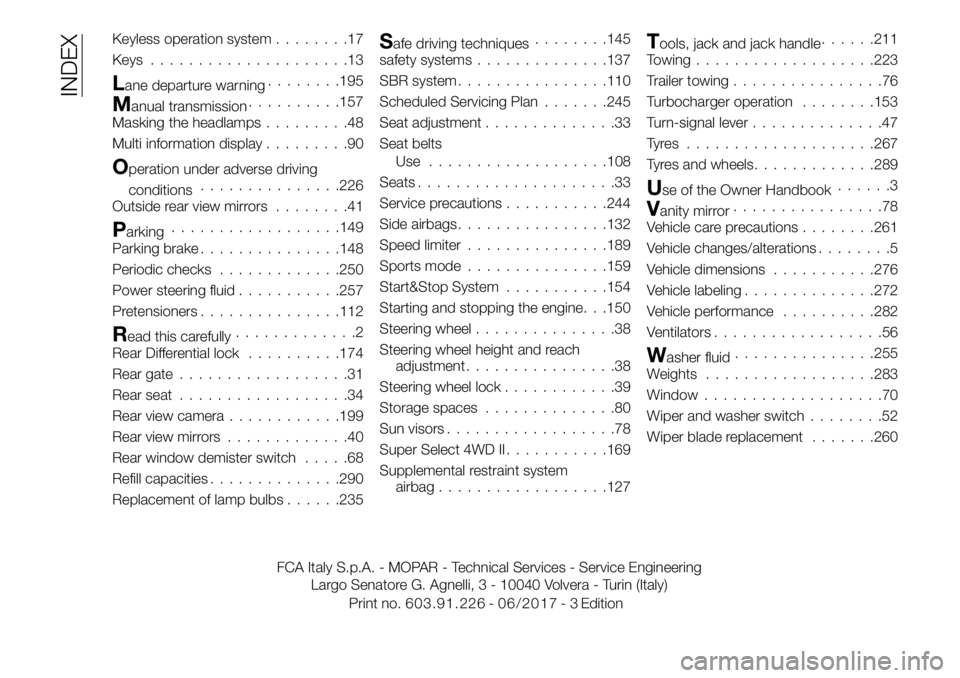
Keyless operation system........17
Keys.....................13
Lane departure warning........195
Manual transmission..........157
Masking the headlamps.........48
Multi information display.........90
Operation under adverse driving
conditions...............226
Outside rear view mirrors........41
Parking..................149
Parking brake...............148
Periodic checks.............250
Power steering fluid...........257
Pretensioners...............112
Read this carefully.............2
Rear Differential lock..........174
Rear gate..................31
Rear seat..................34
Rear view camera............199
Rear view mirrors.............40
Rear window demister switch.....68
Refill capacities..............290
Replacement of lamp bulbs......235
Safe driving techniques........145
safety systems..............137
SBR system................110
Scheduled Servicing Plan.......245
Seat adjustment..............33
Seat belts
Use ...................108
Seats.....................33
Service precautions...........244
Side airbags................132
Speed limiter...............189
Sports mode...............159
Start&Stop System...........154
Starting and stopping the engine. . .150
Steering wheel...............38
Steering wheel height and reach
adjustment................38
Steering wheel lock............39
Storage spaces..............80
Sun visors..................78
Super Select 4WD II...........169
Supplemental restraint system
airbag..................127Tools, jack and jack handle......211
Towing...................223
Trailer towing................76
Turbocharger operation........153
Turn-signal lever..............47
Tyres ....................267
Tyres and wheels.............289
Use of the Owner Handbook......3
Vanity mirror................78
Vehicle care precautions........261
Vehicle changes/alterations........5
Vehicle dimensions...........276
Vehicle labeling..............272
Vehicle performance..........282
Ventilators..................56
Washer fluid...............255
Weights..................283
Window...................70
Wiper and washer switch........52
Wiper blade replacement.......260
FCA Italy S.p.A. - MOPAR - Technical Services - Service Engineering
Largo Senatore G. Agnelli, 3 - 10040 Volvera - Turin (Italy)
INDEX
Print no.603.91.226 - -Edition 0 2017 /3 6