belt FIAT PANDA 2009 169 / 2.G User Guide
[x] Cancel search | Manufacturer: FIAT, Model Year: 2009, Model line: PANDA, Model: FIAT PANDA 2009 169 / 2.GPages: 226, PDF Size: 5.29 MB
Page 100 of 226
99KNOW YOUR
VEHICLESAFETYCORRECT USE
OF THE CAR
WARNING LIGHTS
AND MESSAGES
IN AN EMERGENCY
CAR
MAINTENANCE
TECHNICAL
SPECIFICATIONS
INDEX
F0Z0047m
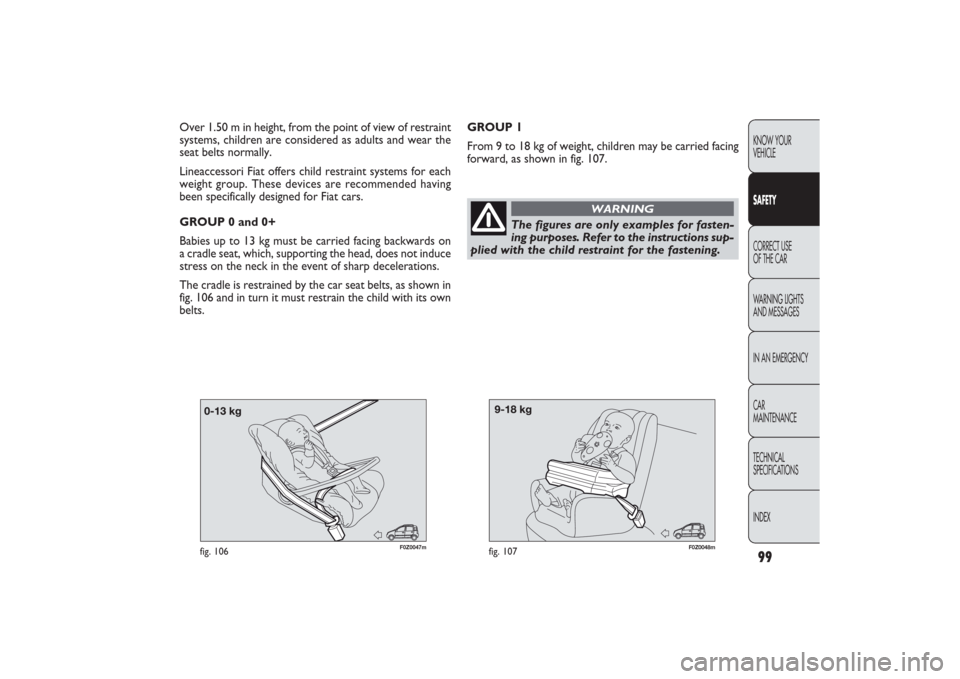
fig. 106
F0Z0048m
fig. 107
GROUP 1
From 9 to 18 kg of weight, children may be carried facing
forward, as shown in fig. 107. Over 1.50 m in height, from the point of view of restraint
systems, children are considered as adults and wear the
seat belts normally.
Lineaccessori Fiat offers child restraint systems for each
weight group. These devices are recommended having
been specifically designed for Fiat cars.
GROUP 0 and 0+
Babies up to 13 kg must be carried facing backwards on
a cradle seat, which, supporting the head, does not induce
stress on the neck in the event of sharp decelerations.
The cradle is restrained by the car seat belts, as shown in
fig. 106 and in turn it must restrain the child with its own
belts.
The figures are only examples for fasten-
ing purposes. Refer to the instructions sup-
plied with the child restraint for the fastening.
WARNING
091-110 PANDA EN 7-10-2009 13:46 Pagina 99
Page 101 of 226
100
KNOW YOUR
VEHICLE
SAFETY
CORRECT USE
OF THE CAR
WARNING LIGHTS
AND MESSAGES
IN AN EMERGENCY
CAR
MAINTENANCE
TECHNICAL
SPECIFICATIONS
INDEX
F0Z0049m
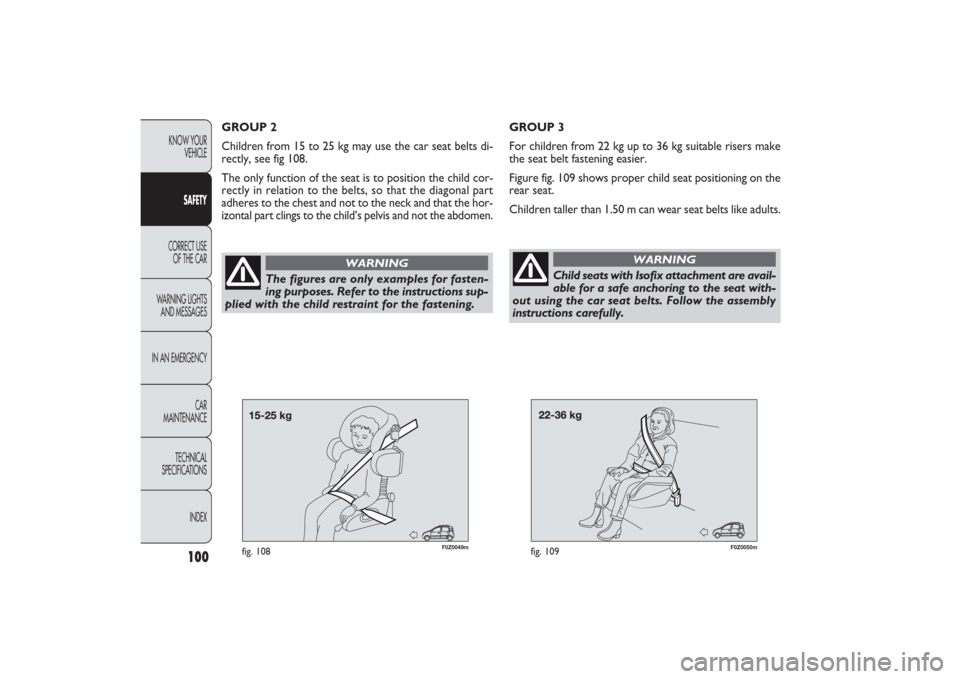
fig. 108
F0Z0050m
fig. 109
GROUP 2
Children from 15 to 25 kg may use the car seat belts di-
rectly, see fig 108.
The only function of the seat is to position the child cor-
rectly in relation to the belts, so that the diagonal part
adheres to the chest and not to the neck and that the hor-
izontal part clings to the child’s pelvis and not the abdomen.
The figures are only examples for fasten-
ing purposes. Refer to the instructions sup-
plied with the child restraint for the fastening.
WARNING
Child seats with Isofix attachment are avail-
able for a safe anchoring to the seat with-
out using the car seat belts. Follow the assembly
instructions carefully.
WARNING
GROUP 3
For children from 22 kg up to 36 kg suitable risers make
the seat belt fastening easier.
Figure fig. 109 shows proper child seat positioning on the
rear seat.
Children taller than 1.50 m can wear seat belts like adults.
091-110 PANDA EN 7-10-2009 13:46 Pagina 100
Page 102 of 226
101KNOW YOUR
VEHICLESAFETYCORRECT USE
OF THE CAR
WARNING LIGHTS
AND MESSAGES
IN AN EMERGENCY
CAR
MAINTENANCE
TECHNICAL
SPECIFICATIONS
INDEX
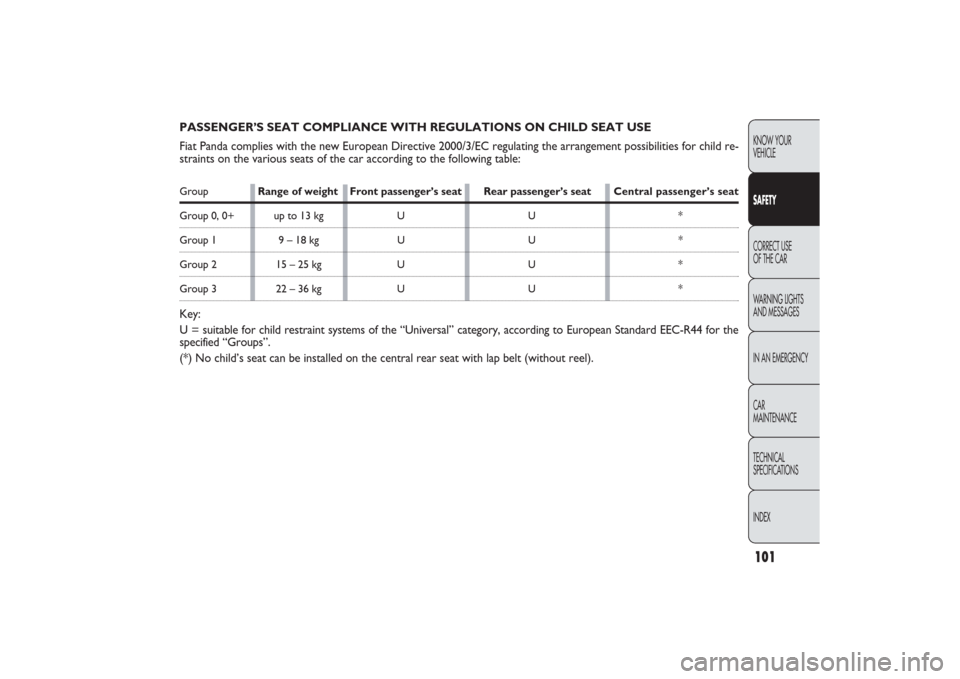
PASSENGER’S SEAT COMPLIANCE WITH REGULATIONS ON CHILD SEAT USE
Fiat Panda complies with the new European Directive 2000/3/EC regulating the arrangement possibilities for child re-
straints on the various seats of the car according to the following table:GroupRange of weight Front passenger’s seat Rear passenger’s seat Central passenger’s seatGroup 0, 0+ up to 13 kg U U *Group 1 9 – 18 kg U U *Group 2 15 – 25 kg U U *Group 3 22 – 36 kg U U *Key:
U = suitable for child restraint systems of the “Universal” category, according to European Standard EEC-R44 for the
specified “Groups”.
(*) No child’s seat can be installed on the central rear seat with lap belt (without reel).
091-110 PANDA EN 7-10-2009 13:46 Pagina 101
Page 103 of 226
102
KNOW YOUR
VEHICLE
SAFETY
CORRECT USE
OF THE CAR
WARNING LIGHTS
AND MESSAGES
IN AN EMERGENCY
CAR
MAINTENANCE
TECHNICAL
SPECIFICATIONS
INDEX
Below is a summary of the safety rules to be followed for
carrying children.❒
Install the child seats on the rear seat, which is the most
protected position in the event of an accident.
❒
If the passenger’s air bag is deactivated always check the
amber warning light
F
on the instrument panel to
make sure that it has actually been deactivated.
❒
Carefully follow the instructions supplied with the child
restraint system which are mandatory by law. Keep the
instructions in the car along with the other papers and
this handbook. Do not use second-hand child seats with-
out instructions.
❒
Always check the seat belt is well fastened by pulling the
webbing.
❒
Only one child is to be strapped to each retaining system.
❒
Always check the seat belts do not fit around the child’s
throat.
❒
While travelling, do not let the child sit incorrectly or
release the belts.
❒
Never carry children on your lap, even newborns. No-one
can hold a child in the event of an accident.
❒
In case of an accident, replace the child seat with a new
one.
In cars fitted with passenger’s air bag nev-
er place child restraint systems on the front
seat, since children must never travel on the
front seat.
WARNING
091-110 PANDA EN 7-10-2009 13:46 Pagina 102
Page 104 of 226
103KNOW YOUR
VEHICLESAFETYCORRECT USE
OF THE CAR
WARNING LIGHTS
AND MESSAGES
IN AN EMERGENCY
CAR
MAINTENANCE
TECHNICAL
SPECIFICATIONS
INDEX
F0Z0055m
fig. 110
PRESETTING FOR MOUNTING
THE “ISOFIX” TYPE CHILD
RESTRAINT SYSTEM (for versions/markets where provided)
The car is preset for mounting the Universal Isofix child
restraint system, a new European standardised system for
carrying children safely. Isofix type is an additional option
that does not prevent from using traditional child restraint
systems.
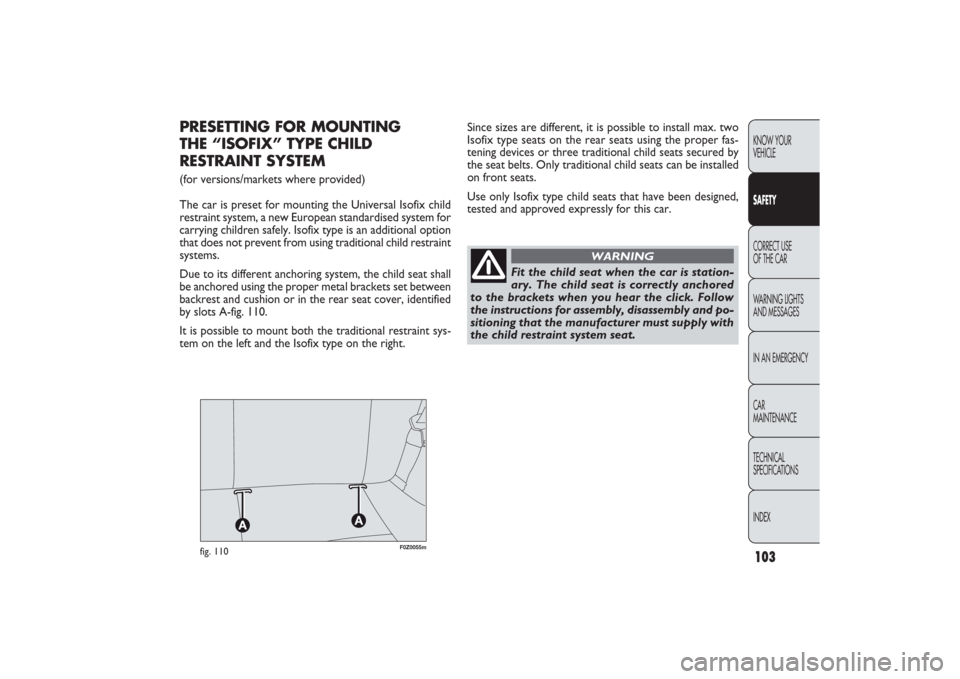
Due to its different anchoring system, the child seat shall
be anchored using the proper metal brackets set between
backrest and cushion or in the rear seat cover, identified
by slots A-fig. 110.
It is possible to mount both the traditional restraint sys-
tem on the left and the Isofix type on the right.Since sizes are different, it is possible to install max. two
Isofix type seats on the rear seats using the proper fas-
tening devices or three traditional child seats secured by
the seat belts. Only traditional child seats can be installed
on front seats.
Use only Isofix type child seats that have been designed,
tested and approved expressly for this car.
Fit the child seat when the car is station-
ary. The child seat is correctly anchored
to the brackets when you hear the click. Follow
the instructions for assembly, disassembly and po-
sitioning that the manufacturer must supply with
the child restraint system seat.
WARNING
091-110 PANDA EN 7-10-2009 13:46 Pagina 103
Page 105 of 226
104
KNOW YOUR
VEHICLE
SAFETY
CORRECT USE
OF THE CAR
WARNING LIGHTS
AND MESSAGES
IN AN EMERGENCY
CAR
MAINTENANCE
TECHNICAL
SPECIFICATIONS
INDEX
AIR BAGThe car is fitted with front air bags (for versions/markets
where provided) for the driver and the passenger and front
side bags (side bag – window bag).
FRONT AIR BAGS
The front driver/passenger air bags have been designed to
protect the occupants in the event of head-on crashes of
medium-high severity, by placing the cushion between the
occupant and the steering wheel or dashboard.
Front air bags are designed to protect car’s passengers in
head-on crashes and therefore non-activation in other
types of collisions (side collisions, rear shunts, roll-overs,
etc.) is not a system malfunction.
An electronic control unit will make the bag inflate in the
event of a front crash.
The bag will inflate instantaneously placing itself between
the front passengers’ body and the structures which could
cause injury. It will deflate immediately afterwards.
Driver and passenger front airbags are not a replacement
of but complementary to the seat belts, which should al-
ways be worn, as specified by law in Europe and most non-
European countries.
In the event of an impact, those not wearing a seat belt will
move forward and come into contact with the bag which
is still inflating. The protection offered by the air bag cush-
ion is reduced in such a case.Front air bags may not be activated in the following situ-
ations:
❒
in collisions against highly deformable objects not af-
fecting the car front surface (e.g. bumper collision against
guard rail, etc.);
❒
car wedging under other vehicles or protective barri-
ers (e.g. trucks or guard rails);
they could not provide any additional protection compared
with seat belts, so their activation would be improper.
Therefore, failure to come into action in the above cir-
cumstances does not mean that the system is not work-
ing properly.
Do not apply stickers or other objects to
the steering wheel, to the passenger’s side
air bag cover side or on the side roof lining. Nev-
er put objects (e.g. mobile phones) on the pas-
senger’s side dashboard since they could interfere
with proper air bag inflation and also cause seri-
ous injury to the passengers.
WARNING
091-110 PANDA EN 7-10-2009 13:46 Pagina 104
Page 106 of 226
105KNOW YOUR
VEHICLESAFETYCORRECT USE
OF THE CAR
WARNING LIGHTS
AND MESSAGES
IN AN EMERGENCY
CAR
MAINTENANCE
TECHNICAL
SPECIFICATIONS
INDEX
F0Z0693m
fig. 111
F0Z0057m
fig. 112
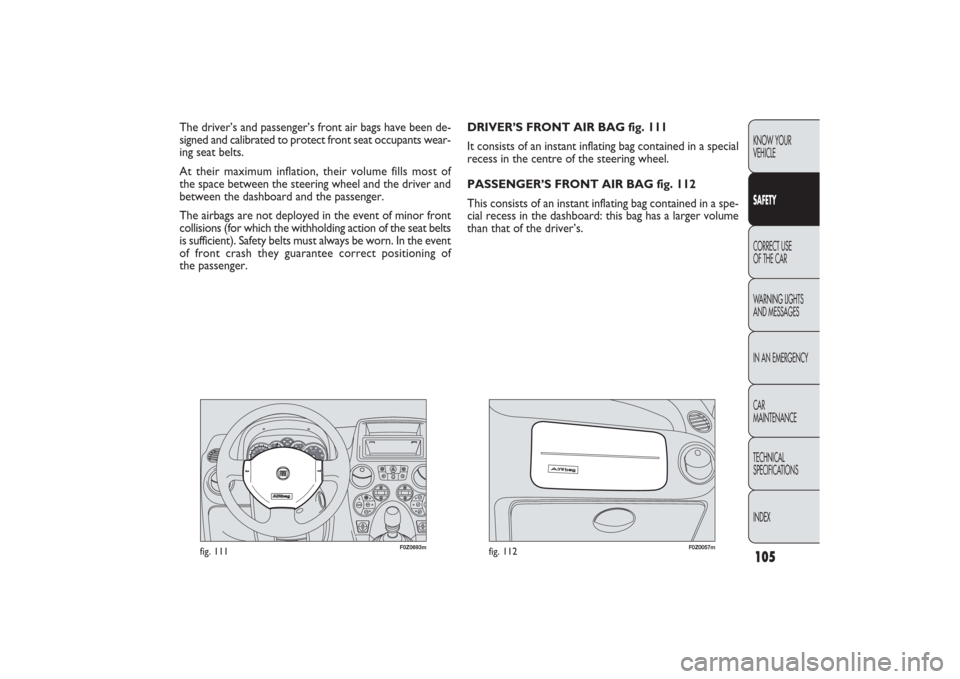
DRIVER’S FRONT AIR BAG fig. 111
It consists of an instant inflating bag contained in a special
recess in the centre of the steering wheel.
PASSENGER’S FRONT AIR BAG fig. 112
This consists of an instant inflating bag contained in a spe-
cial recess in the dashboard: this bag has a larger volume
than that of the driver’s. The driver’s and passenger’s front air bags have been de-
signed and calibrated to protect front seat occupants wear-
ing seat belts.
At their maximum inflation, their volume fills most of
the space between the steering wheel and the driver and
between the dashboard and the passenger.
The airbags are not deployed in the event of minor front
collisions (for which the withholding action of the seat belts
is sufficient). Safety belts must always be worn. In the event
of front crash they guarantee correct positioning of
the passenger.
091-110 PANDA EN 7-10-2009 13:46 Pagina 105
Page 111 of 226
110
KNOW YOUR
VEHICLE
SAFETY
CORRECT USE
OF THE CAR
WARNING LIGHTS
AND MESSAGES
IN AN EMERGENCY
CAR
MAINTENANCE
TECHNICAL
SPECIFICATIONS
INDEX
The front air bag is triggered in case of
stronger shocks with respect to that of pre-
tensioners. For collisions in the range between the
two thresholds, it is normal for only the preten-
sioners to be activated.
WARNING
Do not hook rigid objects to the coat
hooks and to the support handles.
WARNING
The air bag does not replace seat belts but
increases their efficiency. Furthermore,
since front air bags are not deployed in low speed
collisions, side collisions, rear-end shunts or roll-
overs, the passengers are only protected by the
seat belts which must be fastened at all times.
WARNING
If the car has been stolen or in case of at-
tempt to steal it, if it has been subjected
to vandals or floods, have the air bag system
checked by Fiat Dealership.
WARNING
Do not wash the seats with water or pres-
surized vapour (hand washing or auto-
matic seat washing stations).
WARNING
Turning the ignition key to MAR, the warn-
ing light
F
(airbag on passenger’s side en-
abled) goes on and flashes for a few seconds, thus
reminding the passenger that the airbag on his/her
side will deploy in the event of a collision, then it
switches off.
WARNING
091-110 PANDA EN 7-10-2009 13:46 Pagina 110
Page 125 of 226
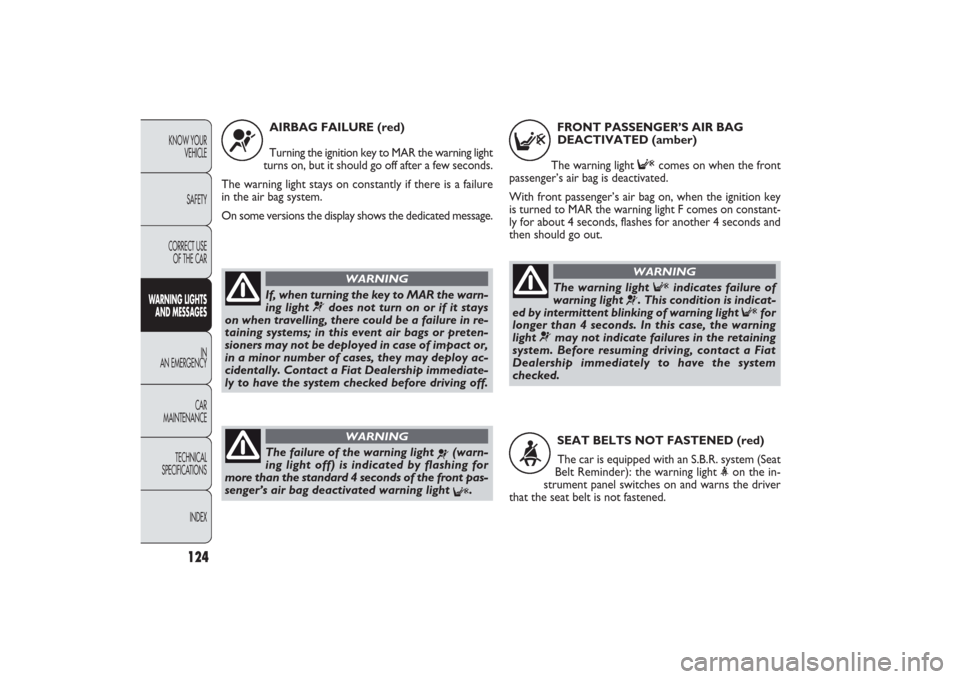
SEAT BELTS NOT FASTENED (red)
The car is equipped with an S.B.R. system (Seat
Belt Reminder): the warning light
<
on the in-
strument panel switches on and warns the driver
that the seat belt is not fastened.
124
KNOW YOUR
VEHICLE
SAFETY
CORRECT USE
OF THE CAR
WARNING LIGHTS
AND MESSAGES
IN
AN EMERGENCY
CAR
MAINTENANCE
TECHNICAL
SPECIFICATIONS
INDEX
AIRBAG FAILURE (red)
Turning the ignition key to MAR the warning light
turns on, but it should go off after a few seconds.
The warning light stays on constantly if there is a failure
in the air bag system.
On some versions the display shows the dedicated message.
¬
If, when turning the key to MAR the warn-
ing light ¬does not turn on or if it stays
on when travelling, there could be a failure in re-
taining systems; in this event air bags or preten-
sioners may not be deployed in case of impact or,
in a minor number of cases, they may deploy ac-
cidentally. Contact a Fiat Dealership immediate-
ly to have the system checked before driving off.
WARNING
The failure of the warning light
¬(warn-
ing light off) is indicated by flashing for
more than the standard 4 seconds of the front pas-
senger’s air bag deactivated warning light
F
.
WARNING
FRONT PASSENGER’S AIR BAG
DEACTIVATED (amber)
The warning light
F
comes on when the front
passenger’s air bag is deactivated.
With front passenger’s air bag on, when the ignition key
is turned to MAR the warning light F comes on constant-
ly for about 4 seconds, flashes for another 4 seconds and
then should go out.
The warning light
F
indicates failure of
warning light
¬. This condition is indicat-
ed by intermittent blinking of warning light
F
for
longer than 4 seconds. In this case, the warning
light ¬may not indicate failures in the retaining
system. Before resuming driving, contact a Fiat
Dealership immediately to have the system
checked.
WARNING
F<
123-134 PANDA EN 7-10-2009 13:49 Pagina 124
Page 171 of 226
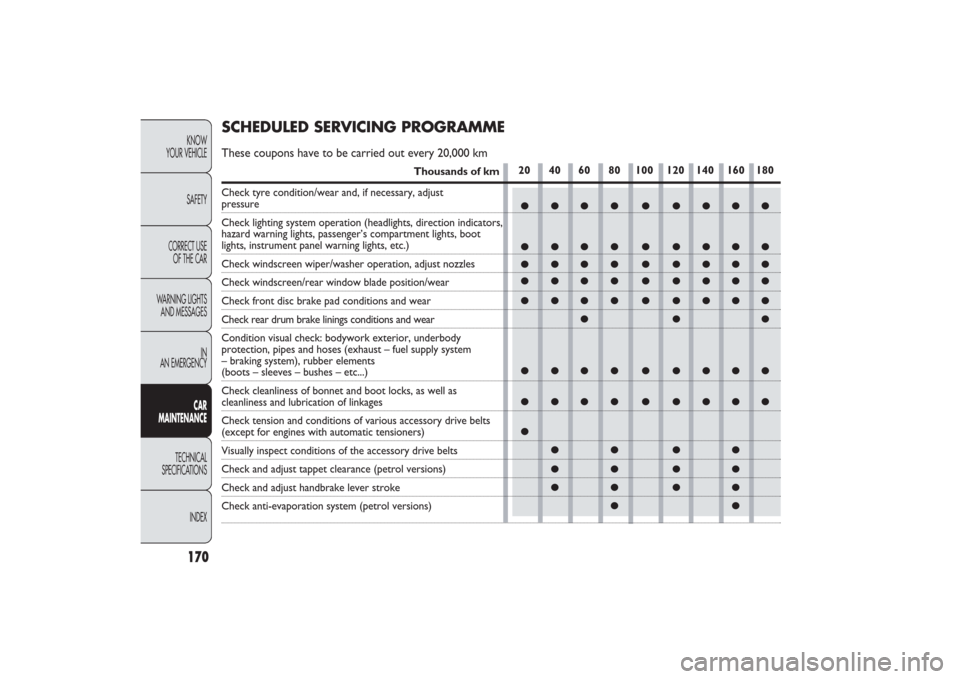
●●●● ● ●●●●
●●●● ● ●●●●
●●●● ● ●●●●
●●●● ● ●●●●
●●●● ● ●●●●
●●●
●●●● ● ●●●●
●●●● ● ●●●●
●
●● ●●
●● ●●
●● ●●
●●20 40 60 80 100 120 140 160 180
SCHEDULED SERVICING PROGRAMMEThese coupons have to be carried out every 20,000 km
Thousands of km
Check tyre condition/wear and, if necessary, adjust
pressure
Check lighting system operation (headlights, direction indicators,
hazard warning lights, passenger’s compartment lights, boot lights, instrument panel warning lights, etc.)Check windscreen wiper/washer operation, adjust nozzlesCheck windscreen/rear window blade position/wearCheck front disc brake pad conditions and wearCheck rear drum brake linings conditions and wear
Condition visual check: bodywork exterior, underbody
protection, pipes and hoses (exhaust – fuel supply system
– braking system), rubber elements (boots – sleeves – bushes – etc...)
Check cleanliness of bonnet and boot locks, as well as cleanliness and lubrication of linkages
Check tension and conditions of various accessory drive belts (except for engines with automatic tensioners)Visually inspect conditions of the accessory drive beltsCheck and adjust tappet clearance (petrol versions)Check and adjust handbrake lever stroke Check anti-evaporation system (petrol versions)
INDEX TECHNICAL
SPECIFICATIONSCAR
MAINTENANCEIN
AN EMERGENCY WARNING LIGHTS
AND MESSAGESCORRECT USE
OF THE CARSAFETYKNOW
YOUR VEHICLE
170
169-190 PANDA EN 7-10-2009 14:14 Pagina 170