boot FIAT PANDA 2009 169 / 2.G User Guide
[x] Cancel search | Manufacturer: FIAT, Model Year: 2009, Model line: PANDA, Model: FIAT PANDA 2009 169 / 2.GPages: 226, PDF Size: 5.29 MB
Page 139 of 226
138KNOW
YOUR VEHICLE
SAFETY
CORRECT USE
OF THE CAR
WARNING LIGHTS
AND MESSAGES
IN
AN EMERGENCYCAR
MAINTENANCE
TECHNICAL
SPECIFICATIONS
INDEX
F0Z0171m
fig. 121
Please note that:❒
the jack weights 1.76 kg;
❒
the jack requires no adjustment;
❒
the jack cannot be repaired. If it breaks it must be re-
placed with a new jack;
❒
no tool other than its cranking device may be fitted on
the jack.
To change a wheel proceed as follows:
❒
stop the car in a position so that it is not a danger for
on-coming traffic and where you can replace the wheel
safely. The ground must be flat and compact;
❒
turn the engine off and pull up the handbrake.
❒
engage the first gear or reverse;
❒
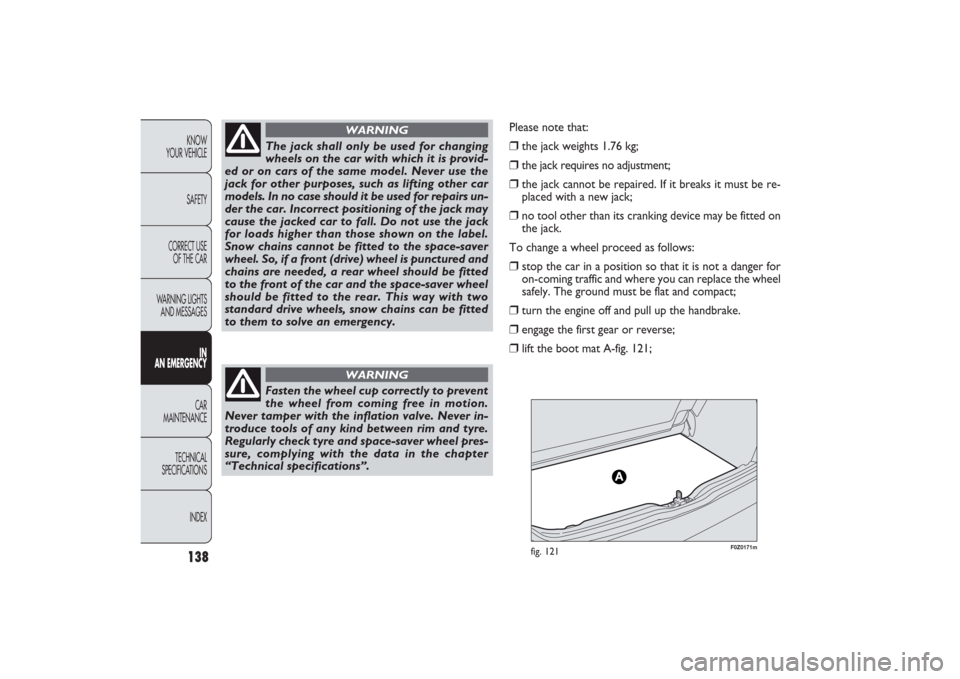
lift the boot mat A-fig. 121;
Fasten the wheel cup correctly to prevent
the wheel from coming free in motion.
Never tamper with the inflation valve. Never in-
troduce tools of any kind between rim and tyre.
Regularly check tyre and space-saver wheel pres-
sure, complying with the data in the chapter
“Technical specifications”.
WARNING
The jack shall only be used for changing
wheels on the car with which it is provid-
ed or on cars of the same model. Never use the
jack for other purposes, such as lifting other car
models. In no case should it be used for repairs un-
der the car. Incorrect positioning of the jack may
cause the jacked car to fall. Do not use the jack
for loads higher than those shown on the label.
Snow chains cannot be fitted to the space-saver
wheel. So, if a front (drive) wheel is punctured and
chains are needed, a rear wheel should be fitted
to the front of the car and the space-saver wheel
should be fitted to the rear. This way with two
standard drive wheels, snow chains can be fitted
to them to solve an emergency.
WARNING
135-168 PANDA EN 7-10-2009 14:06 Pagina 138
Page 144 of 226
143KNOW
YOUR VEHICLE
SAFETY
CORRECT USE
OF THE CAR
WARNING LIGHTS
AND MESSAGESIN
AN EMERGENCYCAR
MAINTENANCE
TECHNICAL
SPECIFICATIONS
INDEX
At the end of the procedure❒
stow the space-saving wheel D-fig. 122 in the space pro-
vided in the boot;
❒
fit the partially-open jack in its box C by forcing it slight-
ly to prevent it from vibrating when travelling;
❒
put the tools back into their locations;
❒
arrange the container and tools in the spare wheel and
secure the clamping device B;
❒
correctly reposition the boot stiff cover.
IMPORTANT Do not use inner tubes with tubeless tyres.
Check the inflation pressure of the tyres and the space-
saving wheel regularly.
IMPORTANT You will need to change the set of bolts if
you want to change the type of wheels fitted (alloy rims
instead of steel rims, and vice versa).The whole set of fas-
tening bolts must be replaced by another set of suitably
sized bolts and use a special space-saving wheel having dif-
ferent building characteristics.
You should keep the bolts and space-saving wheel in case
you decide to use the original type of wheel later on.
F0Z0607m
fig. 131
QUICK TYRE REPAIR KIT FIX & GO
automaticThe quick tyre repair kit Fix & Go automatic is placed in
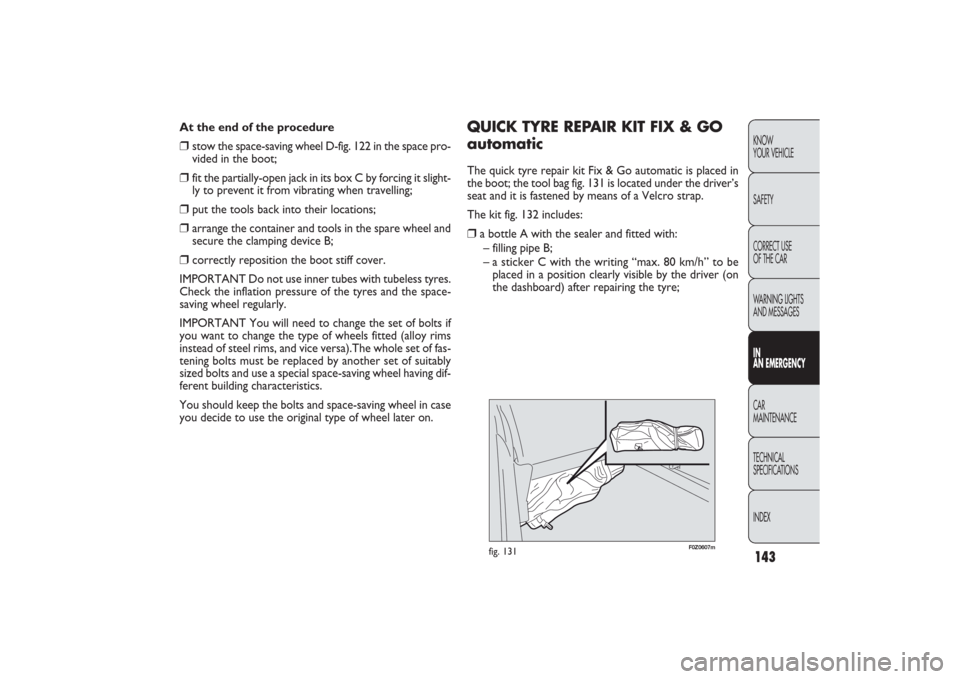
the boot; the tool bag fig. 131 is located under the driver’s
seat and it is fastened by means of a Velcro strap.
The kit fig. 132 includes:❒
a bottle A with the sealer and fitted with:
– filling pipe B;
– a sticker C with the writing “max. 80 km/h” to be
placed in a position clearly visible by the driver (on
the dashboard) after repairing the tyre;
135-168 PANDA EN 7-10-2009 14:06 Pagina 143
Page 152 of 226
151KNOW
YOUR VEHICLE
SAFETY
CORRECT USE
OF THE CAR
WARNING LIGHTS
AND MESSAGESIN
AN EMERGENCYCAR
MAINTENANCE
TECHNICAL
SPECIFICATIONS
INDEX
H4
H4
W5W
PY21W
W5W
PY21W
P21/5W
P21W
P21W
C5W
W5W
C5W
H1
W5W
60/55
60/55
5
21
5
21
21/5
21
21
5
5
5
55
5
D
D
A
B
A
B
B
B
B
C
A
C
E
A
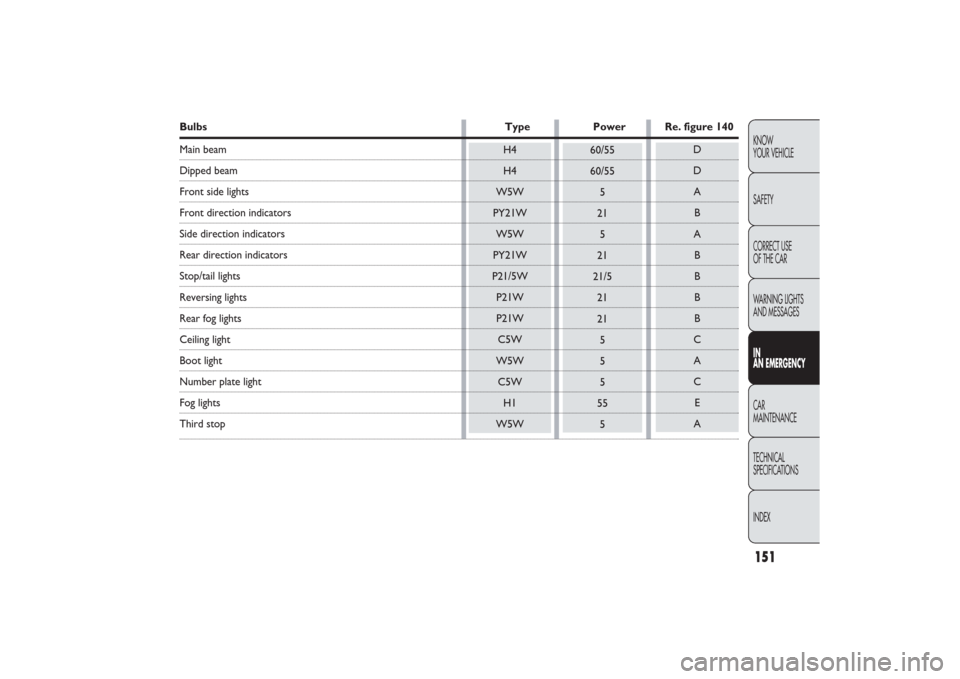
Bulbs Type Power Re. figure 140Main beamDipped beamFront side lightsFront direction indicatorsSide direction indicatorsRear direction indicatorsStop/tail lightsReversing lightsRear fog lightsCeiling lightBoot lightNumber plate lightFog lightsThird stop
135-168 PANDA EN 7-10-2009 14:07 Pagina 151
Page 160 of 226
159KNOW
YOUR VEHICLE
SAFETY
CORRECT USE
OF THE CAR
WARNING LIGHTS
AND MESSAGESIN
AN EMERGENCYCAR
MAINTENANCE
TECHNICAL
SPECIFICATIONS
INDEX
F0Z0102m
fig. 163
F0Z0103m
fig. 164
BOOT LIGHT
(for versions/markets, where provided)
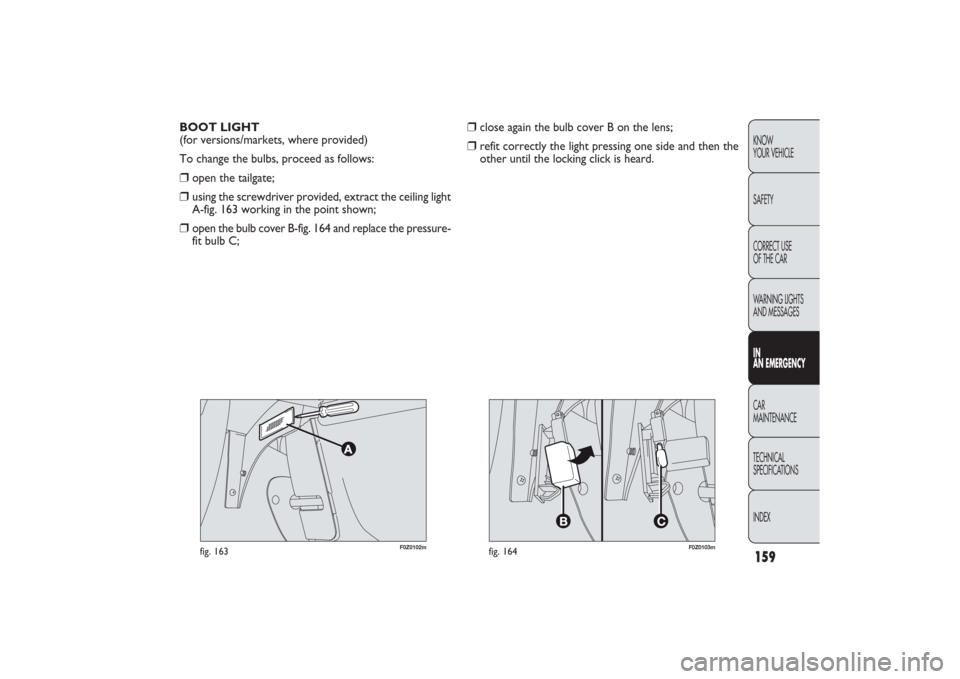
To change the bulbs, proceed as follows:❒
open the tailgate;
❒
using the screwdriver provided, extract the ceiling light
A-fig. 163 working in the point shown;
❒
open the bulb cover B-fig. 164 and replace the pressure-
fit bulb C;
❒
close again the bulb cover B on the lens;
❒
refit correctly the light pressing one side and then the
other until the locking click is heard.
135-168 PANDA EN 7-10-2009 14:07 Pagina 159
Page 168 of 226
167KNOW
YOUR VEHICLE
SAFETY
CORRECT USE
OF THE CAR
WARNING LIGHTS
AND MESSAGESIN
AN EMERGENCYCAR
MAINTENANCE
TECHNICAL
SPECIFICATIONS
INDEX
F0Z0215m
fig. 170
F0Z0217m
fig. 171
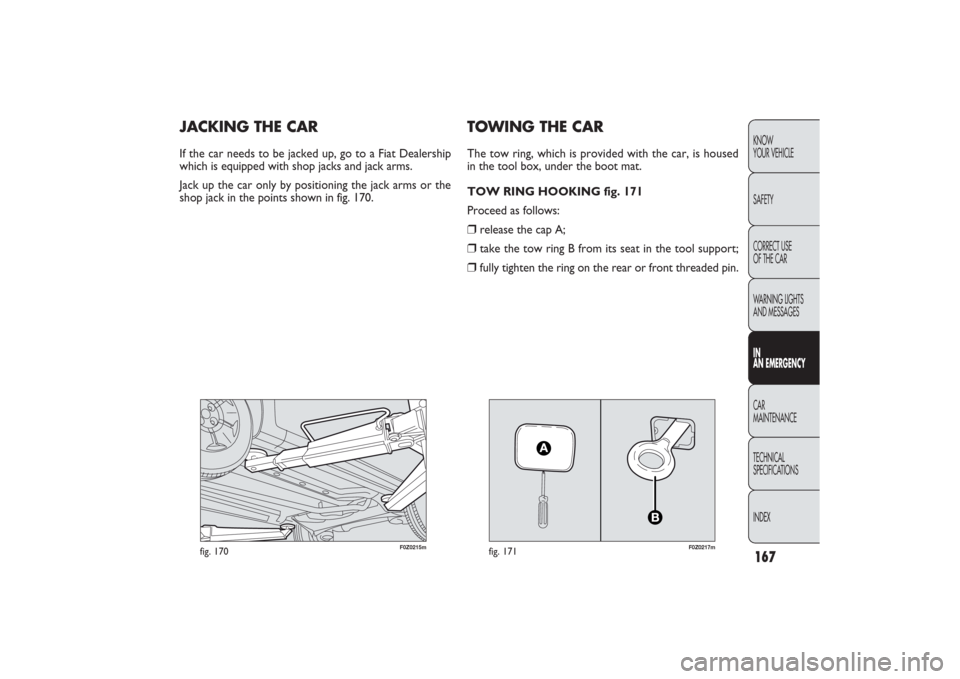
TOWING THE CARThe tow ring, which is provided with the car, is housed
in the tool box, under the boot mat.
TOW RING HOOKING fig. 171
Proceed as follows:❒
release the cap A;
❒
take the tow ring B from its seat in the tool support;
❒
fully tighten the ring on the rear or front threaded pin.
JACKING THE CARIf the car needs to be jacked up, go to a Fiat Dealership
which is equipped with shop jacks and jack arms.
Jack up the car only by positioning the jack arms or the
shop jack in the points shown in fig. 170.
135-168 PANDA EN 7-10-2009 14:07 Pagina 167
Page 171 of 226
●●●● ● ●●●●
●●●● ● ●●●●
●●●● ● ●●●●
●●●● ● ●●●●
●●●● ● ●●●●
●●●
●●●● ● ●●●●
●●●● ● ●●●●
●
●● ●●
●● ●●
●● ●●
●●20 40 60 80 100 120 140 160 180
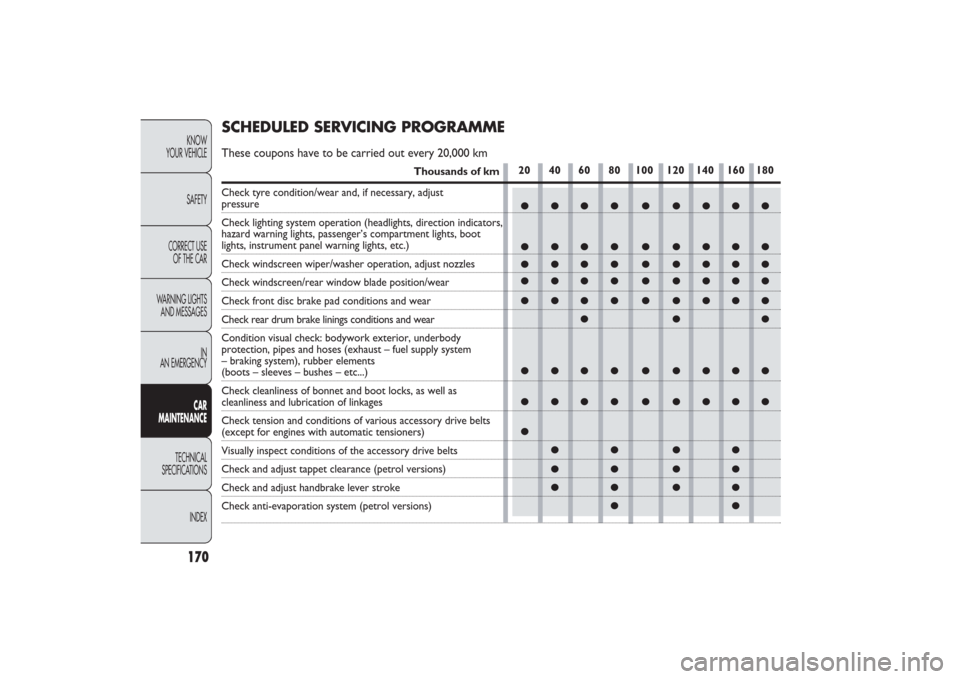
SCHEDULED SERVICING PROGRAMMEThese coupons have to be carried out every 20,000 km
Thousands of km
Check tyre condition/wear and, if necessary, adjust
pressure
Check lighting system operation (headlights, direction indicators,
hazard warning lights, passenger’s compartment lights, boot lights, instrument panel warning lights, etc.)Check windscreen wiper/washer operation, adjust nozzlesCheck windscreen/rear window blade position/wearCheck front disc brake pad conditions and wearCheck rear drum brake linings conditions and wear
Condition visual check: bodywork exterior, underbody
protection, pipes and hoses (exhaust – fuel supply system
– braking system), rubber elements (boots – sleeves – bushes – etc...)
Check cleanliness of bonnet and boot locks, as well as cleanliness and lubrication of linkages
Check tension and conditions of various accessory drive belts (except for engines with automatic tensioners)Visually inspect conditions of the accessory drive beltsCheck and adjust tappet clearance (petrol versions)Check and adjust handbrake lever stroke Check anti-evaporation system (petrol versions)
INDEX TECHNICAL
SPECIFICATIONSCAR
MAINTENANCEIN
AN EMERGENCY WARNING LIGHTS
AND MESSAGESCORRECT USE
OF THE CARSAFETYKNOW
YOUR VEHICLE
170
169-190 PANDA EN 7-10-2009 14:14 Pagina 170
Page 173 of 226
YEARLY INSPECTION SCHEDULEFor cars with an annual mileage of below 20,000 km (for
example about 15,000 km) the following yearly inspec-
tion schedule is advised:❒
check conditions/wear of tyres and adjust pressure if
necessary (including spare wheel);
❒
check lighting system operation (headlights, direction
indicators, hazard warning lights, boot light, passenger’s
compartment, instrument panel warning lights, etc...);
❒
check wiper/washer system operation, adjust nozzles;
❒
check windscreen/rear window blade position/wear;
❒
check front disc brake pad conditions and wear;
❒
check cleanliness of bonnet and boot locks and lever
cleanliness and lubrication;
❒
sight inspect the conditions of: engine, gearbox, trans-
mission, pipes and hoses (exhaust – fuel supply – brak-
ing system) rubber parts (boots – sleeves – bushes etc.),
fuel and brake system hoses;
❒
check battery charge;
❒
visually check the various drive belt conditions;
❒
check and top-up liquids if required (engine coolant,
brakes, windscreen washer, battery, etc.);
❒
change engine oil;
❒
change engine oil filter;
❒
change pollen filter (for versions/markets where pro-
vided).
ADDITIONAL INTERVENTIONSEvery 1,000 km or before long journeys, check and, if nec-
essary, top-up the following:❒
engine coolant fluid level;
❒
brake fluid level;
❒
battery fluid level;
❒
windscreen washer fluid level;
❒
tyre pressure and conditions.
Every 3,000 km check the following and top-up, if required:
❒
engine oil level.
You are recommended to use FL Selenia products de-
signed and produced specifically for Fiat cars (see table
“Capacities” in chapter “Technical specifications”).
IMPORTANT – Engine oil
Should prevailing use of the car be under one of the fol-
lowing specially heavy conditions:
❒
trailer or caravan towing;
❒
dusty roads;
❒
short distances (less than 7–8 km) and with external
temperatures below zero;
INDEX TECHNICAL
SPECIFICATIONSCAR
MAINTENANCEIN
AN EMERGENCY WARNING LIGHTS
AND MESSAGESCORRECT USE
OF THE CARSAFETYKNOW
YOUR VEHICLE
172
169-190 PANDA EN 7-10-2009 14:14 Pagina 172
Page 192 of 226
191KNOW
YOUR VEHICLE
SAFETY
WARNING LIGHTS
AND MESSAGES
IN
AN EMERGENCY
CAR
MAINTENANCETECHNICAL
SPECIFICATIONSINDEX
TECHNICAL SPECIFICATIONS
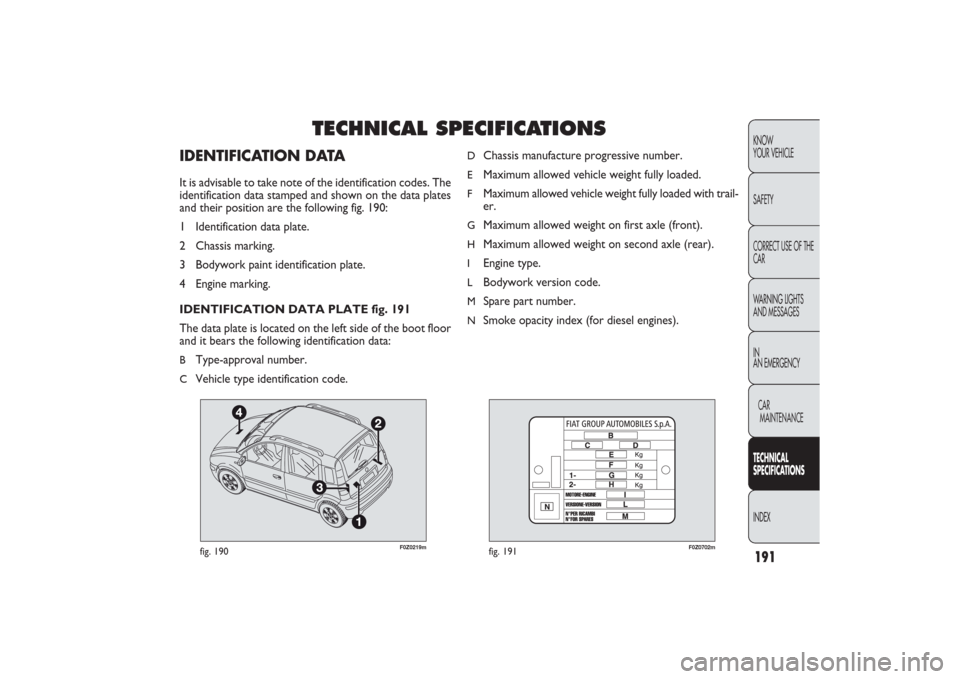
IDENTIFICATION DATAIt is advisable to take note of the identification codes. The
identification data stamped and shown on the data plates
and their position are the following fig. 190:
1 Identification data plate.
2 Chassis marking.
3 Bodywork paint identification plate.
4 Engine marking.
IDENTIFICATION DATA PLATE fig. 191
The data plate is located on the left side of the boot floor
and it bears the following identification data:B
Type-approval number.
C
Vehicle type identification code.
CORRECT USE OF THE
CAR
D
Chassis manufacture progressive number.
E
Maximum allowed vehicle weight fully loaded.
F
Maximum allowed vehicle weight fully loaded with trail-
er.
G
Maximum allowed weight on first axle (front).
H
Maximum allowed weight on second axle (rear).
I
Engine type.
L
Bodywork version code.
M
Spare part number.
N
Smoke opacity index (for diesel engines).
F0Z0219m
fig. 190
F0Z0702m
fig. 191
191-214 PANDA EN 7-10-2009 14:17 Pagina 191
Page 193 of 226
192
KNOW YOUR
VEHICLE
SAFETY
CORRECT USE OF
THE CAR
WARNING LIGHTS
AND MESSAGES
IN
AN EMERGENCY
CAR
MAINTENANCETECHNICAL
SPECIFICATIONS
INDEX
F0Z0114m
fig. 192
F0Z0220m
fig. 193
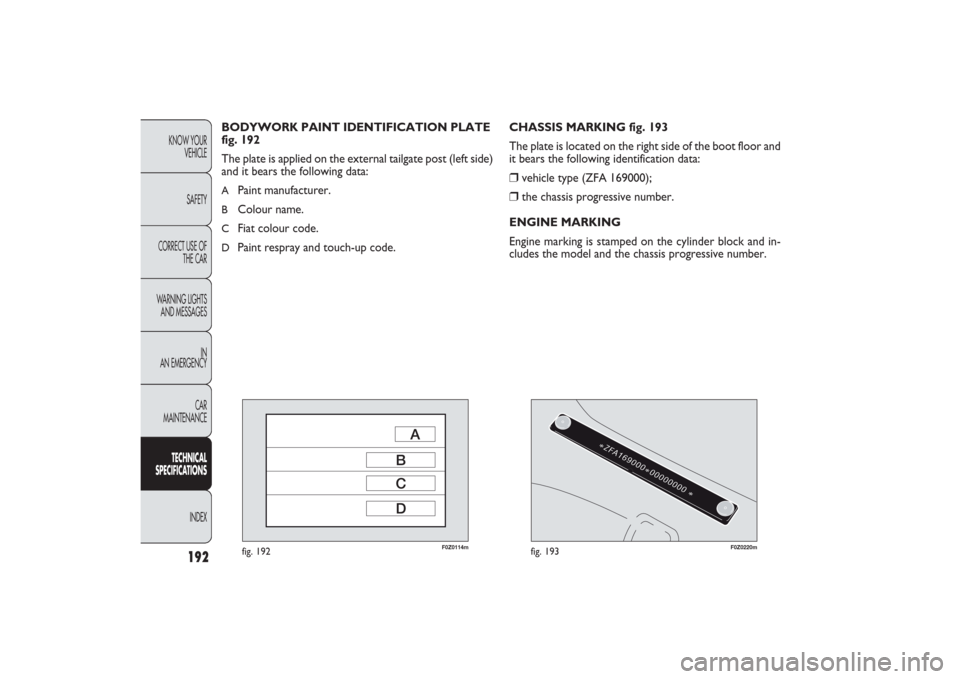
CHASSIS MARKING fig. 193
The plate is located on the right side of the boot floor and
it bears the following identification data:❒
vehicle type (ZFA 169000);
❒
the chassis progressive number.
ENGINE MARKING
Engine marking is stamped on the cylinder block and in-
cludes the model and the chassis progressive number. BODYWORK PAINT IDENTIFICATION PLATE
fig. 192
The plate is applied on the external tailgate post (left side)
and it bears the following data:
A
Paint manufacturer.
B
Colour name.
C
Fiat colour code.
D
Paint respray and touch-up code.
191-214 PANDA EN 7-10-2009 14:17 Pagina 192
Page 202 of 226
150
150
155/162 (*)
155/162 (*)
160
160
165
165
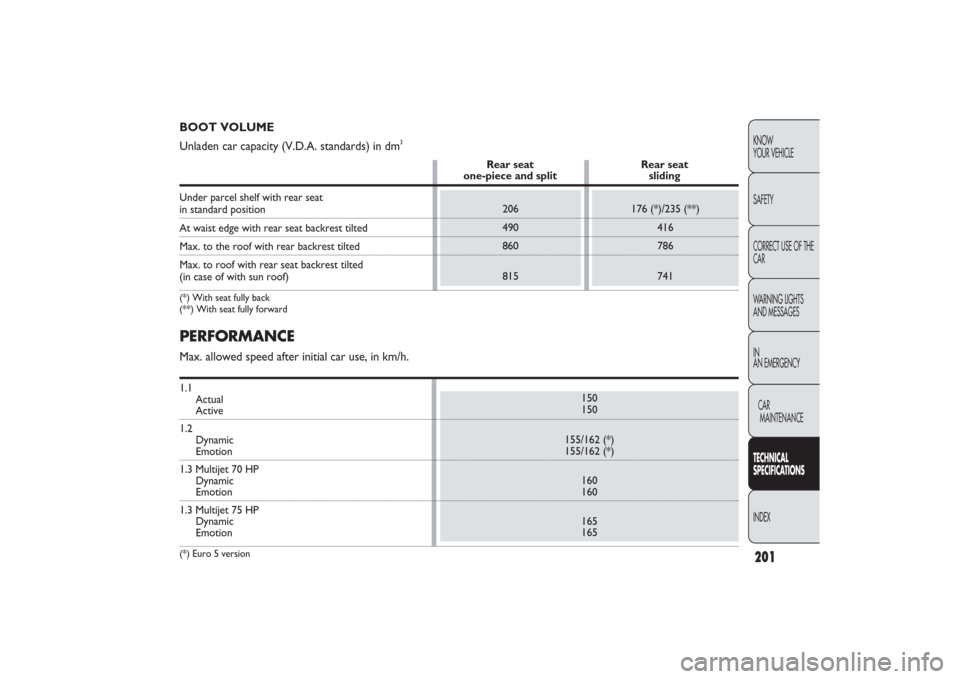
206
490
860
815
176 (*)/235 (**)
416
786
741
201KNOW
YOUR VEHICLE
SAFETY
CORRECT USE OF THE
CAR
WARNING LIGHTS
AND MESSAGES
IN
AN EMERGENCY
CAR
MAINTENANCETECHNICAL
SPECIFICATIONSINDEX
PERFORMANCEMax. allowed speed after initial car use, in km/h.1.1
Actual
Active
1.2
DynamicEmotion
1.3 Multijet 70 HP
DynamicEmotion
1.3 Multijet 75 HP
DynamicEmotion
(*) Euro 5 versionBOOT VOLUME
Unladen car capacity (V.D.A. standards) in dm
3
Rear seat Rear seat
one-piece and split sliding
Under parcel shelf with rear seat
in standard positionAt waist edge with rear seat backrest tiltedMax. to the roof with rear backrest tilted
Max. to roof with rear seat backrest tilted (in case of with sun roof)(*) With seat fully back
(**) With seat fully forward
191-214 PANDA EN 7-10-2009 14:17 Pagina 201