child FIAT PANDA 2009 169 / 2.G User Guide
[x] Cancel search | Manufacturer: FIAT, Model Year: 2009, Model line: PANDA, Model: FIAT PANDA 2009 169 / 2.GPages: 226, PDF Size: 5.29 MB
Page 101 of 226
100
KNOW YOUR
VEHICLE
SAFETY
CORRECT USE
OF THE CAR
WARNING LIGHTS
AND MESSAGES
IN AN EMERGENCY
CAR
MAINTENANCE
TECHNICAL
SPECIFICATIONS
INDEX
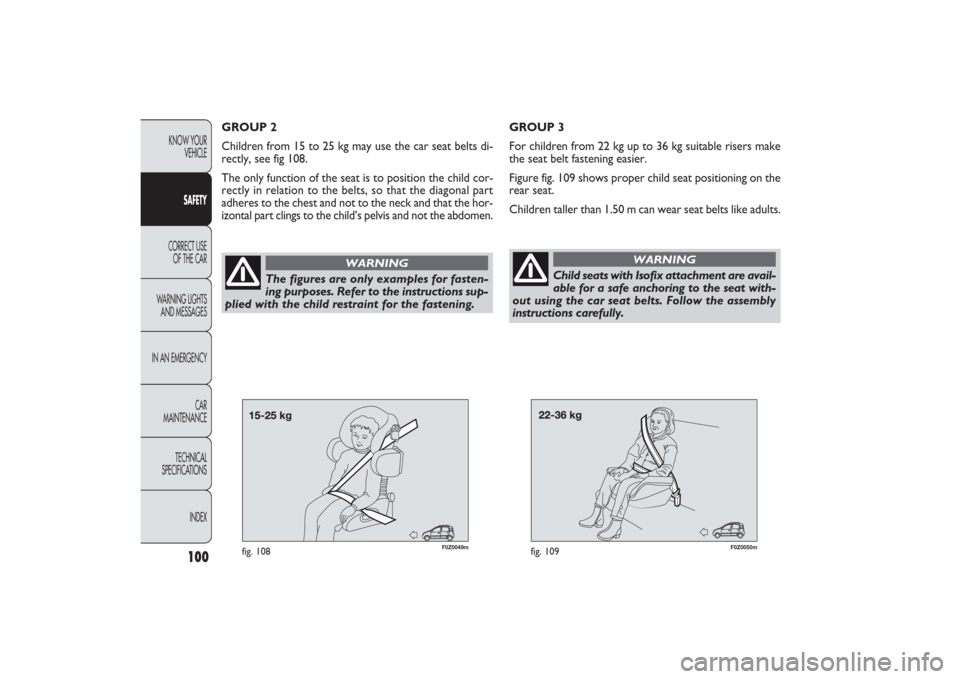
F0Z0049m
fig. 108
F0Z0050m
fig. 109
GROUP 2
Children from 15 to 25 kg may use the car seat belts di-
rectly, see fig 108.
The only function of the seat is to position the child cor-
rectly in relation to the belts, so that the diagonal part
adheres to the chest and not to the neck and that the hor-
izontal part clings to the child’s pelvis and not the abdomen.
The figures are only examples for fasten-
ing purposes. Refer to the instructions sup-
plied with the child restraint for the fastening.
WARNING
Child seats with Isofix attachment are avail-
able for a safe anchoring to the seat with-
out using the car seat belts. Follow the assembly
instructions carefully.
WARNING
GROUP 3
For children from 22 kg up to 36 kg suitable risers make
the seat belt fastening easier.
Figure fig. 109 shows proper child seat positioning on the
rear seat.
Children taller than 1.50 m can wear seat belts like adults.
091-110 PANDA EN 7-10-2009 13:46 Pagina 100
Page 102 of 226
101KNOW YOUR
VEHICLESAFETYCORRECT USE
OF THE CAR
WARNING LIGHTS
AND MESSAGES
IN AN EMERGENCY
CAR
MAINTENANCE
TECHNICAL
SPECIFICATIONS
INDEX
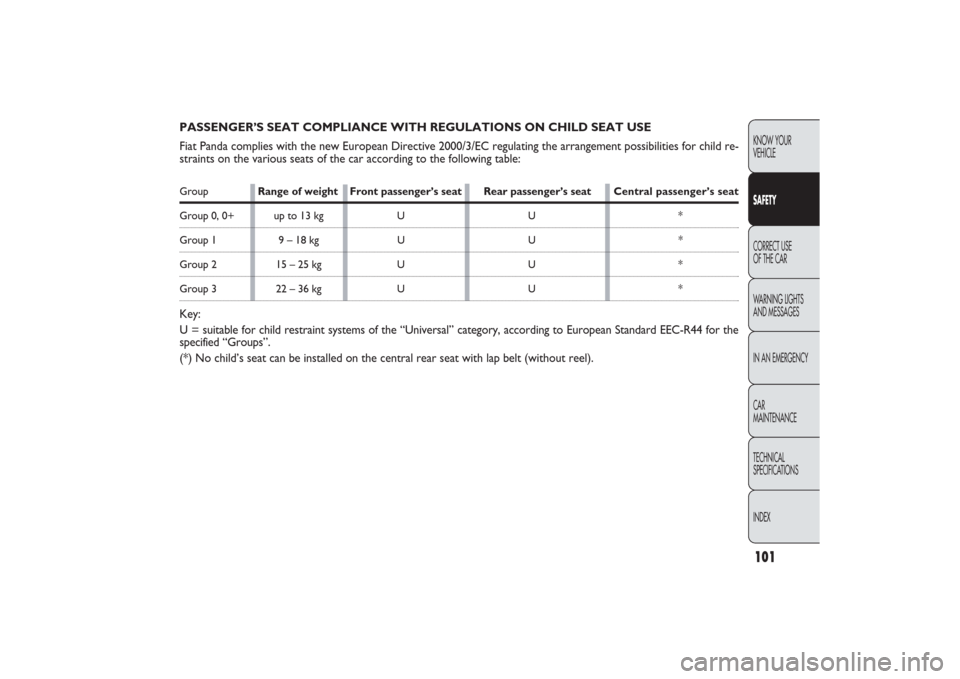
PASSENGER’S SEAT COMPLIANCE WITH REGULATIONS ON CHILD SEAT USE
Fiat Panda complies with the new European Directive 2000/3/EC regulating the arrangement possibilities for child re-
straints on the various seats of the car according to the following table:GroupRange of weight Front passenger’s seat Rear passenger’s seat Central passenger’s seatGroup 0, 0+ up to 13 kg U U *Group 1 9 – 18 kg U U *Group 2 15 – 25 kg U U *Group 3 22 – 36 kg U U *Key:
U = suitable for child restraint systems of the “Universal” category, according to European Standard EEC-R44 for the
specified “Groups”.
(*) No child’s seat can be installed on the central rear seat with lap belt (without reel).
091-110 PANDA EN 7-10-2009 13:46 Pagina 101
Page 103 of 226
102
KNOW YOUR
VEHICLE
SAFETY
CORRECT USE
OF THE CAR
WARNING LIGHTS
AND MESSAGES
IN AN EMERGENCY
CAR
MAINTENANCE
TECHNICAL
SPECIFICATIONS
INDEX
Below is a summary of the safety rules to be followed for
carrying children.❒
Install the child seats on the rear seat, which is the most
protected position in the event of an accident.
❒
If the passenger’s air bag is deactivated always check the
amber warning light
F
on the instrument panel to
make sure that it has actually been deactivated.
❒
Carefully follow the instructions supplied with the child
restraint system which are mandatory by law. Keep the
instructions in the car along with the other papers and
this handbook. Do not use second-hand child seats with-
out instructions.
❒
Always check the seat belt is well fastened by pulling the
webbing.
❒
Only one child is to be strapped to each retaining system.
❒
Always check the seat belts do not fit around the child’s
throat.
❒
While travelling, do not let the child sit incorrectly or
release the belts.
❒
Never carry children on your lap, even newborns. No-one
can hold a child in the event of an accident.
❒
In case of an accident, replace the child seat with a new
one.
In cars fitted with passenger’s air bag nev-
er place child restraint systems on the front
seat, since children must never travel on the
front seat.
WARNING
091-110 PANDA EN 7-10-2009 13:46 Pagina 102
Page 104 of 226
103KNOW YOUR
VEHICLESAFETYCORRECT USE
OF THE CAR
WARNING LIGHTS
AND MESSAGES
IN AN EMERGENCY
CAR
MAINTENANCE
TECHNICAL
SPECIFICATIONS
INDEX
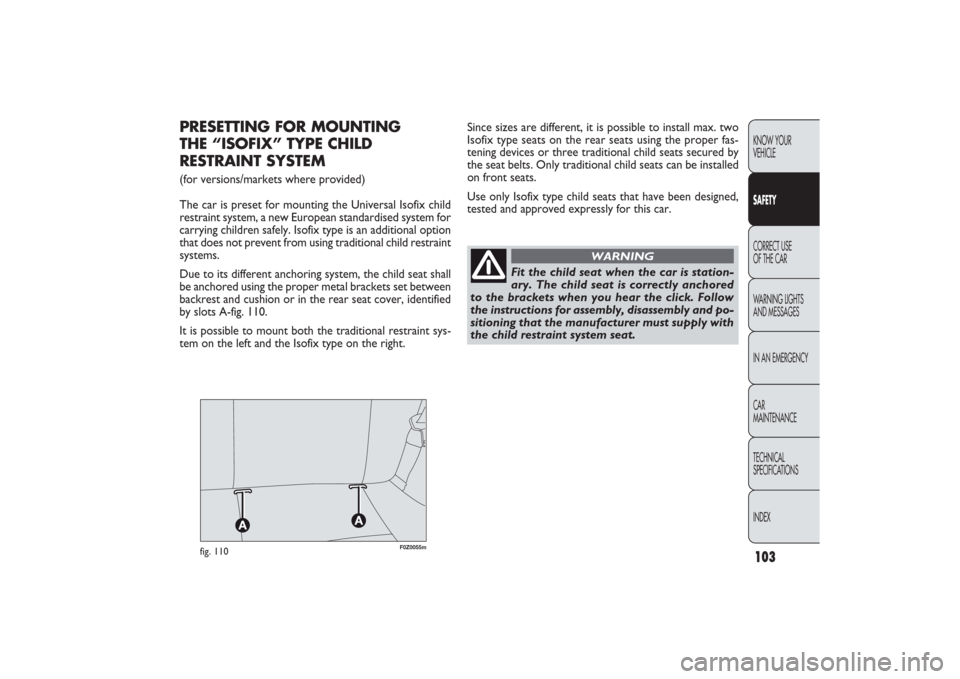
F0Z0055m
fig. 110
PRESETTING FOR MOUNTING
THE “ISOFIX” TYPE CHILD
RESTRAINT SYSTEM (for versions/markets where provided)
The car is preset for mounting the Universal Isofix child
restraint system, a new European standardised system for
carrying children safely. Isofix type is an additional option
that does not prevent from using traditional child restraint
systems.
Due to its different anchoring system, the child seat shall
be anchored using the proper metal brackets set between
backrest and cushion or in the rear seat cover, identified
by slots A-fig. 110.
It is possible to mount both the traditional restraint sys-
tem on the left and the Isofix type on the right.Since sizes are different, it is possible to install max. two
Isofix type seats on the rear seats using the proper fas-
tening devices or three traditional child seats secured by
the seat belts. Only traditional child seats can be installed
on front seats.
Use only Isofix type child seats that have been designed,
tested and approved expressly for this car.
Fit the child seat when the car is station-
ary. The child seat is correctly anchored
to the brackets when you hear the click. Follow
the instructions for assembly, disassembly and po-
sitioning that the manufacturer must supply with
the child restraint system seat.
WARNING
091-110 PANDA EN 7-10-2009 13:46 Pagina 103
Page 107 of 226
106
KNOW YOUR
VEHICLE
SAFETY
CORRECT USE
OF THE CAR
WARNING LIGHTS
AND MESSAGES
IN AN EMERGENCY
CAR
MAINTENANCE
TECHNICAL
SPECIFICATIONS
INDEX
F0Z0170m
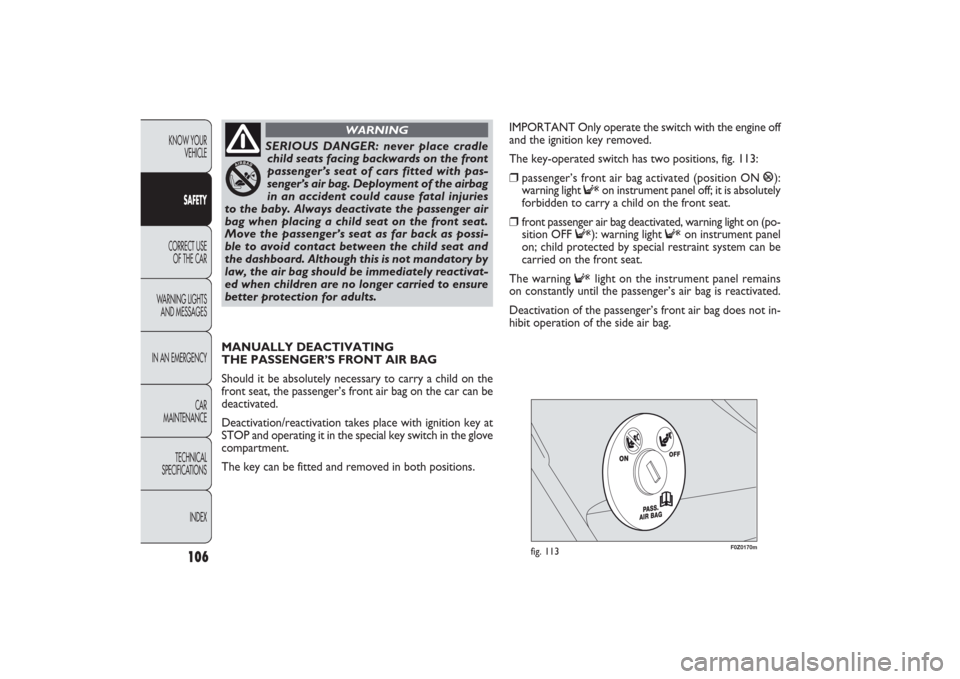
fig. 113
IMPORTANT Only operate the switch with the engine off
and the ignition key removed.
The key-operated switch has two positions, fig. 113:❒
passenger’s front air bag activated (position ON
P):
warning light
F
on instrument panel off; it is absolutely
forbidden to carry a child on the front seat.
❒
front passenger air bag deactivated, warning light on (po-
sition OFF
F
): warning light
F
on instrument panel
on; child protected by special restraint system can be
carried on the front seat.
The warning
F
light on the instrument panel remains
on constantly until the passenger’s air bag is reactivated.
Deactivation of the passenger’s front air bag does not in-
hibit operation of the side air bag.
SERIOUS DANGER: never place cradle
child seats facing backwards on the front
passenger’s seat of cars fitted with pas-
senger’s air bag. Deployment of the airbag
in an accident could cause fatal injuries
to the baby. Always deactivate the passenger air
bag when placing a child seat on the front seat.
Move the passenger’s seat as far back as possi-
ble to avoid contact between the child seat and
the dashboard. Although this is not mandatory by
law, the air bag should be immediately reactivat-
ed when children are no longer carried to ensure
better protection for adults.
WARNING
MANUALLY DEACTIVATING
THE PASSENGER’S FRONT AIR BAG
Should it be absolutely necessary to carry a child on the
front seat, the passenger’s front air bag on the car can be
deactivated.
Deactivation/reactivation takes place with ignition key at
STOP and operating it in the special key switch in the glove
compartment.
The key can be fitted and removed in both positions.
091-110 PANDA EN 7-10-2009 13:46 Pagina 106
Page 110 of 226
109KNOW YOUR
VEHICLESAFETYCORRECT USE
OF THE CAR
WARNING LIGHTS
AND MESSAGES
IN AN EMERGENCY
CAR
MAINTENANCE
TECHNICAL
SPECIFICATIONS
INDEX
GENERAL WARNINGS
If when turning the key to MAR the warn-
ing light
¬
does not turn on or if it stays
on when travelling, there could be a failure in safe-
ty systems; in this event air bags or pretensioners
may not be deployed in case of impact or, in a mi-
nor number of cases, they deploy accidentally.
Contact a Fiat Dealership immediately to have
the system checked.
WARNING
Do not cover the backrest of front seats
with trims or covers that are not suitable
to be used with side bags.
WARNING
Never travel with objects on your lap, in
front of your chest or with a pipe, pencil,
etc. between your lips; injury may result in the
event of the air bag being triggered.
WARNING
Always drive keeping your hands on the
steering wheel rim so that the air bag can
inflate freely in the case of need. Do not drive with
your body bent forward. Keep your back straight
against the backrest.
WARNING
Air bags may be deployed if another vehi-
cle crashes into the car, if the key is insert-
ed and at MAR also if the engine is not running and
the car is stationary. For this reason, children must
never sit on the front seat, even if the car is not
moving. On the other hand, whenever the key is
positioned on STOP, the safety devices (air bags or
pretensioners) do not deploy after a collision. In
this case non-deployment of these devices does not
indicate a system malfunction.
WARNING
091-110 PANDA EN 7-10-2009 13:46 Pagina 109
Page 114 of 226
113KNOW
YOUR VEHICLE
SAFETYCORRECT USE
OF THE CARWARNING LIGHTS
AND MESSAGES
IN
AN EMERGENCY
CAR
MAINTENANCE
TECHNICAL
SPECIFICATIONS
INDEX
F0Z0037m
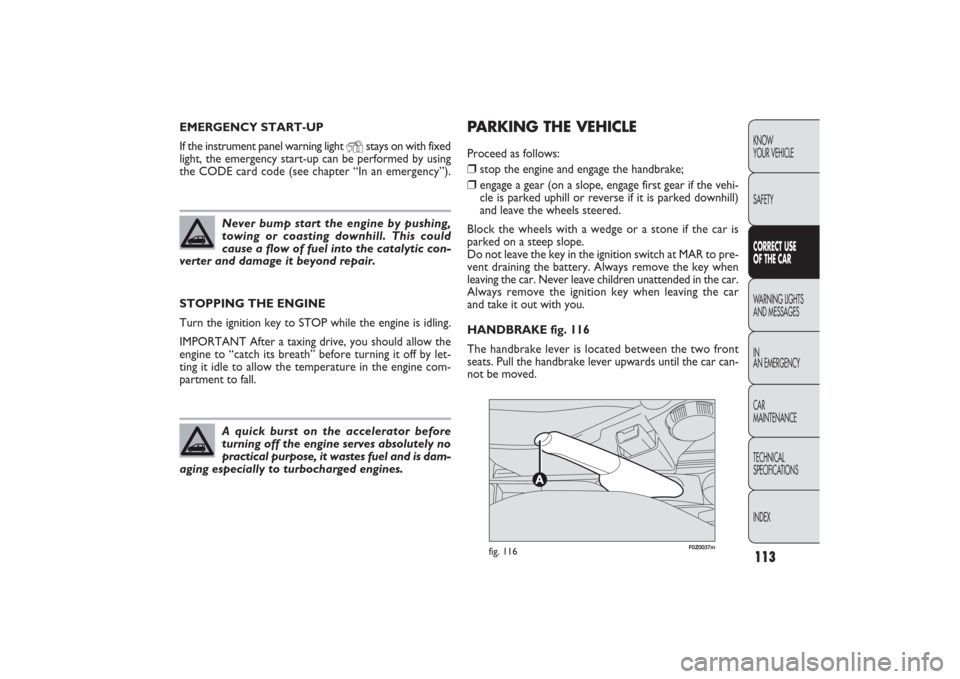
fig. 116
PARKING THE VEHICLEProceed as follows:❒
stop the engine and engage the handbrake;
❒
engage a gear (on a slope, engage first gear if the vehi-
cle is parked uphill or reverse if it is parked downhill)
and leave the wheels steered.
Block the wheels with a wedge or a stone if the car is
parked on a steep slope.
Do not leave the key in the ignition switch at MAR to pre-
vent draining the battery. Always remove the key when
leaving the car. Never leave children unattended in the car.
Always remove the ignition key when leaving the car
and take it out with you.
HANDBRAKE fig. 116
The handbrake lever is located between the two front
seats. Pull the handbrake lever upwards until the car can-
not be moved. STOPPING THE ENGINE
Turn the ignition key to STOP while the engine is idling.
IMPORTANT After a taxing drive, you should allow the
engine to “catch its breath” before turning it off by let-
ting it idle to allow the temperature in the engine com-
partment to fall.
Never bump start the engine by pushing,
towing or coasting downhill. This could
cause a flow of fuel into the catalytic con-
verter and damage it beyond repair.A quick burst on the accelerator before
turning off the engine serves absolutely no
practical purpose, it wastes fuel and is dam-
aging especially to turbocharged engines.
EMERGENCY START-UP
If the instrument panel warning light
Y
stays on with fixed
light, the emergency start-up can be performed by using
the CODE card code (see chapter “In an emergency”).
111-122 PANDA EN 7-10-2009 15:01 Pagina 113
Page 146 of 226
145KNOW
YOUR VEHICLE
SAFETY
CORRECT USE
OF THE CAR
WARNING LIGHTS
AND MESSAGESIN
AN EMERGENCYCAR
MAINTENANCE
TECHNICAL
SPECIFICATIONS
INDEX
Tyre side wall holes and punctures cannot
be repaired. Do not use the quick repair
kit if the tyre is damaged as the vehicle has run on
a flat tyre.
WARNING
If the wheel rim is damaged (bad groove
distortion causing air leakage) it cannot
be repaired. Do not remove the foreign body
(screws or nails) from the tyre.
WARNING
PLEASE REMEMBER THAT:
The sealing fluid of the quick tyre repair kit is effective with
external temperatures between −20 °C and +50 °C.
The sealing fluid has a limited life.
Never not operate the compressor for
longer than 20 consecutive minutes. Risk
of overheating. The quick repair kit is not suitable
for definitive repairs. Tyres may only be repaired
temporarily.
WARNING
The bottle contains ethylene glycol. It con-
tains latex that might cause allergic reac-
tions. It is harmful if swallowed. It is irritant for the
eyes in case of contact. It may cause sensitisation
by inhalation or contact. Avoid contact with your
eyes, skin and clothes. In the event of contact, wash
immediately with plenty of water. Do not induce
vomit if swallowed. Rinse your mouth and drink
plenty of water. Call a doctor immediately. Keep
away from children. The product must not be used
by asthmatics. Do not inhale the vapours during in-
sertion and suction. Call a doctor immediately if al-
lergic reactions are noted. Store the bottle in the
specific compartment, away from sources of heat.
The sealant fluid has a limited life.
WARNING
135-168 PANDA EN 7-10-2009 14:07 Pagina 145
Page 217 of 226
216KNOW
YOUR VEHICLE
SAFETY
CORRECT USE
OF THE CAR
WARNING LIGHTS
AND MESSAGES
IN
AN EMERGENCY
CAR
MAINTENANCE
TECHNICAL
SPECIFICATIONSINDEX
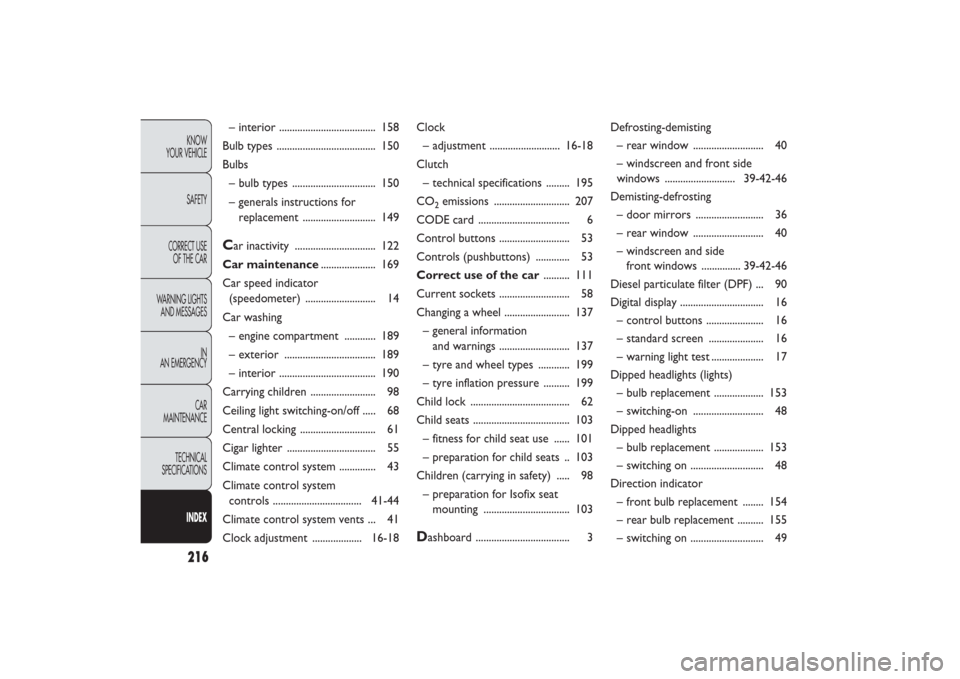
– interior ..................................... 158
Bulb types ...................................... 150
Bulbs
– bulb types ................................ 150
– generals instructions for
replacement ............................ 149Car inactivity ............................... 122
Car maintenance..................... 169
Car speed indicator
(speedometer) ........................... 14
Car washing
– engine compartment ............ 189
– exterior ................................... 189
– interior ..................................... 190
Carrying children ......................... 98
Ceiling light switching-on/off ..... 68
Central locking ............................. 61
Cigar lighter .................................. 55
Climate control system .............. 43
Climate control system
controls .................................. 41-44
Climate control system vents ... 41
Clock adjustment ................... 16-18Clock
– adjustment ........................... 16-18
Clutch
– technical specifications ......... 195
CO
2emissions ............................. 207
CODE card ................................... 6
Control buttons ........................... 53
Controls (pushbuttons) ............. 53
Correct use of the car.......... 111
Current sockets ........................... 58
Changing a wheel ......................... 137
– general information
and warnings ........................... 137
– tyre and wheel types ............ 199
– tyre inflation pressure .......... 199
Child lock ...................................... 62
Child seats ..................................... 103
– fitness for child seat use ...... 101
– preparation for child seats .. 103
Children (carrying in safety) ..... 98
– preparation for Isofix seat
mounting ................................. 103
Dashboard .................................... 3Defrosting-demisting
– rear window ........................... 40
– windscreen and front side
windows ........................... 39-42-46
Demisting-defrosting
– door mirrors .......................... 36
– rear window ........................... 40
– windscreen and side
front windows ............... 39-42-46
Diesel particulate filter (DPF) ... 90
Digital display ................................ 16
– control buttons ...................... 16
– standard screen ..................... 16
– warning light test .................... 17
Dipped headlights (lights)
– bulb replacement ................... 153
– switching-on ........................... 48
Dipped headlights
– bulb replacement ................... 153
– switching on ............................ 48
Direction indicator
– front bulb replacement ........ 154
– rear bulb replacement .......... 155
– switching on ............................ 49
215-224 PANDA EN 7-10-2009 15:09 Pagina 216
Page 218 of 226
217KNOW
YOUR VEHICLE
SAFETY
CORRECT USE
OF THE CAR
WARNING LIGHTS
AND MESSAGES
IN
AN EMERGENCY
CAR
MAINTENANCE
TECHNICAL
SPECIFICATIONSINDEX
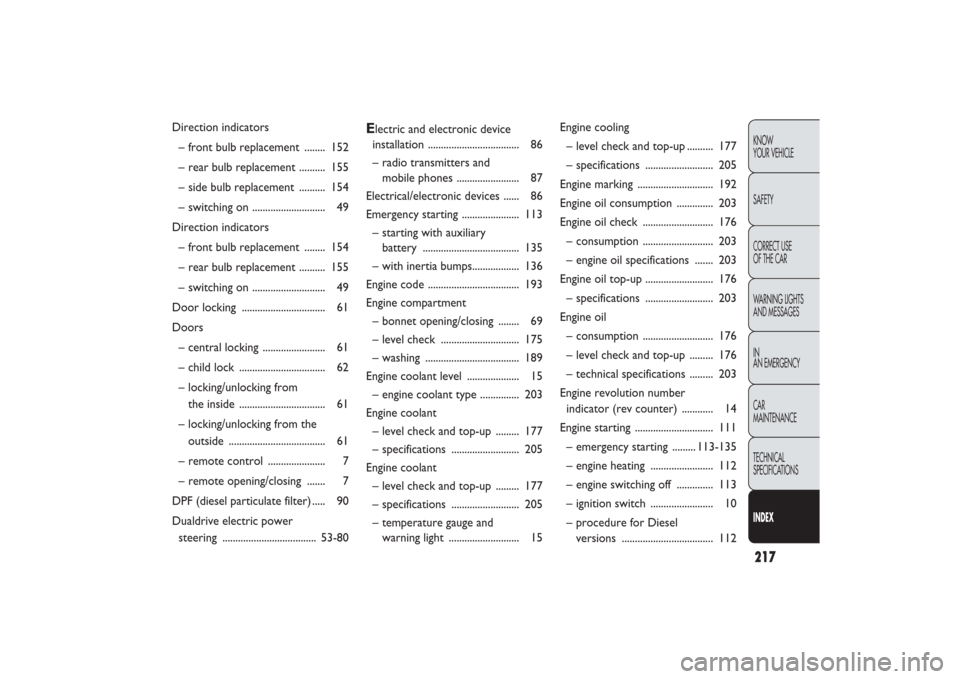
Electric and electronic device
installation ................................... 86
– radio transmitters and
mobile phones ........................ 87
Electrical/electronic devices ...... 86
Emergency starting ...................... 113
– starting with auxiliary
battery ..................................... 135
– with inertia bumps.................. 136
Engine code ................................... 193
Engine compartment
– bonnet opening/closing ........ 69
– level check .............................. 175
– washing .................................... 189
Engine coolant level .................... 15
– engine coolant type ............... 203
Engine coolant
– level check and top-up ......... 177
– specifications .......................... 205
Engine coolant
– level check and top-up ......... 177
– specifications .......................... 205
– temperature gauge and
warning light ........................... 15Engine cooling
– level check and top-up .......... 177
– specifications .......................... 205
Engine marking ............................. 192
Engine oil consumption .............. 203
Engine oil check ........................... 176
– consumption ........................... 203
– engine oil specifications ....... 203
Engine oil top-up .......................... 176
– specifications .......................... 203
Engine oil
– consumption ........................... 176
– level check and top-up ......... 176
– technical specifications ......... 203
Engine revolution number
indicator (rev counter) ............ 14
Engine starting .............................. 111
– emergency starting ......... 113-135
– engine heating ........................ 112
– engine switching off .............. 113
– ignition switch ........................ 10
– procedure for Diesel
versions ................................... 112 Direction indicators
– front bulb replacement ........ 152
– rear bulb replacement .......... 155
– side bulb replacement .......... 154
– switching on ............................ 49
Direction indicators
– front bulb replacement ........ 154
– rear bulb replacement .......... 155
– switching on ............................ 49
Door locking ................................ 61
Doors
– central locking ........................ 61
– child lock ................................. 62
– locking/unlocking from
the inside ................................. 61
– locking/unlocking from the
outside ..................................... 61
– remote control ...................... 7
– remote opening/closing ....... 7
DPF (diesel particulate filter) ..... 90
Dualdrive electric power
steering .................................... 53-80
215-224 PANDA EN 7-10-2009 15:09 Pagina 217