panel FIAT PANDA 2009 169 / 2.G User Guide
[x] Cancel search | Manufacturer: FIAT, Model Year: 2009, Model line: PANDA, Model: FIAT PANDA 2009 169 / 2.GPages: 226, PDF Size: 5.29 MB
Page 59 of 226
F0Z0130m
fig. 61
F0Z0198m
fig. 62
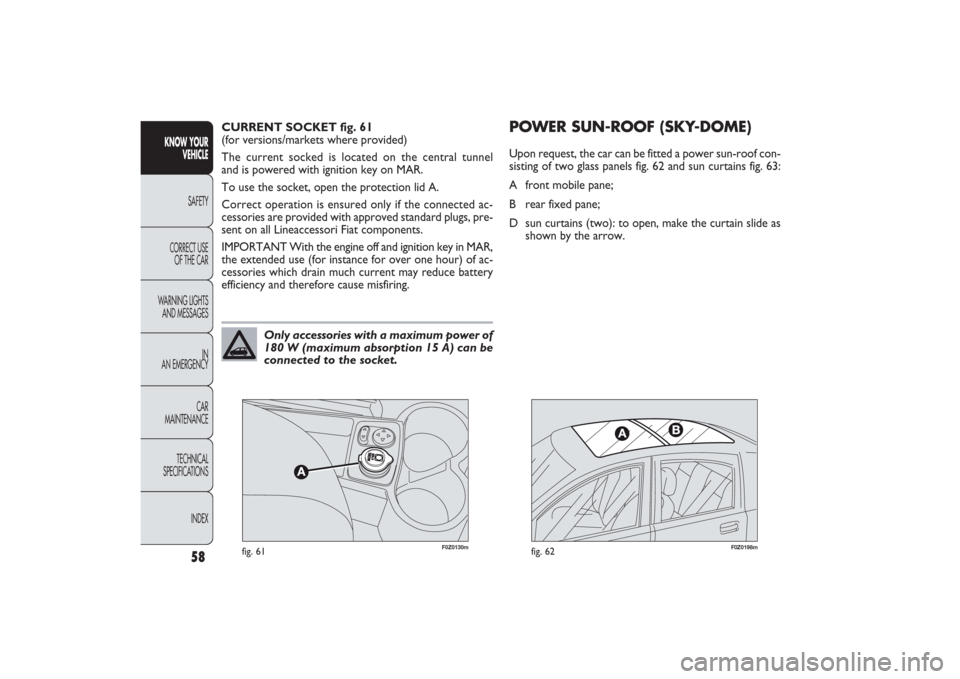
CURRENT SOCKET fig. 61
(for versions/markets where provided)
The current socked is located on the central tunnel
and is powered with ignition key on MAR.
To use the socket, open the protection lid A.
Correct operation is ensured only if the connected ac-
cessories are provided with approved standard plugs, pre-
sent on all Lineaccessori Fiat components.
IMPORTANT With the engine off and ignition key in MAR,
the extended use (for instance for over one hour) of ac-
cessories which drain much current may reduce battery
efficiency and therefore cause misfiring.
58
KNOW YOUR
VEHICLE
SAFETY
CORRECT USE
OF THE CAR
WARNING LIGHTS
AND MESSAGES
IN
AN EMERGENCY
CAR
MAINTENANCE
TECHNICAL
SPECIFICATIONS
INDEX
Only accessories with a maximum power of
180 W (maximum absorption 15 A) can be
connected to the socket.
POWER SUN-ROOF (SKY-DOME)Upon request, the car can be fitted a power sun-roof con-
sisting of two glass panels fig. 62 and sun curtains fig. 63:
A front mobile pane;
B rear fixed pane;
D sun curtains (two): to open, make the curtain slide as
shown by the arrow.
031-064 PANDA EN 7-10-2009 13:43 Pagina 58
Page 66 of 226
F0Z0687m
fig. 72
F0Z0688m
fig. 73
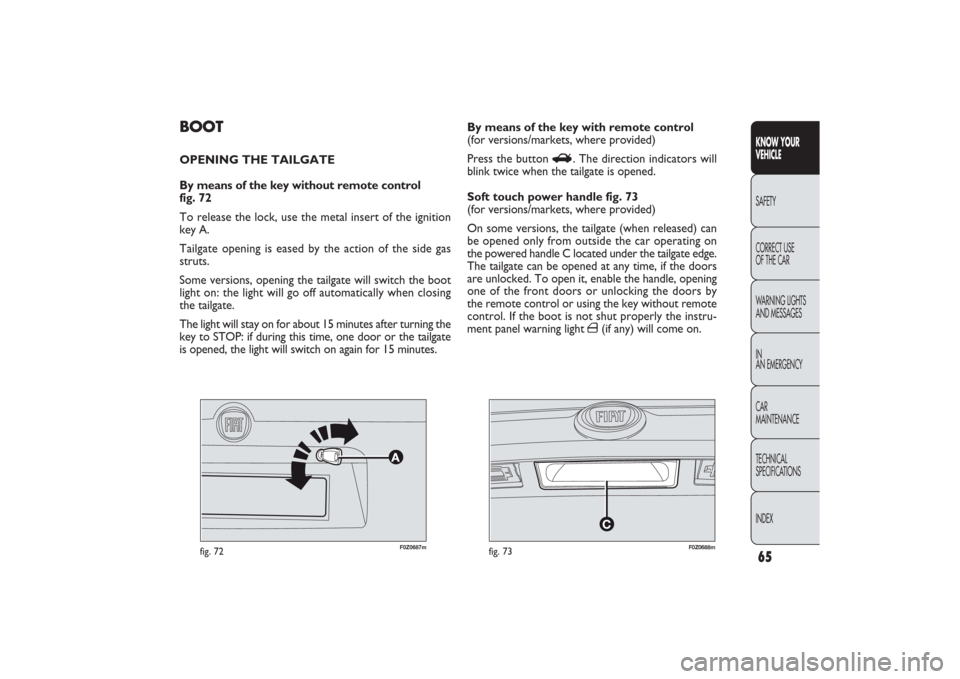
BOOTOPENING THE TAILGATE
By means of the key without remote control
fig. 72
To release the lock, use the metal insert of the ignition
key A.
Tailgate opening is eased by the action of the side gas
struts.
Some versions, opening the tailgate will switch the boot
light on: the light will go off automatically when closing
the tailgate.
The light will stay on for about 15 minutes after turning the
key to STOP: if during this time, one door or the tailgate
is opened, the light will switch on again for 15 minutes.By means of the key with remote control
(for versions/markets, where provided)
Press the button
R
. The direction indicators will
blink twice when the tailgate is opened.
Soft touch power handle fig. 73
(for versions/markets, where provided)
On some versions, the tailgate (when released) can
be opened only from outside the car operating on
the powered handle C located under the tailgate edge.
The tailgate can be opened at any time, if the doors
are unlocked. To open it, enable the handle, opening
one of the front doors or unlocking the doors by
the remote control or using the key without remote
control. If the boot is not shut properly the instru-
ment panel warning light ´(if any) will come on.
65KNOW YOUR
VEHICLESAFETY
CORRECT USE
OF THE CAR
WARNING LIGHTS
AND MESSAGES
IN
AN EMERGENCY
CAR
MAINTENANCE
TECHNICAL
SPECIFICATIONS
INDEX
065-090 PANDA EN 7-10-2009 13:45 Pagina 65
Page 76 of 226
If only the
x
warning light on the instru-
ment panel lights up – together with
a message in the reconfigurable multifunction dis-
play (for versions/markets, where provided) – stop
the car immediately and contact the nearest
Fiat Dealership. Leakage of hydraulic fluid from
the braking system will compromise the operation
of the braking system, whether it is of the con-
ventional type or with ABS.WARNING
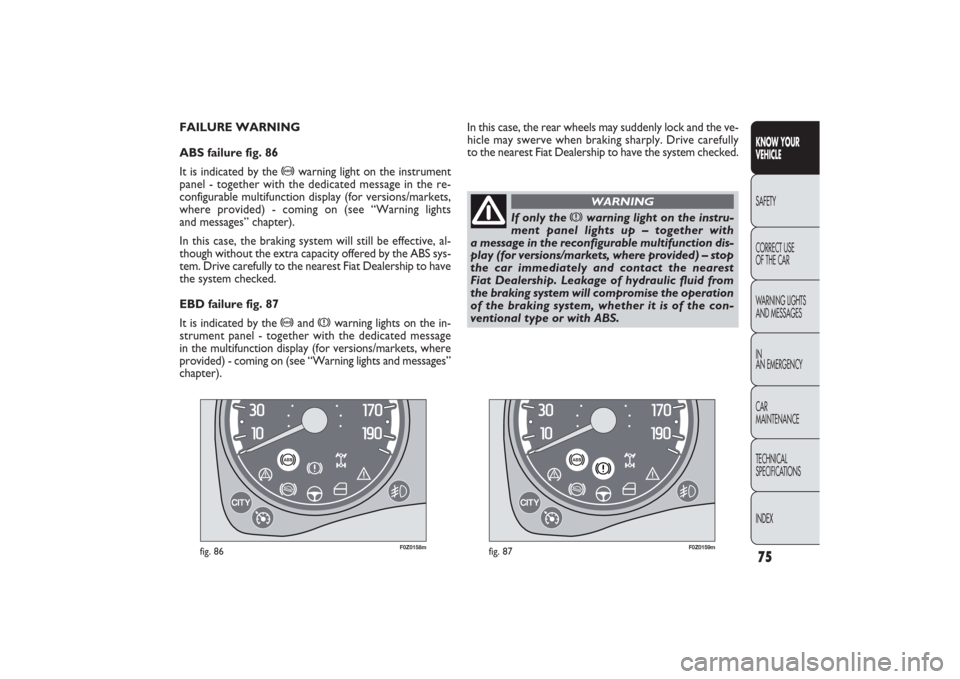
FAILURE WARNING
ABS failure fig. 86
It is indicated by the
>
warning light on the instrument
panel - together with the dedicated message in the re-
configurable multifunction display (for versions/markets,
where provided) - coming on (see “Warning lights
and messages” chapter).
In this case, the braking system will still be effective, al-
though without the extra capacity offered by the ABS sys-
tem. Drive carefully to the nearest Fiat Dealership to have
the system checked.
EBD failure fig. 87
It is indicated by the
>
and
x
warning lights on the in-
strument panel - together with the dedicated message
in the multifunction display (for versions/markets, where
provided) - coming on (see “Warning lights and messages”
chapter).In this case, the rear wheels may suddenly lock and the ve-
hicle may swerve when braking sharply. Drive carefully
to the nearest Fiat Dealership to have the system checked.
fig. 87
F0Z0159m
fig. 86
F0Z0158m
75KNOW YOUR
VEHICLESAFETY
CORRECT USE
OF THE CAR
WARNING LIGHTS
AND MESSAGES
IN
AN EMERGENCY
CAR
MAINTENANCE
TECHNICAL
SPECIFICATIONS
INDEX
065-090 PANDA EN 7-10-2009 13:45 Pagina 75
Page 77 of 226
Do not take unnecessary risks, even if your
vehicle is fitted with an ESP system. Your
driving style must always be suited to the road
conditions, visibility and traffic. The driver is ulti-
mately responsible for road safety.
WARNING
Failure indications
In the event of a failure, the ESP system will be automati-
cally switched off and warning light
á
will appear on
the instrument panel along with a message on the recon-
figurable multifunction display (where provided). The LED
on the button ASR OFF will light up (see “Warning lights
and messages”) In this case, contact a Fiat Dealership.
HILL HOLDER SYSTEM
(for versions/markets, where provided)
This system is integral part of the ESP system and it is pro-
vided to facilitate starting on slopes. It is automatically ac-
tivated in the following conditions:
❒
uphill: car at a standstill on a road with a gradient high-
er than 2%, engine running, clutch and brake pedal
pressed, gearbox in neutral or engaged gear other than
reverse.
ESP SYSTEM
(Electronic Stability Program) (for versions/markets where provided)
GENERAL INFORMATION
This is an electronic system controlling car stability in
the event of tyre grip loss, helping to maintain direction-
al control.
The ESP system is therefore particularly useful when grip
conditions of road surfaces change.
Besides the ESP, the car is provided with ASR (traction
control with interventions on brakes and engine), HILL
HOLDER (device for start on gradient without using
the brakes), MSR (control of engine braking torque when
shifting gear down) and HBA (automatic increase of brak-
ing pressure in case of emergency braking).
SYSTEM INTERVENTION
It is signalled by the blinking of the warning light
á
on the
instrument panel, to inform the driver that the car is in
critical stability and grip conditions.
System engagement
The ESP system comes on automatically when the vehi-
cle is started and cannot be turned off.
76
KNOW YOUR
VEHICLE
SAFETY
CORRECT USE
OF THE CAR
WARNING LIGHTS
AND MESSAGES
IN
AN EMERGENCY
CAR
MAINTENANCE
TECHNICAL
SPECIFICATIONS
INDEX
065-090 PANDA EN 7-10-2009 13:45 Pagina 76
Page 78 of 226
If the space-saver wheel is used, the ESP
system keeps operating. Always remind
that the space-saver wheel, being smaller than
the original wheel provides less grip.
WARNING
For the correct operation of the ESP and
ASR systems, the tyres must absolutely be
the same make and type on all wheels, in perfect
conditions and, above all, of the type, make
and size specified.
WARNING
ASR SYSTEM (Antislip Regulation)
This is integral part of the ESP system and controls the car,
intervening automatically automatically every time one or
both driving wheels slip.
Depending on the slipping conditions, two different con-
trol systems are activated:❒
if the slipping involves both drive wheels, the ASR func-
tion intervenes by reducing the power transmitted by the
engine;
❒
if the slipping involves only one driving wheel, the ASR
system cuts in automatically braking the wheel that is
slipping.
❒
downhill: car at a standstill on a road with a gradient
higher than 2%, engine running, clutch and brake pedal
pressed and reverse gear engaged.
At pickup, the ESP system control unit will keep braking
pressure on the wheels until reaching the required torque
for starting or, in any case, for a maximum of 2 seconds
in order to move easily the right foot from the brake ped-
al to the accelerator pedal.
When two seconds have elapsed, without starting, the sys-
tem is automatically deactivated, gradually releasing the
braking pressure. During this release stage, the typical me-
chanical brake release noise can be heard, indicating that
the car is about to move.
Failure indications
A possible system failure is indicated by the *warning
light on the instrument panel – together with the dedicated
message in the reconfigurable multifunction display
(for versions/markets, where provided) – coming on
(see “Warning lights and messages” chapter).
IMPORTANT The Hill Holder system is not a parking
brake; therefore, never leave the car without having
engaged the handbrake, turned the engine off and engaged
first gear.
77KNOW YOUR
VEHICLESAFETY
CORRECT USE
OF THE CAR
WARNING LIGHTS
AND MESSAGES
IN
AN EMERGENCY
CAR
MAINTENANCE
TECHNICAL
SPECIFICATIONS
INDEX
065-090 PANDA EN 7-10-2009 13:45 Pagina 77
Page 80 of 226
The system also has a diagnosis connector that can be in-
terfaced to suitable instruments, to read the error codes
stored in the control unit together with a series of specific
parameters for engine operation and diagnosis.
This check can also be carried out by traffic control
authorities.
IMPORTANT After eliminating the failure, to check the sys-
tem completely, Fiat Dealerships run a bench test and, if
necessary, road tests which may also call for a long journey.
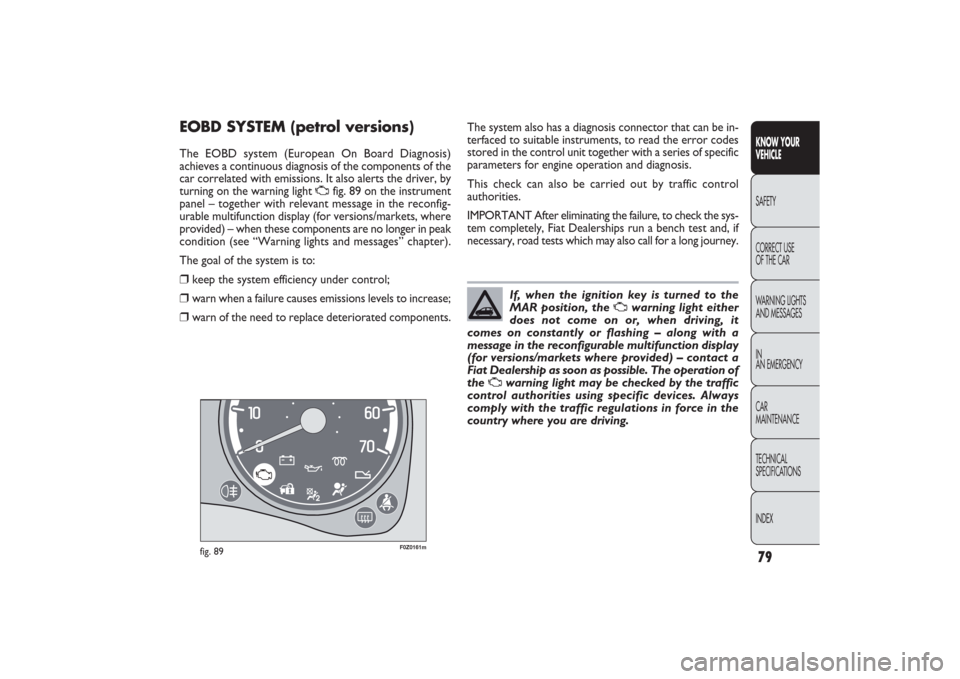
EOBD SYSTEM (petrol versions)The EOBD system (European On Board Diagnosis)
achieves a continuous diagnosis of the components of the
car correlated with emissions. It also alerts the driver, by
turning on the warning light
U
fig. 89 on the instrument
panel – together with relevant message in the reconfig-
urable multifunction display (for versions/markets, where
provided) – when these components are no longer in peak
condition (see “Warning lights and messages” chapter).
The goal of the system is to:
❒
keep the system efficiency under control;
❒
warn when a failure causes emissions levels to increase;
❒
warn of the need to replace deteriorated components.
If, when the ignition key is turned to the
MAR position, the
U
warning light either
does not come on or, when driving, it
comes on constantly or flashing – along with a
message in the reconfigurable multifunction display
(for versions/markets where provided) – contact a
Fiat Dealership as soon as possible. The operation of
the
U
warning light may be checked by the traffic
control authorities using specific devices. Always
comply with the traffic regulations in force in the
country where you are driving.
fig. 89
F0Z0161m
79KNOW YOUR
VEHICLESAFETY
CORRECT USE
OF THE CAR
WARNING LIGHTS
AND MESSAGES
IN
AN EMERGENCY
CAR
MAINTENANCE
TECHNICAL
SPECIFICATIONS
INDEX
065-090 PANDA EN 7-10-2009 13:45 Pagina 79
Page 81 of 226
F0Z0145m
fig. 90
F0Z0162m
fig. 91
When the CITY function is on, the steering wheel effort
is lighter and thus parking operations are easier: there-
fore this function is particularly useful for driving in city
centres.
FAILURE INDICATIONS fig. 92
Possible power steering system failures are indicated by
the
g
warning light on the instrument panel – together
with the dedicated message in the reconfigurable multi-
function display (for versions/markets, where provided)
– coming on (see “Warning lights and messages” chapter).
In the event of electric power steering system failure,
the car can be driven with mechanical steering.
IMPORTANT In some circumstances, factors independent
of the electric power steering could cause the warning light
g
on the instrument panel to come on.
“DUALDRIVE” ELECTRIC POWER
STEERING SYSTEM (for versions/markets, where provided)
Some versions feature an electric power steering system
which only works with the key at MAR and the engine run-
ning; this system, system called “Dualdrive” can be cus-
tomised by the driver according to the driving conditions.
IMPORTANT When turning quickly the ignition key,
power steering full functionality can be achieved after
1-2 seconds.
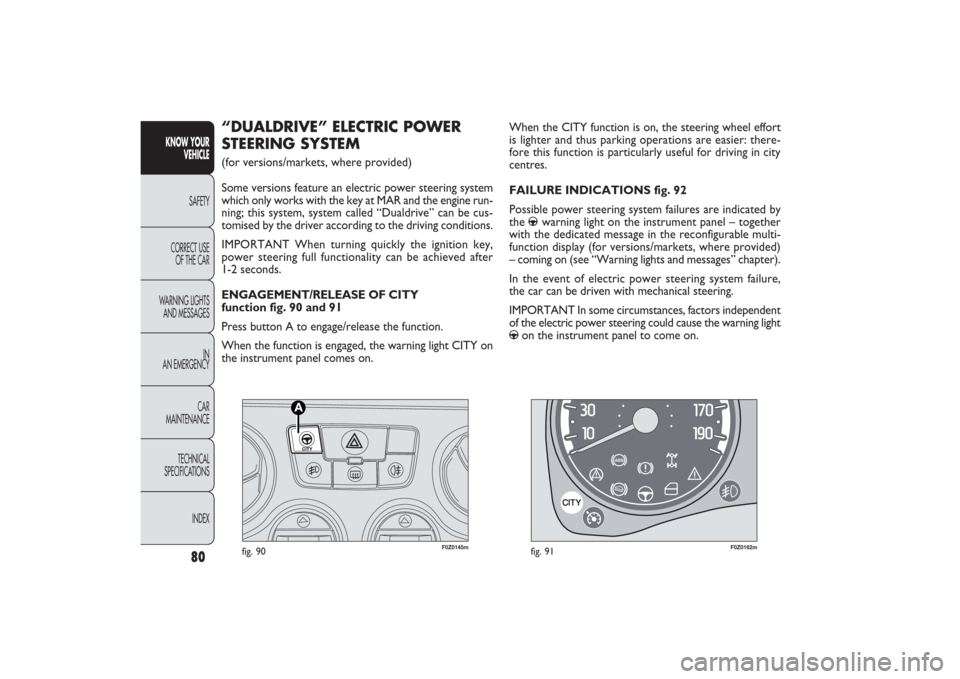
ENGAGEMENT/RELEASE OF CITY
function fig. 90 and 91
Press button A to engage/release the function.
When the function is engaged, the warning light CITY on
the instrument panel comes on.
80
KNOW YOUR
VEHICLE
SAFETY
CORRECT USE
OF THE CAR
WARNING LIGHTS
AND MESSAGES
IN
AN EMERGENCY
CAR
MAINTENANCE
TECHNICAL
SPECIFICATIONS
INDEX
065-090 PANDA EN 7-10-2009 13:45 Pagina 80
Page 85 of 226
F0Z0071m
fig. 94
SOUND SYSTEMWhen the sound system has not been requested, the car
is provided with two oddment compartments on the
instrument panel.
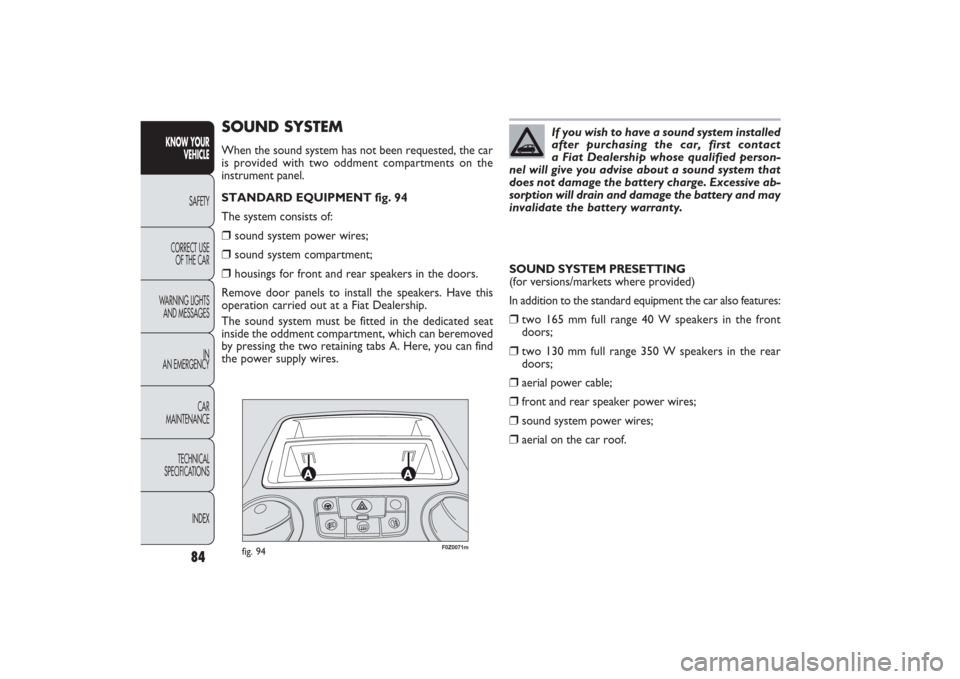
STANDARD EQUIPMENT fig. 94
The system consists of:❒
sound system power wires;
❒
sound system compartment;
❒
housings for front and rear speakers in the doors.
Remove door panels to install the speakers. Have this
operation carried out at a Fiat Dealership.
The sound system must be fitted in the dedicated seat
inside the oddment compartment, which can beremoved
by pressing the two retaining tabs A. Here, you can find
the power supply wires.SOUND SYSTEM PRESETTING
(for versions/markets where provided)
In addition to the standard equipment the car also features:
❒
two 165 mm full range 40 W speakers in the front
doors;
❒
two 130 mm full range 350 W speakers in the rear
doors;
❒
aerial power cable;
❒
front and rear speaker power wires;
❒
sound system power wires;
❒
aerial on the car roof.
If you wish to have a sound system installed
after purchasing the car, first contact
a Fiat Dealership whose qualified person-
nel will give you advise about a sound system that
does not damage the battery charge. Excessive ab-
sorption will drain and damage the battery and may
invalidate the battery warranty.
84
KNOW YOUR
VEHICLE
SAFETY
CORRECT USE
OF THE CAR
WARNING LIGHTS
AND MESSAGES
IN
AN EMERGENCY
CAR
MAINTENANCE
TECHNICAL
SPECIFICATIONS
INDEX
065-090 PANDA EN 7-10-2009 13:45 Pagina 84
Page 92 of 226
91KNOW YOUR
VEHICLESAFETYCORRECT USE
OF THE CAR
WARNING LIGHTS
AND MESSAGES
IN AN EMERGENCY
CAR
MAINTENANCE
TECHNICAL
SPECIFICATIONS
INDEX
SAFETY
F0Z0053m
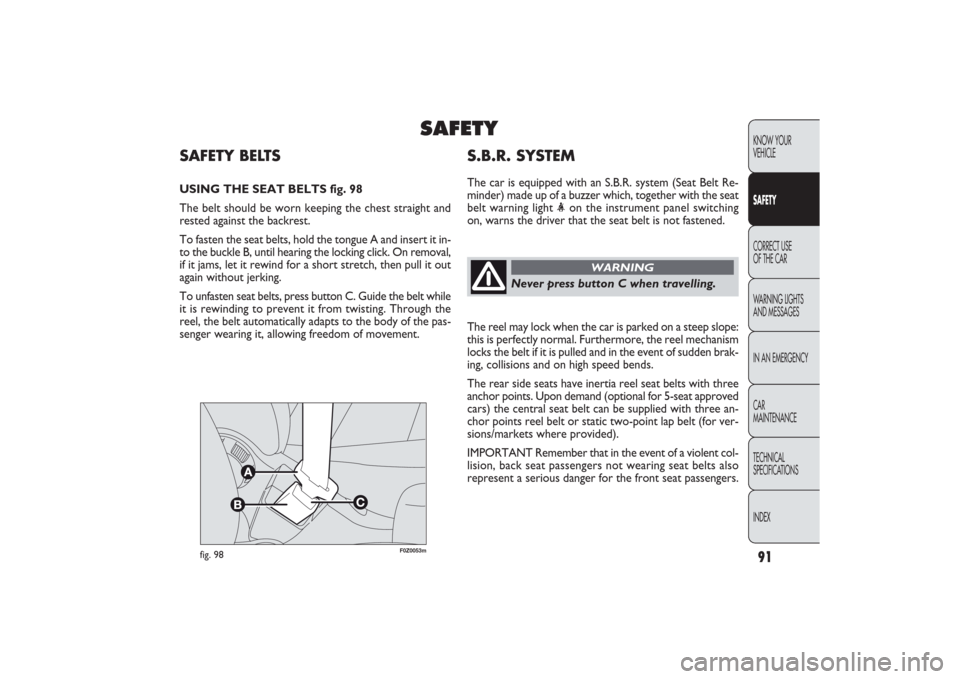
fig. 98
The reel may lock when the car is parked on a steep slope:
this is perfectly normal. Furthermore, the reel mechanism
locks the belt if it is pulled and in the event of sudden brak-
ing, collisions and on high speed bends.
The rear side seats have inertia reel seat belts with three
anchor points. Upon demand (optional for 5-seat approved
cars) the central seat belt can be supplied with three an-
chor points reel belt or static two-point lap belt (for ver-
sions/markets where provided).
IMPORTANT Remember that in the event of a violent col-
lision, back seat passengers not wearing seat belts also
represent a serious danger for the front seat passengers.
SAFETY BELTSUSING THE SEAT BELTS fig. 98
The belt should be worn keeping the chest straight and
rested against the backrest.
To fasten the seat belts, hold the tongue A and insert it in-
to the buckle B, until hearing the locking click. On removal,
if it jams, let it rewind for a short stretch, then pull it out
again without jerking.
To unfasten seat belts, press button C. Guide the belt while
it is rewinding to prevent it from twisting. Through the
reel, the belt automatically adapts to the body of the pas-
senger wearing it, allowing freedom of movement.
Never press button C when travelling.
WARNING
S.B.R. SYSTEMThe car is equipped with an S.B.R. system (Seat Belt Re-
minder) made up of a buzzer which, together with the seat
belt warning light
<
on the instrument panel switching
on, warns the driver that the seat belt is not fastened.
091-110 PANDA EN 7-10-2009 13:46 Pagina 91
Page 103 of 226
102
KNOW YOUR
VEHICLE
SAFETY
CORRECT USE
OF THE CAR
WARNING LIGHTS
AND MESSAGES
IN AN EMERGENCY
CAR
MAINTENANCE
TECHNICAL
SPECIFICATIONS
INDEX
Below is a summary of the safety rules to be followed for
carrying children.❒
Install the child seats on the rear seat, which is the most
protected position in the event of an accident.
❒
If the passenger’s air bag is deactivated always check the
amber warning light
F
on the instrument panel to
make sure that it has actually been deactivated.
❒
Carefully follow the instructions supplied with the child
restraint system which are mandatory by law. Keep the
instructions in the car along with the other papers and
this handbook. Do not use second-hand child seats with-
out instructions.
❒
Always check the seat belt is well fastened by pulling the
webbing.
❒
Only one child is to be strapped to each retaining system.
❒
Always check the seat belts do not fit around the child’s
throat.
❒
While travelling, do not let the child sit incorrectly or
release the belts.
❒
Never carry children on your lap, even newborns. No-one
can hold a child in the event of an accident.
❒
In case of an accident, replace the child seat with a new
one.
In cars fitted with passenger’s air bag nev-
er place child restraint systems on the front
seat, since children must never travel on the
front seat.
WARNING
091-110 PANDA EN 7-10-2009 13:46 Pagina 102