tow FIAT PANDA 2009 169 / 2.G User Guide
[x] Cancel search | Manufacturer: FIAT, Model Year: 2009, Model line: PANDA, Model: FIAT PANDA 2009 169 / 2.GPages: 226, PDF Size: 5.29 MB
Page 116 of 226
115KNOW
YOUR VEHICLE
SAFETYCORRECT USE
OF THE CARWARNING LIGHTS
AND MESSAGES
IN
AN EMERGENCY
CAR
MAINTENANCE
TECHNICAL
SPECIFICATIONS
INDEX
CONTAINING RUNNING COSTSSome useful tips are given below for fuel saving and re-
ducing harmful emissions of CO
2and other pollutants
(nitrogen oxides, unburnt hydrocarbons, Particulate
Matter (PM) etc.).
GENERAL CONSIDERATIONS
Car maintenance
Have checks and adjustments carried out in accordance
with the “Scheduled servicing plan.”
Tyres
Check the pressure of the tyres routinely at an interval
of no more than 4 weeks: if the pressure is too low, con-
sumption levels increase as resistance to rolling is higher.
Unnecessary loads
Do not travel with an overloaded boot. The weight of
the car (especially when driving in town) and its trim great-
ly affects consumption and stability.
Accessories installed on longitudinal bars
Remove accessories like: roof racks, ski racks, luggage con-
tainer, etc. from the roof as soon as they are no longer
used. These accessories lower air penetration and ad-
versely affect consumption levels. When needing to
carry particularly voluminous objects, preferably use
a trailer.
To change gears properly you must push
the clutch pedal fully down. For this rea-
son, there must be no obstacles on the floor un-
der the pedals: ensure that rubber mats (if any)
are lying flat and do not interfere with the pedals.
WARNING
Do not drive with your hand resting on the
shifting lever, because this pressure, even
if light, over time can wear out the gearbox
internal components.
111-122 PANDA EN 7-10-2009 15:01 Pagina 115
Page 118 of 226
117KNOW
YOUR VEHICLE
SAFETYCORRECT USE
OF THE CARWARNING LIGHTS
AND MESSAGES
IN
AN EMERGENCY
CAR
MAINTENANCE
TECHNICAL
SPECIFICATIONS
INDEX
TOWING TRAILERSIMPORTANT NOTES
For towing caravans or trailers the car must be fitted with
a certified tow hook and an adequate electric system. In-
stallation should be carried out by specialised personnel
who will issue the required papers for travelling on roads.
Install any specific and/or additional rear view mirrors as
specified by the Highway Code.
Remember that when towing a trailer, steep hills are hard-
er to climb, braking spaces increase and overtaking takes
longer depending on the overall weight.
Engage a low gear when driving downhill, rather than con-
stantly using the brake.
The weight the trailer exerts on the car tow hook reduces
by the same amount the actual car loading capacity. To
make sure the maximum towable weight is not exceeded
(given in the car registration document) account should
be taken of the fully laden trailer, including accessories and
luggage.
Do not exceed the speed limits specific for each country
you are driving in, in case of vehicles towing trailers. In any
case, the top speed must not exceed 100 km/h. Traffic and road conditions
Rather high consumption levers are tied to situations with
heavy traffic, for instance when travelling in queues with
frequent use of the lower gears or in cities with many traf-
fic lights. Also winding mountain roads and rough road sur-
faces adversely affect consumption.
Traffic hold-ups
During prolonged hold-ups (e.g. level crossings) the engine
should be switched off.
111-122 PANDA EN 7-10-2009 15:01 Pagina 117
Page 119 of 226
118
KNOW YOUR
VEHICLE
SAFETYCORRECT USE
OF THE CARWARNING LIGHTS
AND MESSAGESI
IN
AN EMERGENCY
CAR
MAINTENANCE
TECHNICAL
SPECIFICATIONS
INDEX
INSTALLING THE TOW HOOK
The towing device should be fastened to the body by spe-
cialised personnel according to any additional and/or in-
tegrative information supplied by the Manufacturer of the
device.
The towing device must meet current regulations with
reference to 94/20/EEC Directive and subsequent amend-
ments.
For any version the towing device used must match the
towable weight of the car on which it is to be installed.
For the electric connection a standard connector should
be used which is generally placed on a special bracket nor-
mally fastened to the towing device, and a special ECU for
external trailer light control must be installed on the car.
For the electric connection, a 7 pin 12V DC connection
is to be used (CUNA/UNI and ISO/DIN Standards). Fol-
low the instructions provided by the car manufacturer
and/or the tow hook manufacturer.
An electric brake (or electric winch) should be supplied
directly by the battery through a cable with a cross sec-
tion of no less than 2.5 mm
2.
IMPORTANT Electric brake or other devices shall be used
with running engine.
In addition to the electrical branches, the car electric sys-
tem can only be connected to the supply cable for an elec-
tric brake and to the cable for an internal light for the trail-
er, not exceeding 15 W.
For connections use the preset control unit with battery
cable not less than 2.5 mm2.
The ABS system with which the vehicle
may be equipped does not control the
braking system of the trailer. Take specific care
when travelling on slippery roads.
WARNING
Under no circumstances should the car
braking system be modified to control the
trailer brake. The trailer braking system must be
fully independent of the car’s hydraulic system.
WARNING
111-122 PANDA EN 7-10-2009 15:01 Pagina 118
Page 120 of 226
119KNOW
YOUR VEHICLE
SAFETYCORRECT USE
OF THE CARWARNING LIGHTS
AND MESSAGES
IN
AN EMERGENCY
CAR
MAINTENANCE
TECHNICAL
SPECIFICATIONS
INDEX
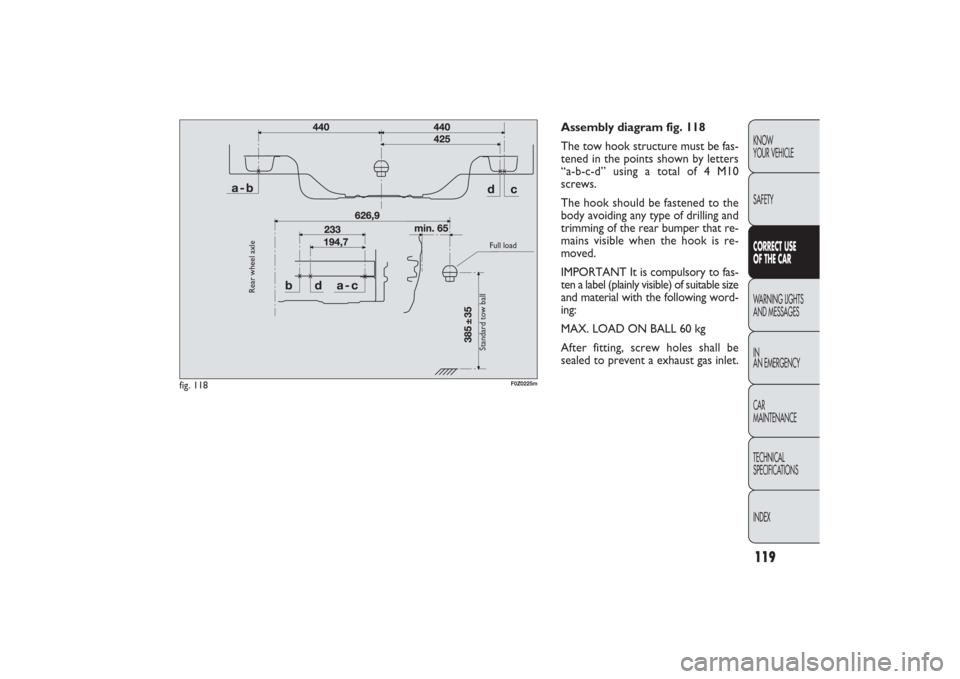
Assembly diagram fig. 118
The tow hook structure must be fas-
tened in the points shown by letters
“a-b-c-d” using a total of 4 M10
screws.
The hook should be fastened to the
body avoiding any type of drilling and
trimming of the rear bumper that re-
mains visible when the hook is re-
moved.
IMPORTANT It is compulsory to fas-
ten a label (plainly visible) of suitable size
and material with the following word-
ing:
MAX. LOAD ON BALL 60 kg
After fitting, screw holes shall be
sealed to prevent a exhaust gas inlet.
fig. 118
F0Z0225m
Rear wheel axle
Standard tow ball
Full load
111-122 PANDA EN 7-10-2009 15:01 Pagina 119
Page 121 of 226
120
KNOW YOUR
VEHICLE
SAFETYCORRECT USE
OF THE CARWARNING LIGHTS
AND MESSAGESI
IN
AN EMERGENCY
CAR
MAINTENANCE
TECHNICAL
SPECIFICATIONS
INDEX
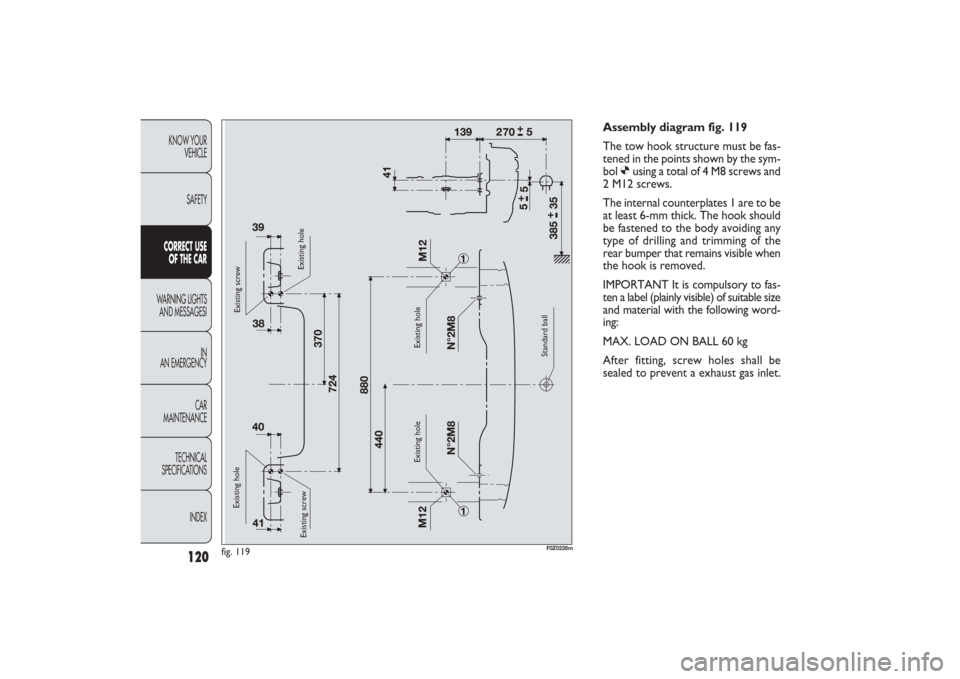
Assembly diagram fig. 119
The tow hook structure must be fas-
tened in the points shown by the sym-
bol
Ø
using a total of 4 M8 screws and
2 M12 screws.
The internal counterplates 1 are to be
at least 6-mm thick. The hook should
be fastened to the body avoiding any
type of drilling and trimming of the
rear bumper that remains visible when
the hook is removed.
IMPORTANT It is compulsory to fas-
ten a label (plainly visible) of suitable size
and material with the following word-
ing:
MAX. LOAD ON BALL 60 kg
After fitting, screw holes shall be
sealed to prevent a exhaust gas inlet.
fig. 119
F0Z0226m
Existing hole
Existing hole
Existing hole Existing hole
Standard ballExisting screw
Existing screw
111-122 PANDA EN 7-10-2009 15:01 Pagina 120
Page 126 of 226
ABS SYSTEM FAILURE (amber)Turning the ignition key to
MAR
the
warning light turns on, but it should go off
after a few seconds.
The warning light will light up when the system is either
not working or not available. Under these circumstances
the braking system will work as normal without the ex-
tra performance offered by the ABS system. Drive care-
fully and contact a Fiat Dealership as soon as possible.
On some versions the display shows the dedicated message.
125KNOW
YOUR VEHICLE
SAFETY
CORRECT USE
OF THE CARWARNING LIGHTS
AND MESSAGESIN
AN EMERGENCY
CAR
MAINTENANCE
TECHNICAL
SPECIFICATIONS
INDEX
IMPORTANT Under severe use of the car, it is advisable
to keep the engine on and slightly accelerated for a few
minutes before switching it off.
On some versions the display shows the dedicated message. ENGINE COOLANT HIGH TEMPERA-
TURE (red)
Turning the ignition key to MAR the warning light
turns on, but it should go off after a few seconds. The
warning light turns on when the engine is overheated. If
the warning light comes on when driving, proceed as fol-
lows:
❒in standard normal driving conditions: stop the car,
switch off the engine and check whether the water lev-
el in the reservoir is not below the MIN. mark. In this
case, wait for a few minutes for the engine to cool
down, then slowly and carefully open the cap, top-up
with coolant and check that the level is between the
MIN. and MAX. marks on the reservoir itself. Also
check for any fluid leaks. If, when restarting, the warn-
ing light should come on again, contact a Fiat Dealer-
ship.
❒In case of car heavy duty (e.g.: towing trailer uphill or
fully laden car): decrease speed, if the warning light stays
on, stop the car. Wait for 2 or 3 minutes with the en-
gine running and slightly accelerated to further accel-
erate the coolant circulation. Then stop the engine.
Check the correct liquid level as described above.
ç
LOW BATTERY CHARGE (red)
Turning the ignition key to
MAR
, the warning
light turns on and should go out as soon as the
engine is started (with the engine running at idle speed
a short delay in going out is allowed).
If the warning light stays on contact immediately a Fiat
Dealership.
wx
>
123-134 PANDA EN 7-10-2009 13:49 Pagina 125
Page 127 of 226
126
KNOW YOUR
VEHICLE
SAFETY
CORRECT USE
OF THE CAR
WARNING LIGHTS
AND MESSAGES
IN
AN EMERGENCY
CAR
MAINTENANCE
TECHNICAL
SPECIFICATIONS
INDEX
CONTINUOUSLY ON: LOW ENGINE
OIL PRESSURE (red)
FLASHING: EXHAUSTED ENGINE OIL
(only Multijet versions with DPF – red)
When the key is turned to MAR the warning light comes
on, but should go out as soon as the engine is started.
Low engine oil pressure
The warning light will turn on constantly together with the
message on the display (for versions/markets where pro-
vided) when the system detects that the engine oil pres-
sure is too low.If the warning light
v
turns on when the
car is travelling (on certain versions to-
gether with the message on the display) stop the
engine immediately and contact a Fiat Dealership.
WARNING
Exhausted engine oil
(Multijet versions with DPF only)
The warning light will turn on flashing together with the
message on the display (for versions/markets where pro-
vided). Depending on the versions, the warning light flash-
ing modes are as follows:
– one minute every two hours;
– cycles of three minutes with intervals with the warning
light off for five seconds until the oil is changed.v
If the warning light comes on, the ex-
hausted engine oil should be changed as
soon as possible, never drive more than 500 km
from the first switching-on of this warning light.
If the above instructions are not complied with,
the engine could be severely damaged and the
warranty may decay. Please note also that the
switching on of this warning light does not depend
on the oil quantity in the engine; when the warn-
ing light flashes, never add oil.
WARNING
After the first indication, at each engine start up the warn-
ing light will continue flashing as above described until the
oil is changed. For those versions/markets where provid-
ed, the display shows a dedicated message together with
the warning light.
The flashing of the warning light should not be consid-
ered as as fault, rather simply informs the customer that
oil needs to be changed after a standard period of car util-
isation.
Remember that the deterioration of the engine oil is ac-
celerated by:
– mainly town use of the car which makes the DPF re-
generation process more frequent;
– use of the car for short journeys, preventing the engine
from reaching operating temperature;
– repeated interruptions to the regeneration process sig-
nalled by the DPF warning light coming on.
123-134 PANDA EN 7-10-2009 13:49 Pagina 126
Page 137 of 226
136KNOW
YOUR VEHICLE
SAFETY
CORRECT USE
OF THE CAR
WARNING LIGHTS
AND MESSAGES
IN
AN EMERGENCYCAR
MAINTENANCE
TECHNICAL
SPECIFICATIONS
INDEX
Never use a fast battery-charger to start the
engine as this could damage the electron-
ic systems of your car, particularly the ig-
nition and fuel supply control units.This procedure must be performed by qual-
ified personnel as incorrect actions may
cause high-intensity electrical discharge. Further-
more, battery fluid is poisonous and corrosive: avoid
contact with your skin and eyes. Keep naked flames
away from the battery. No smoking. Do not cause
sparks.
WARNING
If after a few attempts the engine does not start, do not
insist rather contact the nearest Fiat Dealership.
IMPORTANT Do not directly connect the negative ter-
minals of the two batteries: any sparks may ignite the det-
onating gas which could come out of the battery. If the aux-
iliary battery is installed on another car, prevent any contact
between metal parts of the cars and the flat battery.
BUMP STARTING
Never bump start the engine by pushing, towing or driving
downhill.
This could cause a flow of fuel into the catalytic convert-
er and damage it beyond repair.
IMPORTANT Remember that the servo-brake and elec-
trical power steering system (for versions/markets where
provided) are not operating until the engine is started, a
greater effort will therefore be required to press the brake
pedal or turn the steering wheel. Proceed as follows to start the car:
❒
connect the positive terminals (+ sign close to the ter-
minal) of both batteries using a lead;
❒
with a second lead, connect the negative terminal − of
the auxiliary battery to an earthing point
E
on the en-
gine or the gearbox of the car to be started;
❒
start the engine;
❒
when the engine has been started, follow the sequence
above in reverse order to remove the leads.
135-168 PANDA EN 7-10-2009 14:06 Pagina 136
Page 144 of 226
143KNOW
YOUR VEHICLE
SAFETY
CORRECT USE
OF THE CAR
WARNING LIGHTS
AND MESSAGESIN
AN EMERGENCYCAR
MAINTENANCE
TECHNICAL
SPECIFICATIONS
INDEX
At the end of the procedure❒
stow the space-saving wheel D-fig. 122 in the space pro-
vided in the boot;
❒
fit the partially-open jack in its box C by forcing it slight-
ly to prevent it from vibrating when travelling;
❒
put the tools back into their locations;
❒
arrange the container and tools in the spare wheel and
secure the clamping device B;
❒
correctly reposition the boot stiff cover.
IMPORTANT Do not use inner tubes with tubeless tyres.
Check the inflation pressure of the tyres and the space-
saving wheel regularly.
IMPORTANT You will need to change the set of bolts if
you want to change the type of wheels fitted (alloy rims
instead of steel rims, and vice versa).The whole set of fas-
tening bolts must be replaced by another set of suitably
sized bolts and use a special space-saving wheel having dif-
ferent building characteristics.
You should keep the bolts and space-saving wheel in case
you decide to use the original type of wheel later on.
F0Z0607m
fig. 131
QUICK TYRE REPAIR KIT FIX & GO
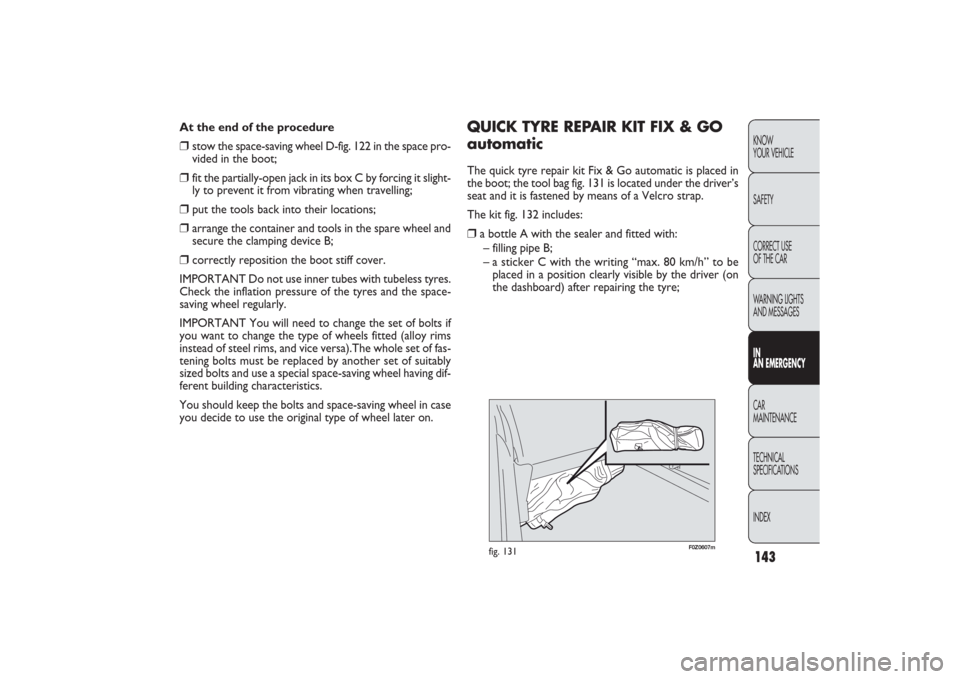
automaticThe quick tyre repair kit Fix & Go automatic is placed in
the boot; the tool bag fig. 131 is located under the driver’s
seat and it is fastened by means of a Velcro strap.
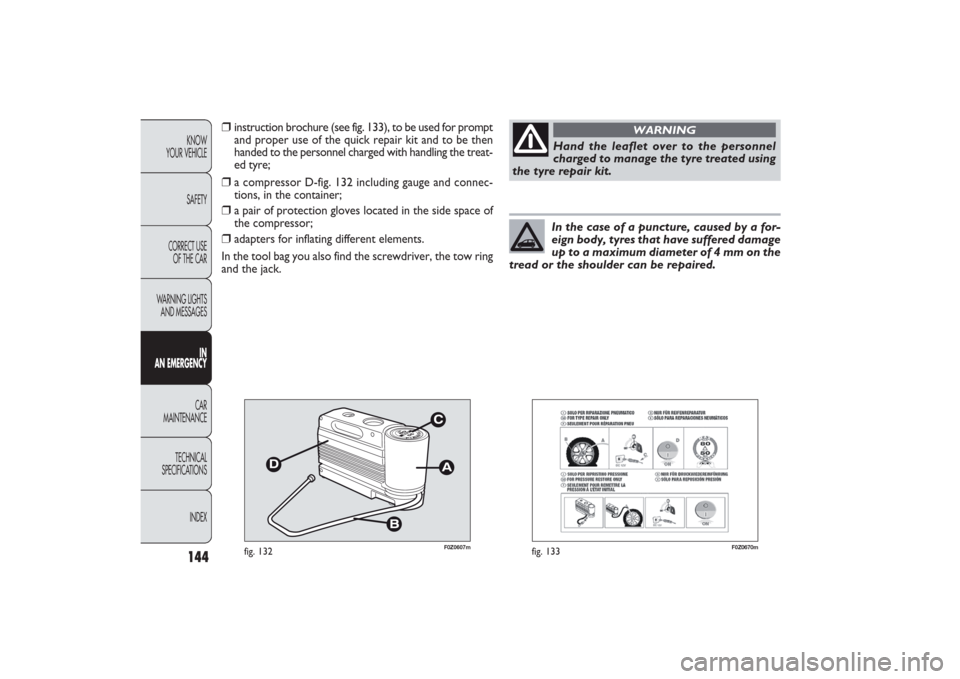
The kit fig. 132 includes:❒
a bottle A with the sealer and fitted with:
– filling pipe B;
– a sticker C with the writing “max. 80 km/h” to be
placed in a position clearly visible by the driver (on
the dashboard) after repairing the tyre;
135-168 PANDA EN 7-10-2009 14:06 Pagina 143
Page 145 of 226
144KNOW
YOUR VEHICLE
SAFETY
CORRECT USE
OF THE CAR
WARNING LIGHTS
AND MESSAGES
IN
AN EMERGENCYCAR
MAINTENANCE
TECHNICAL
SPECIFICATIONS
INDEX
F0Z0670m
fig. 133
Hand the leaflet over to the personnel
charged to manage the tyre treated using
the tyre repair kit.
WARNING
In the case of a puncture, caused by a for-
eign body, tyres that have suffered damage
up to a maximum diameter of 4 mm on the
tread or the shoulder can be repaired.
❒
instruction brochure (see fig. 133), to be used for prompt
and proper use of the quick repair kit and to be then
handed to the personnel charged with handling the treat-
ed tyre;
❒
a compressor D-fig. 132 including gauge and connec-
tions, in the container;
❒
a pair of protection gloves located in the side space of
the compressor;
❒
adapters for inflating different elements.
In the tool bag you also find the screwdriver, the tow ring
and the jack.
F0Z0607m
fig. 132
135-168 PANDA EN 7-10-2009 14:06 Pagina 144