tow FIAT PANDA 2009 169 / 2.G Owner's Manual
[x] Cancel search | Manufacturer: FIAT, Model Year: 2009, Model line: PANDA, Model: FIAT PANDA 2009 169 / 2.GPages: 226, PDF Size: 5.29 MB
Page 168 of 226
167KNOW
YOUR VEHICLE
SAFETY
CORRECT USE
OF THE CAR
WARNING LIGHTS
AND MESSAGESIN
AN EMERGENCYCAR
MAINTENANCE
TECHNICAL
SPECIFICATIONS
INDEX
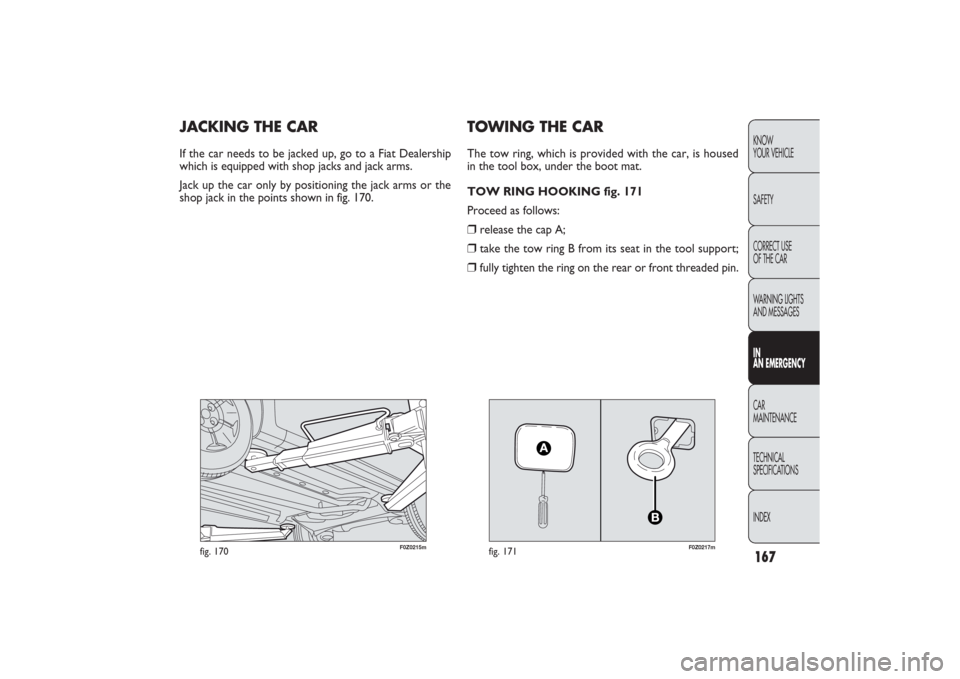
F0Z0215m
fig. 170
F0Z0217m
fig. 171
TOWING THE CARThe tow ring, which is provided with the car, is housed
in the tool box, under the boot mat.
TOW RING HOOKING fig. 171
Proceed as follows:❒
release the cap A;
❒
take the tow ring B from its seat in the tool support;
❒
fully tighten the ring on the rear or front threaded pin.
JACKING THE CARIf the car needs to be jacked up, go to a Fiat Dealership
which is equipped with shop jacks and jack arms.
Jack up the car only by positioning the jack arms or the
shop jack in the points shown in fig. 170.
135-168 PANDA EN 7-10-2009 14:07 Pagina 167
Page 169 of 226
168KNOW
YOUR VEHICLE
SAFETY
CORRECT USE
OF THE CAR
WARNING LIGHTS
AND MESSAGES
IN
AN EMERGENCYCAR
MAINTENANCE
TECHNICAL
SPECIFICATIONS
INDEX
Before towing, turn the ignition key to
MAR and then to STOP without removing
it. The steering column will automatically lock
when the key is removed and the wheels cannot
be steered.
WARNING
When towing, remember that without the
help of the servo-brake and electric pow-
er steering, a greater effort is required on the ped-
al and steering wheel. Do not use flexible cables
when towing and avoid jerky movements. While
towing, make sure not to damage parts in contact
with the car. When towing the car, comply with
the regulations of the Highway Code about tow-
ing, both concerning the towing device and the
driving behaviour on the road.
WARNING
During towing, never start the engine.
WARNING
135-168 PANDA EN 7-10-2009 14:07 Pagina 168
Page 170 of 226
169KNOW
YOUR VEHICLE
SAFETY
WARNING LIGHTS
AND MESSAGES
IN
AN EMERGENCYCAR
MAINTENANCETECHNICAL
SPECIFICATIONS
INDEX
CAR MAINTENANCE
SCHEDULED SERVICINGCorrect servicing is essential in guaranteeing a long life for
the car under the best conditions.
This is why Fiat has programmed a series of checks and
servicing operations every 20,000 km.
It is however important to remember that scheduled ser-
vicing does not completely cover all the car’s requirements:
also in the initial run-in period before 20,000 km service
coupon and later, between each servicing interval, ordi-
nary care is still required, such as for example routine
check and topping-up the level of fluids, tyre pressure
check, etc...
CORRECT USE
OF THE CAR
IMPORTANT Scheduled Servicing coupons are specified
by the Manufacturer. Failure to have them carried out may
invalidate the warranty.
Schedule servicing can be carried out by any Fiat Dealership,
at pre-established times.
If during each operation, in addition to the ones pro-
grammed, the need arises for further replacements or re-
pairs, these may only be carried out with the express
agreement of the Customer.
IMPORTANT It is advisable to contact a Fiat Dealership
in the event of any minor operating failure, without wait-
ing for the next service coupon.
If the car is used frequently for towing a trailer, the inter-
val between services should be reduced.
169-190 PANDA EN 7-10-2009 14:14 Pagina 169
Page 172 of 226
●●●
●●● ●● ●● ●●
●●
●
●●●●
●●●●
●●
●●● ●● ●● ●●
(●)(
●)(
●)(
●)(
●)(
●)(
●)(
●)(
●)
●●●
●●● ●● ●● ●●
●●●●
●●●
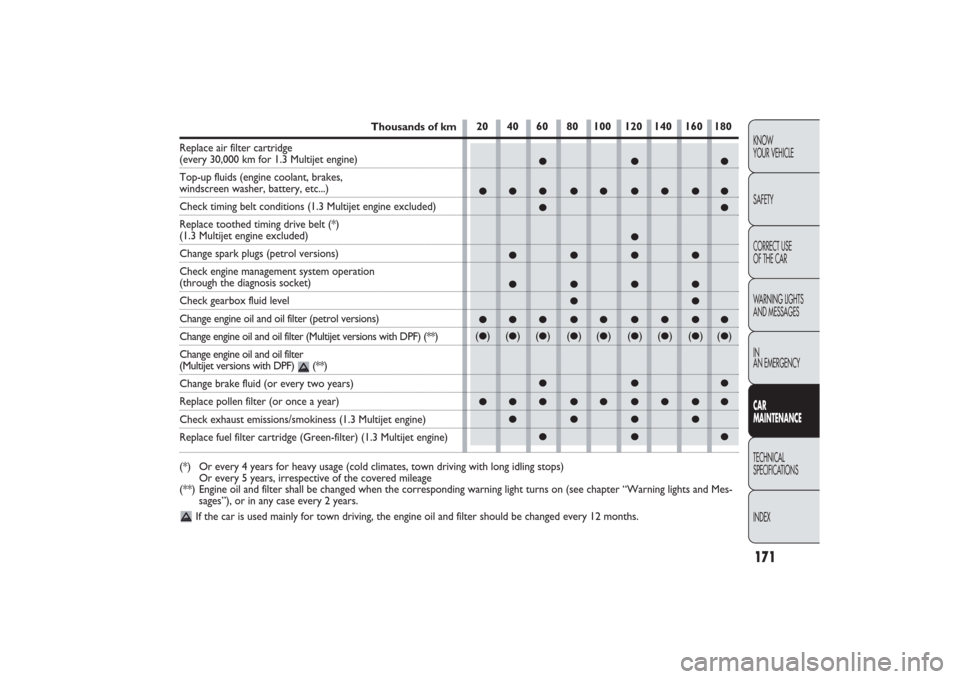
20 40 60 80 100 120 140 160 180
Thousands of km
Replace air filter cartridge
(every 30,000 km for 1.3 Multijet engine)
Top-up fluids (engine coolant, brakes, windscreen washer, battery, etc...)Check timing belt conditions (1.3 Multijet engine excluded)
Replace toothed timing drive belt (*) (1.3 Multijet engine excluded)Change spark plugs (petrol versions)
Check engine management system operation (through the diagnosis socket)Check gearbox fluid levelChange engine oil and oil filter (petrol versions)Change engine oil and oil filter (Multijet versions with DPF) (**)
Change engine oil and oil filter (Multijet versions with DPF) (**)Change brake fluid (or every two years)Replace pollen filter (or once a year)Check exhaust emissions/smokiness (1.3 Multijet engine)Replace fuel filter cartridge (Green-filter) (1.3 Multijet engine)
(*) Or every 4 years for heavy usage (cold climates, town driving with long idling stops)
Or every 5 years, irrespective of the covered mileage
(**) Engine oil and filter shall be changed when the corresponding warning light turns on (see chapter “Warning lights and Mes-
sages”), or in any case every 2 years.
If the car is used mainly for town driving, the engine oil and filter should be changed every 12 months.
INDEX TECHNICAL
SPECIFICATIONSCAR
MAINTENANCEIN
AN EMERGENCY WARNING LIGHTS
AND MESSAGES CORRECT USE
OF THE CAR SAFETY KNOW
YOUR VEHICLE171
169-190 PANDA EN 7-10-2009 14:14 Pagina 171
Page 173 of 226
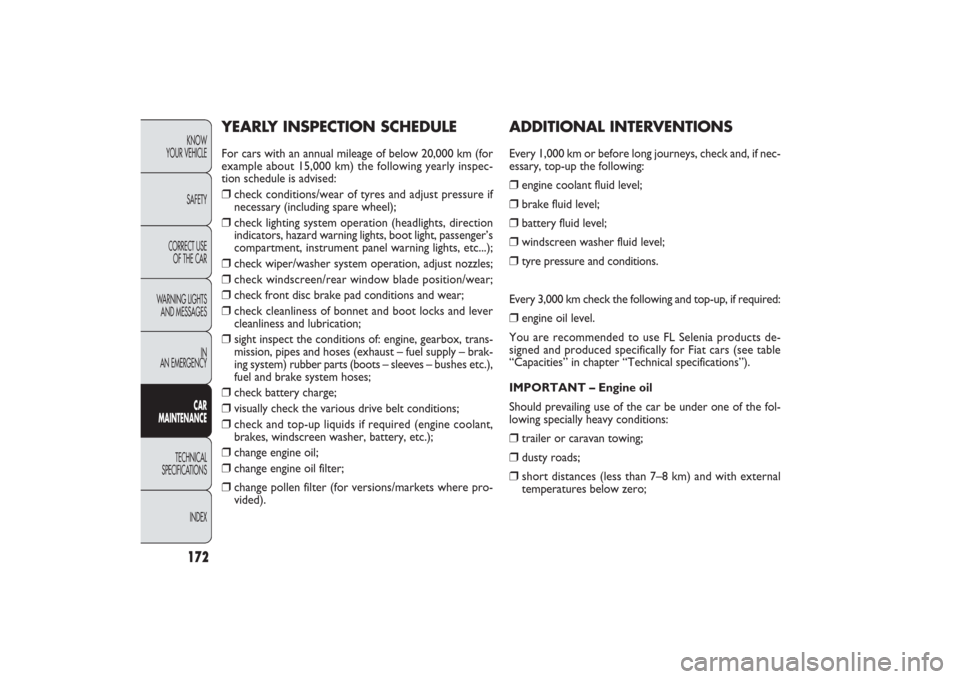
YEARLY INSPECTION SCHEDULEFor cars with an annual mileage of below 20,000 km (for
example about 15,000 km) the following yearly inspec-
tion schedule is advised:❒
check conditions/wear of tyres and adjust pressure if
necessary (including spare wheel);
❒
check lighting system operation (headlights, direction
indicators, hazard warning lights, boot light, passenger’s
compartment, instrument panel warning lights, etc...);
❒
check wiper/washer system operation, adjust nozzles;
❒
check windscreen/rear window blade position/wear;
❒
check front disc brake pad conditions and wear;
❒
check cleanliness of bonnet and boot locks and lever
cleanliness and lubrication;
❒
sight inspect the conditions of: engine, gearbox, trans-
mission, pipes and hoses (exhaust – fuel supply – brak-
ing system) rubber parts (boots – sleeves – bushes etc.),
fuel and brake system hoses;
❒
check battery charge;
❒
visually check the various drive belt conditions;
❒
check and top-up liquids if required (engine coolant,
brakes, windscreen washer, battery, etc.);
❒
change engine oil;
❒
change engine oil filter;
❒
change pollen filter (for versions/markets where pro-
vided).
ADDITIONAL INTERVENTIONSEvery 1,000 km or before long journeys, check and, if nec-
essary, top-up the following:❒
engine coolant fluid level;
❒
brake fluid level;
❒
battery fluid level;
❒
windscreen washer fluid level;
❒
tyre pressure and conditions.
Every 3,000 km check the following and top-up, if required:
❒
engine oil level.
You are recommended to use FL Selenia products de-
signed and produced specifically for Fiat cars (see table
“Capacities” in chapter “Technical specifications”).
IMPORTANT – Engine oil
Should prevailing use of the car be under one of the fol-
lowing specially heavy conditions:
❒
trailer or caravan towing;
❒
dusty roads;
❒
short distances (less than 7–8 km) and with external
temperatures below zero;
INDEX TECHNICAL
SPECIFICATIONSCAR
MAINTENANCEIN
AN EMERGENCY WARNING LIGHTS
AND MESSAGESCORRECT USE
OF THE CARSAFETYKNOW
YOUR VEHICLE
172
169-190 PANDA EN 7-10-2009 14:14 Pagina 172
Page 203 of 226
935
445
750
660
1380
900
400
50
60
860
445
730
660
1305
800
400
50
60
840
415
730
640
1255
800
350
50
60
202
KNOW YOUR
VEHICLE
SAFETY
CORRECT USE OF
THE CAR
WARNING LIGHTS
AND MESSAGES
IN
AN EMERGENCY
CAR
MAINTENANCETECHNICAL
SPECIFICATIONS
INDEX
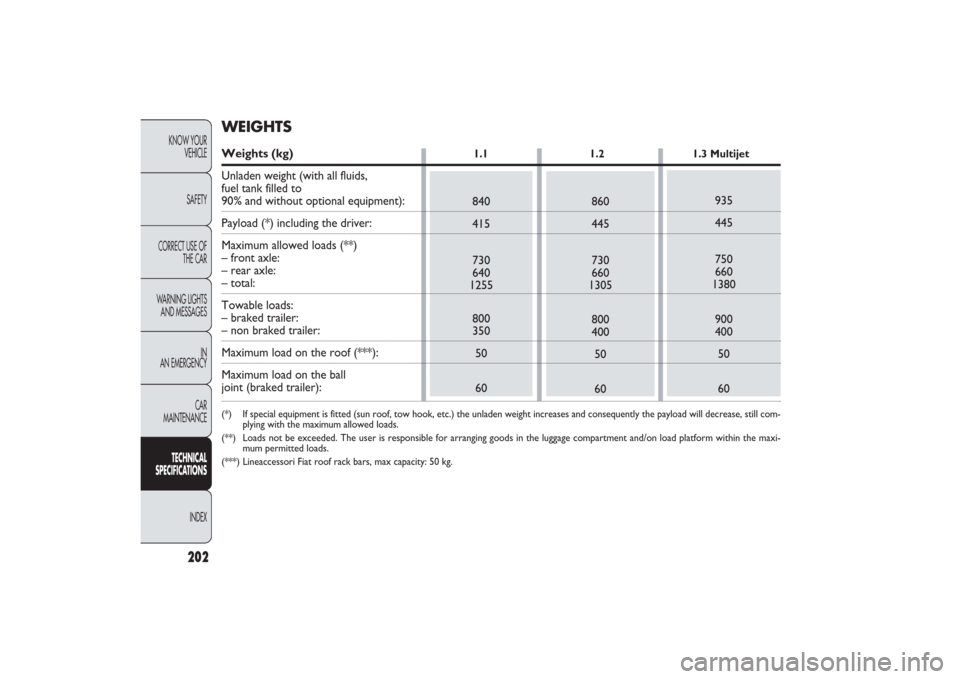
WEIGHTSWeights (kg)
1.1 1.2 1.3 Multijet
Unladen weight (with all fluids,
fuel tank filled to 90% and without optional equipment):Payload (*) including the driver:
Maximum allowed loads (**)
– front axle:
– rear axle:– total:
Towable loads:
– braked trailer:– non braked trailer:Maximum load on the roof (***):
Maximum load on the ball joint (braked trailer):(*) If special equipment is fitted (sun roof, tow hook, etc.) the unladen weight increases and consequently the payload will decrease, still com-
plying with the maximum allowed loads.
(**) Loads not be exceeded. The user is responsible for arranging goods in the luggage compartment and/on load platform within the maxi-
mum permitted loads.
(***) Lineaccessori Fiat roof rack bars, max capacity: 50 kg.
191-214 PANDA EN 7-10-2009 14:18 Pagina 202
Page 207 of 226
206
KNOW YOUR
VEHICLE
SAFETY
CORRECT USE OF
THE CAR
WARNING LIGHTS
AND MESSAGES
IN
AN EMERGENCY
CAR
MAINTENANCETECHNICAL
SPECIFICATIONS
INDEX
❒
extra-urban cycle: drive simulating the driving of the car
out of town with frequent acceleration in all gears; the
speed varies from 0 to 120 km/h;
❒
combined consumption: the weighting is around 37%
urban cycle and 63% extra-urban cycle.
IMPORTANT The type of route, traffic conditions, weath-
er conditions, driving style, general condition of the car,
trim level/equipment/accessories, use of the climate con-
trol system, vehicle load, presence of roof racks and oth-
er situations that adversely affect the aerodynamics or wind
resistance lead to different fuel consumption figures than
those measured.
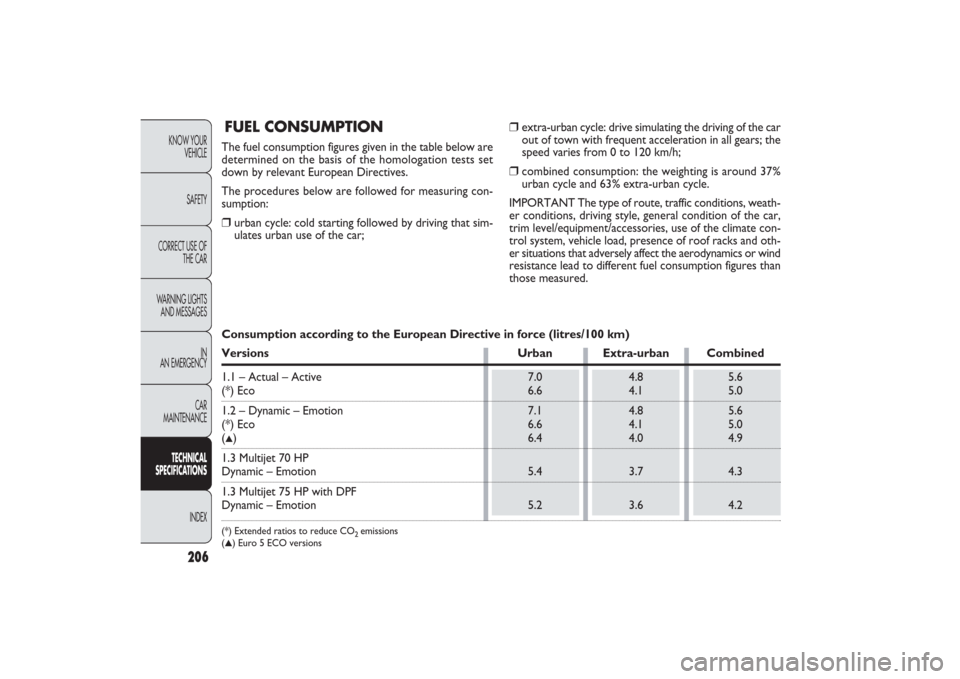
FUEL CONSUMPTIONThe fuel consumption figures given in the table below are
determined on the basis of the homologation tests set
down by relevant European Directives.
The procedures below are followed for measuring con-
sumption:❒
urban cycle: cold starting followed by driving that sim-
ulates urban use of the car;
Consumption according to the European Directive in force (litres/100 km)Versions Urban Extra-urban Combined
1.1 – Actual – Active 7.0 4.8 5.6(*) Eco 6.6 4.1 5.0
1.2 – Dynamic – Emotion 7.1 4.8 5.6
(*) Eco 6.6 4.1 5.0(▲) 6.4 4.0 4.9
1.3 Multijet 70 HP
Dynamic – Emotion 5.4 3.7 4.3
1.3 Multijet 75 HP with DPFDynamic – Emotion 5.2 3.6 4.2(*) Extended ratios to reduce CO
2 emissions
(
▲) Euro 5 ECO versions
191-214 PANDA EN 7-10-2009 14:18 Pagina 206
Page 220 of 226
219KNOW
YOUR VEHICLE
SAFETY
CORRECT USE
OF THE CAR
WARNING LIGHTS
AND MESSAGES
IN
AN EMERGENCY
CAR
MAINTENANCE
TECHNICAL
SPECIFICATIONSINDEX
Fuse replacement
– fuse location
(control units) ............. 161-162
– general information
and warnings ........................... 160
– list .......................... 163-164-165
Fuse summary
table ...............................163-164-165
Fuses:
– fuse location
(central units) ...................161-162
– general instructions
and warnings ........................... 160G
earbox use ................................ 114
Gearbox ......................................... 114
– technical specifications ......... 195
Gearshifting lever ........................ 114
Glove compartment ................... 57
Glove compartments .................. 57
Gloveboxes ................................... 56
H
andbrake ................................... 113
Handbrake lever .......................... 113Hazard warning lights
– switching on ............................ 53
Headlight aiming
(corrector) ................................. 72
Headlight
– alignment corrector .............. 72
– bulb replacement ................... 153
– bulbs (type) ............................. 150
Headlights
(switching on controls) ............ 48
Headlights ...................................... 72
– adjusting the headlights when
abroad ...................................... 73
– beam adjustment ................... 72
– bulb replacement ................... 153
– headlight beam aiming .......... 72
Headrests
– front ......................................... 33
– rear ........................................... 34
Headrests
– front ......................................... 33
– rear ........................................... 34
Heated rear window....... 54-55-72
Heating and ventilation system ... 37Heating and ventilation .............. 37
– adjustable side and
centre vents ............................ 37
– controls ................................... 38
– front window
defrosting/demisting ............. 39
– passenger compartment
heating and ventilation ......... 39
– rear window defrosting/
demisting ................................. 40
Hill holder system ....................... 76
Ignition barrel .............................. 10
Ignition switch .............................. 10
Ignition switch and steering
column lock ................................ 9-10
Ignition switch .............................. 9
In an emergency..................... 135
Installing the tow hook .............. 118
Instrument panel .......................... 11
Interior equipment ...................... 55
Interior fittings ............................. 55
Interiors (cleaning) ...................... 190
Internal lighting ............................. 52
215-224 PANDA EN 7-10-2009 15:09 Pagina 219
Page 224 of 226
223KNOW
YOUR VEHICLE
SAFETY
CORRECT USE
OF THE CAR
WARNING LIGHTS
AND MESSAGES
IN
AN EMERGENCY
CAR
MAINTENANCE
TECHNICAL
SPECIFICATIONSINDEX
– turning circle .......................... 196
Steering
– steering wheel adjustment
lever .......................................... 34
– technical specifications ......... 196
Sun visors ...................................... 56
Suspension .................................... 196
Symbols .......................................... 5Tailgate
– opening with remote
control ..................................... 8
Technical specifications....... 191
Temperature gauge
Third brake light .......................... 157
Top speed ..................................... 201
Towing of trailers ........................ 117
Towing of vehicle ........................ 167
Trailer (towing) ............................ 117
– installing the tow hook ........ 118
Transmission
– technical specifications ......... 195
Trip Computer ............................ 28
– control button ....................... 29– start of journey
procedure ............................... 30
Turning circle ............................... 196
Tyre pressure ............................... 199
Tyre puncturing
– general instructions .............. 137
– quick tyre repair kit
Tyre repair kit Fix&Go
automatic .................................... 143
– bottle replacement
procedure ............................... 148
– inflation procedure ............... 146
Tyres
– in case of puncture ............... 137
– inflation pressure ................... 199
– quick repair kit Fix&Go
automatic ................................. 143
– reading the tyre code ........... 197
– snow chains ............................ 122
– snow tyres .............................. 121
– tool and space-saver wheel
compartment ................... 138-139
– tyre and wheel types ............ 199
– wheel replacement ................ 143– winter tyres ............................ 122
Vehicle dimensions .................... 200
Vehicle end of life ........................ 209
Vehicle identification data .......... 191
Vehicle identification plate ........ 191
Vehicle identification ................... 191
Vehicle lifting points .................... 140
Vehicle scrapping ......................... 209
Vehicle weights ............................ 202W
arning lights and messages
.. 123
Wheel rims ................................... 199
– understanding rim
marking .................................... 198
Wheel trim ................................... 197
Wheels and tyres.......................... 183
– geometry ................................. 197
– in case of puncture ............... 137
– quick repair kit Fix&Go
automatic ................................. 143
– reading the tyre code ........... 197
– snow chains ............................ 122
– snow tyres .............................. 122
215-224 PANDA EN 7-10-2009 15:09 Pagina 223