Brake FIAT PANDA 2009 169 / 2.G Owner's Manual
[x] Cancel search | Manufacturer: FIAT, Model Year: 2009, Model line: PANDA, Model: FIAT PANDA 2009 169 / 2.GPages: 226, PDF Size: 5.29 MB
Page 148 of 226
147KNOW
YOUR VEHICLE
SAFETY
CORRECT USE
OF THE CAR
WARNING LIGHTS
AND MESSAGESIN
AN EMERGENCYCAR
MAINTENANCE
TECHNICAL
SPECIFICATIONS
INDEX
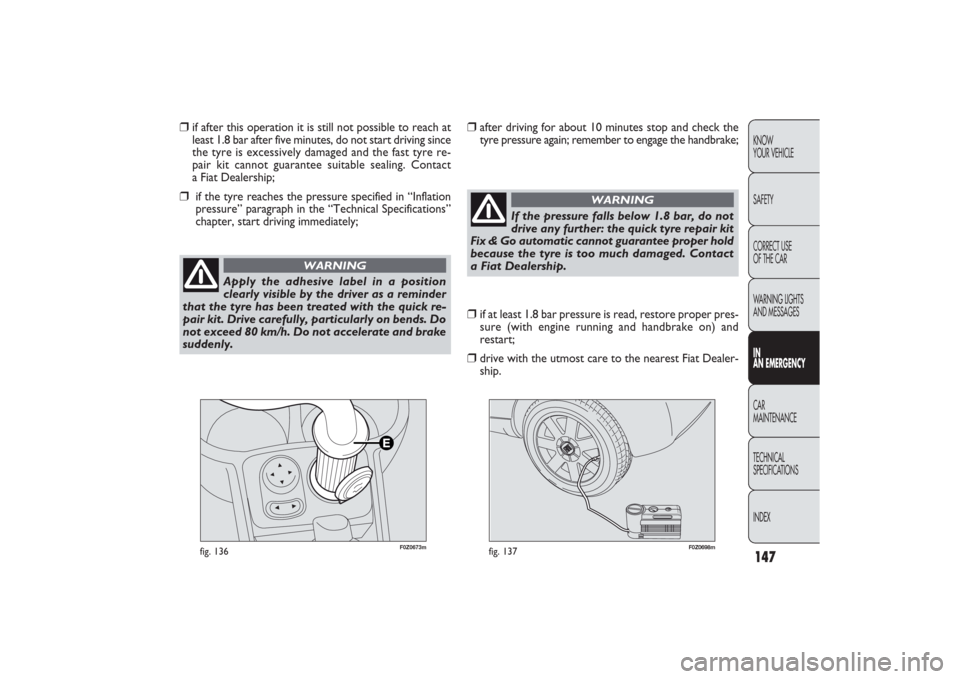
F0Z0673m
fig. 136
F0Z0698m
fig. 137
❒
if after this operation it is still not possible to reach at
least 1.8 bar after five minutes, do not start driving since
the tyre is excessively damaged and the fast tyre re-
pair kit cannot guarantee suitable sealing. Contact
a Fiat Dealership;
❒
if the tyre reaches the pressure specified in “Inflation
pressure” paragraph in the “Technical Specifications”
chapter, start driving immediately;
Apply the adhesive label in a position
clearly visible by the driver as a reminder
that the tyre has been treated with the quick re-
pair kit. Drive carefully, particularly on bends. Do
not exceed 80 km/h. Do not accelerate and brake
suddenly.
WARNING
❒
after driving for about 10 minutes stop and check the
tyre pressure again; remember to engage the handbrake;
If the pressure falls below 1.8 bar, do not
drive any further: the quick tyre repair kit
Fix & Go automatic cannot guarantee proper hold
because the tyre is too much damaged. Contact
a Fiat Dealership.
WARNING
❒
if at least 1.8 bar pressure is read, restore proper pres-
sure (with engine running and handbrake on) and
restart;
❒
drive with the utmost care to the nearest Fiat Dealer-
ship.
135-168 PANDA EN 7-10-2009 14:07 Pagina 147
Page 169 of 226
168KNOW
YOUR VEHICLE
SAFETY
CORRECT USE
OF THE CAR
WARNING LIGHTS
AND MESSAGES
IN
AN EMERGENCYCAR
MAINTENANCE
TECHNICAL
SPECIFICATIONS
INDEX
Before towing, turn the ignition key to
MAR and then to STOP without removing
it. The steering column will automatically lock
when the key is removed and the wheels cannot
be steered.
WARNING
When towing, remember that without the
help of the servo-brake and electric pow-
er steering, a greater effort is required on the ped-
al and steering wheel. Do not use flexible cables
when towing and avoid jerky movements. While
towing, make sure not to damage parts in contact
with the car. When towing the car, comply with
the regulations of the Highway Code about tow-
ing, both concerning the towing device and the
driving behaviour on the road.
WARNING
During towing, never start the engine.
WARNING
135-168 PANDA EN 7-10-2009 14:07 Pagina 168
Page 171 of 226
●●●● ● ●●●●
●●●● ● ●●●●
●●●● ● ●●●●
●●●● ● ●●●●
●●●● ● ●●●●
●●●
●●●● ● ●●●●
●●●● ● ●●●●
●
●● ●●
●● ●●
●● ●●
●●20 40 60 80 100 120 140 160 180
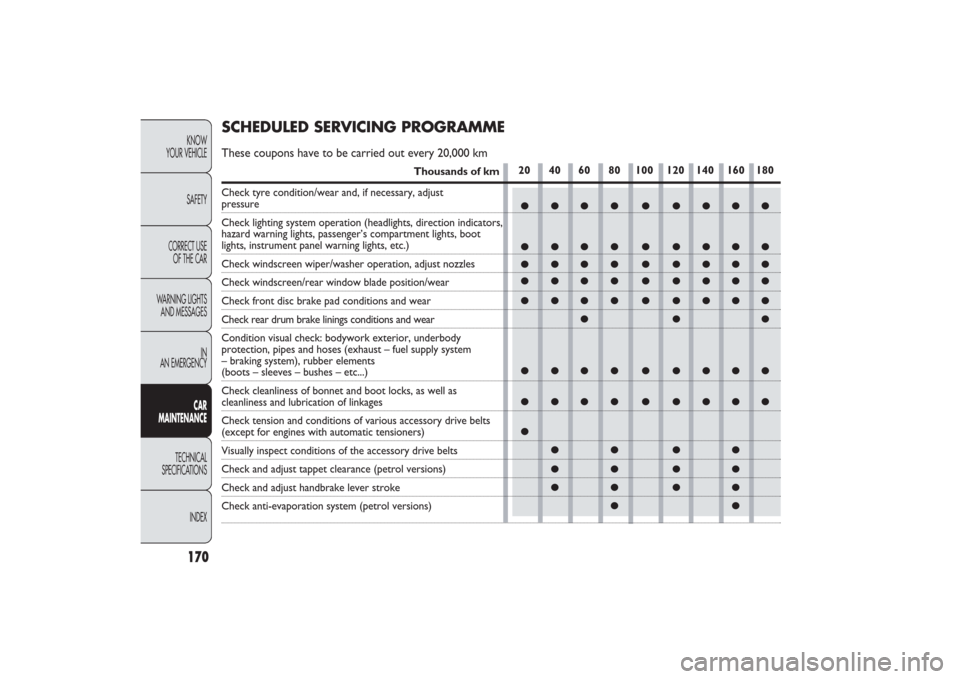
SCHEDULED SERVICING PROGRAMMEThese coupons have to be carried out every 20,000 km
Thousands of km
Check tyre condition/wear and, if necessary, adjust
pressure
Check lighting system operation (headlights, direction indicators,
hazard warning lights, passenger’s compartment lights, boot lights, instrument panel warning lights, etc.)Check windscreen wiper/washer operation, adjust nozzlesCheck windscreen/rear window blade position/wearCheck front disc brake pad conditions and wearCheck rear drum brake linings conditions and wear
Condition visual check: bodywork exterior, underbody
protection, pipes and hoses (exhaust – fuel supply system
– braking system), rubber elements (boots – sleeves – bushes – etc...)
Check cleanliness of bonnet and boot locks, as well as cleanliness and lubrication of linkages
Check tension and conditions of various accessory drive belts (except for engines with automatic tensioners)Visually inspect conditions of the accessory drive beltsCheck and adjust tappet clearance (petrol versions)Check and adjust handbrake lever stroke Check anti-evaporation system (petrol versions)
INDEX TECHNICAL
SPECIFICATIONSCAR
MAINTENANCEIN
AN EMERGENCY WARNING LIGHTS
AND MESSAGESCORRECT USE
OF THE CARSAFETYKNOW
YOUR VEHICLE
170
169-190 PANDA EN 7-10-2009 14:14 Pagina 170
Page 172 of 226
●●●
●●● ●● ●● ●●
●●
●
●●●●
●●●●
●●
●●● ●● ●● ●●
(●)(
●)(
●)(
●)(
●)(
●)(
●)(
●)(
●)
●●●
●●● ●● ●● ●●
●●●●
●●●
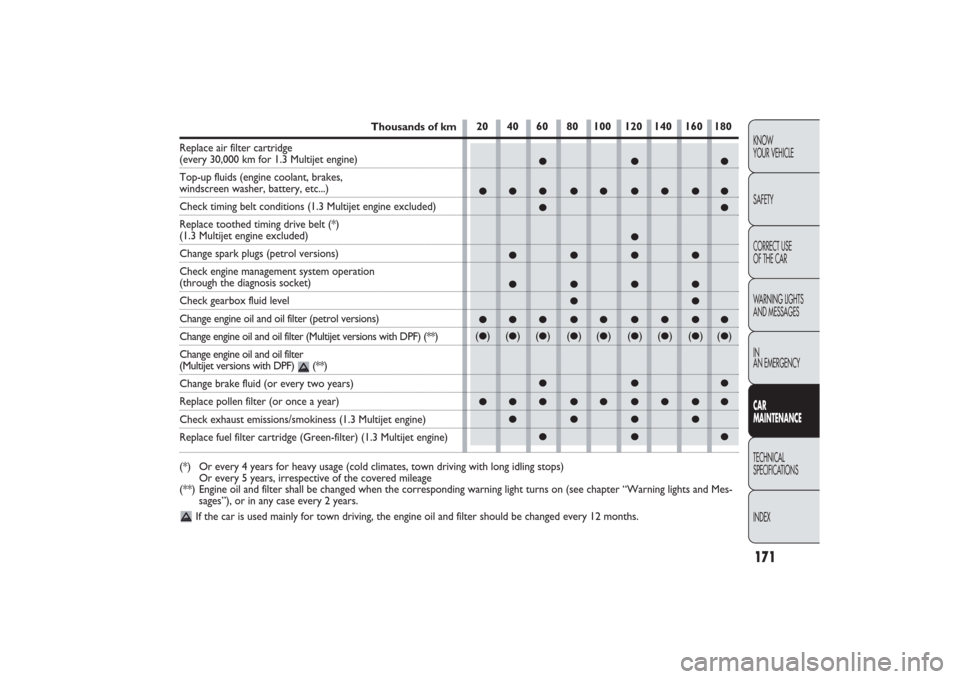
20 40 60 80 100 120 140 160 180
Thousands of km
Replace air filter cartridge
(every 30,000 km for 1.3 Multijet engine)
Top-up fluids (engine coolant, brakes, windscreen washer, battery, etc...)Check timing belt conditions (1.3 Multijet engine excluded)
Replace toothed timing drive belt (*) (1.3 Multijet engine excluded)Change spark plugs (petrol versions)
Check engine management system operation (through the diagnosis socket)Check gearbox fluid levelChange engine oil and oil filter (petrol versions)Change engine oil and oil filter (Multijet versions with DPF) (**)
Change engine oil and oil filter (Multijet versions with DPF) (**)Change brake fluid (or every two years)Replace pollen filter (or once a year)Check exhaust emissions/smokiness (1.3 Multijet engine)Replace fuel filter cartridge (Green-filter) (1.3 Multijet engine)
(*) Or every 4 years for heavy usage (cold climates, town driving with long idling stops)
Or every 5 years, irrespective of the covered mileage
(**) Engine oil and filter shall be changed when the corresponding warning light turns on (see chapter “Warning lights and Mes-
sages”), or in any case every 2 years.
If the car is used mainly for town driving, the engine oil and filter should be changed every 12 months.
INDEX TECHNICAL
SPECIFICATIONSCAR
MAINTENANCEIN
AN EMERGENCY WARNING LIGHTS
AND MESSAGES CORRECT USE
OF THE CAR SAFETY KNOW
YOUR VEHICLE171
169-190 PANDA EN 7-10-2009 14:14 Pagina 171
Page 173 of 226
YEARLY INSPECTION SCHEDULEFor cars with an annual mileage of below 20,000 km (for
example about 15,000 km) the following yearly inspec-
tion schedule is advised:❒
check conditions/wear of tyres and adjust pressure if
necessary (including spare wheel);
❒
check lighting system operation (headlights, direction
indicators, hazard warning lights, boot light, passenger’s
compartment, instrument panel warning lights, etc...);
❒
check wiper/washer system operation, adjust nozzles;
❒
check windscreen/rear window blade position/wear;
❒
check front disc brake pad conditions and wear;
❒
check cleanliness of bonnet and boot locks and lever
cleanliness and lubrication;
❒
sight inspect the conditions of: engine, gearbox, trans-
mission, pipes and hoses (exhaust – fuel supply – brak-
ing system) rubber parts (boots – sleeves – bushes etc.),
fuel and brake system hoses;
❒
check battery charge;
❒
visually check the various drive belt conditions;
❒
check and top-up liquids if required (engine coolant,
brakes, windscreen washer, battery, etc.);
❒
change engine oil;
❒
change engine oil filter;
❒
change pollen filter (for versions/markets where pro-
vided).
ADDITIONAL INTERVENTIONSEvery 1,000 km or before long journeys, check and, if nec-
essary, top-up the following:❒
engine coolant fluid level;
❒
brake fluid level;
❒
battery fluid level;
❒
windscreen washer fluid level;
❒
tyre pressure and conditions.
Every 3,000 km check the following and top-up, if required:
❒
engine oil level.
You are recommended to use FL Selenia products de-
signed and produced specifically for Fiat cars (see table
“Capacities” in chapter “Technical specifications”).
IMPORTANT – Engine oil
Should prevailing use of the car be under one of the fol-
lowing specially heavy conditions:
❒
trailer or caravan towing;
❒
dusty roads;
❒
short distances (less than 7–8 km) and with external
temperatures below zero;
INDEX TECHNICAL
SPECIFICATIONSCAR
MAINTENANCEIN
AN EMERGENCY WARNING LIGHTS
AND MESSAGESCORRECT USE
OF THE CARSAFETYKNOW
YOUR VEHICLE
172
169-190 PANDA EN 7-10-2009 14:14 Pagina 172
Page 175 of 226
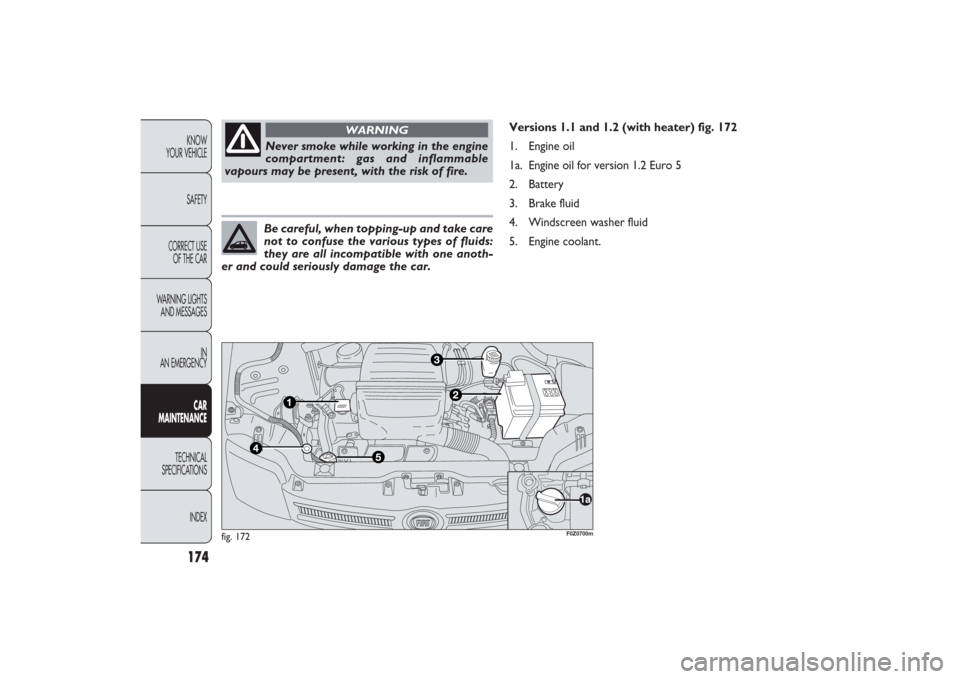
fig. 172
F0Z0700m
Never smoke while working in the engine
compartment: gas and inflammable
vapours may be present, with the risk of fire.
WARNING
Be careful, when topping-up and take care
not to confuse the various types of fluids:
they are all incompatible with one anoth-
er and could seriously damage the car.
Versions 1.1 and 1.2 (with heater) fig. 172
1. Engine oil
1a. Engine oil for version 1.2 Euro 5
2. Battery
3. Brake fluid
4. Windscreen washer fluid
5. Engine coolant.
INDEX TECHNICAL
SPECIFICATIONSCAR
MAINTENANCEIN
AN EMERGENCY WARNING LIGHTS
AND MESSAGESCORRECT USE
OF THE CARSAFETYKNOW
YOUR VEHICLE
174
169-190 PANDA EN 7-10-2009 14:14 Pagina 174
Page 176 of 226
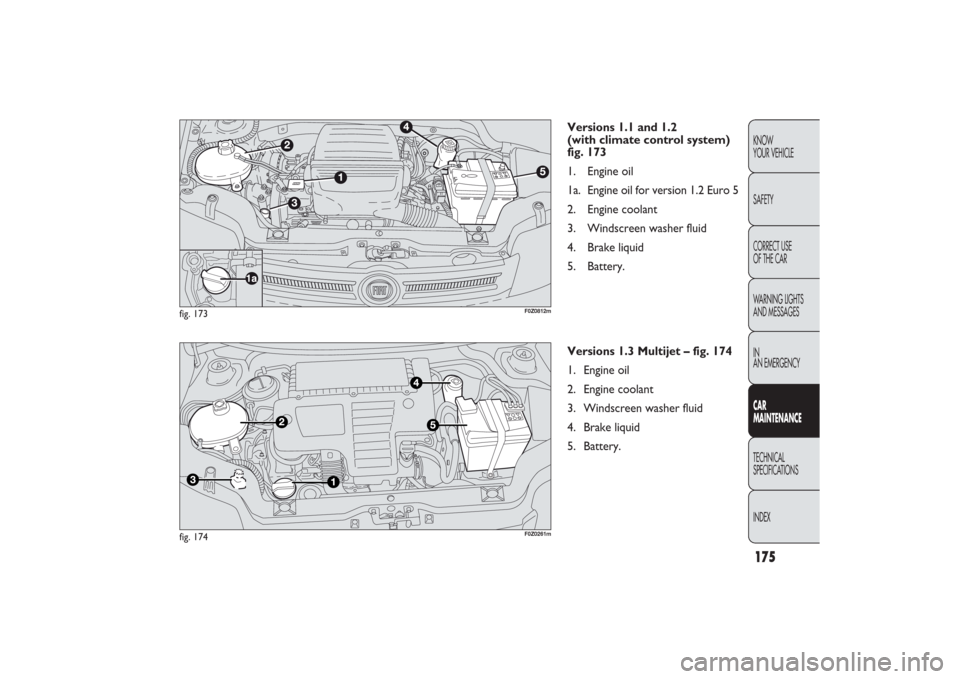
Versions 1.1 and 1.2
(with climate control system)
fig. 173
1. Engine oil
1a. Engine oil for version 1.2 Euro 5
2. Engine coolant
3. Windscreen washer fluid
4. Brake liquid
5. Battery.
fig. 173
F0Z0812m
fig. 174
F0Z0261m
Versions 1.3 Multijet – fig. 174
1. Engine oil
2. Engine coolant
3. Windscreen washer fluid
4. Brake liquid
5. Battery.
INDEX TECHNICAL
SPECIFICATIONSCAR
MAINTENANCEIN
AN EMERGENCY WARNING LIGHTS
AND MESSAGES CORRECT USE
OF THE CAR SAFETY KNOW
YOUR VEHICLE175
169-190 PANDA EN 7-10-2009 14:14 Pagina 175
Page 180 of 226
Certain commercial additives for wind-
screen washers are inflammable. The en-
gine compartment contains hot parts which could
start a fire if they come into contact.
WARNING
Prevent brake fluid which is highly corrosive
from coming into contact with painted
parts. Should this occur, immediately wash
with water. Brake fluid is poisonous and highly corro-
sive. In the event of accidental contact, im-
mediately wash the affected parts with water
and neutral soap. Then rinse thoroughly. If swal-
lowed call a doctor straight away.
WARNING
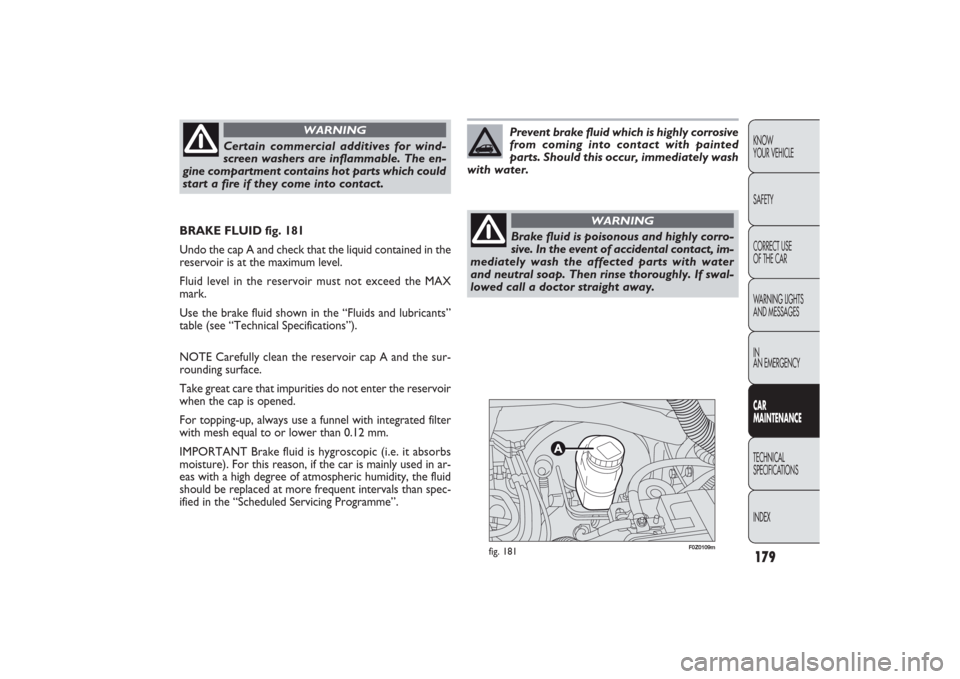
BRAKE FLUID fig. 181
Undo the cap A and check that the liquid contained in the
reservoir is at the maximum level.
Fluid level in the reservoir must not exceed the MAX
mark.
Use the brake fluid shown in the “Fluids and lubricants”
table (see “Technical Specifications”).
NOTE Carefully clean the reservoir cap A and the sur-
rounding surface.
Take great care that impurities do not enter the reservoir
when the cap is opened.
For topping-up, always use a funnel with integrated filter
with mesh equal to or lower than 0.12 mm.
IMPORTANT Brake fluid is hygroscopic (i.e. it absorbs
moisture). For this reason, if the car is mainly used in ar-
eas with a high degree of atmospheric humidity, the fluid
should be replaced at more frequent intervals than spec-
ified in the “Scheduled Servicing Programme”.
fig. 181
F0Z0109m
INDEX TECHNICAL
SPECIFICATIONSCAR
MAINTENANCEIN
AN EMERGENCY WARNING LIGHTS
AND MESSAGES CORRECT USE
OF THE CAR SAFETY KNOW
YOUR VEHICLE179
169-190 PANDA EN 7-10-2009 14:15 Pagina 179
Page 181 of 226
180KNOW
YOUR VEHICLE
SAFETY
CORRECT USE
OF THE CAR
WARNING LIGHTS
AND MESSAGES
IN
AN EMERGENCYCAR
MAINTENANCE
TECHNICAL
SPECIFICATIONS
INDEX
F0Z0135m
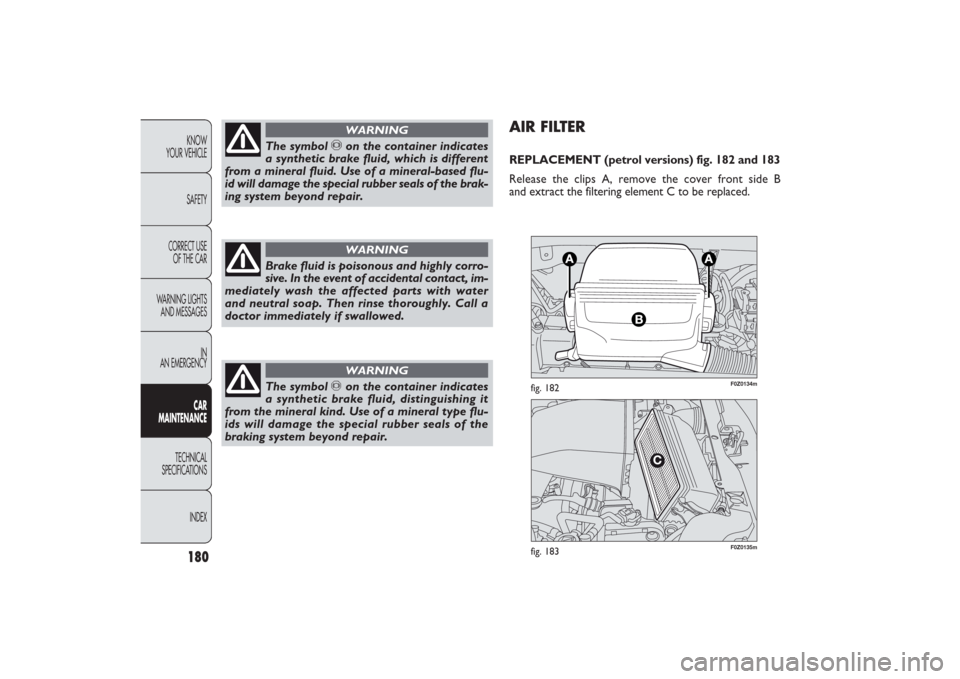
fig. 183
F0Z0134m
fig. 182
AIR FILTERREPLACEMENT (petrol versions) fig. 182 and 183
Release the clips A, remove the cover front side B
and extract the filtering element C to be replaced.
Brake fluid is poisonous and highly corro-
sive. In the event of accidental contact, im-
mediately wash the affected parts with water
and neutral soap. Then rinse thoroughly. Call a
doctor immediately if swallowed.
WARNING
The symbol
π
on the container indicates
a synthetic brake fluid, distinguishing it
from the mineral kind. Use of a mineral type flu-
ids will damage the special rubber seals of the
braking system beyond repair.WARNING
The symbol πon the container indicates
a synthetic brake fluid, which is different
from a mineral fluid. Use of a mineral-based flu-
id will damage the special rubber seals of the brak-
ing system beyond repair.
WARNING
169-190 PANDA EN 7-10-2009 14:15 Pagina 180
Page 186 of 226
185KNOW
YOUR VEHICLE
SAFETY
CORRECT USE
OF THE CAR
WARNING LIGHTS
AND MESSAGES
IN
AN EMERGENCYCAR
MAINTENANCETECHNICAL
SPECIFICATIONS
INDEX
WINDSCREEN/REAR WINDOW
WIPER/WASHERBLADES
Periodically clean the rubber part using special products;
TUTELA PROFESSIONAL SC 35 is recommended.
Replace the blades if the rubber edge is deformed or worn.
In all cases, it is advisable to replace them approximately once
a year.
A few simple precautions can reduce the possibility of dam-
age to the blades:❒
make sure that the rubber part is not stuck to the wind-
screen at sub-zero temperatures. Use an antifreeze
product to release it if required;
❒
remove any snow from the glass: in addition to pro-
tecting the blades, this prevents effort on the motor
and overheating;
❒
do not operate the windscreen and the rear screen
wipers on dry glass.
RUBBER HOSESAs far as the brake system and fuel rubber hoses are concerned,
follow the “Scheduled Servicing Programme” in this chapter care-
fully.
Ozone, high temperatures and prolonged lack of fluid in the sys-
tem may cause hardening and cracking of the hoses, with pos-
sible leaks. Careful control is therefore necessary.
Driving with worn wiper blades is a serious
hazard, because visibility is reduced in bad
weather.
WARNING
169-190 PANDA EN 7-10-2009 14:15 Pagina 185