Speed FIAT PANDA 2009 169 / 2.G Owner's Manual
[x] Cancel search | Manufacturer: FIAT, Model Year: 2009, Model line: PANDA, Model: FIAT PANDA 2009 169 / 2.GPages: 226, PDF Size: 5.29 MB
Page 48 of 226
47KNOW YOUR
VEHICLESAFETY
CORRECT USE
OF THE CAR
WARNING LIGHTS
AND MESSAGES
IN
AN EMERGENCY
CAR
MAINTENANCE
TECHNICAL
SPECIFICATIONS
INDEX
❒
fan speed enabling depending on the coolant
temperature;
❒
air flow conveying to the windscreen and front side win-
dows;
❒
heated rear window switching-on.
IMPORTANT This function stays on for about 3 minutes,
since engine coolant temperature exceeds 50 °C (petrol
versions) or 35 °C (Diesel versions).
When the function is on, the LEDs on button
-
and those
on the heated rear window button
(
turn on, whereas
the AUTO button LED will turn off; when this function is
on, the only operations possible are fan speed adjustment
and heated rear window switching-off.
To turn the function off, press the button
-
again or
the AUTO button.
USING THE CLIMATE CONTROL SYSTEM The system can be turned on in different ways, it is how-
ever advisable to set the required temperature and then
to press the AUTO button. In this way, the system starts
to work fully automatically to reach the required com-
fort conditions as soon as possible.
During automatic operation it is possible:❒
to select the required temperature (buttons
ÔÕ
– E);
❒
to activate or deactivate air recirculation
(button
T
– D);
❒
to activate fast window demisting/defrosting
(button
-
– L);
❒
to select air distribution (buttons
¥wμ
– G H I);
❒
to select the fan speed (buttons
ÕÔ
– F).
The system will automatically modify its settings accord-
ing to set changes and the button LED will turn off.
To restore automatic operation press again the
AUTO
button.
SYSTEM SERVICING
In winter, the climate control system must be turned on
at least once a month for about 10 minutes.
Before summer, have the system inspected at a Fiat
Dealership.
The system uses R134a refrigerant fluid
which does not pollute the environment in
the event of accidental leakage. Under no
circumstances should R12 fluid be used as it is in-
compatible with the system components.
031-064 PANDA EN 7-10-2009 13:43 Pagina 47
Page 51 of 226
,
F0Z0127m
fig. 50
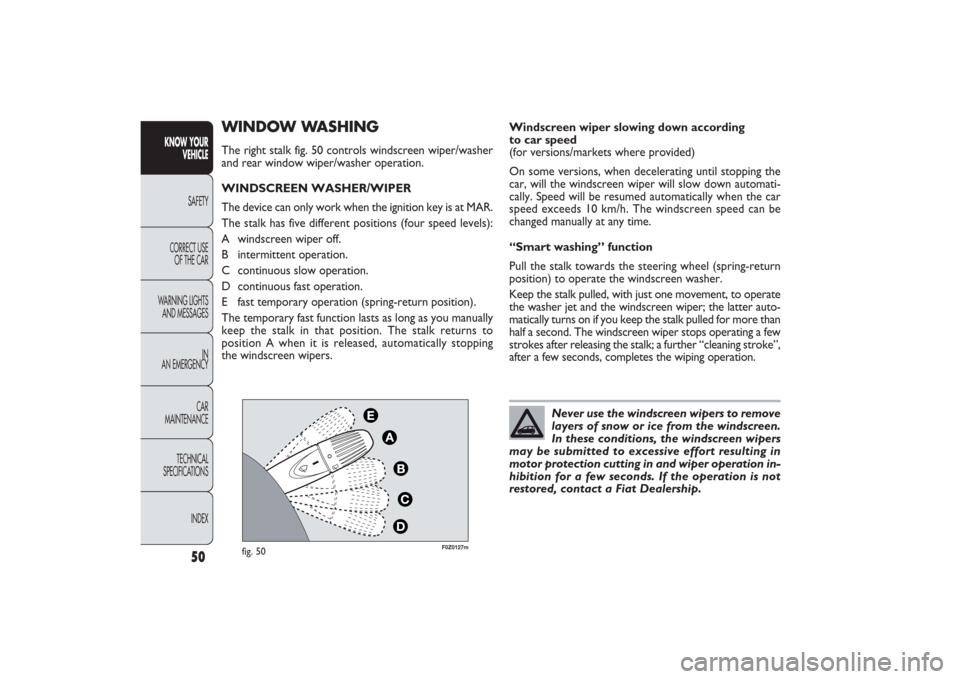
WINDOW WASHINGThe right stalk fig. 50 controls windscreen wiper/washer
and rear window wiper/washer operation.
WINDSCREEN WASHER/WIPER
The device can only work when the ignition key is at MAR.
The stalk has five different positions (four speed levels):
A windscreen wiper off.
B intermittent operation.
C continuous slow operation.
D continuous fast operation.
E fast temporary operation (spring-return position).
The temporary fast function lasts as long as you manually
keep the stalk in that position. The stalk returns to
position A when it is released, automatically stopping
the windscreen wipers.
50
KNOW YOUR
VEHICLE
SAFETY
CORRECT USE
OF THE CAR
WARNING LIGHTS
AND MESSAGES
IN
AN EMERGENCY
CAR
MAINTENANCE
TECHNICAL
SPECIFICATIONS
INDEX
Windscreen wiper slowing down according
to car speed
(for versions/markets where provided)
On some versions, when decelerating until stopping the
car, will the windscreen wiper will slow down automati-
cally. Speed will be resumed automatically when the car
speed exceeds 10 km/h. The windscreen speed can be
changed manually at any time.
“Smart washing” function
Pull the stalk towards the steering wheel (spring-return
position) to operate the windscreen washer.
Keep the stalk pulled, with just one movement, to operate
the washer jet and the windscreen wiper; the latter auto-
matically turns on if you keep the stalk pulled for more than
half a second. The windscreen wiper stops operating a few
strokes after releasing the stalk; a further “cleaning stroke”,
after a few seconds, completes the wiping operation.
Never use the windscreen wipers to remove
layers of snow or ice from the windscreen.
In these conditions, the windscreen wipers
may be submitted to excessive effort resulting in
motor protection cutting in and wiper operation in-
hibition for a few seconds. If the operation is not
restored, contact a Fiat Dealership.
031-064 PANDA EN 7-10-2009 13:43 Pagina 50
Page 52 of 226
51KNOW YOUR
VEHICLESAFETY
CORRECT USE
OF THE CAR
WARNING LIGHTS
AND MESSAGES
IN
AN EMERGENCY
CAR
MAINTENANCE
TECHNICAL
SPECIFICATIONS
INDEX
REAR WINDOW WASHER/WIPER
The device can only work when the ignition key is at MAR.
Turn the knurled ring to
'
to operate the rear window
wiper.
With the windscreen wiper on, turn the knurled ring to
'
to turn on the rear window wiper. In this case the wiper
works (in the different positions) timed with the wind-
screen wiper, but at half speed.
With the windscreen wiper on, engaging reverse gear will
automatically turn the rear window wiper on, in continu-
ous slow operation.
Operation stops by disengaging reverse.
“Smart washing” function
Pushing the stalk towards the dashboard (spring-return
position) will activate the rear window washer.
Keep the stalk pressed, with just one movement, to op-
erate the rear window washer jet and the rear window
wiper itself; the latter automatically turns on if you keep
the stalk pressed for more than half a second.
The rear window wiper stops operating a few strokes af-
ter releasing the stalk; a further “cleaning stroke”, after
a few seconds, completes the wiping operation.
Do not use the rear window wiper to re-
move layers of snow or ice from the wind-
screen. In these conditions, the rear window
wipers may be submitted to excessive effort result-
ing in motor protection cutting in and wiper oper-
ation inhibition for a few seconds. If the operation
is not restored, contact a Fiat Dealership.
031-064 PANDA EN 7-10-2009 13:43 Pagina 51
Page 75 of 226
When the ABS cuts in and you feel the
brake pedal pulsating, do not raise foot,
but keep it pressed; in doing so you will stop in the
shortest amount of space possible depending on
the current road conditions.
WARNING
If the ABS system cuts in, it means that the
grip between the tyre and the road surface
is close to its limit: you must slow down to match
the speed to the road grip available.
WARNING
The ABS make the best use of the avail-
able grip but cannot increase it. You
should always drive carefully on slippery surfaces
and avoid any unnecessary risks.
WARNING
ABS SYSTEM (for versions/markets, where provided)
This system, which is an integral part of the braking sys-
tem, prevents one or more wheels from locking and slip-
ping in all road surface conditions, irrespective of the
intensity of the braking action, ensuring that the vehicle can
be controlled even during emergency braking.
The EBD system (Electronic Braking Force Distribution)
completes the system allowing the brake force to be dis-
tributed between the front and rear wheels.
IMPORTANT To get the maximum efficiency of the brak-
ing system, a bedding-in period of about 500 km is need-
ed: during this period it is better to avoid sharp, repeat-
ed and prolonged braking.
SYSTEM INTERVENTION
The driver can feel the ABS system has come into action
because the brake pedal pulsates slightly and the system gets
noisier: it means that the car speed should be altered to suit
the type of road surface.
74
KNOW YOUR
VEHICLE
SAFETY
CORRECT USE
OF THE CAR
WARNING LIGHTS
AND MESSAGES
IN
AN EMERGENCY
CAR
MAINTENANCE
TECHNICAL
SPECIFICATIONS
INDEX
065-090 PANDA EN 7-10-2009 13:45 Pagina 74
Page 84 of 226
GENERAL WARNINGS❒
When parking, take the utmost care to obstacles that
may be set above or under the sensors.
❒
Objects set close to the car rear, under certain cir-
cumstances are not detected and could therefore cause
damage to the car or be damaged.
❒
Indications sent by the sensors can be altered by dirt,
snow or ice deposited on the sensors or by ultrasound
systems (e.g.: truck pneumatic brakes or pneumatic
hammers) set nearby the car.
For proper operation, sensors must always
be clean from mud, dirt, snow or ice.
Be careful not to scratch or damage the
sensors while cleaning them. Avoid using dry, rough
or hard cloths. The sensors should be washed us-
ing clean water with the addition of car shampoo
if necessary. When using special washing equipment
such as high pressure jets or steam cleaning, clean
the sensors very quickly keeping the jet more than
10 cm away.
Parking manoeuvres however are always
under the driver’s responsibility. While ma-
noeuvring, the driver shall always make sure that
no-one is standing in the area, especially children
or animals. The parking sensor is designed to as-
sist drivers, who shall never reduce attention dur-
ing potentially dangerous manoeuvres even if per-
formed at low speed.
WARNING
83KNOW YOUR
VEHICLESAFETY
CORRECT USE
OF THE CAR
WARNING LIGHTS
AND MESSAGES
IN
AN EMERGENCY
CAR
MAINTENANCE
TECHNICAL
SPECIFICATIONS
INDEX
065-090 PANDA EN 7-10-2009 13:45 Pagina 83
Page 91 of 226
90
DIESEL PARTICULATE FILTER (DPF)
(for 1.3 Multijet 75 HP versions)
The Diesel Particulate Filter is a mechanical filter, inte-
gral with the exhaust system, that physically traps partic-
ulates present in the exhaust gases of diesel engines.
The diesel particulate filter has been adopted to eliminate
almost all particulates in compliance with current/future
legal regulations.
During normal use of the vehicle, the engine control unit
records a set of data (e.g.: travel time, type of route, tem-
peratures, etc.) and it will then calculate how much par-
ticulates has been trapped by the filter.
Since this filter physically traps particulate, it should be re-
generated (cleaned) at regular intervals by burning carbon
particles.
The regeneration procedure is controlled automatically by
the engine management control unit according to the fil-
ter conditions and vehicle use conditions.
There may be a limited increase in the engine idle speed
during the regeneration, a limited increase in fumes and
high temperatures at the exhaust. These are not faults;
they do not impair vehicle performance or damage the
environment.
If the dedicated message is displayed, refer to paragraph
“Warning lights and messages”.
KNOW YOUR
VEHICLE
SAFETY
CORRECT USE
OF THE CAR
WARNING LIGHTS
AND MESSAGES
IN
AN EMERGENCY
CAR
MAINTENANCE
TECHNICAL
SPECIFICATIONS
INDEX
PROTECTING THE ENVIRONMENTThe following devices are used for reducing petrol fuel
engine emissions:❒
three-way catalytic converter;
❒
oxygen sensors;
❒
evaporation control system.
In addition, do not let the engine run, even for a test, with
one or more spark plugs disconnected.
The following devices are used for reducing diesel fuel en-
gine emissions:
❒
oxidising catalytic converter;
❒
exhaust gas recirculation system (E.G.R.);
❒
diesel particulate filter (DPF).
The catalytic converter develops high tem-
perature during operation. Do not park
the car on grass, dry leaves, pine needles or oth-
er flammable material: fire hazard.
WARNING
065-090 PANDA EN 7-10-2009 13:45 Pagina 90
Page 92 of 226
91KNOW YOUR
VEHICLESAFETYCORRECT USE
OF THE CAR
WARNING LIGHTS
AND MESSAGES
IN AN EMERGENCY
CAR
MAINTENANCE
TECHNICAL
SPECIFICATIONS
INDEX
SAFETY
F0Z0053m
fig. 98
The reel may lock when the car is parked on a steep slope:
this is perfectly normal. Furthermore, the reel mechanism
locks the belt if it is pulled and in the event of sudden brak-
ing, collisions and on high speed bends.
The rear side seats have inertia reel seat belts with three
anchor points. Upon demand (optional for 5-seat approved
cars) the central seat belt can be supplied with three an-
chor points reel belt or static two-point lap belt (for ver-
sions/markets where provided).
IMPORTANT Remember that in the event of a violent col-
lision, back seat passengers not wearing seat belts also
represent a serious danger for the front seat passengers.
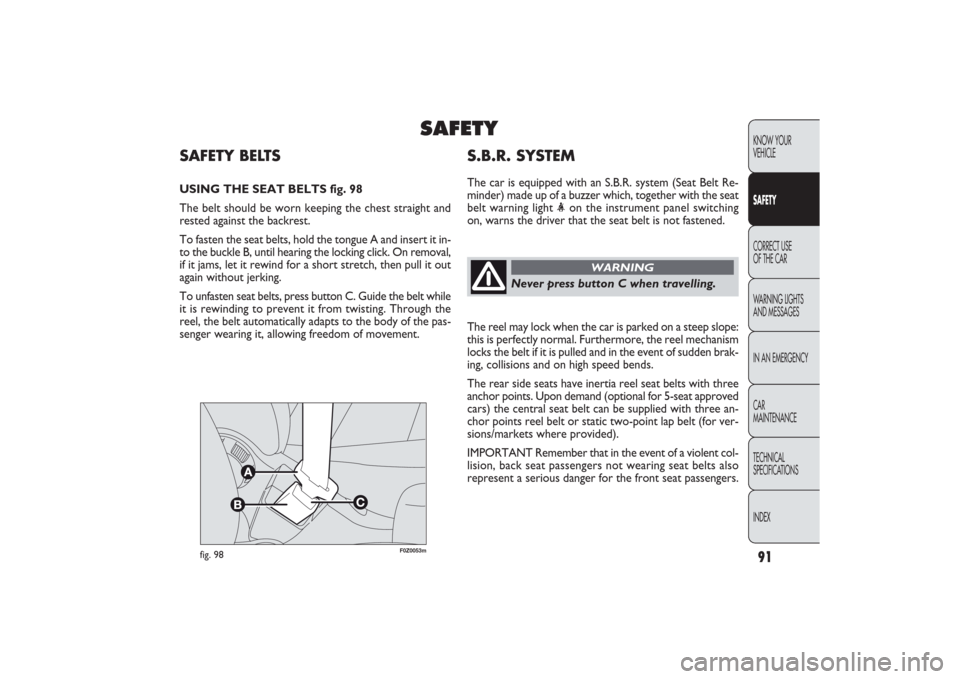
SAFETY BELTSUSING THE SEAT BELTS fig. 98
The belt should be worn keeping the chest straight and
rested against the backrest.
To fasten the seat belts, hold the tongue A and insert it in-
to the buckle B, until hearing the locking click. On removal,
if it jams, let it rewind for a short stretch, then pull it out
again without jerking.
To unfasten seat belts, press button C. Guide the belt while
it is rewinding to prevent it from twisting. Through the
reel, the belt automatically adapts to the body of the pas-
senger wearing it, allowing freedom of movement.
Never press button C when travelling.
WARNING
S.B.R. SYSTEMThe car is equipped with an S.B.R. system (Seat Belt Re-
minder) made up of a buzzer which, together with the seat
belt warning light
<
on the instrument panel switching
on, warns the driver that the seat belt is not fastened.
091-110 PANDA EN 7-10-2009 13:46 Pagina 91
Page 111 of 226
110
KNOW YOUR
VEHICLE
SAFETY
CORRECT USE
OF THE CAR
WARNING LIGHTS
AND MESSAGES
IN AN EMERGENCY
CAR
MAINTENANCE
TECHNICAL
SPECIFICATIONS
INDEX
The front air bag is triggered in case of
stronger shocks with respect to that of pre-
tensioners. For collisions in the range between the
two thresholds, it is normal for only the preten-
sioners to be activated.
WARNING
Do not hook rigid objects to the coat
hooks and to the support handles.
WARNING
The air bag does not replace seat belts but
increases their efficiency. Furthermore,
since front air bags are not deployed in low speed
collisions, side collisions, rear-end shunts or roll-
overs, the passengers are only protected by the
seat belts which must be fastened at all times.
WARNING
If the car has been stolen or in case of at-
tempt to steal it, if it has been subjected
to vandals or floods, have the air bag system
checked by Fiat Dealership.
WARNING
Do not wash the seats with water or pres-
surized vapour (hand washing or auto-
matic seat washing stations).
WARNING
Turning the ignition key to MAR, the warn-
ing light
F
(airbag on passenger’s side en-
abled) goes on and flashes for a few seconds, thus
reminding the passenger that the airbag on his/her
side will deploy in the event of a collision, then it
switches off.
WARNING
091-110 PANDA EN 7-10-2009 13:46 Pagina 110
Page 112 of 226
111KNOW
YOUR VEHICLE
SAFETY
WARNING LIGHTS
AND MESSAGES
IN
AN EMERGENCY
CAR
MAINTENANCE
TECHNICAL
SPECIFICATIONS
INDEX
CORRECT USE OF THE CAR
STARTING PROCEDURE FOR PETROL
VERSIONS
Proceed as follows:❒
engage the handbrake;
❒
place the gearshifting lever in neutral;
❒
press the clutch pedal all the way down without touch-
ing the accelerator;
❒
turn the ignition key to
AVV
and let it go as soon as
the engine starts.
If the engine does not start at the first attempt, return
the ignition key to
STOP
before repeating starting.
STARTING THE ENGINEThe car is fitted with an electronic engine lock device:
if the engine fails to start, see the paragraph “The Fiat
CODE system” in section “Know your vehicle”.
The engine may be noisier during the first few seconds of
operation, especially after a long period of inactivity. This
characteristic feature of the hydraulic tappet system does
not compromise functionality or reliability: the system de-
vised for your car was designed to limit maintenance
interventions.
It is dangerous to let the engine run in en-
closed spaces. The engine consumes oxy-
gen and engine exhaust contains carbon dioxide,
carbon monoxide and other toxic gasses.
WARNING
CORRECT USE
OF THE CAR
We recommend that during the initial pe-
riod you do not drive to full car perfor-
mance (e.g.: excessive acceleration, long
journeys at top speed, sharp braking, etc.).When the engine is switched off never leave
the key into the ignition switch to prevent
useless current absorption from draining the
battery.
Remember that the servo-brake and pow-
er steering are not operational until the
engine has been started, therefore much effort
than usual is required on the brake pedal
and teering wheel.
WARNING
111-122 PANDA EN 7-10-2009 15:01 Pagina 111
Page 113 of 226
112
KNOW YOUR
VEHICLE
SAFETYCORRECT USE
OF THE CARWARNING LIGHTS
AND MESSAGESI
IN
AN EMERGENCY
CAR
MAINTENANCE
TECHNICAL
SPECIFICATIONS
INDEX
If, when the ignition key is at MAR, warning light
Y
re-
mains lit together with warning light
U
turn the key to
STOP and then back to MAR; if the warning light remains
on, try with the other keys provided with the car.
If you are still unable to start the engine, perform the emer-
gency start-up procedure (see “Emergency start-up” in “In
an emergency” chapter) and contact a Fiat Dealership.
STARTING PROCEDURE FOR DIESEL
VERSIONS
Proceed as follows:
❒
engage the handbrake;
❒
put the gearshifting lever into neutral;
❒
turn the ignition key at MAR: the warning lights
m
and
Y
on the instrument panel will turn on;
❒
wait for the warning lights
Y
and
m
to turn off.
The hotter the engine is, the quicker this will happen;
❒
press the clutch pedal all the way down without touch-
ing the accelerator;
❒
turn the ignition key to AVV as soon as the warning lightm
turns off. Waiting too long will waste the work
done by the glow plugs.
Release the key as soon as the engine starts.
IMPORTANT With cold engine, the accelerator must
be entirely released when turning the ignition key to
position AVV.If the engine does not start at the first attempt, return
the ignition key to STOP before repeating starting.
If, when the ignition key is at MAR, the instrument panel
warning light
Y
remains lit, turn the key to STOP
and then back to MAR; if the warning lights remain on,
try with the other keys provided with the car.
If you still cannot start the engine, contact a Fiat Dealership.
Warning light
m
will flash for 60 seconds
after starting or during prolonged cranking
to indicate a fault to the glow plug heating
system. You can use the car as usual if the engine
starts but you should contact a Fiat Dealership as
soon as possible.
HOW TO WARM UP THE ENGINE AFTER IT
HAS JUST STARTED
Proceed as follows:❒
drive off slowly, letting the engine turn at medium speed.
Do not accelerate abruptly;
❒
do not demand maximum performance for the first few
kilometres. Wait until the engine temperature coolant
gauge starts moving.
111-122 PANDA EN 7-10-2009 15:01 Pagina 112