instrument panel FIAT PANDA 2009 169 / 2.G Owner's Manual
[x] Cancel search | Manufacturer: FIAT, Model Year: 2009, Model line: PANDA, Model: FIAT PANDA 2009 169 / 2.GPages: 226, PDF Size: 5.29 MB
Page 115 of 226
114
KNOW YOUR
VEHICLE
SAFETYCORRECT USE
OF THE CARWARNING LIGHTS
AND MESSAGESI
IN
AN EMERGENCY
CAR
MAINTENANCE
TECHNICAL
SPECIFICATIONS
INDEX
F0Z0060m
fig. 117
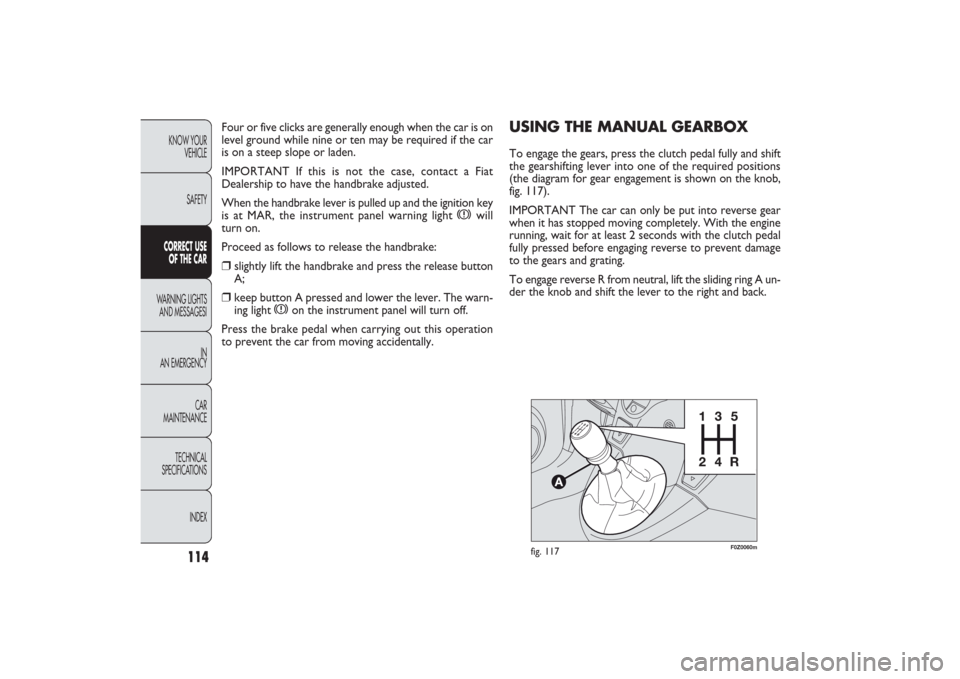
USING THE MANUAL GEARBOXTo engage the gears, press the clutch pedal fully and shift
the gearshifting lever into one of the required positions
(the diagram for gear engagement is shown on the knob,
fig. 117).
IMPORTANT The car can only be put into reverse gear
when it has stopped moving completely. With the engine
running, wait for at least 2 seconds with the clutch pedal
fully pressed before engaging reverse to prevent damage
to the gears and grating.
To engage reverse R from neutral, lift the sliding ring A un-
der the knob and shift the lever to the right and back. Four or five clicks are generally enough when the car is on
level ground while nine or ten may be required if the car
is on a steep slope or laden.
IMPORTANT If this is not the case, contact a Fiat
Dealership to have the handbrake adjusted.
When the handbrake lever is pulled up and the ignition key
is at MAR, the instrument panel warning light
x
will
turn on.
Proceed as follows to release the handbrake:
❒
slightly lift the handbrake and press the release button
A;
❒
keep button A pressed and lower the lever. The warn-
ing light
x
on the instrument panel will turn off.
Press the brake pedal when carrying out this operation
to prevent the car from moving accidentally.
111-122 PANDA EN 7-10-2009 15:01 Pagina 114
Page 124 of 226
123KNOW
YOUR VEHICLE
SAFETYWARNING LIGHTS
AND MESSAGESIN
AN EMERGENCY
CAR
MAINTENANCE
TECHNICAL
SPECIFICATIONS
INDEX
WARNING LIGHTS AND MESSAGES
WARNING LIGHTS AND MESSAGESGENERAL WARNINGSTurning on of warning light is accompanied by specific mes-
sage and/or by buzzer sound where provided by instru-
ment panel. These indications are concise and brief and
cautionary and as such must not be considered as ex-
haustive and/or alternative to the information contained
in the Owner Handbook, which shall always be read
through carefully and thoroughly. In case of failure indi-
cation, always refer to the specifications contained in this
chapter.
IMPORTANT Failure indications displayed are divided in-
to two categories: very serious and less serious failures.
Very serious failures are indicated by a repeated and pro-
longed warning “cycle”.
Less serious failures are indicated by a limited “warning”
cycle.
The warning cycle of both failure types can be stopped
by pressing the button MODE. The instrument panel warn-
ing light will stay on until the cause of the failure is elimi-
nated.
For messages relevant to the versions equipped with Dua-
logic gearbox, see the attached Supplement.
CORRECT USE
OF THE CAR
LOW BRAKE FLUID (red)
HANDBRAKE ON (red)
Turning the ignition key to MAR the warning light turns
on, but it should go off after a few seconds.
Low brake fluid
The warning light turns on when the level of the brake flu-
id in the reservoir falls below the minimum level due to
a possible leak in the circuit.
On some versions the display shows the dedicated message.
x
If the warning light xturns on when trav-
elling (on certain versions together with
the message on the display) stop the car imme-
diately and contact a Fiat Dealership.
WARNING
Handbrake on
The warning light turns on when the handbrake is on.
On certain versions, if the car is moving the buzzer will al-
so sound.
IMPORTANT If the warning light turns on when travel-
ling, make sure the handbrake is not engaged.
123-134 PANDA EN 7-10-2009 13:49 Pagina 123
Page 129 of 226
128
KNOW YOUR
VEHICLE
SAFETY
CORRECT USE
OF THE CAR
WARNING LIGHTS
AND MESSAGES
IN
AN EMERGENCY
CAR
MAINTENANCE
TECHNICAL
SPECIFICATIONS
INDEX
INCOMPLETE DOOR LOCKING
(red)
On some versions the warning light turns on
when one or more doors or the tailgate are not
properly closed.
On some versions the display shows the dedicated message.
A buzzer will sound (for versions with reconfigurable mul-
tifunction display only) when doors are open and the car
is moving.
´
INJECTION SYSTEM FAILURE
(Multijet versions – amber)
EOBD ENGINE CONTROL SYSTEM
FAILURE (petrol versions – amber)
Injection system failure
Under standard conditions, when the ignition key is moved
to MAR, the warning light turns on and should go off af-
ter engine start-up.
The warning light staying on or turning on when travelling,
signal a fault in the supply/ignition system which could cause
possible lack of performance, poor handling and high con-
sumption levels.
On some versions the display shows the dedicated message.
Under these conditions, you may continue travelling at mod-
erate speed without demanding excessive effort from the en-
gine. Contact a Fiat Dealership as soon as possible.U
Under these conditions, you may continue travelling at
moderate speed without demanding excessive effort from
the engine. Prolonged use of the car with the warning light
on may cause damages. Contact a Fiat Dealership as soon
as possible. The warning light goes off if the failure disap-
pears, but it is still stored by the system.
❒flashing: it indicates the possibility of damage to the cat-
alytic converter (see “EOBD system” in section “Know
your vehicle”).
If warning light
v
flashes, contact a
Fiat Dealership as soon as possible to have
engine oil changed and instrument panel warning
light turned off.
WARNING
“DUALDRIVE” ELECTRIC POWER
STEERING FAILURE (red)
Turning the ignition key to
MAR
the warning light
turns on, but it should go off after a few seconds.
If the warning light stays on, you will not have the steer-
ing assistance and the effort on the steering wheel will be
increased, steering is still however possible. Contact
a Fiat Dealership.
On some versions the display shows the dedicated message.
g
123-134 PANDA EN 7-10-2009 13:49 Pagina 128
Page 136 of 226
135KNOW
YOUR VEHICLE
SAFETY
WARNING LIGHTS
AND MESSAGESIN
AN EMERGENCYCAR
MAINTENANCE
TECHNICAL
SPECIFICATIONS
INDEX
IN AN EMERGENCY
STARTING THE ENGINEEMERGENCY START-UP
If the Fiat CODE system fails to deactivate engine immo-
bilising system the instrument panel warning lights
Y
and
U
stay on and the engine cannot be started.
To start the engine the emergency start-up can be per-
formed.
Read the whole procedure carefully before trying to car-
ry it out: if you make a mistake, you need to turn the ig-
nition key back to STOP and repeat the whole operation
from the beginning.
Proceed as follows:
❒
read the five-digit electronic code from the CODE card;
❒
turn the ignition key to MAR;
❒
press and hold down the accelerator pedal: the warn-
ing light
U
turns on for about 8 seconds, and then goes
off;
❒
release the accelerator pedal and count the flashes of
the warning light
U
;
❒
count the number of flashes that corresponds to the
first digit of the code on the CODE card, then press the
accelerator pedal and hold it there until the warning
light
U
comes on (for 4 seconds) and then goes off. Re-
lease the accelerator pedal;
CORRECT USE
OF THE CAR
❒
the warning light
U
will start flashing again: after it has
flashed the number of times corresponding to the
second digit on the CODE card, fully depress the ac-
celerator pedal and hold it there;
❒
do the same for the remaining digits on the CODE card;
❒
once the last digit has been entered, hold the acceler-
ator pedal pressed. The warning light
U
will light up for
four seconds and then go out. Release the accelerator
pedal;
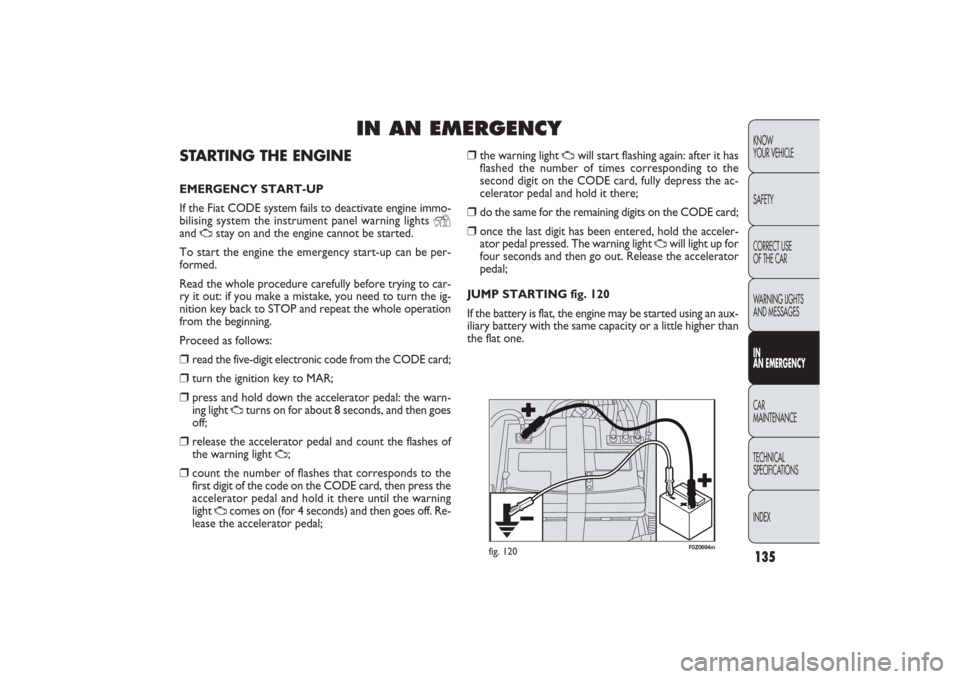
JUMP STARTING fig. 120
If the battery is flat, the engine may be started using an aux-
iliary battery with the same capacity or a little higher than
the flat one.
F0Z0694m
fig. 120
135-168 PANDA EN 7-10-2009 14:06 Pagina 135
Page 164 of 226
163KNOW
YOUR VEHICLE
SAFETY
CORRECT USE
OF THE CAR
WARNING LIGHTS
AND MESSAGESIN
AN EMERGENCYCAR
MAINTENANCE
TECHNICAL
SPECIFICATIONS
INDEX
5
7,5
7,5
10
7,5
15
15
7,5
7,5
7,5
7,5
5
5
15
–
–
7,5
7,5
7,5
20
10
10
10
10
F31
F35
F35
F37
F41
F45
F46
F49
F49
F49
F50
F51
F51
F54
FA
FB
F12
F13
F13
F38
F39
F39
F39
F39
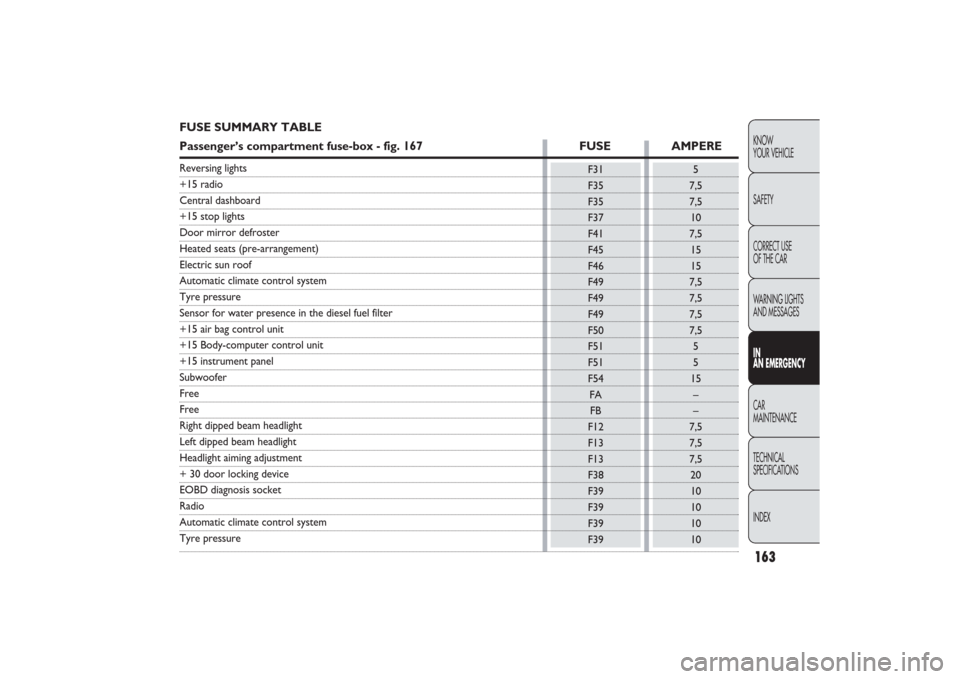
FUSE SUMMARY TABLEPassenger’s compartment fuse-box - fig. 167 FUSE AMPEREReversing lights+15 radioCentral dashboard+15 stop lightsDoor mirror defroster Heated seats (pre-arrangement)Electric sun roofAutomatic climate control systemTyre pressureSensor for water presence in the diesel fuel filter +15 air bag control unit+15 Body-computer control unit+15 instrument panelSubwooferFreeFreeRight dipped beam headlightLeft dipped beam headlightHeadlight aiming adjustment+ 30 door locking deviceEOBD diagnosis socketRadioAutomatic climate control systemTyre pressure
135-168 PANDA EN 7-10-2009 14:07 Pagina 163
Page 171 of 226
●●●● ● ●●●●
●●●● ● ●●●●
●●●● ● ●●●●
●●●● ● ●●●●
●●●● ● ●●●●
●●●
●●●● ● ●●●●
●●●● ● ●●●●
●
●● ●●
●● ●●
●● ●●
●●20 40 60 80 100 120 140 160 180
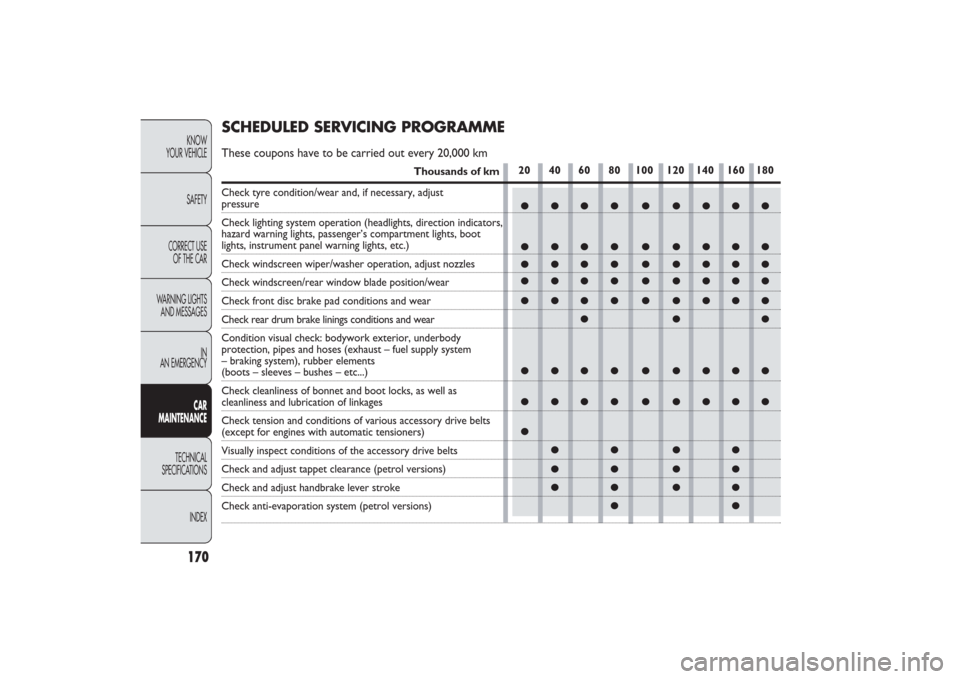
SCHEDULED SERVICING PROGRAMMEThese coupons have to be carried out every 20,000 km
Thousands of km
Check tyre condition/wear and, if necessary, adjust
pressure
Check lighting system operation (headlights, direction indicators,
hazard warning lights, passenger’s compartment lights, boot lights, instrument panel warning lights, etc.)Check windscreen wiper/washer operation, adjust nozzlesCheck windscreen/rear window blade position/wearCheck front disc brake pad conditions and wearCheck rear drum brake linings conditions and wear
Condition visual check: bodywork exterior, underbody
protection, pipes and hoses (exhaust – fuel supply system
– braking system), rubber elements (boots – sleeves – bushes – etc...)
Check cleanliness of bonnet and boot locks, as well as cleanliness and lubrication of linkages
Check tension and conditions of various accessory drive belts (except for engines with automatic tensioners)Visually inspect conditions of the accessory drive beltsCheck and adjust tappet clearance (petrol versions)Check and adjust handbrake lever stroke Check anti-evaporation system (petrol versions)
INDEX TECHNICAL
SPECIFICATIONSCAR
MAINTENANCEIN
AN EMERGENCY WARNING LIGHTS
AND MESSAGESCORRECT USE
OF THE CARSAFETYKNOW
YOUR VEHICLE
170
169-190 PANDA EN 7-10-2009 14:14 Pagina 170
Page 173 of 226
YEARLY INSPECTION SCHEDULEFor cars with an annual mileage of below 20,000 km (for
example about 15,000 km) the following yearly inspec-
tion schedule is advised:❒
check conditions/wear of tyres and adjust pressure if
necessary (including spare wheel);
❒
check lighting system operation (headlights, direction
indicators, hazard warning lights, boot light, passenger’s
compartment, instrument panel warning lights, etc...);
❒
check wiper/washer system operation, adjust nozzles;
❒
check windscreen/rear window blade position/wear;
❒
check front disc brake pad conditions and wear;
❒
check cleanliness of bonnet and boot locks and lever
cleanliness and lubrication;
❒
sight inspect the conditions of: engine, gearbox, trans-
mission, pipes and hoses (exhaust – fuel supply – brak-
ing system) rubber parts (boots – sleeves – bushes etc.),
fuel and brake system hoses;
❒
check battery charge;
❒
visually check the various drive belt conditions;
❒
check and top-up liquids if required (engine coolant,
brakes, windscreen washer, battery, etc.);
❒
change engine oil;
❒
change engine oil filter;
❒
change pollen filter (for versions/markets where pro-
vided).
ADDITIONAL INTERVENTIONSEvery 1,000 km or before long journeys, check and, if nec-
essary, top-up the following:❒
engine coolant fluid level;
❒
brake fluid level;
❒
battery fluid level;
❒
windscreen washer fluid level;
❒
tyre pressure and conditions.
Every 3,000 km check the following and top-up, if required:
❒
engine oil level.
You are recommended to use FL Selenia products de-
signed and produced specifically for Fiat cars (see table
“Capacities” in chapter “Technical specifications”).
IMPORTANT – Engine oil
Should prevailing use of the car be under one of the fol-
lowing specially heavy conditions:
❒
trailer or caravan towing;
❒
dusty roads;
❒
short distances (less than 7–8 km) and with external
temperatures below zero;
INDEX TECHNICAL
SPECIFICATIONSCAR
MAINTENANCEIN
AN EMERGENCY WARNING LIGHTS
AND MESSAGESCORRECT USE
OF THE CARSAFETYKNOW
YOUR VEHICLE
172
169-190 PANDA EN 7-10-2009 14:14 Pagina 172
Page 191 of 226
190KNOW
YOUR VEHICLE
SAFETY
CORRECT USE
OF THE CAR
WARNING LIGHTS
AND MESSAGES
IN
AN EMERGENCYCAR
MAINTENANCE
TECHNICAL
SPECIFICATIONS
INDEX
INTERIORSRegularly check that water is not trapped under the mats
(due to water dripping off shoes, umbrellas, etc.), as this
would cause oxidation of the sheet metal.
Never use flammable products, such as
petrol ether or rectified petrol to clean the
car inside. The electrostatic charges which are
generated by rubbing during the cleaning opera-
tion may cause a fire.
WARNING
Do not keep aerosol bottles in the vehicle:
risk of bursting. Aerosol bottles must not
be exposed to a temperature exceeding 50 °C.
When the car is exposed to sunlight, inner tem-
perature can greatly exceed this value.
WARNING
SEATS AND FABRIC PARTS
Remove dust with a soft brush or a vacuum cleaner. It is
advisable to use a moist brush on velvet upholstery.
Rub the seats with a sponge moistened with a solution of
water and neutral detergent.
INTERIOR PLASTIC PARTS
It is advisable to clean interior parts with a moist cloth and
a solution of water and mild soap. Use specific products
for cleaning plastic, without solvents and specifically de-
signed to prevent damage to the appearance and colour
of the treated parts to remove grease and tough stains.
IMPORTANT Never use alcohol or petroleum to clean
the instrument panel.
CLEANING SEAT PROTECTORS
In order to clean/remove stains from the
seat protectors, it is not advisable to use
alcohol or alcohol based products (e.g. solvents).
WARNING
169-190 PANDA EN 7-10-2009 14:15 Pagina 190
Page 220 of 226
219KNOW
YOUR VEHICLE
SAFETY
CORRECT USE
OF THE CAR
WARNING LIGHTS
AND MESSAGES
IN
AN EMERGENCY
CAR
MAINTENANCE
TECHNICAL
SPECIFICATIONSINDEX
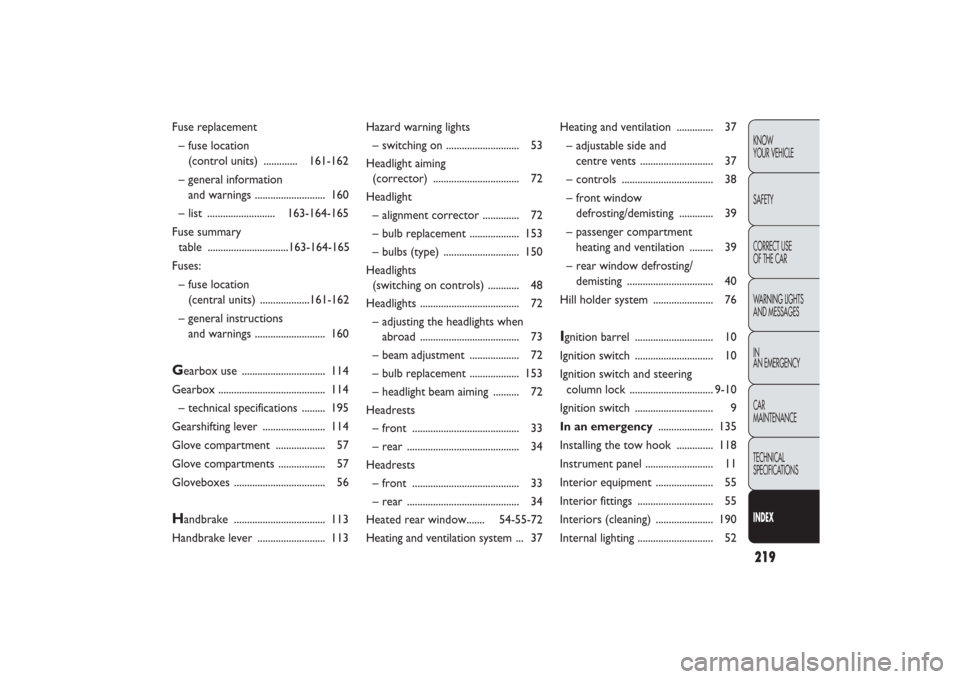
Fuse replacement
– fuse location
(control units) ............. 161-162
– general information
and warnings ........................... 160
– list .......................... 163-164-165
Fuse summary
table ...............................163-164-165
Fuses:
– fuse location
(central units) ...................161-162
– general instructions
and warnings ........................... 160G
earbox use ................................ 114
Gearbox ......................................... 114
– technical specifications ......... 195
Gearshifting lever ........................ 114
Glove compartment ................... 57
Glove compartments .................. 57
Gloveboxes ................................... 56
H
andbrake ................................... 113
Handbrake lever .......................... 113Hazard warning lights
– switching on ............................ 53
Headlight aiming
(corrector) ................................. 72
Headlight
– alignment corrector .............. 72
– bulb replacement ................... 153
– bulbs (type) ............................. 150
Headlights
(switching on controls) ............ 48
Headlights ...................................... 72
– adjusting the headlights when
abroad ...................................... 73
– beam adjustment ................... 72
– bulb replacement ................... 153
– headlight beam aiming .......... 72
Headrests
– front ......................................... 33
– rear ........................................... 34
Headrests
– front ......................................... 33
– rear ........................................... 34
Heated rear window....... 54-55-72
Heating and ventilation system ... 37Heating and ventilation .............. 37
– adjustable side and
centre vents ............................ 37
– controls ................................... 38
– front window
defrosting/demisting ............. 39
– passenger compartment
heating and ventilation ......... 39
– rear window defrosting/
demisting ................................. 40
Hill holder system ....................... 76
Ignition barrel .............................. 10
Ignition switch .............................. 10
Ignition switch and steering
column lock ................................ 9-10
Ignition switch .............................. 9
In an emergency..................... 135
Installing the tow hook .............. 118
Instrument panel .......................... 11
Interior equipment ...................... 55
Interior fittings ............................. 55
Interiors (cleaning) ...................... 190
Internal lighting ............................. 52
215-224 PANDA EN 7-10-2009 15:09 Pagina 219
Page 222 of 226
221KNOW
YOUR VEHICLE
SAFETY
CORRECT USE
OF THE CAR
WARNING LIGHTS
AND MESSAGES
IN
AN EMERGENCY
CAR
MAINTENANCE
TECHNICAL
SPECIFICATIONSINDEX
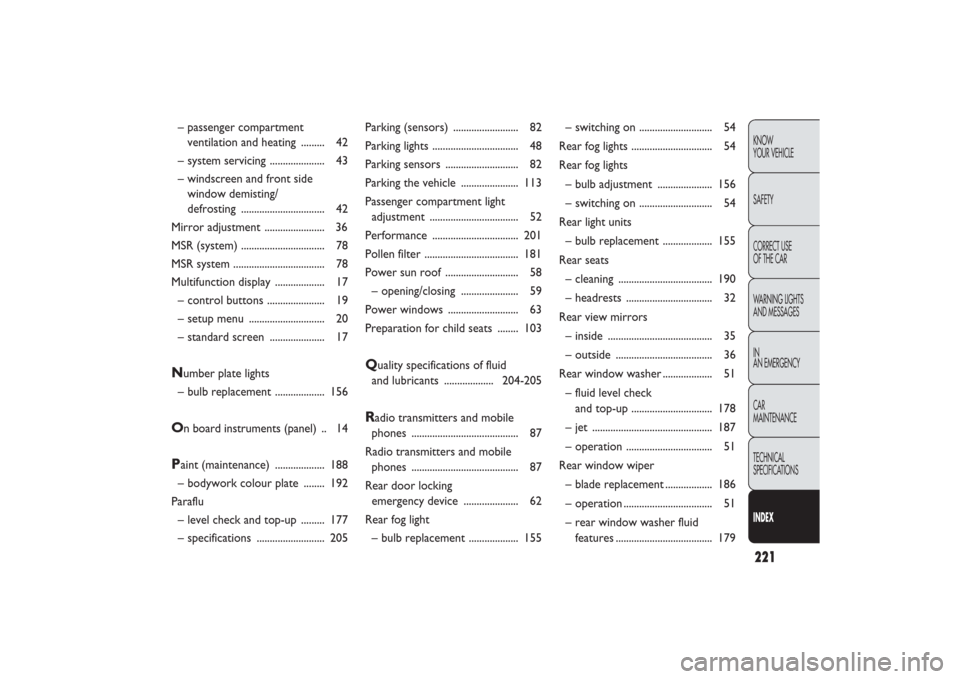
– passenger compartment
ventilation and heating ......... 42
– system servicing ..................... 43
– windscreen and front side
window demisting/
defrosting ................................ 42
Mirror adjustment ....................... 36
MSR (system) ................................ 78
MSR system ................................... 78
Multifunction display ................... 17
– control buttons ...................... 19
– setup menu ............................. 20
– standard screen ..................... 17N
umber plate lights
– bulb replacement ................... 156
O
n board instruments (panel) .. 14
Paint (maintenance) ................... 188
– bodywork colour plate ........ 192
Paraflu
– level check and top-up ......... 177
– specifications .......................... 205Parking (sensors) ......................... 82
Parking lights ................................. 48
Parking sensors ............................ 82
Parking the vehicle ...................... 113
Passenger compartment light
adjustment .................................. 52
Performance ................................. 201
Pollen filter .................................... 181
Power sun roof ............................ 58
– opening/closing ...................... 59
Power windows ........................... 63
Preparation for child seats ........ 103
Q
uality specifications of fluid
and lubricants ................... 204-205
Radio transmitters and mobile
phones ......................................... 87
Radio transmitters and mobile
phones ......................................... 87
Rear door locking
emergency device ..................... 62
Rear fog light
– bulb replacement ................... 155– switching on ............................ 54
Rear fog lights ............................... 54
Rear fog lights
– bulb adjustment ..................... 156
– switching on ............................ 54
Rear light units
– bulb replacement ................... 155
Rear seats
– cleaning .................................... 190
– headrests ................................. 32
Rear view mirrors
– inside ........................................ 35
– outside ..................................... 36
Rear window washer ................... 51
– fluid level check
and top-up ............................... 178
– jet .............................................. 187
– operation ................................. 51
Rear window wiper
– blade replacement .................. 186
– operation .................................. 51
– rear window washer fluid
features ..................................... 179
215-224 PANDA EN 7-10-2009 15:09 Pagina 221