Fig. 49 FIAT PANDA 2009 169 / 2.G Manual Online
[x] Cancel search | Manufacturer: FIAT, Model Year: 2009, Model line: PANDA, Model: FIAT PANDA 2009 169 / 2.GPages: 226, PDF Size: 5.29 MB
Page 120 of 226
119KNOW
YOUR VEHICLE
SAFETYCORRECT USE
OF THE CARWARNING LIGHTS
AND MESSAGES
IN
AN EMERGENCY
CAR
MAINTENANCE
TECHNICAL
SPECIFICATIONS
INDEX
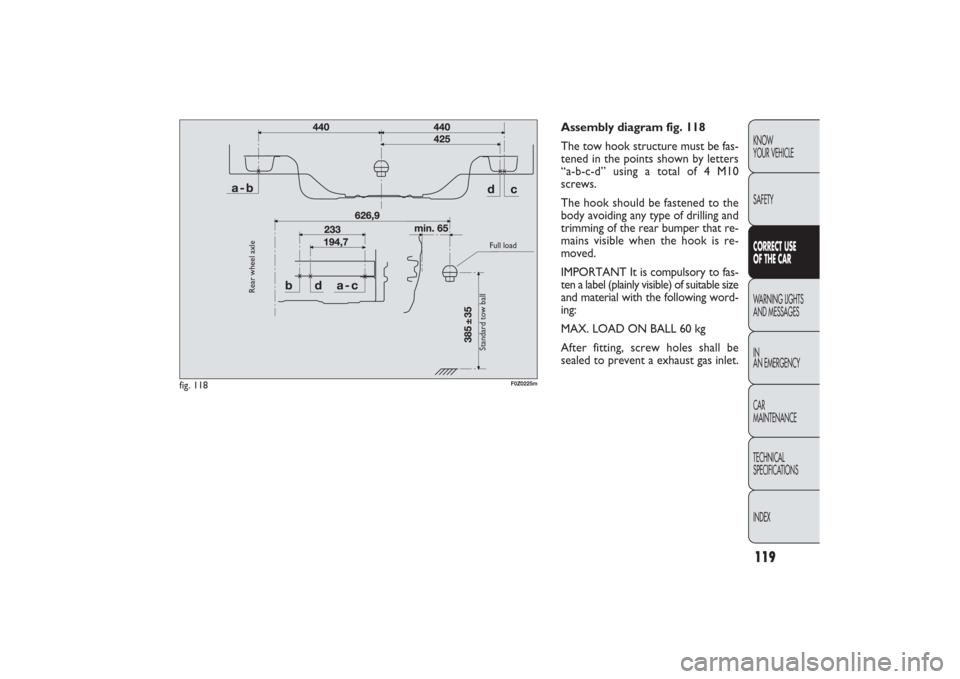
Assembly diagram fig. 118
The tow hook structure must be fas-
tened in the points shown by letters
“a-b-c-d” using a total of 4 M10
screws.
The hook should be fastened to the
body avoiding any type of drilling and
trimming of the rear bumper that re-
mains visible when the hook is re-
moved.
IMPORTANT It is compulsory to fas-
ten a label (plainly visible) of suitable size
and material with the following word-
ing:
MAX. LOAD ON BALL 60 kg
After fitting, screw holes shall be
sealed to prevent a exhaust gas inlet.
fig. 118
F0Z0225m
Rear wheel axle
Standard tow ball
Full load
111-122 PANDA EN 7-10-2009 15:01 Pagina 119
Page 121 of 226
120
KNOW YOUR
VEHICLE
SAFETYCORRECT USE
OF THE CARWARNING LIGHTS
AND MESSAGESI
IN
AN EMERGENCY
CAR
MAINTENANCE
TECHNICAL
SPECIFICATIONS
INDEX
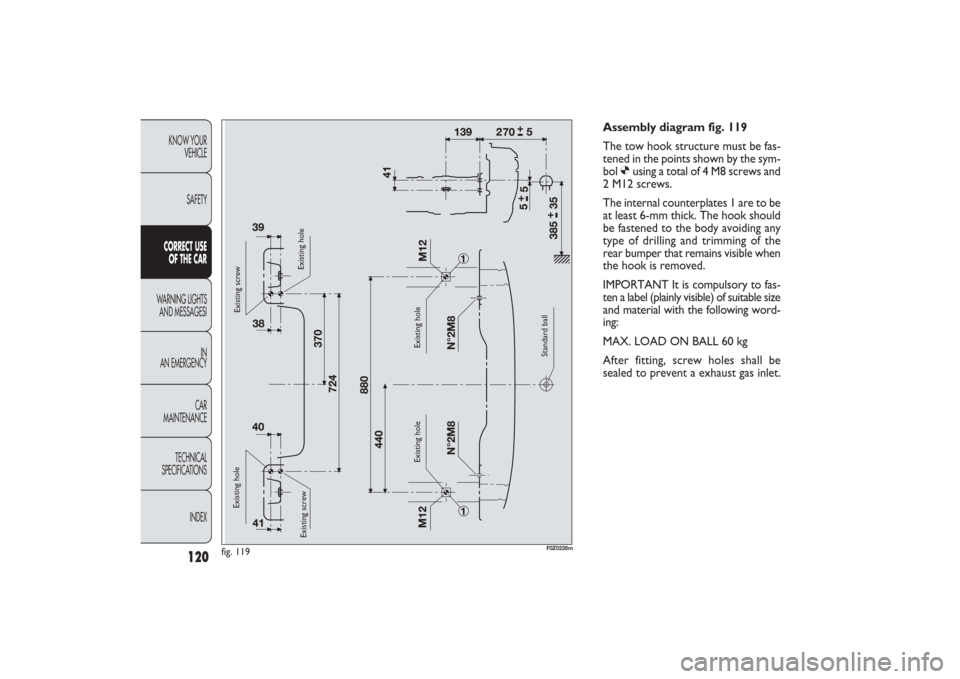
Assembly diagram fig. 119
The tow hook structure must be fas-
tened in the points shown by the sym-
bol
Ø
using a total of 4 M8 screws and
2 M12 screws.
The internal counterplates 1 are to be
at least 6-mm thick. The hook should
be fastened to the body avoiding any
type of drilling and trimming of the
rear bumper that remains visible when
the hook is removed.
IMPORTANT It is compulsory to fas-
ten a label (plainly visible) of suitable size
and material with the following word-
ing:
MAX. LOAD ON BALL 60 kg
After fitting, screw holes shall be
sealed to prevent a exhaust gas inlet.
fig. 119
F0Z0226m
Existing hole
Existing hole
Existing hole Existing hole
Standard ballExisting screw
Existing screw
111-122 PANDA EN 7-10-2009 15:01 Pagina 120
Page 136 of 226
135KNOW
YOUR VEHICLE
SAFETY
WARNING LIGHTS
AND MESSAGESIN
AN EMERGENCYCAR
MAINTENANCE
TECHNICAL
SPECIFICATIONS
INDEX
IN AN EMERGENCY
STARTING THE ENGINEEMERGENCY START-UP
If the Fiat CODE system fails to deactivate engine immo-
bilising system the instrument panel warning lights
Y
and
U
stay on and the engine cannot be started.
To start the engine the emergency start-up can be per-
formed.
Read the whole procedure carefully before trying to car-
ry it out: if you make a mistake, you need to turn the ig-
nition key back to STOP and repeat the whole operation
from the beginning.
Proceed as follows:
❒
read the five-digit electronic code from the CODE card;
❒
turn the ignition key to MAR;
❒
press and hold down the accelerator pedal: the warn-
ing light
U
turns on for about 8 seconds, and then goes
off;
❒
release the accelerator pedal and count the flashes of
the warning light
U
;
❒
count the number of flashes that corresponds to the
first digit of the code on the CODE card, then press the
accelerator pedal and hold it there until the warning
light
U
comes on (for 4 seconds) and then goes off. Re-
lease the accelerator pedal;
CORRECT USE
OF THE CAR
❒
the warning light
U
will start flashing again: after it has
flashed the number of times corresponding to the
second digit on the CODE card, fully depress the ac-
celerator pedal and hold it there;
❒
do the same for the remaining digits on the CODE card;
❒
once the last digit has been entered, hold the acceler-
ator pedal pressed. The warning light
U
will light up for
four seconds and then go out. Release the accelerator
pedal;
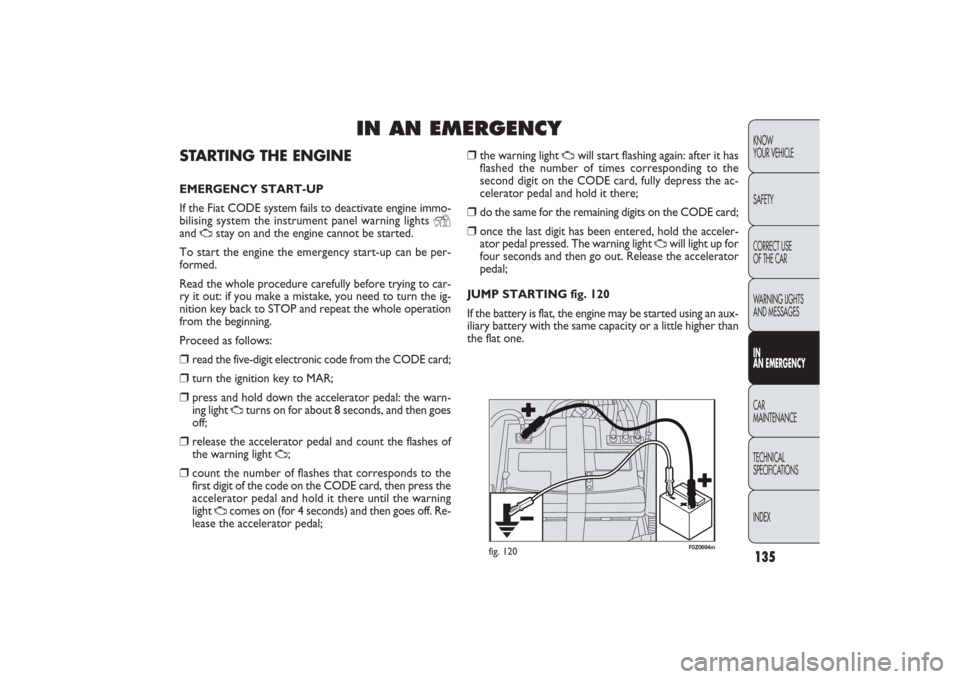
JUMP STARTING fig. 120
If the battery is flat, the engine may be started using an aux-
iliary battery with the same capacity or a little higher than
the flat one.
F0Z0694m
fig. 120
135-168 PANDA EN 7-10-2009 14:06 Pagina 135
Page 139 of 226
138KNOW
YOUR VEHICLE
SAFETY
CORRECT USE
OF THE CAR
WARNING LIGHTS
AND MESSAGES
IN
AN EMERGENCYCAR
MAINTENANCE
TECHNICAL
SPECIFICATIONS
INDEX
F0Z0171m
fig. 121
Please note that:❒
the jack weights 1.76 kg;
❒
the jack requires no adjustment;
❒
the jack cannot be repaired. If it breaks it must be re-
placed with a new jack;
❒
no tool other than its cranking device may be fitted on
the jack.
To change a wheel proceed as follows:
❒
stop the car in a position so that it is not a danger for
on-coming traffic and where you can replace the wheel
safely. The ground must be flat and compact;
❒
turn the engine off and pull up the handbrake.
❒
engage the first gear or reverse;
❒
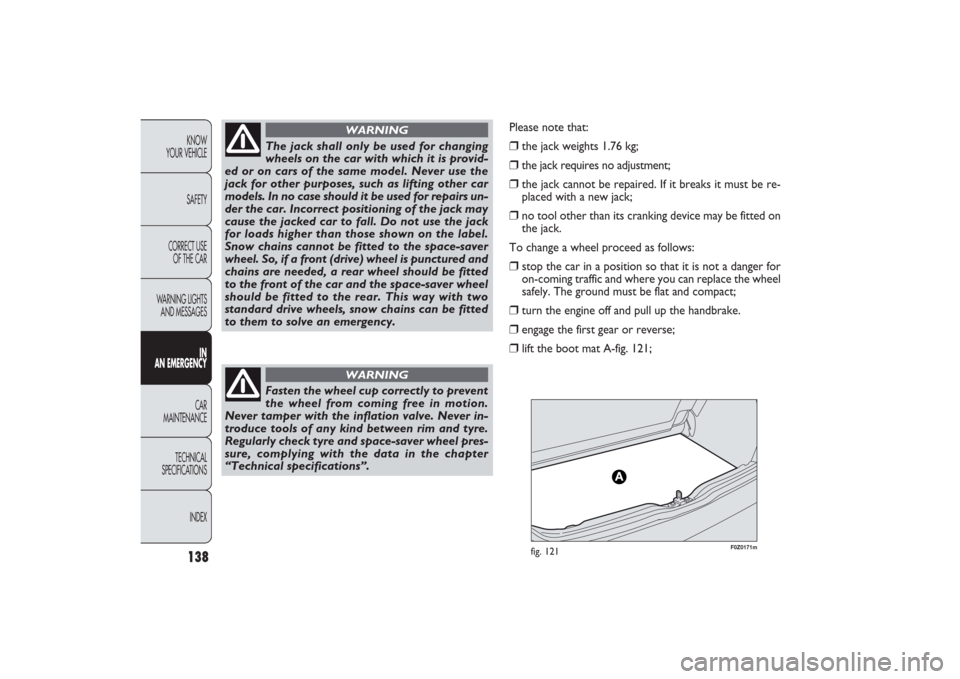
lift the boot mat A-fig. 121;
Fasten the wheel cup correctly to prevent
the wheel from coming free in motion.
Never tamper with the inflation valve. Never in-
troduce tools of any kind between rim and tyre.
Regularly check tyre and space-saver wheel pres-
sure, complying with the data in the chapter
“Technical specifications”.
WARNING
The jack shall only be used for changing
wheels on the car with which it is provid-
ed or on cars of the same model. Never use the
jack for other purposes, such as lifting other car
models. In no case should it be used for repairs un-
der the car. Incorrect positioning of the jack may
cause the jacked car to fall. Do not use the jack
for loads higher than those shown on the label.
Snow chains cannot be fitted to the space-saver
wheel. So, if a front (drive) wheel is punctured and
chains are needed, a rear wheel should be fitted
to the front of the car and the space-saver wheel
should be fitted to the rear. This way with two
standard drive wheels, snow chains can be fitted
to them to solve an emergency.
WARNING
135-168 PANDA EN 7-10-2009 14:06 Pagina 138
Page 140 of 226
139KNOW
YOUR VEHICLE
SAFETY
CORRECT USE
OF THE CAR
WARNING LIGHTS
AND MESSAGESIN
AN EMERGENCYCAR
MAINTENANCE
TECHNICAL
SPECIFICATIONS
INDEX
F0Z0078m
fig. 122
F0Z0695m
fig. 123
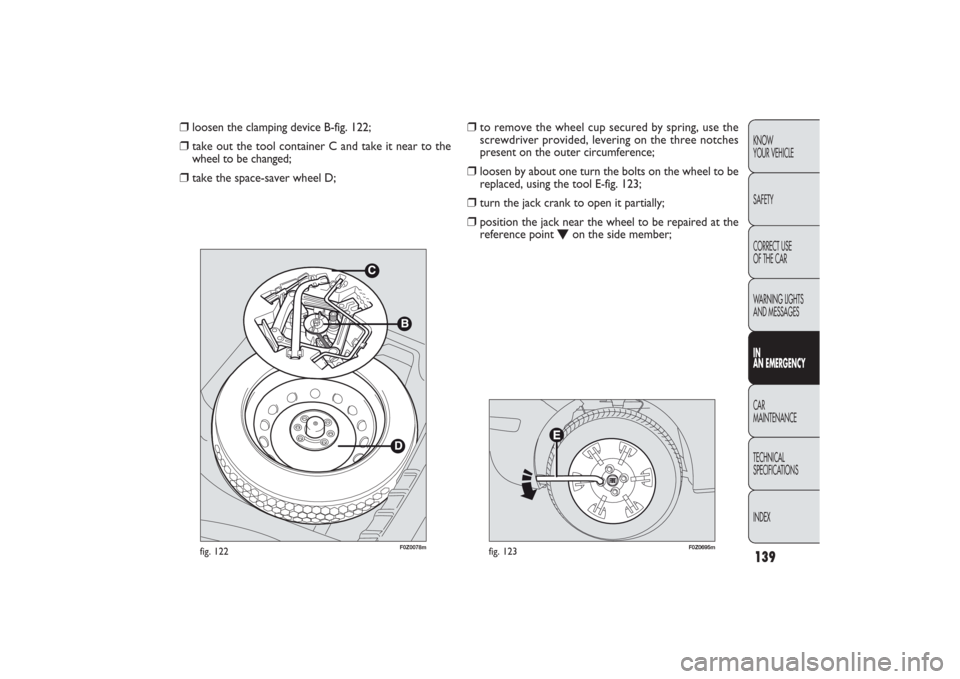
❒
to remove the wheel cup secured by spring, use the
screwdriver provided, levering on the three notches
present on the outer circumference;
❒
loosen by about one turn the bolts on the wheel to be
replaced, using the tool E-fig. 123;
❒
turn the jack crank to open it partially;
❒
position the jack near the wheel to be repaired at the
reference point
O
on the side member;
❒
loosen the clamping device B-fig. 122;
❒
take out the tool container C and take it near to the
wheel to be changed;
❒
take the space-saver wheel D;
135-168 PANDA EN 7-10-2009 14:06 Pagina 139
Page 141 of 226
140KNOW
YOUR VEHICLE
SAFETY
CORRECT USE
OF THE CAR
WARNING LIGHTS
AND MESSAGES
IN
AN EMERGENCYCAR
MAINTENANCE
TECHNICAL
SPECIFICATIONS
INDEX
F0Z0173m
fig. 124
F0Z0233m
fig. 125
❒
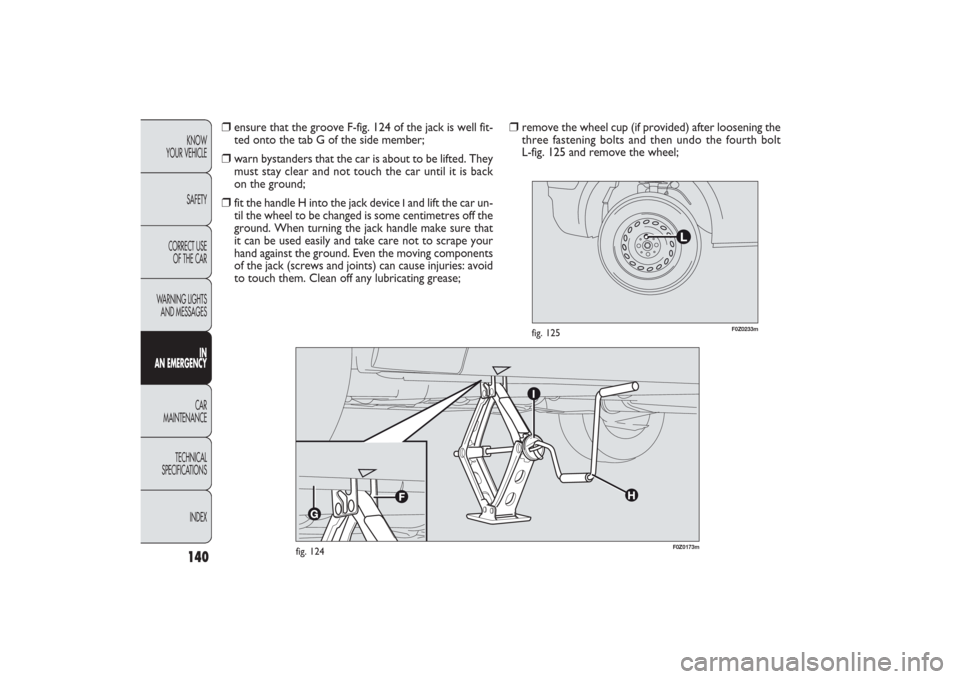
remove the wheel cup (if provided) after loosening the
three fastening bolts and then undo the fourth bolt
L-fig. 125 and remove the wheel;
❒
ensure that the groove F-fig. 124 of the jack is well fit-
ted onto the tab G of the side member;
❒
warn bystanders that the car is about to be lifted. They
must stay clear and not touch the car until it is back
on the ground;
❒
fit the handle H into the jack device
Iand lift the car un-
til the wheel to be changed is some centimetres off the
ground. When turning the jack handle make sure that
it can be used easily and take care not to scrape your
hand against the ground. Even the moving components
of the jack (screws and joints) can cause injuries: avoid
to touch them. Clean off any lubricating grease;
135-168 PANDA EN 7-10-2009 14:06 Pagina 140
Page 142 of 226
141KNOW
YOUR VEHICLE
SAFETY
CORRECT USE
OF THE CAR
WARNING LIGHTS
AND MESSAGESIN
AN EMERGENCYCAR
MAINTENANCE
TECHNICAL
SPECIFICATIONS
INDEX
F0Z0204m
fig. 126
F0Z0206m
fig. 127
❒
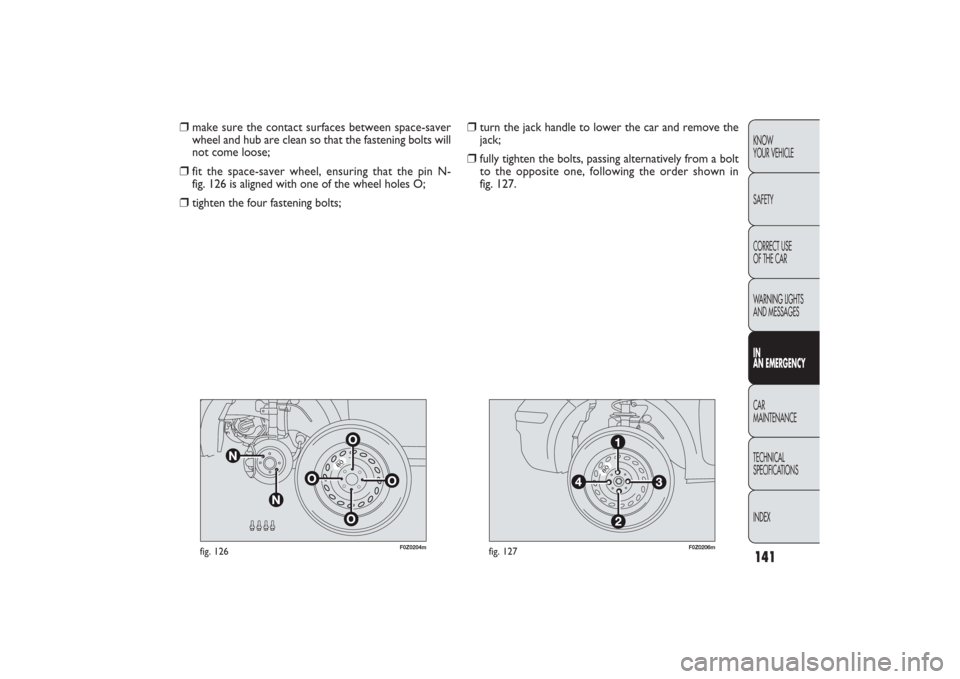
turn the jack handle to lower the car and remove the
jack;
❒
fully tighten the bolts, passing alternatively from a bolt
to the opposite one, following the order shown in
fig. 127.
❒
make sure the contact surfaces between space-saver
wheel and hub are clean so that the fastening bolts will
not come loose;
❒
fit the space-saver wheel, ensuring that the pin N-
fig. 126 is aligned with one of the wheel holes O;
❒
tighten the four fastening bolts;
135-168 PANDA EN 7-10-2009 14:06 Pagina 141
Page 143 of 226
142KNOW
YOUR VEHICLE
SAFETY
CORRECT USE
OF THE CAR
WARNING LIGHTS
AND MESSAGES
IN
AN EMERGENCYCAR
MAINTENANCE
TECHNICAL
SPECIFICATIONS
INDEX
F0Z0696m
fig. 130
F0Z0603m
fig. 129
❒
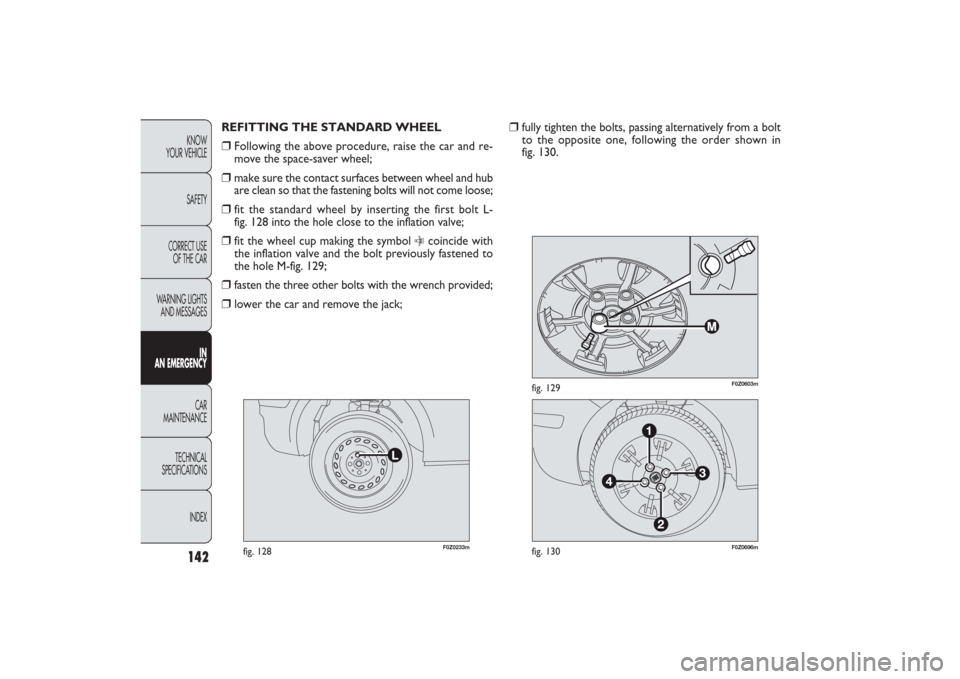
fully tighten the bolts, passing alternatively from a bolt
to the opposite one, following the order shown in
fig. 130. REFITTING THE STANDARD WHEEL
❒
Following the above procedure, raise the car and re-
move the space-saver wheel;
❒
make sure the contact surfaces between wheel and hub
are clean so that the fastening bolts will not come loose;
❒
fit the standard wheel by inserting the first bolt L-
fig. 128 into the hole close to the inflation valve;
❒
fit the wheel cup making the symbol
C
coincide with
the inflation valve and the bolt previously fastened to
the hole M-fig. 129;
❒
fasten the three other bolts with the wrench provided;
❒
lower the car and remove the jack;
F0Z0233m
fig. 128
135-168 PANDA EN 7-10-2009 14:06 Pagina 142
Page 144 of 226
143KNOW
YOUR VEHICLE
SAFETY
CORRECT USE
OF THE CAR
WARNING LIGHTS
AND MESSAGESIN
AN EMERGENCYCAR
MAINTENANCE
TECHNICAL
SPECIFICATIONS
INDEX
At the end of the procedure❒
stow the space-saving wheel D-fig. 122 in the space pro-
vided in the boot;
❒
fit the partially-open jack in its box C by forcing it slight-
ly to prevent it from vibrating when travelling;
❒
put the tools back into their locations;
❒
arrange the container and tools in the spare wheel and
secure the clamping device B;
❒
correctly reposition the boot stiff cover.
IMPORTANT Do not use inner tubes with tubeless tyres.
Check the inflation pressure of the tyres and the space-
saving wheel regularly.
IMPORTANT You will need to change the set of bolts if
you want to change the type of wheels fitted (alloy rims
instead of steel rims, and vice versa).The whole set of fas-
tening bolts must be replaced by another set of suitably
sized bolts and use a special space-saving wheel having dif-
ferent building characteristics.
You should keep the bolts and space-saving wheel in case
you decide to use the original type of wheel later on.
F0Z0607m
fig. 131
QUICK TYRE REPAIR KIT FIX & GO
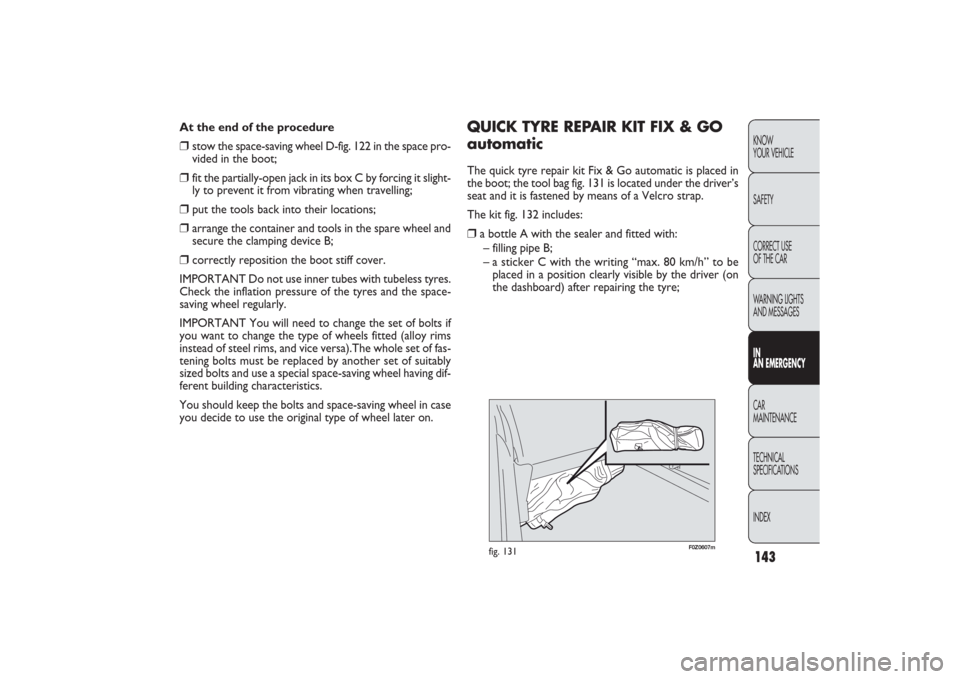
automaticThe quick tyre repair kit Fix & Go automatic is placed in
the boot; the tool bag fig. 131 is located under the driver’s
seat and it is fastened by means of a Velcro strap.
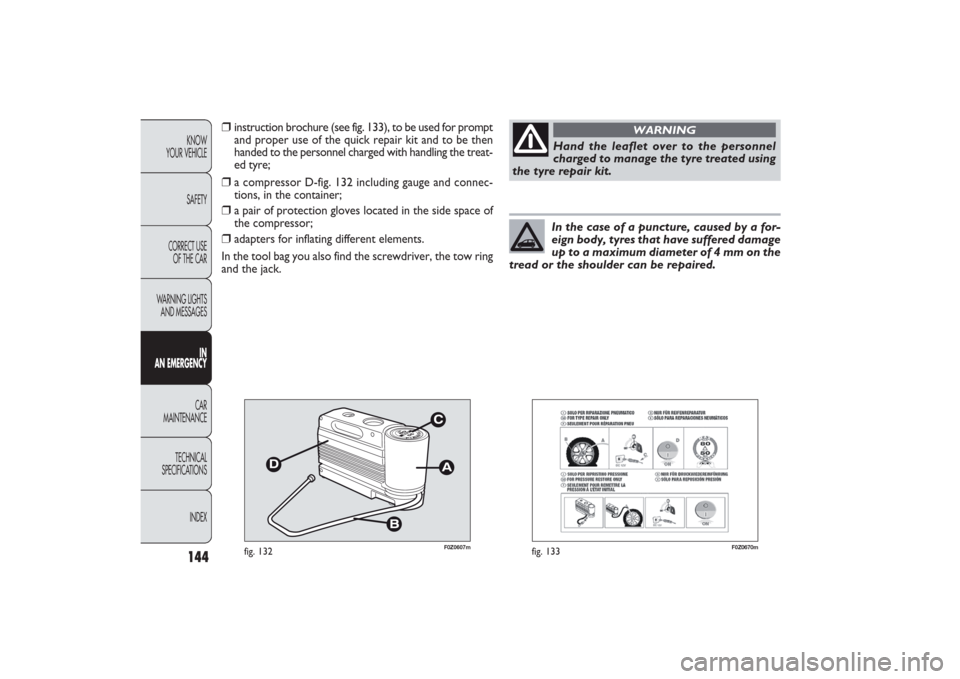
The kit fig. 132 includes:❒
a bottle A with the sealer and fitted with:
– filling pipe B;
– a sticker C with the writing “max. 80 km/h” to be
placed in a position clearly visible by the driver (on
the dashboard) after repairing the tyre;
135-168 PANDA EN 7-10-2009 14:06 Pagina 143
Page 145 of 226
144KNOW
YOUR VEHICLE
SAFETY
CORRECT USE
OF THE CAR
WARNING LIGHTS
AND MESSAGES
IN
AN EMERGENCYCAR
MAINTENANCE
TECHNICAL
SPECIFICATIONS
INDEX
F0Z0670m
fig. 133
Hand the leaflet over to the personnel
charged to manage the tyre treated using
the tyre repair kit.
WARNING
In the case of a puncture, caused by a for-
eign body, tyres that have suffered damage
up to a maximum diameter of 4 mm on the
tread or the shoulder can be repaired.
❒
instruction brochure (see fig. 133), to be used for prompt
and proper use of the quick repair kit and to be then
handed to the personnel charged with handling the treat-
ed tyre;
❒
a compressor D-fig. 132 including gauge and connec-
tions, in the container;
❒
a pair of protection gloves located in the side space of
the compressor;
❒
adapters for inflating different elements.
In the tool bag you also find the screwdriver, the tow ring
and the jack.
F0Z0607m
fig. 132
135-168 PANDA EN 7-10-2009 14:06 Pagina 144