wiper FIAT PANDA 2009 169 / 2.G Owners Manual
[x] Cancel search | Manufacturer: FIAT, Model Year: 2009, Model line: PANDA, Model: FIAT PANDA 2009 169 / 2.GPages: 226, PDF Size: 5.29 MB
Page 4 of 226
3KNOW YOUR
VEHICLESAFETY
CORRECT USE
OF THE CAR
WARNING LIGHTS
AND MESSAGES
IN
AN EMERGENCY
CAR
MAINTENANCE
TECHNICAL
SPECIFICATIONS
INDEX
KNOW YOUR VEHICLE
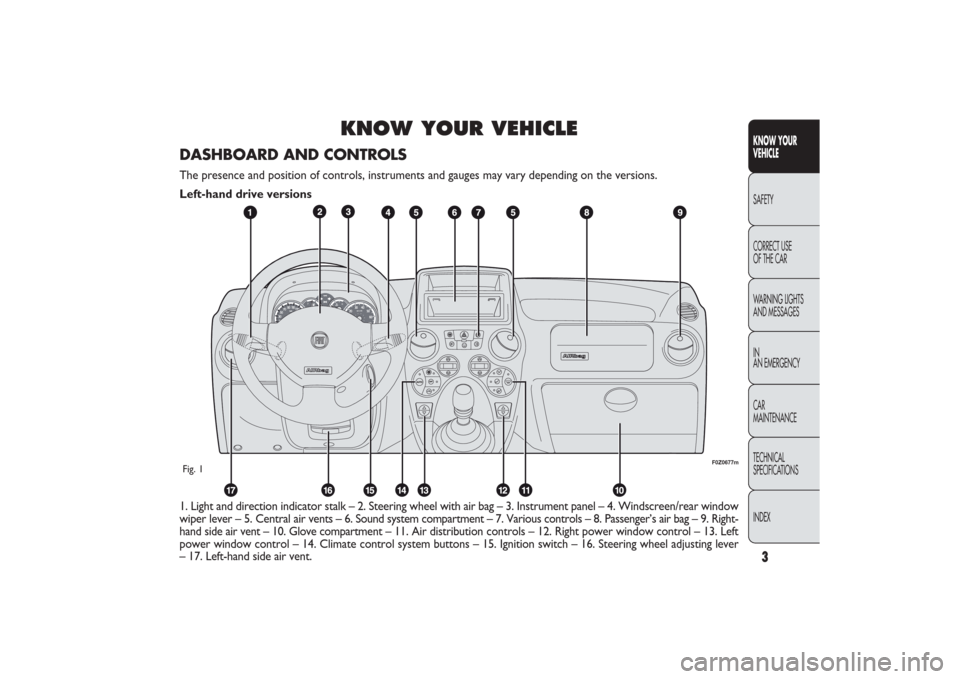
1. Light and direction indicator stalk – 2. Steering wheel with air bag – 3. Instrument panel – 4. Windscreen/rear window
wiper lever – 5. Central air vents – 6. Sound system compartment – 7. Various controls – 8. Passenger’s air bag – 9. Right-
hand side air vent – 10. Glove compartment – 11. Air distribution controls – 12. Right power window control – 13. Left
power window control – 14. Climate control system buttons – 15. Ignition switch – 16. Steering wheel adjusting lever
– 17. Left-hand side air vent.
F0Z0677m
Fig. 1DASHBOARD AND CONTROLSThe presence and position of controls, instruments and gauges may vary depending on the versions.
Left-hand drive versions
001-030 PANDA EN 7-10-2009 13:39 Pagina 3
Page 5 of 226
4
KNOW YOUR
VEHICLE
SAFETY
CORRECT USE
OF THE CAR
WARNING LIGHTS
AND MESSAGES
IN
AN EMERGENCY
CAR
MAINTENANCE
TECHNICAL
SPECIFICATIONS
INDEX
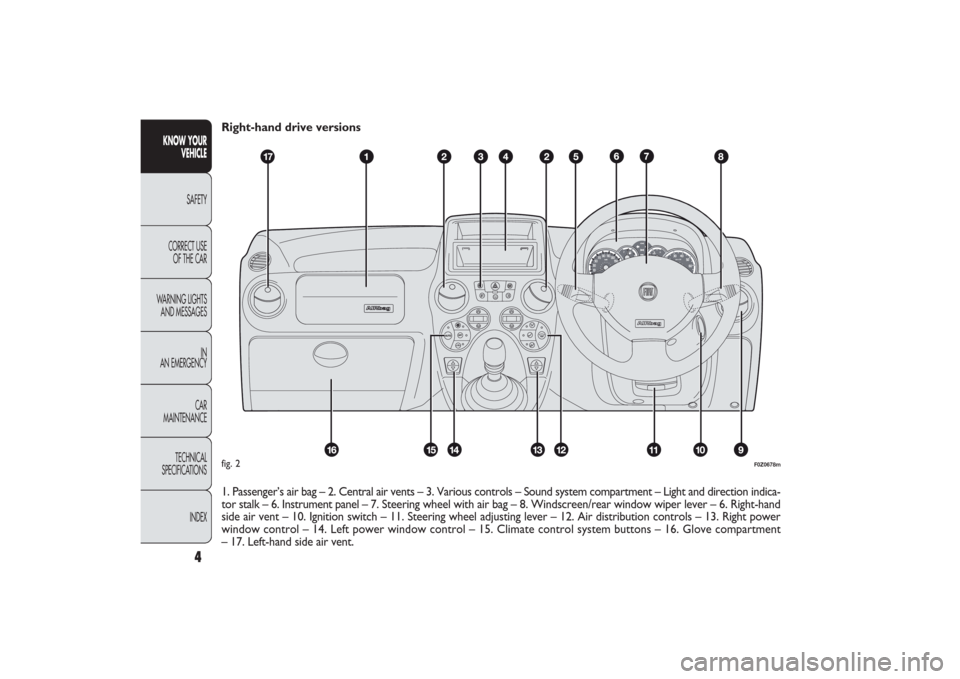
Right-hand drive versions
1. Passenger’s air bag – 2. Central air vents – 3. Various controls – Sound system compartment – Light and direction indica-
tor stalk – 6. Instrument panel – 7. Steering wheel with air bag – 8. Windscreen/rear window wiper lever – 6. Right-hand
side air vent – 10. Ignition switch – 11. Steering wheel adjusting lever – 12. Air distribution controls – 13. Right power
window control – 14. Left power window control – 15. Climate control system buttons – 16. Glove compartment
– 17. Left-hand side air vent.
CH
F
E
F0Z0678m
fig. 2
001-030 PANDA EN 7-10-2009 13:39 Pagina 4
Page 51 of 226
,
F0Z0127m
fig. 50
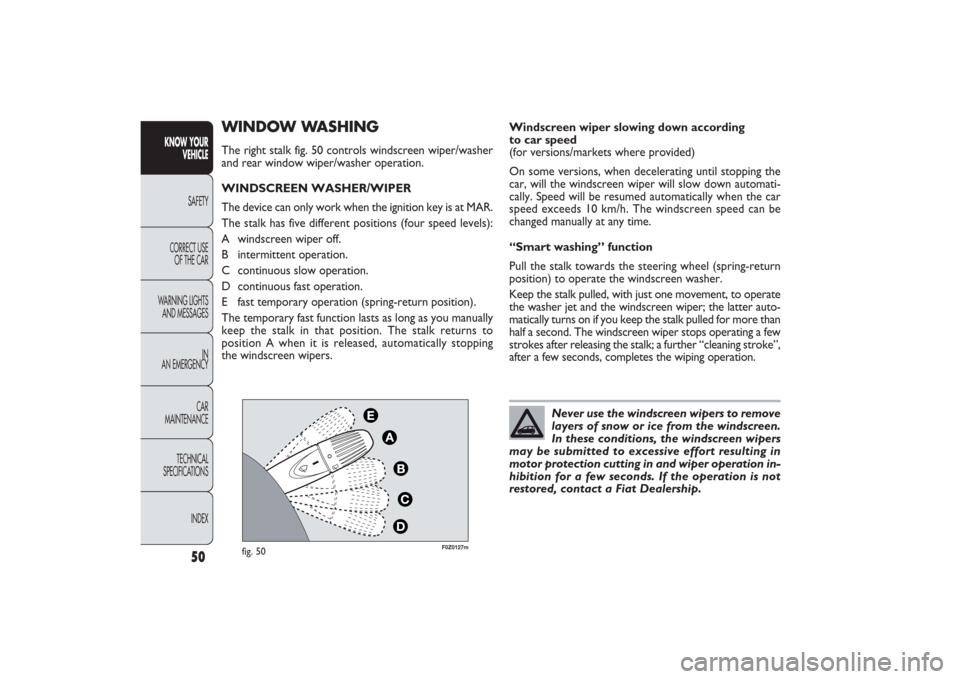
WINDOW WASHINGThe right stalk fig. 50 controls windscreen wiper/washer
and rear window wiper/washer operation.
WINDSCREEN WASHER/WIPER
The device can only work when the ignition key is at MAR.
The stalk has five different positions (four speed levels):
A windscreen wiper off.
B intermittent operation.
C continuous slow operation.
D continuous fast operation.
E fast temporary operation (spring-return position).
The temporary fast function lasts as long as you manually
keep the stalk in that position. The stalk returns to
position A when it is released, automatically stopping
the windscreen wipers.
50
KNOW YOUR
VEHICLE
SAFETY
CORRECT USE
OF THE CAR
WARNING LIGHTS
AND MESSAGES
IN
AN EMERGENCY
CAR
MAINTENANCE
TECHNICAL
SPECIFICATIONS
INDEX
Windscreen wiper slowing down according
to car speed
(for versions/markets where provided)
On some versions, when decelerating until stopping the
car, will the windscreen wiper will slow down automati-
cally. Speed will be resumed automatically when the car
speed exceeds 10 km/h. The windscreen speed can be
changed manually at any time.
“Smart washing” function
Pull the stalk towards the steering wheel (spring-return
position) to operate the windscreen washer.
Keep the stalk pulled, with just one movement, to operate
the washer jet and the windscreen wiper; the latter auto-
matically turns on if you keep the stalk pulled for more than
half a second. The windscreen wiper stops operating a few
strokes after releasing the stalk; a further “cleaning stroke”,
after a few seconds, completes the wiping operation.
Never use the windscreen wipers to remove
layers of snow or ice from the windscreen.
In these conditions, the windscreen wipers
may be submitted to excessive effort resulting in
motor protection cutting in and wiper operation in-
hibition for a few seconds. If the operation is not
restored, contact a Fiat Dealership.
031-064 PANDA EN 7-10-2009 13:43 Pagina 50
Page 52 of 226
51KNOW YOUR
VEHICLESAFETY
CORRECT USE
OF THE CAR
WARNING LIGHTS
AND MESSAGES
IN
AN EMERGENCY
CAR
MAINTENANCE
TECHNICAL
SPECIFICATIONS
INDEX
REAR WINDOW WASHER/WIPER
The device can only work when the ignition key is at MAR.
Turn the knurled ring to
'
to operate the rear window
wiper.
With the windscreen wiper on, turn the knurled ring to
'
to turn on the rear window wiper. In this case the wiper
works (in the different positions) timed with the wind-
screen wiper, but at half speed.
With the windscreen wiper on, engaging reverse gear will
automatically turn the rear window wiper on, in continu-
ous slow operation.
Operation stops by disengaging reverse.
“Smart washing” function
Pushing the stalk towards the dashboard (spring-return
position) will activate the rear window washer.
Keep the stalk pressed, with just one movement, to op-
erate the rear window washer jet and the rear window
wiper itself; the latter automatically turns on if you keep
the stalk pressed for more than half a second.
The rear window wiper stops operating a few strokes af-
ter releasing the stalk; a further “cleaning stroke”, after
a few seconds, completes the wiping operation.
Do not use the rear window wiper to re-
move layers of snow or ice from the wind-
screen. In these conditions, the rear window
wipers may be submitted to excessive effort result-
ing in motor protection cutting in and wiper oper-
ation inhibition for a few seconds. If the operation
is not restored, contact a Fiat Dealership.
031-064 PANDA EN 7-10-2009 13:43 Pagina 51
Page 70 of 226
The bonnet may drop suddenly if the sup-
porting rod is not positioned properly. This
should only be done when the car is stationary.
WARNING
Before opening the bonnet, check that
windscreen wiper arm is not lifted from
the windscreen.
WARNING
With hot engine, proceed with the utmost
care inside the engine compartment to
avoid burns. Do not place your hands close to the
fan: it might start working also with the ignition
key removed. Wait for engine cooling.
WARNING
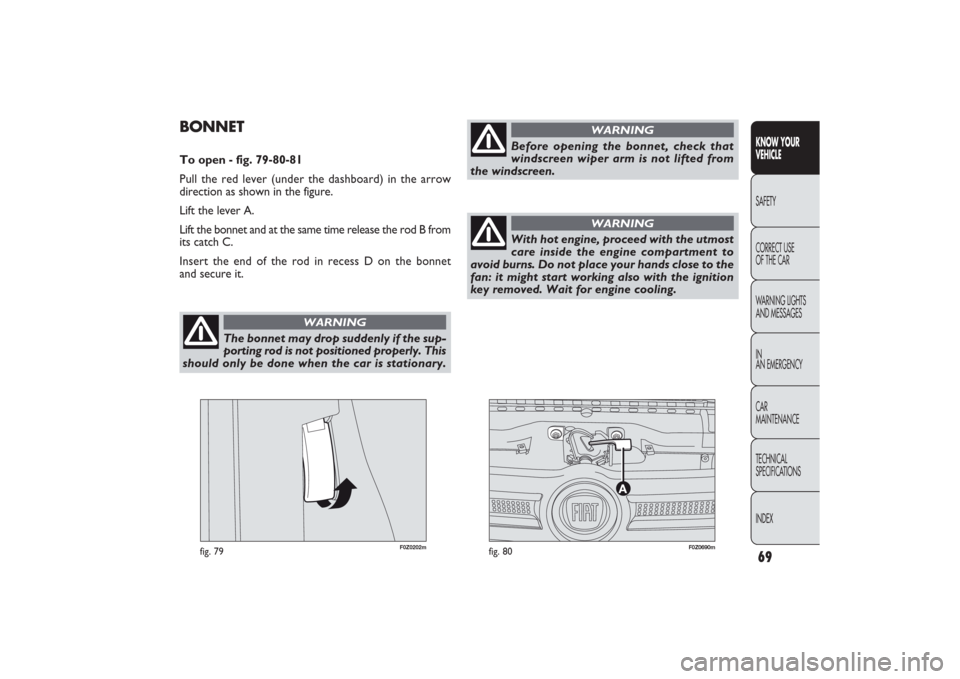
BONNETTo open - fig. 79-80-81
Pull the red lever (under the dashboard) in the arrow
direction as shown in the figure.
Lift the lever A.
Lift the bonnet and at the same time release the rod B from
its catch C.
Insert the end of the rod in recess D on the bonnet
and secure it.
fig. 80
F0Z0690m
fig. 79
F0Z0202m
69KNOW YOUR
VEHICLESAFETY
CORRECT USE
OF THE CAR
WARNING LIGHTS
AND MESSAGES
IN
AN EMERGENCY
CAR
MAINTENANCE
TECHNICAL
SPECIFICATIONS
INDEX
065-090 PANDA EN 7-10-2009 13:45 Pagina 69
Page 117 of 226
116
KNOW YOUR
VEHICLE
SAFETYCORRECT USE
OF THE CARWARNING LIGHTS
AND MESSAGESI
IN
AN EMERGENCY
CAR
MAINTENANCE
TECHNICAL
SPECIFICATIONS
INDEX
clutching is absolutely pointless on modern cars and also
increases consumption and pollution.
Gear selection
As soon as the conditions of the traffic and road allow, use
a higher gear. Using a low gear for faster acceleration will
increase consumption.
In the same way improper use of a high gear increases con-
sumption, emissions an engine wear.
Top speed
Fuel consumption considerably increases with speed.
Avoiding unnecessary braking and acceleration, which cost
in terms of both fuel and emissions.
Acceleration
Accelerating violently increasing the revs will greatly af-
fect consumption and emissions: acceleration should be
gradual.
CONDITIONS OF USE
Cold starting
Short journeys and frequent cold starts will prevent the en-
gine from reaching optimal running temperature. This re-
sults in a significant increase in consumption levels (from
+15 to +30% on the urban cycle) and emission of harmful
substances. Electric devices
Use electric devices only for the amount of time needed.
Rear heated window, additional headlights, windscreen
wipers and heater fan need a considerable amount of en-
ergy, therefore a higher requirement of current involves
and increase of fuel consumption (up to +25% in the
urban cycle).
Climate control system
The climate control system is an additional load which
greatly affects the engine leading to higher consumption
(on average up to +20%): when the temperature outside
the car permits it, use the air vents where possible.
Devices for aerodynamic control
The use of non-certified devices for aerodynamic control
may adversely affect air drag and consumption levels.
DRIVING STYLE
Starting
Do not warm the engine with the car at a standstill or at
idle or high speed: under these conditions the engine
warms up much more slowly, increasing electrical con-
sumption and emissions. It is therefore advisable to move
off immediately, slowly, avoiding high speeds: in this way
the engine will warm faster.
Unnecessary actions
Avoid accelerating when starting at traffic lights or be-
fore switching off the engine. This and also double de-
111-122 PANDA EN 7-10-2009 15:01 Pagina 116
Page 123 of 226
122
KNOW YOUR
VEHICLE
SAFETYCORRECT USE
OF THE CARWARNING LIGHTS
AND MESSAGESI
IN
AN EMERGENCY
CAR
MAINTENANCE
TECHNICAL
SPECIFICATIONS
INDEX
CAR INACTIVITYIf the car is to be left inactive for longer than a month,
the following precautions should be followed:❒
park the car in covered, dry and if possible well-venti-
lated premises;
❒
engage one gear;
❒
check that the handbrake is not engaged;
❒
disconnect the negative battery terminal and check bat-
tery charge. Repeat this check once every three months
during storage. Recharge if the optical indicator shows
a dark colour without the central green area;
❒
clean and protect the painted parts using protective
wax;
❒
clean and protect the shiny metal parts using special
compounds readily available;
❒
sprinkle talcum powder on the rubber windscreen and
rear window wiper blades and lift them off the glass;
❒
slightly open the windows;
❒
cover the car with a cloth or perforated plastic sheet.
Do not use sheets of non-perforated plastic as they do
not allow moisture on the car body to evaporate;
❒
inflate tyres to 0.5 bar above the standard specified pres-
sure and check it at intervals;
❒
if you don’t disconnect the battery from the electric sys-
tem, check its charge every month and recharge it if the
optical indicator shows a dark colour without the central
green area;
❒
do not drain the engine cooling system.
SNOW CHAINSThe use of snow chains should be in compliance with lo-
cal regulations.
The snow chains may be applied only onto the front wheel
tyres (drive wheels).
Check the tension of the snow chains after the first few
metres have been driven.
IMPORTANT Snow chains cannot be fitted to the space-
saver spare wheel. So, if a front (drive) wheel is punctured
and chains are needed, a rear wheel should be fitted to the
front of the car and the space-saving spare wheel should
be fitted to the rear. This way with two normal drive
wheels, snow chains can be fitted to them to solve an
emergency.
Keep your speed down when snow chains
are fitted. Do not exceed 50 km/h. Avoid
potholes, steps and pavements and also
avoid driving long distances on roads not covered
with snow in order to prevent damaging the car and
the roadbed.
111-122 PANDA EN 7-10-2009 15:01 Pagina 122
Page 165 of 226
164KNOW
YOUR VEHICLE
SAFETY
CORRECT USE
OF THE CAR
WARNING LIGHTS
AND MESSAGES
IN
AN EMERGENCYCAR
MAINTENANCE
TECHNICAL
SPECIFICATIONS
INDEX
10
10
30
30
15
20
20
15
F39
F39
F40
F43
F53
F47
F48
F52
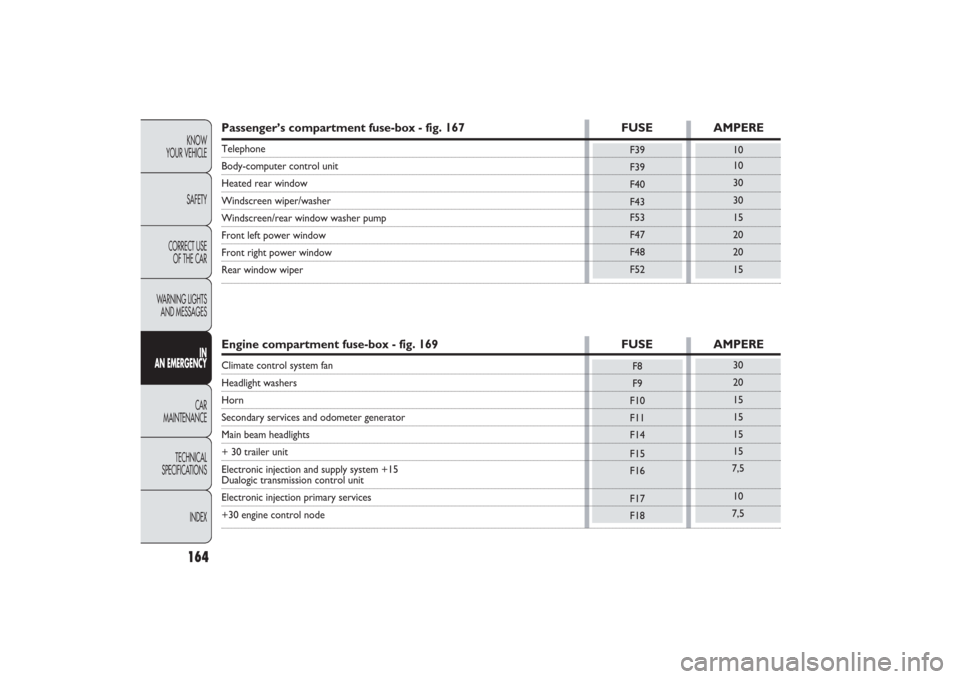
Passenger’s compartment fuse-box - fig. 167 FUSE AMPERETelephoneBody-computer control unitHeated rear windowWindscreen wiper/washerWindscreen/rear window washer pumpFront left power windowFront right power windowRear window wiper
30
20
15
15
15
15
7,5
10
7,5
F8
F9
F10
F11
F14
F15
F16
F17
F18
Engine compartment fuse-box - fig. 169 FUSE AMPEREClimate control system fanHeadlight washersHornSecondary services and odometer generatorMain beam headlights+ 30 trailer unit
Electronic injection and supply system +15 Dualogic transmission control unitElectronic injection primary services+30 engine control node
135-168 PANDA EN 7-10-2009 14:07 Pagina 164
Page 171 of 226
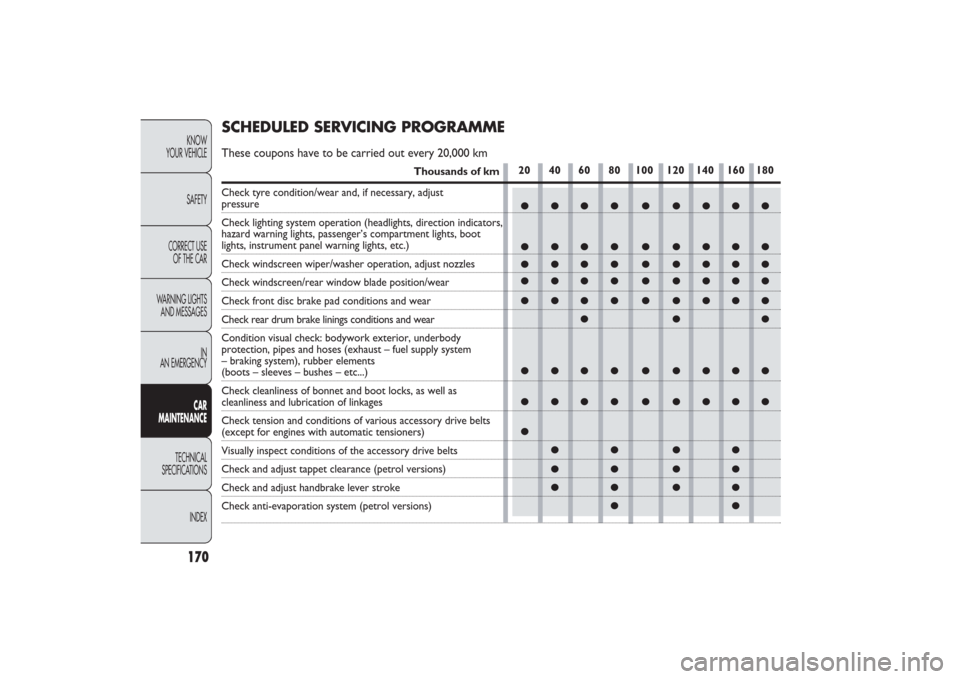
●●●● ● ●●●●
●●●● ● ●●●●
●●●● ● ●●●●
●●●● ● ●●●●
●●●● ● ●●●●
●●●
●●●● ● ●●●●
●●●● ● ●●●●
●
●● ●●
●● ●●
●● ●●
●●20 40 60 80 100 120 140 160 180
SCHEDULED SERVICING PROGRAMMEThese coupons have to be carried out every 20,000 km
Thousands of km
Check tyre condition/wear and, if necessary, adjust
pressure
Check lighting system operation (headlights, direction indicators,
hazard warning lights, passenger’s compartment lights, boot lights, instrument panel warning lights, etc.)Check windscreen wiper/washer operation, adjust nozzlesCheck windscreen/rear window blade position/wearCheck front disc brake pad conditions and wearCheck rear drum brake linings conditions and wear
Condition visual check: bodywork exterior, underbody
protection, pipes and hoses (exhaust – fuel supply system
– braking system), rubber elements (boots – sleeves – bushes – etc...)
Check cleanliness of bonnet and boot locks, as well as cleanliness and lubrication of linkages
Check tension and conditions of various accessory drive belts (except for engines with automatic tensioners)Visually inspect conditions of the accessory drive beltsCheck and adjust tappet clearance (petrol versions)Check and adjust handbrake lever stroke Check anti-evaporation system (petrol versions)
INDEX TECHNICAL
SPECIFICATIONSCAR
MAINTENANCEIN
AN EMERGENCY WARNING LIGHTS
AND MESSAGESCORRECT USE
OF THE CARSAFETYKNOW
YOUR VEHICLE
170
169-190 PANDA EN 7-10-2009 14:14 Pagina 170
Page 173 of 226
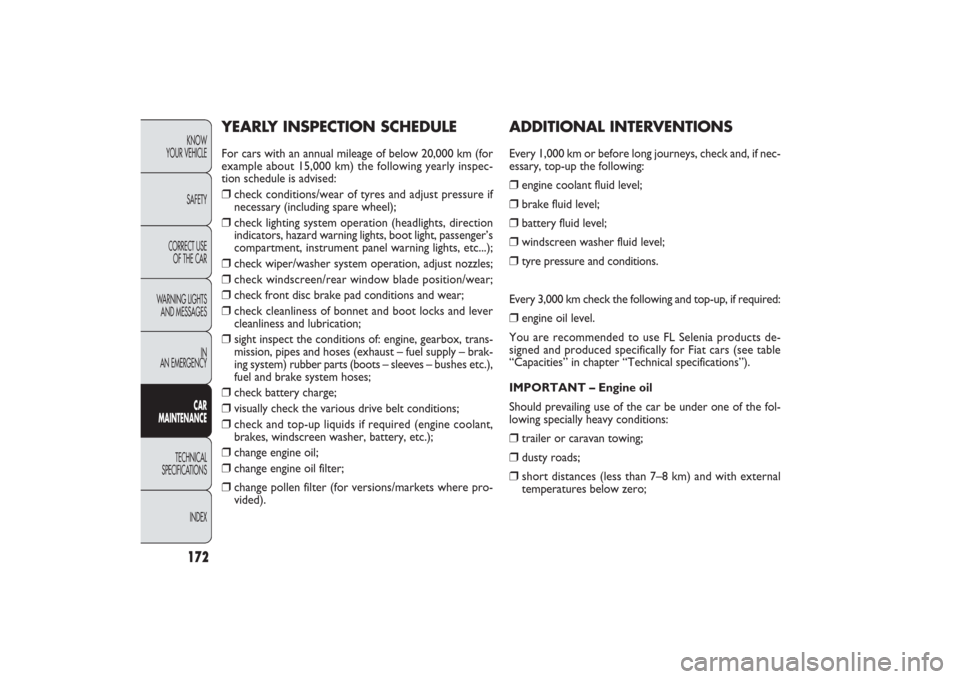
YEARLY INSPECTION SCHEDULEFor cars with an annual mileage of below 20,000 km (for
example about 15,000 km) the following yearly inspec-
tion schedule is advised:❒
check conditions/wear of tyres and adjust pressure if
necessary (including spare wheel);
❒
check lighting system operation (headlights, direction
indicators, hazard warning lights, boot light, passenger’s
compartment, instrument panel warning lights, etc...);
❒
check wiper/washer system operation, adjust nozzles;
❒
check windscreen/rear window blade position/wear;
❒
check front disc brake pad conditions and wear;
❒
check cleanliness of bonnet and boot locks and lever
cleanliness and lubrication;
❒
sight inspect the conditions of: engine, gearbox, trans-
mission, pipes and hoses (exhaust – fuel supply – brak-
ing system) rubber parts (boots – sleeves – bushes etc.),
fuel and brake system hoses;
❒
check battery charge;
❒
visually check the various drive belt conditions;
❒
check and top-up liquids if required (engine coolant,
brakes, windscreen washer, battery, etc.);
❒
change engine oil;
❒
change engine oil filter;
❒
change pollen filter (for versions/markets where pro-
vided).
ADDITIONAL INTERVENTIONSEvery 1,000 km or before long journeys, check and, if nec-
essary, top-up the following:❒
engine coolant fluid level;
❒
brake fluid level;
❒
battery fluid level;
❒
windscreen washer fluid level;
❒
tyre pressure and conditions.
Every 3,000 km check the following and top-up, if required:
❒
engine oil level.
You are recommended to use FL Selenia products de-
signed and produced specifically for Fiat cars (see table
“Capacities” in chapter “Technical specifications”).
IMPORTANT – Engine oil
Should prevailing use of the car be under one of the fol-
lowing specially heavy conditions:
❒
trailer or caravan towing;
❒
dusty roads;
❒
short distances (less than 7–8 km) and with external
temperatures below zero;
INDEX TECHNICAL
SPECIFICATIONSCAR
MAINTENANCEIN
AN EMERGENCY WARNING LIGHTS
AND MESSAGESCORRECT USE
OF THE CARSAFETYKNOW
YOUR VEHICLE
172
169-190 PANDA EN 7-10-2009 14:14 Pagina 172