wheel FIAT QUBO 2017 1.G Owner's Manual
[x] Cancel search | Manufacturer: FIAT, Model Year: 2017, Model line: QUBO, Model: FIAT QUBO 2017 1.GPages: 260, PDF Size: 4.74 MB
Page 126 of 260
STARTING AND DRIVING
STARTING THE ENGINE
The vehicle is fitted with an immobiliser: if the engine
fails to start, see the paragraph on “The Fiat CODE
system” in the “Knowing your vehicle” section.
The engine may be noisier during the first few
seconds of operation, particularly after a long period
of inactivity. This is due to the hydraulic tappets,
the timing system chosen for petrol engine versions
to reduce the number of servicing interventions,
and affects neither functionality nor reliability.
It is advisable not to demand maximum
performance from your vehicle (e.g.
excessive acceleration, long distances at
high speeds, excessive intense braking, etc .) during
the initial period of use.
When the engine is switched off never
leave the key on (at MAR) to prevent
unnecessary consumption and draining
the battery.
WARNING
It is dangerous to have the engine
running indoors.The engine takes in
oxygen and discharges carbon dioxide, carbon
monoxide and other toxic gases.
WARNING
Remember that the brake booster and
electric power steering are not
operational until the engine has been started,
so you need to apply much more force than
usual to the brake pedal and steering wheel.
122
KNOWING YOUR
VEHICLE
SAFETY
STARTING AND
DRIVING
WARNING LIGHTS
AND MESSAGES
IN AN EMERGENCY
SERVICING AND
CARE
TECHNICAL DATA
INDEX
Page 129 of 260
HANDBRAKE
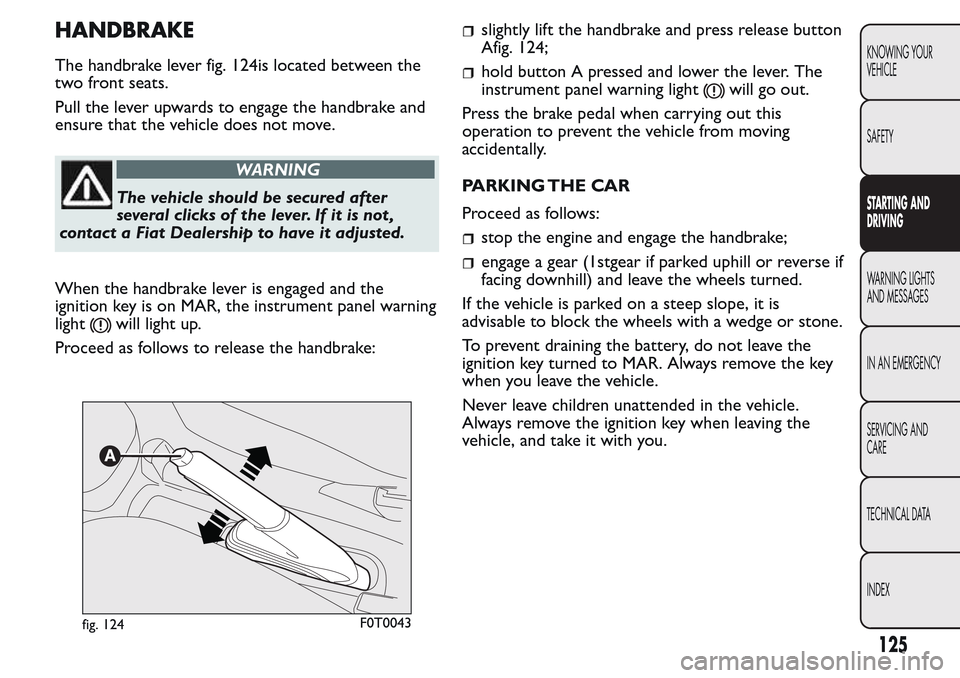
The handbrake lever fig. 124is located between the
two front seats.
Pull the lever upwards to engage the handbrake and
ensure that the vehicle does not move.
WARNING
The vehicle should be secured after
several clicks of the lever. If it is not ,
contact a Fiat Dealership to have it adjusted.
When the handbrake lever is engaged and the
ignition key is on MAR, the instrument panel warning
light
will light up.
Proceed as follows to release the handbrake:
slightly lift the handbrake and press release button
Afig. 124;
hold button A pressed and lower the lever. The
instrument panel warning light
will go out.
Press the brake pedal when carrying out this
operation to prevent the vehicle from moving
accidentally.
PARKING THE CAR
Proceed as follows:
stop the engine and engage the handbrake;
engage a gear (1stgear if parked uphill or reverse if
facing downhill) and leave the wheels turned.
If the vehicle is parked on a steep slope, it is
advisable to block the wheels with a wedge or stone.
To prevent draining the battery, do not leave the
ignition key turned to MAR. Always remove the key
when you leave the vehicle.
Never leave children unattended in the vehicle.
Always remove the ignition key when leaving the
vehicle, and take it with you.
fig. 124F0T0043
125
KNOWING YOUR
VEHICLE
SAFETY
STARTING AND
DRIVING
WARNING LIGHTS
AND MESSAGES
IN AN EMERGENCY
SERVICING AND
CARE
TECHNICAL DATA
INDEX
Page 130 of 260
SNOW TYRES
The Fiat Dealership will be happy to provide advice
concerning the most suitable type of tyre for the
customer's requirements.
For the type, pressures and specifications of the
snow tyre to be used, follow carefully the
instructions given in the “Wheels” paragraph of the
“Technical specifications” section.
The winter performance of these tyres is
considerably reduced when the tread thickness is less
than 4 mm. If this is the case, replace them.
Due to the specific characteristics of snow tyres, in
normal weather conditions or on long motorway
journeys, the performance of these tyres is lower
than that of standard tyres. Their usage should
therefore be restricted in accordance with their type
approval.
IMPORTANT When using snow tyres with a
maximum speed index below the one that can be
reached by the vehicle (increased by 5%), place
a notice in the passenger compartment, plainly in
view, which states the maximum speed allowed
by the snow tyres (as per EC Directive).
All four tyres should be the same (brand and profile)
to ensure greater safety when driving and braking
as well as making the car more responsive.
Remember that you should not change the rotation
direction of the tyres.
WARNING
You must not exceed 160 km/h on snow
tyres with a “Q” mark; in any case, make
sure you stick to the rules of the highway code.
126
KNOWING YOUR
VEHICLE
SAFETY
STARTING AND
DRIVING
WARNING LIGHTS
AND MESSAGES
IN AN EMERGENCY
SERVICING AND
CARE
TECHNICAL DATA
INDEX
Page 135 of 260
WARNING
The ABS with which the vehicle may be
equipped will not control the braking
system of the trailer. Particular caution is
therefore required on slippery roads.
WARNING
Never modify the braking system of the
vehicle to control the trailer brake.
The trailer braking system must be fully
independent from the hydraulic system of the
vehicle.
SNOW CHAINS
The use of snow chains should be in compliance with
local regulations.
Snow chains may be fitted only to the front wheel
tyres (drive wheels).
Check the tension of the chains after the first few
metres have been driven.
Keep your speed down when snow chains
are fitted: do not exceed 50 km/h. Avoid
potholes, steps and pavements and also
avoid driving for long distances on roads not
covered with snow to avoid damaging the car and
the road surface.
131
KNOWING YOUR
VEHICLE
SAFETY
STARTING AND
DRIVING
WARNING LIGHTS
AND MESSAGES
IN AN EMERGENCY
SERVICING AND
CARE
TECHNICAL DATA
INDEX
Page 140 of 260
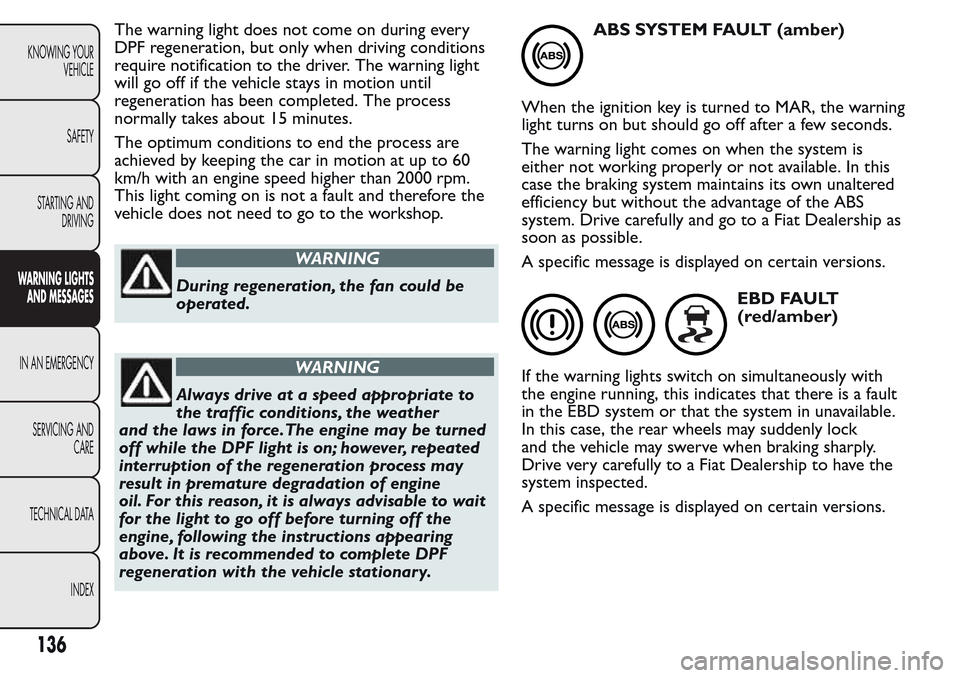
The warning light does not come on during every
DPF regeneration, but only when driving conditions
require notification to the driver. The warning light
will go off if the vehicle stays in motion until
regeneration has been completed. The process
normally takes about 15 minutes.
The optimum conditions to end the process are
achieved by keeping the car in motion at up to 60
km/h with an engine speed higher than 2000 rpm.
This light coming on is not a fault and therefore the
vehicle does not need to go to the workshop.
WARNING
During regeneration, the fan could be
operated.
WARNING
Always drive at a speed appropriate to
the traffic conditions, the weather
and the laws in force.The engine may be turned
off while the DPF light is on; however, repeated
interruption of the regeneration process may
result in premature degradation of engine
oil. For this reason, it is always advisable to wait
for the light to go off before turning off the
engine, following the instructions appearing
above. It is recommended to complete DPF
regeneration with the vehicle stationar y.
ABS SYSTEM FAULT (amber)
When the ignition key is turned to MAR, the warning
light turns on but should go off after a few seconds.
The warning light comes on when the system is
either not working properly or not available. In this
case the braking system maintains its own unaltered
efficiency but without the advantage of the ABS
system. Drive carefully and go to a Fiat Dealership as
soon as possible.
A specific message is displayed on certain versions.
EBD FAULT
(red/amber)
If the warning lights switch on simultaneously with
the engine running, this indicates that there is a fault
in the EBD system or that the system in unavailable.
In this case, the rear wheels may suddenly lock
and the vehicle may swerve when braking sharply.
Drive very carefully to a Fiat Dealership to have the
system inspected.
A specific message is displayed on certain versions.
136
KNOWING YOUR
VEHICLE
SAFETY
STARTING AND
DRIVING
WARNING LIGHTS
AND MESSAGES
IN AN EMERGENCY
SERVICING AND
CARE
TECHNICAL DATA
INDEX
Page 151 of 260
WARNING
This procedure must be performed by
experts because incorrect actions may
cause considerable electrical discharge.
Furthermore, battery fluid is poisonous and
corrosive: avoid contact with skin and eyes.
Keep naked flames and lit cigarettes away from
the battery. Do not create sparks.
BUMP STARTING
Never bump start the engine by pushing, towing or
driving downhill. This could cause fuel to flow into
the catalytic converter and damage it beyond repair.
IMPORTANT Remember that the brake booster
and the power steering system are not active until
the engine is started, so you will need to apply much
more force to the brake pedal or steering wheel.
CHANGING A WHEEL
The vehicle is originally equipped with the Fix&Go
automatic quick tyre repair kit (see instructions
in the next section). As an alternative, the vehicle
may have a normal-sized spare wheel.
Wheel changing and correct use of the jack and
spare wheel call for some precautions, as listed
below.
WARNING
The spare wheel (for versions/markets,
where provided) is specifically for your
vehicle.Therefore, it must not be used on other
models. Do not use spare wheels of other
models on your vehicle.The spare wheel must
be used only in an emergency. Use of the spare
wheel must be strictly reduced to the necessary
minimum.
147
KNOWING YOUR
VEHICLE
SAFETY
STARTING AND
DRIVING
WARNING LIGHTS
AND MESSAGES
IN AN
EMERGENCY
SERVICING AND
CARE
TECHNICAL DATA
INDEX
Page 152 of 260
WARNING
Use your hazard lights, warning triangle,
etc to show that your vehicle is
stationar y. Passengers should get out of the
vehicle, particularly if it is heavily loaded, and
wait for the wheel to be changed away from the
traffic . If you are on a slope or uneven surface,
place wedges or other suitable objects under
the wheels to secure the vehicle. Have the
wheel repaired and refitted as soon as possible.
Do not apply grease to the bolt threads before
fitting: they could come unscrewed.
WARNING
Use the jack only to replace wheels on
the vehicle with which it is supplied
or on other vehicles of the same model. Never
use the jack for other purposes, such as lifting
other models. Never use the jack to carr y out
repairs under the vehicle. Incorrect positioning
of the jack may cause the lifted vehicle to
fall. Do not use the jack for loads higher than
the one shown on its label.
WARNING
Incorrect hub cap assembly may cause it
to come off when the vehicle is moving.
Never tamper with the inflation valve. Never
introduce tools of any kind between rim and
tyre. Check tyre and space-saver wheel
pressures regularly, referring to the values
shown in the "Technical data" chapter.
Please note that:
the jack weight is 1.76 kg;
the jack requires no adjustment;
the jack cannot be repaired and in the event of a
fault it must be replaced by another genuine one;
no tool other than its cranking device may be
fitted on the jack.
To change a wheel, proceed as follows:
stop the vehicle in a position that is not dangerous
for oncoming traffic where you can change the
wheel safely. The ground must be flat and
sufficiently compact;
switch off the engine and pull the handbrake;
engage first gear or reverse;
wear the reflective safety jacket (compulsory by
law in certain countries) before getting out of
the vehicle;
148
KNOWING YOUR
VEHICLE
SAFETY
STARTING AND
DRIVING
WARNING LIGHTS
AND MESSAGES
IN AN
EMERGENCY
SERVICING AND
CARE
TECHNICAL DATA
INDEX
Page 153 of 260
indicate that the vehicle has broken down using
the devices required by the law in the current
country (e.g. warning triangle, hazard lights, etc.);
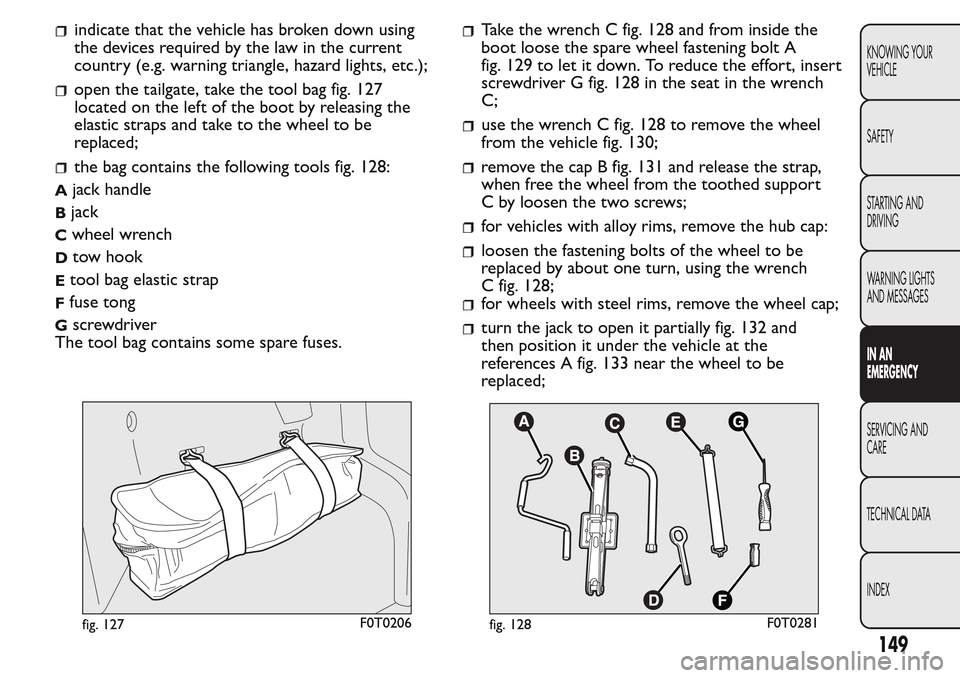
open the tailgate, take the tool bag fig. 127
located on the left of the boot by releasing the
elastic straps and take to the wheel to be
replaced;
the bag contains the following tools fig. 128:
Ajack handle
Bjack
Cwheel wrench
Dtow hook
Etool bag elastic strap
Ffuse tong
Gscrewdriver
The tool bag contains some spare fuses.
Take the wrench C fig. 128 and from inside the
boot loose the spare wheel fastening bolt A
fig. 129 to let it down. To reduce the effort, insert
screwdriver G fig. 128 in the seat in the wrench
C;
use the wrench C fig. 128 to remove the wheel
from the vehicle fig. 130;
remove the cap B fig. 131 and release the strap,
when free the wheel from the toothed support
C by loosen the two screws;
for vehicles with alloy rims, remove the hub cap:
loosen the fastening bolts of the wheel to be
replaced by about one turn, using the wrench
C fig. 128;
for wheels with steel rims, remove the wheel cap;
turn the jack to open it partially fig. 132 and
then position it under the vehicle at the
references A fig. 133 near the wheel to be
replaced;
fig. 127F0T0206fig. 128F0T0281
149
KNOWING YOUR
VEHICLE
SAFETY
STARTING AND
DRIVING
WARNING LIGHTS
AND MESSAGES
IN AN
EMERGENCY
SERVICING AND
CARE
TECHNICAL DATA
INDEX
Page 155 of 260
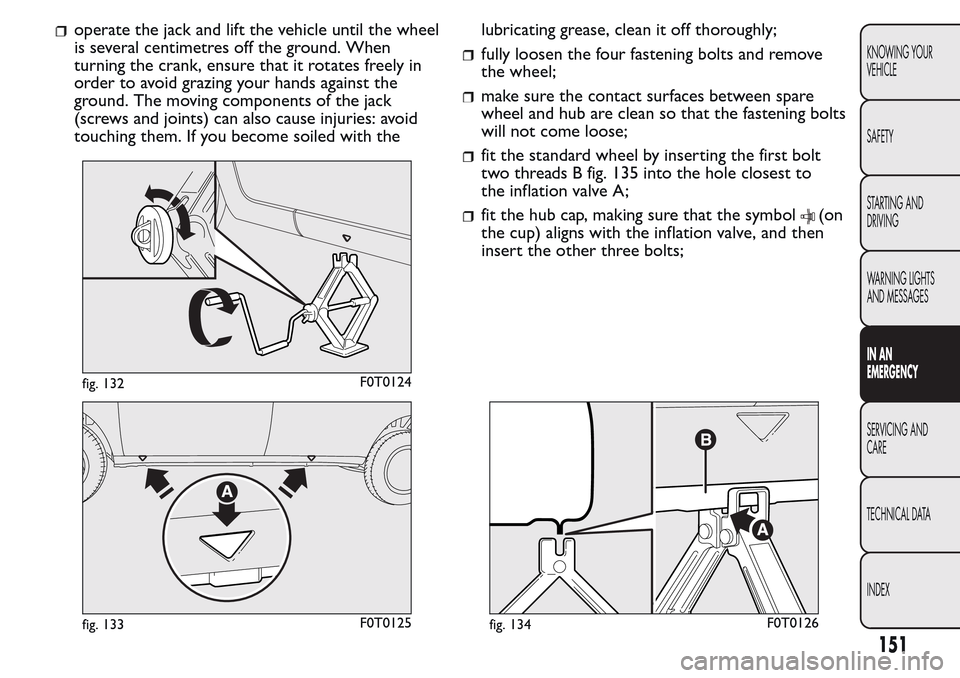
operate the jack and lift the vehicle until the wheel
is several centimetres off the ground. When
turning the crank, ensure that it rotates freely in
order to avoid grazing your hands against the
ground. The moving components of the jack
(screws and joints) can also cause injuries: avoid
touching them. If you become soiled with thelubricating grease, clean it off thoroughly;
fully loosen the four fastening bolts and remove
the wheel;
make sure the contact surfaces between spare
wheel and hub are clean so that the fastening bolts
will not come loose;
fit the standard wheel by inserting the first bolt
two threads B fig. 135 into the hole closest to
the inflation valve A;
fit the hub cap, making sure that the symbol(on
the cup) aligns with the inflation valve, and then
insert the other three bolts;
fig. 132F0T0124
fig. 133F0T0125fig. 134F0T0126
151
KNOWING YOUR
VEHICLE
SAFETY
STARTING AND
DRIVING
WARNING LIGHTS
AND MESSAGES
IN AN
EMERGENCY
SERVICING AND
CARE
TECHNICAL DATA
INDEX
Page 156 of 260
tighten the bolts using the spanner provided;
for vehicles with alloy rim, fit the hub cap;
turn the jack handle to lower the vehicle, and
remove the jack;
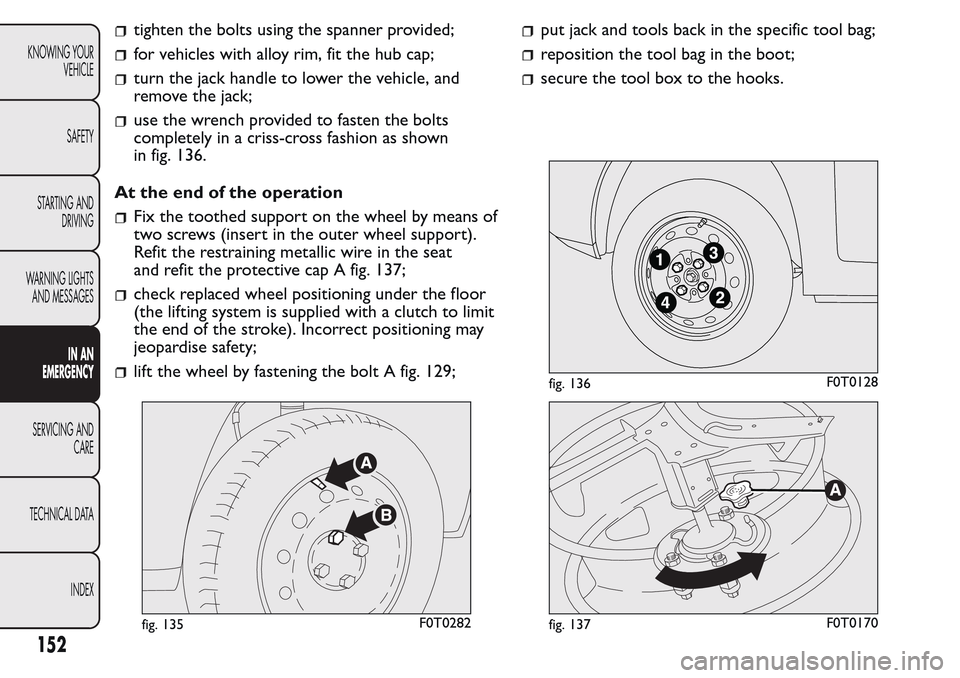
use the wrench provided to fasten the bolts
completely in a criss-cross fashion as shown
in fig. 136.
At the end of the operation
Fix the toothed support on the wheel by means of
two screws (insert in the outer wheel support).
Refit the restraining metallic wire in the seat
and refit the protective cap A fig. 137;
check replaced wheel positioning under the floor
(the lifting system is supplied with a clutch to limit
the end of the stroke). Incorrect positioning may
jeopardise safety;
lift the wheel by fastening the bolt A fig. 129;
put jack and tools back in the specific tool bag;
reposition the tool bag in the boot;
secure the tool box to the hooks.
fig. 135F0T0282
fig. 136F0T0128
fig. 137F0T0170
152
KNOWING YOUR
VEHICLE
SAFETY
STARTING AND
DRIVING
WARNING LIGHTS
AND MESSAGES
IN AN
EMERGENCY
SERVICING AND
CARE
TECHNICAL DATA
INDEX