wheel FIAT QUBO 2017 1.G User Guide
[x] Cancel search | Manufacturer: FIAT, Model Year: 2017, Model line: QUBO, Model: FIAT QUBO 2017 1.GPages: 260, PDF Size: 4.74 MB
Page 78 of 260
SYSTEM INTERVENTION
It is signalled by the blinking of the instrument panel
warning light
, to inform the driver that the car
is in critical stability and grip conditions.
Switching the system on
The ESC system is automatically activated when the
vehicle is started and cannot be deactivated.
Failure indications
In the event of a failure, the ESC system will be
automatically switched off and warning light
will
switch on constantly on the instrument panel along
with a message on the multifunction display (for
versions/markets where provided) (see chapter
"Warning lights and messages"). Contact a Fiat
Dealership as soon as possible.
WARNING
The ESC system can’t overrule the
natural laws of physics, and can’t
increase the grip available according to the
condition of the road.
WARNING
The ESC system cannot prevent
accidents, including those due to
excessive speed on corners, driving on low-grip
surfaces or aquaplaning.
WARNING
The capability of the ESC system must
never be tested irresponsibly and
dangerously, in such a way as to compromise
personal safety and the safety of others.
HILL HOLDER SYSTEM
(for versions/markets, where provided)
This system is an integral part of the ESC system and
facilitates starting on slopes.
It is automatically activated in the following
conditions:
uphill: vehicle stationary on a road with a gradient
higher than 5%, engine running, brake pedal
pressed and gearbox in neutral or gear other than
reverse;
downhill: vehicle stationary on a road with a
gradient higher than 5%, engine running, brake
pedal pressed and reverse gear engaged.
When setting off, the ESC system control unit
maintains the braking pressure on the wheels until
the torque necessary for starting is reached, or
in any case for a maximum of 2 seconds, allowing
your right foot to be moved easily from the brake
pedal to the accelerator. When two seconds have
elapsed, without starting, the system is automatically
deactivated, gradually releasing the braking pressure.
During this release stage, the typical brake
disengagement noise indicating that the vehicle is
going to move imminently will be heard.
74
KNOWING YOUR
VEHICLE
SAFETY
STARTING AND
DRIVING
WARNING LIGHTS
AND MESSAGES
IN AN EMERGENCY
SERVICING AND
CARE
TECHNICAL DATA
INDEX
Page 79 of 260
Failure indications
Instrument panel warning light
will light up in the
event of a failure (see “Warning lights and
messages”).
IMPORTANT The Hill Holder system is not a parking
brake; therefore, never leave the vehicle without
having engaged the handbrake, turned the engine off
and engaged the first gear.
WARNING
For the ESC and ASR systems to function
correctly, all four tyres must be the
same brand and type, must be in excellent
condition and, above all, must be of the
prescribed type and size.
ASR SYSTEM (Anti-Slip Regulation)
(for versions/markets, where provided)
This is a traction control system that cuts in
automatically every time one or both drive wheels
slip.
Depending on how slippery the road is, two different
control systems are activated:
if slipping involves both driving wheels, the ASR
function intervenes reducing the power
transmitted by the engine;
if the slipping only involves one of the drive
wheels, the ASR intervenes automatically braking
the wheel that is slipping.
The action of the ASR system is especially useful in
the following conditions:
slipping of the inner wheel round bends due to
dynamic variations in the load of excessive
acceleration;
excessive power transmitted to the wheels, also in
relation to road surface conditions;
acceleration on slippery, snowy or icy road
surfaces;
in the case of loss of grip on a wet surface
(aquaplaning).
WARNING
For the ESC and ASR systems to function
correctly, all four tyres must be the
same brand and type, must be in excellent
condition and, above all, must be of the
prescribed type and size.
WARNING
The ASR system cannot overrule the
natural laws of physics, and cannot
increase the grip available according to the
condition of the road.
75
KNOWING YOUR
VEHICLE
SAFETY
STARTING AND
DRIVING
WARNING LIGHTS
AND MESSAGES
IN AN EMERGENCY
SERVICING AND
CARE
TECHNICAL DATA
INDEX
Page 80 of 260
WARNING
The ASR system cannot prevent
accidents, including those due to
excessive speed on corners, driving on low-grip
surfaces or aquaplaning.
WARNING
The capability of the ASR system must
never be tested irresponsibly and
dangerously, in such a way as to compromise
personal safety and the safety of others.
MSR SYSTEM (engine drive regulation)
This is an integral part of the ESC system that, in the
event of a sudden gear down shift or an ABS braking,
cuts in and provides torque to the engine thus
preventing excessive driving wheel drive which,
especially in poor grip conditions, can lead to a loss
of stability.Engagement/ disengagement of the ASR
system
The ASR system switches on automatically each time
the engine is started.
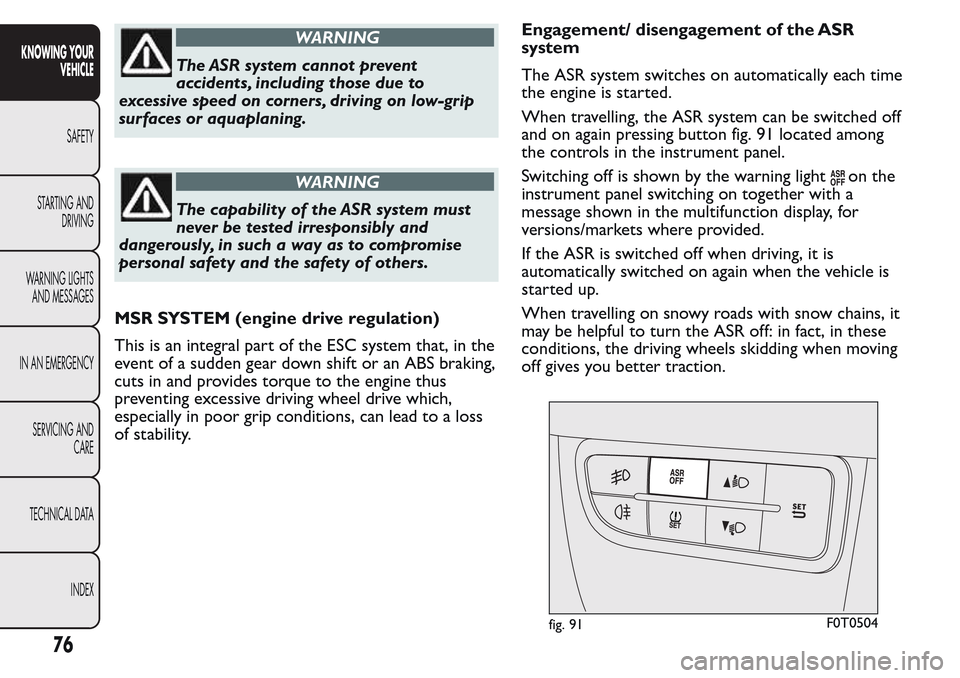
When travelling, the ASR system can be switched off
and on again pressing button fig. 91 located among
the controls in the instrument panel.
Switching off is shown by the warning light
on the
instrument panel switching on together with a
message shown in the multifunction display, for
versions/markets where provided.
If the ASR is switched off when driving, it is
automatically switched on again when the vehicle is
started up.
When travelling on snowy roads with snow chains, it
may be helpful to turn the ASR off: in fact, in these
conditions, the driving wheels skidding when moving
off gives you better traction.
fig. 91F0T0504
76
KNOWING YOUR
VEHICLE
SAFETY
STARTING AND
DRIVING
WARNING LIGHTS
AND MESSAGES
IN AN EMERGENCY
SERVICING AND
CARE
TECHNICAL DATA
INDEX
Page 82 of 260
iTPMS System (indirect Tyre
Pressure Monitoring System)
(for versions/markets, where provided)
The indirect Tyre Pressure Monitoring System iTPMS
can monitor the tyre inflation status through the
wheel speed sensors. The system warns the driver if
one or more tyres are flat by switching on the
warning light on the instrument panel and
a warning message on the display, along with an
acoustic signal.
If one tyre only is flat, the system can indicate its
position: it is in any case recommended to check the
pressure on all four tyres. This indication is displayed
also when turning the engine off and on until the
“Reset” procedure is carried out.
“Reset” procedure
The iTPMS needs an initial "self-learning" phase (with
length depending on the driving style and road
conditions: optimal conditions being driving on a
straight road at 80 km/h for at least 20 minutes)
which starts when the “Reset” procedure is carried
out.
The “Reset” procedure must be carried out:
each time tyre pressure is modified;
when even only one tyre is changed;
when tyres are rotated/inverted;
when the space-saver wheel is fitted. Before
carrying out the “Reset” procedure, inflate the
tyres to the rated pressure values specified in the
inflation pressure table (see "Wheels" paragraph in
the "Technical specifications" chapter).
If the “Reset” procedure is not carried out, in all
above cases, the
warning light may give false
indications on one or more tyres.
To carry out the “Reset” procedure, with the vehicle
stopped and the ignition device at MAR, use the
Setup Menu as follows:
briefly press thebutton: the display will show
"Reset";
press thebutton or thebutton to select
("Yes" or "No");
briefly press thebutton: the display will show
"Confirm";
pressbutton orto select ("Yes" to
“Reset” or "No" to exit the video page);
press thebutton again to return to the standard
screen or to the main menu according to where
you are in the menu.
After the “Reset” the display will show the "Reset
saved" message, indicating that the "self-learning" has
been started.
78
KNOWING YOUR
VEHICLE
SAFETY
STARTING AND
DRIVING
WARNING LIGHTS
AND MESSAGES
IN AN EMERGENCY
SERVICING AND
CARE
TECHNICAL DATA
INDEX
Page 83 of 260
Operating conditions
The system is active for speeds above 15 km/h. In a
few situations such as sporty driving, particular
conditions of the road surface (e.g. icy, snowy,
unsurfaced roads...) the signalling may be delayed or
partial in detecting the contemporary deflation of
more than one tyre. Under special conditions (e.g.
vehicle loaded asymmetrically on one side, towing
a trailer, damaged or worn tyre, fitting the
space-saver wheel, use of the "Fix&Go Automatic"
kit, fitting snow chains, fitting different tyres on
the axles) the system may give false indications or be
temporarily deactivated.
If the system is temporarily deactivated, the warning
light
flashes for about 75 seconds and then is
continuously on; at the same time, the display shows
a dedicated message. This indication is displayed
also after the engine has been switched off and then
on again if the correct operating conditions are
not restored.
WARNING
The system is an aid for the driver, who
must always pay full attention while
driving.The responsibility always rests with the
driver, who must take into account the traffic
conditions in order to drive in complete safety.
The driver must always maintain a safe distance
from the vehicle in front .
WARNING
If the driver depresses the brake pedal
fully or carries out a fast steering during
system operation, the automatic braking
function may stop (e.g. to allow a possible
manoeuvre to avoid the obstacle).
WARNING
The laser beam is not visible at the
naked eye. Do not look directly, or with
optical instruments (e.g. lenses), at the laser
beam from a distance lower than 10 cm: this
may cause damage to the sight .The laser beam
is also present when the key is at MAR but its
operation is off, not available or manually
deactivated with the display Setup Menu.
WARNING
The system intervenes on vehicles
travelling in the same lane. Small sized
vehicles (e.g. bicycles or motorbikes) or people,
animals and things (e.g. pushchairs) and more in
general all those obstacles with a low reflection
of the light emitted by the laser (e.g. vehicles
soiled with mud) are not taken into
consideration.
79
KNOWING YOUR
VEHICLE
SAFETY
STARTING AND
DRIVING
WARNING LIGHTS
AND MESSAGES
IN AN EMERGENCY
SERVICING AND
CARE
TECHNICAL DATA
INDEX
Page 85 of 260
Do not cover the operating range of the
sensor with stickers or other objects.
Also pay attention to other objects on the
bonnet (e.g. a layer of snow) and make sure they
do not interfere with the light emitted by the
laser.
If a trailer or a vehicle is towed the system
must be deactivated with the display
Setup Menu.
If the system signals a loss of pressure on
a specific tyre, it is recommended to
check the pressure on all four tyres.
TRACTION PLUS SYSTEM
(for versions/markets, where provided)
Traction Plus is a driving aid, useful for setting off in
poor grip conditions (snow, ice, mud, etc.) which
allows the drive force to be distributed in the best
way over the front axle when one wheel is slipping.
In effect, Traction Plus acts by braking the wheels
with poor grip (or those slipping more than the
others), thereby transferring the drive force to those
which have more grip on the ground.
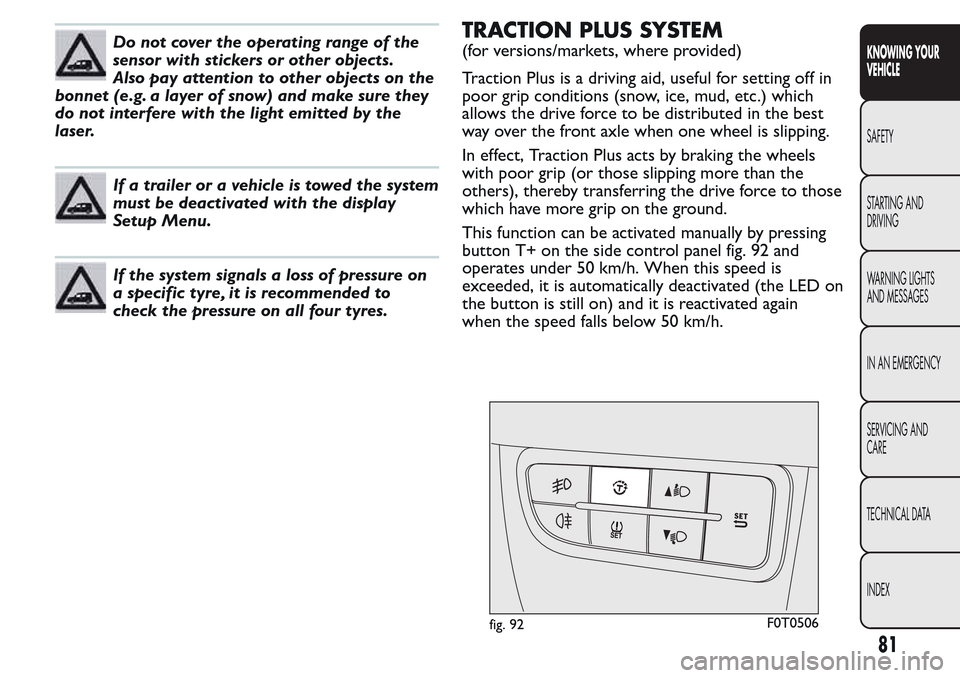
This function can be activated manually by pressing
button T+ on the side control panel fig. 92 and
operates under 50 km/h. When this speed is
exceeded, it is automatically deactivated (the LED on
the button is still on) and it is reactivated again
when the speed falls below 50 km/h.
fig. 92F0T0506
81
KNOWING YOUR
VEHICLE
SAFETY
STARTING AND
DRIVING
WARNING LIGHTS
AND MESSAGES
IN AN EMERGENCY
SERVICING AND
CARE
TECHNICAL DATA
INDEX
Page 105 of 260
Operations which lead to knocks,
vibrations or localised heating (over 100°C
for a maximum of 6 hours) in the area
around the pretensioner may cause damage or
trigger them.This device is not affected by
vibrations caused by irregularities of the road
surface or low obstacles such as kerbs, etc .
Contact a Fiat Dealership for any assistance.
LOAD LIMITERS
(for versions/markets, where provided)
To increase occupant safety in an accident, the front
and rear (for versions/markets where provided)
seat belt reels contain a load limiter which controls
the force acting on the chest and shoulders during
the restraining action of the belts in the event of
a head-on collision.
GENERAL INSTRUCTIONS FOR USING
THE SEAT BELTS
The driver is responsible for respecting, and ensuring
that all the other occupants of the vehicle also
respect, the local laws in force in relation to the use
of the seat belts. Always fasten the seat belts before
setting off.
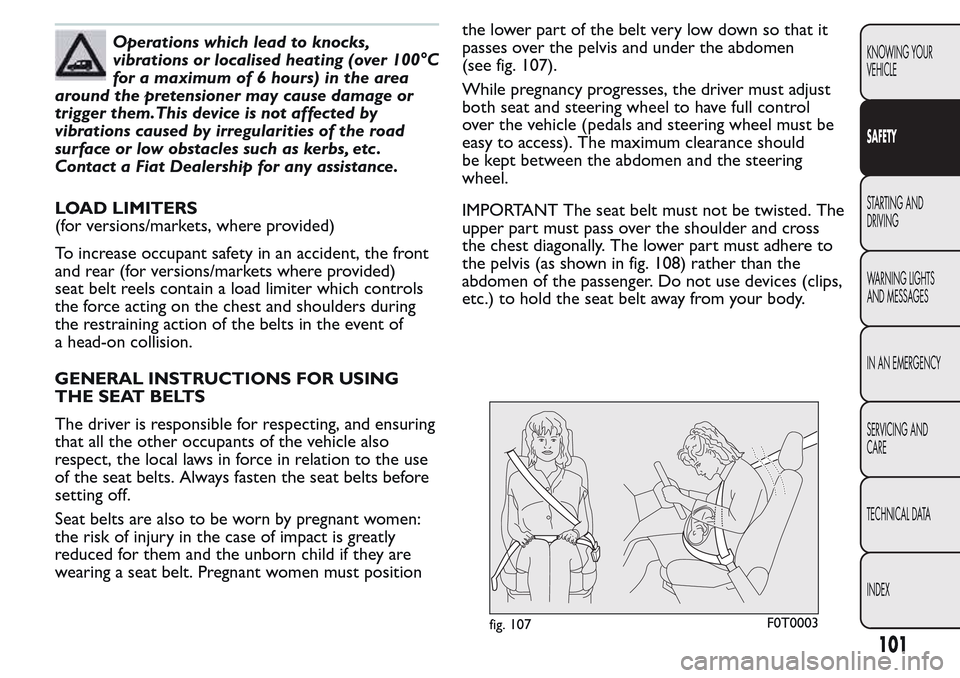
Seat belts are also to be worn by pregnant women:
the risk of injury in the case of impact is greatly
reduced for them and the unborn child if they are
wearing a seat belt. Pregnant women must positionthe lower part of the belt very low down so that it
passes over the pelvis and under the abdomen
(see fig. 107).
While pregnancy progresses, the driver must adjust
both seat and steering wheel to have full control
over the vehicle (pedals and steering wheel must be
easy to access). The maximum clearance should
be kept between the abdomen and the steering
wheel.
IMPORTANT The seat belt must not be twisted. The
upper part must pass over the shoulder and cross
the chest diagonally. The lower part must adhere to
the pelvis (as shown in fig. 108) rather than the
abdomen of the passenger. Do not use devices (clips,
etc.) to hold the seat belt away from your body.
fig. 107F0T0003
101
KNOWING YOUR
VEHICLE
SAFETY
STARTING AND
DRIVING
WARNING LIGHTS
AND MESSAGES
IN AN EMERGENCY
SERVICING AND
CARE
TECHNICAL DATA
INDEX
Page 117 of 260
SUPPLEMENTARY RESTRAINT
SYSTEM (SRS) - AIRBAG
The vehicle may be equipped with:
front driver airbag;
front passenger airbag;
driver and passenger front side bags for pelvis,
chest and shoulder protection (Side bags).
The location of the airbags on the vehicle is marked
by the word "AIRBAG" in the middle of the steering
wheel, on the dashboard, on the side trim or on a
label placed next to the airbag deployment area.
FRONT AIRBAGS
The vehicle is fitted with front airbags for driver and
passenger (for versions/markets where provided).
The front driver/passenger airbags (for versions/
markets, where provided) are designed to protect
the front-seat occupants in the event of head-on
crashes of medium-high severity, by placing the bag
between the occupant and the steering wheel or
dashboard.
Therefore, non-activation in other types of collisions
(side collisions, rear shunts, roll-overs, etc.) is not
a system malfunction.
An electronic control unit will make the bag inflate in
the event of a frontal impact.
The bag will inflate instantaneously placing itself
between the front occupants body and the
structures which could cause injury. It will deflate
immediately afterwards.
Front driver/passenger airbags (for versions/markets,
where provided) are not a replacement for, but
rather a complement to, the seat belts, which should
be worn at all times as specified by law in Europe
and most non-European countries.
In the event of an impact, someone not wearing a
seat belt will move forward and come into contact
with the bag which is still in the opening stage.
The protection offered by the bag is compromised in
these circumstances.
Front airbags may not activate in the following
situations:
113
KNOWING YOUR
VEHICLE
SAFETY
STARTING AND
DRIVING
WARNING LIGHTS
AND MESSAGES
IN AN EMERGENCY
SERVICING AND
CARE
TECHNICAL DATA
INDEX
Page 118 of 260
frontal impacts against highly deformable objects
not involving the front surface of the vehicle (e.g.
wing collision against guard rail, etc.);
vehicle wedging under other vehicles or protective
barriers (e.g. trucks or guard rails);
Failure to activate in the conditions described above
is due to the fact that they may not provide any
additional protection compared with seat belts, so
their activation would be inappropriate. In these
cases, non-deployment does not indicate a system
malfunction.
WARNING
Do not apply stickers or other objects to
the steering wheel, the dashboard in
the passenger side airbag area and the seats.
Never put objects (e.g. mobile phones) on the
passenger side of the dashboard since they
could interfere with correct inflation of the
passenger airbag and also cause serious injur y
to the passengers.
The driver's and passenger's front airbags have been
designed and calibrated to protect front seat
occupants wearing seat belts. At their maximum
inflation, their volume fills most of the space
between the steering wheel and the driver and
between the dashboard and the passenger.
The airbags are not deployed in the event of minor
frontal impacts (for which the restraining actionof the seat belts is sufficient). Seat belts must always
be worn. In the event of frontal impacts they
guarantee correct positioning of the passenger.
FRONT AIRBAG DRIVER'S SIDE
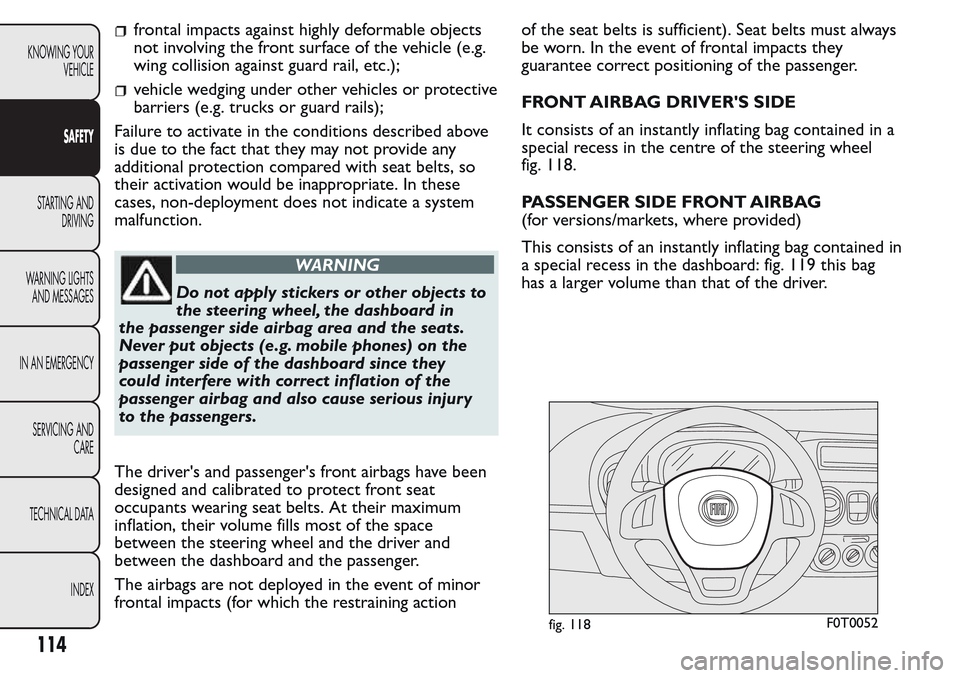
It consists of an instantly inflating bag contained in a
special recess in the centre of the steering wheel
fig. 118.
PASSENGER SIDE FRONT AIRBAG
(for versions/markets, where provided)
This consists of an instantly inflating bag contained in
a special recess in the dashboard: fig. 119 this bag
has a larger volume than that of the driver.
fig. 118F0T0052
114
KNOWING YOUR
VEHICLE
SAFETY
STARTING AND
DRIVING
WARNING LIGHTS
AND MESSAGES
IN AN EMERGENCY
SERVICING AND
CARE
TECHNICAL DATA
INDEX
Page 123 of 260
IMPORTANT NOTES
The front airbags and/or side bags (for versions/
markets, where provided) may be deployed if the
vehicle is subject to heavy knocks or accidents
involving the underbody area, such as for example
violent shocks against steps, kerbs or low obstacles,
or the vehicle falling into big potholes or depressions
in the road.
A small amount of dust will be released when the
airbags are deployed. The dust is not harmful and
does not indicate the beginning of a fire.
Furthermore, the surface of the deployed bag and
the interior of the vehicle may be covered in a dusty
residue: this may irritate your skin and eyes. Wash
with mild soap and water in the event of exposure.
Should an accident occur in which any of the safety
devices are activated, take the vehicle to a Fiat
Dealership to have the activated devices replaced and
to have the whole system checked.
Every control, repair and replacement operation
concerning the airbags must be carried out only at
Fiat Dealerships.
If you are having the vehicle scrapped, have the airbag
system deactivated at a Fiat Dealership first. If the
vehicle changes ownership, the new owner must be
informed of the method of use of airbags and the
above warnings and also be given this "Owner's
Handbook".
Pretensioners, front airbags and front side bags are
deployed differently according to the type ofcollision. Failure to activate one or more of the
devices does not indicate a system malfunction.
WARNING
There may be a fault in the retaining
systems if the warning light
does not
light up when the key is turn on or remains on
while travelling (on some versions with a
message on the display). In this case, the airbags
or the pretensioners may not be activated in
the case of an accident or (in a lesser number of
cases) they may be activated incorrectly.
Contact a Fiat Dealership immediately to have
the system checked.
WARNING
Always drive with your hands on the rim
of the steering wheel so that the airbag
can inflate freely if required. Do not drive with
your body bent forward. Keep your back
straight against the backrest .
WARNING
In some versions, in case of a LED
failure (located on the plate of the
instrument panel), the
warning light on the
instrument panel turns on and the passenger
side airbags are deactivated.
119
KNOWING YOUR
VEHICLE
SAFETY
STARTING AND
DRIVING
WARNING LIGHTS
AND MESSAGES
IN AN EMERGENCY
SERVICING AND
CARE
TECHNICAL DATA
INDEX