weight FIAT SCUDO 2016 Owner handbook (in English)
[x] Cancel search | Manufacturer: FIAT, Model Year: 2016, Model line: SCUDO, Model: FIAT SCUDO 2016Pages: 227, PDF Size: 4.46 MB
Page 83 of 227
79
SAFETY
DEVICESCORRECT USE
OF THE VEHICLE WARNING
LIGHTS AND
MESSAGESIN AN
EMERGENCYVEHICLE
MAINTENANCETECHNICAL
SPECIFICATIONSINDEX DASHBOARD
AND CONTROLS
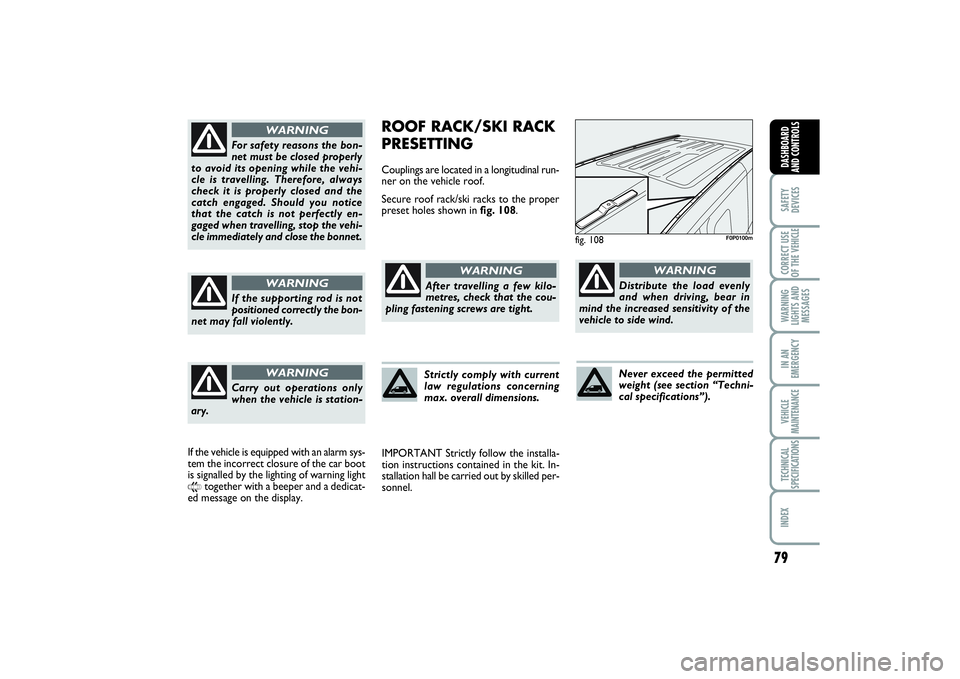
ROOF RACK/SKI RACK
PRESETTINGCouplings are located in a longitudinal run-
ner on the vehicle roof.
Secure roof rack/ski racks to the proper
preset holes shown in fig. 108.
IMPORTANT Strictly follow the installa-
tion instructions contained in the kit. In-
stallation hall be carried out by skilled per-
sonnel.
fig. 108
F0P0100m
After travelling a few kilo-
metres, check that the cou-
pling fastening screws are tight.
WARNING
Strictly comply with current
law regulations concerning
max. overall dimensions.
Distribute the load evenly
and when driving, bear in
mind the increased sensitivity of the
vehicle to side wind.
WARNING
Never exceed the permitted
weight (see section “Techni-
cal specifications”).
For safety reasons the bon-
net must be closed properly
to avoid its opening while the vehi-
cle is travelling. Therefore, always
check it is properly closed and the
catch engaged. Should you notice
that the catch is not perfectly en-
gaged when travelling, stop the vehi-
cle immediately and close the bonnet.
WARNING
If the supporting rod is not
positioned correctly the bon-
net may fall violently.
WARNING
Carry out operations only
when the vehicle is station-
ary.
WARNING
If the vehicle is equipped with an alarm sys-
tem the incorrect closure of the car boot
is signalled by the lighting of warning light9
together with a beeper and a dedicat-
ed message on the display.
020-082 SCUDO LUM GB 19/11/13 09.54 Pagina 79
Page 85 of 227
81
SAFETY
DEVICESCORRECT USE
OF THE VEHICLE WARNING
LIGHTS AND
MESSAGESIN AN
EMERGENCYVEHICLE
MAINTENANCETECHNICAL
SPECIFICATIONSINDEX DASHBOARD
AND CONTROLS
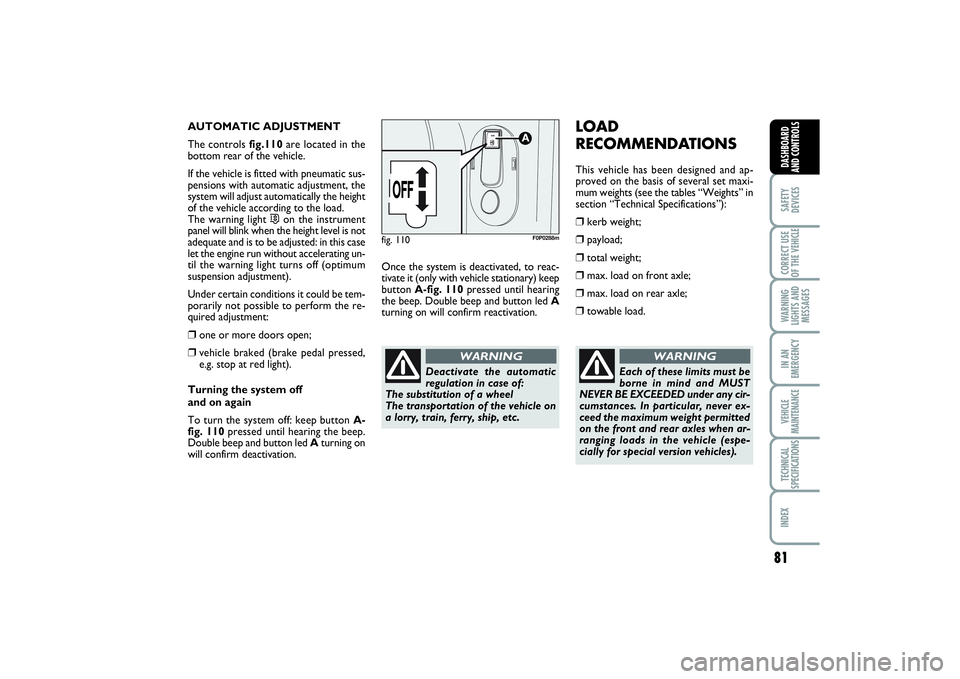
AUTOMATIC ADJUSTMENT
The controls fig.110are located in the
bottom rear of the vehicle.
If the vehicle is fitted with pneumatic sus-
pensions with automatic adjustment, the
system will adjust automatically the height
of the vehicle according to the load.
The warning light
…
on the instrument
panel will blink when the height level is not
adequate and is to be adjusted: in this case
let the engine run without accelerating un-
til the warning light turns off (optimum
suspension adjustment).
Under certain conditions it could be tem-
porarily not possible to perform the re-
quired adjustment:
❒
one or more doors open;
❒
vehicle braked (brake pedal pressed,
e.g. stop at red light).
Turning the system off
and on again
To turn the system off: keep button A-
fig. 110pressed until hearing the beep.
Double beep and button led Aturning on
will confirm deactivation.Once the system is deactivated, to reac-
tivate it (only with vehicle stationary) keep
button A-fig. 110pressed until hearing
the beep. Double beep and button led A
turning on will confirm reactivation.
fig. 110
F0P0288m
LOAD
RECOMMENDATIONSThis vehicle has been designed and ap-
proved on the basis of several set maxi-
mum weights (see the tables “Weights” in
section “Technical Specifications”):❒
kerb weight;
❒
payload;
❒
total weight;
❒
max. load on front axle;
❒
max. load on rear axle;
❒
towable load.
Each of these limits must be
borne in mind and MUST
NEVER BE EXCEEDED under any cir-
cumstances. In particular, never ex-
ceed the maximum weight permitted
on the front and rear axles when ar-
ranging loads in the vehicle (espe-
cially for special version vehicles).
WARNING
Deactivate the automatic
regulation in case of:
The substitution of a wheel
The transportation of the vehicle on
a lorry, train, ferry, ship, etc.
WARNING
020-082 SCUDO LUM GB 19/11/13 09.54 Pagina 81
Page 86 of 227
82SAFETY
DEVICESCORRECT USE
OF THE VEHICLE
WARNING
LIGHTS AND
MESSAGESIN AN
EMERGENCYVEHICLE
MAINTENANCETECHNICAL
SPECIFICATIONSINDEX
DASHBOARD
AND
CONTROLS
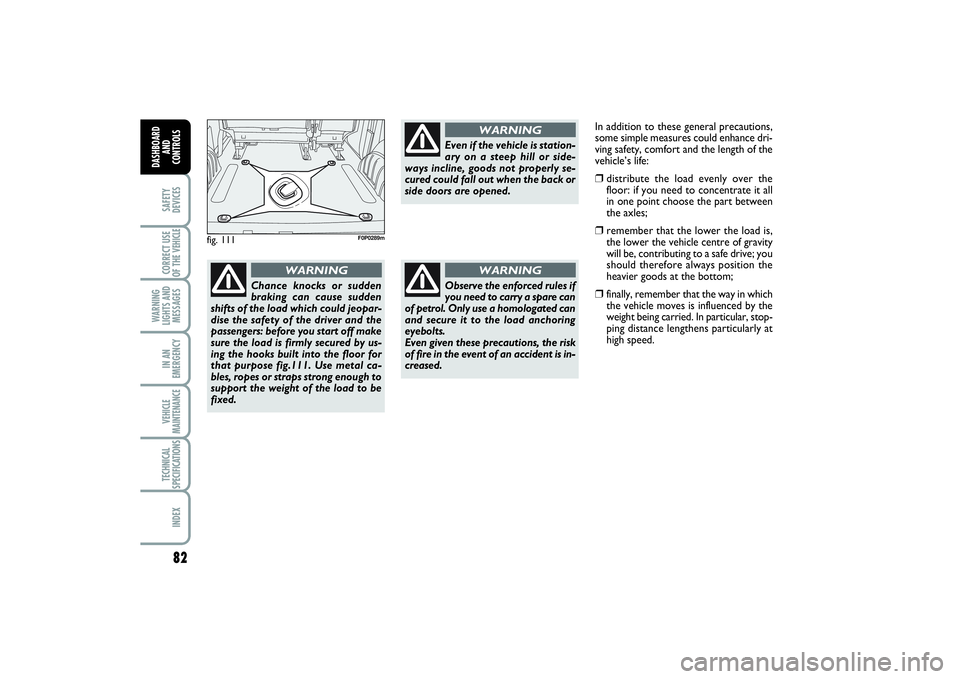
fig. 111
F0P0289m
Chance knocks or sudden
braking can cause sudden
shifts of the load which could jeopar-
dise the safety of the driver and the
passengers: before you start off make
sure the load is firmly secured by us-
ing the hooks built into the floor for
that purpose fig.111. Use metal ca-
bles, ropes or straps strong enough to
support the weight of the load to be
fixed.
WARNING
Even if the vehicle is station-
ary on a steep hill or side-
ways incline, goods not properly se-
cured could fall out when the back or
side doors are opened.
WARNING
Observe the enforced rules if
you need to carry a spare can
of petrol. Only use a homologated can
and secure it to the load anchoring
eyebolts.
Even given these precautions, the risk
of fire in the event of an accident is in-
creased.
WARNING
In addition to these general precautions,
some simple measures could enhance dri-
ving safety, comfort and the length of the
vehicle’s life:❒
distribute the load evenly over the
floor: if you need to concentrate it all
in one point choose the part between
the axles;
❒
remember that the lower the load is,
the lower the vehicle centre of gravity
will be, contributing to a safe drive; you
should therefore always position the
heavier goods at the bottom;
❒
finally, remember that the way in which
the vehicle moves is influenced by the
weight being carried. In particular, stop-
ping distance lengthens particularly at
high speed.
020-082 SCUDO LUM GB 19/11/13 09.54 Pagina 82
Page 107 of 227
103
CORRECT USE
OF THE VEHICLEWARNING
LIGHTS AND
MESSAGESIN AN
EMERGENCYVEHICLE
MAINTENANCETECHNICAL
SPECIFICATIONSINDEXDASHBOARD
AND CONTROLSSAFETY
DEVICES
For optimal protection in the event of an
impact, all occupants must be seated and
wearing adequate restraint systems, in-
cluding infants and other children. This pre-
scription is compulsory in all EC countries
according to EC Directive 2003/20/EC.
Compared with an adult, a child’s head is
larger and heavier in proportion to his/her
body and the child’s muscular and bone
structures are not fully developed. There-
fore, correct restraint systems other than
adult seat belts are necessary to reduce as
much as possible the risk of injuries in case
of accident, braking or sudden manoeu-
vre.
Children must be seated safely and com-
fortably. As far as the characteristics of the
child restraint systems used, you are ad-
vised to keep children in rearward facing
restraint systems for as long as possible;
this is the most protected position in the
event of an impact.
The choice of the most suitable child re-
straint system depends on the weight of
the child; there are various types of child
restraint systems and you are advised al-
ways to choose the one that is most suit-
able for the child. When over 1.50 m in height, from the
point of view of restraint systems, children
are considered as adults and wear seat
belts normally.
In Europe the characteristics of child re-
straint systems are ruled by regulation
ECE-R44, making them compulsory and
dividing them into five weight groups:
Group 0 up to 10 kg
Group 0+ up to 13 kg
Group 1 9-18 kg
Group 2 15-25 kg
Group 3 22-36 kg
All child restraint systems must bear the
type-approval data along with the control
mark on a label firmly secured to the child
restraint system which must never be re-
moved. Lineaccessori Fiat offers child re-
straint systems for each weight group.
These devices are recommended having
been specifically designed and tested for
Fiat cars.CARRYING CHILDREN SAFELY
A label with the dedicated
symbol indicating that it is
mandatory to deactivate the airbag
for rearward facing child restraint sys-
tems is applied on the sun visor. Al-
ways comply with the instructions on
the sun visor (see the “Airbag” section
in this paragraph).
WARNING
097-118 SCUDO LUM GB 02/04/14 10:40 Pagina 103
Page 108 of 227
104CORRECT USE
OF THE VEHICLE
WARNING
LIGHTS AND
MESSAGESIN AN
EMERGENCYVEHICLE
MAINTENANCETECHNICAL
SPECIFICATIONSIINDEXDASHBOARD
AND CONTROLSSAFETY
DEVICES
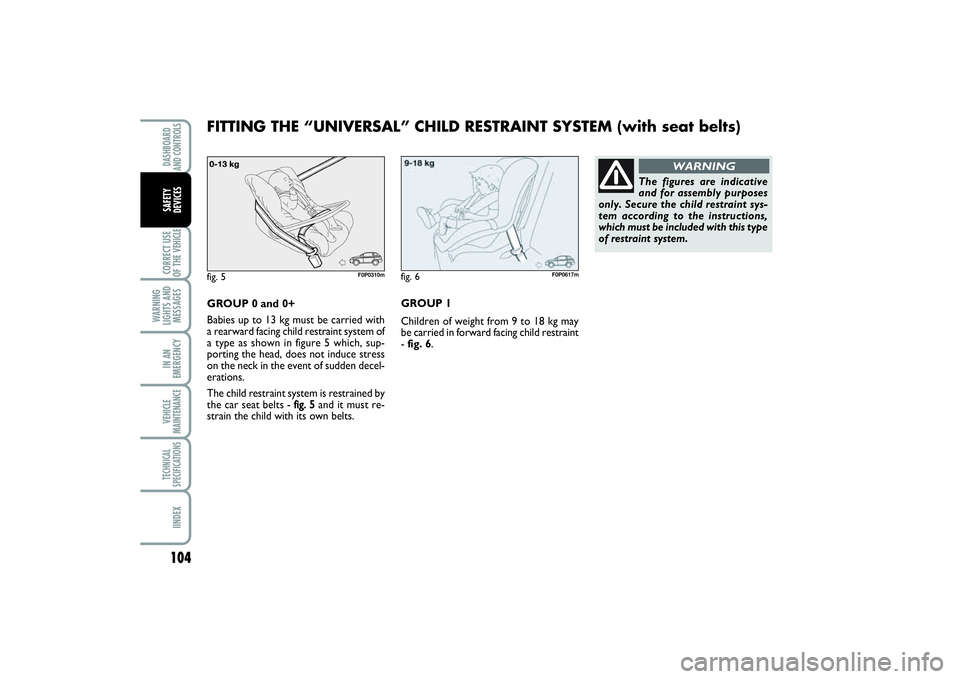
GROUP 0 and 0+
Babies up to 13 kg must be carried with
a rearward facing child restraint system of
a type as shown in figure 5 which, sup-
porting the head, does not induce stress
on the neck in the event of sudden decel-
erations.
The child restraint system is restrained by
the car seat belts - f
fig. 5
and it must re-
strain the child with its own belts.
fig. 5
F0P0310m
The figures are indicative
and for assembly purposes
only. Secure the child restraint sys-
tem according to the instructions,
which must be included with this type
of restraint system.
WARNING
fig. 6
F0P0617m
GROUP 1
Children of weight from 9 to 18 kg may
be carried in forward facing child restraint
- fig. 6.
FITTING THE “UNIVERSAL” CHILD RESTRAINT SYSTEM (with seat belts)
097-118 SCUDO LUM GB 02/04/14 10:40 Pagina 104
Page 110 of 227
106CORRECT USE
OF THE VEHICLE
WARNING
LIGHTS AND
MESSAGESIN AN
EMERGENCYVEHICLE
MAINTENANCETECHNICAL
SPECIFICATIONSIINDEXDASHBOARD
AND CONTROLSSAFETY
DEVICES
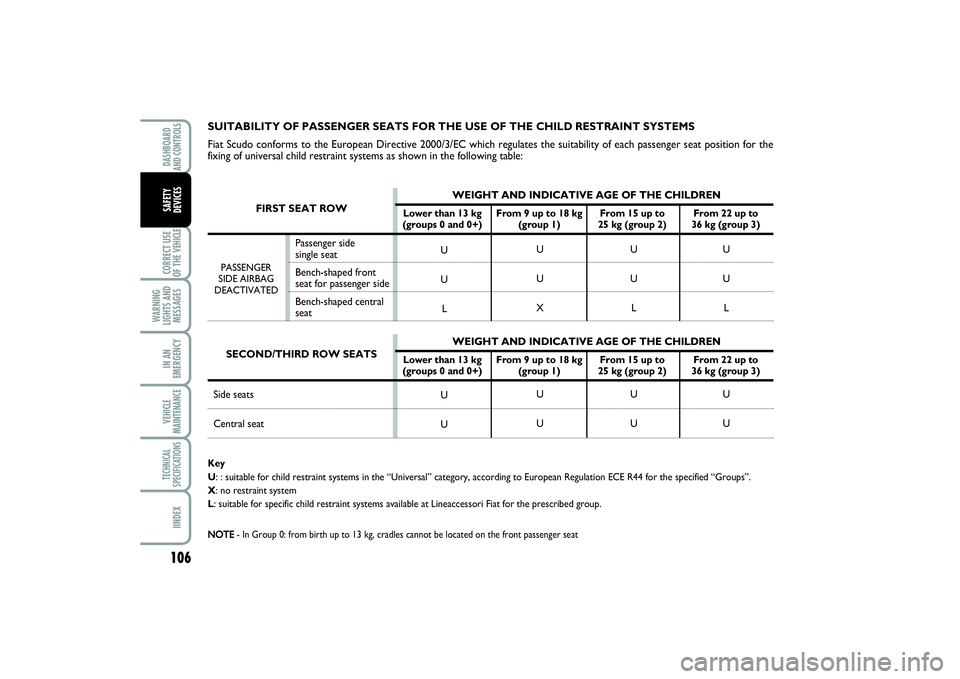
SUITABILITY OF PASSENGER SEATS FOR THE USE OF THE CHILD RESTRAINT SYSTEMS
Fiat Scudo conforms to the European Directive 2000/3/EC which regulates the suitability of each passenger seat position for the
fixing of universal child restraint systems as shown in the following table:Key
U: : suitable for child restraint systems in the “Universal” category, according to European Regulation ECE R44 for the specified “Groups”.
X: no restraint system
L: suitable for specific child restraint systems available at Lineaccessori Fiat for the prescribed group. NOTE
- In Group 0: from birth up to 13 kg, cradles cannot be located on the front passenger seat
U
U
L
U
UU
U
X
U
UU
U
L
U
UU
U
L
U
U
FIRST SEAT ROW
Side seats
Central seat
WEIGHT AND INDICATIVE AGE OF THE CHILDREN
Lower than 13 kg From 9 up to 18 kg From 15 up to From 22 up to (groups 0 and 0+) (group 1) 25 kg (group 2) 36 kg (group 3)
WEIGHT AND INDICATIVE AGE OF THE CHILDREN
Lower than 13 kg From 9 up to 18 kg From 15 up to From 22 up to (groups 0 and 0+) (group 1) 25 kg (group 2) 36 kg (group 3)
Passenger side
single seat
Bench-shaped front
seat for passenger side
Bench-shaped central
seat
SECOND/THIRD ROW SEATSPASSENGER
SIDE AIRBAG
DEACTIVATED
097-118 SCUDO LUM GB 02/04/14 10:40 Pagina 106
Page 111 of 227
107
CORRECT USE
OF THE VEHICLEWARNING
LIGHTS AND
MESSAGESIN AN
EMERGENCYVEHICLE
MAINTENANCETECHNICAL
SPECIFICATIONSINDEXDASHBOARD
AND CONTROLSSAFETY
DEVICES
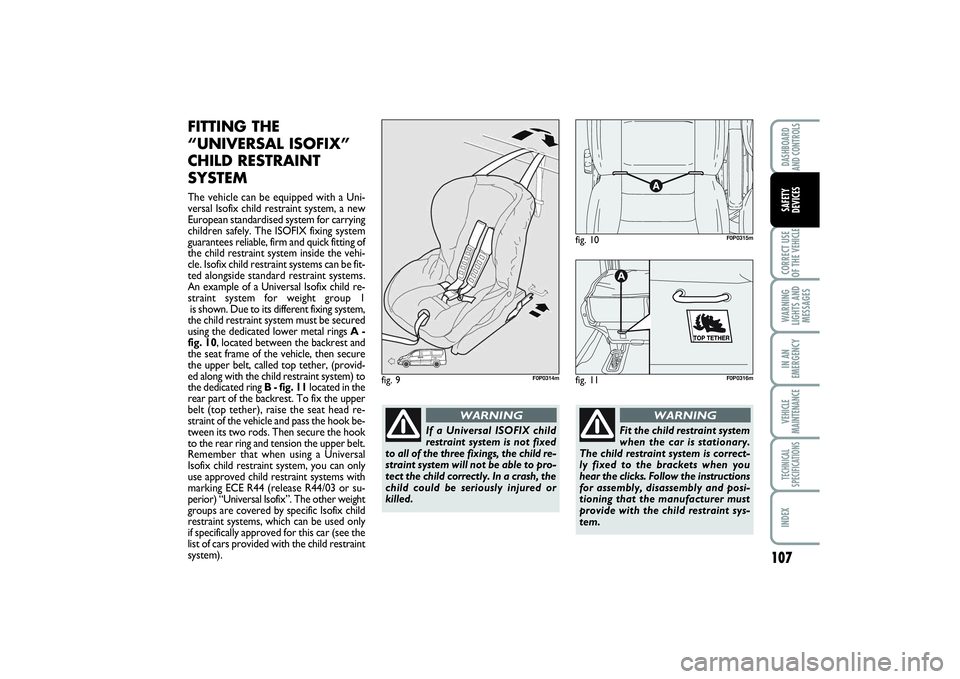
FITTING THE
“UNIVERSAL ISOFIX”
CHILD RESTRAINT
SYSTEMThe vehicle can be equipped with a Uni-
versal Isofix child restraint system, a new
European standardised system for carrying
children safely. The ISOFIX fixing system
guarantees reliable, firm and quick fitting of
the child restraint system inside the vehi-
cle. Isofix child restraint systems can be fit-
ted alongside standard restraint systems.
An example of a Universal Isofix child re-
straint system for weight group 1
is shown. Due to its different fixing system,
the child restraint system must be secured
using the dedicated lower metal rings A -
fig. 10, located between the backrest and
the seat frame of the vehicle, then secure
the upper belt, called top tether, (provid-
ed along with the child restraint system) to
the dedicated ring B - fig. 11located in the
rear part of the backrest. To fix the upper
belt (top tether), raise the seat head re-
straint of the vehicle and pass the hook be-
tween its two rods. Then secure the hook
to the rear ring and tension the upper belt.
Remember that when using a Universal
Isofix child restraint system, you can only
use approved child restraint systems with
marking ECE R44 (release R44/03 or su-
perior) “Universal Isofix”. The other weight
groups are covered by specific Isofix child
restraint systems, which can be used only
if specifically approved for this car (see the
list of cars provided with the child restraint
system).
fig. 9
F0P0314m
fig. 10
F0P0315m
fig. 11
A
F0P0316m
If a Universal ISOFIX child
restraint system is not fixed
to all of the three fixings, the child re-
straint system will not be able to pro-
tect the child correctly. In a crash, the
child could be seriously injured or
killed.
WARNING
Fit the child restraint system
when the car is stationary.
The child restraint system is correct-
ly fixed to the brackets when you
hear the clicks. Follow the instructions
for assembly, disassembly and posi-
tioning that the manufacturer must
provide with the child restraint sys-
tem.
WARNING
097-118 SCUDO LUM GB 02/04/14 10:40 Pagina 107
Page 112 of 227
108CORRECT USE
OF THE VEHICLE
WARNING
LIGHTS AND
MESSAGESIN AN
EMERGENCYVEHICLE
MAINTENANCETECHNICAL
SPECIFICATIONSIINDEXDASHBOARD
AND CONTROLSSAFETY
DEVICES
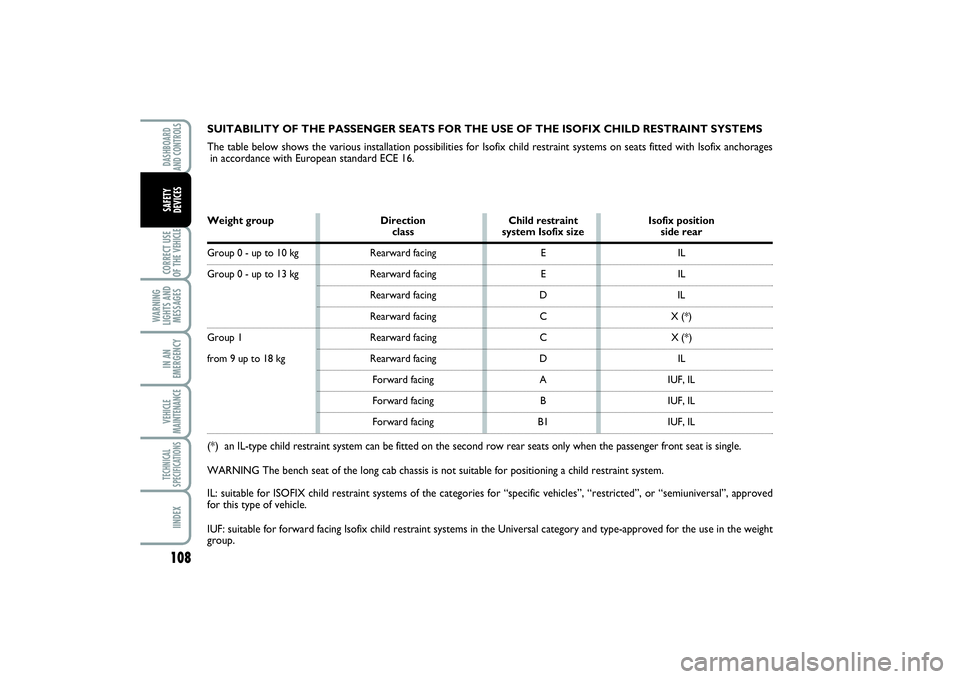
SUITABILITY OF THE PASSENGER SEATS FOR THE USE OF THE ISOFIX CHILD RESTRAINT SYSTEMS
The table below shows the various installation possibilities for Isofix child restraint systems on seats fitted with Isofix anchorages
in accordance with European standard ECE 16.Weight group Direction Child restraint Isofix position
class system Isofix size side rear
Group 0 - up to 10 kg Rearward facing E ILGroup 0 - up to 13 kg Rearward facing E IL
Rearward facing D ILRearward facing C X (*)
Group 1 Rearward facing C X (*)from 9 up to 18 kg Rearward facing D IL
Forward facing A IUF, ILForward facing B IUF, ILForward facing B1 IUF, IL
(*)
an IL-type child restraint system can be fitted on the second row rear seats only when the passenger front seat
is single.
WARNING The bench seat of the long cab chassis is not suitable for positioning a child restraint system.
IL: suitable for ISOFIX child restraint systems of the categories for “specific vehicles”, “restricted”, or “semiuniversal”, approved
for this type of vehicle.
IUF: suitable for forward facing Isofix child restraint systems in the Universal category and type-approved for the use in the weight
group.
097-118 SCUDO LUM GB 02/04/14 10:40 Pagina 108
Page 128 of 227
124WARNING
LIGHTS AND
MESSAGESIN AN
EMERGENCYVEHICLE
MAINTENANCETECHNICAL
SPECIFICATIONSINDEXDASHBOARD
AND CONTROLSSAFETY
DEVICESCORRECT USE
OF THE VEHICLE
Roof rack/ski rack
Remove the roof rack or the ski rack from
the roof as soon as they are no longer
used. These accessories lower air pene-
tration and adversely affect consumption
levels. When needing to carry particular-
ly voluminous objects, preferably use a
trailer.
Electric devices
Use electric devices only for the amount
of time needed. Rear heated window, ad-
ditional headlights, windscreen wipers and
heater fan need a considerable amount of
energy, therefore increasing the require-
ment of current increases fuel consump-
tion (up to +25% in the urban cycle).
Climate control
The air conditioner is an additional load
which greatly affects the engine leading to
higher consumption (on average up to
+20%). When the temperature outside
the vehicle permits it, use the air vents
where possible.
Spoilers
The use of non-certified aerodynamic
items may adversely affect air drag and
consumption levels.DRIVING STYLE
Starting
Do not warm the engine when the vehi-
cle is stationary or at high or low speed:
in this way the engine will warm up grad-
ually increasing consumption and emis-
sions. You should drive off slowly straight
away avoiding high revs so that the engine
will warm up more quickly.
Unnecessary actions
Avoid accelerating when waiting at traffic
lights or before switching off the engine.
This and also double declutching is ab-
solutely pointless on modern vehicles and
also increase consumption and pollution.
Gear selections
As soon as the conditions of the traffic and
road allow, use a higher gear. Using a low
gear to obtain brilliant performance in-
creases consumption.
In the same way improper use of a high
gear increases consumption, emissions an
engine wear.
CONTAINING
RUNNING COSTSSome suggestions which may help you to
keep the running costs of the vehicle
down and lower the amount of toxic emis-
sions released into the atmosphere are
given below.
GENERAL CONSIDERATIONS
Vehicle maintenance
Carry out the checks and adjustments/reg-
ulations specified in the “Service Sched-
ule”.
Tyres
Check tyre inflation pressure regularly.
Tyres should be checked at least once
every four weeks: if the pressure is too
low, fuel consumption increases as the re-
sistance to the rolling movement of the
tyre is greater.
Unnecessary loads
Do not travel with too much load.
The weight of the vehicle (specially in ur-
ban traffic) and its trim greatly effects con-
sumption and stability.
119-128 SCUDO LUM GB 18/11/13 14.26 Pagina 124
Page 129 of 227
125
WARNING
LIGHTS AND
MESSAGESIN AN
EMERGENCYVEHICLE
MAINTENANCETECHNICAL
SPECIFICATIONSINDEXDASHBOARD
AND CONTROLSSAFETY
DEVICESCORRECT USE
OF THE VEHICLE
CONDITIONS OF USE
Cold starting
Short journeys and frequent cold starts do
not allow the engine to reach optimum op-
erating temperature. This results in a sig-
nificant increase in consumption levels
(from +15 to +30% on the urban cycle)
and emission of harmful substances.
Traffic and road conditions
Rather high consumption levels are tied to
situations with heavy traffic, for example
in queues with frequent use of the lower
gears or in cities with many traffic lights.
Also winding mountain roads and rough
road surfaces adversely affect consump-
tion.
Enforced halts
During prolonged hold-ups (level crossings)
the engine should be switched off. Top speed
Fuel consumption increases considerably
as speed increases. Your speed should be
kept as even as possible and superfluous
braking and acceleration avoided as this
increases both consumption and emis-
sions.
Acceleration
Accelerating violently increasing the revs
will greatly affect consumption and emis-
sions: acceleration should be gradual and
should not exceed the maximum torque.TOWING TRAILERS
IMPORTANTS
For towing caravans or trailers the vehi-
cle must be fitted with a certified tow
hook and an adequate electric system.
To prevent damages to the vehicle elec-
tric system, adopt an electronic control
unit specially designed and dedicated to
the trailer.
Installation should be carried out by spe-
cialised personnel who release a special
document for circulation on the road.
Install any specific and/or additional rear-
view mirrors as specified by law.
Remember that when towing a trailer,
steep hills are harder to climb, the brak-
ing spaces increase and overtaking takes
longer depending on the overall weight.
119-128 SCUDO LUM GB 18/11/13 14.26 Pagina 125