warning FIAT SPIDER ABARTH 2017 Owners Manual
[x] Cancel search | Manufacturer: FIAT, Model Year: 2017, Model line: SPIDER ABARTH, Model: FIAT SPIDER ABARTH 2017Pages: 292, PDF Size: 9.24 MB
Page 228 of 292
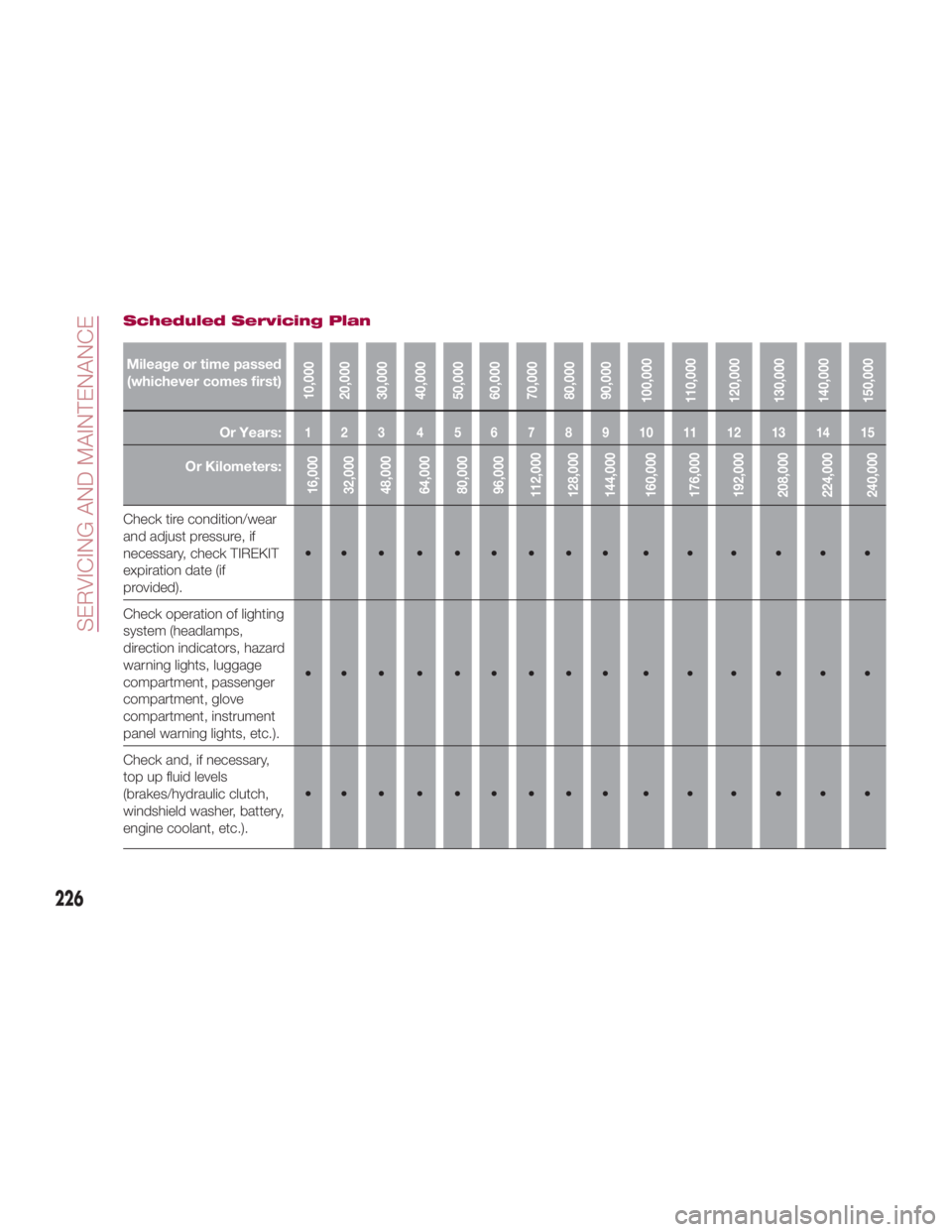
Scheduled Servicing Plan
Mileage or time passed
(whichever comes first)
10,000
20,000
30,000
40,000
50,000
60,000
70,000
80,000
90,000
100,000
110,000
120,000
130,000
140,000
150,000Or Years: 123 456789101112131415
Or Kilometers:
16,000
32,000
48,000
64,000
80,000
96,000
112,000
128,000
144,000
160,000
176,000
192,000
208,000
224,000
240,000Check tire condition/wear
and adjust pressure, if
necessary, check TIREKIT
expiration date (if
provided). •••••••••••••••
Check operation of lighting
system (headlamps,
direction indicators, hazard
warning lights, luggage
compartment, passenger
compartment, glove
compartment, instrument
panel warning lights, etc.). •••••••••••••••
Check and, if necessary,
top up fluid levels
(brakes/hydraulic clutch,
windshield washer, battery,
engine coolant, etc.). •••••••••••••••
226
SERVICING AND MAINTENANCE
Page 231 of 292
Mileage or time passed
(whichever comes first)
10,000
20,000
30,000
40,000
50,000
60,000
70,000
80,000
90,000
100,000
110,000
120,000
130,000
140,000
150,000Or Years: 123 456789101112131415
Or Kilometers:
16,000
32,000
48,000
64,000
80,000
96,000
112,000
128,000
144,000
160,000
176,000
192,000
208,000
224,000
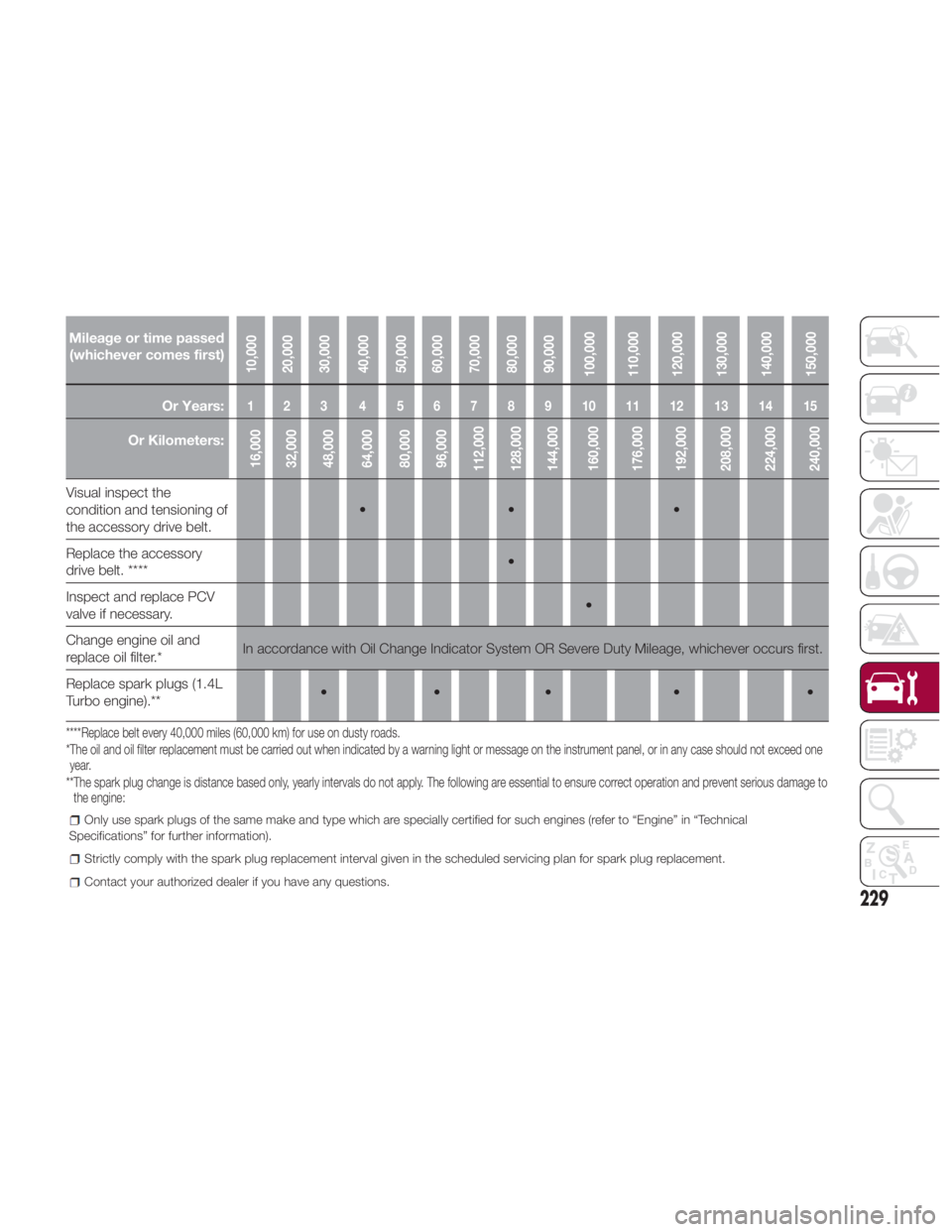
240,000Visual inspect the
condition and tensioning of
the accessory drive belt. •• •
Replace the accessory
drive belt.
**** •
Inspect and replace PCV
valve if necessary. •
Change engine oil and
replace oil filter.
* In accordance with Oil Change Indicator System OR Severe Duty Mileage, whichever occurs first.
Replace spark plugs (1.4L
Turbo engine).
** ••• • •
****Replace belt every 40,000 miles (60,000 km) for use on dusty roads.
*The oil and oil filter replacement must be carried out when indicated by a warning light or message on the instrument panel, or in any case should not exceed one
year.
**The spark plug change is distance based only, yearly intervals do not apply. The following are essential to ensure correct operation and prevent serious damage to
the engine: Only use spark plugs of the same make and type which are specially certified for such engines (refer to “Engine” in “Technical
Specifications” for further information).
Strictly comply with the spark plug replacement interval given in the scheduled servicing plan for spark plug replacement.
Contact your authorized dealer if you have any questions.
229
Page 232 of 292
Mileage or time passed
(whichever comes first)
10,000
20,000
30,000
40,000
50,000
60,000
70,000
80,000
90,000
100,000
110,000
120,000
130,000
140,000
150,000Or Years: 123 456789101112131415
Or Kilometers:
16,000
32,000
48,000
64,000
80,000
96,000
112,000
128,000
144,000
160,000
176,000
192,000
208,000
224,000
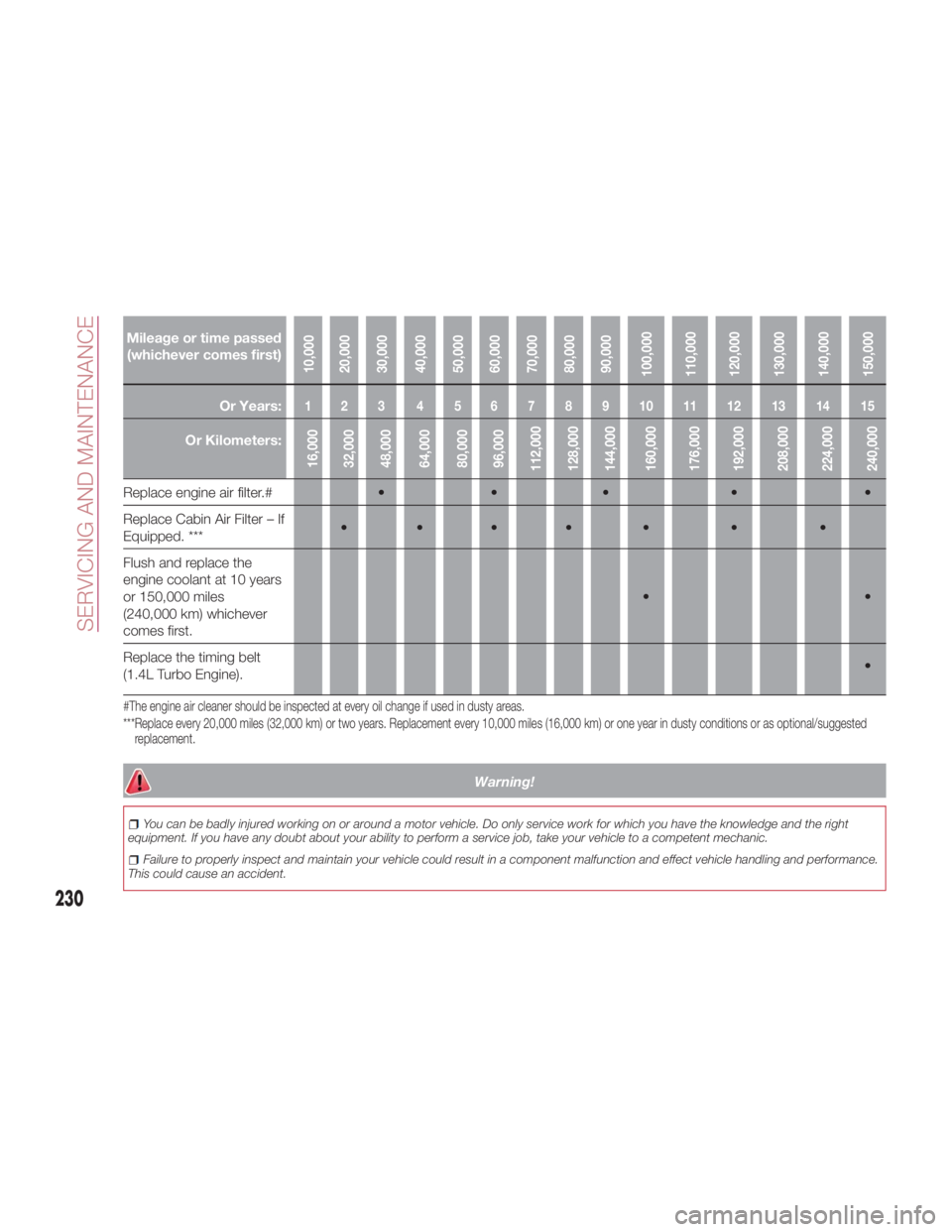
240,000Replace engine air filter.
# ••• • •
Replace Cabin Air Filter – If
Equipped.
*** •••• • • •
Flush and replace the
engine coolant at 10 years
or 150,000 miles
(240,000 km) whichever
comes first. ••
Replace the timing belt
(1.4L Turbo Engine). •
#The engine air cleaner should be inspected at every oil change if used in dusty areas.
***Replace every 20,000 miles (32,000 km) or two years. Replacement every 10,000 miles (16,000 km) or one year in dusty conditions or as optional/suggested
replacement.
Warning!You can be badly injured working on or around a motor vehicle. Do only service work for which you have the knowledge and the right
equipment. If you have any doubt about your ability to perform a service job, take your vehicle to a competent mechanic.
Failure to properly inspect and maintain your vehicle could result in a component malfunction and effect vehicle handling and performance.
This could cause an accident.
230
SERVICING AND MAINTENANCE
Page 234 of 292
Engine Oil
Warning!Be very careful when working in the
engine compartment when the engine is
hot: you may get burned.
Do not get too close to the radiator
cooling fan: the electric fan may start;
danger of injury.
Loose clothing might be pulled by
moving parts.
Recommended Oil
Refer to “Fluids And Lubricants” in
“Technical Specifications” for further
information.
Inspecting engine oil level
Proceed as follows:
1. Be sure the vehicle is on a level
surface.
2. Warm up the engine to normal
operating temperature.
3. Turn it off and wait at least five
minutes for the oil to return to the
sump.
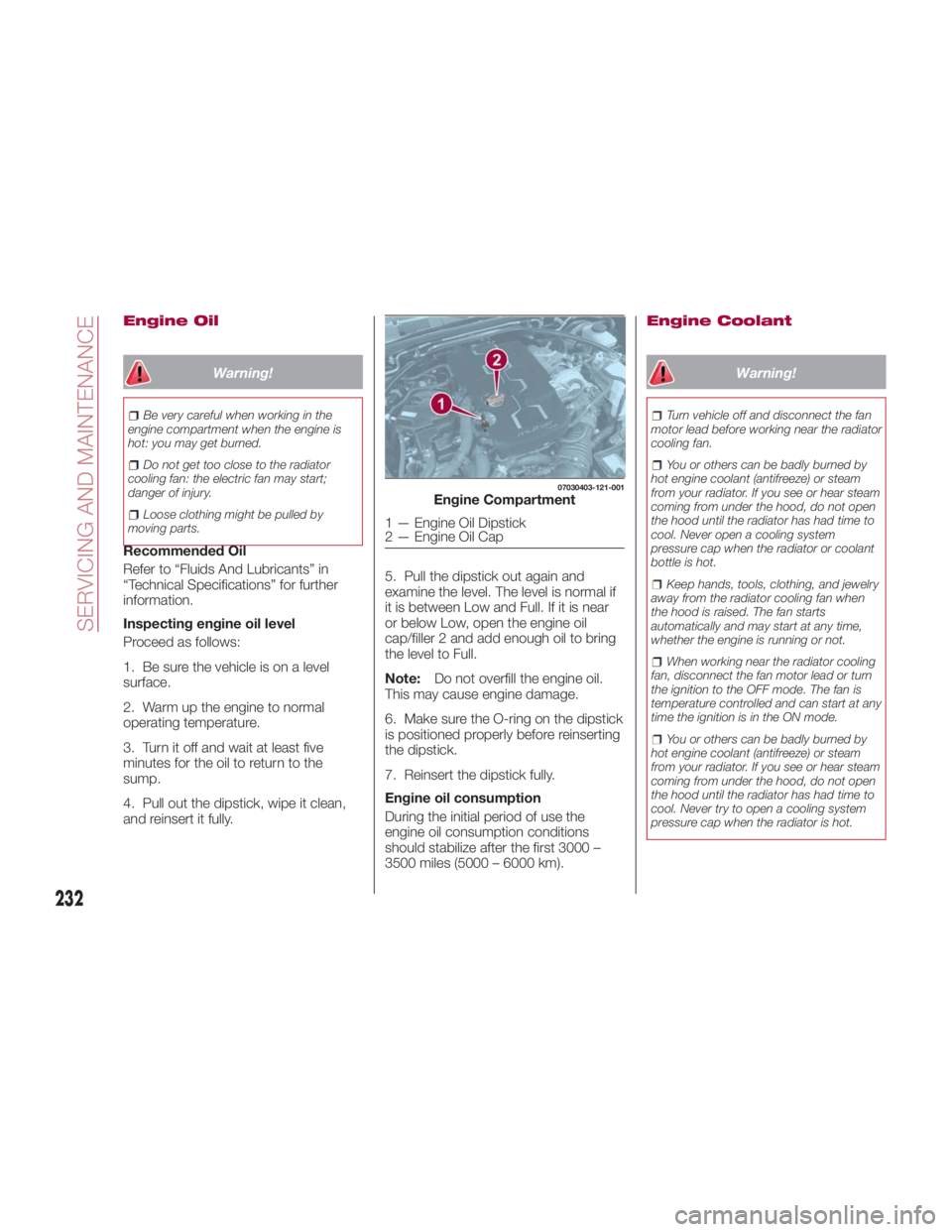
4. Pull out the dipstick, wipe it clean,
and reinsert it fully. 5. Pull the dipstick out again and
examine the level. The level is normal if
it is between Low and Full. If it is near
or below Low, open the engine oil
cap/filler 2 and add enough oil to bring
the level to Full.
Note: Do not overfill the engine oil.
This may cause engine damage.
6. Make sure the O-ring on the dipstick
is positioned properly before reinserting
the dipstick.
7. Reinsert the dipstick fully.
Engine oil consumption
During the initial period of use the
engine oil consumption conditions
should stabilize after the first 3000 –
3500 miles (5000 – 6000 km). Engine Coolant
Warning! Turn vehicle off and disconnect the fan
motor lead before working near the radiator
cooling fan.
You or others can be badly burned by
hot engine coolant (antifreeze) or steam
from your radiator. If you see or hear steam
coming from under the hood, do not open
the hood until the radiator has had time to
cool. Never open a cooling system
pressure cap when the radiator or coolant
bottle is hot.
Keep hands, tools, clothing, and jewelry
away from the radiator cooling fan when
the hood is raised. The fan starts
automatically and may start at any time,
whether the engine is running or not.
When working near the radiator cooling
fan, disconnect the fan motor lead or turn
the ignition to the OFF mode. The fan is
temperature controlled and can start at any
time the ignition is in the ON mode.
You or others can be badly burned by
hot engine coolant (antifreeze) or steam
from your radiator. If you see or hear steam
coming from under the hood, do not open
the hood until the radiator has had time to
cool. Never try to open a cooling system
pressure cap when the radiator is hot. 07030403-121-001
Engine Compartment
1 — Engine Oil Dipstick
2 — Engine Oil Cap
232
SERVICING AND MAINTENANCE
Page 235 of 292
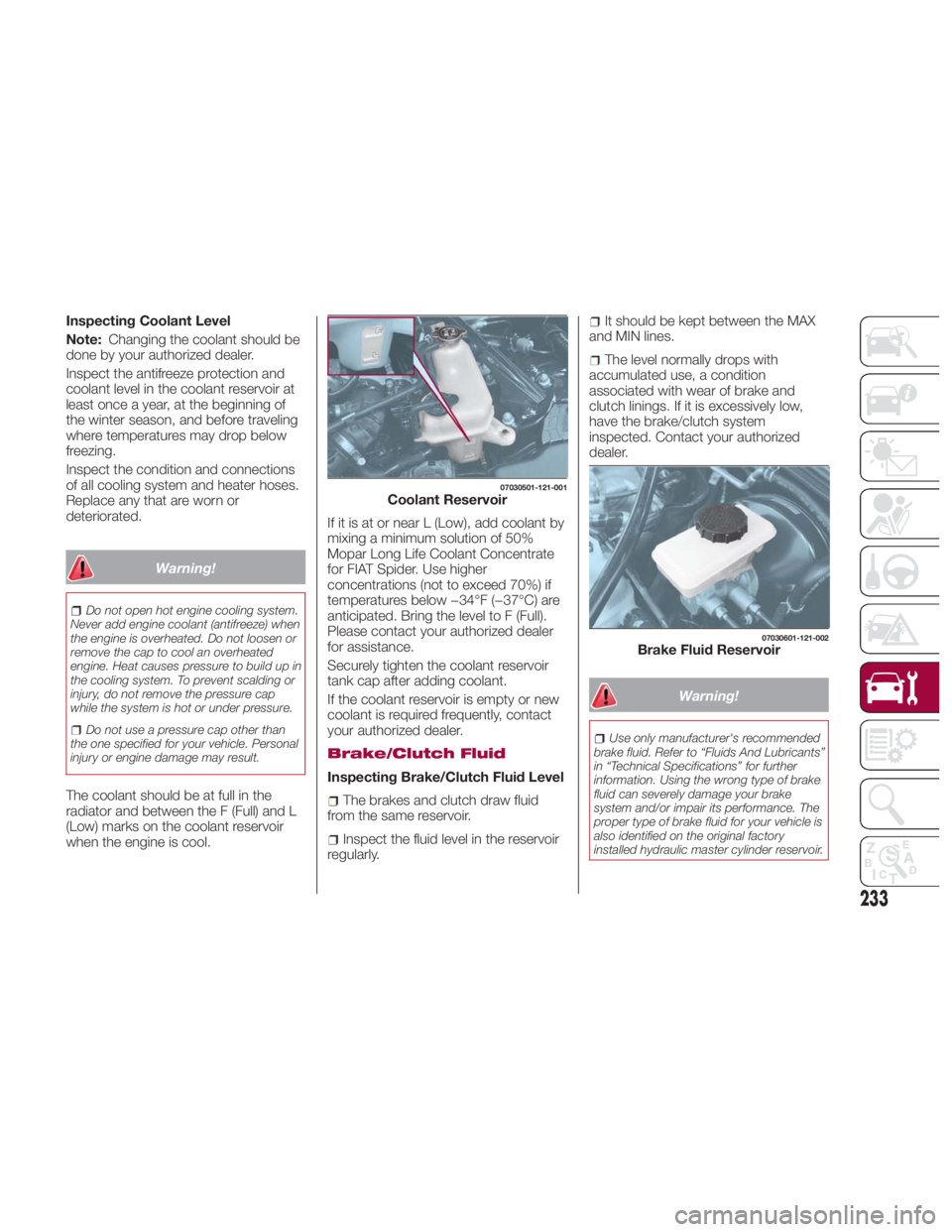
Inspecting Coolant Level
Note: Changing the coolant should be
done by your authorized dealer.
Inspect the antifreeze protection and
coolant level in the coolant reservoir at
least once a year, at the beginning of
the winter season, and before traveling
where temperatures may drop below
freezing.
Inspect the condition and connections
of all cooling system and heater hoses.
Replace any that are worn or
deteriorated.
Warning!Do not open hot engine cooling system.
Never add engine coolant (antifreeze) when
the engine is overheated. Do not loosen or
remove the cap to cool an overheated
engine. Heat causes pressure to build up in
the cooling system. To prevent scalding or
injury, do not remove the pressure cap
while the system is hot or under pressure.
Do not use a pressure cap other than
the one specified for your vehicle. Personal
injury or engine damage may result.
The coolant should be at full in the
radiator and between the F (Full) and L
(Low) marks on the coolant reservoir
when the engine is cool. If it is at or near L (Low), add coolant by
mixing a minimum solution of 50%
Mopar Long Life Coolant Concentrate
for FIAT Spider. Use higher
concentrations (not to exceed 70%) if
temperatures below −34°F (−37°C) are
anticipated. Bring the level to F (Full).
Please contact your authorized dealer
for assistance.
Securely tighten the coolant reservoir
tank cap after adding coolant.
If the coolant reservoir is empty or new
coolant is required frequently, contact
your authorized dealer.
Brake/Clutch Fluid
Inspecting Brake/Clutch Fluid Level
The brakes and clutch draw fluid
from the same reservoir.
Inspect the fluid level in the reservoir
regularly. It should be kept between the MAX
and MIN lines.
The level normally drops with
accumulated use, a condition
associated with wear of brake and
clutch linings. If it is excessively low,
have the brake/clutch system
inspected. Contact your authorized
dealer.
Warning! Use only manufacturer's recommended
brake fluid. Refer to “Fluids And Lubricants”
in “Technical Specifications” for further
information. Using the wrong type of brake
fluid can severely damage your brake
system and/or impair its performance. The
proper type of brake fluid for your vehicle is
also identified on the original factory
installed hydraulic master cylinder reservoir. 07030501-121-001
Coolant Reservoir 07030601-121-002
Brake Fluid Reservoir
233
Page 236 of 292
To avoid contamination from foreign
matter or moisture, use only new brake
fluid or fluid that has been in a tightly
closed container. Keep the master cylinder
reservoir cap secured at all times. Brake
fluid in a open container absorbs moisture
from the air resulting in a lower boiling
point. This may cause it to boil
unexpectedly during hard or prolonged
braking, resulting in sudden brake failure.
This could result in a collision.
Overfilling the brake fluid reservoir can
result in spilling brake fluid on hot engine
parts, causing the brake fluid to catch fire.
Brake fluid can also damage painted and
vinyl surfaces, care should be taken to
avoid its contact with these surfaces.
Do not allow petroleum based fluid to
contaminate the brake fluid. Brake seal
components could be damaged, causing
partial or complete brake failure. This could
result in a collision.
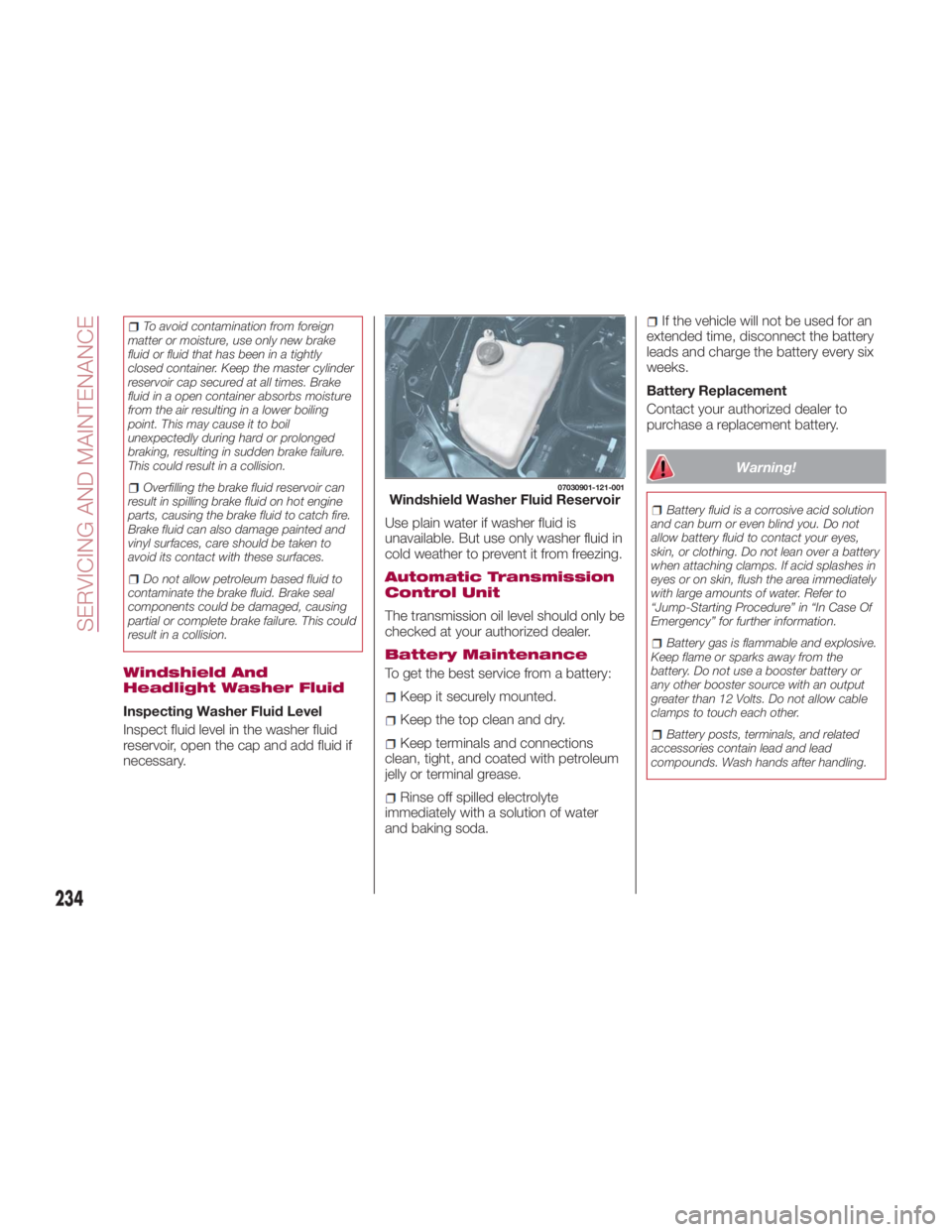
Windshield And
Headlight Washer Fluid
Inspecting Washer Fluid Level
Inspect fluid level in the washer fluid
reservoir, open the cap and add fluid if
necessary. Use plain water if washer fluid is
unavailable. But use only washer fluid in
cold weather to prevent it from freezing.
Automatic Transmission
Control Unit
The transmission oil level should only be
checked at your authorized dealer.
Battery Maintenance
To get the best service from a battery:
Keep it securely mounted.
Keep the top clean and dry.
Keep terminals and connections
clean, tight, and coated with petroleum
jelly or terminal grease.
Rinse off spilled electrolyte
immediately with a solution of water
and baking soda. If the vehicle will not be used for an
extended time, disconnect the battery
leads and charge the battery every six
weeks.
Battery Replacement
Contact your authorized dealer to
purchase a replacement battery.
Warning! Battery fluid is a corrosive acid solution
and can burn or even blind you. Do not
allow battery fluid to contact your eyes,
skin, or clothing. Do not lean over a battery
when attaching clamps. If acid splashes in
eyes or on skin, flush the area immediately
with large amounts of water. Refer to
“Jump-Starting Procedure” in “In Case Of
Emergency” for further information.
Battery gas is flammable and explosive.
Keep flame or sparks away from the
battery. Do not use a booster battery or
any other booster source with an output
greater than 12 Volts. Do not allow cable
clamps to touch each other.
Battery posts, terminals, and related
accessories contain lead and lead
compounds. Wash hands after handling. 07030901-121-001
Windshield Washer Fluid Reservoir
234
SERVICING AND MAINTENANCE
Page 237 of 292
BATTERY
RECHARGING BATTERY CHARGING
PROCEDURE
Warning!Battery fluid is a corrosive acid solution
and can burn or even blind you. Do not
allow battery fluid to contact your eyes,
skin, or clothing. Do not lean over a battery
when attaching clamps. If acid splashes in
eyes or on skin, flush the area immediately
with large amounts of water. Refer to
“Jump-Starting Procedure” in “In Case Of
Emergency” for further information.
Battery gas is flammable and explosive.
Keep flame or sparks away from the
battery. Do not use a booster battery or
any other booster source with an output
greater than 12 Volts. Do not allow cable
clamps to touch each other.
Battery posts, terminals, and related
accessories contain lead and lead
compounds. Wash hands after handling. Caution!It is essential when replacing the cables
on the battery that the positive cable is
attached to the positive post and the
negative cable is attached to the negative
post. Battery posts are marked positive (+)
and negative (-) and are identified on the
battery case. Cable clamps should be tight
on the terminal posts and free of corrosion.
If a “fast charger” is used while the
battery is in the vehicle, disconnect both
vehicle battery cables before connecting
the charger to the battery. Do not use a
“fast charger” to provide starting voltage.
Charge battery as follows:
Before recharging the battery, turn off
all accessories and turn the engine off
by placing the ignition in the OFF mode.
Disconnect the negative battery
cable.
Connect the charger cables to the
battery terminals, observing the polarity
(+,–).
Turn on the charger.
When finished, turn the charger off
before disconnecting the battery.
Reconnect the negative battery
terminal. MAINTENANCE
PROCEDURES The following pages contain
instructions on the required
maintenance from the technical
personnel who designed the vehicle.
In addition to these specific
maintenance instructions specified for
routine scheduled servicing, there are
other components which may require
periodic maintenance or replacement
over the vehicle’s life cycle.
Body Lubrication
Ensure that the locks and bodywork
junction points, including components
such as the seat guides, door hinges
(and rollers), trunk and hood are
periodically lubricated with lithium
based grease to ensure correct, silent
operation and to protect them from rust
and wear.
Thoroughly clean the components,
eliminating every trace of dirt and dust.
After lubricating, eliminate excess oil
and grease. Also pay particular
attention to the hood closing devices,
to ensure correct operation.
During operations on the hood, be sure
to perform with the engine cold, also
remember to check, clean and lubricate
the locking, release and safety devices.
Make sure the hood's secondary latch
keeps the hood from opening when the
primary latch is released.
235
Page 239 of 292
Warning!To prevent damage to the windshield let
the wiper arm down easily, do not let it slap
down on the windshield.
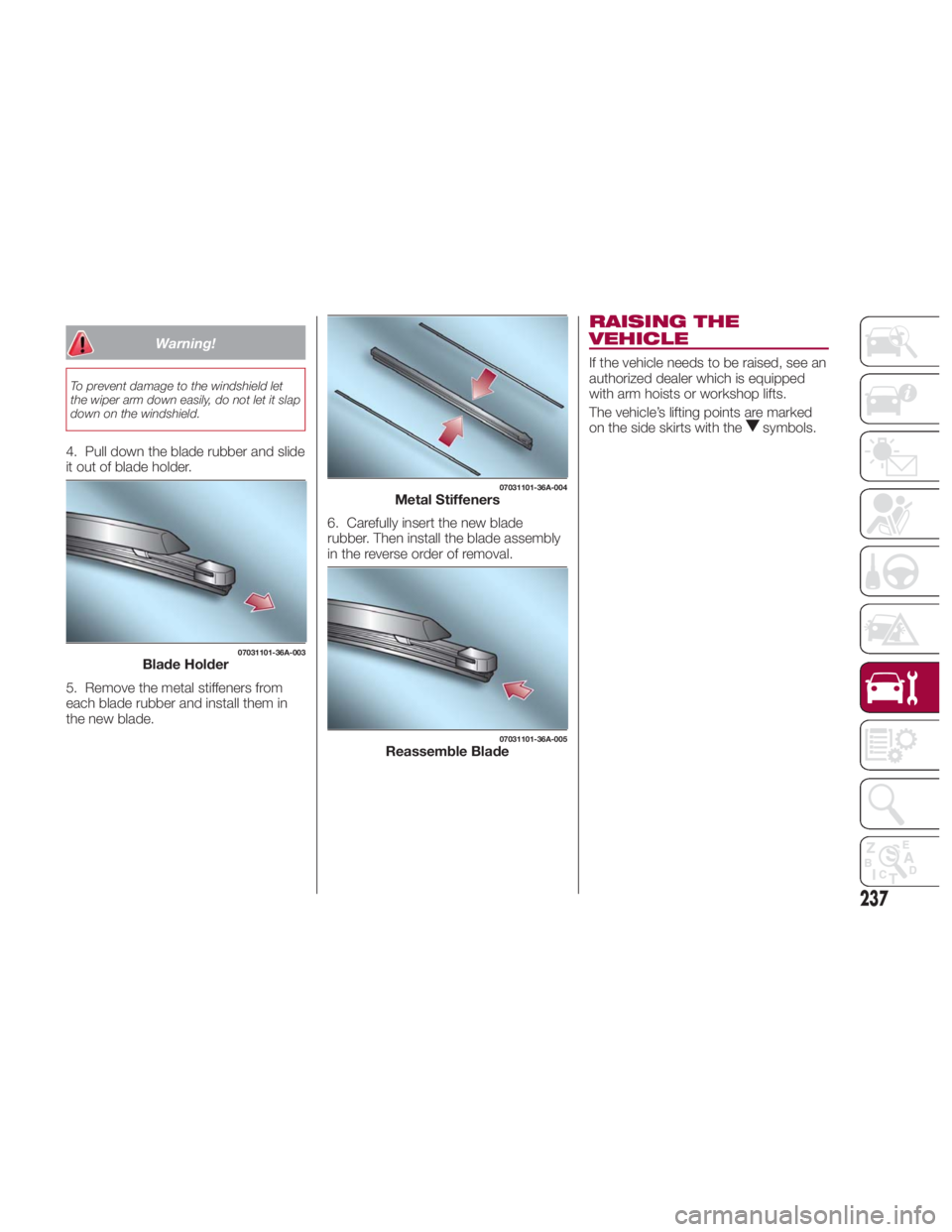
4. Pull down the blade rubber and slide
it out of blade holder.
5. Remove the metal stiffeners from
each blade rubber and install them in
the new blade. 6. Carefully insert the new blade
rubber. Then install the blade assembly
in the reverse order of removal. RAISING THE
VEHICLE If the vehicle needs to be raised, see an
authorized dealer which is equipped
with arm hoists or workshop lifts.
The vehicle’s lifting points are marked
on the side skirts with the
symbols.07031101-36A-003
Blade Holder 07031101-36A-004
Metal Stiffeners 07031101-36A-005
Reassemble Blade
237
Page 247 of 292
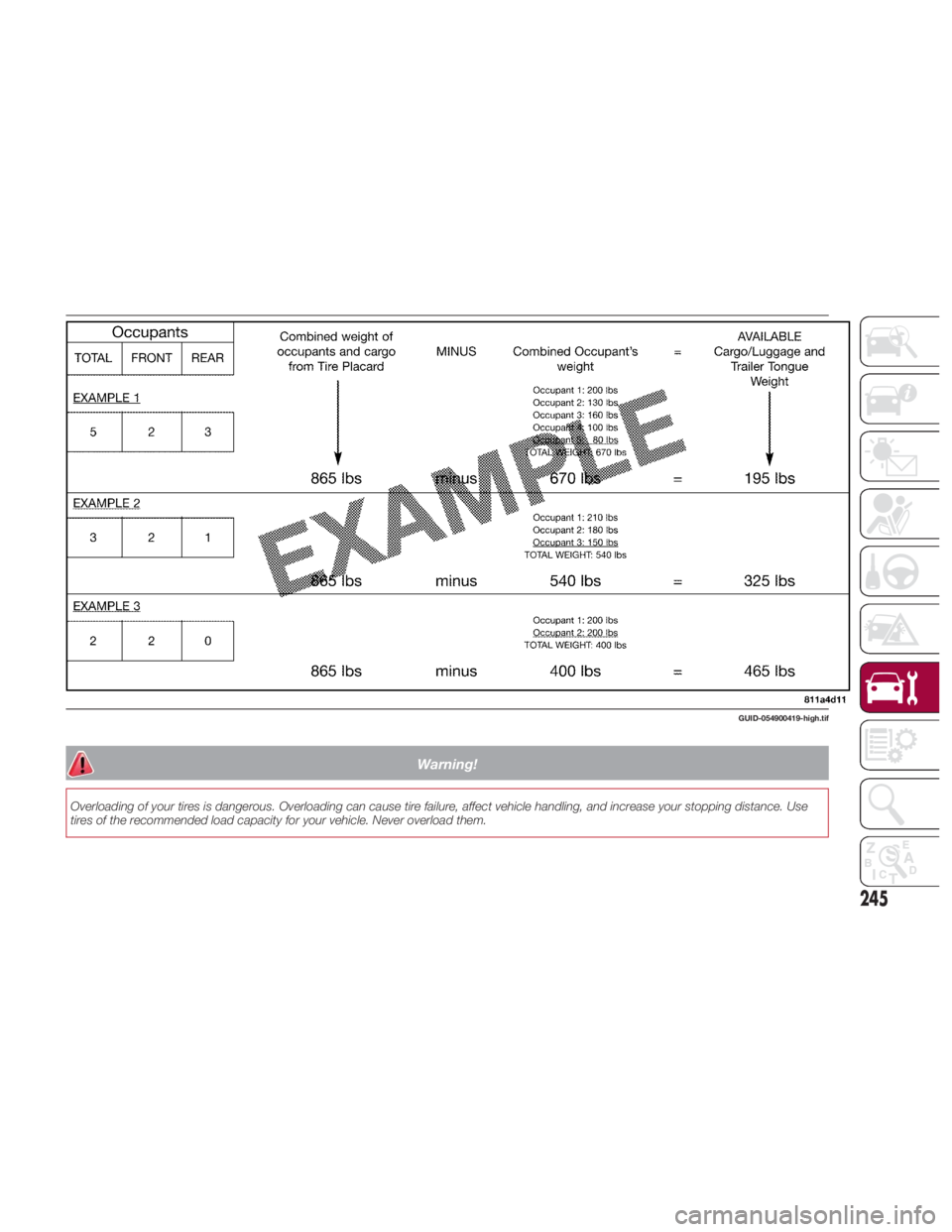
Warning!Overloading of your tires is dangerous. Overloading can cause tire failure, affect vehicle handling, and increase your stopping distance. Use
tires of the recommended load capacity for your vehicle. Never overload them. GUID-054900419-high.tif
245
Page 248 of 292
Tires — General
Information
Tire Pressure Proper tire inflation pressure is essential
to the safe and satisfactory operation of
your vehicle. Four primary areas are
affected by improper tire pressure:
Safety and Vehicle Stability
Economy
Tread Wear
Ride Comfort
Safety
Warning!Improperly inflated tires are dangerous
and can cause collisions.
Underinflation increases tire flexing and
can result in overheating and tire failure.
Overinflation reduces a tire's ability to
cushion shock. Objects on the road and
chuckholes can cause damage that result
in tire failure.
Overinflated or underinflated tires can
affect vehicle handling and can fail
suddenly, resulting in loss of vehicle
control.
Unequal tire pressures can cause
steering problems. You could lose control
of your vehicle. Unequal tire pressures from one side of
the vehicle to the other can cause the
vehicle to drift to the right or left.
Always drive with each tire inflated to the
recommended cold tire inflation pressure.
Both under-inflation and over-inflation
affect the stability of the vehicle and can
produce a feeling of sluggish response
or over responsiveness in the steering.
Note:
Unequal tire pressures from side to
side may cause erratic and
unpredictable steering response.
Unequal tire pressure from side to
side may cause the vehicle to drift left
or right.
Fuel Economy
Underinflated tires will increase tire
rolling resistance resulting in higher fuel
consumption.
Tread Wear
Improper cold tire inflation pressures
can cause abnormal wear patterns and
reduced tread life, resulting in the need
for earlier tire replacement.
Ride Comfort And Vehicle Stability
Proper tire inflation contributes to a
comfortable ride. Over-inflation
produces a jarring and uncomfortable
ride. Tire Inflation Pressures The proper cold tire inflation pressure is
listed on the driver's side B-Pillar or rear
edge of the driver's side door.
At least once a month:
Check and adjust tire pressure with a
good quality pocket-type pressure
gauge. Do not make a visual judgement
when determining proper inflation. Tires
may look properly inflated even when
they are under-inflated.
Inspect tires for signs of tire wear or
visible damage.
Caution!After inspecting or adjusting the tire
pressure, always reinstall the valve stem
cap. This will prevent moisture and dirt
from entering the valve stem, which could
damage the valve stem.
Inflation pressures specified on the
placard are always “cold tire inflation
pressure”. Cold tire inflation pressure is
defined as the tire pressure after the
vehicle has not been driven for at least
three hours, or driven less than 1 mile
(1.6 km) after sitting for a minimum of
three hours. The cold tire inflation
pressure must not exceed the
maximum inflation pressure molded into
the tire sidewall.
246
SERVICING AND MAINTENANCE