engine FIAT TEMPRA 1988 Service And User Guide
[x] Cancel search | Manufacturer: FIAT, Model Year: 1988, Model line: TEMPRA, Model: FIAT TEMPRA 1988Pages: 171, PDF Size: 18.05 MB
Page 15 of 171
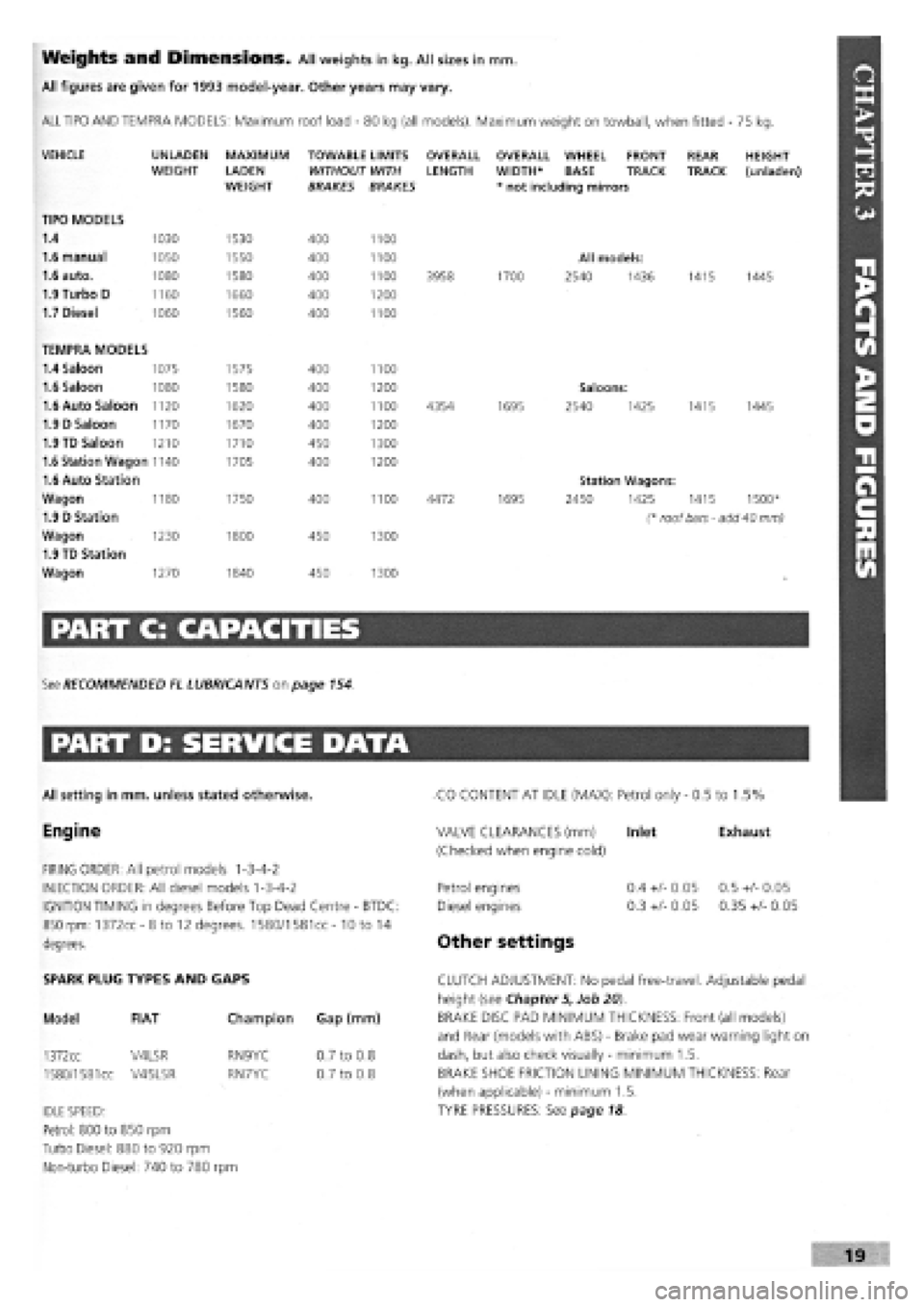
Weights and Dimensions. All weights in kg. All sizes in mm.
All figures are given for 1993 model-year. Other years may vary.
ALL TIPO AND TEMPRA MODELS: Maximum roof load
-
80 kg (all models). Maximum weight on towball, when fitted - 75 kg.
VEHICLE
TIPO MODELS
1.4
1.6 manual
1.6 auto.
1.9 Turbo D
1.7 Diesel
UNLADEN WEIGHT
1030
1050
1080
1160
1060
MAXIMUM
LADEN WEIGHT
1530
1550
1580
1660
1560
TOWABLE LIMITS WITHOUT WITH BRAKES BRAKES
400
400
400
400
400
1100
1100
1100
1200
1100
OVERALL LENGTH
3958
OVERALL WHEEL FRONT WIDTH* BASE TRACK * not including mirrors
1700
All models:
2540 1436
REAR TRACK
1415
HEIGHT (unladen)
1445
TEMPRA MODELS
1.4 Saloon 1075 1575 400 1100
1.6 Saloon 1080 1580 400 1200 Saloons:
1.6 Auto Saloon 1120 1620 400 1100 4354 1695 2540 1425 1415 1445
1.9 D Saloon 1170 1670 400 1200
1.9 TD Saloon 1210 1710 450 1300
1.6 Station Wagon 1140 1705 400 1200
1.6 Auto Station Station Wagons:
Wagon 1180 1750 400 1100 4472 1695 2450 1425 1415 1500*
1.9 D Station (* roof bars - add 40 mm)
Wagon 1230 1800 450 1300
1.9 TD Station
Wagon 1270 1840 450 1300
PART C: CAPACITIES
See RECOMMENDED EL LUBRICANTS on page 154.
PART D: SERVICE DATA
All setting in mm. unless stated otherwise.
Engine
FIRING ORDER: All petrol models 1-3-4-2
INJECTION ORDER: All diesel models 1-3-4-2
IGNITION TIMING in degrees Before Top Dead Centre
-
BTDC:
850 rpm: 1372cc-8to 12 degrees. 1580/1581cc- 10 to 14
degrees.
CO CONTENT AT IDLE (MAX): Petrol only
-
0.5 to 1.5%
Exhaust VALVE CLEARANCES (mm) Inlet
(Checked when engine cold)
Petrol engines
Diesel engines
Other settings
0.4
+/-
0.05
0.3
+/-
0.05
0.5
+/-
0.05
0.35
+/-
0.05
SPARK PLUG TYPES AND GAPS
Model FIAT
1372cc V4LSR
1580/1581
cc V45LSR
Champion Gap (mm)
RN9YC
RN7YC
IDLE SPEED:
Petrol: 800 to 850 rpm
Turbo Diesel: 880 to 920 rpm
Non-turbo Diesel: 740 to 780 rpm
0.7 to 0.8
0.7 to 0.8
CLUTCH ADJUSTMENT: No pedal free-travel. Adjustable pedal
height (see Chapter 5, Job 20).
BRAKE DISC PAD MINIMUM THICKNESS: Front (all models)
and Rear (models with ABS)
-
Brake pad wear warning light on
dash, but also check visually
-
minimum 1.5.
BRAKE SHOE FRICTION LINING MINIMUM THICKNESS: Rear
(when applicable)
-
minimum 1.5.
TYRE PRESSURES: See page 18
Page 16 of 171
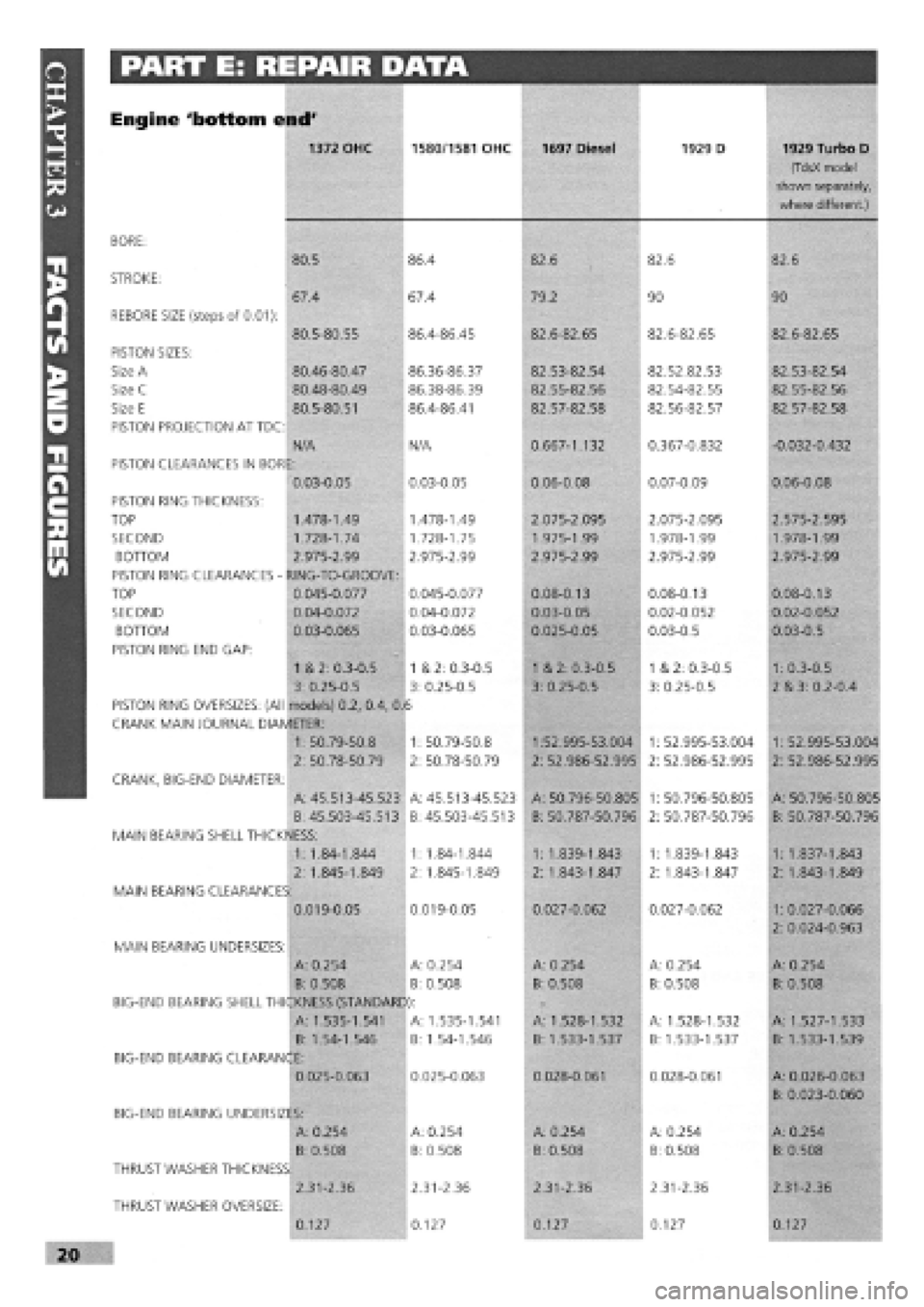
PART E: REPAIR DATA 1
Engine 'bottom end'
1372 OHC 1580/1581 OHC 1697 Diesel 1929 D 1929 Turbo D
(TdsX model
shown separately,
where different.)
BORE:
80.5 86.4 82.6 82.6 82.6
STROKE:
67.4 67.4 79.2 90 90
REBORE SIZE (steps of 0.01):
80.5-80.55 86.4-86.45 82.6-82.65 82.6-82.65 82.6-82.65
PISTON SIZES:
Size A 80.46-80.47 86.36-86.37 82.53-82.54 82.52.82.53 82.53-82.54
Size C 80.48-80.49 86.38-86.39 82.55-82.56 82.54-82.55 82.55-82.56
Size E 80.5-80.51 86.4-86.41 82.57-82.58 82.56-82.57 82.57-82.58
PISTON PROJECTION AT TDC:
N/A N/A 0.667-1.132 0.367-0.832 -0.032-0.432
PISTON CLEARANCES IN BORE:
0.03-0.05 0.03-0.05 0.06-0.08 0.07-0.09 0.06-0.08
PISTON RING THICKNESS: S^MRttffl
TOP 1.478-1.49 1.478-1.49 2.075-2.095 2.075-2.095 2.575-2.595
SECOND 1.728-1.74 1.728-1.75 1.975-1.99 1.978-1.99 1.978-1.99
BOTTOM 2.975-2.99 2.975-2.99 2.975-2.99 2.975-2.99 2.975-2.99
PISTON RING CLEARANCES -RING-TO-GROOVE:
TOP 0.045-0.077 0.045-0.077 0.08-0.13 0.08-0.13 0.08-0.13
SECOND 0.04-0.072 0.04-0.072 0.03-0.05 0.02-0.052 0.02-0.052
BOTTOM 0.03-0.065 0.03-0.065 0.025-0.05 0.03-0.5 0.03-0.5
PISTON RING END GAP:
1 & 2: 0.3-0.5 1 & 2: 0.3-0.5 1 & 2: 0.3-0.5 1 & 2: 0.3-0.5 1: 0.3-0.5
3: 0.25-0.5 3: 0.25-0.5 3: 0.25-0.5 3: 0.25-0.5 2 & 3: 0.2-0.4
PISTON RING OVERSIZES: (All models) 0.2, 0.4, 0. 6
CRANK MAIN JOURNAL DIAMETER:
1: 50.79-50.8 1: 50.79-50.8 1:52.995-53.004 1: 52.995-53.004 1: 52.995-53.004
2: 50.78-50.79 2: 50.78-50.79 2: 52.986-52.995 2: 52.986-52.995 2: 52.986-52.995
CRANK, BIG-END DIAMETER:
A: 45.513-45.523 A: 45.513-45.523 A: 50.796-50.805 1: 50.796-50.805 A: 50.796-50.805
B: 45.503-45.513 B: 45.503-45.513 B: 50.787-50.796 2: 50.787-50.796 B: 50.787-50.796
MAIN BEARING SHELL THICKNESS:
1: 1.84-1.844 1: 1.84-1.844 1: 1.839-1.843 1: 1.839-1.843 1: 1.837-1.843
2: 1.845-1.849 2: 1.845-1.849 2: 1.843-1.847 2: 1.843-1.847 2: 1.843-1.849
MAIN BEARING CLEARANCES
0.019-0.05 0.019-0.05 0.027-0.062 0.027-0.062 1: 0.027-0.066
2: 0.024-0.963
MAIN BEARING UNDERSIZES:
A: 0.254 A: 0.254 A: 0.254 A: 0.254 A: 0.254
B: 0.508 B: 0.508 B: 0.508 B: 0.508 B: 0.508
BIG-END BEARING SHELL THICKNESS (STANDARC ):
A: 1.535-1.541 A: 1.535-1.541 A: 1.528-1.532 A: 1.528-1.532 A: 1.527-1.533
B: 1.54-1.546 B: 1.54-1.546 B: 1.533-1.537 B: 1.533-1.537 B: 1.533-1.539
BIG-END BEARING CLEARANCE:
0.025-0.063 0.025-0.063 0.028-0.061 0.028-0.061 A: 0.026-0.063
B: 0.023-0.060
BIG-END BEARING UNDERSIZES:
A: 0.254 A: 0.254 A: 0.254 A: 0.254 A: 0.254
B: 0.508 B: 0.508 B: 0.508 B: 0.508 B: 0.508
THRUST WASHER THICKNESS
2.31-2.36 2.31-2.36 2.31-2.36 2.31-2.36 2.31-2.36
THRUST WASHER OVERSIZE:
0.127 0.127 0.127 0.127 0.127
20
Page 17 of 171
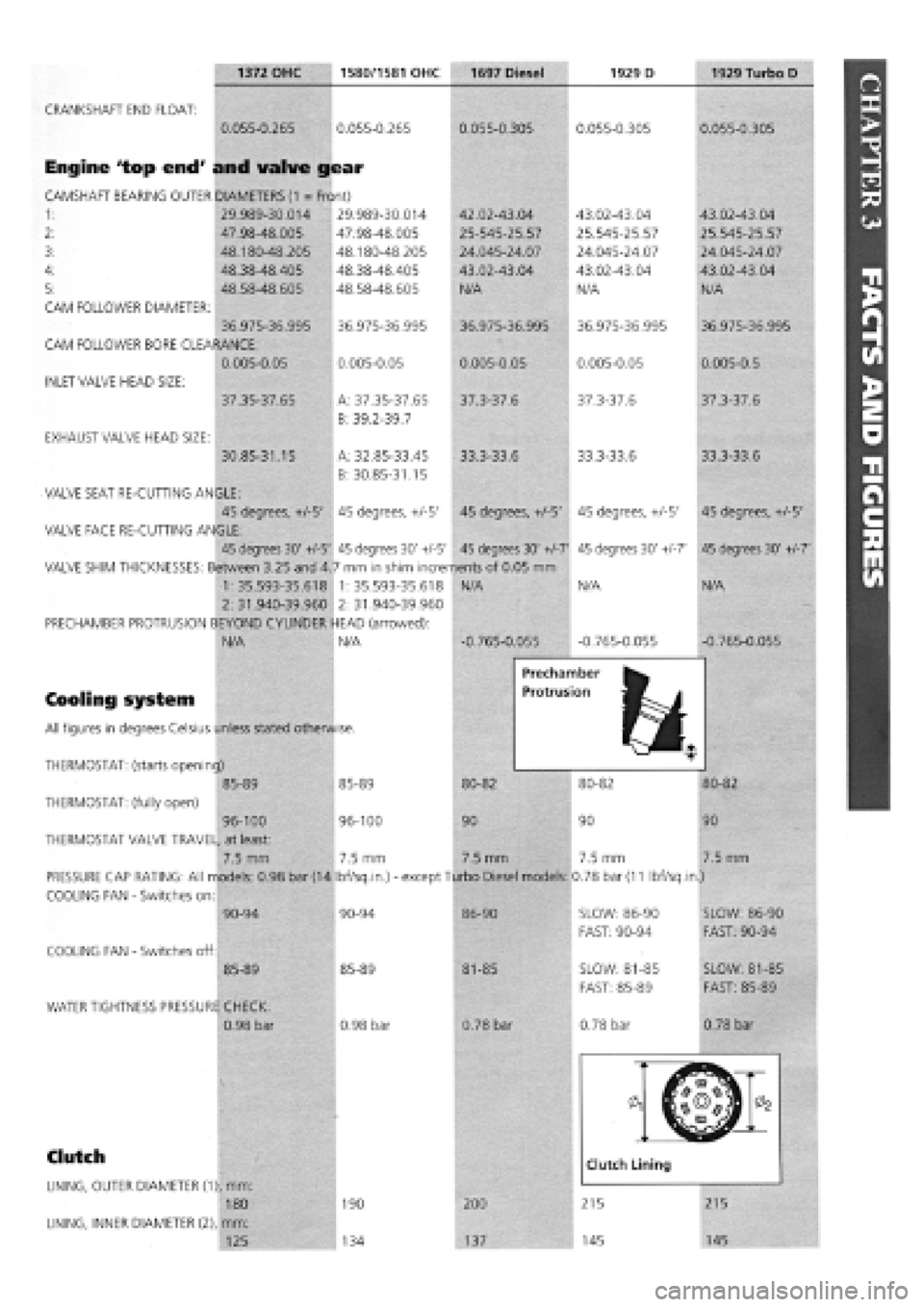
1372 OHC 1580/1581 OHC 1697 Diesel 1929 D 1929 Turbo D
CRANKSHAFT END FLOAT:
0.055-0.265 0.055-0.265
Engine 'top end' and valve gear
CAMSHAFT BEARING OUTER DIAMETERS
(1
= Front)
1: 29.989-30.014
2: 47.98-48.005
48.180-48.205
48.38-48.405
48.58-48.605
CAM FOLLOWER DIAMETER:
36.975-36.995
CAM FOLLOWER BORE CLEARANCE:
0.005-0.05
INLET VALVE HEAD SIZE:
37.35-37.65
EXHAUST VALVE HEAD SIZE:
30.85-31.15
29.989-30.014
47.98-48.005
48.180-48.205
48.38-48.405
48.58-48.605
36.975-36.995
0.005-0.05
A: 37.35-37.65
B: 39.2-39.7
A: 32.85-33.45
B: 30.85-31.15
0.055-0.305
42.02-43.04
25-545-25.57
24.045-24.07
43.02-43.04
N/A
36.975-36.995
0.005-0.05
37.3-37.6
33.3-33.6
VALVE SEAT RE-CUTTING ANGLE:
45 degrees, +/-5' 45 degrees, +/-5' 45 degrees, +/-5'
VALVE FACE RE-CUTTING ANGLE:
45 degrees 30' +/-5' 45 degrees 30' +/-5' 45 degrees 30' +/-7'
VALVE SHIM THICKNESSES: Between 3.25 and 4.7 mm in shim increments of 0.05 mm
1:35.593-35.618 1:35.593-35.618 N/A
2:31.940-39.960 2:31.940-39.960
PRECHAMBER PROTRUSION BEYOND CYLINDER HEAD (arrowed):
N/A N/A -0.765-0.055
0.055-0.305
43.02-43.04
25.545-25.57
24.045-24.07
43.02-43.04
N/A
36.975-36.995
0.005-0.05
37.3-37.6
33.3-33.6
45 degrees, +/-5'
45 degrees 30' +/-7'
N/A
-0.765-0.055
0.055-0.305
43.02-43.04
25.545-25.57
24.045-24.07
43.02-43.04
N/A
36.975-36.995
0.005-0.5
37.3-37.6
33.3-33.6
45 degrees, +/-5'
45 degrees 30' +1-1'
N/A
-0.765-0.055
Cooling system
All figures in degrees Celsius unless stated otherwise.
Prechamber
Protrusion
THERMOSTAT: (starts opening) M^M
85-89 85-89 80-82 80-82
THERMOSTAT: (fully open)
96-100 96-100 90 90
THERMOSTAT VALVE TRAVEL, at least:
7.5 mm 7.5 mm 7.5 mm 7.5 mm
PRESSURE CAP RATING: All models: 0.98 bar (14 Ibf/sq.in.)
-
except Turbo Diesel models: 0.78 bar
(11
Ibf/sq.in.)
COOLING FAN
-
Switches on:
80-82
90
7.5 mm
COOLING FAN
-
Switches off:
90-94
85-89
WATER TIGHTNESS PRESSURE CHECK:
0.98 bar
90-94
85-89
0.98 bar
86-90
81-85
0.78 bar
SLOW: 86-90
FAST: 90-94
SLOW: 81-85
FAST: 85-89
0.78 bar
SLOW: 86-90
FAST: 90-94
SLOW: 81-85
FAST: 85-89
0.78 bar
Clutch
LINING, OUTER DIAMETER (1), mm:
180
LINING, INNER DIAMETER (2), mm:
125
190
134
200
137
Page 19 of 171
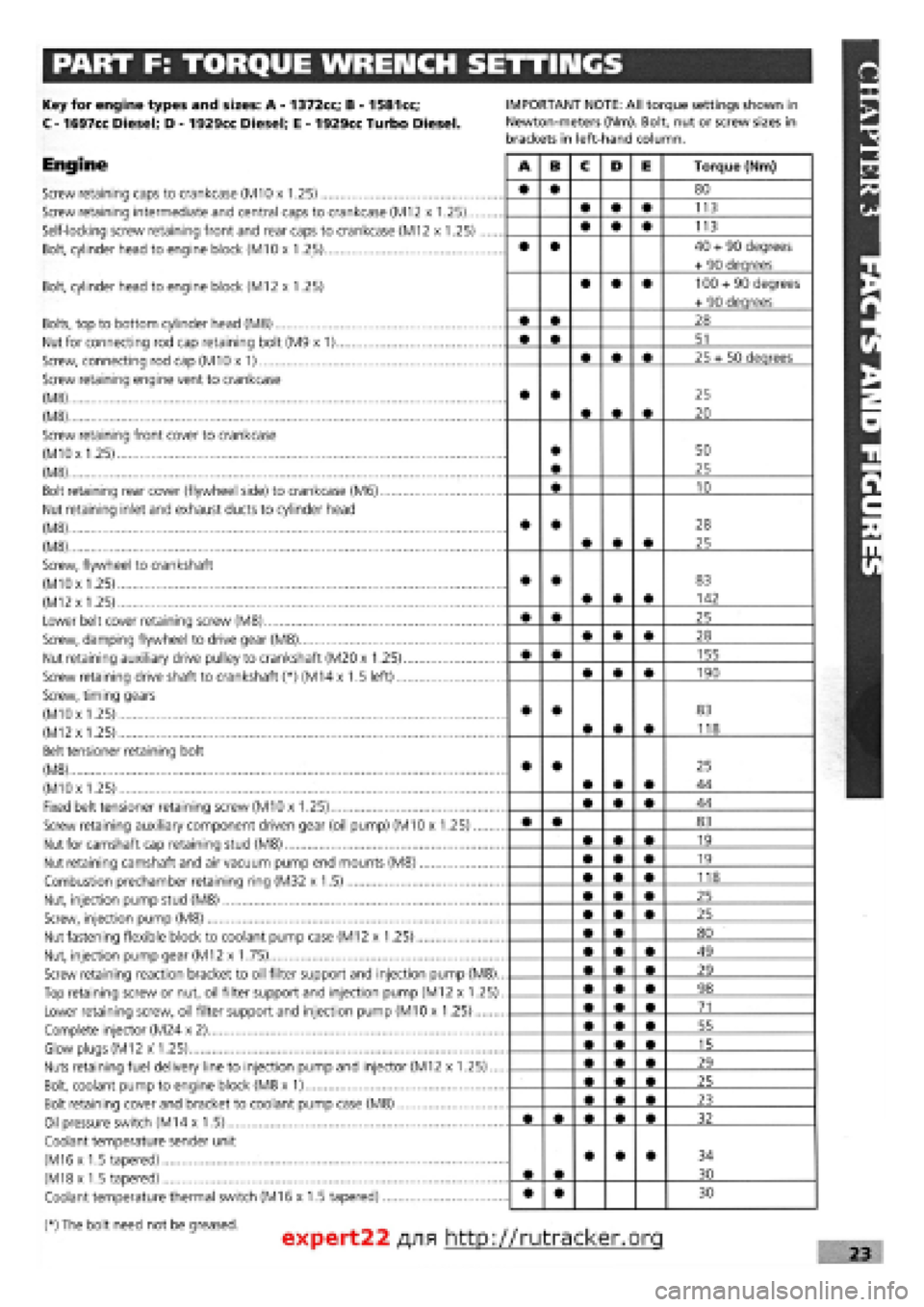
PART F: TORQUE WRENCH SETTINGS
Key for engine types and sizes: A
-
1372cc; B
-
1581cc;
C
-
1697cc Diesel; D
-
1929cc Diesel; E
-
1929cc Turbo Diesel.
Engine
Screw retaining caps to crankcase (M10 x 1.25)
Screw retaining intermediate and central caps to crankcase (M12 x 1.25)...
Self-locking screw retaining front and rear caps to crankcase (M12 x 1.25)
Bolt, cylinder head to engine block (M10 x 1.25)
IMPORTANT NOTE: All torque settings shown in
Newton-meters (Nm). Bolt, nut or screw sizes in
brackets in left-hand column.
Bolt, cylinder head to engine block (M12 x 1.25)
Bolts, top to bottom cylinder head (M8)
Nut for connecting rod cap retaining bolt (M9 x 1)
Screw, connecting rod cap (M10 x 1)
Screw retaining engine vent to crankcase
(M8)
(M8)
Screw retaining front cover to crankcase
(MlOx 1.25)
(M8)
Bolt retaining rear cover (flywheel side) to crankcase (M6)
Nut retaining inlet and exhaust ducts to cylinder head
(M8)
(M8)
Screw, flywheel to crankshaft
(M10x 1.25)
(M12
x
1.25)
Lower belt cover retaining screw (M8)
Screw, damping flywheel to drive gear (M8)
Nut retaining auxiliary drive pulley to crankshaft (M20 x 1.25)
Screw retaining drive shaft to crankshaft (*) (M14 x 1.5 left)
Screw, timing gears
(M10x 1.25)
(M12x 1.25)
Belt tensioner retaining bolt
(M8)
(M10x 1.25)
Fixed belt tensioner retaining screw (M10 x 1.25)
Screw retaining auxiliary component driven gear (oil pump) (M10 x 1.25)
Nut for camshaft cap retaining stud (M8)
Nut retaining camshaft and air vacuum pump end mounts (M8)
Combustion prechamber retaining ring (M32 x 1.5)
Nut, injection pump stud (M8)
Screw, injection pump (M8)
Nut fastening flexible block to coolant pump case (M12 x 1.25)
Nut, injection pump gear (M12 x 1.75)
Screw retaining reaction bracket to oil filter support and injection pump (M8).
Top retaining screw or nut, oil filter support and injection pump (M12 x 1.25)
Lower retaining screw, oil filter support and injection pump (M10 x 1.25)
Complete injector (M24 x 2)
Glow plugs (M12 x 1.25)
Nuts retaining fuel delivery line to injection pump and injector (M12 x 1.25)...
Bolt, coolant pump to engine block (M8 x 1)
Bolt retaining cover and bracket to coolant pump case (M8)
Oil pressure switch (M14 x 1.5)
Coolant temperature sender unit
(M16 x 1.5 tapered)
(M18x 1.5 tapered)
Coolant temperature thermal switch (M16 x 1.5 tapered)
(*) The bolt need not be greased.
A B C D E Torque (Nm)
• • 80
• • • 113
• • • 113
• • 40
+
90 degrees
+ 90 deqrees
• • • 100
+
90 degrees
+ 90 deqrees
• • 28
• • 51
• • • 25 + 50 deqrees
• •
• • •
25
20
• • 50
25
• 10
• •
• • •
28
25
• •
• • •
83
142
• • 25
• • • 28
• • 155
• • • 190
• •
• • •
83
118
• •
• • •
25
44
• • • 44
• • 83
• • • 19
• • • 19
• • • 118
• • • 25
• • • 25
• • 80
• • • 49
• • • 29
• • • 98
• • • 71
• • • 55
• • • 15
• • • 29
• • • 25
• • • 23
32
• •
• • • 34
30
• • 30
expert22 fl/i* http://rutracker.org 23
Page 20 of 171
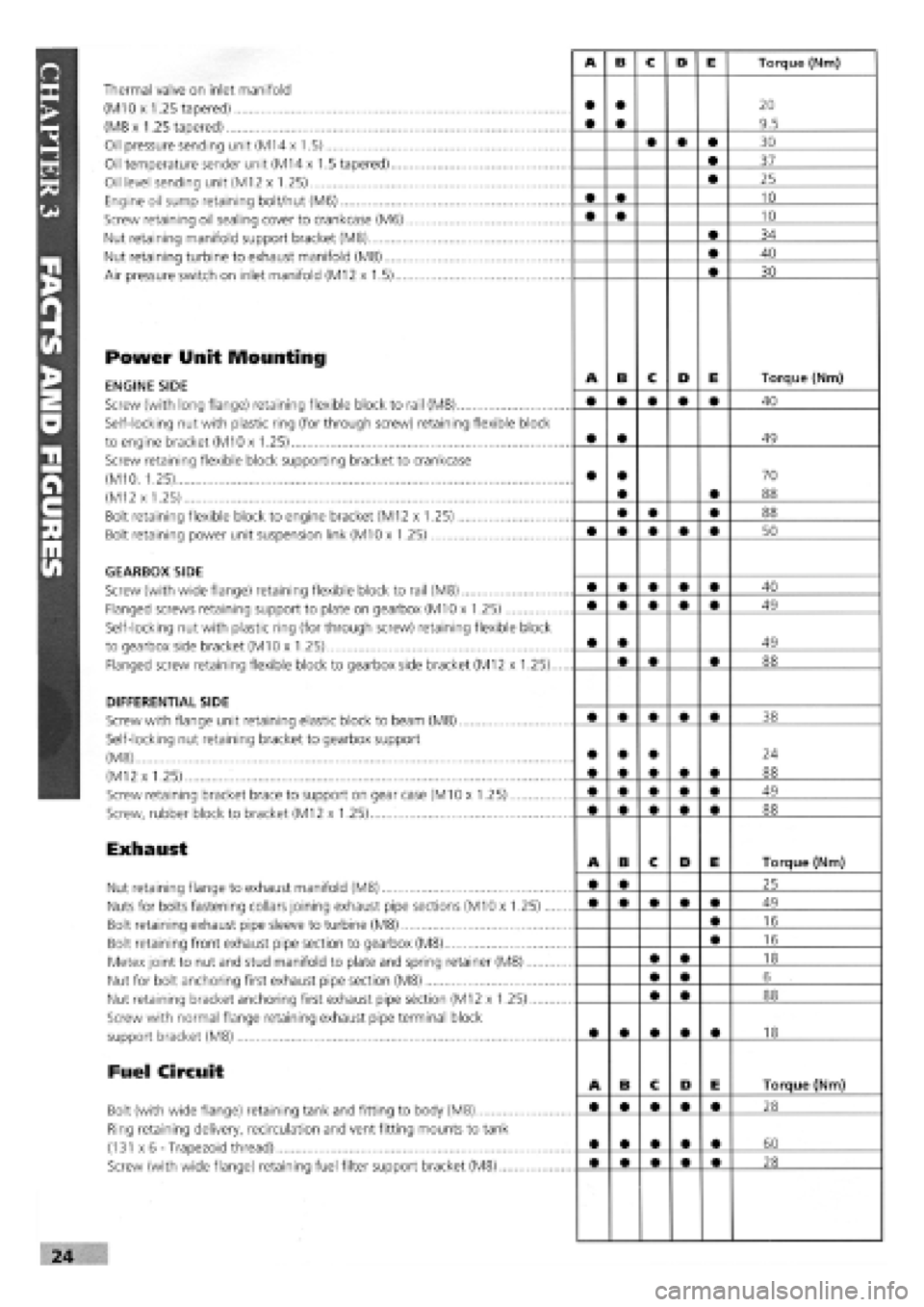
Thermal valve on inlet manifold
(M10 x 1.25 tapered)
(M8 x 1.25 tapered)
Oil pressure sending unit (M14 x 1.5)
Oil temperature sender unit (M14 x 1.5 tapered)....
Oil level sending unit (M12 x 1.25)
Engine oil sump retaining bolt/nut (M6)
Screw retaining oil sealing cover to crankcase (M6)
Nut retaining manifold support bracket (M8)
Nut retaining turbine to exhaust manifold (M8)
Air pressure switch on inlet manifold (M12 x 1.5)...
Power Unit Mounting
ENGINE SIDE
Screw (with long flange) retaining flexible block to rail (M8)
Self-locking nut with plastic ring (for through screw) retaining flexible block
to engine bracket (M10 x 1.25)
Screw retaining flexible block supporting bracket to crankcase
(M10. 1.25)
(M12 x 1.25)
Bolt retaining flexible block to engine bracket (M12 x 1.25)
Bolt retaining power unit suspension link (M10 x 1.25)
GEARBOX SIDE
Screw (with wide flange) retaining flexible block to rail (M8)
Flanged screws retaining support to plate on gearbox (M10 x 1.25)
Self-locking nut with plastic ring (for through screw) retaining flexible block
to gearbox side bracket (M10 x 1.25)
Flanged screw retaining flexible block to gearbox side bracket (M12 x 1.25).
DIFFERENTIAL SIDE
Screw with flange unit retaining elastic block to beam (M8)
Self-locking nut retaining bracket to gearbox support
(M8)
(M12 x 1.25)
Screw retaining bracket brace to support on gear case (M10 x 1.25)
Screw, rubber block to bracket (M12 x 1.25)
Exhaust
Nut retaining flange to exhaust manifold (M8)
Nuts for bolts fastening collars joining exhaust pipe sections (M10 x 1.25)...
Bolt retaining exhaust pipe sleeve to turbine (M8)
Bolt retaining front exhaust pipe section to gearbox (M8)
Metex joint to nut and stud manifold to plate and spring retainer (M8)
Nut for bolt anchoring first exhaust pipe section (M8)
Nut retaining bracket anchoring first exhaust pipe section (M12 x 1.25)
Screw with normal flange retaining exhaust pipe terminal block
support bracket (M8)
Fuel Circuit
Bolt (with wide flange) retaining tank and fitting to body (M8)
Ring retaining delivery, recirculation and vent fitting mounts to tank
(131 x 6-Trapezoid thread)
Screw (with wide flange) retaining fuel filter support bracket (M8)
Page 23 of 171
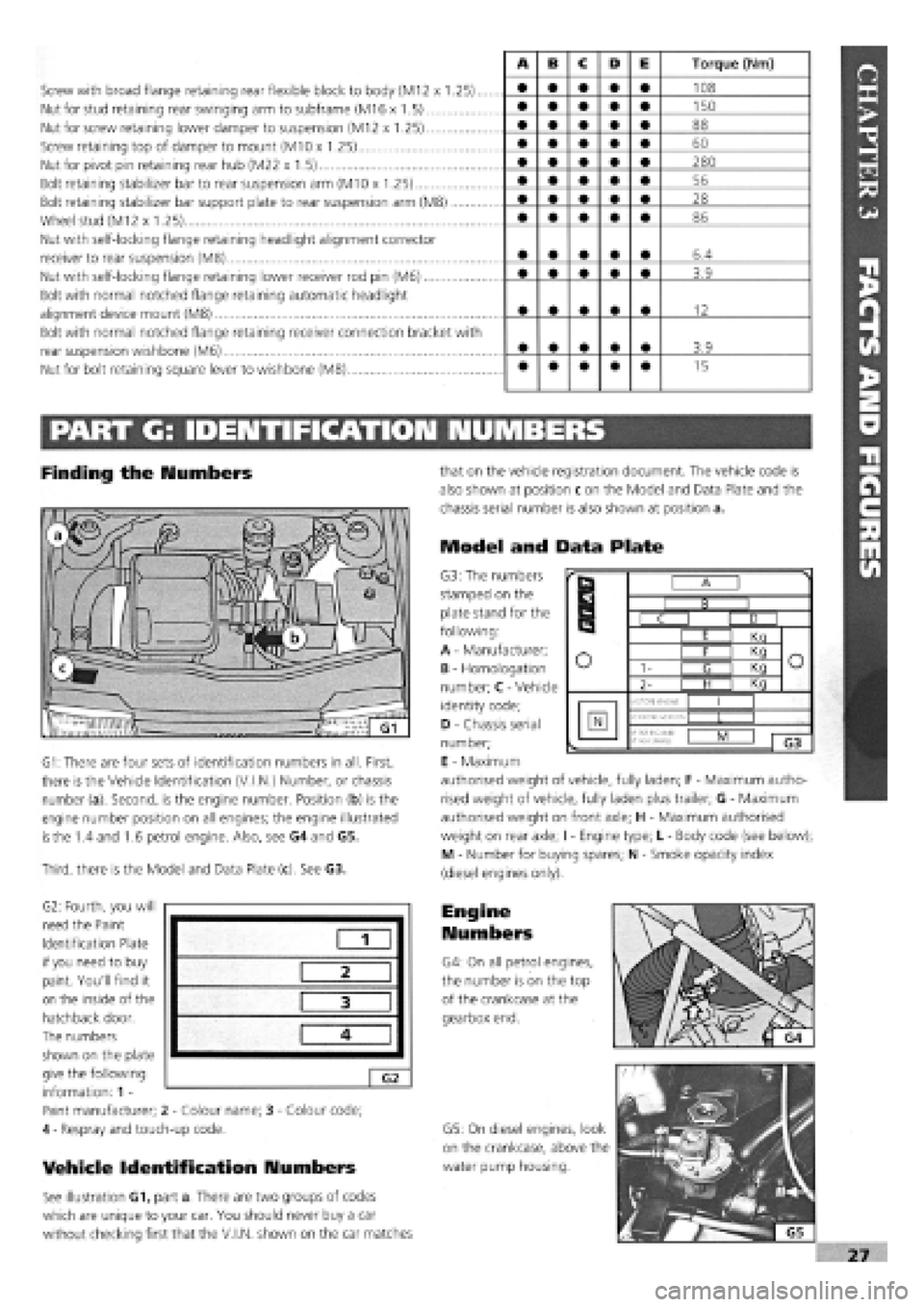
Screw with broad flange retaining rear flexible block to body (M12 x 1.25)..
Nut for stud retaining rear swinging arm to subframe (M16 x 1.5)
Nut for screw retaining lower damper to suspension (M12 x 1.25)
Screw retaining top of damper to mount (M10 x 1.25)
Nut for pivot pin retaining rear hub (M22 x 1.5)
Bolt retaining stabilizer bar to rear suspension arm (M10 x 1.25)
Bolt retaining stabilizer bar support plate to rear suspension arm (M8)
Wheel stud (M12 x 1.25)
Nut with self-locking flange retaining headlight alignment corrector
receiver to rear suspension (M8)
Nut with self-locking flange retaining lower receiver rod pin (M6)
Bolt with normal notched flange retaining automatic headlight
alignment device mount (M8)
Bolt with normal notched flange retaining receiver connection bracket with
rear suspension wishbone (M6)
Nut for bolt retaining square lever to wishbone (M8)
A B c D E Torque (Nm)
• • • • • 108
• • • • • 150
• • • • • 88
• • • • • 60
• • • • • 280
• • • • • 56
• • • • • 28
• • • • • 86
• • • • • 6.4
• • • • • 3.9
• • • • • 12
• • • • • 3.9
• • • • • 15
PART G: IDENTIFICATION NUMBERS
Finding the Numbers
G1: There are four sets of identification numbers in all. First,
there is the Vehicle Identification (V.I.N.) Number, or chassis
number (a). Second, is the engine number. Position (b) is the
engine number position on all engines; the engine illustrated
is
the 1.4 and 1.6 petrol engine. Also, see G4 and G5.
Third, there is the Model and Data Plate (c). See G3.
G2: Fourth, you will
need the Paint
Identification Plate
if you need to buy
paint. You'll find it
on the inside of the
hatchback door.
The numbers
shown on the plate
give the following
information: 1 -
Paint manufacturer; 2
-
Colour name; 3
-
Colour code;
4
-
Respray and touch-up code.
Vehicle Identification Numbers
See illustration G1, part a. There are two groups of codes
which are unique to your car. You should never buy a car
without checking first that the V.I.N, shown on the car matches
that on the vehicle registration document. The vehicle code is
also shown at position c on the Model and Data Plate and the
chassis serial number is also shown at position a.
Model and Data Plate
G3: The numbers
stamped on the
plate stand for the
following:
A
-
Manufacturer;
B
-
Homologation
number; C
-
Vehicle
identity code;
D
-
Chassis serial
number;
E
-
Maximum
authorised weight of vehicle, fully laden; F
-
Maximum autho-
rised weight of vehicle, fully laden plus trailer; G
-
Maximum
authorised weight on front axle; H
-
Maximum authorised
weight on rear axle; I
-
Engine type; L
-
Body code (see below);
M - Number for buying spares; N
-
Smoke opacity index
(diesel engines only).
Engine
Numbers
G4: On all petrol engines,
the number is on the top
of the crankcase at the
gearbox end.
G5: On diesel engines, look
on the crankcase, above the
water pump housing.
1
2
3
4
G2
r
B
r
B I B I
r
B
C I D I
r
B
I E I Kn
o o I F I Kq o o 1- I <3 I Kq o o
2- | H I Kq
o
MOTORE ENGINE
I I
N VERSIONE-VERSION •f
PER RICAM8:
N*
FOR SPARED
L I
1 G3
Page 25 of 171
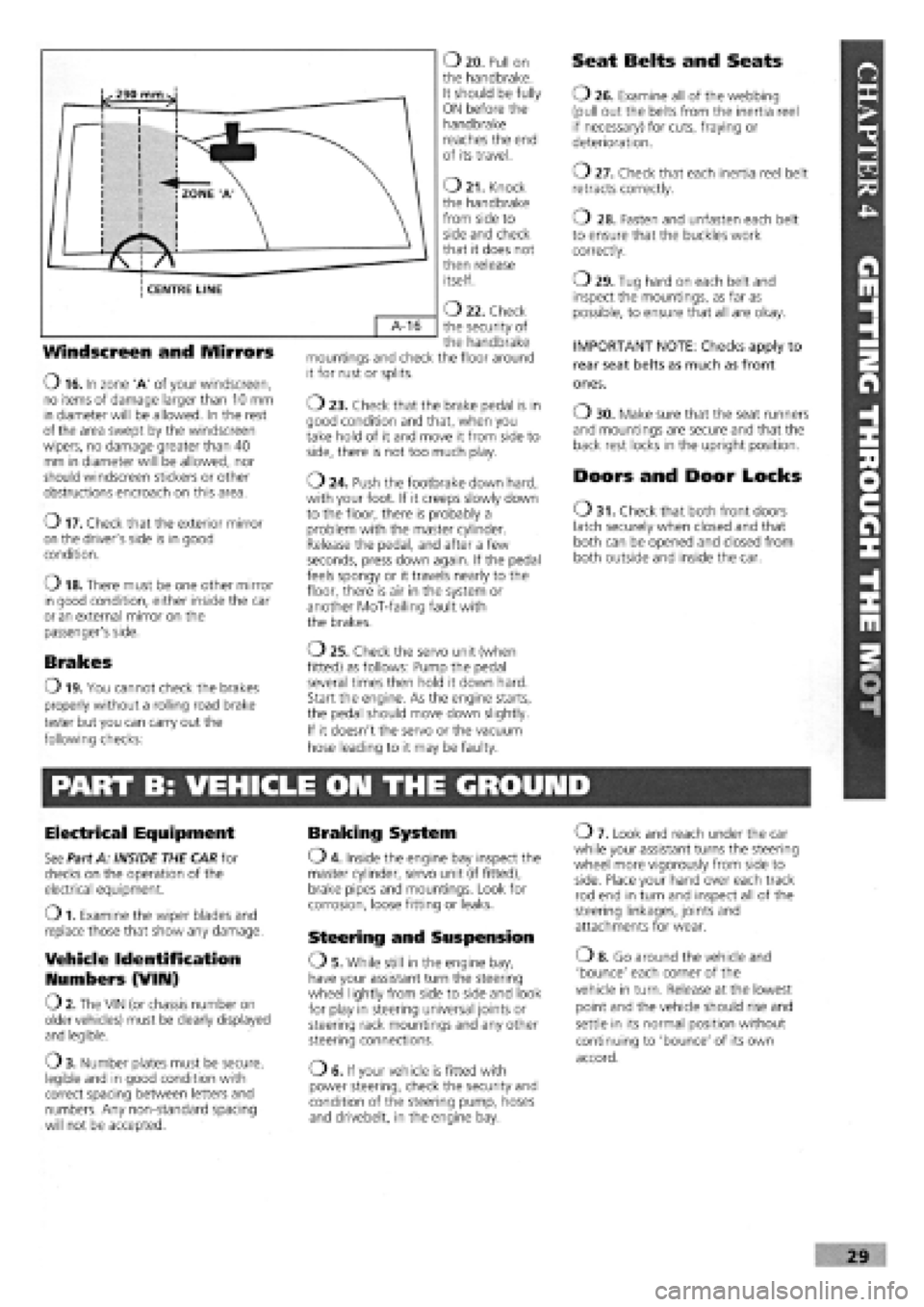
Windscreen and Mirrors
O 16. In zone 'A' of your windscreen, no items of damage larger than 10 mm in diameter will be allowed. In the rest of the area swept by the windscreen wipers, no damage greater than 40 mm in diameter will be allowed, nor should windscreen stickers or other obstructions encroach on this area.
o 17. Check that the exterior mirror on the driver's side is in good condition.
o 18. There must be one other mirror in good condition, either inside the car or an external mirror on the passenger's side.
Brakes
O 19. You cannot check the brakes
properly without a rolling road brake
tester but you can carry out the
following checks:
O 20. Pull on the handbrake. It should be fully ON before the handbrake reaches the end of its travel.
O 21. Knock the handbrake from side to side and check that it does not then release itself.
O 22. Check the security of the handbrake mountings and check the floor around it for rust or splits.
o 23. Check that the brake pedal is in good condition and that, when you take hold of it and move it from side to side, there is not too much play.
o 24. Push the footbrake down hard, with your foot. If it creeps slowly down to the floor, there is probably a problem with the master cylinder. Release the pedal, and after a few seconds, press down again. If the pedal feels spongy or it travels nearly to the floor, there is air in the system or another MoT-failing fault with the brakes.
o 25. Check the servo unit (when
fitted) as follows: Pump the pedal
several times then hold it down hard.
Start the engine. As the engine starts,
the pedal should move down slightly.
If it doesn't the servo or the vacuum
hose leading to it may be faulty.
Seat Belts and Seats
O 26. Examine all of the webbing (pull out the belts from the inertia reel if necessary) for cuts, fraying or deterioration.
o 27. Check that each inertia reel belt retracts correctly.
o 28. Fasten and unfasten each belt to ensure that the buckles work correctly.
o 29. Tug hard on each belt and inspect the mountings, as far as possible, to ensure that all are okay.
IMPORTANT NOTE: Checks apply to
rear seat belts as much as front
ones.
O 30. Make sure that the seat runners and mountings are secure and that the back rest locks in the upright position.
Doors and Door Locks
O 31. Check that both front doors latch securely when closed and that both can be opened and closed from both outside and inside the car.
PART B: VEHICLE ON THE GROUND
Electrical Equipment
See Part A: INSIDE THE CAR for checks on the operation of the electrical equipment.
O 1. Examine the wiper blades and replace those that show any damage.
Vehicle Identification
Numbers (VIIU)
O 2. The VIN (or chassis number on older vehicles) must be clearly displayed and legible.
O 3. Number plates must be secure, legible and in good condition with correct spacing between letters and numbers. Any non-standard spacing will not be accepted.
Braking System
O 4. Inside the engine bay inspect the master cylinder, servo unit (if fitted), brake pipes and mountings. Look for corrosion, loose fitting or leaks.
Steering and Suspension
OS . While still in the engine bay, have your assistant turn the steering wheel lightly from side to side and look for play in steering universal joints or steering rack mountings and any other steering connections.
OE. If your vehicle is fitted with power steering, check the security and condition of the steering pump, hoses and drivebelt, in the engine bay.
O 7. Look and reach under the car while your assistant turns the steering wheel more vigorously from side to side. Place your hand over each track rod end in turn and inspect all of the steering linkages, joints and attachments for wear.
o 8. Go around the vehicle and
'bounce' each corner of the
vehicle in turn. Release at the lowest
point and the vehicle should rise and
settle in its normal position without
continuing to 'bounce' of its own
accord.
Page 27 of 171
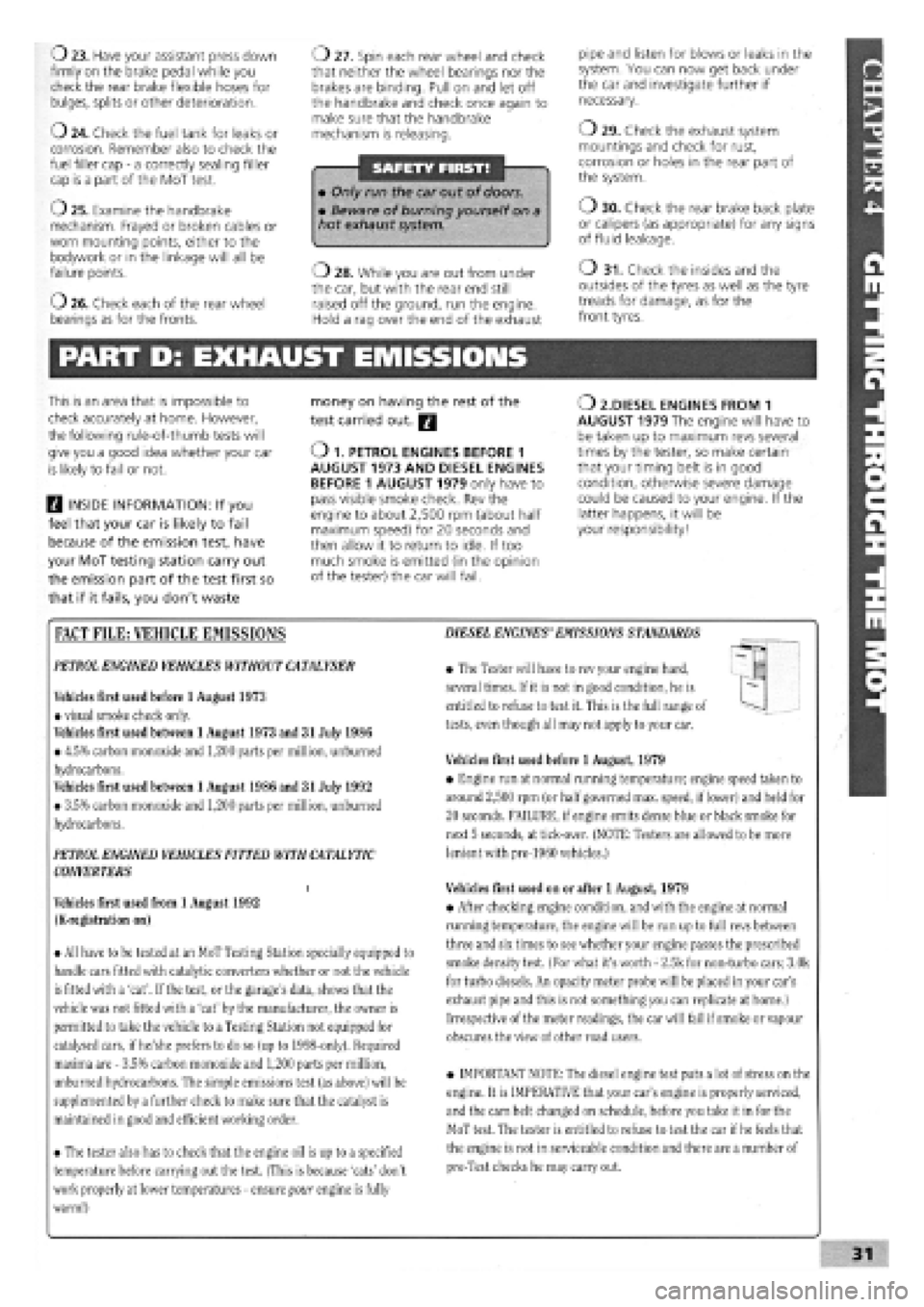
O 23. Have your assistant press down firmly on the brake pedal while you check the rear brake flexible hoses for bulges, splits or other deterioration.
o 24. Check the fuel tank for leaks or corrosion. Remember also to check the fuel filler cap
-
a correctly sealing filler cap is a part of the MoT test.
O 25. Examine the handbrake mechanism. Frayed or broken cables or worn mounting points, either to the bodywork or in the linkage will all be failure points.
o 26. Check each of the rear wheel
bearings as for the fronts.
o 27. Spin each rear wheel and check that neither the wheel bearings nor the brakes are binding. Pull on and let off the handbrake and check once again to make sure that the handbrake mechanism is releasing.
SAFETY FIRST!
• Only run the car out of doors.
• Beware of burning yourself on a hot exhaust system.
o 28. While you are out from under the car, but with the rear end still raised off the ground, run the engine. Hold a rag over the end of the exhaust
pipe and listen for blows or leaks in the system. You can now get back under the car and investigate further if necessary.
o 29. Check the exhaust system mountings and check for rust, corrosion or holes in the rear part of the system.
o 30. Check the rear brake back plate or calipers (as appropriate) for any signs of fluid leakage.
o 31. Check the insides and the outsides of the tyres as well as the tyre treads for damage, as for the front tyres.
PART D: EXHAUST EMISSIONS
This is an area that is impossible to
check accurately at home. However,
the following rule-of-thumb tests will
give you a good idea whether your car
is likely to fail or not.
H INSIDE INFORMATION: If you
feel that your car is likely to fail
because of the emission test, have
your MoT testing station carry out
the emission part of the test first so
that if it fails, you don't waste
money on having the rest of the
test carried out. Q
O 1. PETROL ENGINES BEFORE 1 AUGUST 1973 AND DIESEL ENGINES BEFORE 1 AUGUST 1979 only have to pass visible smoke check. Rev the engine to about 2,500 rpm (about half maximum speed) for 20 seconds and then allow it to return to idle. If too much smoke is emitted (in the opinion of the tester) the car will fail.
O 2.DIESEL ENGINES FROM 1 AUGUST 1979 The engine will have to be taken up to maximum revs several times by the tester, so make certain that your timing belt is in good condition, otherwise severe damage could be caused to your engine. If the latter happens, it will be your responsibility!
FACT FILE: VEHICLE EMISSIONS
PETROL
ENGINED VEHICLES WITHOUT
CATALYSER
Vehicles first used before 1 August 1973
• visual smoke check only.
Vehicles first used between 1 August 1973 and 31 July 1986
• 4.5% carbon monoxide and 1,200 parts per million, unburned
hydrocarbons.
Vehicles first used between 1 August 1986 and 31 July 1992
• 3.5% carbon monoxide and 1,200 parts per million, unburned
hydrocarbons.
PETROL ENGINED VEHICLES FITTED WITH
CATALYTIC
CONVERTERS
i
Vehicles first used from 1 August 1992
(K-registration on)
• All have to be tested at an MoT Testing Station specially equipped to
handle cars fitted with catalytic converters whether or not the vehicle
is fitted with a 'cat'. If
the
test, or the garage's data, shows that the
vehicle was not fitted with a 'cat' by the manufacturer, the owner is
permitted to take the vehicle to
a
Testing Station not equipped for
catalysed cars, if he/she prefers to do so (up to 1998-only). Required
maxima are
-
3.5% carbon monoxide and 1,200 parts per million,
unburned hydrocarbons. The simple emissions test (as above) will be
supplemented by a further check to make sure that the catalyst is
maintained in
good
and efficient working order.
• The tester also has to check that the engine oil is up to a specified
temperature before carrying out the test. (This is because 'cats' don't
work properly at lower temperatures
-
ensure your engine is fully
warm!)
DIESEL ENGINES'EMISSIONS
STANDARDS
• The Tester will have to rev your engine hard,
several times. If it is not in good condition, he is
entitled to refuse to test it. This is the full range of
tests, even though all may not apply to your car.
Vehicles first used before 1 August, 1979
• Engine run at normal running temperature; engine speed taken to
around 2,500 rpm (or half
governed
max. speed, if lower) and held for
20 seconds. FAILURE, if engine emits dense blue or black smoke for
next 5 seconds, at tick-over. (NOTE: Testers are allowed to be more
lenient with pre-1960 vehicles.)
Vehicles first used on or after 1 August, 1979
• After checking engine condition, and with the engine at normal
running temperature, the engine will be run up to full revs between
three and six times to see whether your engine passes the prescribed
smoke density test. (For what it's worth
-
2.5k for non-turbo cars; 3.0k
for turbo diesels. An opacity meter probe will be placed in your car's
exhaust pipe and this is not something you can replicate at home.)
Irrespective of the meter readings, the car will fail if
smoke
or vapour
obscures the view of other road users.
• IMPORTANT NOTE: The diesel engine test puts a lot of stress on the
engine. It is IMPERATIVE that your car's engine is properly serviced,
and the cam belt changed on schedule, before you take it in for the
MoT test. The tester is entitled to refuse to test the car if
he
feels that
the engine is not in serviceable condition and there are a number of
pre-Test checks he may carry out.
Page 28 of 171
Please read the whole of the Introduction to this Chapter before carrying out any work on your car.
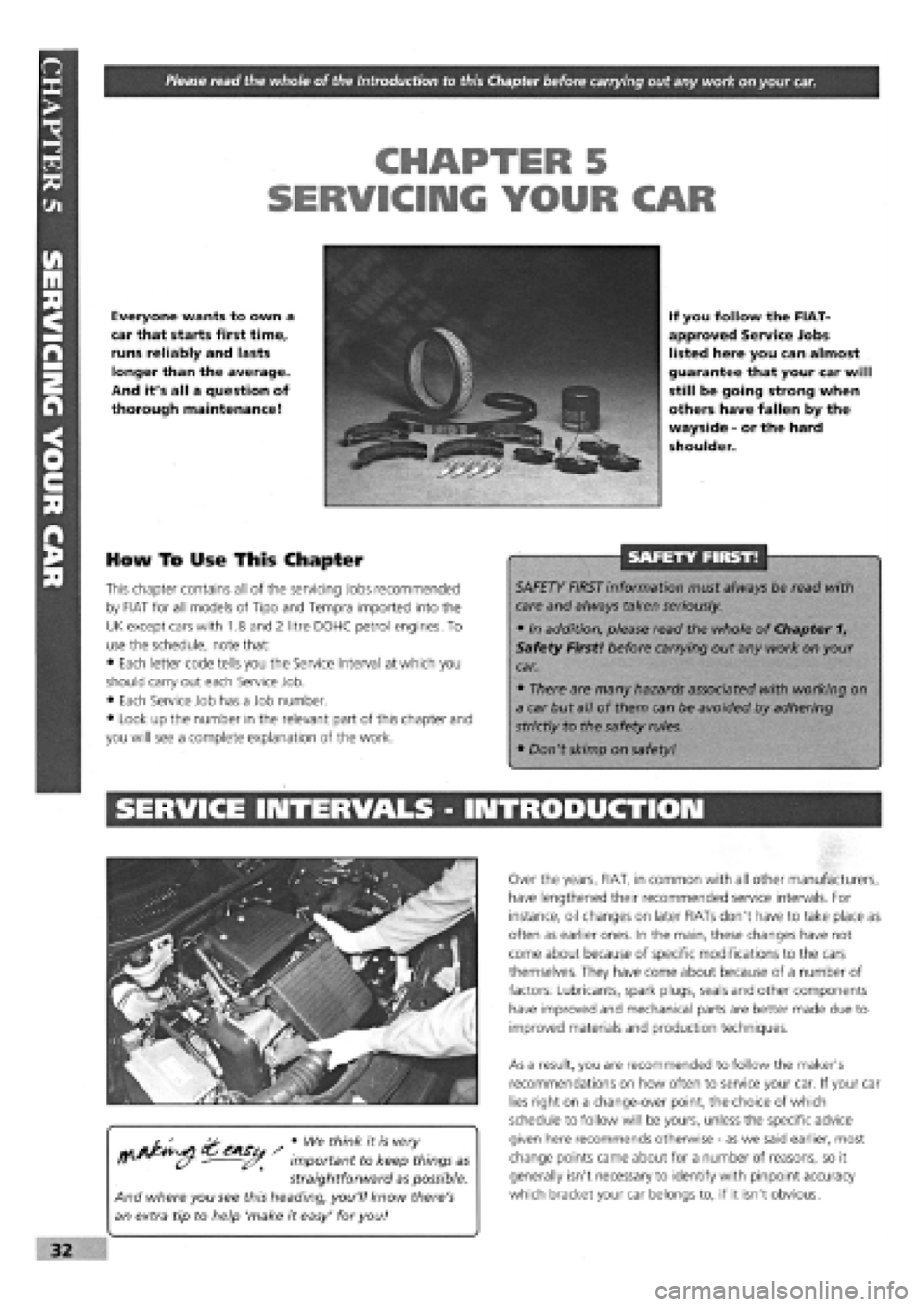
CHAPTER 5
SERVICING YOUR CAR
Everyone wants to own a
car that starts first time,
runs reliably and lasts
longer than the average.
And it's all a question of
thorough maintenance!
If you follow the FIAT-
approved Service Jobs
listed here you can almost
guarantee that your car will
still be going strong when
others have fallen by the
wayside
-
or the hard
shoulder.
How To Use This Chapter
This chapter contains all of the servicing Jobs recommended
by FIAT for all models of Tipo and Tempra imported into the
UK except cars with 1.8 and 2 litre DOHC petrol engines. To
use the schedule, note that:
• Each letter code tells you the Service Interval at which you
should carry out each Service Job.
• Each Service Job has a Job number.
• Look up the number in the relevant part of this chapter and
you will see a complete explanation of the work.
SAFETY FIRST!
SAFETY FIRST information must always be read with
care and always taken seriously.
• In addition, please read the whole of Chapter 1,
Safety First! before carrying out any work on your
car.
• There are many hazards associated with working on
a car but all of them can be avoided by adhering
strictly to the safety rules.
• Don't skimp on safety!
SERVICE INTERVALS - INTRODUCTION
• We think it is very
important to keep things as
straightforward as possible.
And where you see this heading, you'll know there's
an extra tip to help 'make it easy' for you!
Over the years, FIAT, in common with all other manufacturers,
have lengthened their recommended service intervals. For
instance, oil changes on later FIATs don't have to take place as
often as earlier ones. In the main, these changes have not
come about because of specific modifications to the cars
themselves. They have come about because of a number of
factors: Lubricants, spark plugs, seals and other components
have improved and mechanical parts are better made due to
improved materials and production techniques.
As a result, you are recommended to follow the maker's
recommendations on how often to service your car. If your car
lies right on a change-over point, the choice of which
schedule to follow will be yours, unless the specific advice
given here recommends otherwise
-
as we said earlier, most
change points came about for a number of reasons, so it
generally isn't necessary to identify with pinpoint accuracy
which bracket your car belongs to, if it isn't obvious.
32
Page 29 of 171
Thanks
are due to the excellent, knowledgeable and helpful staff at FIAT main dealers, Ryauto of Amblecote, in the West
Midlands for supplying vehicles and for their assistance with this chapter. In particular, thanks are due to the efficient Maurice
Hough, Service Manager, the experienced Foreman, Tony Morris, and young demon mechanic, Matthew Worsfold.
Some of the suggested inspection/replacement intervals may not correspond to those shown in the original handbook. The suggested
schedule, based on FIAT'S recommendations, takes into account the age of the vehicle and the annual MoT test in the UK.
In practice, because of the split between (mainly) 12 month/9,000 mile and 18 month/13,500 mile intervals, you will need to
service your Tipo or Tempra at most, if not every, 6 month interval.
IMPORTANT NOTE: Each service should be carried out at EITHER the recommended mileage OR the recommended time
interval, whichever comes first.
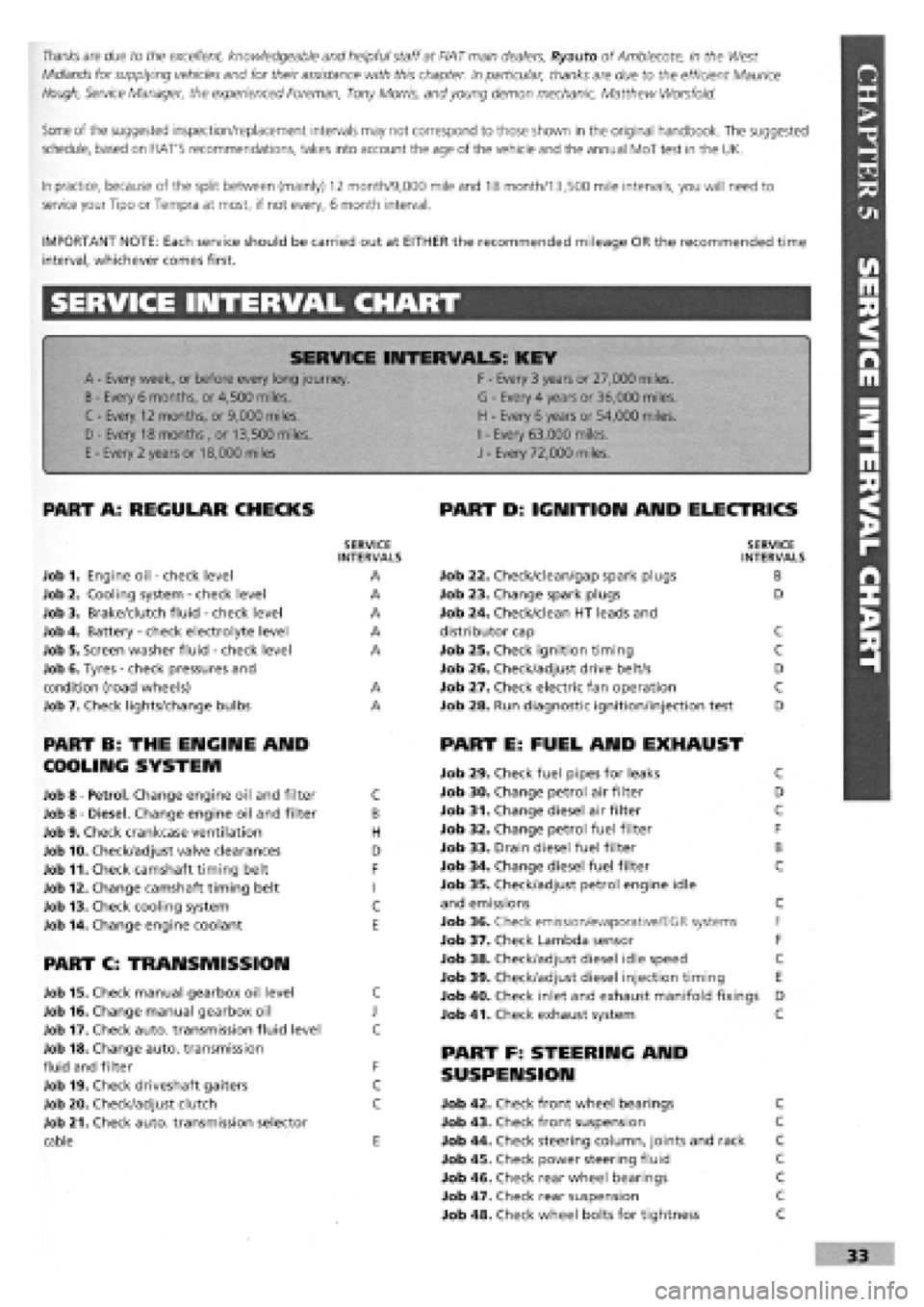
SERVICE INTERVAL CHART
SERVICE INTERVALS: KEY
A
-
Every week, or before every long journey. F
-
Every 3 years or 27,000 miles.
B
-
Every 6 months, or 4,500 miles. G
-
Every 4 years or 36,000 miles.
C - Every 12 months, or 9,000 miles. H
-
Every 6 years or 54,000 miles.
I
-
Every 63,000 miles. D - Every 18 months , or 13,500 miles.
H
-
Every 6 years or 54,000 miles.
I
-
Every 63,000 miles.
E
-
Every 2 years or 18,000 miles J
-
Every 72,000 miles.
PART A: REGULAR CHECKS
SERVICE INTERVALS
Job 1. Engine oil
-
check level A
Job 2. Cooling system
-
check level A
Job 3. Brake/clutch fluid
-
check level A
Job 4. Battery
-
check electrolyte level A
Job 5. Screen washer fluid
-
check level A
Job 6. Tyres
-
check pressures and
condition (road wheels) A
Job 7. Check lights/change bulbs A
PART B: THE ENGINE AND
COOLING SYSTEM
Job 8
-
Petrol. Change engine oil and filter C
Job 8
-
Diesel. Change engine oil and filter B
Job 9. Check crankcase ventilation H
Job 10. Check/adjust valve clearances D
Job 11. Check camshaft timing belt F
Job 12. Change camshaft timing belt I
Job 13. Check cooling system C
Job 14. Change engine coolant E
PART C: TRANSMISSION
Job 15. Check manual gearbox oil level C
Job 16. Change manual gearbox oil J
Job 17. Check auto, transmission fluid level C
Job 18. Change auto, transmission
fluid and filter F
Job 19. Check driveshaft gaiters C
Job 20. Check/adjust clutch C
Job 21. Check auto, transmission selector
cable E
PART D: IGNITION AND ELECTRICS
SERVICE INTERVALS
Job 22. Check/clean/gap spark plugs B
Job 23. Change spark plugs D
Job 24. Check/clean HT leads and
distributor cap C
Job 25. Check ignition timing C
Job 26. Check/adjust drive belt/s D
Job 27. Check electric fan operation C
Job 28. Run diagnostic ignition/injection test D
PART E: FUEL AND EXHAUST
Job 29. Check fuel pipes for leaks C
Job 30. Change petrol air filter D
Job 31. Change diesel air filter C
Job 32. Change petrol fuel filter F
Job 33. Drain diesel fuel filter B
Job 34. Change diesel fuel filter C
Job 35. Check/adjust petrol engine idle
and emissions C
Job 36. Check emission/evaporative/EGR systems F
Job 37. Check Lambda sensor F
Job 38. Check/adjust diesel idle speed C
Job 39. Check/adjust diesel injection timing E
Job 40. Check inlet and exhaust manifold fixings D
Job 41. Check exhaust system C
PART F: STEERING AND
SUSPENSION
Job 42. Check front wheel bearings C
Job 43. Check front suspension C
Job 44. Check steering column, joints and rack C
Job 45. Check power steering fluid C
Job 46. Check rear wheel bearings C
Job 47. Check rear suspension C
Job 48. Check wheel bolts for tightness C