warning FORD B MAX 2012 1.G Manual Online
[x] Cancel search | Manufacturer: FORD, Model Year: 2012, Model line: B MAX, Model: FORD B MAX 2012 1.GPages: 256, PDF Size: 19.67 MB
Page 141 of 256
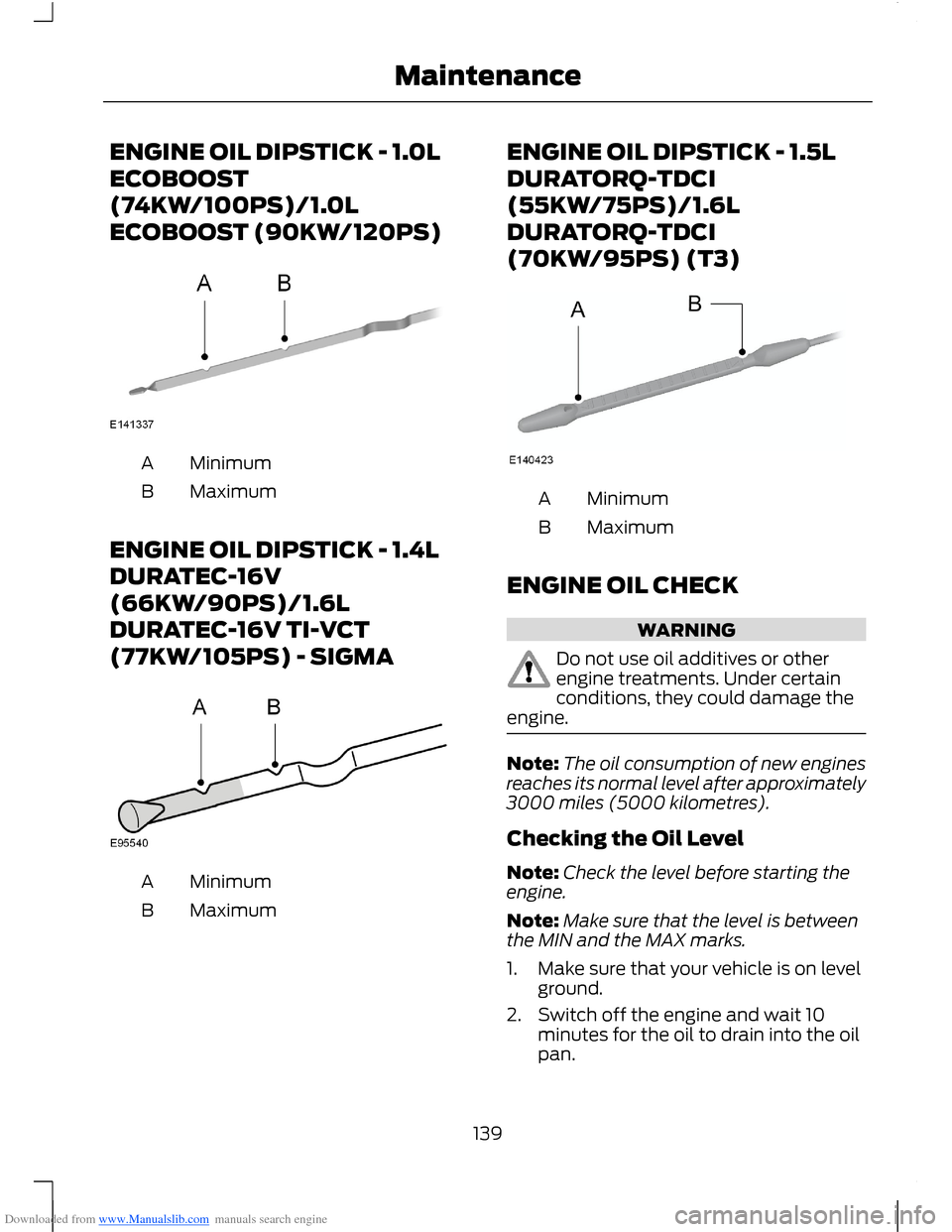
Downloaded from www.Manualslib.com manuals search engine ENGINE OIL DIPSTICK - 1.0L
ECOBOOST
(74KW/100PS)/1.0L
ECOBOOST (90KW/120PS)
MinimumA
MaximumB
ENGINE OIL DIPSTICK - 1.4L
DURATEC-16V
(66KW/90PS)/1.6L
DURATEC-16V TI-VCT
(77KW/105PS) - SIGMA
MinimumA
MaximumB
ENGINE OIL DIPSTICK - 1.5L
DURATORQ-TDCI
(55KW/75PS)/1.6L
DURATORQ-TDCI
(70KW/95PS) (T3)
MinimumA
MaximumB
ENGINE OIL CHECK
WARNING
Do not use oil additives or otherengine treatments. Under certainconditions, they could damage theengine.
Note:The oil consumption of new enginesreaches its normal level after approximately3000 miles (5000 kilometres).
Checking the Oil Level
Note:Check the level before starting theengine.
Note:Make sure that the level is betweenthe MIN and the MAX marks.
1.Make sure that your vehicle is on levelground.
2.Switch off the engine and wait 10minutes for the oil to drain into the oilpan.
139Maintenance
Page 142 of 256
Downloaded from www.Manualslib.com manuals search engine 3.Remove the dipstick and wipe it witha clean, lint free cloth. Replace thedipstick and remove it again to checkthe oil level.
If the level is at the MIN mark, top upimmediately.
Topping Up
WARNINGS
Only top up when the engine is cold.If the engine is hot, wait 10 minutesfor the engine to cool down.
Do not remove the filler cap whenthe engine is running.
Remove the filler cap.
WARNING
Do not top up further than the MAXmark.
Note:Soak up any spillage with anabsorbent cloth immediately.
Top up with fluid that meets the Fordspecification. See TechnicalSpecifications (page 150).
Replace the filler cap. Turn it until you feela strong resistance.
ENGINE COOLANT CHECK
WARNING
Do not allow the fluid to touch yourskin or eyes. If this happens, rinse theaffected areas immediately withplenty of water and contact your doctor.
Note:Make sure that the level is betweenthe MIN and the MAX marks.
Note:Coolant expands when it is hot. Thelevel may therefore extend beyond the MAXmark.
If the level is at the MIN mark, add coolantimmediately.
Adding Engine Coolant
WARNINGS
Only add coolant when the engine iscold. If the engine is hot, wait 10minutes for the engine to cool down.
Do not remove the filler cap whenthe engine is running.
Do not remove the filler cap whenthe engine is hot. Wait for the engineto cool down.
Undiluted coolant is flammable andmay ignite if spilt on a hot exhaust.
Note:In an emergency, you can add justwater to the cooling system to reach avehicle service station. Have the systemchecked by an authorised dealer as soon aspossible.
Note:Prolonged use of incorrect dilutionof the coolant can cause engine damagefrom corrosion, overheating or freezing.
Note:Do not add coolant further than theMAX mark.
1.Remove the filler cap. Any pressure willescape slowly as you unscrew the cap.
2.Add a 50/50 mixture of coolant andwater using fluid that meets the Fordspecifications. See TechnicalSpecifications (page 150).
3.Replace the filler cap. Turn it until youfeel a strong resistance.
140Maintenance
Page 143 of 256
Downloaded from www.Manualslib.com manuals search engine BRAKE AND CLUTCH FLUID
CHECK
WARNINGS
Use of any fluid other than therecommended brake fluid mayreduce brake efficiency and not meetFord's performance standards.
Do not allow the fluid to touch yourskin or eyes. If this happens, rinse theaffected areas immediately withplenty of water and contact your doctor.
If the level is at the MIN mark, havethe system checked by an authoriseddealer as soon as possible.
Note:Keep brake fluid clean and dry.Contamination with dirt, water, petroleumproducts or other materials may result inbrake system damage and possible failure.
Note:The brake and the clutch systems aresupplied from the same reservoir.
Add fluid that meets the Ford specification.See Technical Specifications (page 150).
WASHER FLUID CHECK
Note:The reservoir supplies the front andrear washer systems.
When adding fluid, use a mixture of washerfluid and water to help prevent freezing incold weather and improve the cleaningcapability. We recommend that you useonly high quality washer fluid.
For information on fluid dilution, refer tothe product instructions.
CHANGING THE 12V BATTERY
WARNING
For vehicles with start-stop thebattery requirement is different. Youmust replace the battery with one ofexactly the same specification.
Note:Where applicable you mustreprogram the audio system using thekeycode.
The battery is located in the enginecompartment. See Maintenance (page134).
CHECKING THE WIPER
BLADES
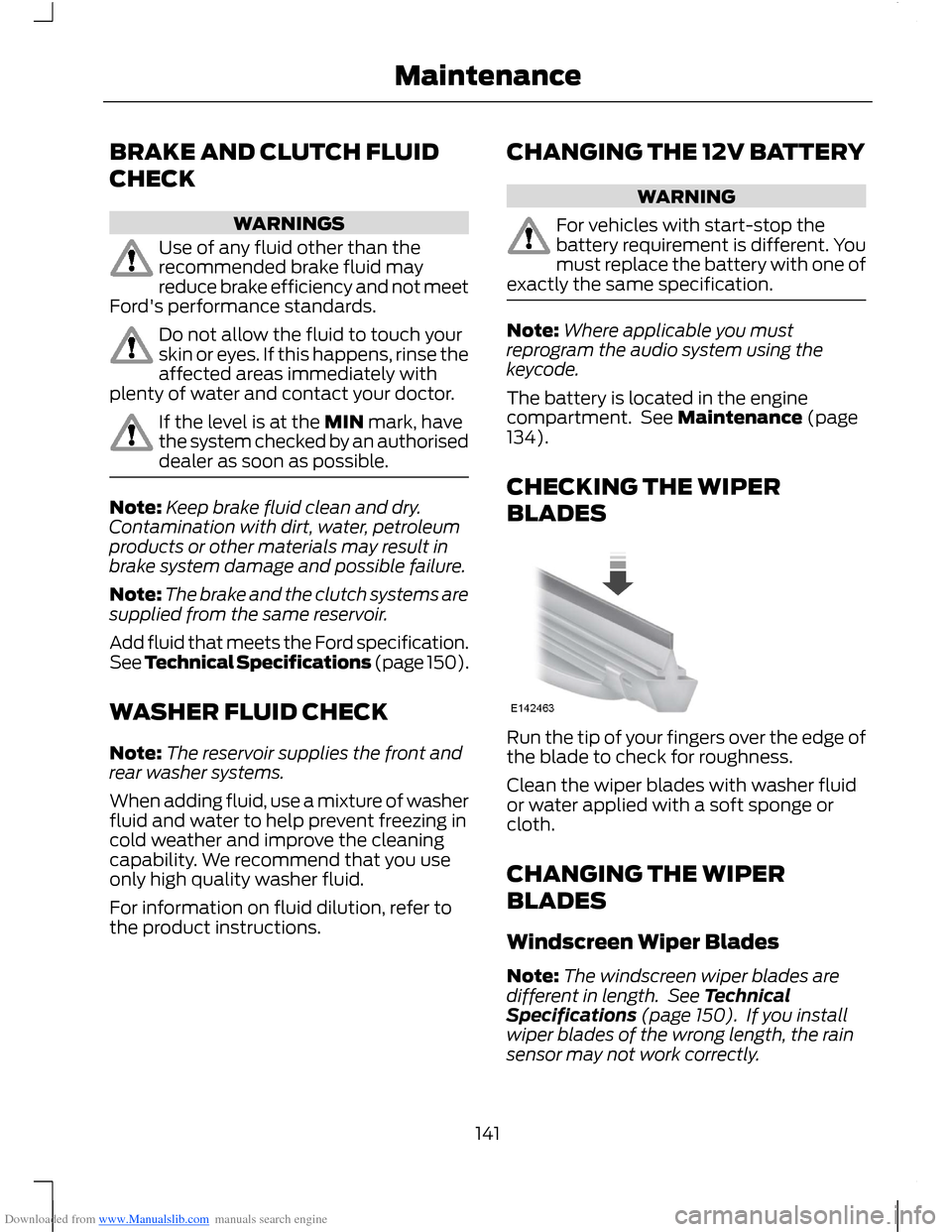
Run the tip of your fingers over the edge ofthe blade to check for roughness.
Clean the wiper blades with washer fluidor water applied with a soft sponge orcloth.
CHANGING THE WIPER
BLADES
Windscreen Wiper Blades
Note:The windscreen wiper blades aredifferent in length. See TechnicalSpecifications (page 150). If you installwiper blades of the wrong length, the rainsensor may not work correctly.
141Maintenance
Page 145 of 256
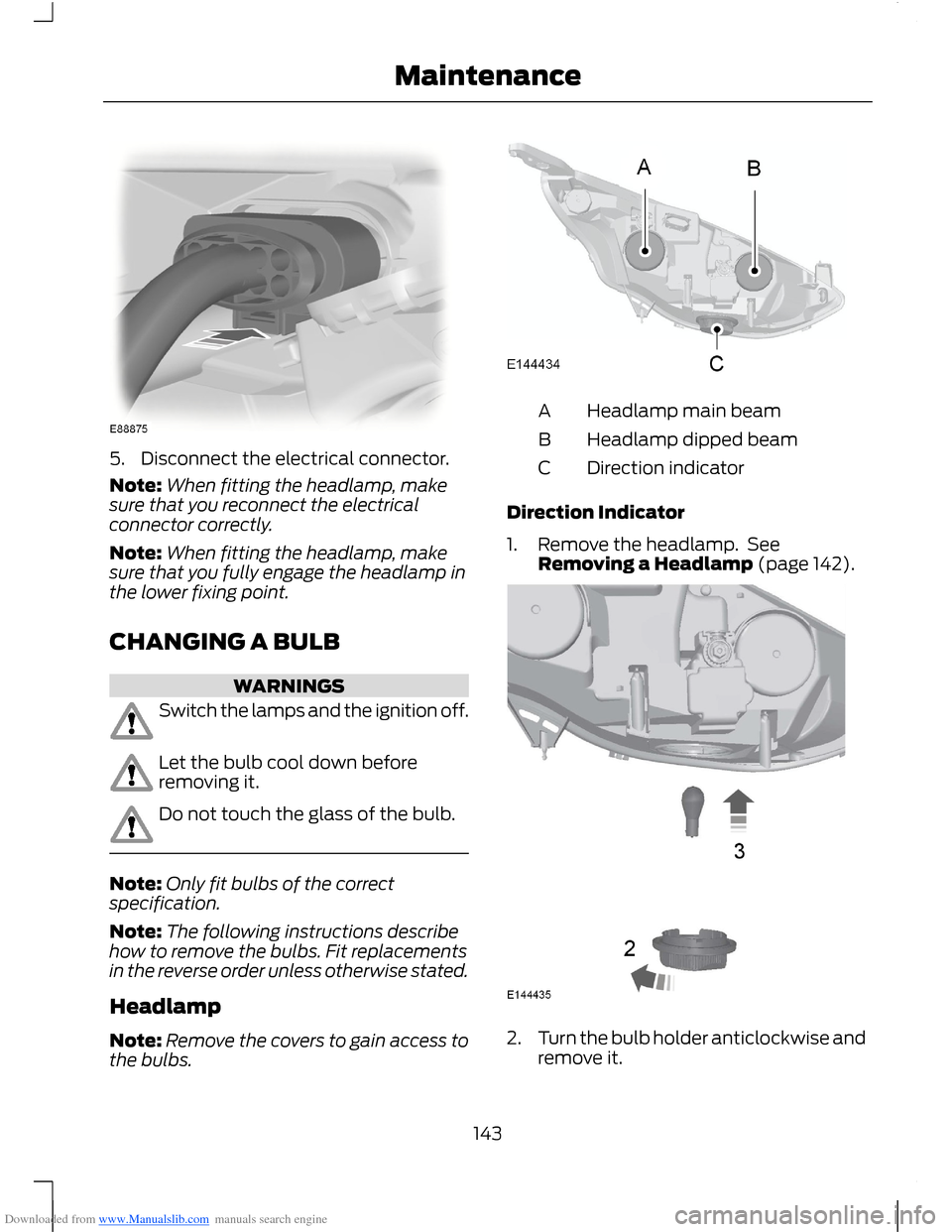
Downloaded from www.Manualslib.com manuals search engine 5.Disconnect the electrical connector.
Note:When fitting the headlamp, makesure that you reconnect the electricalconnector correctly.
Note:When fitting the headlamp, makesure that you fully engage the headlamp inthe lower fixing point.
CHANGING A BULB
WARNINGS
Switch the lamps and the ignition off.
Let the bulb cool down beforeremoving it.
Do not touch the glass of the bulb.
Note:Only fit bulbs of the correctspecification.
Note:The following instructions describehow to remove the bulbs. Fit replacementsin the reverse order unless otherwise stated.
Headlamp
Note:Remove the covers to gain access tothe bulbs.
Headlamp main beamA
Headlamp dipped beamB
Direction indicatorC
Direction Indicator
1.Remove the headlamp. SeeRemoving a Headlamp (page 142).
2.Turn the bulb holder anticlockwise andremove it.
143Maintenance
Page 155 of 256
Downloaded from www.Manualslib.com manuals search engine CLEANING THE EXTERIOR
WARNINGS
If you use a car wash with a waxingcycle, make sure that you remove thewax from the windscreen.
Prior to using a car wash facilitycheck the suitability of it for yourvehicle.
Some car wash installations usewater at high pressure. This coulddamage certain parts of your vehicle.
Remove the aerial before using anautomatic car wash.
Switch the heater blower off toprevent contamination of the freshair filter.
We recommend that you wash your vehiclewith a sponge and lukewarm watercontaining a car shampoo.
Cleaning the Headlamps
WARNINGS
Do not scrape the headlamp lensesor use abrasives, alcoholic solventsor chemical solvents to clean them.
Do not wipe the headlamps whenthey are dry.
Cleaning the Rear Window
WARNING
Do not scrape the inside of the rearwindow or use abrasives or chemicalsolvents to clean it.
Use a clean, lint free cloth or a dampchamois leather to clean the inside of therear window.
Cleaning the Chrome Trim
WARNINGS
Do not use abrasives or chemicalsolvents. Use soapy water.
Do not apply cleaning product to hotsurfaces and do not leave cleaningproduct on chrome surfaces for aperiod of time exceeding that which isrecommended.
Industrial-strength (heavy-duty)cleaners, or cleaning chemicals, maycause damage over a period of time.
Body Paintwork Preservation
WARNINGS
Do not polish your vehicle in strongsunshine.
Do not allow polish to touch plasticsurfaces. It could be difficult toremove.
Do not apply polish to thewindscreen or rear window. Thiscould cause the wipers to becomenoisy and they may not clear the windowproperly.
We recommend that you wax thepaintwork once or twice a year.
CLEANING THE INTERIOR
Seat Belts
WARNINGS
Do not use abrasives, or chemicalsolvents to clean them.
Do not allow moisture to penetratethe seat belt retractor mechanism.
153Vehicle Care
Page 156 of 256
Downloaded from www.Manualslib.com manuals search engine Clean the seat belts with interior cleaneror water applied with a soft sponge. Letthe seat belts dry naturally, away fromartificial heat.
Instrument Cluster Screens, LCDScreens and Radio Screens
WARNING
Do not use abrasives, alcoholicsolvents or chemical solvents toclean them.
Rear Windows
WARNING
Do not use any abrasive materials toclean the interior of the rearwindows.
Note:Do not install stickers or labels to theinterior of the rear windows.
REPAIRING MINOR PAINT
DAMAGE
You should repair paintwork damagecaused by stones from the road or minorscratches as soon as possible. A choice ofproducts are available from an authoriseddealer.
Remove particles such as bird droppings,tree sap, insect deposits, tar spots, roadsalt and industrial fallout before repairingpaint chips.
Always read and follow the manufacturer’sinstructions before using the products.
CLEANING THE ALLOY
WHEELS
Note:Do not apply a cleaning chemical towarm or hot wheel rims and covers.
Note:Industrial-strength (heavy-duty)cleaners, or cleaning chemicals, incombination with brush agitation to removebrake dust and dirt, could wear away theclear coat finish over a period time.
Note:Do not use hydrofluoric acid-basedor high caustic-based wheel cleaners, steelwool, fuels or strong household detergent.
Note:If you intend parking your vehicle foran extended period after cleaning thewheels with a wheel cleaner, drive yourvehicle for a few minutes before doing so.This will reduce the risk of increasedcorrosion of the brake discs, brake pads andlinings.
Note:Some automatic car washes maycause damage to the finish on your wheelrims and covers.
Alloy wheels and wheel covers are coatedwith a clear coat paint finish. To maintaintheir condition we recommend that you:
•Clean them weekly with therecommended wheel and tyre cleaner.
•Use a sponge to remove heavydeposits of dirt and brake dustaccumulation.
•Rinse them thoroughly with apressurised stream of water when youhave completed the cleaning process.
We recommend that you use Ford servicewheel cleaner. Make sure that you readand follow the manufacturer’s instructions.
Using other non-recommended cleaningproducts can result in severe andpermanent cosmetic damage.
154Vehicle Care
Page 157 of 256
Downloaded from www.Manualslib.com manuals search engine GENERAL INFORMATION
A decal with tyre pressure data is locatedin the driver’s door opening.
Check and set the tyre pressure at theambient temperature in which you areintending to drive your vehicle and whenthe tyres are cold.
Note:Check your tyre pressures regularlyto optimise fuel economy.
Note:Use only approved wheel and tyresizes. Using other sizes could damage yourvehicle and will make the National TypeApproval invalid.
Note:If you change the diameter of thetyres from that fitted at the factory, thespeedometer may not display the correctspeed. Take your vehicle to an authoriseddealer to have the engine managementsystem reprogrammed.
Note:If you intend to change the size of thewheels from that fitted at the factory, checkthe suitability with an authorised dealer.
TEMPORARY MOBILITY KIT
Your vehicle may not have a spare tyre.Therefore you will have an emergency kitwhich will only repair one flat tyre.
The kit is located in the spare wheel well.
General Information
WARNINGS
Depending on the type and extent oftyre damage, some tyres can only bepartially sealed or not sealed at all.Loss of tyre pressure can affect vehiclehandling, leading to loss of vehicle control.
Do not use the kit on a previouslydamaged tyre, for example when ithas been driven under inflated.
WARNINGS
Do not use the kit on run flat tyre.
Do not try to seal damage other thanthat located within the visible treadof the tyre.
Do not try to seal damage to thetyre’s sidewall.
The kit seals most tyre punctures [with adiameter of up to 1/4 inch (sixmillimetres)] to temporarily restoremobility.
Observe the following rules when using thekit:
•Drive with caution and avoid makingsudden steering or driving manoeuvres,especially if your vehicle is heavilyloaded or you are towing a trailer.
•The kit will provide you with anemergency temporary repair, enablingyou to continue your journey to the nextvehicle or tyre dealer, or to drive amaximum distance of 125 miles(200 kilometres).
•Do not exceed a maximum speed of50 mph (80 km/h).
•Keep the kit out of the reach ofchildren.
•Only use the kit when the ambienttemperature is between -22°F (–30°C)and +158°F (+70°C).
Using the Kit
WARNINGS
Compressed air can act as anexplosive or propellant.
Never leave the kit unattended whilein use.
Do not keep the compressoroperating for more than 10 minutes.
155Wheels and Tyres
Page 158 of 256
Downloaded from www.Manualslib.com manuals search engine Note:Use the kit only for the vehicle withwhich it was supplied.
•Park your vehicle at the roadside sothat you do not obstruct the flow oftraffic and so that you are able to usethe kit without being in danger.
•Apply the parking brake, even if youhave parked on a level road, to makesure that your vehicle will not move.
•Do not attempt to remove foreignobjects like nails or screws penetratingthe tyre.
•Leave the engine running while the kitis in use, but not if your vehicle is in anenclosed or poorly ventilated area (forexample, inside a building). In thesecircumstances, switch the compressoron with the engine turned off.
•You must replace the sealant bottlewith a new one before the expiry date(see top of bottle).
•Inform all other users of your vehiclethat the tyre has been temporarilysealed with the kit. Make them awareof the special driving conditions to beobserved.
Inflating the Tyre
WARNINGS
Check the sidewall of the tyre priorto inflation. If there are any cracks,bumps or similar damage, do notattempt to inflate the tyre.
Do not stand directly beside the tyrewhile the compressor is pumping.
Watch the sidewall of the tyre. If anycracks, bumps or similar damageappear, turn off the compressor andlet the air out by means of the pressurerelief valve I. Do not continue driving withthis tyre.
WARNINGS
The sealant contains natural rubberlatex. Avoid contact with skin andclothing. If this happens, rinse theaffected areas immediately with plenty ofwater. Consult a doctor if you experiencean adverse reaction.
If the tyre inflation pressure does notreach 26 psi (1.8 bar) within 10minutes, the tyre may have sufferedexcessive damage, making a temporaryrepair impossible. In this case, do notcontinue driving with this tyre.
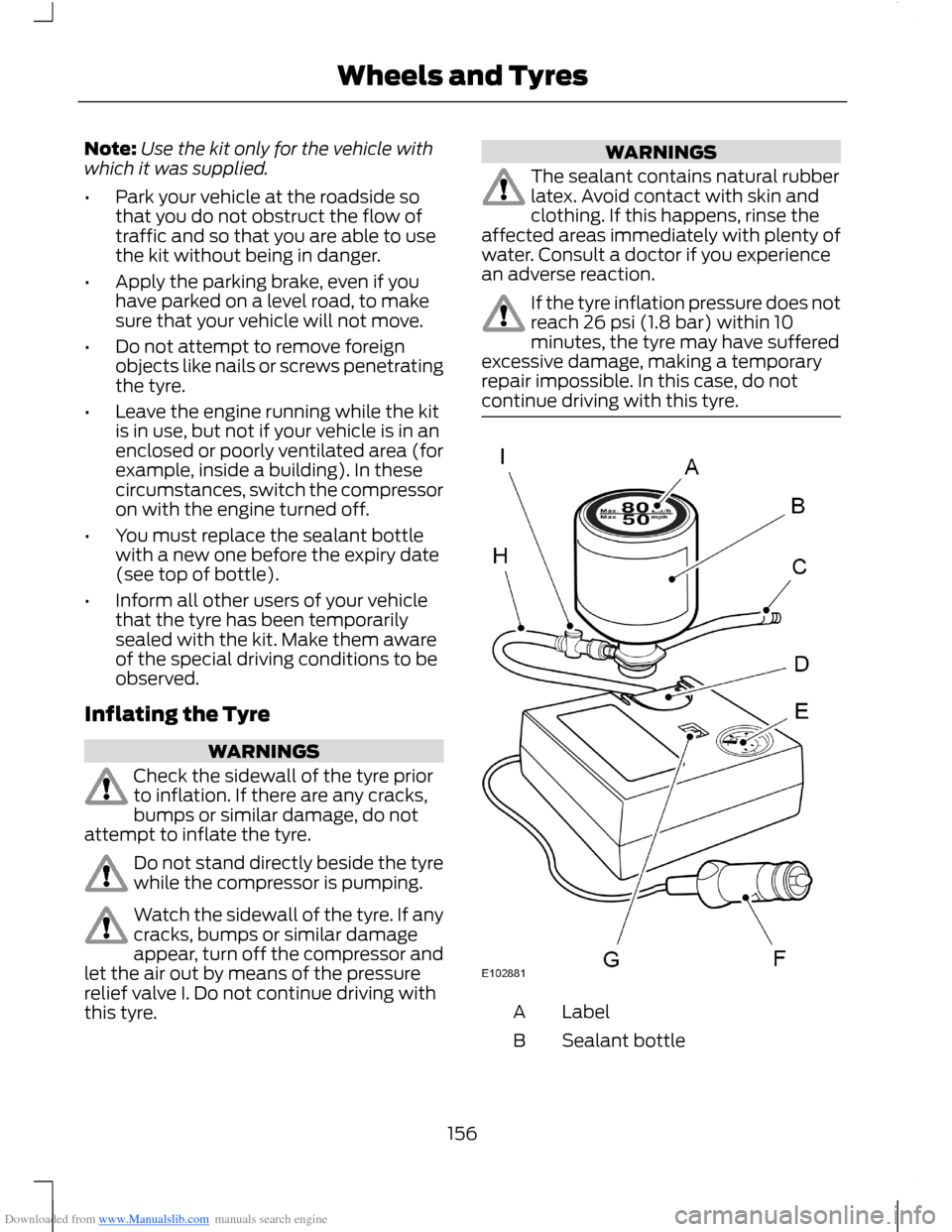
LabelA
Sealant bottleB
156Wheels and Tyres
Page 159 of 256
Downloaded from www.Manualslib.com manuals search engine Sealant bottle hoseC
Bottle holderD
Pressure gaugeE
Power plug with cableF
Compressor switchG
Repair kit hoseH
Pressure relief valveI
1.Remove the kit from the wrapping.
2.Peel off the label A showing themaximum permissible speed of50 mph (80 km/h) from the sealantbottle and attach it to the instrumentpanel in the driver’s field of view. Makesure the label does not obscureanything important.
3.Take the hose H with the pressure reliefvalve I and the power plug with cableF out of the kit.
4.Connect the hose H with the pressurerelief valve I to the sealant bottle B.
5.Engage the sealant bottle B into thebottle holder D.
6.Remove the valve cap from thedamaged tyre.
7.Screw the sealant bottle hose C firmlyonto the valve of the damaged tyre.
8.Make sure that the compressor switchG is in position 0.
9.Insert the power plug F into the cigarlighter socket or auxiliary power socket.See Cigar Lighter (page 81). SeeAuxiliary Power Points (page 81).
10.Start the engine.
11.Move the compressor switch G toposition 1.
12.Inflate the tyre for no longer than 10minutes to an inflation pressure ofminimum 26 psi (1.8 bar) and amaximum of 51 psi (3.5 bar). Movethe compressor switch G to position0 and check the current tyre pressurewith pressure gauge E.
Note:If a tyre pressure of 26 psi (1.8 bar)is not reached do not continue.
Note:When pumping in the sealant throughthe tyre valve, the pressure may rise up to87 psi (6 bar) but will drop again after about30 seconds.
13.Remove the power plug F from thecigar lighter socket or auxiliary powersocket.
14.Quickly unscrew the hose C from thetyre valve. Fasten the valve cap again.
15.Leave the sealant bottle B in thebottle holder D.
16.Make sure the kit is stored safely, butstill easily accessible in your vehicle.The kit will be required again whenyou check the tyre pressure.
17.Immediately drive approximatelytwo miles (three kilometres) so thatthe sealant can seal the damagedarea.
WARNING
If you experience heavy vibrations,unsteady steering behavior or noiseswhile driving, reduce your speed anddrive with caution to a place where it issafe for you to stop your vehicle. Recheckthe tyre and its pressure. If the tyrepressure is less than 14.7 psi (1 bar) or ifthere are any cracks, bumps or similardamage visible, do not continue drivingwith this tyre.
157Wheels and Tyres
Page 160 of 256
Downloaded from www.Manualslib.com manuals search engine 18.Stop your vehicle after drivingapproximately two miles (threekilometres). Check, and wherenecessary, adjust the pressure of thedamaged tyre.
19.Attach the kit and read the tyrepressure from the pressure gauge E.
20.Adjust it to the specified pressure.See Technical Specifications(page 164).
21.Once you have inflated the tyre to itscorrect tyre pressure, move thecompressor switch G to position 0,remove the power plug F from thesocket, unscrew the hose C andfasten the valve cap.
22.Leave hose C and H connected to thesealant bottle B and store the kitaway safely.
23.Go to the nearest tyre specialist toget the damaged tyre replaced.Before the tyre is removed from therim, inform your tyre dealer that thetyre contains sealant. You mustrenew the sealant bottle B and hoseC as soon as possible once used.
Note:Remember that emergency roadsidekits only provide temporary mobility.Regulations concerning tyre repair afterusage of the kit may differ from country tocountry. You should consult a tyre specialistfor advice.
WARNING
You must, make sure the tyre isadjusted to the recommendedinflation pressure. See TechnicalSpecifications (page 164). You must,monitor the tyre pressure until the sealedtyre is replaced.
Empty sealant bottles can be disposed oftogether with normal household waste.Return remains of sealant to your dealeror dispose of it in compliance with localwaste disposal regulations.
TYRE CARE
To make sure the front and rear tyres ofyour vehicle wear evenly and last longer,we recommend that you swap the tyresfrom front to rear and vice versa at regularintervals of between 3000 and 6000 miles(5000 and 10000 kilometres).
WARNING
Do not scrub the sidewalls of thetyres when you are parking.
If you have to mount a kerb, do so slowlyand approach it with the wheels atright-angles to the curb.
Examine the tyres regularly for cuts, foreignobjects and uneven wear of the tread.Uneven wear could mean that the wheelalignment is outside specification.
Check the tyre pressures (including thespare) when cold, every two weeks.
158Wheels and Tyres