warning FORD B MAX 2012 1.G Workshop Manual
[x] Cancel search | Manufacturer: FORD, Model Year: 2012, Model line: B MAX, Model: FORD B MAX 2012 1.GPages: 256, PDF Size: 19.67 MB
Page 91 of 256
Downloaded from www.Manualslib.com manuals search engine START-STOP
Note:For vehicles with start-stop thebattery requirement is different. It must bereplaced by one of exactly the samespecification as the original.
The system reduces fuel consumption andCO2 emissions by shutting down theengine when your vehicle is idling, forexample at traffic lights. The engine willautomatically restart when you press theclutch pedal or when required by a vehiclesystem, for example to recharge thebattery.
To obtain maximum benefit from thesystem, move the transmission selectorlever to neutral and release the clutchpedal during any stop of longer than threeseconds.
Using Start-Stop
WARNINGS
The engine may restartautomatically if required by thesystem.
Switch the ignition off beforeopening the bonnet or carrying outany maintenance.
Always switch the ignition off beforeleaving your vehicle, as the systemmay have shut down the engine butthe ignition will still be live.
Note:The system only operates when theengine is warm and the outside temperatureis between 32°F (0°C) and 86°F (30°C).
Note:If you stall the engine, and thendepress the clutch pedal within a shortperiod of time, the system will automaticallyrestart the engine.
Note:The start-stop indicator willilluminate green when the engine shutsdown. See Warning Lamps and Indicators(page 53).
Note:When the start-stop indicator flashesamber, move the transmission selector leverto neutral or depress the clutch pedal.
Note:If the system detects a malfunction,it will switch off. Have the system checkedby an authorised dealer.
Note:When you switch the system off, theswitch will illuminate.
Note:The system automatically turns onevery time you switch the ignition on. Toswitch the system off, press the switch inthe instrument panel. The system will onlybe switched off for the current ignition cycle.To turn it on, press the switch again. For itemlocation See At a Glance (page 8).
To Stop the Engine
1.Stop your vehicle.
2.Move the transmission selector leverto neutral.
3.Release the clutch pedal.
4.Release the accelerator pedal.
The system may not shut down the engineunder certain conditions, for example:
•To maintain the interior climate.
•Low battery voltage.
•The outside temperature is too low ortoo high.
•The driver's door has been opened.
•Low engine operating temperature.
•Low brake system vacuum.
•If a road speed of 3 mph (5 km/h) hasnot been exceeded.
•The driver's seat belt has not beenfastened.
89Unique Driving Characteristics
Page 93 of 256
Downloaded from www.Manualslib.com manuals search engine SAFETY PRECAUTIONS
WARNINGS
Do not overfill the fuel tank. Thepressure in an overfilled tank maycause leakage and lead to fuel sprayand fire.
The fuel system may be underpressure. If you hear a hissing soundnear the fuel filler door (Easy Fuelcapless fuel system), do not refuel untilthe sound stops. Otherwise, fuel may sprayout, which could cause serious personalinjury.
Automotive fuels can cause seriousinjury or death if misused ormishandled.
The flow of fuel through a fuel pumpnozzle can produce static electricity,which can cause a fire if fuel ispumped into an ungrounded fuel container.
Fuel ethanol and petrol may containbenzene, which is a cancer-causingagent.
When refuelling always shut theengine off and never allow sparks oropen flames near the filler neck.Never smoke while refuelling. Fuel vapouris extremely hazardous under certainconditions. Care should be taken to avoidinhaling excess fumes.
Observe the following guidelines whenhandling automotive fuel:
•Extinguish all smoking materials andany open flames before refuelling yourvehicle.
•Always turn off the vehicle beforerefuelling.
•Automotive fuels can be harmful orfatal if swallowed. Fuel such as petrolis highly toxic and if swallowed cancause death or permanent injury. If fuelis swallowed, call a doctorimmediately, even if no symptoms areimmediately apparent. The toxiceffects of fuel may not be visible forhours.
•Avoid inhaling fuel vapours. Inhalingtoo much fuel vapour of any kind canlead to eye and respiratory tractirritation. In severe cases, excessive orprolonged breathing of fuel vapour cancause serious illness and permanentinjury.
•Avoid getting fuel liquid in your eyes. Iffuel is splashed in the eyes, removecontact lenses (if worn), flush withwater for 15 minutes and seek medicalattention. Failure to seek propermedical attention could lead topermanent injury.
•Fuels can also be harmful if absorbedthrough the skin. If fuel is splashed onthe skin, clothing or both, promptlyremove contaminated clothing andwash skin thoroughly with soap andwater. Repeated or prolonged skincontact with fuel liquid or vapourcauses skin irritation.
•Be particularly careful if you are taking“Antabuse” or other forms of disulfiramfor the treatment of alcoholism.Breathing petrol vapours, or skincontact could cause an adversereaction. In sensitive individuals, seriouspersonal injury or sickness may result.If fuel is splashed on the skin, promptlywash skin thoroughly with soap andwater. Consult a doctor immediately ifyou experience an adverse reaction.
91Fuel and Refuelling
Page 94 of 256
Downloaded from www.Manualslib.com manuals search engine FUEL QUALITY - PETROL
WARNINGS
Do not mix petrol with oil, diesel orother liquids. This could cause achemical reaction.
Do not use leaded petrol or petrolwith additives containing othermetallic compounds (e.g.manganese-based). They could damagethe emission system.
Note:We recommend that you use onlyhigh quality fuel.
Note:We do not recommend the use ofadditional additives or other enginetreatments for normal vehicle use.
Use minimum 95 octane unleaded petrolthat meets the specification defined by EN228 or the equivalent nationalspecification.
Your vehicle is suitable for use with ethanolblends up to 10% (E5 and E10).
Long-Term Storage
Most petrol contains ethanol. Werecommend that you fill the fuel tank withfuel that does not contain ethanol if youintend to store your vehicle for more thantwo months. Alternatively, we recommendthat you seek advice from your dealer.
FUEL QUALITY - DIESEL
WARNINGS
Do not mix diesel with oil, petrol orother liquids. This could cause achemical reaction.
Do not add kerosene, paraffin orpetrol to diesel. This could causedamage to the fuel system.
WARNINGS
Use diesel that meets thespecification defined by EN 590 orthe relevant national specification.
Note:We recommend that you use onlyhigh quality fuel.
Note:We do not recommend the use ofadditional additives or other enginetreatments for normal vehicle use.
Note:We do not recommend the use ofadditional additives to prevent fuel waxing.
Long-Term Storage
Most diesel fuels contain biodiesel. Werecommend that you fill the fuel tank withfuel that does not contain biodiesel if youintend to store your vehicle for more thantwo months. Alternatively, we recommendthat you seek advice from your dealer.
RUNNING OUT OF FUEL
Avoid running out of fuel because thissituation may have an adverse effect onpowertrain components.
If you have run out of fuel:
•You may need to cycle the ignition fromoff to on several times after refuellingto allow the fuel system to pump thefuel from the tank to the engine. Onrestarting, cranking time will take a fewseconds longer than normal. Withkeyless ignition, just start the engine.Crank time will be longer than usual.
•Normally, adding 1 gallon (4.6 litres) offuel is enough to restart the engine. Ifyour vehicle is out of fuel and on asteep slope, more than 1 gallon (4.6litres) may be required.
92Fuel and Refuelling
Page 95 of 256
Downloaded from www.Manualslib.com manuals search engine Refilling With a Portable FuelContainer
WARNINGS
Do not insert the nozzle of portablefuel containers or aftermarketfunnels into the capless fuel system.This could damage the fuel system and itsseal, and may cause fuel to run onto theground instead of filling the tank, whichcould result in serious personal injury.
Do not try to pry open or push openthe capless fuel system with foreignobjects. This could damage the fuelsystem and its seal and cause injury to youor others.
Note:Do not use aftermarket funnels; theywill not work with the capless fuel systemand can damage it. The included funnel hasbeen specially designed to work safely withyour vehicle.
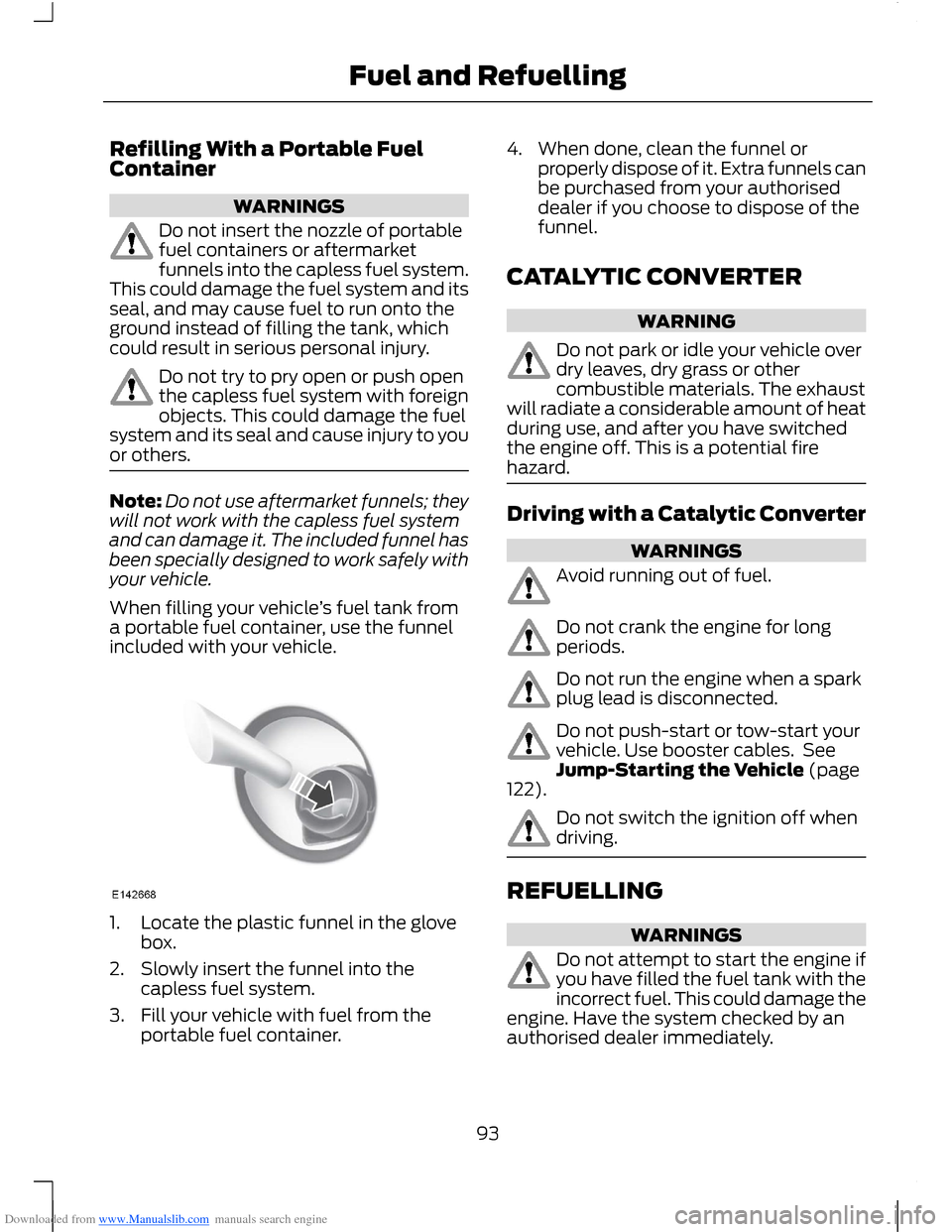
When filling your vehicle’s fuel tank froma portable fuel container, use the funnelincluded with your vehicle.
1.Locate the plastic funnel in the glovebox.
2.Slowly insert the funnel into thecapless fuel system.
3.Fill your vehicle with fuel from theportable fuel container.
4.When done, clean the funnel orproperly dispose of it. Extra funnels canbe purchased from your authoriseddealer if you choose to dispose of thefunnel.
CATALYTIC CONVERTER
WARNING
Do not park or idle your vehicle overdry leaves, dry grass or othercombustible materials. The exhaustwill radiate a considerable amount of heatduring use, and after you have switchedthe engine off. This is a potential firehazard.
Driving with a Catalytic Converter
WARNINGS
Avoid running out of fuel.
Do not crank the engine for longperiods.
Do not run the engine when a sparkplug lead is disconnected.
Do not push-start or tow-start yourvehicle. Use booster cables. SeeJump-Starting the Vehicle (page122).
Do not switch the ignition off whendriving.
REFUELLING
WARNINGS
Do not attempt to start the engine ifyou have filled the fuel tank with theincorrect fuel. This could damage theengine. Have the system checked by anauthorised dealer immediately.
93Fuel and Refuelling
Page 96 of 256
Downloaded from www.Manualslib.com manuals search engine WARNINGS
Do not use any kind of flames or heatnear the fuel system. The fuel systemis under pressure. There is a risk ofinjury if the fuel system is leaking.
If you use a high pressure spray towash your vehicle, only spray the fuelfiller flap briefly from a distance notless than 8 inches (200 millimetres).
We recommend that you wait atleast 10 seconds before removing thefuel pipe nozzle to allow any residualfuel to drain into the fuel tank.
Stop refuelling after the fuel nozzlestops the second time. Additionalfuel will fill the expansion space inthe fuel tank which could lead to fueloverflowing. Fuel spillage could behazardous to other road users.
Do not remove the nozzle from itsfully inserted position during theentire refuelling process.
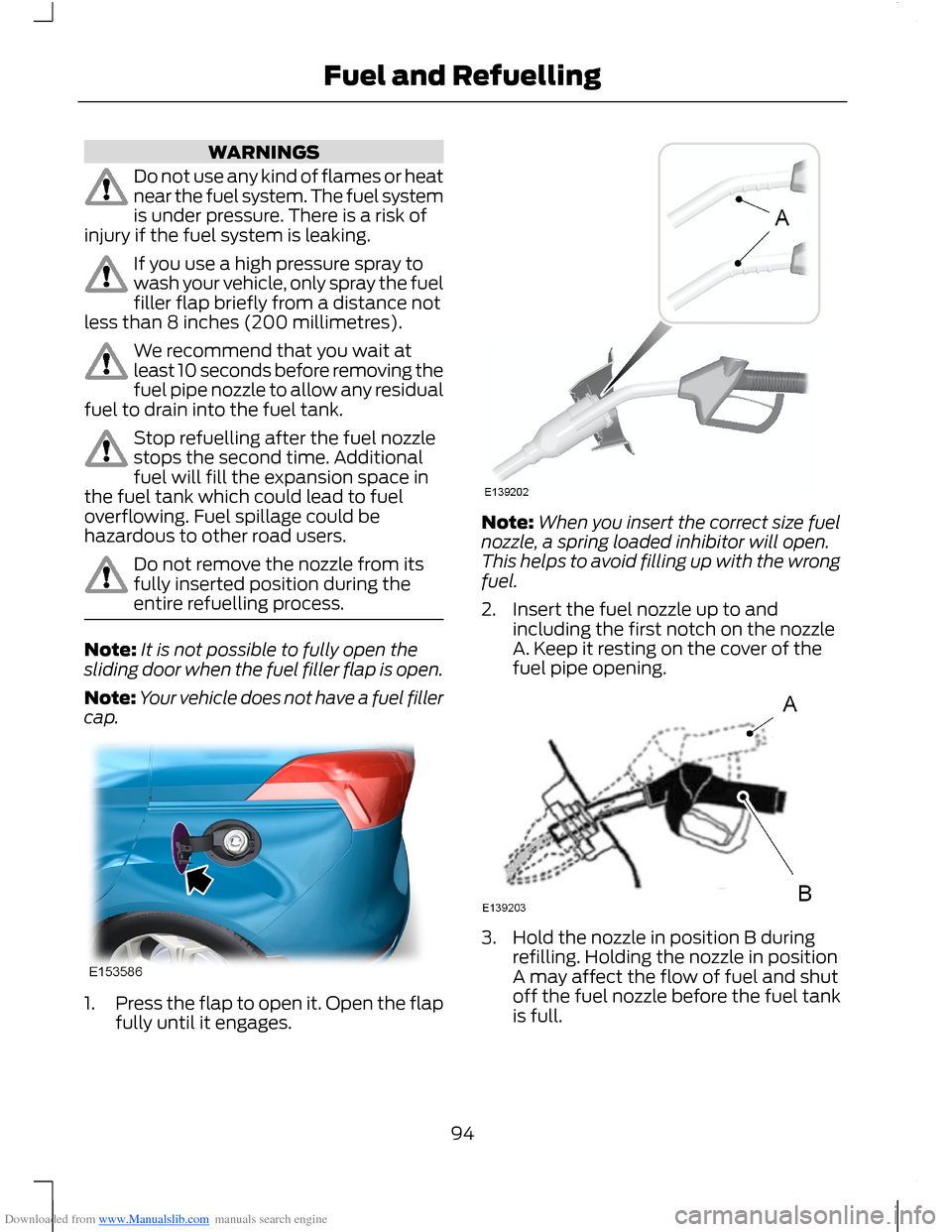
Note:It is not possible to fully open thesliding door when the fuel filler flap is open.
Note:Your vehicle does not have a fuel fillercap.
1.Press the flap to open it. Open the flapfully until it engages.
Note:When you insert the correct size fuelnozzle, a spring loaded inhibitor will open.This helps to avoid filling up with the wrongfuel.
2.Insert the fuel nozzle up to andincluding the first notch on the nozzleA. Keep it resting on the cover of thefuel pipe opening.
3.Hold the nozzle in position B duringrefilling. Holding the nozzle in positionA may affect the flow of fuel and shutoff the fuel nozzle before the fuel tankis full.
94Fuel and Refuelling
Page 99 of 256
Downloaded from www.Manualslib.com manuals search engine MANUAL TRANSMISSION
Selecting Reverse Gear
Do not engage reverse gear when yourvehicle is moving. This can cause damageto the transmission.
AUTOMATIC TRANSMISSION
WARNING
Always set the parking brake fullyand make sure you move thetransmission selector lever toposition P. Switch the ignition off andremove the key whenever you leave yourvehicle.
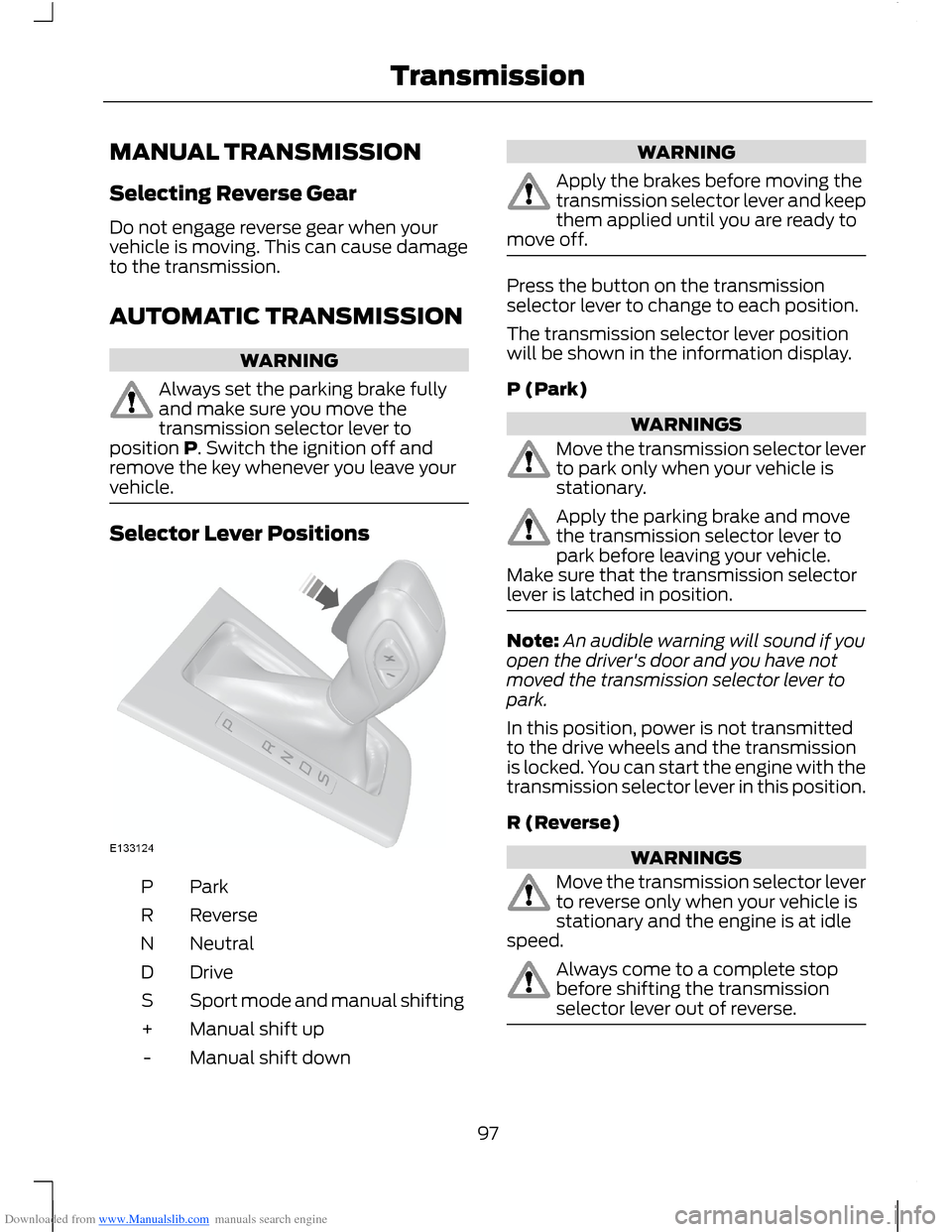
Selector Lever Positions
ParkP
ReverseR
NeutralN
DriveD
Sport mode and manual shiftingS
Manual shift up+
Manual shift down-
WARNING
Apply the brakes before moving thetransmission selector lever and keepthem applied until you are ready tomove off.
Press the button on the transmissionselector lever to change to each position.
The transmission selector lever positionwill be shown in the information display.
P (Park)
WARNINGS
Move the transmission selector leverto park only when your vehicle isstationary.
Apply the parking brake and movethe transmission selector lever topark before leaving your vehicle.Make sure that the transmission selectorlever is latched in position.
Note:An audible warning will sound if youopen the driver's door and you have notmoved the transmission selector lever topark.
In this position, power is not transmittedto the drive wheels and the transmissionis locked. You can start the engine with thetransmission selector lever in this position.
R (Reverse)
WARNINGS
Move the transmission selector leverto reverse only when your vehicle isstationary and the engine is at idlespeed.
Always come to a complete stopbefore shifting the transmissionselector lever out of reverse.
97Transmission
Page 100 of 256
Downloaded from www.Manualslib.com manuals search engine Move the transmission selector lever toreverse to allow your vehicle to movebackward.
N (Neutral)
In this position, power is not transmittedto the drive wheels but the transmission isnot locked. You can start the engine withthe transmission selector lever in thisposition.
D (Drive)
Note:A shift will occur only when yourvehicle speed and the engine speed areappropriate.
Note:You may temporarily override thecurrent gear selected using the + and -buttons.
Select drive to shift automatically throughthe forward gears.
The transmission will select theappropriate gear for optimum performancebased on ambient temperature, roadgradient, vehicle load and your input.
Sport Mode and Manual Shifting
Sport Mode
Note:In sport mode the transmissionoperates as normal but gears are selectedmore quickly and at higher engine speeds.
Note:In sport mode S will be shown in theinformation display.
Switch on sport mode by moving thetransmission selector lever to position S.Sport mode will remain on until either youshift manually up or down the gears using+ and - or move the transmission selectorlever to position D.
Manual Shifting
WARNINGS
Do not hold the buttons permanentlyin - or +.
WARNINGS
The transmission will automaticallydownshift when the engine speed istoo low.
Press the - button to shift down and pressthe + button to shift up.
Gears may be skipped by pressing thebuttons repeatedly at short intervals.
Manual mode also provides a kickdownfunction. See Kickdown.
Hints on Driving With anAutomatic Transmission
WARNING
Do not idle the engine for longperiods of time in drive with thebrakes applied.
Moving Off
1.Release the parking brake.
2.Release the brake pedal and press theaccelerator pedal.
Stopping
1.Release the accelerator pedal andpress the brake pedal.
2.Apply the parking brake.
3.Move the transmission selector leverto N or P.
Kickdown
Press the accelerator pedal fully with thetransmission selector lever in the driveposition to select the next lowest gear foroptimum performance. Release theaccelerator pedal when you no longerrequire kickdown.
98Transmission
Page 101 of 256
Downloaded from www.Manualslib.com manuals search engine If Your Vehicle Gets Stuck In Mud orSnow
Note:Do not rock your vehicle if the engineis not at normal operating temperature ordamage to the transmission may occur.
Note:Do not rock your vehicle for morethan a minute or damage to thetransmission and tyres may occur, or theengine may overheat.
If your vehicle gets stuck in mud or snow,it may be rocked out by shifting betweenforward and reverse gears, stoppingbetween shifts in a steady pattern. Presslightly on the accelerator in each gear.
Emergency Park Position ReleaseLever
WARNINGS
Do not drive your vehicle until youverify that the brake lamps areworking.
If the parking brake is fully released,but the brake warning lamp remainsilluminated, the brakes may not beworking correctly. See an authoriseddealer.
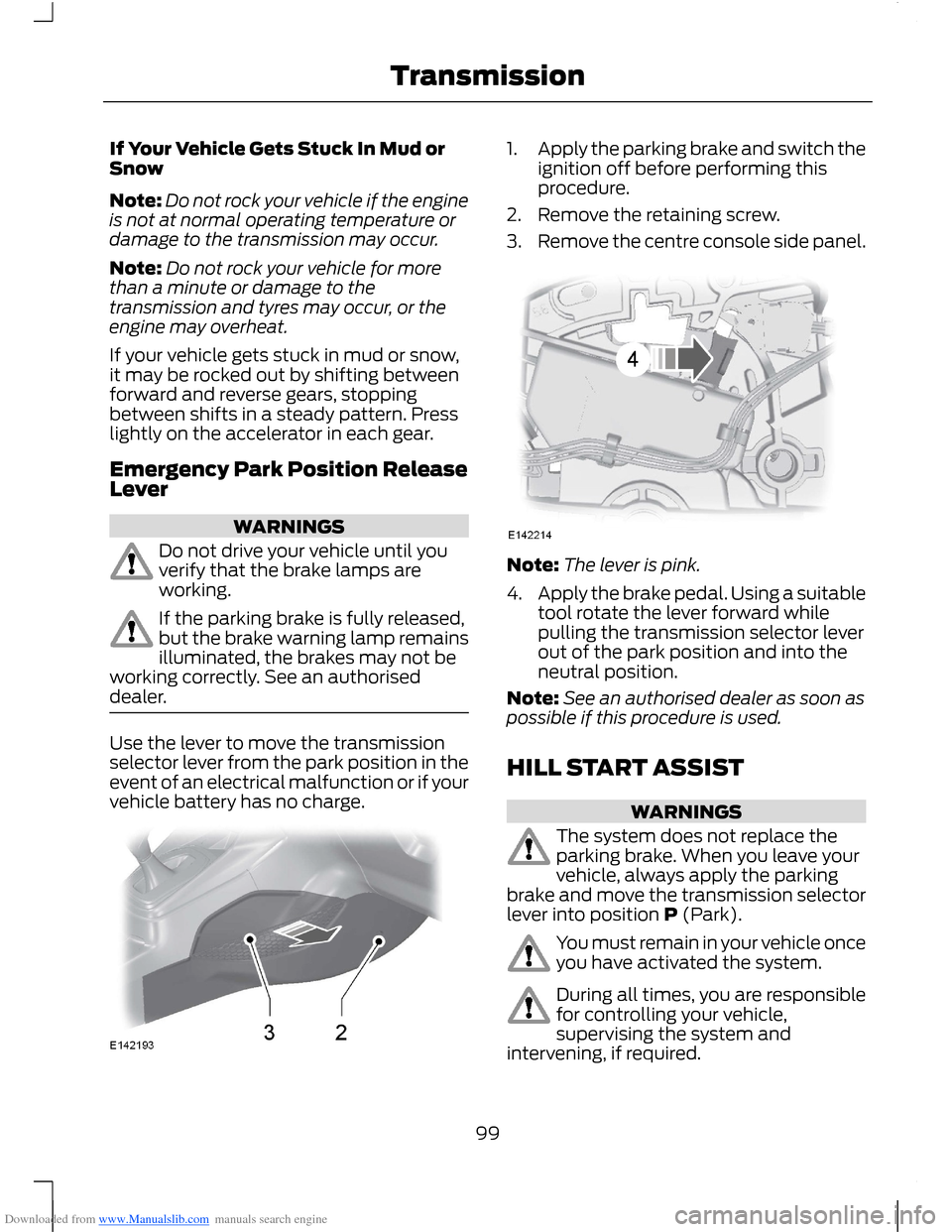
Use the lever to move the transmissionselector lever from the park position in theevent of an electrical malfunction or if yourvehicle battery has no charge.
1.Apply the parking brake and switch theignition off before performing thisprocedure.
2.Remove the retaining screw.
3.Remove the centre console side panel.
Note:The lever is pink.
4.Apply the brake pedal. Using a suitabletool rotate the lever forward whilepulling the transmission selector leverout of the park position and into theneutral position.
Note:See an authorised dealer as soon aspossible if this procedure is used.
HILL START ASSIST
WARNINGS
The system does not replace theparking brake. When you leave yourvehicle, always apply the parkingbrake and move the transmission selectorlever into position P (Park).
You must remain in your vehicle onceyou have activated the system.
During all times, you are responsiblefor controlling your vehicle,supervising the system andintervening, if required.
99Transmission
Page 102 of 256
Downloaded from www.Manualslib.com manuals search engine WARNINGS
If the engine is revved excessively, orif a malfunction is detected, thesystem will be deactivated.
The system makes it easier to pull awaywhen your vehicle is on a slope without theneed to use the parking brake.
When the system is active, your vehicle willremain stationary on the slope for two tothree seconds after you release the brakepedal. This allows you time to move yourfoot from the brake to the acceleratorpedal. The brakes are releasedautomatically once the engine hasdeveloped sufficient drive to prevent yourvehicle from rolling down the slope. Thisis an advantage when pulling away on aslope, (for example from a car park ramp,traffic lights or when reversing uphill intoa parking space).
The system will activate automatically onany slope which can result in significantvehicle rollback.
Using Hill Start Assist
1.Press the brake pedal to bring yourvehicle to a complete standstill. Keepthe brake pedal pressed.
2.If the sensors detect that your vehicleis on a slope, the system will beactivated automatically.
3.When you remove your foot from thebrake pedal, your vehicle will remainon the slope without rolling away forapproximately two or three seconds.This hold time will automatically beextended if you are in the process ofdriving off.
4.Drive off in the normal manner. Thebrakes will be released automatically.
Switching the System On and Off
Note:The system can only be switched onand off for manual transmissions.
Note:Once you have switched off thesystem, it will remain off until you switch iton again.
Your vehicle comes with the systemalready enabled. If desired, you can disablethe feature: See General Information(page 58).
100Transmission
Page 103 of 256
Downloaded from www.Manualslib.com manuals search engine GENERAL INFORMATION
WARNING
The system does not relieve you ofyour responsibility to drive with duecare and attention.
Note:Occasional brake noise is normal. Ifa metal-to-metal, continuous grinding orcontinuous squeal sound is present, thebrake linings may be worn-out. If the vehiclehas continuous vibration or shudder in thesteering wheel while braking, have yourvehicle checked by an authorised dealer.
Note:Brake dust may accumulate on thewheels, even under normal drivingconditions. Some dust is inevitable as thebrakes wear. See Cleaning the AlloyWheels (page 154).
Wet brakes result in reduced brakingefficiency. Gently press the brake pedal afew times when driving from a car wash orstanding water to dry the brakes.
Emergency Brake Assist
Emergency brake assist detects when youbrake heavily by measuring the rate atwhich you press the brake pedal. Itprovides maximum braking efficiency aslong as you press the pedal. Emergencybrake assist can reduce stopping distancesin critical situations.
Anti-lock Brake System
This system helps you maintain steeringcontrol and vehicle stability duringemergency stops by keeping the brakesfrom locking.
HINTS ON DRIVING WITH
ANTI-LOCK BRAKES
Note:When the system is operating, thebrake pedal will pulse and may travelfurther. Maintain pressure on the brakepedal. You may also hear a noise from thesystem. This is normal.
The ABS will not eliminate the risks when:
•you drive too closely to the vehicle infront of you
•your vehicle is aquaplaning
•you take corners too fast
•the road surface is poor.
PARKING BRAKE
Vehicles With AutomaticTransmission
WARNING
Always set the parking brake fullyand leave your vehicle with thetransmission selector lever inposition P.
Note:If you park your vehicle on a hill andfacing uphill move the transmission selectorlever to position P and turn the steeringwheel away from the kerb.
Note:If you park your vehicle on a hill andfacing downhill move the transmissionselector lever to position P and turn thesteering wheel toward the kerb.
Vehicles With ManualTransmission
Note:If you park your vehicle on a hill andfacing uphill select first gear and turn thesteering wheel away from the kerb.
Note:If you park your vehicle on a hill andfacing downhill select reverse gear and turnthe steering wheel toward the kerb.
101Brakes