warning FORD C MAX ENERGI 2016 Manual PDF
[x] Cancel search | Manufacturer: FORD, Model Year: 2016, Model line: C MAX ENERGI, Model: FORD C MAX ENERGI 2016Pages: 395, PDF Size: 6.78 MB
Page 148 of 395
Note:When the fuel level is less thanone-quarter full, refueling your vehicle willend fuel freshness mode.
Note:We recommend you use a fuelstabilizer if you use less than a full tank offuel during an 18-month period.
FUEL FILLER FUNNEL
LOCATION
The fuel filler funnel is in the under floorstorage compartment behind theright-hand front seat.
RUNNING OUT OF FUEL
Running out of fuel can cause damage notcovered by the vehicle Warranty.
If your vehicle runs out of fuel:
•Add a minimum of 1.3 gal (5 L) of fuelto restart the engine. If your vehicle isout of fuel and on a steep slope, morefuel may be required.
•You may need to switch the ignitionfrom off to on several times afterrefueling to allow the fuel system topump the fuel from the tank to theengine. When restarting, cranking timetakes a few seconds longer thannormal.
Filling a Portable Fuel Container
Use the following guidelines to avoidelectrostatic charge build-up when fillingan ungrounded fuel container:
•Only use an approved fuel container totransfer fuel to your vehicle. Place thecontainer on the ground when filling it.
•Do not fill a fuel container when it isinside your vehicle (including the cargoarea).
•Keep the fuel pump nozzle in contactwith the fuel container when filling it.
•Do not use a device that holds the fuelpump nozzle lever in the fill position.
Adding Fuel From a Portable FuelContainer
WARNINGS
Do not insert the nozzle of a fuelcontainer or an aftermarket funnelinto the fuel system filler neck. Thismay damage the fuel system filler neck orits seal and cause fuel to run onto theground.
Do not try to pry open or push openthe capless fuel system with foreignobjects. This could damage the fuelsystem and its seal and cause injury to youor others.
Do not dispose of fuel in thehousehold refuse or the publicsewage system. Use an authorizedwaste disposal facility.
When refueling the vehicle fuel tank froma fuel container, use the plastic funnelincluded with your vehicle. See Fuel FillerFunnel Location (page 145).
Note:Do not use aftermarket funnels asthey will not work with the capless fuelsystem and can damage it.
When refueling the vehicle fuel tank froma fuel container, do the following:
1.Fully open the fuel tank filler door untilit engages and remove the fuel tankfiller cap.
Note:Capless fuel systems do not have afuel tank filler cap.
2. Fully insert the plastic funnel into thefuel tank filler pipe opening.
145
C-MAX (CCG) Canada/United States of America, enUSA, First Printing
Fuel and Refueling
Page 149 of 395
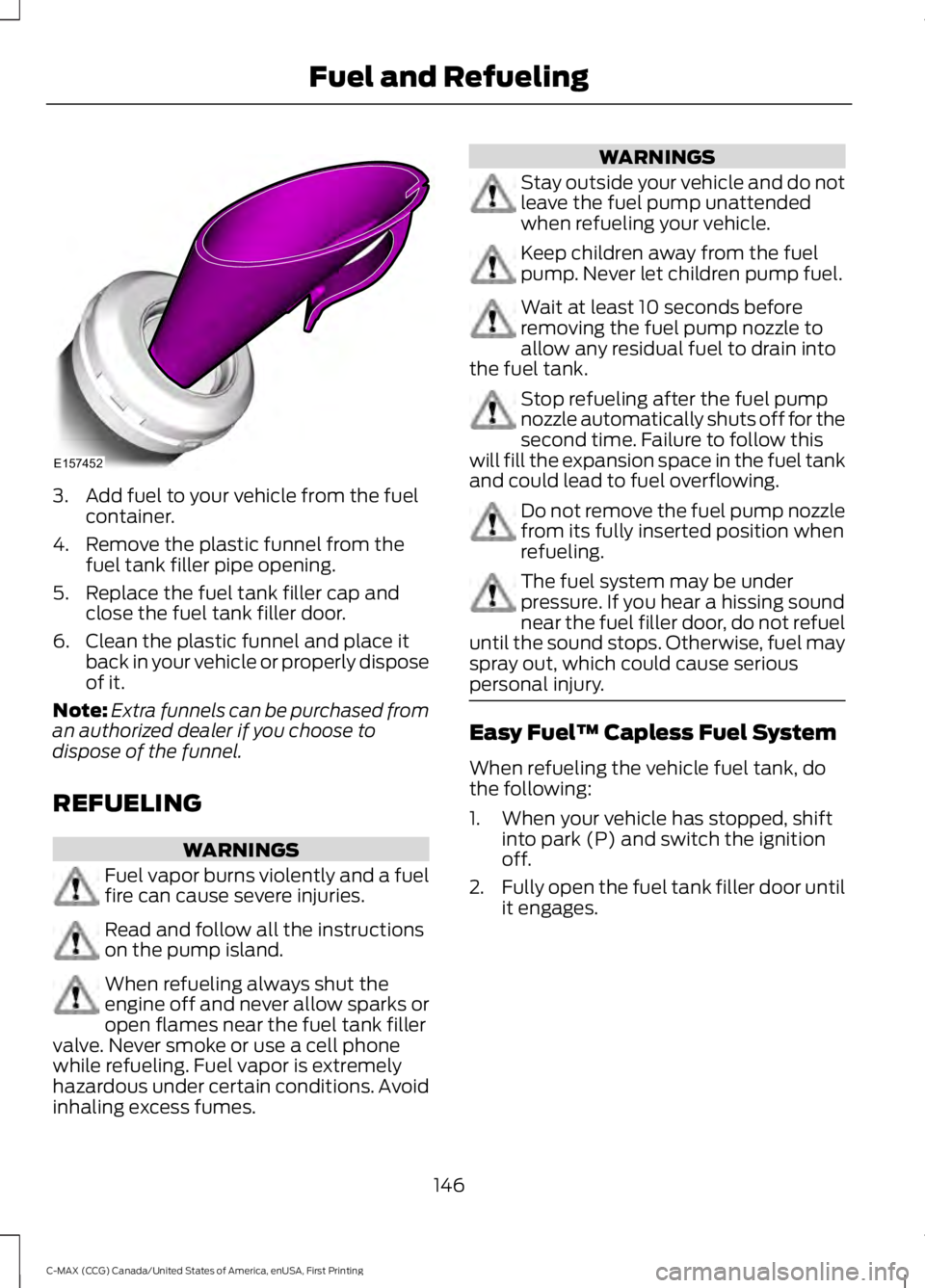
3. Add fuel to your vehicle from the fuelcontainer.
4. Remove the plastic funnel from thefuel tank filler pipe opening.
5. Replace the fuel tank filler cap andclose the fuel tank filler door.
6. Clean the plastic funnel and place itback in your vehicle or properly disposeof it.
Note:Extra funnels can be purchased froman authorized dealer if you choose todispose of the funnel.
REFUELING
WARNINGS
Fuel vapor burns violently and a fuelfire can cause severe injuries.
Read and follow all the instructionson the pump island.
When refueling always shut theengine off and never allow sparks oropen flames near the fuel tank fillervalve. Never smoke or use a cell phonewhile refueling. Fuel vapor is extremelyhazardous under certain conditions. Avoidinhaling excess fumes.
WARNINGS
Stay outside your vehicle and do notleave the fuel pump unattendedwhen refueling your vehicle.
Keep children away from the fuelpump. Never let children pump fuel.
Wait at least 10 seconds beforeremoving the fuel pump nozzle toallow any residual fuel to drain intothe fuel tank.
Stop refueling after the fuel pumpnozzle automatically shuts off for thesecond time. Failure to follow thiswill fill the expansion space in the fuel tankand could lead to fuel overflowing.
Do not remove the fuel pump nozzlefrom its fully inserted position whenrefueling.
The fuel system may be underpressure. If you hear a hissing soundnear the fuel filler door, do not refueluntil the sound stops. Otherwise, fuel mayspray out, which could cause seriouspersonal injury.
Easy Fuel™ Capless Fuel System
When refueling the vehicle fuel tank, dothe following:
1. When your vehicle has stopped, shiftinto park (P) and switch the ignitionoff.
2.Fully open the fuel tank filler door untilit engages.
146
C-MAX (CCG) Canada/United States of America, enUSA, First Printing
Fuel and RefuelingE157452
Page 150 of 395
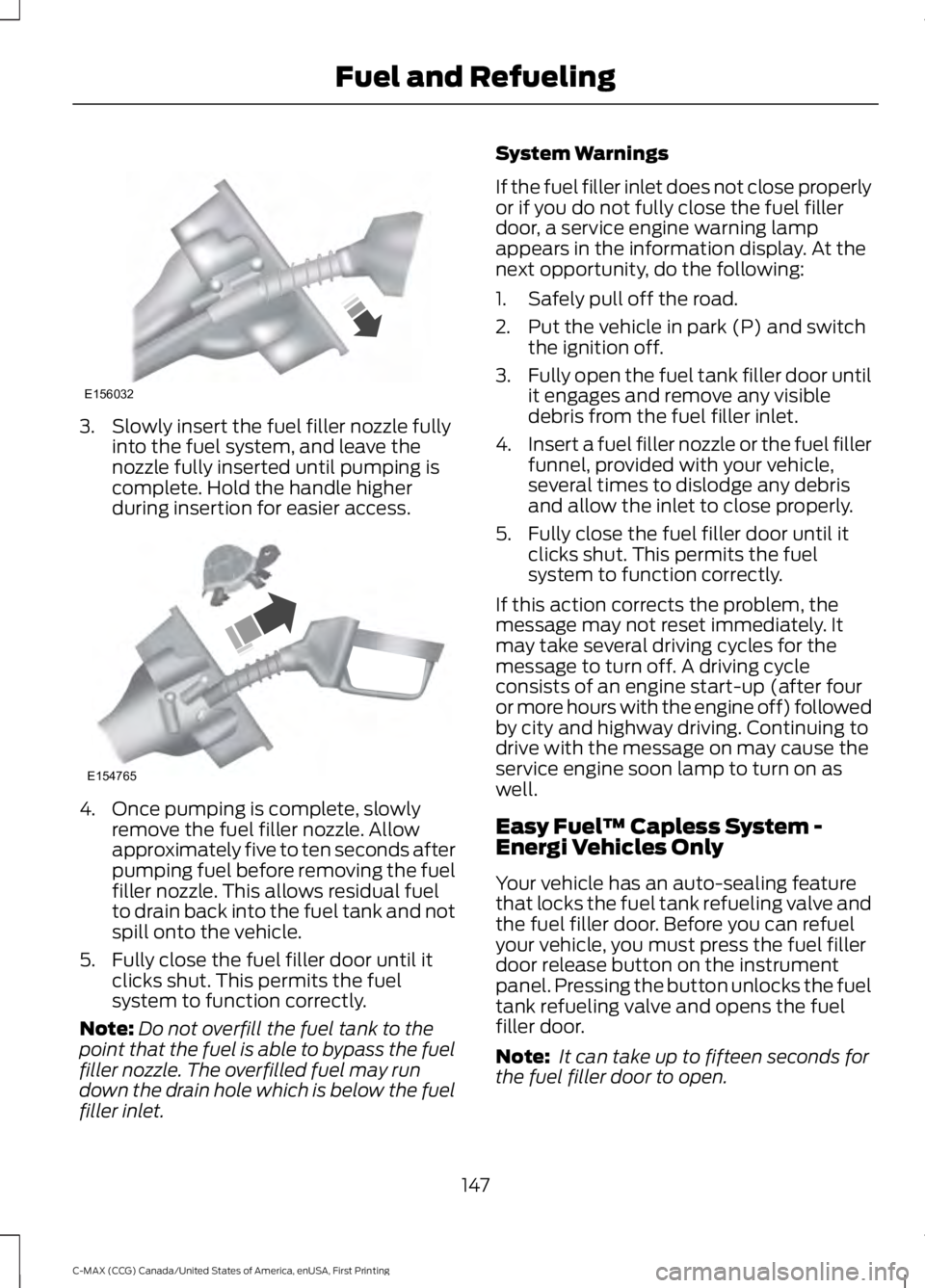
3. Slowly insert the fuel filler nozzle fullyinto the fuel system, and leave thenozzle fully inserted until pumping iscomplete. Hold the handle higherduring insertion for easier access.
4. Once pumping is complete, slowlyremove the fuel filler nozzle. Allowapproximately five to ten seconds afterpumping fuel before removing the fuelfiller nozzle. This allows residual fuelto drain back into the fuel tank and notspill onto the vehicle.
5. Fully close the fuel filler door until itclicks shut. This permits the fuelsystem to function correctly.
Note:Do not overfill the fuel tank to thepoint that the fuel is able to bypass the fuelfiller nozzle. The overfilled fuel may rundown the drain hole which is below the fuelfiller inlet.
System Warnings
If the fuel filler inlet does not close properlyor if you do not fully close the fuel fillerdoor, a service engine warning lampappears in the information display. At thenext opportunity, do the following:
1. Safely pull off the road.
2. Put the vehicle in park (P) and switchthe ignition off.
3.Fully open the fuel tank filler door untilit engages and remove any visibledebris from the fuel filler inlet.
4.Insert a fuel filler nozzle or the fuel fillerfunnel, provided with your vehicle,several times to dislodge any debrisand allow the inlet to close properly.
5. Fully close the fuel filler door until itclicks shut. This permits the fuelsystem to function correctly.
If this action corrects the problem, themessage may not reset immediately. Itmay take several driving cycles for themessage to turn off. A driving cycleconsists of an engine start-up (after fouror more hours with the engine off) followedby city and highway driving. Continuing todrive with the message on may cause theservice engine soon lamp to turn on aswell.
Easy Fuel™ Capless System -Energi Vehicles Only
Your vehicle has an auto-sealing featurethat locks the fuel tank refueling valve andthe fuel filler door. Before you can refuelyour vehicle, you must press the fuel fillerdoor release button on the instrumentpanel. Pressing the button unlocks the fueltank refueling valve and opens the fuelfiller door.
Note: It can take up to fifteen seconds forthe fuel filler door to open.
147
C-MAX (CCG) Canada/United States of America, enUSA, First Printing
Fuel and RefuelingE156032 E154765
Page 152 of 395
System Warnings
If the fuel filler inlet does not close properlyor if you do not fully close the fuel fillerdoor, a service engine warning lampappears in the information display. At thenext opportunity, do the following:
1. Safely pull off the road.
2. When your vehicle has stopped, shiftinto park (P) and switch the ignitionoff.
3.Press the refueling button on the centerconsole.
4.Fully open the fuel tank filler door untilit engages and remove any visibledebris from the fuel filler inlet.
5.Insert a fuel filler nozzle or the fuel fillerfunnel, provided with your vehicle,several times to dislodge any debrisand allow the inlet to close properly.
6. Fully close the fuel filler door until itclicks shut. This permits the fuelsystem to function correctly.
If this action corrects the problem, themessage may not reset immediately. Itmay take several driving cycles for themessage to turn off. A driving cycleconsists of an engine start-up (after fouror more hours with the engine off) followedby city and highway driving. Continuing todrive with the message on may cause theservice engine soon lamp to turn on aswell.
Using the Manual Fuel Filler DoorRelease Lever
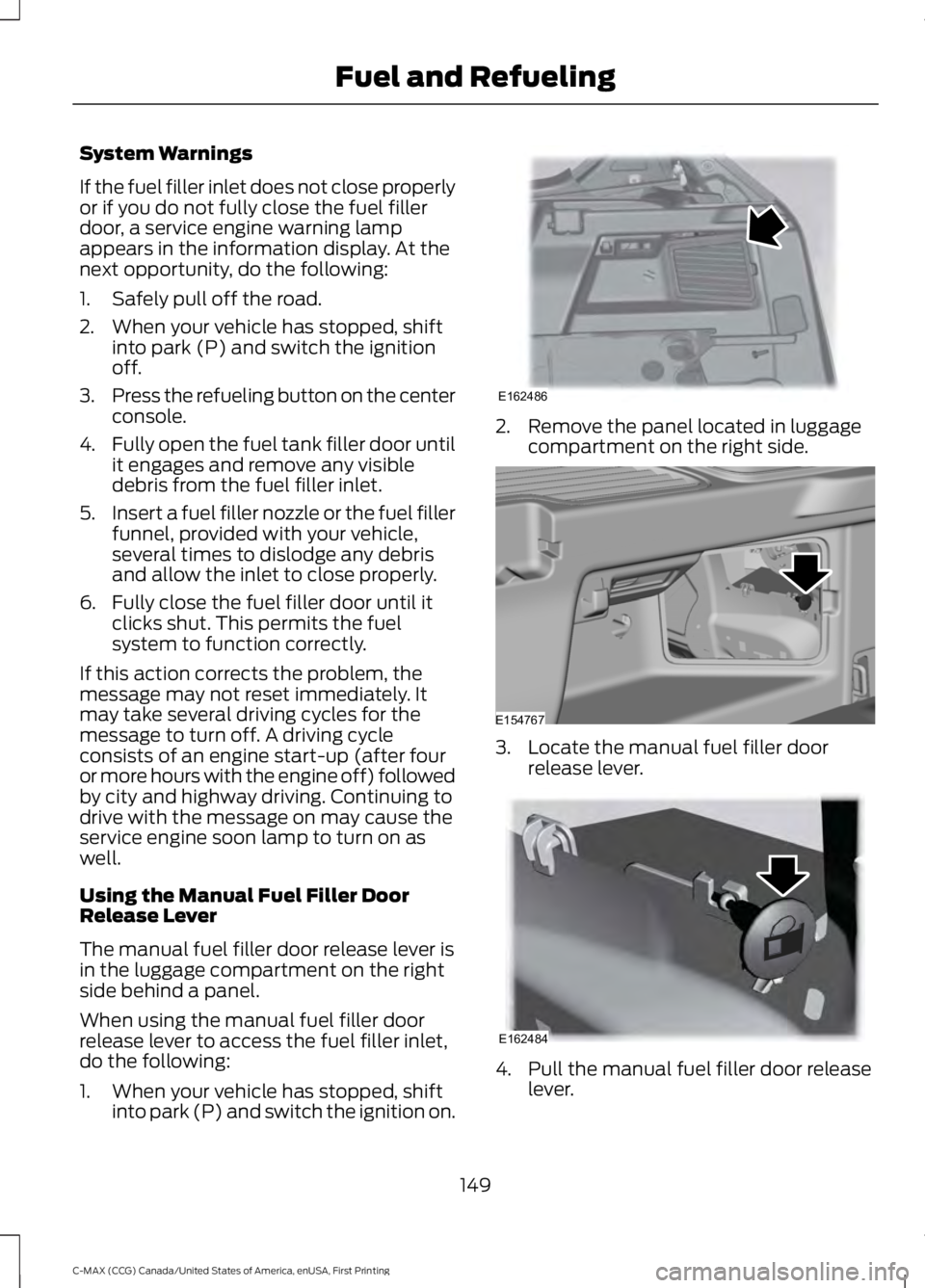
The manual fuel filler door release lever isin the luggage compartment on the rightside behind a panel.
When using the manual fuel filler doorrelease lever to access the fuel filler inlet,do the following:
1. When your vehicle has stopped, shiftinto park (P) and switch the ignition on.
2. Remove the panel located in luggagecompartment on the right side.
3. Locate the manual fuel filler doorrelease lever.
4. Pull the manual fuel filler door releaselever.
149
C-MAX (CCG) Canada/United States of America, enUSA, First Printing
Fuel and RefuelingE162486 E154767 E162484
Page 153 of 395
5. Switch the ignition off and refuel yourvehicle within 20 minutes. If more than20 minutes is required, fully close thefuel filler door and repeat theprocedure.
FUEL CONSUMPTION
Note:The amount of usable fuel in theempty reserve varies and should not berelied upon to increase driving range. Whenrefueling your vehicle after the fuel gaugeindicates empty, you might not be able torefuel the full amount of the advertisedcapacity of the fuel tank due to the emptyreserve still present in the tank.
Empty reserve is the amount of fuelremaining in the tank after the fuel gaugeindicates empty. Do not rely on this fuel fordriving. The usable capacity of the fueltank is the amount of fuel that can be putinto the tank after the gauge indicatesempty. The advertised capacity is the totalfuel tank size – it is the combined usablecapacity plus the empty reserve.
Filling the Tank
For consistent results when filling the fueltank:
•Turn the ignition off before fueling; aninaccurate reading results if the engineis left running.
•Use the same fill rate(low-medium-high) each time the tankis filled.
•Allow no more than two automaticclick-offs when filling.
Results are most accurate when the fillingmethod is consistent.
Calculating Fuel Economy
Do not measure fuel economy during thefirst 1000 miles (1600 kilometers) ofdriving (this is your engine’s break-inperiod); a more accurate measurement isobtained after 2000 miles - 3000 miles(3200 kilometers - 4800 kilometers). Also,fuel expense, frequency of fill ups or fuelgauge readings are not accurate ways tomeasure fuel economy.
1.Fill the fuel tank completely and recordthe initial odometer reading.
2. Each time you fill the tank, record theamount of fuel added.
3. After at least three to five tank fill ups,fill the fuel tank and record the currentodometer reading.
4. Subtract your initial odometer readingfrom the current odometer reading.
5. Calculate fuel economy by dividingmiles traveled by gallons used (ForMetric: Multiply liters used by 100, thendivide by kilometers traveled).
Keep a record for at least one month andrecord the type of driving (city or highway).This provides an accurate estimate of thevehicle’s fuel economy under currentdriving conditions. Additionally, keepingrecords during summer and winter showhow temperature impacts fuel economy.In general, lower temperatures mean lowerfuel economy.
EMISSION CONTROL SYSTEM
WARNINGS
Do not park, idle, or drive your vehiclein dry grass or other dry ground cover.The emission system heats up theengine compartment and exhaust system,which can start a fire.
150
C-MAX (CCG) Canada/United States of America, enUSA, First Printing
Fuel and Refueling
Page 154 of 395
WARNINGS
Exhaust leaks may result in entry ofharmful and potentially lethal fumesinto the passenger compartment. Ifyou smell exhaust fumes inside yourvehicle, have your dealer inspect yourvehicle immediately. Do not drive if yousmell exhaust fumes.
Your vehicle is equipped with variousemission control components and acatalytic converter that will enable yourvehicle to comply with applicable exhaustemission standards.
To make sure that the catalytic converterand other emission control componentscontinue to work properly:
•Use only the specified fuel listed.
•Avoid running out of fuel.
•Do not turn off the ignition while yourvehicle is moving, especially at highspeeds.
•Have the items listed in scheduledmaintenance information performedaccording to the specified schedule.
The scheduled maintenance items listedin scheduled maintenance information areessential to the life and performance ofyour vehicle and to its emissions system.
If you use anything other than Ford,Motorcraft or Ford-authorized parts formaintenance replacements or for serviceof components affecting emission control,such non-Ford parts should be equivalentto genuine Ford Motor Company parts inperformance and durability.
Illumination of the service engine soonindicator, charging system warning light orthe temperature warning light, fluid leaks,strange odors, smoke or loss of enginepower could indicate that the emissioncontrol system is not working properly.
An improperly operating or damagedexhaust system may allow exhaust toenter the vehicle. Have a damaged orimproperly operating exhaust systeminspected and repaired immediately.
Do not make any unauthorized changes toyour vehicle or engine. By law, vehicleowners and anyone who manufactures,repairs, services, sells, leases, tradesvehicles, or supervises a fleet of vehiclesare not permitted to intentionally removean emission control device or prevent itfrom working. Information about yourvehicle’s emission system is on the VehicleEmission Control Information Decallocated on or near the engine. This decalalso lists engine displacement.
Please consult your warranty informationfor complete details.
On-Board Diagnostics (OBD-II)
Your vehicle has a computer known as theon-board diagnostics system (OBD-II) thatmonitors the engine’s emission controlsystem. The system protects theenvironment by making sure that yourvehicle continues to meet governmentemission standards. The OBD-II systemalso assists a service technician in properlyservicing your vehicle.
When the service engine soonindicator illuminates, the OBD-IIsystem has detected amalfunction. Temporary malfunctions maycause the service engine soon indicator toilluminate. Examples are:
1. Your vehicle has run out of fuel—theengine may misfire or run poorly.
2. Poor fuel quality or water in thefuel—the engine may misfire or runpoorly.
3. The fuel fill inlet may not have closedproperly. See Refueling (page 146).
151
C-MAX (CCG) Canada/United States of America, enUSA, First Printing
Fuel and Refueling
Page 156 of 395
GENERAL INFORMATION
WARNING
Have the battery pack serviced onlyby an authorized electric vehicletechnician. Improper handling canresult in personal injury or death.
Note:The high-voltage battery does notrequire regular service maintenance.
Your vehicle consists of varioushigh-voltage components and wiring. Allof the high-voltage power flows throughspecific wiring assemblies labeled as suchor covered with a solid orange convolute,orange striped tape or both. Do not comein contact with these components.
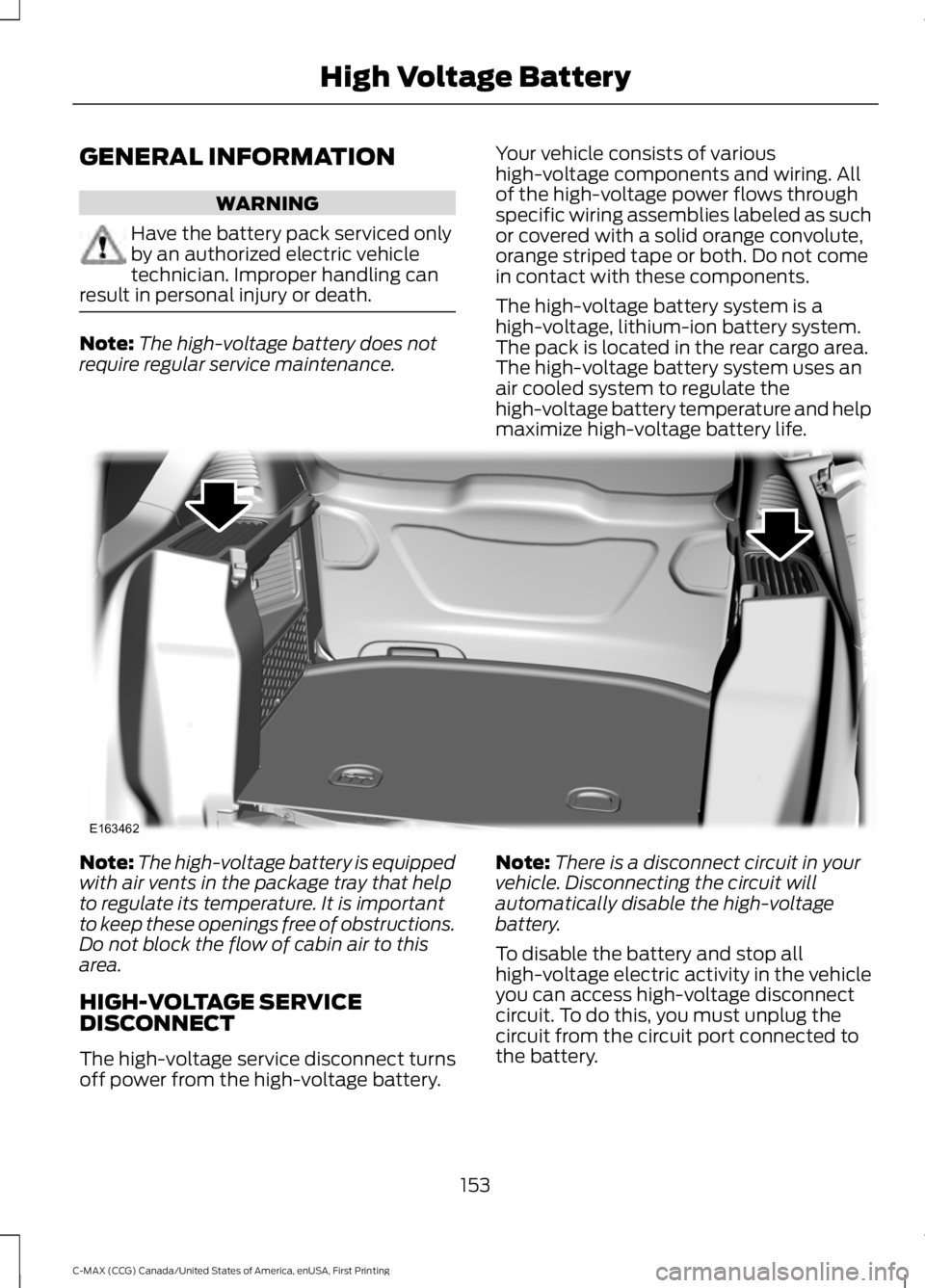
The high-voltage battery system is ahigh-voltage, lithium-ion battery system.The pack is located in the rear cargo area.The high-voltage battery system uses anair cooled system to regulate thehigh-voltage battery temperature and helpmaximize high-voltage battery life.
Note:The high-voltage battery is equippedwith air vents in the package tray that helpto regulate its temperature. It is importantto keep these openings free of obstructions.Do not block the flow of cabin air to thisarea.
HIGH-VOLTAGE SERVICEDISCONNECT
The high-voltage service disconnect turnsoff power from the high-voltage battery.
Note:There is a disconnect circuit in yourvehicle. Disconnecting the circuit willautomatically disable the high-voltagebattery.
To disable the battery and stop allhigh-voltage electric activity in the vehicleyou can access high-voltage disconnectcircuit. To do this, you must unplug thecircuit from the circuit port connected tothe battery.
153
C-MAX (CCG) Canada/United States of America, enUSA, First Printing
High Voltage BatteryE163462
Page 158 of 395
5.Pull the handle toward you and removethe service disconnect from the vehicleto disable the high-voltage battery.
Reactivating the High-Voltage Battery
Note:If you have manually disconnectedyour high-voltage shut off circuit, you willneed to reconnect the circuit before you canreactivate it. The system will detect if theelectrical system is safe and turn onautomatically.
CHARGING THE HIGH
VOLTAGE BATTERY
WARNINGS
Do not use the 120 volt conveniencecord with an extension cord,two-prong adapter, surge protector,timer or other adapter.
In Canada, do not use the 120 voltconvenience cord in commercialgarages.
This equipment has arcing orsparking parts, do not expose toflammable vapors. Position thisequipment at least 18 in (45 cm) abovethe floor.
The AC wall plug must fit firmly intothe AC outlet. If the connection feelsloose, worn or the AC outlet isdamaged, please have a qualifiedelectrician replace the AC outlet. Using aconvenience cord with a worn outlet maycause burns, property damage andincrease the risk of electric shock.
Charging Equipment
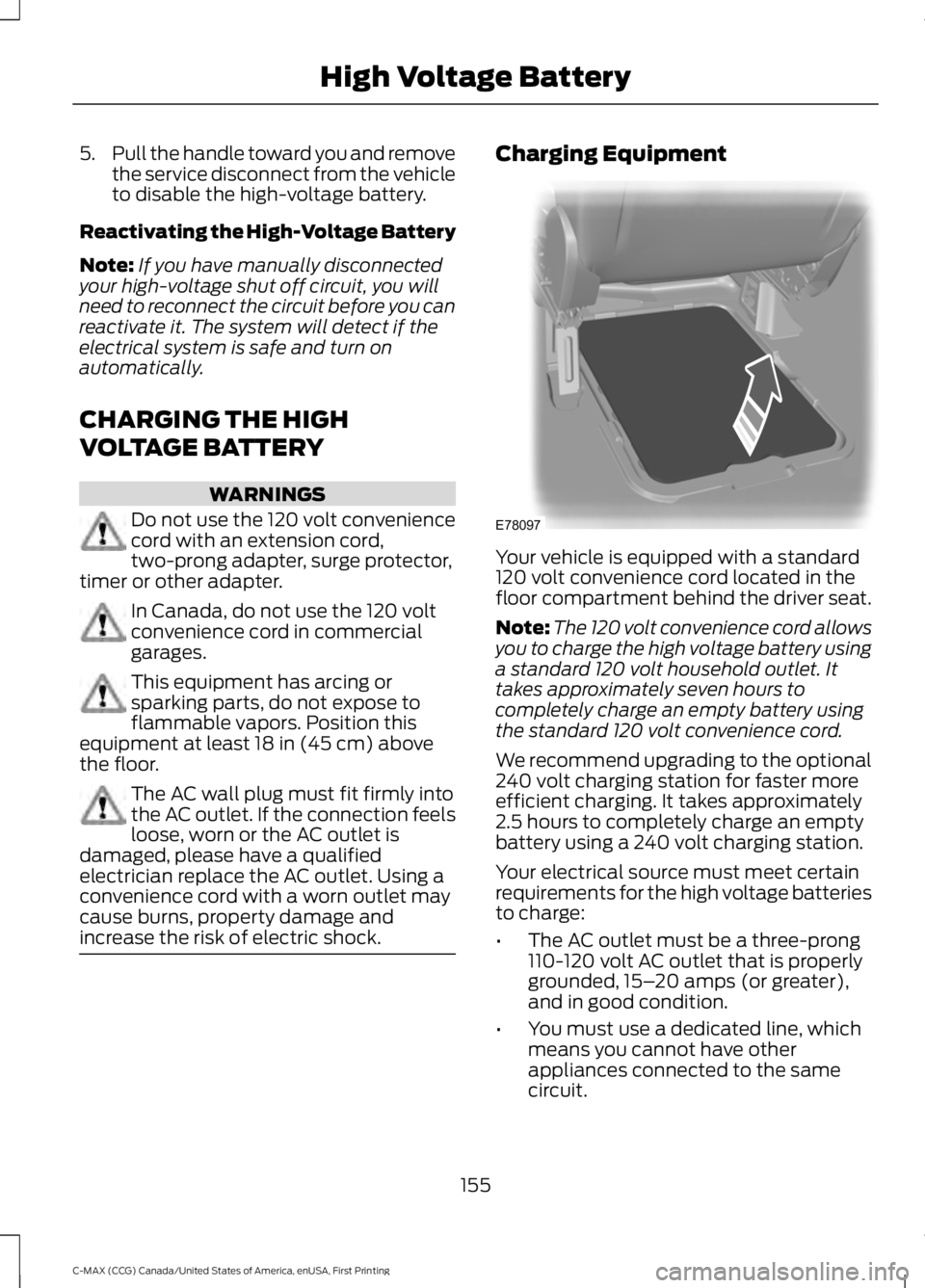
Your vehicle is equipped with a standard120 volt convenience cord located in thefloor compartment behind the driver seat.
Note:The 120 volt convenience cord allowsyou to charge the high voltage battery usinga standard 120 volt household outlet. Ittakes approximately seven hours tocompletely charge an empty battery usingthe standard 120 volt convenience cord.
We recommend upgrading to the optional240 volt charging station for faster moreefficient charging. It takes approximately2.5 hours to completely charge an emptybattery using a 240 volt charging station.
Your electrical source must meet certainrequirements for the high voltage batteriesto charge:
•The AC outlet must be a three-prong110-120 volt AC outlet that is properlygrounded, 15–20 amps (or greater),and in good condition.
•You must use a dedicated line, whichmeans you cannot have otherappliances connected to the samecircuit.
155
C-MAX (CCG) Canada/United States of America, enUSA, First Printing
High Voltage BatteryE78097
Page 164 of 395
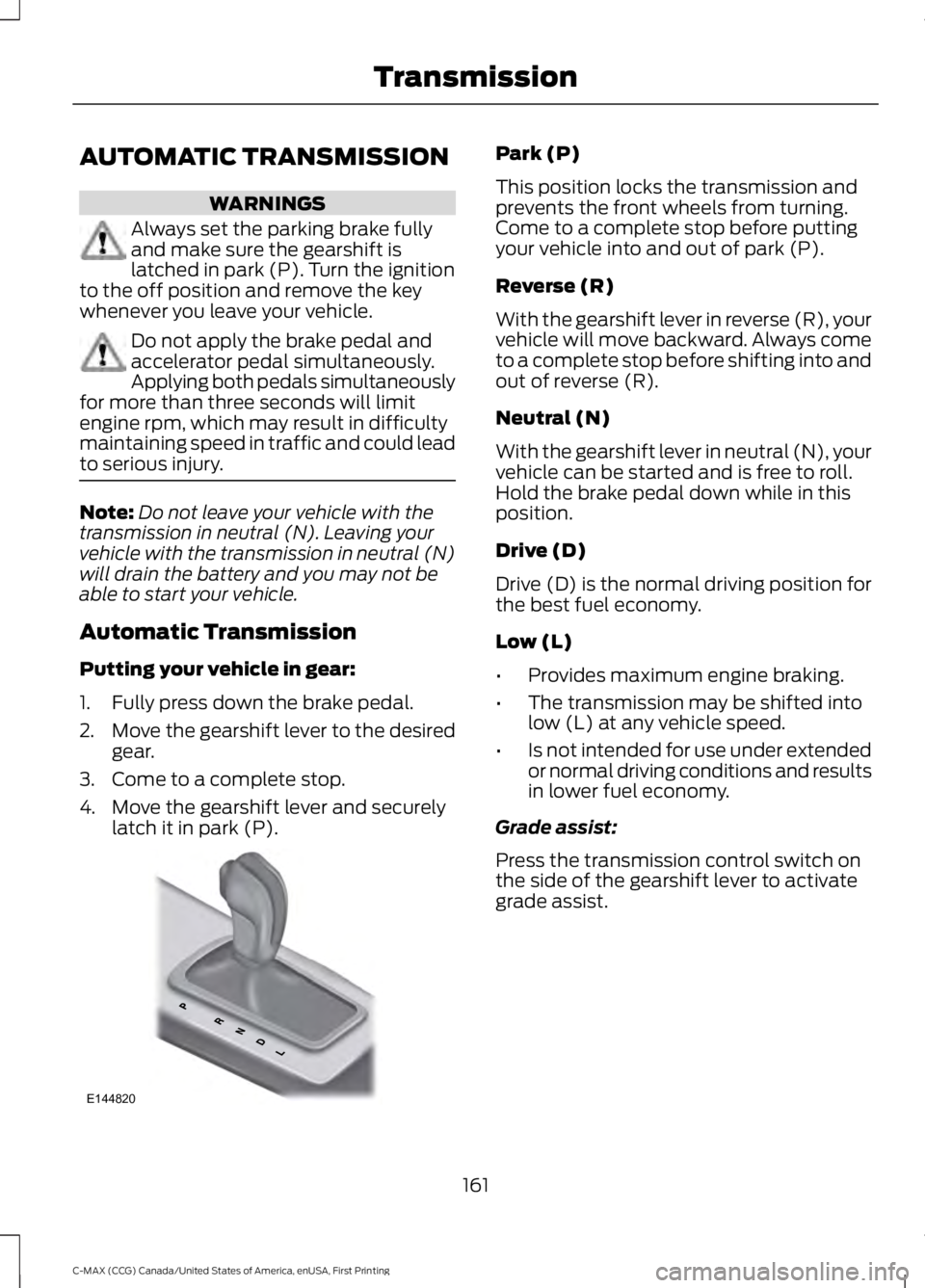
AUTOMATIC TRANSMISSION
WARNINGS
Always set the parking brake fullyand make sure the gearshift islatched in park (P). Turn the ignitionto the off position and remove the keywhenever you leave your vehicle.
Do not apply the brake pedal andaccelerator pedal simultaneously.Applying both pedals simultaneouslyfor more than three seconds will limitengine rpm, which may result in difficultymaintaining speed in traffic and could leadto serious injury.
Note:Do not leave your vehicle with thetransmission in neutral (N). Leaving yourvehicle with the transmission in neutral (N)will drain the battery and you may not beable to start your vehicle.
Automatic Transmission
Putting your vehicle in gear:
1. Fully press down the brake pedal.
2.Move the gearshift lever to the desiredgear.
3. Come to a complete stop.
4. Move the gearshift lever and securelylatch it in park (P).
Park (P)
This position locks the transmission andprevents the front wheels from turning.Come to a complete stop before puttingyour vehicle into and out of park (P).
Reverse (R)
With the gearshift lever in reverse (R), yourvehicle will move backward. Always cometo a complete stop before shifting into andout of reverse (R).
Neutral (N)
With the gearshift lever in neutral (N), yourvehicle can be started and is free to roll.Hold the brake pedal down while in thisposition.
Drive (D)
Drive (D) is the normal driving position forthe best fuel economy.
Low (L)
•Provides maximum engine braking.
•The transmission may be shifted intolow (L) at any vehicle speed.
•Is not intended for use under extendedor normal driving conditions and resultsin lower fuel economy.
Grade assist:
Press the transmission control switch onthe side of the gearshift lever to activategrade assist.
161
C-MAX (CCG) Canada/United States of America, enUSA, First Printing
TransmissionE144820
Page 165 of 395
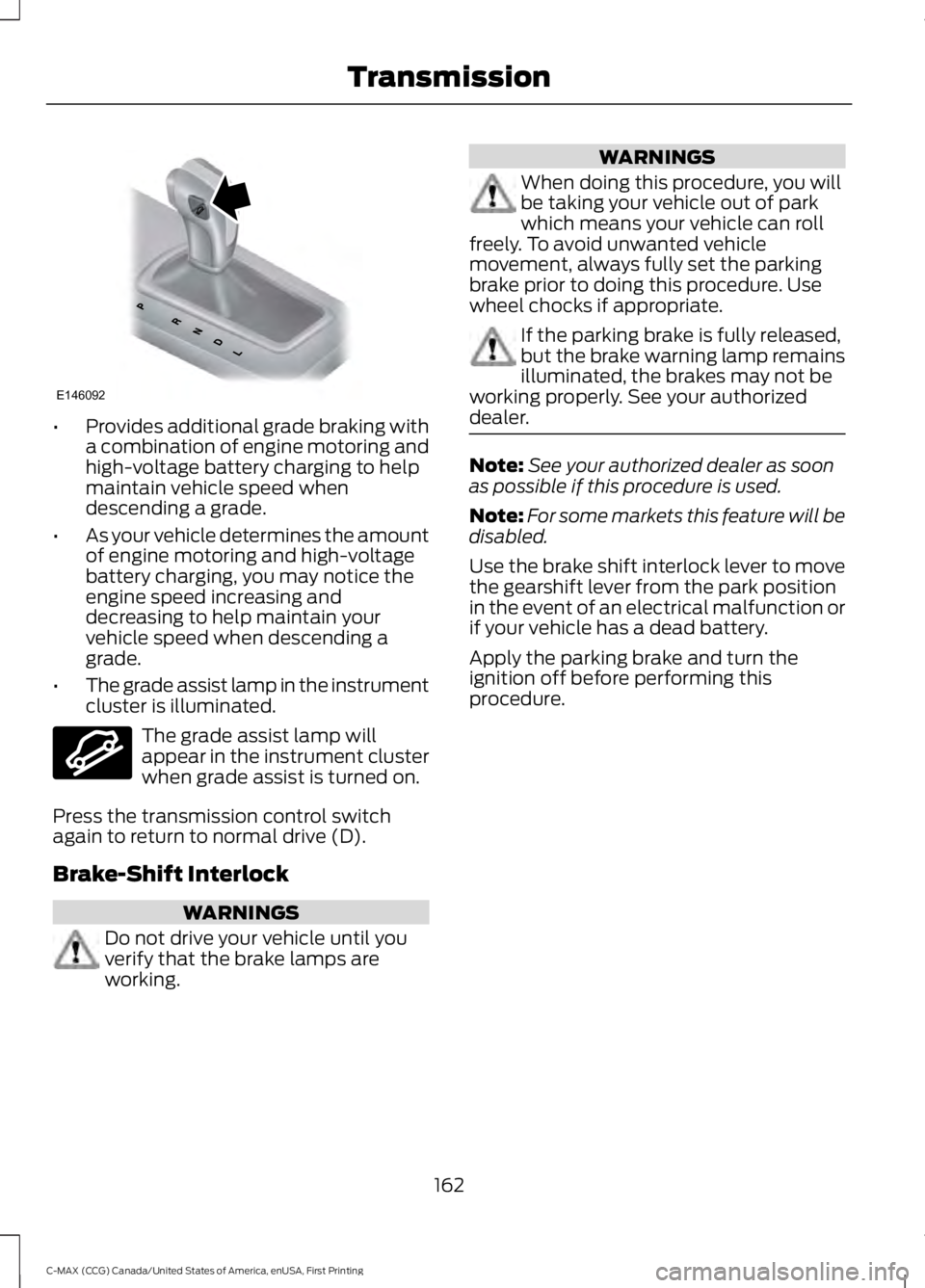
•Provides additional grade braking witha combination of engine motoring andhigh-voltage battery charging to helpmaintain vehicle speed whendescending a grade.
•As your vehicle determines the amountof engine motoring and high-voltagebattery charging, you may notice theengine speed increasing anddecreasing to help maintain yourvehicle speed when descending agrade.
•The grade assist lamp in the instrumentcluster is illuminated.
The grade assist lamp willappear in the instrument clusterwhen grade assist is turned on.
Press the transmission control switchagain to return to normal drive (D).
Brake-Shift Interlock
WARNINGS
Do not drive your vehicle until youverify that the brake lamps areworking.
WARNINGS
When doing this procedure, you willbe taking your vehicle out of parkwhich means your vehicle can rollfreely. To avoid unwanted vehiclemovement, always fully set the parkingbrake prior to doing this procedure. Usewheel chocks if appropriate.
If the parking brake is fully released,but the brake warning lamp remainsilluminated, the brakes may not beworking properly. See your authorizeddealer.
Note:See your authorized dealer as soonas possible if this procedure is used.
Note:For some markets this feature will bedisabled.
Use the brake shift interlock lever to movethe gearshift lever from the park positionin the event of an electrical malfunction orif your vehicle has a dead battery.
Apply the parking brake and turn theignition off before performing thisprocedure.
162
C-MAX (CCG) Canada/United States of America, enUSA, First Printing
TransmissionE146092 E144523