driver FORD E SERIES 2015 4.G User Guide
[x] Cancel search | Manufacturer: FORD, Model Year: 2015, Model line: E SERIES, Model: FORD E SERIES 2015 4.GPages: 360, PDF Size: 3.28 MB
Page 41 of 360
DRIVER AND PASSENGER AIRBAGS
WARNING:Never place your arm or any objects over an airbag
module. Placing your arm over a deploying airbag can result in
serious arm fractures or other injuries. Objects placed on or over the
airbag inflation area may cause those objects to be propelled by the
airbag into your face and torso causing serious injury.
WARNING:Airbags can kill or injure a child in a child seat.
Never place a rear-facing child seat in front of an active airbag.
If you must use a forward-facing child seat in the front seat, move the
seat upon which the child seat is installed all the way back.
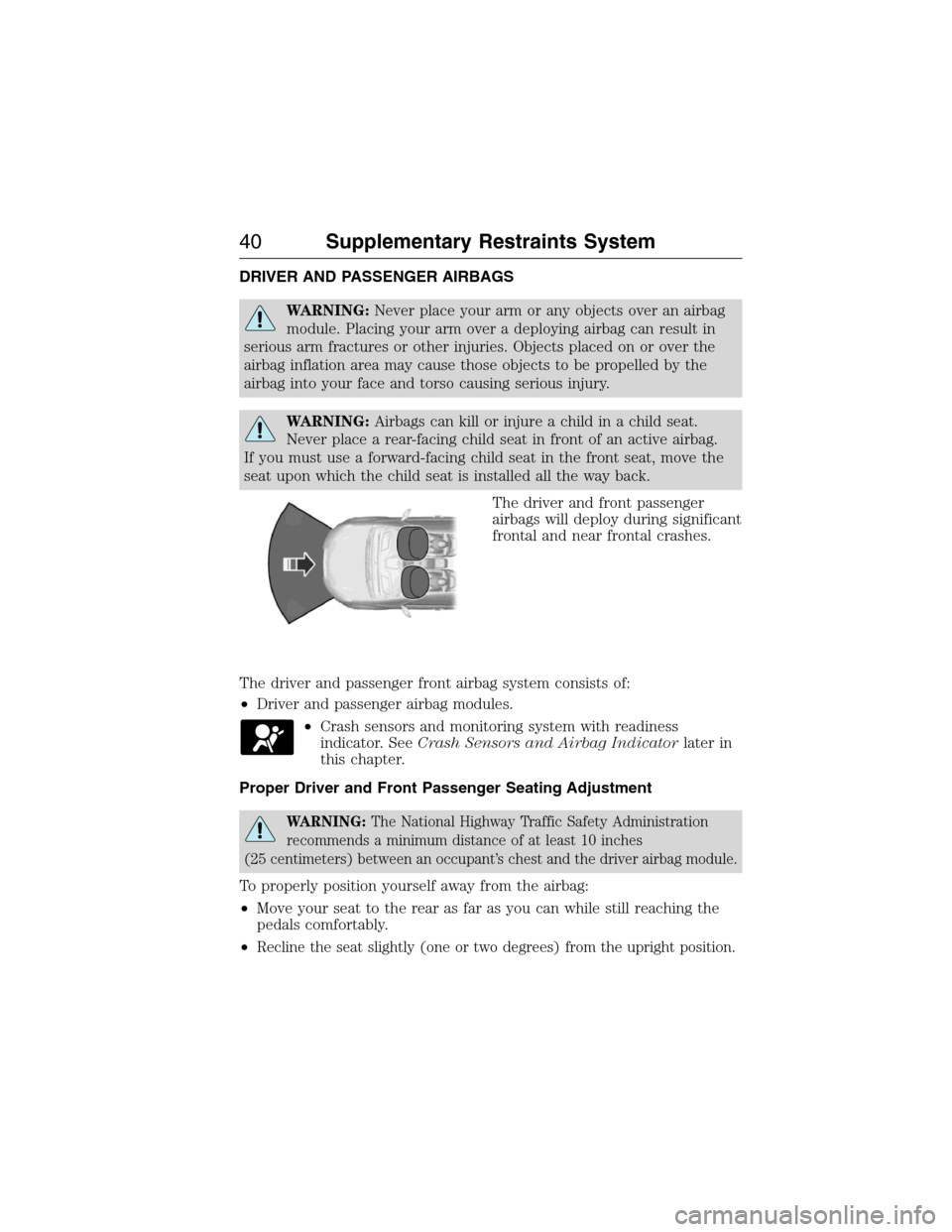
The driver and front passenger
airbags will deploy during significant
frontal and near frontal crashes.
The driver and passenger front airbag system consists of:
•Driver and passenger airbag modules.
•Crash sensors and monitoring system with readiness
indicator. SeeCrash Sensors and Airbag Indicatorlater in
this chapter.
Proper Driver and Front Passenger Seating Adjustment
WARNING:The National Highway Traffic Safety Administration
recommends a minimum distance of at least 10 inches
(25 centimeters) between an occupant’s chest and the driver airbag module.
To properly position yourself away from the airbag:
•Move your seat to the rear as far as you can while still reaching the
pedals comfortably.
•
Recline the seat slightly (one or two degrees) from the upright position.
40Supplementary Restraints System
2015 Econoline(eco)
Owners Guide gf, 1st Printing, June 2014
USA(fus)
Page 43 of 360
Turning the Passenger Airbag Off
WARNING:If the light fails to illuminate when the passenger air
bag switch is in the OFF position and the ignition switch is in
ON, contact your authorized dealer as soon as possible.
WARNING:In order to avoid inadvertent activation of the
switch, always remove the ignition key from the passenger air
bag ON and OFF switch.
WARNING:An infant in a rear-facing seat faces a high risk of
serious or fatal injuries from a deploying passenger airbag. Rear
facing infant seats should never be placed in the front seats, unless the
passenger airbag is turned off.
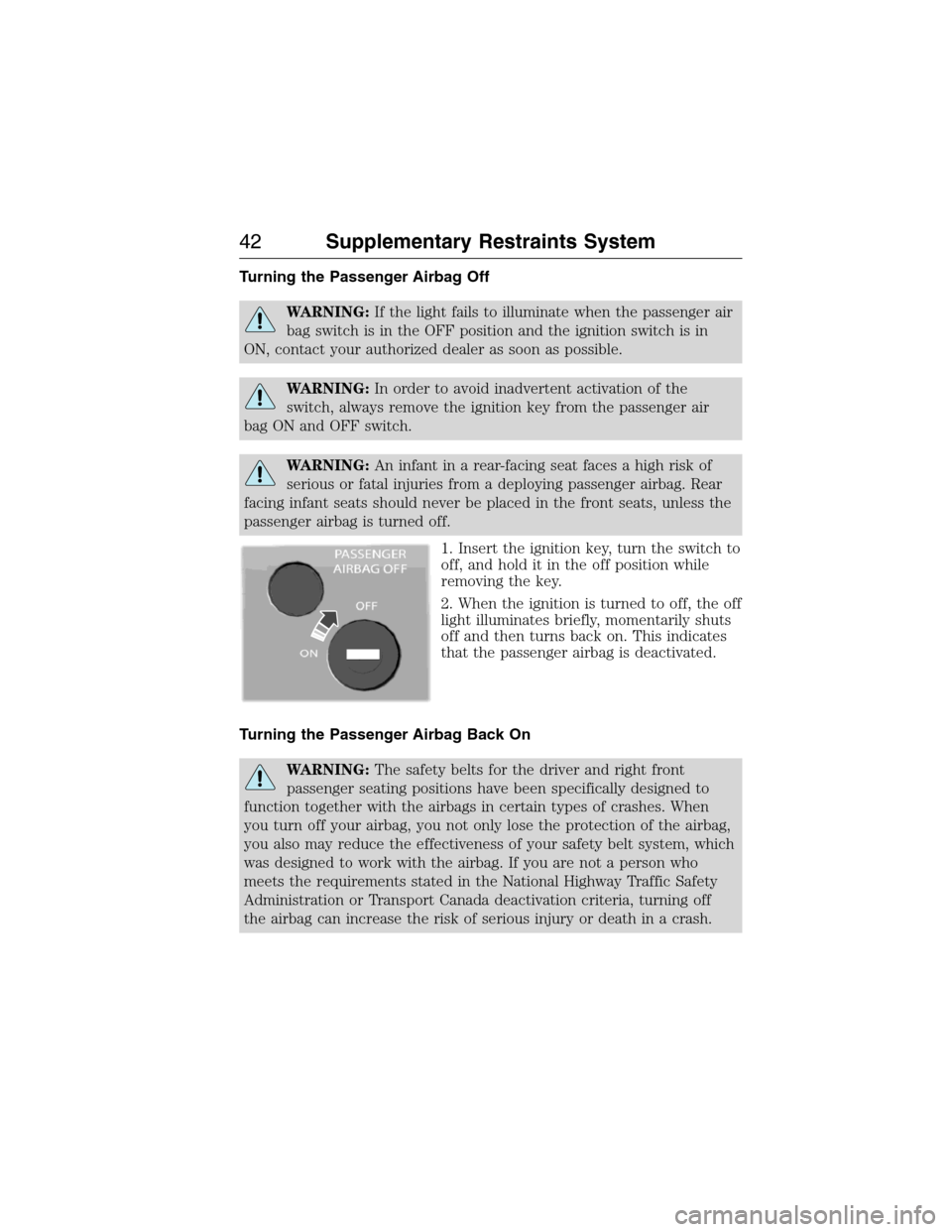
1. Insert the ignition key, turn the switch to
off, and hold it in the off position while
removing the key.
2. When the ignition is turned to off, the off
light illuminates briefly, momentarily shuts
off and then turns back on. This indicates
that the passenger airbag is deactivated.
Turning the Passenger Airbag Back On
WARNING:The safety belts for the driver and right front
passenger seating positions have been specifically designed to
function together with the airbags in certain types of crashes. When
you turn off your airbag, you not only lose the protection of the airbag,
you also may reduce the effectiveness of your safety belt system, which
was designed to work with the airbag. If you are not a person who
meets the requirements stated in the National Highway Traffic Safety
Administration or Transport Canada deactivation criteria, turning off
the airbag can increase the risk of serious injury or death in a crash.
42Supplementary Restraints System
2015 Econoline(eco)
Owners Guide gf, 1st Printing, June 2014
USA(fus)
Page 44 of 360
WARNING:If your vehicle has rear seats, always transport
children who are 12 and younger in a rear seating position.
Always use safety belts and child restraints properly. Do not place a
child in a rear facing infant seat in the front seat unless your vehicle is
equipped with an airbag ON and OFF switch and the passenger airbag
is turned off. This is because the back of the infant seat is too close to
the inflating airbag and the risk of a fatal injury to the infant when the
airbag inflates is substantial.
WARNING:If the OFF light is illuminated when the passenger
airbag switch is in the ON position and the ignition switch is in
ON, have the passenger airbag switch serviced at an authorized dealer
immediately.
The passenger airbag remains off until you turn it back on.
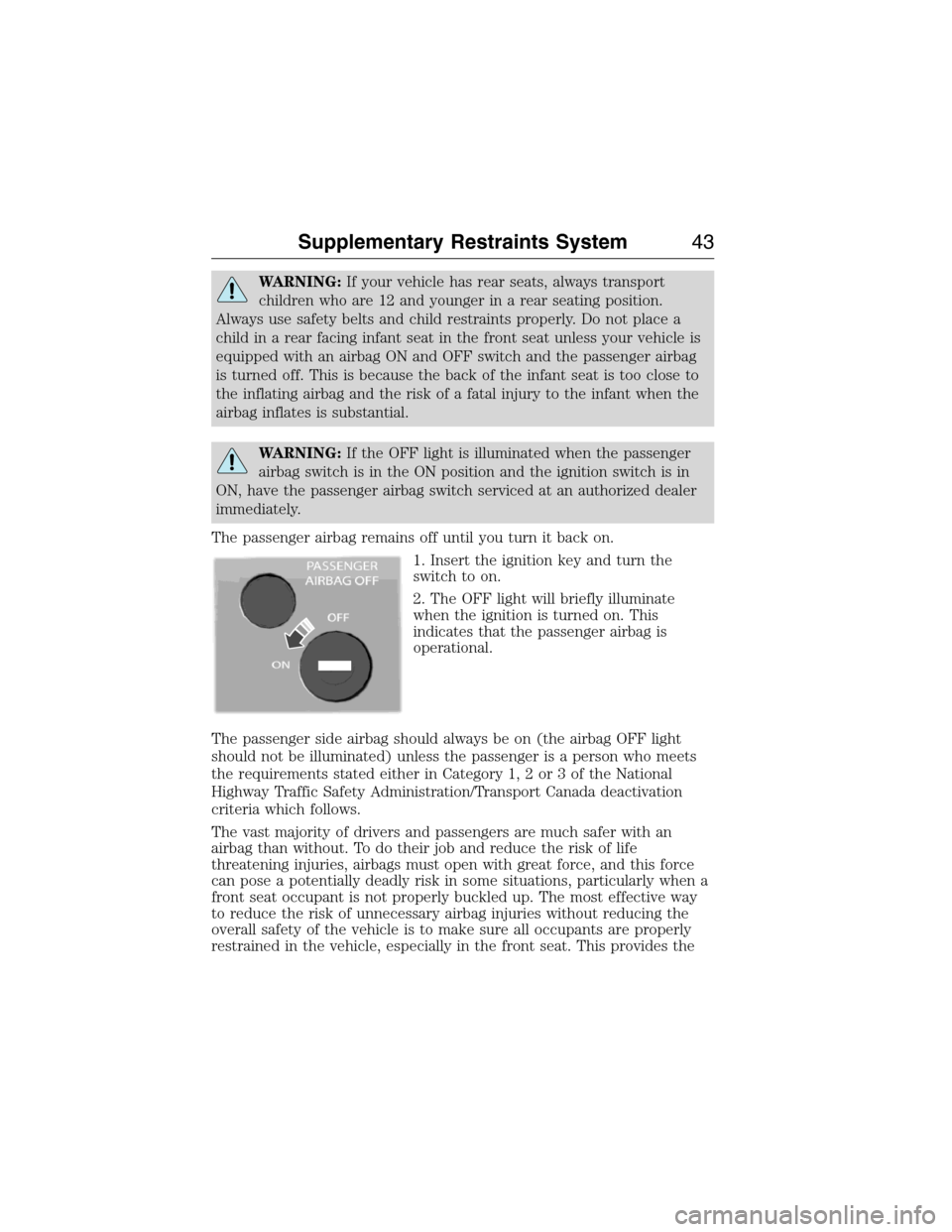
1. Insert the ignition key and turn the
switch to on.
2. The OFF light will briefly illuminate
when the ignition is turned on. This
indicates that the passenger airbag is
operational.
The passenger side airbag should always be on (the airbag OFF light
should not be illuminated) unless the passenger is a person who meets
the requirements stated either in Category 1, 2 or 3 of the National
Highway Traffic Safety Administration/Transport Canada deactivation
criteria which follows.
The vast majority of drivers and passengers are much safer with an
airbag than without. To do their job and reduce the risk of life
threatening injuries, airbags must open with great force, and this force
can pose a potentially deadly risk in some situations, particularly when a
front seat occupant is not properly buckled up. The most effective way
to reduce the risk of unnecessary airbag injuries without reducing the
overall safety of the vehicle is to make sure all occupants are properly
restrained in the vehicle, especially in the front seat. This provides the
Supplementary Restraints System43
2015 Econoline(eco)
Owners Guide gf, 1st Printing, June 2014
USA(fus)
Page 45 of 360
protection of safety belts and permits the airbags to provide the
additional protection they were designed to provide. If you choose to
deactivate your airbag, you are losing the very significant risk reducing
benefits of the airbag and you are also reducing the effectiveness of the
safety belts, because safety belts in modern vehicles are designed to
work as a safety system with the airbags.
National Highway Traffic Safety Administration Deactivation
Criteria (excluding Canada)
WARNING:This vehicle has special energy management safety
belts for the driver and right front passenger. These particular
belts are specifically designed to work with airbags to help reduce the
risk of injury in a crash. The energy management safety belt is designed
to give or release additional belt webbing in some accidents to reduce
concentration of force on an occupant’s chest and reduce the risk of
certain bone fractures and injuries to underlying organs. In a crash, if
the airbag is turned off, this energy management safety belt might
permit the person wearing the belt to move forward enough to incur a
serious or fatal injury. The more severe the crash, and the heavier the
occupant, the greater the risk is. Be sure the airbag is turned on for
any person who does not qualify under the National Highway Traffic
Safety Administration deactivation criteria.
1.Infant.An infant (less than 1 year old) must ride in the front seat
because:
•the vehicle has no rear seat;
•the vehicle has a rear seat too small to accommodate a rear-facing
infant seat; or
•the infant has a medical condition which, according to the infant’s
physician, makes it necessary for the infant to ride in the front so that
the driver can constantly monitor the child’s condition.
2.Child age 1 to 12.A child age 1 to 12 must ride in the front seat
because:
•the vehicle has no rear seat;
•although children ages 1 to 12 ride in the rear seat(s) whenever
possible, children ages 1 to 12 sometimes must ride in the front
because no space is available in the rear seat(s) of the vehicle; or
44Supplementary Restraints System
2015 Econoline(eco)
Owners Guide gf, 1st Printing, June 2014
USA(fus)
Page 46 of 360
•the child has a medical condition which, according to the child’s
physician, makes it necessary for the child to ride in the front seat so
that the driver can constantly monitor the child’s condition.
3.Medical condition.A passenger has a medical condition which,
according to his or her physician:
•causes the passenger airbag to pose a special risk for the passenger;
and
•makes the potential harm from the passenger airbag in a crash greater
than the potential harm from turning off the airbag and allowing the
passenger, even if belted, to hit the dashboard or windshield in a
crash.
Transport Canada Deactivation Criteria (Canada Only)
WARNING:This vehicle has special energy management safety
belts for the driver and right front passenger. These particular
belts are specifically designed to work with airbags to help reduce the
risk of injury in a crash. The energy management safety belt is designed
to give or release additional belt webbing in some accidents to reduce
concentration of force on an occupant’s chest and reduce the risk of
certain bone fractures and injuries to underlying organs. In a crash, if
the airbag is turned off, this energy management safety belt might
permit the person wearing the belt to move forward enough to incur a
serious or fatal injury. The more severe the crash, and the heavier the
occupant, the greater the risk is. Be sure the airbag is turned on for
any person who does not qualify under the National Highway Traffic
Safety Administration deactivation criteria.
1.Infant:An infant (less than 1 year old) must ride in the front seat
because:
•my vehicle has no rear seat;
•the rear seat in my vehicle cannot accommodate a rear-facing infant
seat; or
•the infant has a medical condition which, according to the infant’s
physician, makes it necessary for the infant to ride in the front seat so
that the driver can monitor the infant’s condition.
Supplementary Restraints System45
2015 Econoline(eco)
Owners Guide gf, 1st Printing, June 2014
USA(fus)
Page 47 of 360
2.Child age 12 or under:A child age 12 or under must ride in the
front seat because:
•my vehicle has no rear seat;
•although children age 12 and under ride in the rear seat whenever
possible, children age 12 and under have no option but to sometimes
ride in the front seat because rear seat space is insufficient; or
•the child has a medical condition that, according to the child’s
physician, makes it necessary for the child to ride in the front seat so
that the driver can monitor the child’s condition.
3.Medical condition:A passenger has a medical condition that,
according to his or her physician:
•poses a special risk for the passenger if the airbag deploys; and
•makes the potential harm from the passenger airbag deployment
greater than the potential harm from turning off the airbag and
experiencing a crash without the protection offered by the airbag
CRASH SENSORS AND AIRBAG INDICATOR
WARNING:Modifying or adding equipment to the front end of
your vehicle (including frame, bumper, front end body structure
and tow hooks) may affect the performance of the airbag system,
increasing the risk of injury. Do not modify the front end of your
vehicle.
Your vehicle has a collection of crash and occupant sensors which
provide information to the restraints control module. The restraints
control module deploys (activates) the front safety belt pretensioners,
driver airbag and passenger airbag. Based on the type of accident, the
restraints control module will deploy the appropriate safety devices.
The restraints control module also monitors the readiness of the above
safety devices plus the crash sensors. The readiness of the safety system
is indicated by a warning indicator light in the instrument cluster or by a
backup tone if the warning light is not working. See theInstrument
Clusterchapter. Routine maintenance of the airbag is not required.
46Supplementary Restraints System
2015 Econoline(eco)
Owners Guide gf, 1st Printing, June 2014
USA(fus)
Page 52 of 360
LOCKING AND UNLOCKING
You can use the power door lock control or the remote control to lock
and unlock your vehicle.
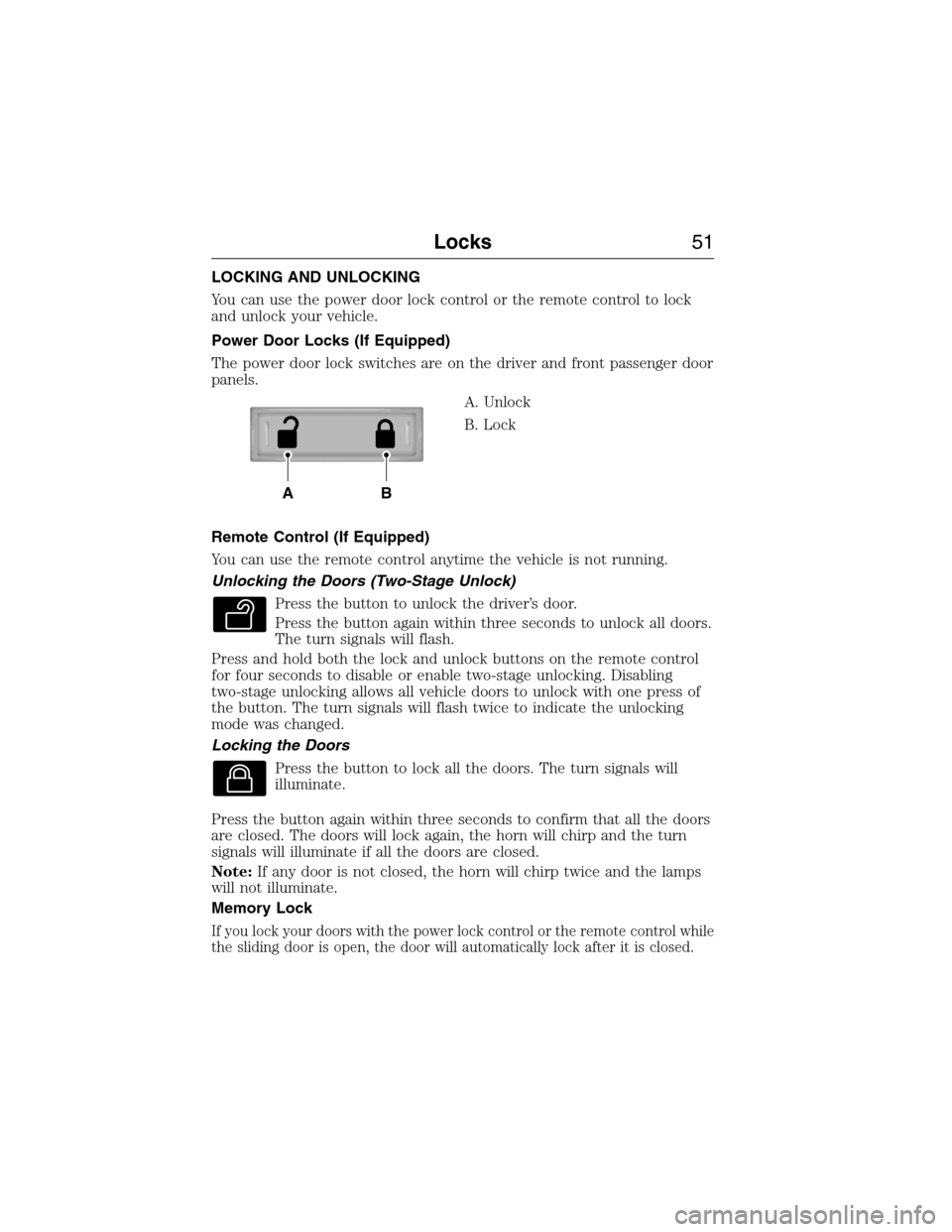
Power Door Locks (If Equipped)
The power door lock switches are on the driver and front passenger door
panels.
A. Unlock
B. Lock
Remote Control (If Equipped)
You can use the remote control anytime the vehicle is not running.
Unlocking the Doors (Two-Stage Unlock)
Press the button to unlock the driver’s door.
Press the button again within three seconds to unlock all doors.
The turn signals will flash.
Press and hold both the lock and unlock buttons on the remote control
for four seconds to disable or enable two-stage unlocking. Disabling
two-stage unlocking allows all vehicle doors to unlock with one press of
the button. The turn signals will flash twice to indicate the unlocking
mode was changed.
Locking the Doors
Press the button to lock all the doors. The turn signals will
illuminate.
Press the button again within three seconds to confirm that all the doors
are closed. The doors will lock again, the horn will chirp and the turn
signals will illuminate if all the doors are closed.
Note:If any door is not closed, the horn will chirp twice and the lamps
will not illuminate.
Memory Lock
If you lock your doors with the power lock control or the remote control while
the sliding door is open, the door will automatically lock after it is closed.
AB
Locks51
2015 Econoline(eco)
Owners Guide gf, 1st Printing, June 2014
USA(fus)
Page 53 of 360
Autolock and Unlock
Note:Your vehicle comes with this feature disabled.
The autolock feature will lock all the doors when:
•all doors are closed,
•the ignition is on,
•you shift into any gear putting the vehicle in motion, and
•the vehicle attains a speed greater than 12 mph (20 km/h).
If the vehicle was autolocked, the autounlock feature will unlock all
doors when the driver’s door is opened within 10 minutes of switching
the ignition off.
Enabling or Disabling Autolock and Autounlock
These features can be enabled or disabled:
•by your authorized dealer
•through the information display
•using the power door lock procedure.
To enable or disable using the power door locks, do the following:
Note:You will have 30 seconds to complete the procedure.
1. Switch the ignition on.
2. Press the power door lock button three times.
3. Switch the ignition off.
4. Press the power door lock button three times.
5. Switch the ignition on. The horn will chirp indicating the programming
mode has been entered.
Autolock:Once in programming mode, press the power door unlock
button then the lock button. The horn will chirp once if autolock was
deactivated or twice (one short and one long chirp) if autolock was
activated.
Autounlock:Once in programming mode, press the power door lock
button then the unlock button. The horn will chirp once if autounlock
was deactivated or twice (one short and one long chirp) if autounlock
was activated.
6. Turn the ignition off. The horn will chirp once to confirm the
procedure is complete.
Note:The autounlock feature can be enabled or disabled independently
of the autolock feature.
52Locks
2015 Econoline(eco)
Owners Guide gf, 1st Printing, June 2014
USA(fus)
Page 74 of 360
Solid illumination after the engine is started indicates the on-board
diagnostics system (OBD-II) has detected a malfunction. Refer to
On-board diagnostics (OBD-II)in theFuel and Refuelingchapter.
If the light is blinking, engine misfire is occurring which could damage
your catalytic converter. Drive in a moderate fashion (avoid heavy
acceleration and deceleration) and have your vehicle serviced
immediately by your authorized dealer.
WARNING:Under engine misfire conditions, excessive exhaust
temperatures could damage the catalytic converter, the fuel system,
interior floor coverings or other vehicle components, possibly causing a fire.
Stability Control System
Displays when the AdvanceTrac®/Traction control is active.
If the light remains on, have the system serviced immediately.
Stability Control System Off
It will illuminate when AdvanceTrac®/Traction control has been
disabled by the driver.
Transmission Tow/Haul
It will illuminate when the Tow/Haul feature has been activated.
Refer to theTransmissionchapter for transmission function
and operation. If the light flashes steadily, have the system
serviced immediately, damage to the transmission could occur.
AUDIBLE WARNINGS AND INDICATORS
Key In Ignition Warning Chime
Sounds when the key is left in the ignition in the off or accessory
position and the driver’s door is opened.
Headlamps On Warning Chime
Sounds when the headlamps or parking lamps are on, the ignition is off
(the key is not in the ignition) and the driver’s door is opened.
Parking Brake On Warning Chime
Sounds when you have left the parking brake on and drive your vehicle.
If the warning chime remains on after you have released the parking
brake, have the system checked by your authorized dealer immediately.
Instrument Cluster73
2015 Econoline(eco)
Owners Guide gf, 1st Printing, June 2014
USA(fus)
Page 78 of 360
•UNITS ENG / METRIC: Displays the current units in English or Metric.
•AUTOLOCK: This feature automatically locks all vehicle doors when
the vehicle is shifted into any gear, putting the vehicle in motion.
•AUTOUNLOCK: This feature automatically unlocks all vehicle doors
when the driver’s door is opened within 10 minutes of the ignition
being turned off.
•COMPASS (if equipped): Displays the vehicle’s heading direction.
The compass reading may be affected when you drive near large
buildings, bridges, power lines and powerful broadcast antenna. Magnetic
or metallic objects placed in, on or near the vehicle may also affect
compass accuracy. If the compass appears to be inaccurate, a manual
calibration may be necessary. Refer toCompass zone adjustment
Compass zone adjustment
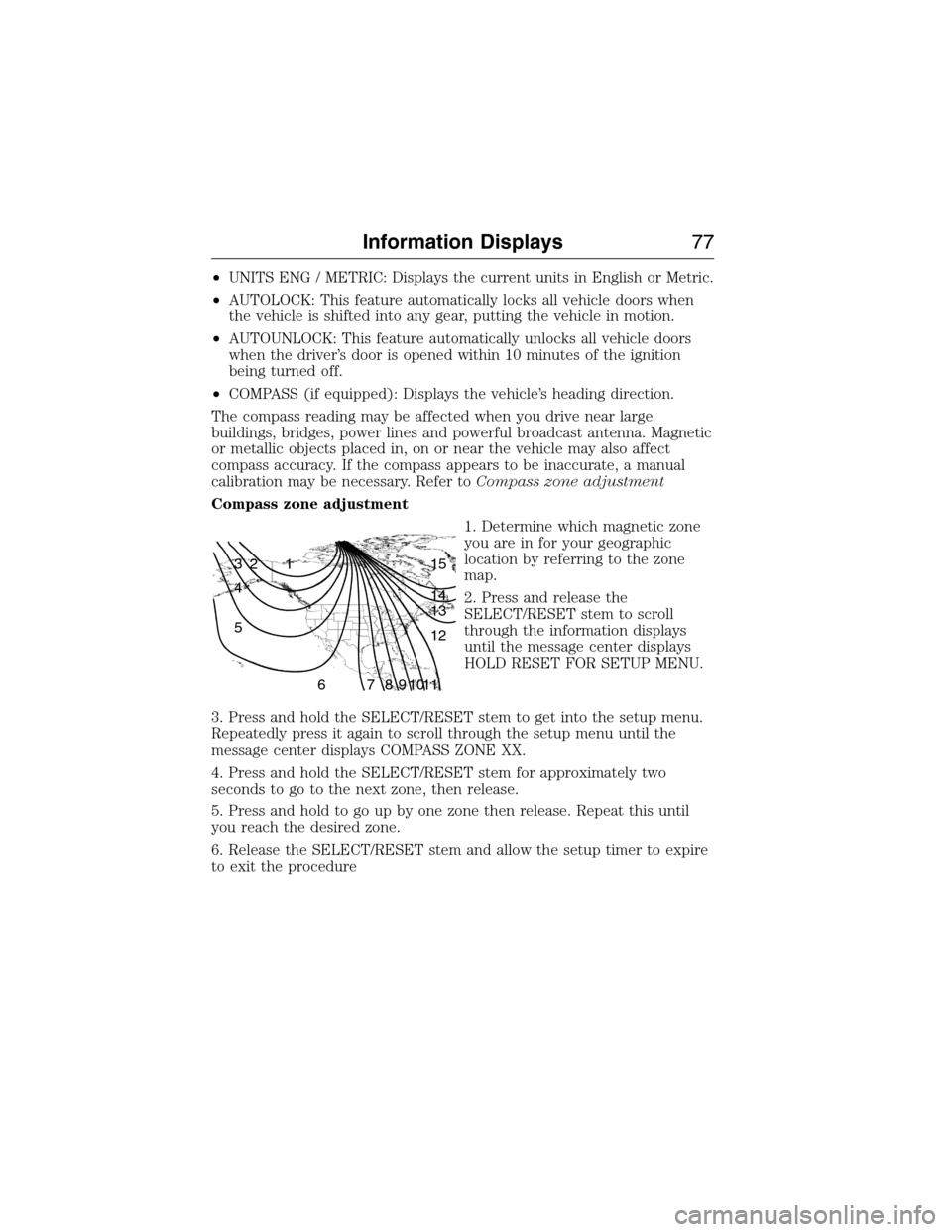
1. Determine which magnetic zone
you are in for your geographic
location by referring to the zone
map.
2. Press and release the
SELECT/RESET stem to scroll
through the information displays
until the message center displays
HOLD RESET FOR SETUP MENU.
3. Press and hold the SELECT/RESET stem to get into the setup menu.
Repeatedly press it again to scroll through the setup menu until the
message center displays COMPASS ZONE XX.
4. Press and hold the SELECT/RESET stem for approximately two
seconds to go to the next zone, then release.
5. Press and hold to go up by one zone then release. Repeat this until
you reach the desired zone.
6. Release the SELECT/RESET stem and allow the setup timer to expire
to exit the procedure
1 2 3
4
5
6 7 8 9 101112 13 14 15
Information Displays77
2015 Econoline(eco)
Owners Guide gf, 1st Printing, June 2014
USA(fus)