driver FORD E SERIES 2015 4.G Owners Manual
[x] Cancel search | Manufacturer: FORD, Model Year: 2015, Model line: E SERIES, Model: FORD E SERIES 2015 4.GPages: 360, PDF Size: 3.28 MB
Page 2 of 360

Introduction 7
Child Safety 16
Child seat positioning...................................18
Booster seats.........................................20
Installing child seats....................................23
Safety Belts 29
Fastening the safety belts................................31
Safety belt height adjustment.............................34
Safetybeltwarninglightandindicatorchime..................35
Safety belt-minder.....................................35
Child restraint and safety belt maintenance...................37
Supplementary Restraints System 38
Driver and passenger airbags.............................40
Crash sensors and airbag indicator.........................46
Airbag disposal........................................47
Keys and Remote Control 48
General information on radio frequencies.....................48
Remote control.......................................48
Replacing a lost key or remote control.......................50
Locks 51
Locking and unlocking..................................51
Security 55
SecuriLock® passive anti-theft system.......................55
Steering Wheel 58
Adjusting the steering wheel..............................58
Wipers and Washers 59
Windshield wipers.....................................59
Windshield washers....................................59
Table of Contents1
2015 Econoline(eco)
Owners Guide gf, 1st Printing, June 2014
USA(fus)
Page 11 of 360

DATA RECORDING
Service Data Recording
Service data recorders in your vehicle are capable of collecting and
storing diagnostic information about your vehicle. This potentially
includes information about the performance or status of various systems
and modules in the vehicle, such as engine, throttle, steering or brake
systems. In order to properly diagnose and service your vehicle, Ford
Motor Company, Ford of Canada, and service and repair facilities may
access or share among them vehicle diagnostic information received
through a direct connection to your vehicle when diagnosing or servicing
your vehicle. Additionally, when your vehicle is in for service or repair,
Ford Motor Company, Ford of Canada, and service and repair facilities
may access or share among them data for vehicle improvement purposes.
For U.S. only (if equipped), if you choose to use the SYNC® Vehicle
Health Report, you consent that certain diagnostic information may also
be accessed electronically by Ford Motor Company and Ford authorized
service facilities, and that the diagnostic information may be used for any
purpose. See theSYNC®chapter for more information.
Event Data Recording
This vehicle is equipped with an event data recorder (EDR).
The main purpose of an EDR is to record, in certain crash or near
crash-like situations, such as an airbag deployment or hitting a
road obstacle; this data will assist in understanding how a
vehicle’s systems performed. The EDR is designed to record data
related to vehicle dynamics and safety systems for a short period
of time, typically 30 seconds or less. The EDR in this vehicle is
designed to record such data as:
•How various systems in your vehicle were operating;
•Whether or not the driver and passenger safety belts were
buckled/fastened;
•How far (if at all) the driver was depressing the accelerator
and/or the brake pedal;
•How fast the vehicle was travelling;
•Where the driver was positioning the steering wheel.
This data can help provide a better understanding of the
circumstances in which crashes and injuries occur.
10Introduction
2015 Econoline(eco)
Owners Guide gf, 1st Printing, June 2014
USA(fus)
Page 15 of 360

Notice to owners of pickup trucks and utility type vehicles
WARNING:Utility vehicles have a significantly higher rollover
rate than other types of vehicles.
Before you drive your vehicle, please read this Owner’s Manual carefully.
Your vehicle is not a passenger car. As with other vehicles of this type,
failure to operate your vehicle correctly may result in loss of vehicle
control, vehicle rollover, personal injury or death.
Using your vehicle as an ambulance
If your light truck is equipped with the Ford Ambulance Preparation
Package, it may be utilized as an ambulance. Ford urges ambulance
manufacturers to follow the recommendations of theFord Incomplete
Vehicle Manual, Ford Truck Body Builder’s Layout Bookand the
Qualified Vehicle Modifiers (QVM) Guidelinesas well as pertinent
supplements. For additional information, please contact the Truck Body
Builders Advisory Service at http://www.fleet.ford.com/truckbbas/ and
then by selecting “Contact Us” or by phone at 1–877–840–4338.
Use of your Ford light truck as an ambulance, without the Ford
Ambulance Preparation Package voids the Ford New Vehicle Limited
Warranty and may void the Emissions Warranties. In addition, ambulance
usage without the preparation package could cause high underbody
temperatures, overpressurized fuel and a risk of spraying fuel which
could lead to fires.
If your vehicle is equipped with the Ford Ambulance Preparation
Package, it will be indicated on the Safety Compliance Certification
Label. The label is located on the driver’s side door pillar or on the rear
edge of the driver’s door. You can determine whether the ambulance
manufacturer followed Ford’s recommendations by directly contacting
that manufacturer.
14Introduction
2015 Econoline(eco)
Owners Guide gf, 1st Printing, June 2014
USA(fus)
Page 30 of 360
PRINCIPLES OF OPERATION
WARNING:Always drive and ride with your seatback upright
and the lap belt snug and low across the hips.
WARNING:Never let a passenger hold a child on his or her lap
while the vehicle is moving. The passenger cannot protect the
child from injury in a crash.
WARNING:To reduce the risk of injury, make sure children sit
where they can be properly restrained.
WARNING:All occupants of the vehicle, including the driver,
should always properly wear their safety belts, even when an
airbag supplemental restraint system is provided. Failure to properly
wear your safety belt could seriously increase the risk of injury or
death.
WARNING:It is extremely dangerous to ride in a cargo area,
inside or outside of a vehicle. In a crash, people riding in these
areas are more likely to be seriously injured or killed. Do not allow
people to ride in any area of your vehicle that is not equipped with
seats and safety belts. Be sure everyone in your vehicle is in a seat and
using a safety belt properly.
WARNING:In a rollover crash, an unbelted person is significantly
more likely to die than a person wearing a safety belt.
WARNING:Each seating position in your vehicle has a specific
safety belt assembly which is made up of one buckle and one
tongue that are designed to be used as a pair. 1) Use the shoulder belt
on the outside shoulder only. Never wear the shoulder belt under the
arm. 2) Never swing the safety belt around your neck over the inside
shoulder. 3) Never use a single belt for more than one person.
Safety Belts29
2015 Econoline(eco)
Owners Guide gf, 1st Printing, June 2014
USA(fus)
Page 31 of 360
WARNING:Safety belts and seats can become hot in a vehicle
that has been closed up in sunny weather; they could burn a
small child. Check seat covers and buckles before you place a child
anywhere near them.
WARNING:Front seat occupants, including pregnant women,
should wear safety belts for optimum protection in an accident.
All seating positions in this vehicle have lap and shoulder safety belts.
All occupants of the vehicle should always properly wear their safety
belts, even when an airbag supplemental restraint system is provided.
The safety belt system consists of:
•Lap and shoulder safety belts.
•Shoulder safety belt with automatic locking mode (except driver
safety belt).
•Height adjuster at the front outboard seating positions.
•Safety belt pretensioner at the front outboard seating positions.
•Safety belt warning light and chime. SeeSafety belt warning
light and indicator chime.
•Crash sensors and monitoring system with readiness
indicator. SeeCrash sensors and airbag indicatorin the
Supplemental Restraints Systemchapter.
The safety belt pretensioners are designed to activate in frontal or
near-frontal crashes and may deploy in rollovers if the vehicle is
equipped with roll stability control. The safety belt pretensioners at the
front seating positions are designed to tighten the safety belts firmly
against the occupant’s body when activated. This helps increase the
effectiveness of the safety belts.
30Safety Belts
2015 Econoline(eco)
Owners Guide gf, 1st Printing, June 2014
USA(fus)
Page 34 of 360
All safety restraints in the vehicle are combination lap and shoulder
belts. The driver safety belt has the first type of locking mode.
The front outboard passenger safety belt has both types of locking
modes described as follows:
Vehicle Sensitive Mode
This is the normal retractor mode, which allows free shoulder belt length
adjustment to your movements and locking in response to vehicle
movement. For example, if the driver brakes suddenly or turns a corner
sharply, or the vehicle receives an impact of about 5 mph (8 km/h) or
more, the combination safety belts will lock to help reduce forward
movement of the driver and passengers.
In addition, the retractor is designed to lock if the webbing is pulled out
too quickly. If this occurs, let the belt retract slightly and pull webbing
out again in a slow and controlled manner.
Automatic Locking Mode
In this mode, the shoulder belt is automatically pre-locked. The belt will
still retract to remove any slack in the shoulder belt. The automatic
locking mode is not available on the driver safety belt.
When to Use the Automatic Locking Mode
This mode should be used any time a child safety seat, except a booster,
is installed in the passenger front seating position. See theChild Safety
chapter.
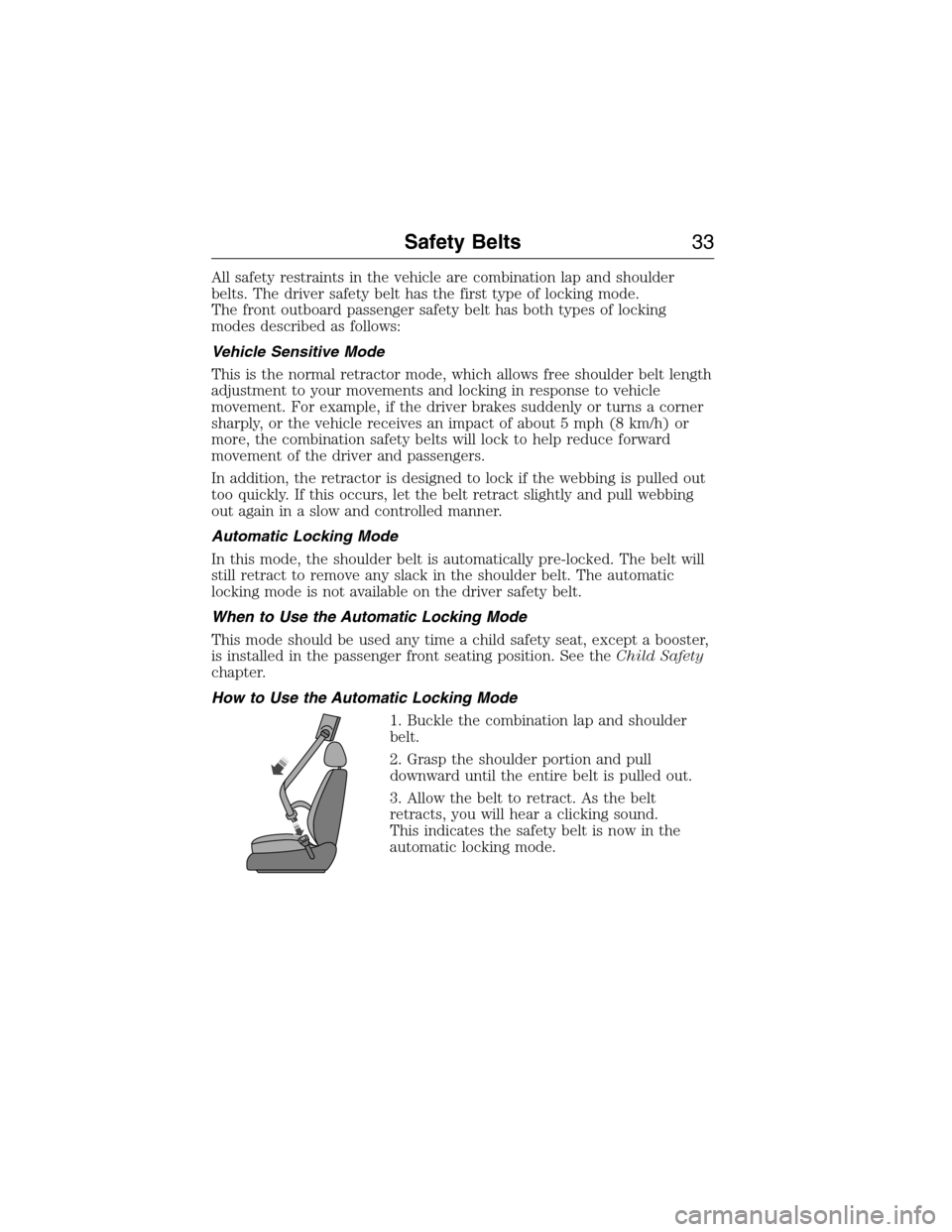
How to Use the Automatic Locking Mode
1. Buckle the combination lap and shoulder
belt.
2. Grasp the shoulder portion and pull
downward until the entire belt is pulled out.
3. Allow the belt to retract. As the belt
retracts, you will hear a clicking sound.
This indicates the safety belt is now in the
automatic locking mode.
Safety Belts33
2015 Econoline(eco)
Owners Guide gf, 1st Printing, June 2014
USA(fus)
Page 36 of 360
SAFETY BELT WARNING LIGHT AND INDICATOR CHIME
This lamp illuminates and an audible warning will sound if the
driver’s safety belt has not been fastened when the vehicle’s
ignition is turned on.
Conditions of Operation
If... Then...
The driver safety belt is not
buckled before the ignition
switch is turned to the on
position...The safety belt warning light
illuminates 1-2 minutes and the
warning chime sounds 4-8 seconds.
The driver safety belt is
buckled while the indicator
light is illuminated and the
warning chime is sounding...The safety belt warning light and
warning chime turn off.
The driver safety belt is
buckled before the ignition
switch is turned to the on
position...The safety belt warning light and
indicator chime remain off.
SAFETY BELT-MINDER™ (IF EQUIPPED)
This feature supplements the safety belt warning function by providing
additional reminders that intermittently sound a tone and illuminate the
safety belt warning light when you are in the driver seat and the safety
belt is unbuckled.
If... Then...
You buckle your safety belt
before you switch the ignition
on or less than 1-2 minutes
elapse after you switch the
ignition on...The Belt-Minder feature will not
activate.
Safety Belts35
2015 Econoline(eco)
Owners Guide gf, 1st Printing, June 2014
USA(fus)
Page 37 of 360
If... Then...
You do not buckle your safety
belt before your vehicle
reaches at least 6 mph
(9.7 km/h) and 1-2 minutes
elapse after you switch the
ignition...The Belt-Minder feature activates, the
safety belt warning light illuminates
and a warning tone sounds for
6 seconds every 25 seconds, repeating
for about 5 minutes or until you
buckle your safety belt.
The driver safety belt is
unbuckled for about one
minute while the vehicle is
traveling at least 6 mph
(9.7 km/h) and more than
1-2 minutes elapse after you
switch the ignition on...The Belt-Minder feature activates,
the safety belt warning light
illuminates and a warning tone sounds
for 6 seconds every 25 seconds,
repeating for about 5 minutes or until
you buckle your safety belt.
Deactivating and Activating the Belt-Minder Feature
WARNING:While the design allows you to deactivate your
Belt-Minder, this system is designed to improve your chances of
being safely belted and surviving an accident. We recommend you leave
the Belt-Minder system activated for yourself and others who may use
the vehicle.
Read Steps1-5thoroughly before proceeding with the programming
procedure.
Before following the procedure, make sure that:
•The parking brake is set.
•The transmission is in park (P).
•The ignition is off.
•All vehicle doors and the hood are closed.
•The driver safety belt is unbuckled.
•The parking lamps and headlamps are off.
36Safety Belts
2015 Econoline(eco)
Owners Guide gf, 1st Printing, June 2014
USA(fus)
Page 39 of 360
PRINCIPLES OF OPERATION
WARNING:Airbags do not inflate slowly or gently, and the risk
of injury from a deploying airbag is the greatest close to the trim
covering the airbag module.
WARNING:All occupants of your vehicle, including the driver,
should always properly wear their safety belts, even when an
airbag supplemental restraint system is provided. Failure to properly
wear your safety belt could seriously increase the risk of injury or
death.
WARNING:Airbags can kill or injure a child in a child seat.
Always transport children 12 years old and under in the back
seat and always properly use appropriate child restraints.
WARNING:Never place your arm over the airbag module, as a
deploying airbag can result in serious arm fractures or other
injuries.
WARNING:Airbags can kill or injure a child in a child seat.
Never place a rear-facing child seat in front of an active airbag.
If you must use a forward-facing child seat in the front seat, move the
seat upon which the child seat is installed all the way back.
WARNING:Do not attempt to service, repair, or modify the
airbag supplemental restraint systems or its fuses as you could be
seriously injured or killed. Contact your authorized dealer as soon as
possible.
WARNING:Several airbag system components get hot after
inflation. Do not touch them after inflation as this may result in
serious injury.
38Supplementary Restraints System
2015 Econoline(eco)
Owners Guide gf, 1st Printing, June 2014
USA(fus)
Page 40 of 360
WARNING:If the airbag has deployed, the airbag will not function
again and must be replaced immediately. If the airbag is not
replaced, the unrepaired area will increase the risk of injury in a crash.
The airbags are a supplemental restraint system and are designed to
work with the safety belts to help protect the driver and right front
passenger from certain upper body injuries. Airbags do not inflate slowly;
there is a risk of injury from a deploying airbag.
Note:You will hear a loud bang and see a cloud of harmless powdery
residue if an airbag deploys. This is normal.
The airbags inflate and deflate rapidly upon activation. After airbag
deployment, it is normal to notice a smoke-like, powdery residue or
smell the burnt propellant. This may consist of cornstarch, talcum
powder (to lubricate the bag) or sodium compounds (for example,
baking soda) that result from the combustion process that inflates the
airbag. Small amounts of sodium hydroxide may be present which may
irritate the skin and eyes, but none of the residue is toxic.
While the system is designed to help reduce serious injuries,
contact with a deploying airbag may also cause abrasions or swelling.
Temporary hearing loss is also a possibility as a result of the noise
associated with a deploying airbag. Because airbags must inflate rapidly
and with considerable force, there is the risk of death or serious injuries,
such as fractures, facial and eye injuries or internal injuries, particularly
to occupants who are not properly restrained or are otherwise out of
position at the time of airbag deployment. Thus, it is extremely
important that occupants be properly restrained as far away from the
airbag module as possible while maintaining vehicle control.
Routine maintenance of the airbags is not required.
SOS POST-CRASH ALERT SYSTEM™
The system flashes the direction indicator lamps and the horn sounds
(intermittently) in the event of a serious impact that deploys an airbag
equipped on your vehicle.
The horn and lamps turn off when:
•You press the hazard button.
•
You press the panic button (if equipped) on the remote entry transmitter.
•Your vehicle runs out of power.
Supplementary Restraints System39
2015 Econoline(eco)
Owners Guide gf, 1st Printing, June 2014
USA(fus)