audio FORD ESCAPE 2015 3.G Owners Manual
[x] Cancel search | Manufacturer: FORD, Model Year: 2015, Model line: ESCAPE, Model: FORD ESCAPE 2015 3.GPages: 449, PDF Size: 5.36 MB
Page 4 of 449
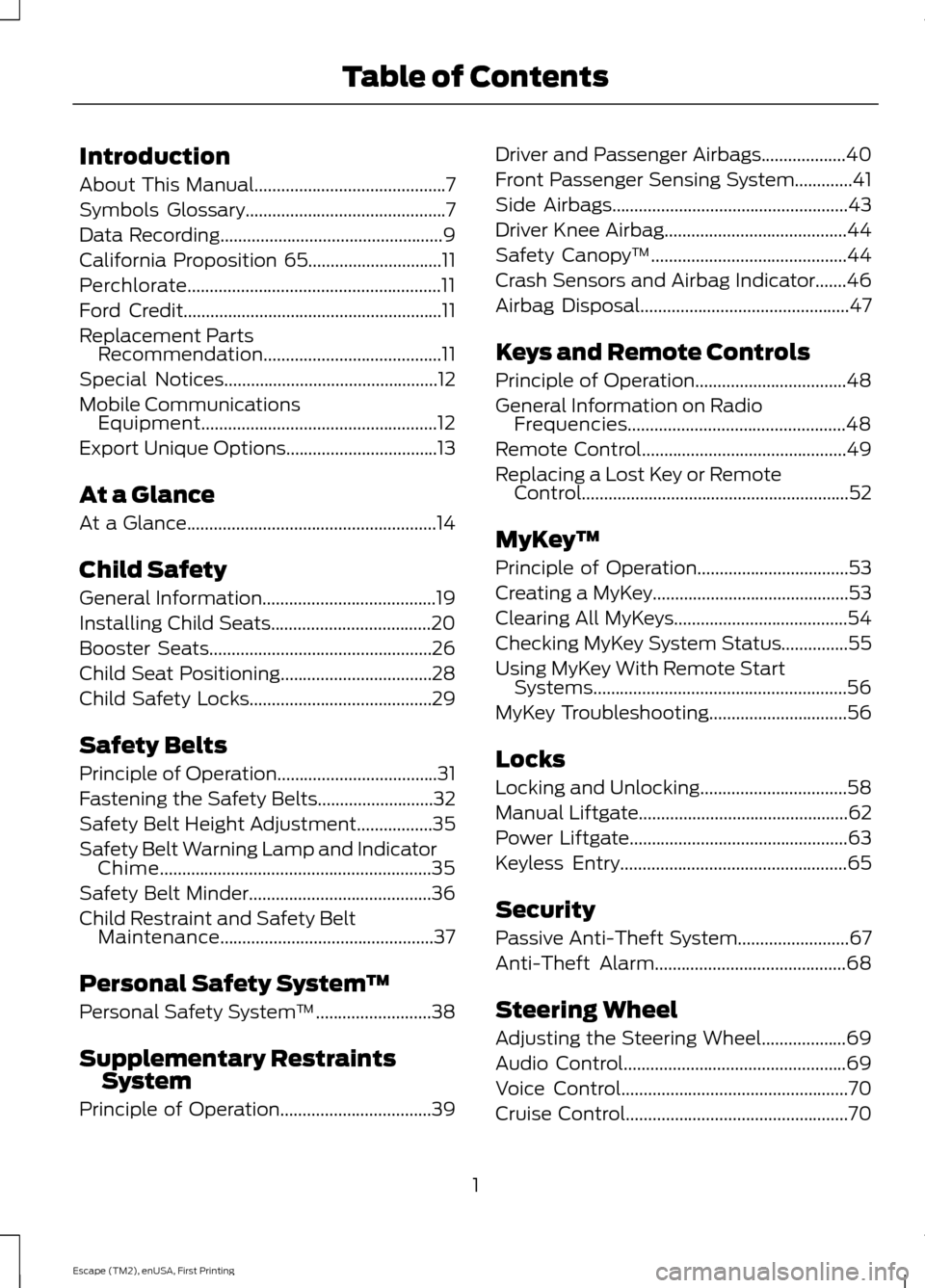
Introduction
About This Manual...........................................7
Symbols Glossary
.............................................7
Data Recording
..................................................9
California Proposition 65..............................11
Perchlorate.........................................................11
Ford Credit
..........................................................11
Replacement Parts Recommendation
........................................11
Special Notices................................................12
Mobile Communications Equipment.....................................................12
Export Unique Options..................................13
At a Glance
At a Glance........................................................14
Child Safety
General Information
.......................................19
Installing Child Seats....................................20
Booster Seats..................................................26
Child Seat Positioning
..................................28
Child Safety Locks.........................................29
Safety Belts
Principle of Operation....................................31
Fastening the Safety Belts..........................32
Safety Belt Height Adjustment.................35
Safety Belt Warning Lamp and Indicator Chime
.............................................................35
Safety Belt Minder.........................................36
Child Restraint and Safety Belt Maintenance................................................37
Personal Safety System ™
Personal Safety System ™
..........................38
Supplementary Restraints System
Principle of Operation..................................39 Driver and Passenger Airbags
...................40
Front Passenger Sensing System.............41
Side Airbags
.....................................................43
Driver Knee Airbag
.........................................44
Safety Canopy ™
............................................44
Crash Sensors and Airbag Indicator.......46
Airbag Disposal
...............................................47
Keys and Remote Controls
Principle of Operation..................................48
General Information on Radio Frequencies.................................................48
Remote Control
..............................................49
Replacing a Lost Key or Remote Control............................................................52
MyKey ™
Principle of Operation..................................53
Creating a MyKey............................................53
Clearing All MyKeys
.......................................54
Checking MyKey System Status...............55
Using MyKey With Remote Start Systems.........................................................56
MyKey Troubleshooting...............................56
Locks
Locking and Unlocking
.................................58
Manual Liftgate
...............................................62
Power Liftgate
.................................................63
Keyless Entry
...................................................65
Security
Passive Anti-Theft System
.........................67
Anti-Theft Alarm
...........................................68
Steering Wheel
Adjusting the Steering Wheel...................69
Audio Control
..................................................69
Voice Control
...................................................70
Cruise Control..................................................70
1
Escape (TM2), enUSA, First Printing Table of Contents
Page 7 of 449
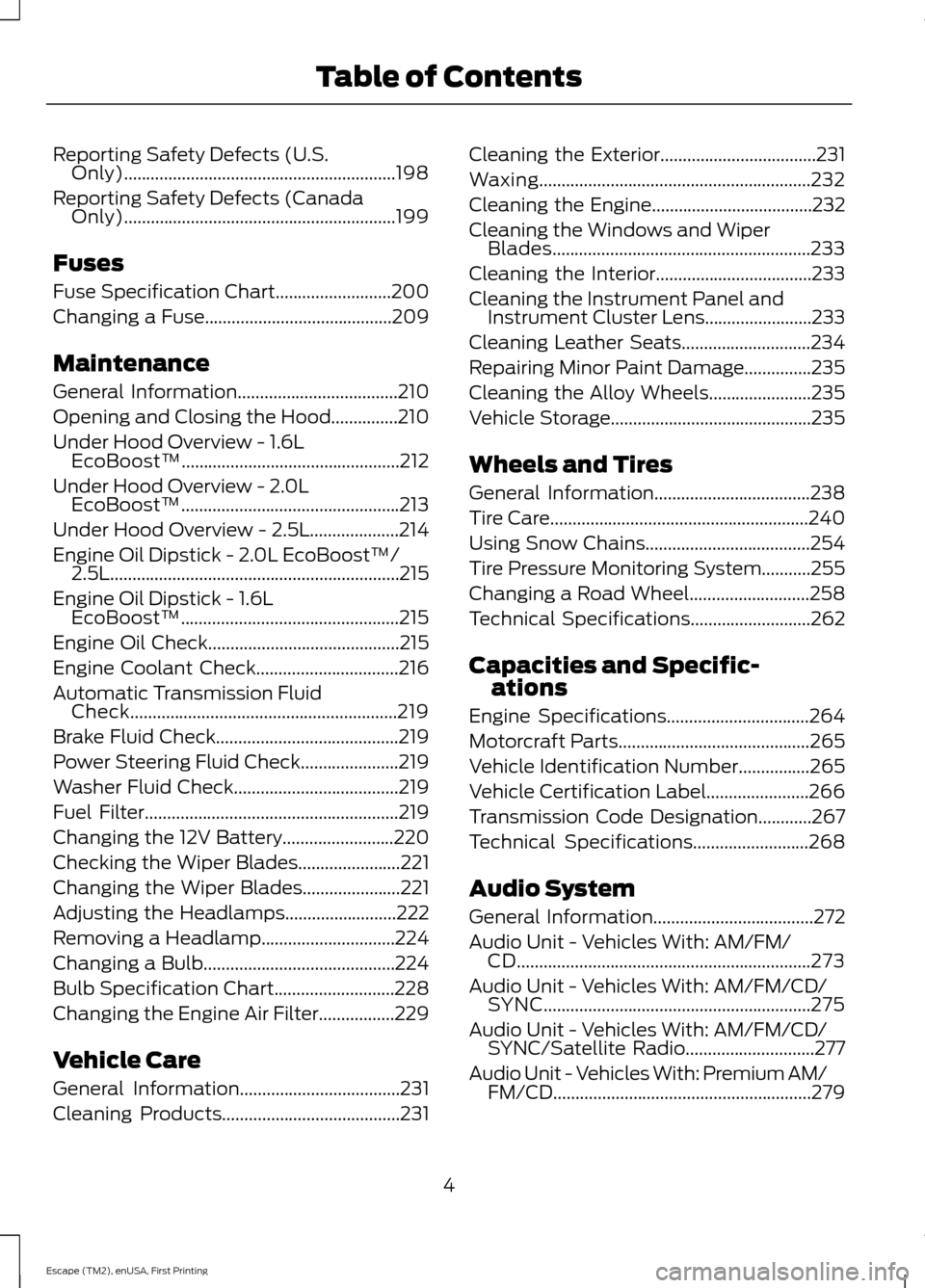
Reporting Safety Defects (U.S.
Only).............................................................198
Reporting Safety Defects (Canada Only).............................................................199
Fuses
Fuse Specification Chart..........................200
Changing a Fuse..........................................209
Maintenance
General Information
....................................210
Opening and Closing the Hood
...............210
Under Hood Overview -
1.6L
EcoBoost™.................................................212
Under Hood Overview -
2.0L
EcoBoost™.................................................213
Under Hood Overview - 2.5L....................214
Engine Oil Dipstick -
2.0L EcoBoost™/
2.5L.................................................................215
Engine Oil Dipstick -
1.6L
EcoBoost™.................................................215
Engine Oil Check
...........................................215
Engine Coolant Check
................................216
Automatic Transmission Fluid Check............................................................219
Brake Fluid Check.........................................219
Power Steering Fluid Check......................219
Washer Fluid Check
.....................................219
Fuel Filter
.........................................................219
Changing the 12V Battery.........................220
Checking the Wiper Blades
.......................221
Changing the Wiper Blades
......................221
Adjusting the Headlamps
.........................222
Removing a Headlamp..............................224
Changing a Bulb...........................................224
Bulb Specification Chart...........................228
Changing the Engine Air Filter.................229
Vehicle Care
General Information
....................................231
Cleaning Products
........................................231 Cleaning the Exterior...................................231
Waxing.............................................................232
Cleaning the Engine
....................................232
Cleaning the Windows and Wiper Blades..........................................................233
Cleaning the Interior...................................233
Cleaning the Instrument Panel and Instrument Cluster Lens........................233
Cleaning Leather Seats.............................234
Repairing Minor Paint Damage
...............235
Cleaning the Alloy Wheels.......................235
Vehicle Storage
.............................................235
Wheels and Tires
General Information
...................................238
Tire Care..........................................................240
Using Snow Chains.....................................254
Tire Pressure Monitoring System...........255
Changing a Road Wheel...........................258
Technical Specifications...........................262
Capacities and Specific- ations
Engine Specifications
................................264
Motorcraft Parts
...........................................265
Vehicle Identification Number
................265
Vehicle Certification Label.......................266
Transmission Code Designation............267
Technical Specifications
..........................268
Audio System
General Information
....................................272
Audio Unit -
Vehicles With: AM/FM/
CD..................................................................273
Audio Unit - Vehicles With: AM/FM/CD/ SYNC............................................................275
Audio Unit - Vehicles With: AM/FM/CD/ SYNC/
Satellite Radio.............................277
Audio Unit - Vehicles With: Premium AM/ FM/
CD..........................................................279
4
Escape (TM2), enUSA, First Printing Table of Contents
Page 8 of 449
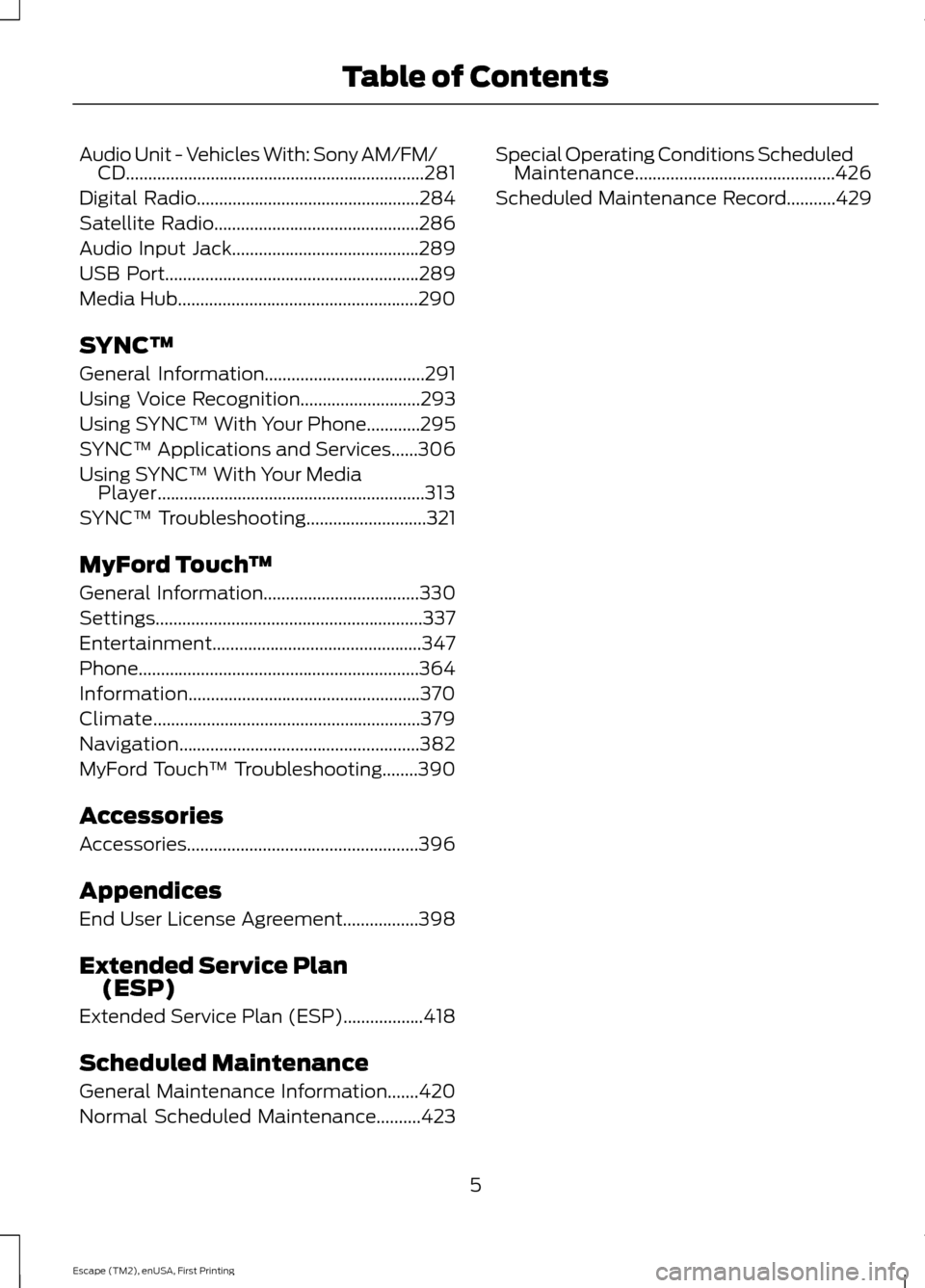
Audio Unit - Vehicles With: Sony AM/FM/
CD...................................................................281
Digital Radio
..................................................284
Satellite Radio
..............................................286
Audio Input Jack..........................................289
USB Port
.........................................................289
Media Hub......................................................290
SYNC™
General Information....................................291
Using Voice Recognition...........................293
Using SYNC™ With Your Phone
............295
SYNC™ Applications and Services......306
Using SYNC™ With Your Media Player............................................................313
SYNC™ Troubleshooting
...........................321
MyFord Touch ™
General Information
...................................330
Settings............................................................337
Entertainment...............................................347
Phone...............................................................364
Information....................................................370
Climate............................................................379
Navigation......................................................382
MyFord Touch ™ Troubleshooting........390
Accessories
Accessories....................................................396
Appendices
End User License Agreement.................398
Extended Service Plan (ESP)
Extended Service Plan (ESP)..................418
Scheduled Maintenance
General Maintenance Information.......420
Normal Scheduled Maintenance
..........423 Special Operating Conditions Scheduled
Maintenance.............................................426
Scheduled Maintenance Record
...........429
5
Escape (TM2), enUSA, First Printing Table of Contents
Page 19 of 449
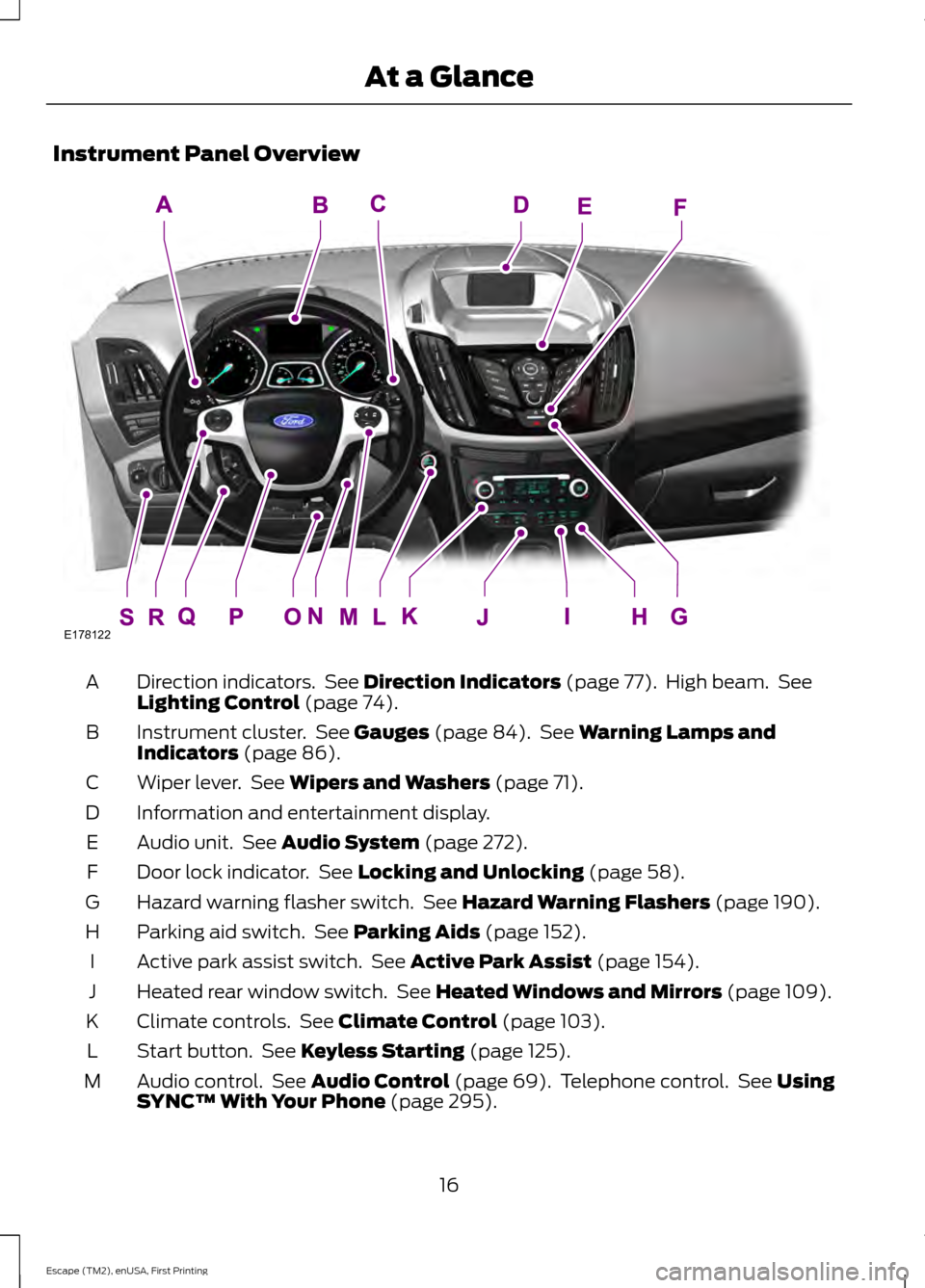
Instrument Panel Overview
Direction indicators. See Direction Indicators (page 77). High beam. See
Lighting Control (page 74).
A
Instrument cluster. See
Gauges (page 84). See Warning Lamps and
Indicators (page 86).
B
Wiper lever. See
Wipers and Washers (page 71).
C
Information and entertainment display.
D
Audio unit. See
Audio System (page 272).
E
Door lock indicator. See
Locking and Unlocking (page 58).
F
Hazard warning flasher switch. See
Hazard Warning Flashers (page 190).
G
Parking aid switch. See
Parking Aids (page 152).
H
Active park assist switch. See
Active Park Assist (page 154).
I
Heated rear window switch. See
Heated Windows and Mirrors (page 109).
J
Climate controls. See
Climate Control (page 103).
K
Start button. See
Keyless Starting (page 125).
L
Audio control. See
Audio Control (page 69). Telephone control. See Using
SYNC™ With Your Phone (page 295).
M
16
Escape (TM2), enUSA, First Printing At a GlanceE178122
Page 56 of 449
PRINCIPLE OF OPERATION
MyKey allows you to program keys with
restricted driving modes to promote good
driving habits. All but one of the keys
programmed to the vehicle can be
activated with these restricted modes.
Any keys that have not been programmed
are referred to as administrator keys or
admin keys. These can be used to:
•
Create a MyKey.
• Program configurable MyKey settings.
• Clear all MyKey features.
When you have created a MyKey, you can
access the following information using the
information display:
• How many admin keys and MyKeys are
programmed to your vehicle.
• The total distance your vehicle has
traveled using any MyKey.
Note: All MyKeys are programmed to the
same settings. You cannot program them
individually.
Note: For vehicles with keyless start, when
both a MyKey transmitter and an admin
transmitter are present, the admin
transmitter will be recognized by the vehicle
to start the engine.
Non-configurable Settings
The following settings cannot be changed
by an admin key user:
• Belt-minder. You cannot disable this
feature. The audio system will mute
when the safety belts are not fastened.
• Early low fuel warning. The low-fuel
warning activates earlier, giving the
MyKey user more time to refuel. •
Driver assist features, if equipped on
your vehicle, are forced on: parking aid,
blind spot information system (BLIS)
with cross traffic alert, lane departure
warning and forward collision warning
system.
• Satellite radio adult content
restrictions.
Configurable Settings
With an admin key, you can configure
certain MyKey settings when you first
create a MyKey and before you recycle the
key or restart the vehicle. You can also
change the settings afterward with an
admin key:
• Vehicle speed limits can be set.
Warnings will be shown in the display
followed by an audible tone when your
vehicle reaches the set speed. You
cannot override the set speed by fully
depressing the accelerator pedal.
• Vehicle speed minders. Once you select
a speed, it will be shown in the display
followed by a tone when the set vehicle
speed is exceeded.
• Audio system maximum volume of
45%. A message will be shown in the
display when you attempt to exceed
the limited volume. Also, the speed
sensitive compensated volume
(automatic volume control) feature
will be disabled.
• Always on setting. When this is
selected you will not be able to disable
AdvanceTrac, 911 Assist or the do not
disturb feature (if your vehicle is
equipped with these features).
CREATING A MYKEY
Use the information display to create a
MyKey:
53
Escape (TM2), enUSA, First Printing MyKey
™
Page 72 of 449
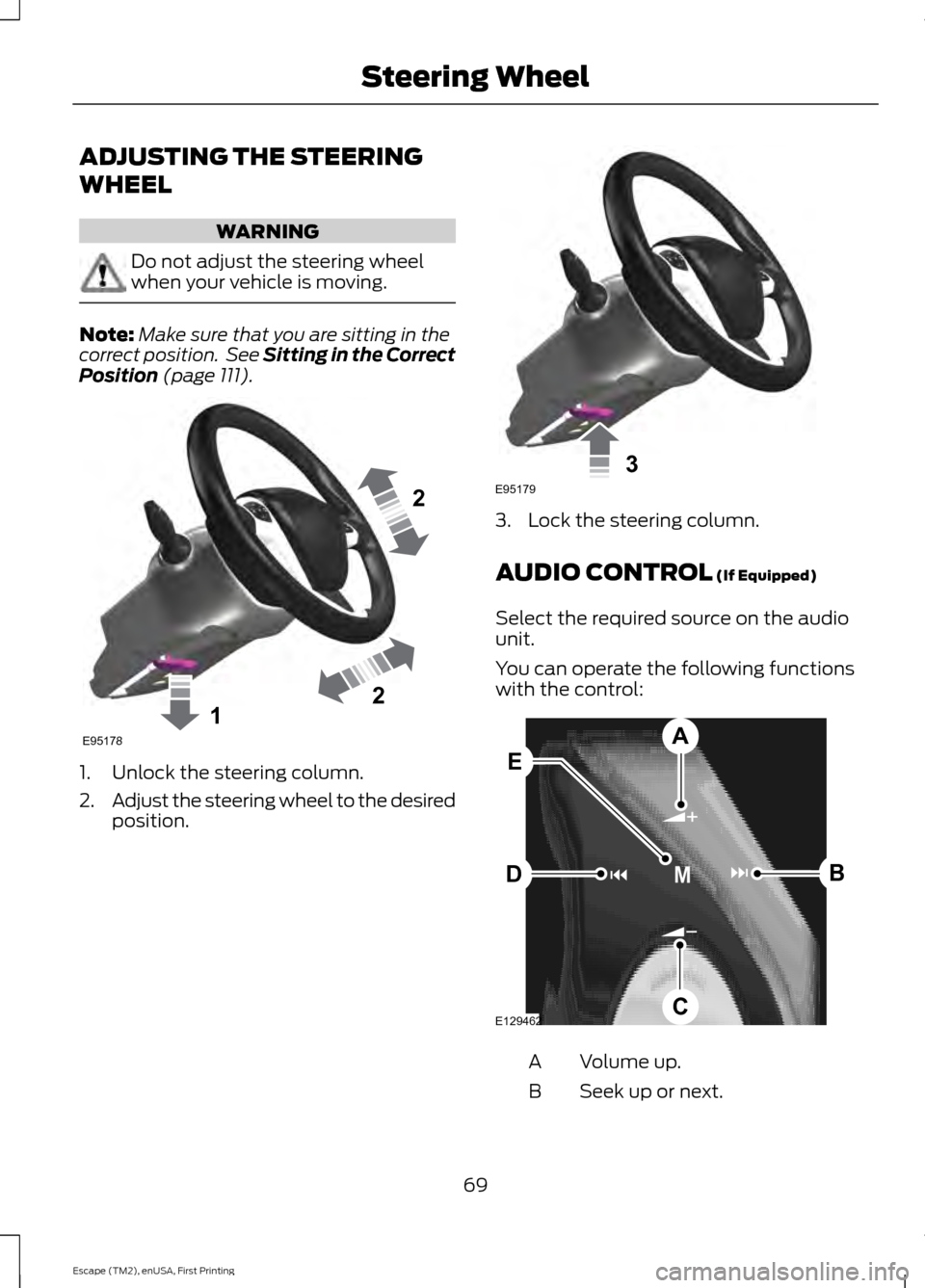
ADJUSTING THE STEERING
WHEEL
WARNING
Do not adjust the steering wheel
when your vehicle is moving.
Note:
Make sure that you are sitting in the
correct position. See Sitting in the Correct
Position (page 111). 1. Unlock the steering column.
2.
Adjust the steering wheel to the desired
position. 3. Lock the steering column.
AUDIO CONTROL
(If Equipped)
Select the required source on the audio
unit.
You can operate the following functions
with the control: Volume up.
A
Seek up or next.
B
69
Escape (TM2), enUSA, First Printing Steering Wheel122E95178 3E95179 E129462
BD
C
A
E
Page 102 of 449
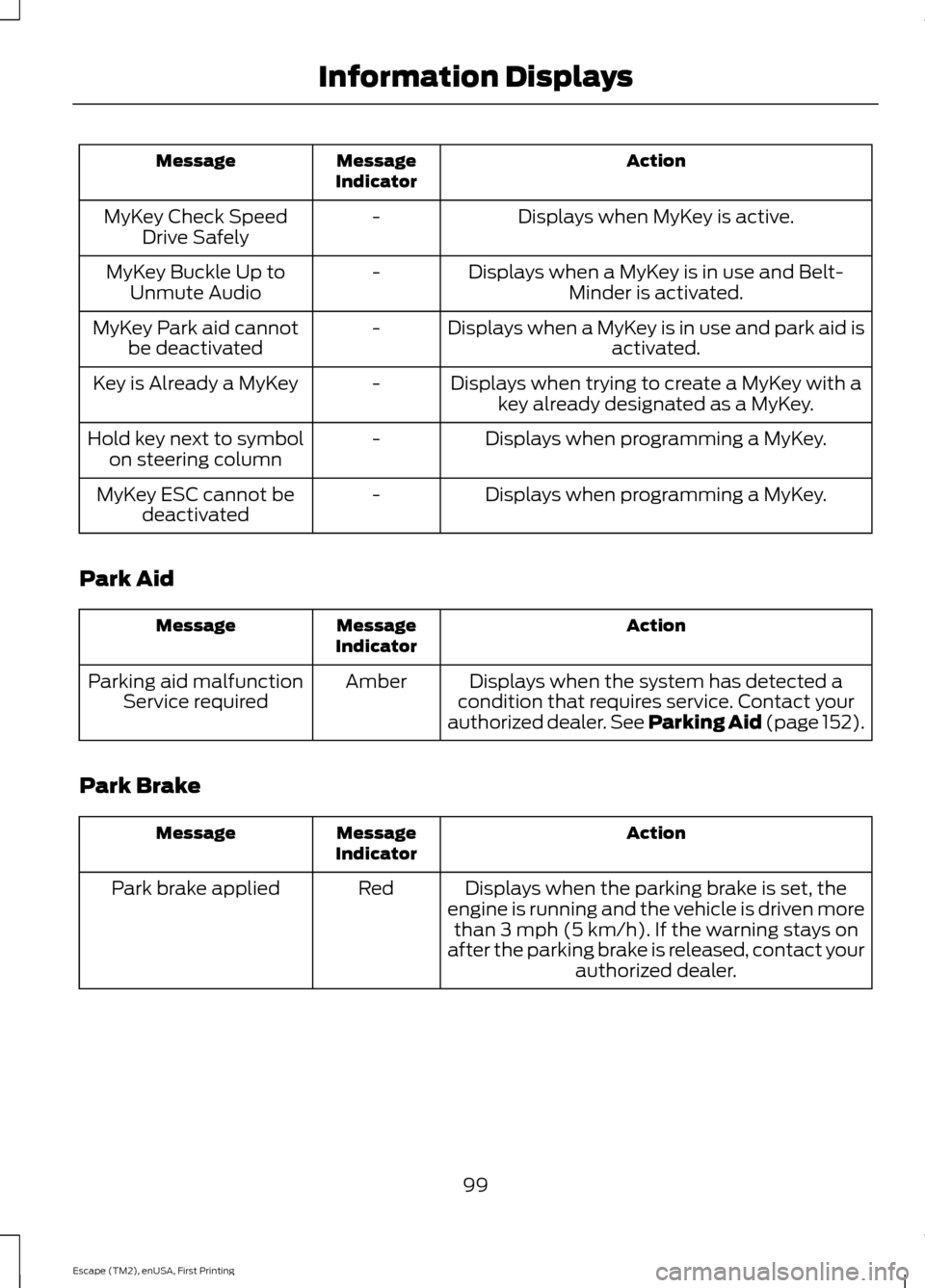
Action
Message
Indicator
Message
Displays when MyKey is active.
-
MyKey Check Speed
Drive Safely
Displays when a MyKey is in use and Belt-Minder is activated.
-
MyKey Buckle Up to
Unmute Audio
Displays when a MyKey is in use and park aid isactivated.
-
MyKey Park aid cannot
be deactivated
Displays when trying to create a MyKey with akey already designated as a MyKey.
-
Key is Already a MyKey
Displays when programming a MyKey.
-
Hold key next to symbol
on steering column
Displays when programming a MyKey.
-
MyKey ESC cannot be
deactivated
Park Aid Action
Message
Indicator
Message
Displays when the system has detected a
condition that requires service. Contact your
authorized dealer. See Parking Aid (page 152).
Amber
Parking aid malfunction
Service required
Park Brake Action
Message
Indicator
Message
Displays when the parking brake is set, the
engine is running and the vehicle is driven more than 3 mph (5 km/h). If the warning stays on
after the parking brake is released, contact your authorized dealer.
Red
Park brake applied
99
Escape (TM2), enUSA, First Printing Information Displays
Page 210 of 449
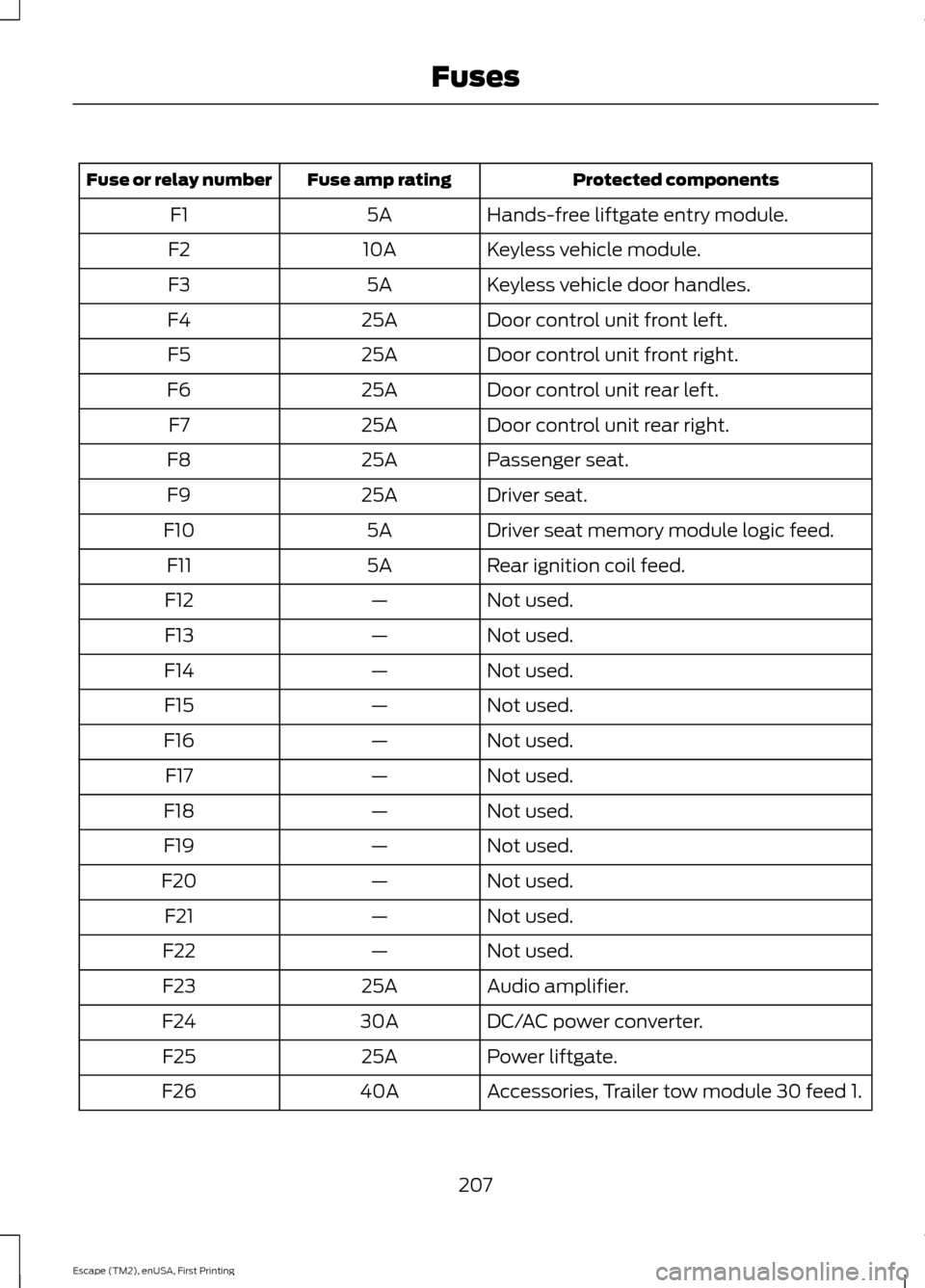
Protected components
Fuse amp rating
Fuse or relay number
Hands-free liftgate entry module.
5A
F1
Keyless vehicle module.
10A
F2
Keyless vehicle door handles.
5A
F3
Door control unit front left.
25A
F4
Door control unit front right.
25A
F5
Door control unit rear left.
25A
F6
Door control unit rear right.
25A
F7
Passenger seat.
25A
F8
Driver seat.
25A
F9
Driver seat memory module logic feed.
5A
F10
Rear ignition coil feed.
5A
F11
Not used.
—
F12
Not used.
—
F13
Not used.
—
F14
Not used.
—
F15
Not used.
—
F16
Not used.
—
F17
Not used.
—
F18
Not used.
—
F19
Not used.
—
F20
Not used.
—
F21
Not used.
—
F22
Audio amplifier.
25A
F23
DC/AC power converter.
30A
F24
Power liftgate.
25A
F25
Accessories, Trailer tow module 30 feed 1.
40A
F26
207
Escape (TM2), enUSA, First Printing Fuses
Page 224 of 449
presets, are also maintained in memory by
power from the low voltage battery. When
a technician disconnects and connects the
low voltage battery, these settings are
erased. Complete the following procedure
in order to restore the settings:
1. With the vehicle at a complete stop,
set the parking brake.
2. Shift the transmission into P.
3. Turn off all accessories.
4. Step on the brake pedal and start the vehicle.
5. Run the engine until it reaches normal operating temperature. While the
engine is warming up, complete the
following: Reset the clock. See Audio
System (page 272). Reset the power
windows bounce-back feature. See
Windows and Mirrors
(page 79).
Reset the radio station presets. See
Audio System
(page 272).
6. Allow the engine to idle for at least one
minute. If the engine turns off, step on
the accelerator to start the engine.
7. While the engine is running, step on the
brake pedal and shift the transmission
to N.
8. Allow the engine to run for at least one
minute by pressing on the accelerator
pedal.
9. Drive the vehicle at least 10 miles (16 kilometers) to completely relearn the
idle and fuel trim strategy.
Note: If you do not allow the engine to
relearn the idle and fuel trim strategy, the
idle quality of your vehicle may be adversely
affected until the engine computer
eventually relearns the idle trim and fuel
trim strategy. Note:
Always dispose of automotive
batteries in a responsible manner. Follow
your local authorized standards for disposal.
Call your local authorized recycling center
to find out more about recycling automotive
batteries.
Note: It is recommended that the negative
battery cable terminal be disconnected from
the battery if you plan to store your vehicle
for an extended period of time.
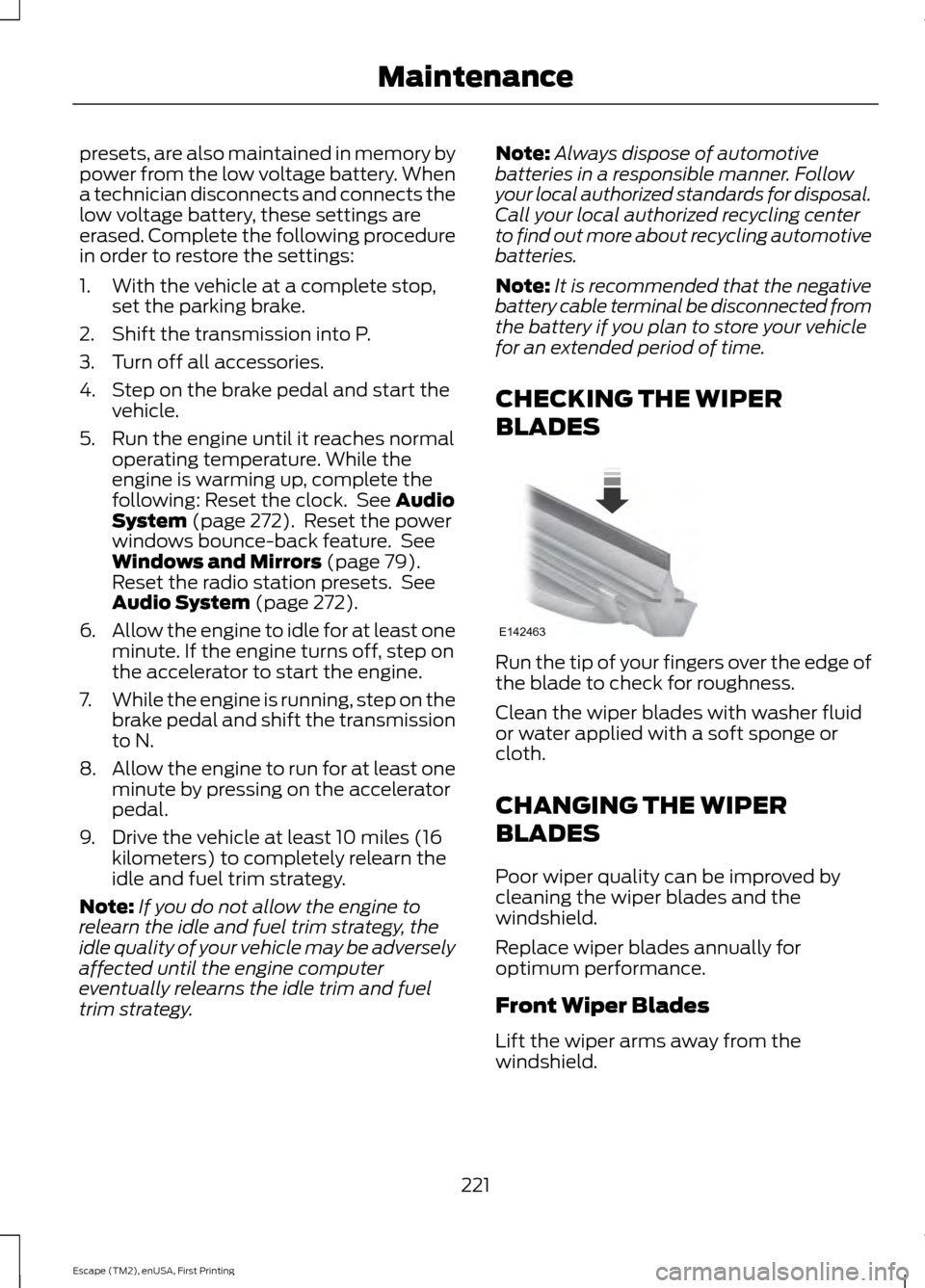
CHECKING THE WIPER
BLADES Run the tip of your fingers over the edge of
the blade to check for roughness.
Clean the wiper blades with washer fluid
or water applied with a soft sponge or
cloth.
CHANGING THE WIPER
BLADES
Poor wiper quality can be improved by
cleaning the wiper blades and the
windshield.
Replace wiper blades annually for
optimum performance.
Front Wiper Blades
Lift the wiper arms away from the
windshield.
221
Escape (TM2), enUSA, First Printing MaintenanceE142463
Page 275 of 449
GENERAL INFORMATION
Radio Frequencies and Reception
Factors
AM and FM frequencies are established by
the Federal Communications Commission
(FCC) and the Canadian Radio and
Telecommunications Commission (CRTC).
Those frequencies are:
•
AM: 530, 540-1700, 1710 kHz
• FM: 87.9-107.7, 107.9 MHz Radio Reception Factors
The further you travel from an FM station, the weaker the
signal and the weaker the reception.
Distance and Strength
Hills, mountains, tall buildings, bridges, tunnels, freeway
overpasses, parking garages, dense tree foliage and
thunderstorms can interfere with the reception.
Terrain
When you pass a ground-based broadcast repeating
tower, a stronger signal may overtake a weaker one and
result in the audio system muting.
Station overload
CD and CD Player Information
Note: CD units play commercially pressed
4.75-inch (12 centimeter) audio compact
discs only. Due to technical incompatibility,
certain recordable and re-recordable
compact discs may not function correctly
when used in Ford CD players.
Note: Do not insert CDs with homemade
paper (adhesive) labels into the CD player
as the label may peel and cause the CD to
become jammed. You should use a
permanent felt tip marker rather than
adhesive labels on your homemade CDs.
Ballpoint pens may damage CDs. Please
contact an authorized dealer for further
information.
Note: Do not use any irregularly shaped
discs or discs with a scratch protection film
attached.
Always handle discs by their edges only.
Clean the disc with an approved CD
cleaner only. Wipe it from the center of the
disc toward the edge. Do not clean in a
circular motion. Do not expose discs to direct sunlight or
heat sources for extended periods.
MP3 and WMA Track and Folder
Structure
Audio systems capable of recognizing and
playing MP3 and WMA individual tracks
and folder structures work as follows:
•
There are two different modes for MP3
and WMA disc playback: MP3 and
WMA track mode (system default) and
MP3 and WMA folder mode.
• MP3 and WMA track mode ignores any
folder structure on the MP3 and WMA
disc. The player numbers each MP3
and WMA track on the disc (noted by
the MP3 or WMA file extension) from
T001 to a maximum of T255. The
maximum number of playable MP3 and
WMA files may be less depending on
the structure of the CD and exact
model of radio present.
272
Escape (TM2), enUSA, First Printing Audio System