climate control FORD EXPLORER 2011 5.G Owner's Manual
[x] Cancel search | Manufacturer: FORD, Model Year: 2011, Model line: EXPLORER, Model: FORD EXPLORER 2011 5.GPages: 449, PDF Size: 4.03 MB
Page 168 of 449
Note:When the heated/cooled front seat is active, you will be able to
hear the fan operating inside the seat. This is normal.
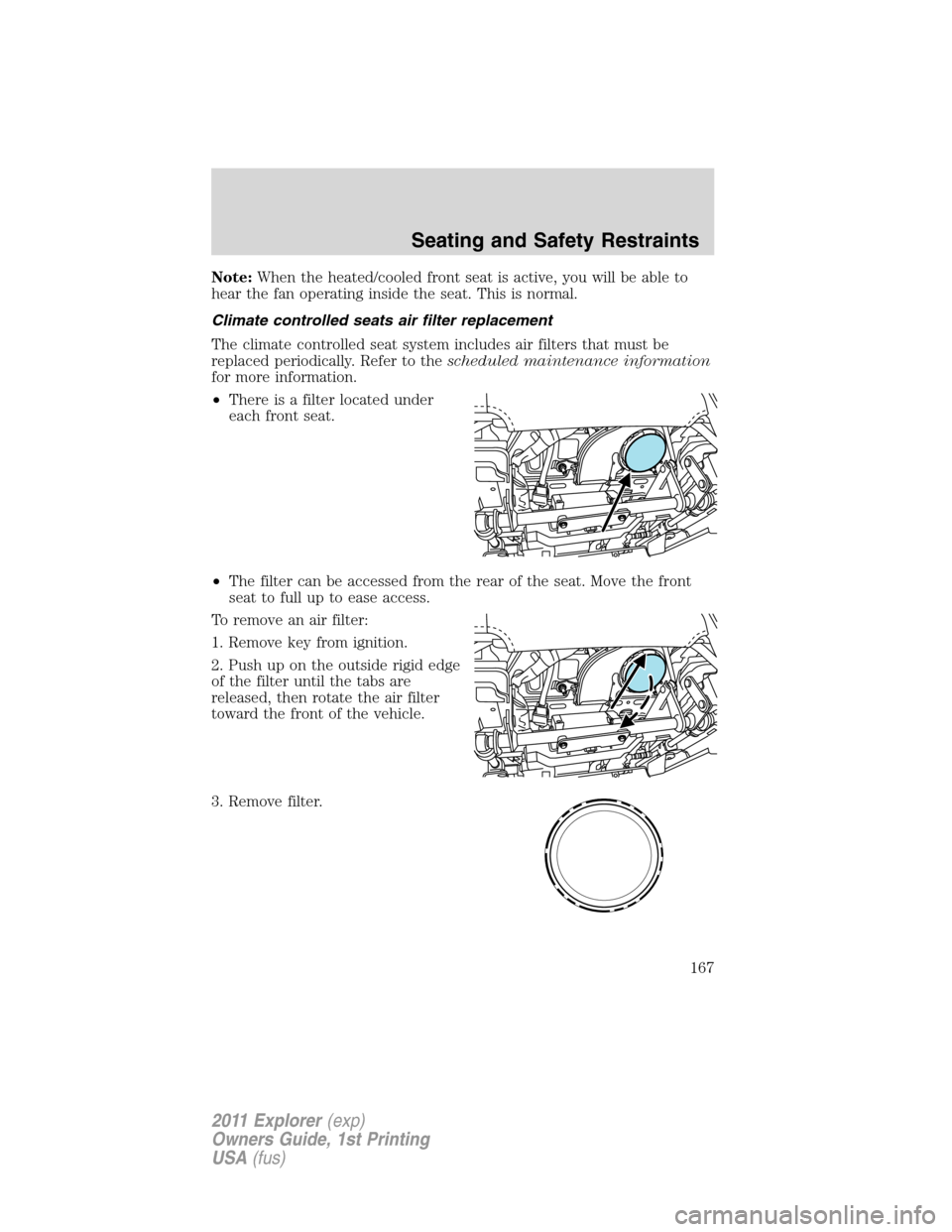
Climate controlled seats air filter replacement
The climate controlled seat system includes air filters that must be
replaced periodically. Refer to thescheduled maintenance information
for more information.
•There is a filter located under
each front seat.
•The filter can be accessed from the rear of the seat. Move the front
seat to full up to ease access.
To remove an air filter:
1. Remove key from ignition.
2. Push up on the outside rigid edge
of the filter until the tabs are
released, then rotate the air filter
toward the front of the vehicle.
3. Remove filter.
Seating and Safety Restraints
167
2011 Explorer(exp)
Owners Guide, 1st Printing
USA(fus)
Page 236 of 449
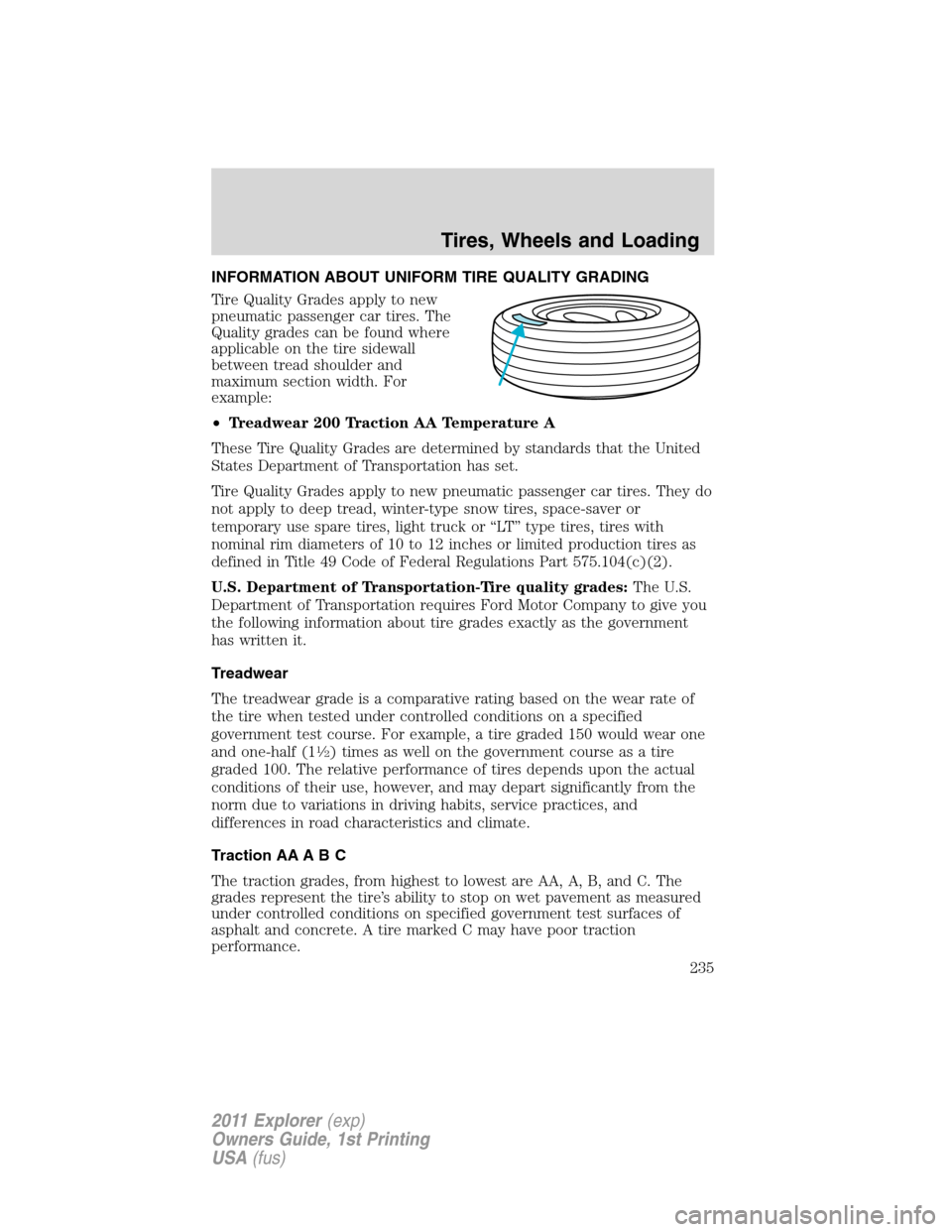
INFORMATION ABOUT UNIFORM TIRE QUALITY GRADING
Tire Quality Grades apply to new
pneumatic passenger car tires. The
Quality grades can be found where
applicable on the tire sidewall
between tread shoulder and
maximum section width. For
example:
•Treadwear 200 Traction AA Temperature A
These Tire Quality Grades are determined by standards that the United
States Department of Transportation has set.
Tire Quality Grades apply to new pneumatic passenger car tires. They do
not apply to deep tread, winter-type snow tires, space-saver or
temporary use spare tires, light truck or “LT” type tires, tires with
nominal rim diameters of 10 to 12 inches or limited production tires as
defined in Title 49 Code of Federal Regulations Part 575.104(c)(2).
U.S. Department of Transportation-Tire quality grades:The U.S.
Department of Transportation requires Ford Motor Company to give you
the following information about tire grades exactly as the government
has written it.
Treadwear
The treadwear grade is a comparative rating based on the wear rate of
the tire when tested under controlled conditions on a specified
government test course. For example, a tire graded 150 would wear one
and one-half (1
12) times as well on the government course as a tire
graded 100. The relative performance of tires depends upon the actual
conditions of their use, however, and may depart significantly from the
norm due to variations in driving habits, service practices, and
differences in road characteristics and climate.
Traction AA A B C
The traction grades, from highest to lowest are AA, A, B, and C. The
grades represent the tire’s ability to stop on wet pavement as measured
under controlled conditions on specified government test surfaces of
asphalt and concrete. A tire marked C may have poor traction
performance.
Tires, Wheels and Loading
235
2011 Explorer(exp)
Owners Guide, 1st Printing
USA(fus)
Page 255 of 449
SNOW TIRES AND CABLES
WARNING:Snow tires must be the same size, load index, speed
rating as those originally provided by Ford. Use of any tire or
wheel not recommended by Ford can affect the safety and
performance of your vehicle, which could result in an increased risk of
loss of vehicle control, vehicle rollover, personal injury and death.
Additionally, the use of non-recommended tires and wheels could
cause steering, suspension, axle or transfer case/power transfer unit
failure.
The tires on your vehicle have all-weather treads to provide traction in
rain and snow. However, in some climates, you may need to use snow
tires and chains. If you need to use chains, it is recommended that only
cable chains are used with steel wheels (of the same size and
specifications) as chains may chip aluminum wheels.
Note:The suspension insulation and bumpers will help prevent vehicle
damage. Do not remove these components from your vehicle when using
snow tires and chains.
Follow these guidelines when using snow tires and cable chains:
•If possible, avoid fully loading your vehicle.
•Install cable chains only on the front wheels.
•Use only cable chains on vehicles equipped with either P245/65R17
tires or P245/60R18 tires.
•Do not use tire chains, cables or optional traction devices on vehicles
equipped with P255/50R20 tires.
•Drive cautiously. If you hear the cable chains rub or bang against your
vehicle, stop and retighten the cable chains. If this does not work,
remove the cable chains to prevent damage to your vehicle.
•Remove the tire cable chains when they are no longer needed. Do not
use tire cable chains on dry roads.
Tires, Wheels and Loading
254
2011 Explorer(exp)
Owners Guide, 1st Printing
USA(fus)
Page 266 of 449
Trailer towing tips
•Practice turning, stopping and backing-up before starting on a trip to
get the feel of the vehicle-trailer combination. When turning, make
wider turns so the trailer wheels will clear curbs and other obstacles.
•To aid in engine/transmission cooling and A/C efficiency during hot
weather while stopped in traffic, place the gearshift lever in P (Park).
•After you have traveled 50 miles (80 km), thoroughly check your
hitch, electrical connections and trailer wheel lug nuts.
•If you are driving down a long or steep hill, shift to a lower gear. Do
not apply the brakes continuously, as they may overheat and become
less effective.
•Vehicles with trailers should not be parked on a grade. If you must
park on a grade, place wheel chocks under the trailer’s wheels.
RECREATIONAL TOWING
Follow these guidelines for your specific powertrain combination to tow
your vehicle for personal travel (such as behind a motor home or a
truck).
Note:Put your climate control system in recirculated air mode to
prevent exhaust fumes from entering the vehicle. Refer to theClimate
Controlschapter for more information.
In case of a roadside emergency with a disabled vehicle, please refer to
Wrecker towingin theRoadside Emergencieschapter.
These guidelines are designed to prevent damage to your vehicle after it
is hooked-up to the RV or tow dolly.
Front-wheel drive (FWD) vehiclescan be towed with all four wheels
on the ground or with the front wheels off the ground by using a tow
dolly. If you are using a tow dolly follow the instructions specified by the
equipment provider. If you are towing with all four wheels on the ground,
refer to the towing instructions found at the end of this section.
Four-wheel drive (4WD) vehiclescan be towed with all four wheels
on the ground or with all four wheels off the ground using a vehicle
transport trailer.Do not tow your 4WD vehicle with the front
wheels off the ground (by using a tow dolly) and the rear wheels
on the ground; this will cause damage to your 4WD system.If you
are using a vehicle transport trailer, follow the instruction specified by
the equipment provider. If you are towing with all four wheels on the
ground, refer to the towing instructions found at the end of this section.
Tires, Wheels and Loading
265
2011 Explorer(exp)
Owners Guide, 1st Printing
USA(fus)
Page 332 of 449
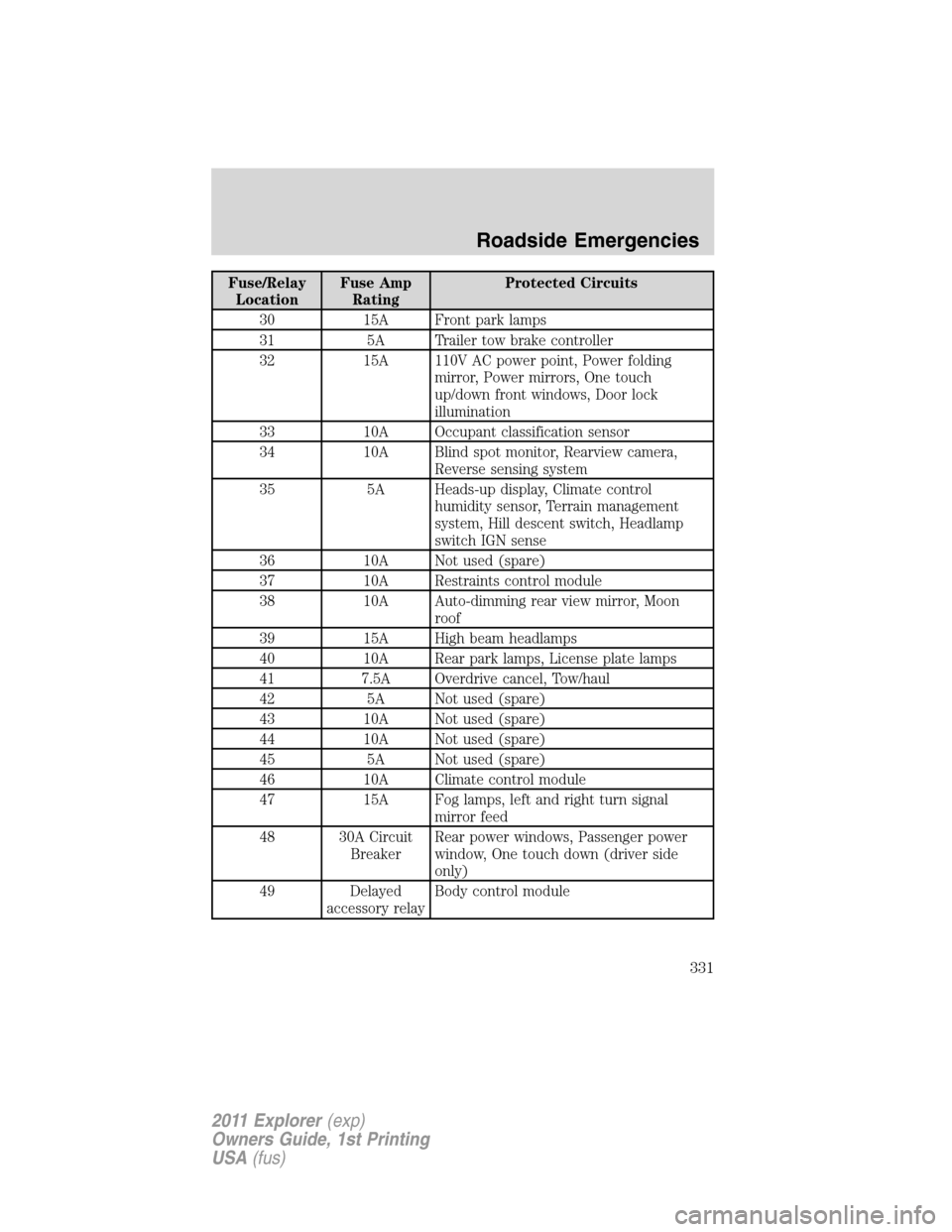
Fuse/Relay
LocationFuse Amp
RatingProtected Circuits
30 15A Front park lamps
31 5A Trailer tow brake controller
32 15A 110V AC power point, Power folding
mirror, Power mirrors, One touch
up/down front windows, Door lock
illumination
33 10A Occupant classification sensor
34 10A Blind spot monitor, Rearview camera,
Reverse sensing system
35 5A Heads-up display, Climate control
humidity sensor, Terrain management
system, Hill descent switch, Headlamp
switch IGN sense
36 10A Not used (spare)
37 10A Restraints control module
38 10A Auto-dimming rear view mirror, Moon
roof
39 15A High beam headlamps
40 10A Rear park lamps, License plate lamps
41 7.5A Overdrive cancel, Tow/haul
42 5A Not used (spare)
43 10A Not used (spare)
44 10A Not used (spare)
45 5A Not used (spare)
46 10A Climate control module
47 15A Fog lamps, left and right turn signal
mirror feed
48 30A Circuit
BreakerRear power windows, Passenger power
window, One touch down (driver side
only)
49 Delayed
accessory relayBody control module
Roadside Emergencies
331
2011 Explorer(exp)
Owners Guide, 1st Printing
USA(fus)
Page 334 of 449
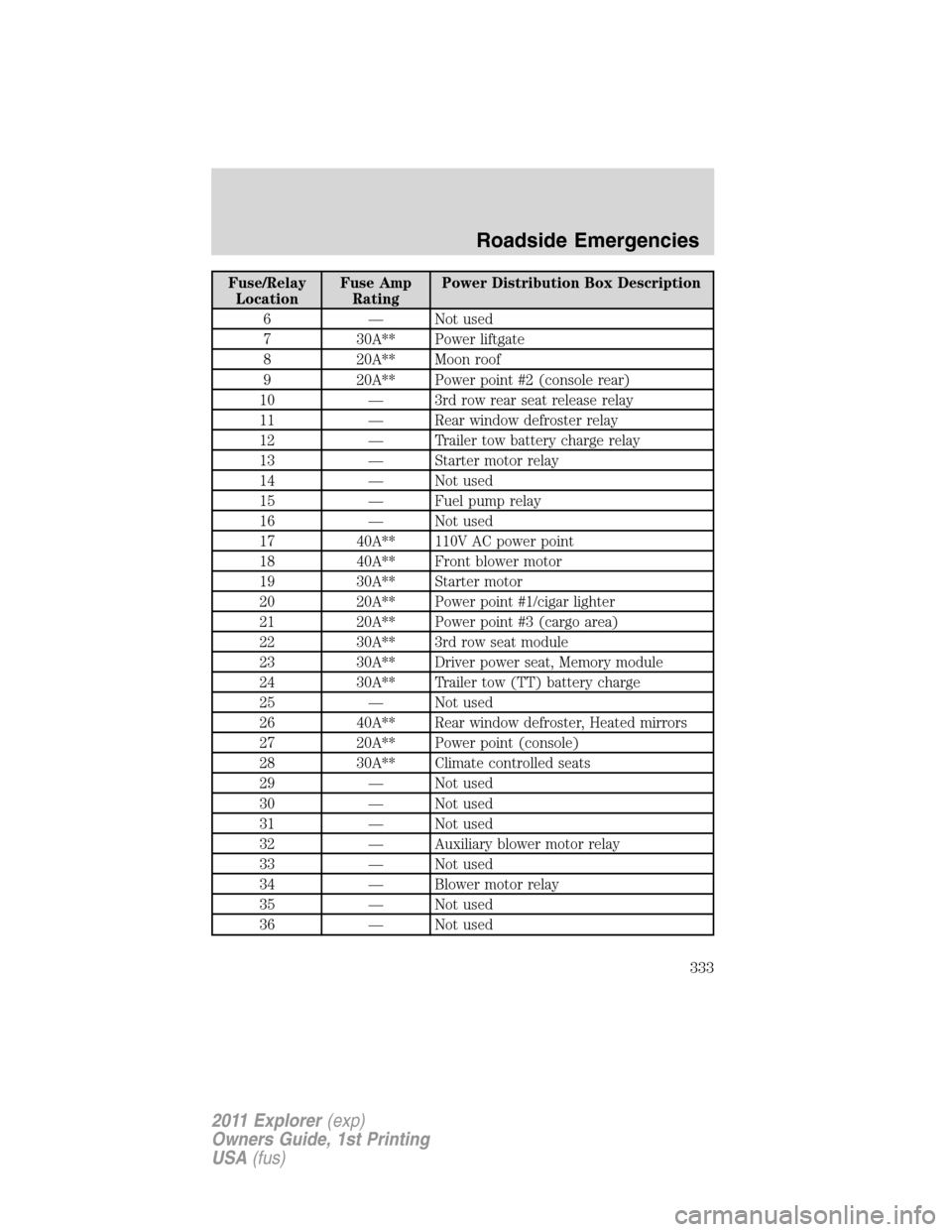
Fuse/Relay
LocationFuse Amp
RatingPower Distribution Box Description
6 — Not used
7 30A** Power liftgate
8 20A** Moon roof
9 20A** Power point #2 (console rear)
10 — 3rd row rear seat release relay
11 — Rear window defroster relay
12 — Trailer tow battery charge relay
13 — Starter motor relay
14 — Not used
15 — Fuel pump relay
16 — Not used
17 40A** 110V AC power point
18 40A** Front blower motor
19 30A** Starter motor
20 20A** Power point #1/cigar lighter
21 20A** Power point #3 (cargo area)
22 30A** 3rd row seat module
23 30A** Driver power seat, Memory module
24 30A** Trailer tow (TT) battery charge
25 — Not used
26 40A** Rear window defroster, Heated mirrors
27 20A** Power point (console)
28 30A** Climate controlled seats
29 — Not used
30 — Not used
31 — Not used
32 — Auxiliary blower motor relay
33 — Not used
34 — Blower motor relay
35 — Not used
36 — Not used
Roadside Emergencies
333
2011 Explorer(exp)
Owners Guide, 1st Printing
USA(fus)
Page 385 of 449
•If you do not allow the engine to relearn its idle trim, the idle
quality of your vehicle may be adversely affected until the idle
trim is eventually relearned.
When the battery is disconnected or a new battery installed, the
transmission must relearn its adaptive strategy. As a result of this, the
transmission may shift firmly. This operation is considered normal and
will not affect function or durability of the transmission. Over time the
adaptive learning process will fully update transmission operation to its
optimum shift feel.
If the battery has been disconnected or a new battery has been installed,
the clock and the preset radio stations must be reset once the battery is
reconnected.
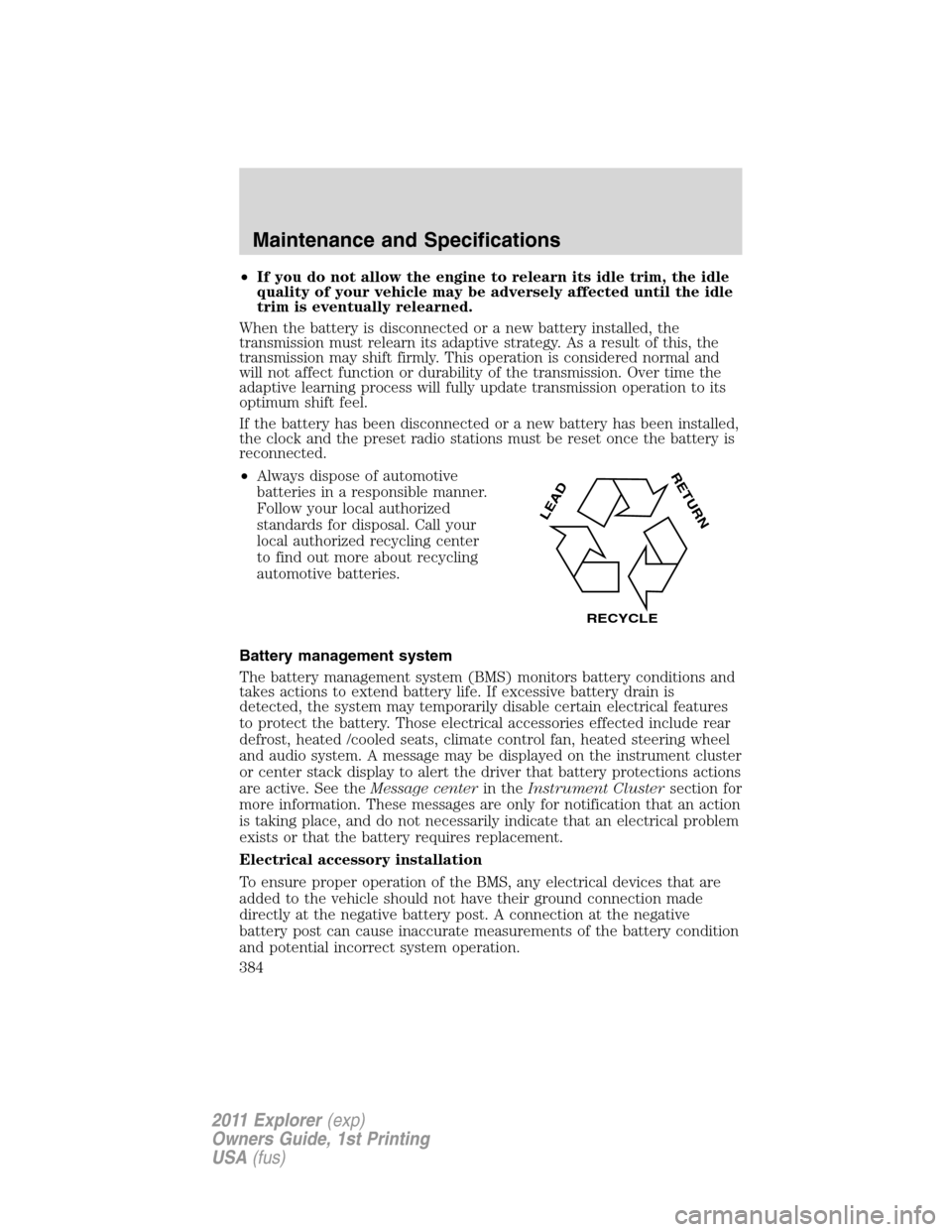
•Always dispose of automotive
batteries in a responsible manner.
Follow your local authorized
standards for disposal. Call your
local authorized recycling center
to find out more about recycling
automotive batteries.
Battery management system
The battery management system (BMS) monitors battery conditions and
takes actions to extend battery life. If excessive battery drain is
detected, the system may temporarily disable certain electrical features
to protect the battery. Those electrical accessories effected include rear
defrost, heated /cooled seats, climate control fan, heated steering wheel
and audio system. A message may be displayed on the instrument cluster
or center stack display to alert the driver that battery protections actions
are active. See theMessage centerin theInstrument Clustersection for
more information. These messages are only for notification that an action
is taking place, and do not necessarily indicate that an electrical problem
exists or that the battery requires replacement.
Electrical accessory installation
To ensure proper operation of the BMS, any electrical devices that are
added to the vehicle should not have their ground connection made
directly at the negative battery post. A connection at the negative
battery post can cause inaccurate measurements of the battery condition
and potential incorrect system operation.
L
E
A
D
RETURN
RECYCLE
Maintenance and Specifications
384
2011 Explorer(exp)
Owners Guide, 1st Printing
USA(fus)
Page 432 of 449
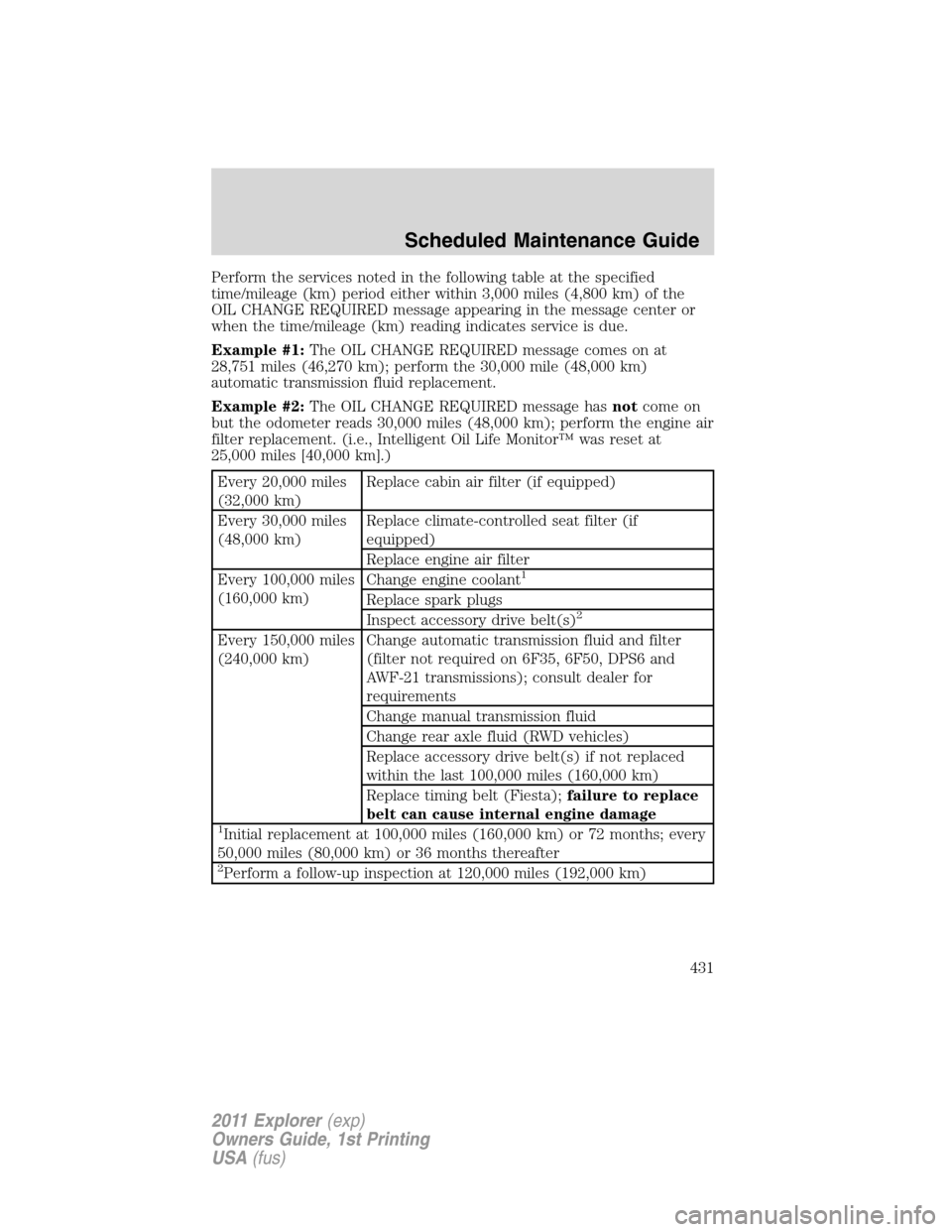
Perform the services noted in the following table at the specified
time/mileage (km) period either within 3,000 miles (4,800 km) of the
OIL CHANGE REQUIRED message appearing in the message center or
when the time/mileage (km) reading indicates service is due.
Example #1:The OIL CHANGE REQUIRED message comes on at
28,751 miles (46,270 km); perform the 30,000 mile (48,000 km)
automatic transmission fluid replacement.
Example #2:The OIL CHANGE REQUIRED message hasnotcome on
but the odometer reads 30,000 miles (48,000 km); perform the engine air
filter replacement. (i.e., Intelligent Oil Life Monitor™ was reset at
25,000 miles [40,000 km].)
Every 20,000 miles
(32,000 km)Replace cabin air filter (if equipped)
Every 30,000 miles
(48,000 km)Replace climate-controlled seat filter (if
equipped)
Replace engine air filter
Every 100,000 miles
(160,000 km)Change engine coolant
1
Replace spark plugs
Inspect accessory drive belt(s)2
Every 150,000 miles
(240,000 km)Change automatic transmission fluid and filter
(filter not required on 6F35, 6F50, DPS6 and
AWF-21 transmissions); consult dealer for
requirements
Change manual transmission fluid
Change rear axle fluid (RWD vehicles)
Replace accessory drive belt(s) if not replaced
within the last 100,000 miles (160,000 km)
Replace timing belt (Fiesta);failure to replace
belt can cause internal engine damage
1Initial replacement at 100,000 miles (160,000 km) or 72 months; every
50,000 miles (80,000 km) or 36 months thereafter
2Perform a follow-up inspection at 120,000 miles (192,000 km)
Scheduled Maintenance Guide
431
2011 Explorer(exp)
Owners Guide, 1st Printing
USA(fus)
Page 444 of 449
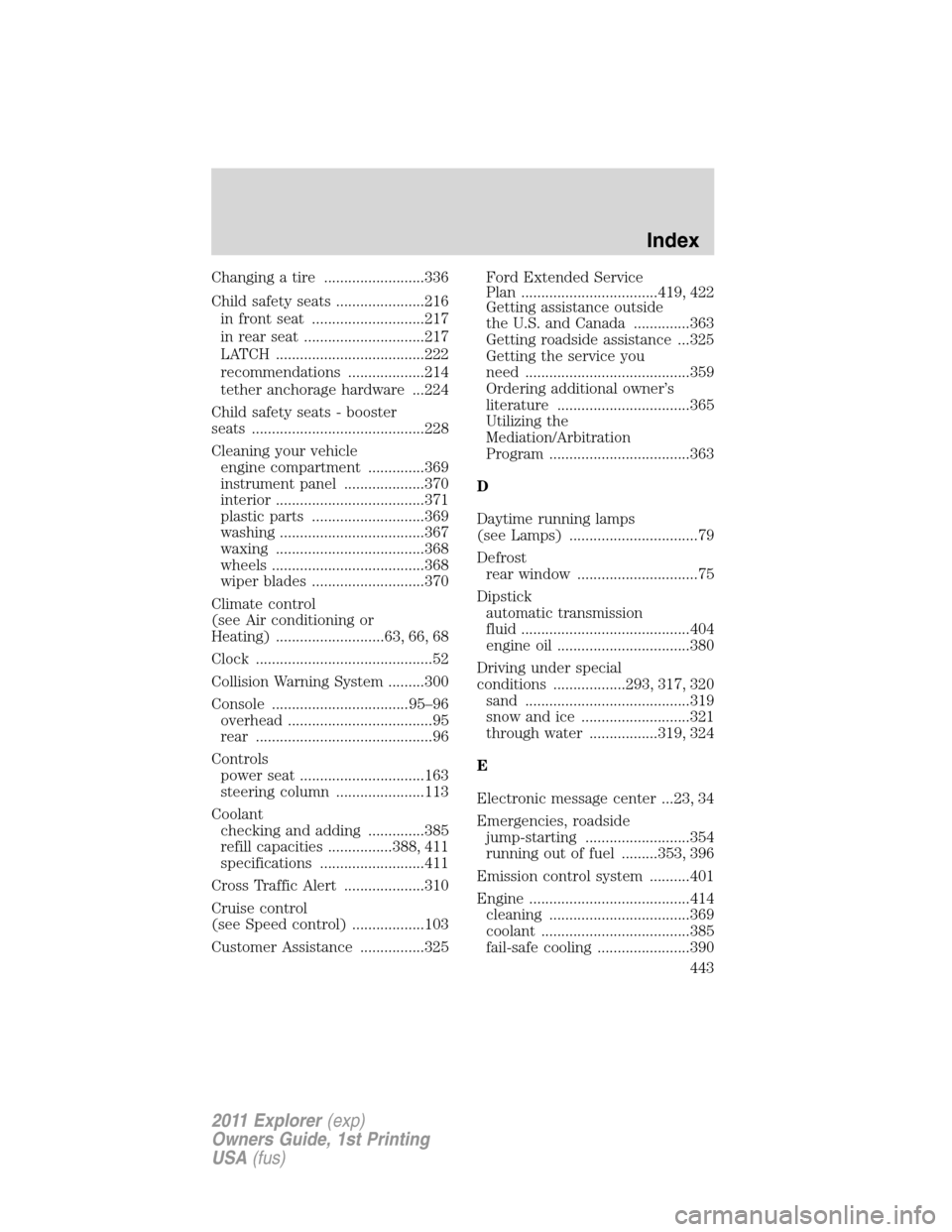
Changing a tire .........................336
Child safety seats ......................216
in front seat ............................217
in rear seat ..............................217
LATCH .....................................222
recommendations ...................214
tether anchorage hardware ...224
Child safety seats - booster
seats ...........................................228
Cleaning your vehicle
engine compartment ..............369
instrument panel ....................370
interior .....................................371
plastic parts ............................369
washing ....................................367
waxing .....................................368
wheels ......................................368
wiper blades ............................370
Climate control
(see Air conditioning or
Heating) ...........................63, 66, 68
Clock ............................................52
Collision Warning System .........300
Console ..................................95–96
overhead ....................................95
rear ............................................96
Controls
power seat ...............................163
steering column ......................113
Coolant
checking and adding ..............385
refill capacities ................388, 411
specifications ..........................411
Cross Traffic Alert ....................310
Cruise control
(see Speed control) ..................103
Customer Assistance ................325Ford Extended Service
Plan ..................................419, 422
Getting assistance outside
the U.S. and Canada ..............363
Getting roadside assistance ...325
Getting the service you
need .........................................359
Ordering additional owner’s
literature .................................365
Utilizing the
Mediation/Arbitration
Program ...................................363
D
Daytime running lamps
(see Lamps) ................................79
Defrost
rear window ..............................75
Dipstick
automatic transmission
fluid ..........................................404
engine oil .................................380
Driving under special
conditions ..................293, 317, 320
sand .........................................319
snow and ice ...........................321
through water .................319, 324
E
Electronic message center ...23, 34
Emergencies, roadside
jump-starting ..........................354
running out of fuel .........353, 396
Emission control system ..........401
Engine ........................................414
cleaning ...................................369
coolant .....................................385
fail-safe cooling .......................390
Index
443
2011 Explorer(exp)
Owners Guide, 1st Printing
USA(fus)
Page 448 of 449
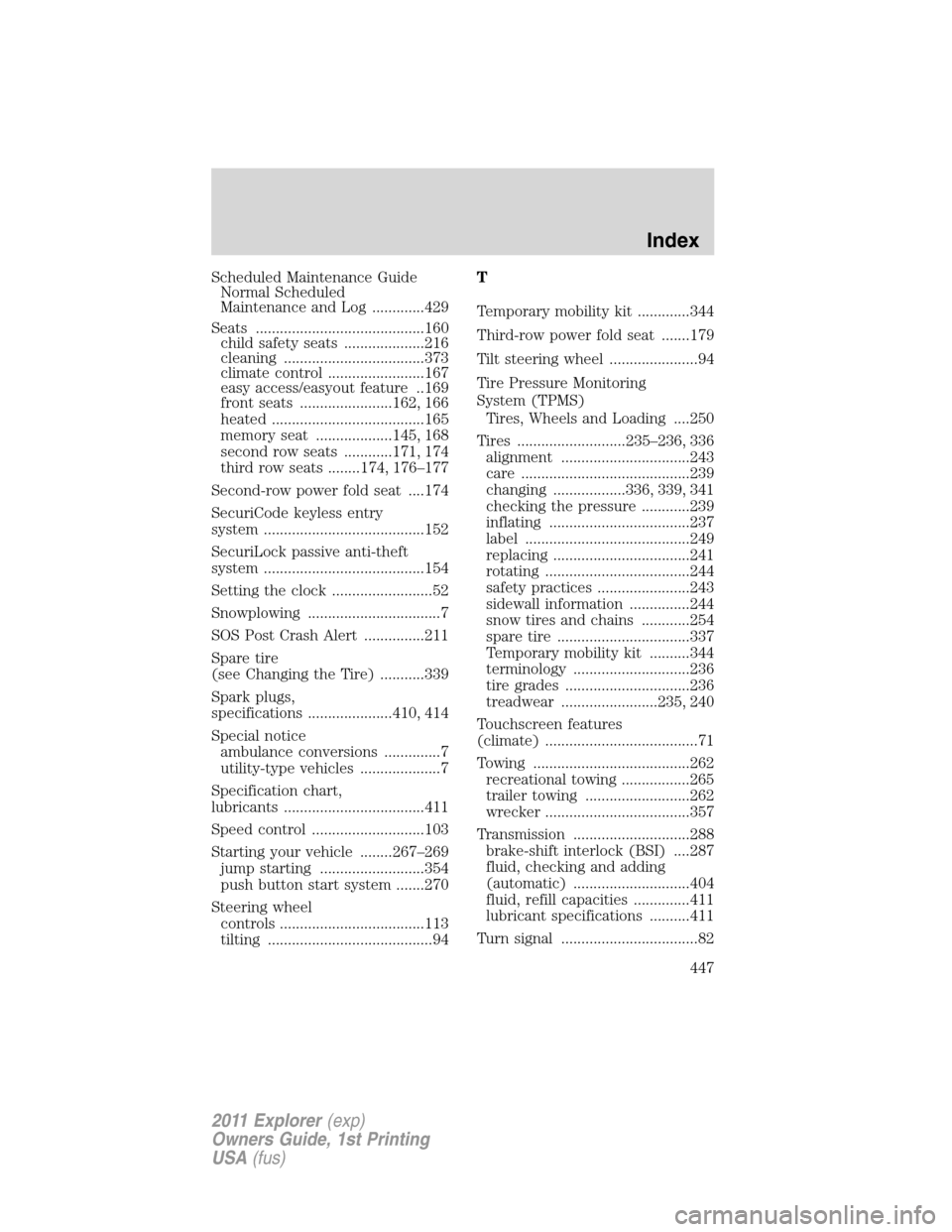
Scheduled Maintenance Guide
Normal Scheduled
Maintenance and Log .............429
Seats ..........................................160
child safety seats ....................216
cleaning ...................................373
climate control ........................167
easy access/easyout feature ..169
front seats .......................162, 166
heated ......................................165
memory seat ...................145, 168
second row seats ............171, 174
third row seats ........174, 176–177
Second-row power fold seat ....174
SecuriCode keyless entry
system ........................................152
SecuriLock passive anti-theft
system ........................................154
Setting the clock .........................52
Snowplowing .................................7
SOS Post Crash Alert ...............211
Spare tire
(see Changing the Tire) ...........339
Spark plugs,
specifications .....................410, 414
Special notice
ambulance conversions ..............7
utility-type vehicles ....................7
Specification chart,
lubricants ...................................411
Speed control ............................103
Starting your vehicle ........267–269
jump starting ..........................354
push button start system .......270
Steering wheel
controls ....................................113
tilting .........................................94T
Temporary mobility kit .............344
Third-row power fold seat .......179
Tilt steering wheel ......................94
Tire Pressure Monitoring
System (TPMS)
Tires, Wheels and Loading ....250
Tires ...........................235–236, 336
alignment ................................243
care ..........................................239
changing ..................336, 339, 341
checking the pressure ............239
inflating ...................................237
label .........................................249
replacing ..................................241
rotating ....................................244
safety practices .......................243
sidewall information ...............244
snow tires and chains ............254
spare tire .................................337
Temporary mobility kit ..........344
terminology .............................236
tire grades ...............................236
treadwear ........................235, 240
Touchscreen features
(climate) ......................................71
Towing .......................................262
recreational towing .................265
trailer towing ..........................262
wrecker ....................................357
Transmission .............................288
brake-shift interlock (BSI) ....287
fluid, checking and adding
(automatic) .............................404
fluid, refill capacities ..............411
lubricant specifications ..........411
Turn signal ..................................82
Index
447
2011 Explorer(exp)
Owners Guide, 1st Printing
USA(fus)