cooling FORD F150 2004 11.G User Guide
[x] Cancel search | Manufacturer: FORD, Model Year: 2004, Model line: F150, Model: FORD F150 2004 11.GPages: 280, PDF Size: 4.13 MB
Page 236 of 280
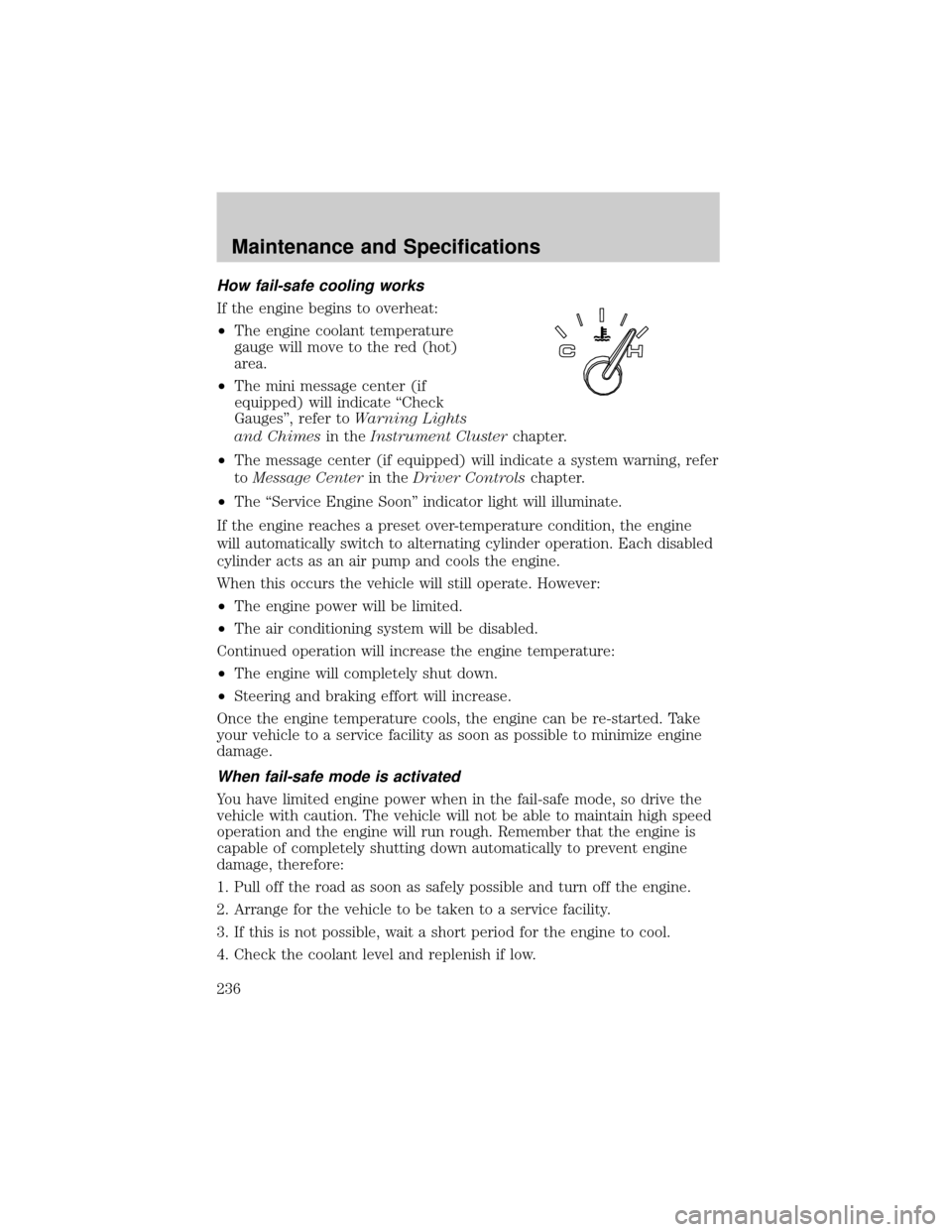
How fail-safe cooling works
If the engine begins to overheat:
²The engine coolant temperature
gauge will move to the red (hot)
area.
²The mini message center (if
equipped) will indicate ªCheck
Gaugesº, refer toWarning Lights
and Chimesin theInstrument Clusterchapter.
²The message center (if equipped) will indicate a system warning, refer
toMessage Centerin theDriver Controlschapter.
²The ªService Engine Soonº indicator light will illuminate.
If the engine reaches a preset over-temperature condition, the engine
will automatically switch to alternating cylinder operation. Each disabled
cylinder acts as an air pump and cools the engine.
When this occurs the vehicle will still operate. However:
²The engine power will be limited.
²The air conditioning system will be disabled.
Continued operation will increase the engine temperature:
²The engine will completely shut down.
²Steering and braking effort will increase.
Once the engine temperature cools, the engine can be re-started. Take
your vehicle to a service facility as soon as possible to minimize engine
damage.
When fail-safe mode is activated
You have limited engine power when in the fail-safe mode, so drive the
vehicle with caution. The vehicle will not be able to maintain high speed
operation and the engine will run rough. Remember that the engine is
capable of completely shutting down automatically to prevent engine
damage, therefore:
1. Pull off the road as soon as safely possible and turn off the engine.
2. Arrange for the vehicle to be taken to a service facility.
3. If this is not possible, wait a short period for the engine to cool.
4. Check the coolant level and replenish if low.
Maintenance and Specifications
236
Page 260 of 280

4Approximate dry fill capacity including transmission fluid cooling
system, actual refill capacities will vary based on vehicle application and
transmission fluid cooling system (i.e. coolers size, cooling lines. auxiliary
cooler capacities). The amount of transmission fluid and fluid level
should be set by the indication on the dipstick's normal operating range.
5Your vehicle's rear axle is filled with a synthetic rear axle lubricant and
is considered lubricated for life. These lubricants do not need to be
checked or changed unless a leak is suspected, service is required or the
axle assembly has been submerged in water. The axle lubricant should
be changed any time the rear axle has been submerged in water.
6Service refill capacity is determined by filling the axle to 6-14 mm
(1/4-9/16 inch) below the bottom of the filler hole with the vehicle on a
level surface.
Add 118 ml (4 oz.) of FEHP Friction Modifier, XL-7 or equivalent, for
complete fill of 8.8 inch and 9.75 inch Traction-Lok axles.
7Service refill capacity is determined by filling the axle to the bottom of
the filler hole with the vehicle on a level surface.
For 10.25 inch Traction-Lok axles, use 3.1L (6.5 pints) of Motorcraft SAE
75W-90 Fuel Efficient High Performance Synthetic Rear Axle Lubricant
and 118 ml (4 oz.) of FEHP Friction Modifier XL-7 or equivalent.
8Use of synthetic or synthetic blend motor oil is not mandatory. Engine
oil need only meet the requirements of Ford specification
WSS-M2C153±H and the API Certification mark.
Maintenance and Specifications
260
Page 276 of 280

Engine oil ..................................226
checking and adding ..............226
dipstick ....................................226
filter, specifications ........228, 257
recommendations ...................228
refill capacities ........................257
specifications ..................261, 263
Exhaust fumes ..........................148
F
Fail safe cooling ........................235
Fluid capacities .........................257
Foglamps .....................................42
Four-Wheel Drive vehicles .......159
driving off road .......................162
electronic shift ........................161
indicator light .........................159
lever operated shift ................160
preparing to drive your
vehicle .....................................151
Fuel ............................................237
calculating fuel
economy ............................73, 241
cap ...........................................239
capacity ...................................257
choosing the right fuel ...........240
comparisons with EPA fuel
economy estimates .................244
detergent in fuel .....................241
filling your vehicle with
fuel ...........................237, 239, 242
filter, specifications ........241, 257
fuel pump shut-off switch .....187
improving fuel economy ........241
octane rating ...................240, 263
quality ......................................240
running out of fuel .................241
safety information relating to
automotive fuels .....................237
Fuel pump shut-off switch .......187Fuses ..................................188±189
G
Garage Door Opener
(see Homelink wireless control
system) ........................................66
Gas cap (see Fuel cap) ............239
Gas mileage
(see Fuel economy) .................241
Gauges .........................................15
GAWR (Gross Axle Weight
Rating) .......................................171
calculating ...............................173
definition .................................171
driving with a heavy load ......171
location ....................................171
GVWR (Gross Vehicle Weight
Rating) .......................................171
calculating .......................171, 173
definition .................................171
driving with a heavy load ......171
location ....................................171
H
Hazard flashers .........................187
Head restraints ...................97, 101
Headlamps ...................................41
aiming ........................................43
autolamp system .......................41
bulb specifications ....................47
daytime running lights .............42
flash to pass ..............................43
high beam .................................42
replacing bulbs .........................48
turning on and off ....................41
Heating
heater only system ...................32
Index
276