cool FORD FESTIVA 1991 Manual Online
[x] Cancel search | Manufacturer: FORD, Model Year: 1991, Model line: FESTIVA, Model: FORD FESTIVA 1991Pages: 454, PDF Size: 9.53 MB
Page 268 of 454

Fig. 14: Typical Negative Backpressure EGR Valve
Courtesy of GENERAL MOTORS CORP.
Digital EGR Valve
The digital EGR valve operates independently of engine manifold vacuum. This valve controls EGR flow through 3 orifices. These 3 orifices
are opened and closed by electric solenoids. The solenoids are, in turn, controlled by the Electronic Control Module (ECM). When a
solenoid is energized, the armature with attached shaft and swivel pintle is lifted, opening the orifice. See Fig. 15
.
The ECM uses inputs from the Coolant Temperature Sensor (CTS), Throttle Position Sensor (TPS) and Mass Airflow (MAF) sensors to
control the EGR orifices to make 7 different combinations for precise EGR flow control. At idle, the EGR valve allows a very small amount of
exhaust gas to enter the intake manifold. This EGR valve normally operates above idle speed during warm engine operation.
Verify EGR valve is present and not modified or purposely damaged. Ensure thermal vacuum switches, pressure transducers, speed switches,
etc., (if applicable) are not by-passed or modified. Ensure vacuum hose(s) to EGR valve is not plugged. Ensure electrical connector to EGR
valve is not disconnected.
Page 8 of 12 MITCHELL 1 ARTICLE - EMISSION CONTROL VISUAL INSPECTION PROCEDURES 1983-93 GENERAL INFORMATI
...
3/10/2009 http://www.eautorepair.net/app/PrintItems.asp?S0=2097152&S1=0&SG=%7B9B990D68%2D660A%2D45E9%2D8F46%2DE
...
Page 306 of 454
Back To Article
1991 GENERAL SERVICING
A/C Com pressor Refrigerant Oil Checking
ISOLATING COMPRESSOR
1. Connect service gauge set to the compressor service valves and open compressor valves slightly (turn in clockwise). Start engine and
operate air conditioning. Slowly turn compressor suction valve clockwise toward closed (front-seated) position.
2. When suction pressure is reduced to zero or less, turn off engine and compressor and quickly turn suction valve stem in to full front-
seated position. Suction pressure should be slightly above zero. Turn discharge valve into front-seated position.
3. To check oil level, slowly open compressor crankcase plug to relieve any remaining pressure. After oil level is corrected, cap service
gauge ports on both valves. Back-seat suction service valve to allow refrigerant to enter compressor. Open discharge valve halfway.
4. Loosen discharge service valve cap, allowing refrigerant pressure to force air out of compressor. Back-seat service valve and tighten cap.
Compressor is now ready for operation.
REFRIGERANT OIL
Only new, pure, moisture-free refrigerant oil should be used in the air conditioning system. This oil is highly refined and dehydrated to a point
where moisture content is less than 10 parts per million. The oil container must be tightly closed at all times when not in use, or moisture will
be absorbed into the refrigerant oil from the air.
SERVICING PRECAUTIONS
DISCHARGING SYSTEM PRECAUTIONS
If compressor has stem-type service valves, it can be isolated and removed without discharging entire system. See ISOLATING
COMPRESSOR at the beginning of this article. Otherwise, discharge system completely before loosening any fittings.
DISCONNECTING LINES & FITTINGS TEST
After system is discharged, carefully clean area around all fittings to be opened. Always use 2 wrenches when tightening or loosening fittings
to avoid twisting or distorting lines. Cap or plug all openings as soon as lines are removed. DO NOT remove caps until immediately before
connections are made. This will keep entry of air and moisture to a minimum.
CONNECTING LINES AND FITTINGS
A new gasket or "O" ring should be used in all instances when connecting lines or fittings. Dip "O" ring in new refrigerant oil and ensure it is
not twisted during installation. Always use 2 wrenches to prevent damage to lines and fittings.
PLACING SYSTEM IN OPERATION
After component service or replacement has been completed and all connections have been made, evacuate system thoroughly with a vacuum
pump. Charge system with proper amount of refrigerant and perform a leak test. See REFRIGERANT OIL & R-12 SPECIFICATIONS chart in
this section for system capacities. Be sure to check all fittings that have been opened. After system has been leak tested, make a system
performance check.
ATSUGI ROTARY VANE DRAIN & REFILL
1. Before checking and adjusting oil level, operate compressor at engine idling speed, with controls set for maximum cooling and high
blower speed, for 20 to 30 minutes to return oil to compressor.
2. Stop engine, discharge refrigerant and remove compressor from vehicle. See SERVICING PRECAUTIONS at beginning of article. Drain
compressor oil from compressor discharge port and measure the amount. Oil is sometimes hard to drain when compressor is cool.
Remove oil while compressor is warm.
3. If the amount drained is less than 3 ounces, conduct leak tests at system connections, and if necessary, repair or replace faulty parts.
Check purity of oil and adjust oil level as follows.
4. If amount drained was above 3 ounces, oil level is right. Pour in same amount as was drained. If amount drained was below 3 ounces,
pour in 3 ounces of new refrigerant oil.
BOSCH 6-CYL DRAIN & REFILL
1. Before checking and adjusting oil level, operate compressor at engine idling speed, with controls set for maximum cooling and high
blower speed, for 20 to 30 minutes to return oil to compressor.
2. Stop engine and discharge refrigerant. Remove refrigerant oil level inspection plug on side of compressor. Oil should be at lower lip of
threaded hole. Add necessary new refrigerant oil (if low). Replace inspection plug and tighten to 10-12 ft. lbs. (14-16 N.m). NOTE:Only com pressors with stem -type service valves can be isolated.
NOTE:Recent findings by the EPA indicate that refrigerant is harm ful to the earth's protective Ozone layer.
When discharging refrigerant, DO NOT allow refrigerant to enter the atm osphere. If available, use
refrigerant recovery/recycle system s when discharging system . Always follow m anufacturer's
instructions.
NOTE:Air conditioning system s will not norm ally need addition of refrigerant oil unless definite oil loss has
occurred due to ruptured lines, leaking com pressor seals, com pressor overhaul or com ponent
replacem ent.
Page 1 of 4 MITCHELL 1 ARTICLE - 1991 GENERAL SERVICING A/C Compressor Refrigerant Oil Checking
3/10/2009 http://www.eautorepair.net/app/PrintItems.asp?S0=2097152&S1=0&SG=%7B9B990D68%2D660A%2D45E9%2D8F46%2DE
...
Page 307 of 454
CALSONIC V5 5-CYLINDER
1. Before checking and adjusting oil level, operate compressor at 1000-1500 engine RPM, and set controls at maximum cooling and
blowing speed for 20-30 minutes to return oil to compressor.
2. Stop engine. Discharge refrigerant and remove compressor from vehicle. See SERVICING PRECAUTIONS at the beginning of this
article. Drain compressor oil from compressor discharge port and measure oil amount. Oil may be hard to drain if compressor is cool.
Drain oil while compressor is warm.
3. If amount drained is less than 3.2 ounces, conduct leak tests at system connections. Repair or replace faulty parts as necessary. Check
purity of oil and oil level as follows.
4. If amount drained is more than 3.2 ounces, oil level is okay; fill with same amount drained using new oil. If amount drained is less than
3.2 ounces, pour in 3.2 ounces of new refrigerant oil.
DIESEL KIKI ROTARY VANE DRAIN & REFILL
1. Before checking and adjusting oil level, operate compressor at engine idling speed, with controls set for maximum cooling and high
blower speed, for 20 to 30 minutes to return oil to compressor.
2. Stop engine, discharge refrigerant and remove compressor from vehicle. See SERVICING PRECAUTIONS at the beginning of this
article. Drain compressor oil from compressor discharge port and measure the amount. Oil is sometimes hard to drain when compressor
is cool. Remove oil while compressor is warm.
3. If the amount is less than 2.4 ounces, conduct leak tests at system connections, and if necessary, repair or replace faulty parts. Check
purity of oil and adjust oil level as follows.
4. If amount drained was above 2.4 ounces, oil level is right. Pour in same amount as was drained. If amount drained was below 2.4
ounces, pour in 2.4 ounces of new refrigerant oil.
DIESEL KIKI 6-CYL DRAIN & REFILL
1. Before checking and adjusting oil level, operate compressor at engine idling speed, with controls set for maximum cooling and high
blower speed, for 20 to 30 minutes to return oil to compressor.
2. Stop engine, discharge refrigerant and remove compressor from vehicle. See SERVICING PRECAUTIONS at the beginning of this
article. Remove oil drain plug and drain oil. Measure amount of oil drained. Install drain plug with new "O" ring.
3. If amount drained was more than 2 ounces (4.4 ounces for Infinity), refill with same amount of new oil. If amount drained was less than
2 ounces (4.4 ounces for Infinity), refill with 2 ounces (4.4 ounces for Infinity). Install filler plug and recharge system.
FORD FX-15 6-CYLINDER DRAIN & REFILL
1. Slowly discharge system. Remove A/C compressor. Drain compressor oil from suction and discharge ports. Measure amount drained and
discard oil.
2. If amount drained from removed (old) compressor is between 3 and 5 ounces, add drained amount of new SUNINSO 5GS refrigerant oil
into the NEW compressor through suction port.
3. If amount drained is less than 3 ounces, add 3 ounces to the NEW compressor. If amount drained is more than 5 ounces, add 5 ounces.
Use new "O" rings on refrigerant lines. Install A/C compressor. Evacuate and recharge system. Perform leak test.
HARRISON 4-CYL DRAIN & REFILL
The Harrison 4-cyl compressor is charged (new) with 6 ounces of refrigerant oil. Because compressor does not have an oil sump, it should not
have to be removed for oil measurement (it retains very little oil). Note the following situations for checking and adding oil to this compressor.
NO OIL LEAK; REPLACING COMPONENTS
If only the compressor is to be replaced, remove, drain oil, measure and reinstall an equal amount of new oil. If evaporator is being replaced,
add 3 ounces of new oil. If condenser is being replaced, add one ounce.
LOSS OF REFRIGERANT OVER EXTENDED PERIOD
When a loss of refrigerant has occurred over an extended period of time and a component is being replaced to correct the leak, add an
appropriate amount of refrigerant oil to the component.
SIGNS OF EXCESSIVE OIL LEAKAGE
If system has lost excessive oil, remove accumulator. Drain and measure oil. If more than 3 ounces is measured, replace the same amount of
new oil as was drained. If less than 3 ounces is measured, add 3 ounces of new oil. Add and additional 2 ounces of new oil to compensate for
that lost by replacing the accumulator (held in desiccant).
HARRISON V5 5-CYLINDER DRAIN & REFILL
1. If system is operable, run for several minutes to stabilize system before performing repairs. Turn off engine. Discharge system and
remove compressor. See SERVICING PRECAUTIONS at the beginning of this article. Remove drain plug. Drain and measure oil. NOTE:Replacem ent FX-15 com pressors contain 7 ounces of refrigerant oil. Prior to installing com pressor,
drain refrigerant oil and determ ine proper am ount of refrigerant oil to be added.
NOTE:T he Harrison com pressor DOES NOT have an oil sum p. It's crucial that the com pressor rem ains well
oiled. It takes very little tim e to destroy this com pressor if it runs dry.
NOTE:If the exact oil charge is in doubt, drain and flush system . Add a new 6-ounce charge of refrigerant oil to
the system .
Page 2 of 4 MITCHELL 1 ARTICLE - 1991 GENERAL SERVICING A/C Compressor Refrigerant Oil Checking
3/10/2009 http://www.eautorepair.net/app/PrintItems.asp?S0=2097152&S1=0&SG=%7B9B990D68%2D660A%2D45E9%2D8F46%2DE
...
Page 308 of 454
2. If more than one ounce is drained, add same amount. If less than one ounce is drained, add 2 ounces of new refrigerant oil to
compressor.
3. If A/C components are replaced, add refrigerant oil to system. Add one ounce if condenser is replaced. Add 3.5 ounces if accumu l at o r is
replaced.
4. When replacing a component which has caused a large refrigerant leak, add 3 ounces of new oil plus the required amount for the part
being replaced. Add oil directly to part being replaced if possible. If oil can not be easily added to part, add oil to accumulator.
HITACHI 5-CYL DRAIN & REFILL
1. Before checking and adjusting oil level, operate compressor at 1000-1500 engine RPM, and set controls at maximum cooling and high
blowing speed for about 10 minutes to return oil to compressor.
2. Stop engine. Discharge refrigerant and remove compressor from vehicle. See SERVICING PRECAUTIONS at the beginning of this
article. Drain oil from compressor through suction port. Measure amount of oil drained.
3. If amount drained is more than 2.4 ounces, fill with same amount using new oil. If amount drained is less than 2.4 ounces, fill with 2.4
ounces. Install compressor and recharge.
4. If A/C components are replaced. add refrigerant oil to system. Add 1.7 ounces if condenser is replaced. Add 2.4 ounces if evaporator is
replaced. oil does not need to be added if receiver-drier is replaced.
HITACHI 6-CYL DRAIN & REFILL
1. Before checking and adjusting oil level, operate compressor at engine idling speed, with controls set for maximum cooling and high
blower speed, for 10 minutes to return oil to compressor.
2. Stop engine, discharge refrigerant and remove compressor from vehicle. See SERVICING PRECAUTIONS at the beginning of this
article. Drain oil from compressor suction port. Measure amount of oil drained. If amount drained was more than 2.4 ounces, refill with
same amount of new oil. If amount drained was less than 2.4 ounces, refill with 2.4 ounces. Install compressor and recharge.
MATSUSHITA ROTARY VANE DRAIN & REFILL
Discharge system. Remove compressor from vehicle. Drain oil from compressor through inlet and outlet holes. Refill compressor with 3.4-4.7
ounces of oil through suction port. When replacing evaporator, add 2 ounces. When replacing other A/C components, add 1.4 ounces per
component replaced.
NIPPONDENSO ROTARY VANE DRAIN & REFILL
1. Before checking and adjusting oil level, operate compressor at engine idle speed, and set controls at maximum cooling and high blowing
speed for 20-30 minutes to return oil to compressor.
2. Stop engine. Discharge refrigerant and remove compressor from vehicle. See SERVICING PRECAUTIONS at the beginning of this
article. Drain compressor oil through compressor intake and discharge ports. Measure amount drained. Oil may be hard to drain if
compressor cool. Drain compressor while compressor is warm.
3. If amount drained is less than 2.4 ounces, conduct leak tests at system connections. If necessary, repair or replace faulty parts. Check
purity of oil level and adjust oil level as follows.
4. If amount drained is more than 2.4 ounces, oil level is okay; fill with same amount drained using new oil. If amount drained is less than
2.4 ounces, pour 2.4 ounces of new refrigerant oil.
5. When replacing condenser, add one ounce. when replacing other A/C components, add .33 ounce per container replaced.
NIPPONDENSO 6 & 10-CYL DRAIN & REFILL
When inspecting system for oil loss, look for signs of leaking (shiny, wet spots on components or underside of hood). If oil leak is noted or
component replacement is required, use the following procedure as indicated:
NO OIL LEAK
Discharge system and change components as necessary. See SERVICING PRECAUTIONS at the beginning of this article. Add refrigerant oil
to components as necessary.
OIL LEAK
1. Slowly discharge system. Repair or replace faulty components. If equipped with a drain plug, remove plug, drain and discard oil. If not
equipped with a drain plug, remove compressor from vehicle and pour oil out suction and discharge ports.
2. Replace drain plug (if equipped). Add 1.5 ounces of new refrigerant oil through suction port. Use new gaskets or "O" rings when
replacing suction and discharge lines.
COMPRESSOR FAILURE OR SYSTEM CONTAMINATED
If either situation exists, discharge system and remove compressor, receiver-drier and expansion valve. Clean expansion valve screen. Flush
entire system. Install new compressor and receiver-drier. New compressors contain correct amount of oil. If installing overhauled compressor,
add 1.5 ounces of new refrigerant oil through suction port.
PANASONIC ROTARY VANE DRAIN & REFILL
1. Before checking and adjusting oil level, operate compressor at 1000-1500 engine RPM, and set controls at maximum cooling and high
blowing speed for about 10 minutes to return oil to compressor.
2. Stop engine. Discharge refrigerant and remove compressor from vehicle. See SERVICING PRECAUTIONS at the beginning of this NOTE:If oil drained contains m etal chips or other debris, replace receiver-drier. Flush out system before
evacuating and recharging.
Page 3 of 4 MITCHELL 1 ARTICLE - 1991 GENERAL SERVICING A/C Compressor Refrigerant Oil Checking
3/10/2009 http://www.eautorepair.net/app/PrintItems.asp?S0=2097152&S1=0&SG=%7B9B990D68%2D660A%2D45E9%2D8F46%2DE
...
Page 309 of 454
article. Drain oil from compressor through suction and discharge ports. Measure amount of oil drained. If amount drained is more than
2.4 ounces, fill with same amount using new oil. If amount drained is less than 2.4 ounces, fill with 2.4 ounces. Install compressor and
recharge.
3. If A/C components are replaced, add refrigerant oil to system. Add 1.4 ounces if condenser is replaced. Add 2 ounces if the evaporator
is replaced. Oil does not need to be added if receiver-drier is replaced.
SANDEN SCROLL DRAIN & REFILL
Discharge system. Remove compressor from vehicle. Drain oil from compressor through inlet and outlet holes. Refill compressor with 2.8
ounces of oil through suction port. When replacing condenser, add .5 ounce. When replacing evaporator, add 1.7 ounces. When replacing
other A/C components, add .5 ounce per component replaced.
SANDEN 5-CYL DRAIN & REFILL
1. Discharge system. Remove compressor belt and loosen mounting bolts. Rotate compressor in brackets until filler plug is at top. Clean
area around filler plug and remove plug slowly. Rotate front hub plate so notch in lobe is 110 degrees from the bottom. This rotates ball
end of top piston to align with oil fill port and allows clearance for dipstick. See Fig. 1
.
2. Insert compressor dipstick diagonally from right to left until stop on dipstick contacts filler plug surface. Remove dipstick and note oil
fill level. Each increment on dipstick represents one ounce of oil. Add oil if necessary to reach 3-4 ounce level.
Fig. 1: Sanden 5
-Cylinder Oil Level Checking
Courtesy of SANDEN INTERNATIONAL U.S.A, INC.
SANDEN 7-CYL DRAIN & REFILL
1. Before checking and adjusting oil level, operate compressor at engine idle speed, and set controls at maximum cooling and high blowing
speed for 20-30 minutes to return oil to compressor.
2. Stop engine. Discharge refrigerant and remove compressor from vehicle. See SERVICING PRECAUTIONS at the beginning of this
article. Remove oil drain plug and drain oil. Measure amount of oil drained. Install drain plug with new "O" ring.
3. If amount drained is more than 3 ounces, fill with same amount using new oil. If amount drained is less than 3 ounces, fill with 3
ounces. Install filler plug. Install compressor and recharge system.
Copyr ight 2009 Mitchell Repair Information Company, LLC. All Rights Reserved.
Article GUID: A00038952
Page 4 of 4 MITCHELL 1 ARTICLE - 1991 GENERAL SERVICING A/C Compressor Refrigerant Oil Checking
3/10/2009 http://www.eautorepair.net/app/PrintItems.asp?S0=2097152&S1=0&SG=%7B9B990D68%2D660A%2D45E9%2D8F46%2DE
...
Page 335 of 454
Back To Article
1991-92 AIR CONDIT IONING & HEAT ING
A/C System General Servicing
HANDLING/SAFETY PRECAUTIONS
1. Always work in a well-ventilated, clean area. Refrigerant R-134a is colorless and is invisible as a gas. Refrigerant (R-12 or R-134a) is
heavier than oxygen and will displace oxygen in a confined area. Avoid breathing refrigerant vapors. Exposure may irritate eyes, nose
and throat.
2. The system's high pressure can cause severe injury to eyes and skin if a hose were to burst. Always wear eye protection when working
around A/C system and refrigerant. If necessary, wear rubber gloves or other protective clothing.
3. Refrigerant evaporates quickly when exposed to atmosphere, freezing anything it contacts. If liquid refrigerant contacts eyes or skin, DO
NOT rub eyes or skin. Immediately flush affected area with cool water for 15 minutes and consult a doctor or hospital.
4. Never use R-134a in combination with compressed air for leak testing. Pressurized R-134a in the presence of oxygen (air concentrations
greater than 60% by volume) may form a combustible mixture. DO NOT introduce compressed air into R-134a containers (full or
empty), A/C system components or service equipment.
5. DO NOT expose A/C system components to high temperatures, steam cleaning for example, as excessive heat will cause
refrigerant/system pressure to increase. Never expose refrigerant directly to open flame. If refrigerant needs to be warmed, place bottom
of refrigerant tank in warm water. Water temperature MUST NOT exceed 125°F (52°C).
6. Use care when handling refrigerant containers. DO NOT drop, strike, puncture or incinerate containers. Use Department Of
Transportation (DOT) approved, DOT 4BW or DOT 4BA, refrigerant containers.
7. Never overfill refrigerant containers. The safe filling level of a refrigerant container MUST NOT exceed 60% of the container's gross
weight rating. Store refrigerant containers at temperature less than 125°F (52°C).
8. R-12 refrigerant (Freon) will be sold and stored in White containers, while R-134a refrigerant will be sold and stored in 30- or 50-
pound Light Blue containers.
9. R-12 and R-134a refrigerants must never be mixed, as their desiccants and lubricants are not compatible. If the refrigerants are mixed,
system cross-contamination or A/C system component failure may occur. Always use separate servicing and refrigerant
recovery/recycling equipment.
10. Follow equipment manufacturer instructions of all service equipment to be used. The Material Safety Data Sheet (MSDS), provided by
refrigerant manufacturer/suppliers, contains valuable information regarding the safe handling of R-12 or R-134a refrigerants.
IDENTIFYING R-134A SYSTEMS & COMPONENTS
To prevent refrigerant cross-contamination, use following methods to identify R-134a based systems and components.
Fittings & "O" Rings
All R-134a based A/C systems use 1/2" - 16 ACME threaded fittings (identifiable by square threads) and quick-connect service couplings. See
Fig. 1
. Besides the use of these fittings, most manufacturers will use Green colored "O" rings in R-134a systems. CAUT ION: When discharging air conditioning system , use only approved refrigerant recovery/recycling
equipm ent. Make every attem pt to avoid discharging refrigerant into the atm osphere.
Page 1 of 6 MITCHELL 1 ARTICLE - 1991-92 AIR CONDITIONING & HEATING A/C System General Servicing
3/10/2009 http://www.eautorepair.net/app/PrintItems.asp?S0=2097152&S1=0&SG=%7B9B990D68%2D660A%2D45E9%2D8F46%2DE
...
Page 345 of 454
Back To Article
HEAT ER SYST EM
1990-92 HEAT ER SYST EMS Ford Motor Co.
DESCRIPTION
The heater system consists of control panel, blower case, heater case, air control doors and ducts. The control panel incorporates 3 control
levers and a 3-speed fan switch. The control panel is located in the center of the instrument panel. All air control doors are cable operated
from the control panel.
The blower case is mounted on the bulkhead, behind the instrument panel on passenger's side of vehicle. The blower case houses a blower
motor, blower motor resistor and the fresh/recirculation air door. The heater case contains mode select door, temperature air mix door and
heater core.
OPERATION
Three control levers, temperature mix, fresh/recirculation and mode select, mechanically operate their associated cables and doors. The
temperature control lever adjusts the mix of fresh or recirculated air with heated air. In full heat position, all airflow goes through the heater
core.
In full cool position, the mix air door closes, allowing airflow to by-pass the heater core. The mode select lever, directs airflow to selected
vents. The fresh/recirculation control lever allows selection of fresh (outside) air or recirculated compartment air.
AJUSTMENT
FRESH/RECIRCULATION CONTROL CABLE
Remove the glove box. Remove fresh/recirculation cable retaining clip. Move control lever to RECIRCULATION position, while holding the
lever door in RECIRCULATION position. Ensure control lever does not move. Install fresh/recirculation cable retaining clip.
MODE SELECT CABLE
Remove mode select cable retaining clip. Move mode select lever to VENT position. Hold mode select lever downward against its stop.
Ensure that mode select lever does not move. Install mode select cable retaining clip.
TEMPERATURE CONTROL CABLE
Set temperature control lever to maximum cold position. Remove temperature cable retaining clip. Hold temperature control lever upward and
against its stop. Ensure that temperature lever does not move. Install temperature cable retaining clip.
TROUBLE SHOOTING
BLOWER MOTOR INOPERATIVE
Check blown motor fuse. Check for defective blower motor and/or blower motor resistor. Check blower motor switch. Check for open in
ground wire. Check for loose electrical connectors or poor connections. See WIRING DIAGRAMS
in this article.
BLOWER DOES NOT CHANGE SPEED
Check for defective blower motor. Check blower motor wiring harness. Check blower motor resistor. Check for blower motor fan switch. See
WIRING DIAGRAMS
in this article.
BLOWER RUNS CONSTANTLY
Check for defective blower motor resistor. Check for short in blower switch or wiring. See WIRING DIAGRAMS
in this article.
HEATER TEMPERATURE INSUFFICIENT
Check for proper coolant level. Check water pump for noise, leaks or wear. Check heater hoses for leaks or restrictions. Check heater core for
leaks, plugs or restrictions. Check inlet and outlet heater hoses for hot water flow. Check thermostat condition and operation. Check air mix
door position and adjust cable if necessary.
IMPROPER WARM AIR DISTRIBUTION
Check air mix door position. Adjust cable as necessary. Check function control door position. Adjust cable as necessary. Check for restriction
in ventilation air duct assembly. Repair as necessary.
TESTING BLOWER MOTOR & RESISTOR
1. Ensure 15-amp blower motor fuse is okay. Using voltmeter, check for battery voltage at blower motor Blue/Yellow terminal. If battery
voltage is present, go to next step. If battery voltage is not present, repair open in Blue/Yellow wire between blower motor and fuse box.
2. Disconnect blower motor connector. Using a jumper wire, apply battery voltage to Blue/Yellow terminal and ground the Blue/Red
terminal. If blower motor does not run, replace blower motor. If blower motor runs, go to next step.
3. Reconnect blower motor connector. Turn ignition on. Turn blower motor off. Disconnect the blower motor resistor connector. Using a
voltmeter, measure voltage at Blue/Red terminal of resistor connector. If battery voltage is not present, repair open in Blue/Red wire
between resistor and blower motor. If voltage is present, go to next step.
4. Using a jumper wire, ground Blue/Black, Blue/Yellow and Blue/White terminals of the blower fan switch one at a time. If the motor
runs at 3 different speeds, go to next step. If not, repair open in wire that failed to operate blower motor.
Page 1 of 4 MITCHELL 1 ARTICLE - HEATER SYSTEM 1990-92 HEATER SYSTEMS Ford Motor Co.
3/10/2009 http://www.eautorepair.net/app/PrintItems.asp?S0=2097152&S1=0&SG=%7B9B990D68%2D660A%2D45E9%2D8F46%2DE
...
Page 346 of 454
5. Check blower motor fan switch continuity. Resistance should not exceed 4 ohms. See BLOWER MOTOR FAN SWITCH
CONTINUITY table. If continuity is not present, replace fan switch. If continuity is okay, repair open in Black wire from blower motor
switch to ground.
BLOWER MOTOR FAN SWITCH CONTINUITY
REMOVAL & INSTALLATION
CONTROL PANEL
1. Remove bezel screws and accessory bezel. Remove radio. Remove 4 screws securing control panel to instrument panel. Remove glove
box attaching screws and glove box. Remove the retaining clip and disconnect fresh/recirculation air door cable from mode door lever.
2. Disconnect mode select cable at mode control door lever. Disconnect temperature control cable at temperature control mode door lever.
Pull control panel away from instrument panel. Disconnect blower motor switch connector. Disconnect illumination electrical
connector. Remove control panel. To install, reverse removal procedure. Adjust control cables. See ADJUSTMENTS in this article.
BLOWER MOTOR FAN SWITCH
Remove control panel. See CONTROL PANEL R & I
. Remove blower motor fan switch knob. Remove attaching nut. To install, reverse
removal procedure.
HEATER CORE
1. Disconnect negative battery cable. Remove steering wheel by prying out center trim insert and removing steering wheel retaining nut.
Remove 2 steering wheel cover retaining screws and remove cover. Using a steering wheel puller, remove steering wheel.
2. Remove 5 screws and remove lower and upper steering column covers. Disconnect electrical connections and remove multifunction
switch. Remove 5 screws and pull instrument cluster hood rearward. Disconnect electrical connections and remove instrument cluster
hood.
3. Disconnect speedometer cable at transaxle. Remove 4 instrument cluster screws. Pull instrument cluster rearward and disconnect
speedometer cable and electrical connections. Remove instrument cluster.
4. Remove 2 center bracket mounting bolts under steering column and remove bracket. Remove glove box attaching screws and remove
glove box. Remove left and right heater ducts. Remove fuse panel cover. Remove 2 screws securing fuse panel and push fuse panel
inward. DO NOT remove fuse panel.
5. Slide both seats to most forward position. Remove 2 console attaching screws, located in front of seat belt anchors. Slide both seats to
rearmost position. Remove parking brake console insert. Using a Phillips screwdriver, remove push retainer insert, located at front lower
edge of parking brake console. Pull back on parking brake lever and remove parking brake console.
6. Remove gearshift knob. Remove screws and remove shift console. Remove radio/heater control panel bezel screws and remove bezel.
Remove 4 radio attaching screws. Pull radio out and disconnect antenna lead and electrical connections. Disconnect radio ground lead
and remove radio.
7. Remove 4 screws attaching heater control panel. Disconnect control cables and electrical connections. Remove control panel, while
pulling cables through opening.
8. Pry out bolt cover trim inserts in top corners of dash. Remove bolts located under trim panels. Remove 7 instrument panel attaching
bolts and 2 nuts. Pull instrument panel rearward. Disconnect any harness connectors and clips. Remove instrument panel.
9. Disconnect electrical connections at blower and resistor. Remove harness from routing brackets on heater box. Loosen clamp screw
securing air inlet housing. Remove attaching nuts at top and bottom of heater box. Disconnect defroster ducts and remove heater
assembly.
10. Disconnect link connecting 2 defroster doors. Remove attaching screw just above and to right of blower resistor. Turn heater assembly
around and remove screw just to left of blower motor opening. Remove clips securing 2 halves of heater assembly. Separate halves. Lift
out heater core.
11. To install, reverse removal procedure. Ensure all heater control cables are routed and adjusted properly. See ADJUSTMENTS in this
article. Fill cooling system. Check for leaks.
BLOWER MOTOR & RESISTOR
Disconnect negative battery cable. Remove instrument panel spacer brace located below steering column. Remove airflow duct below steering
column. Disconnect blower motor or resistor wiring. Remove 3 blower motor attaching screws or 2 resistor attaching screws and remove
component. To install, reverse removal procedure.
Switch PositionContinuity Between Wire Colors
1Black-to-Blue/White
2Black-to-Blue/Yellow & Blue/Yellow-to-Blue/Red
3Black-to-Blue/Black & Blue/Black-to-Blue/Red
Page 2 of 4 MITCHELL 1 ARTICLE - HEATER SYSTEM 1990-92 HEATER SYSTEMS Ford Motor Co.
3/10/2009 http://www.eautorepair.net/app/PrintItems.asp?S0=2097152&S1=0&SG=%7B9B990D68%2D660A%2D45E9%2D8F46%2DE
...
Page 349 of 454
Back To Article
1991 AIR CONDIT IONING & HEAT
MANUAL A/C
A/C SYSTEM SPECIFICATIONS
SPECIFICATIONS
DESCRIPTION
This A/C-heater system is fully integrated to provide cooling, heating and ventilation with either fresh or recirculated air. A/C system is
expansion valve type. Interior air temperature is controlled by cycling the compressor on and off at different rates. A/C compressor is protected
by a low pressure switch, which stops compressor operation when refrigerant pressure is too low. Compressor operation is cut when throttle is
wide open to improve driveability.
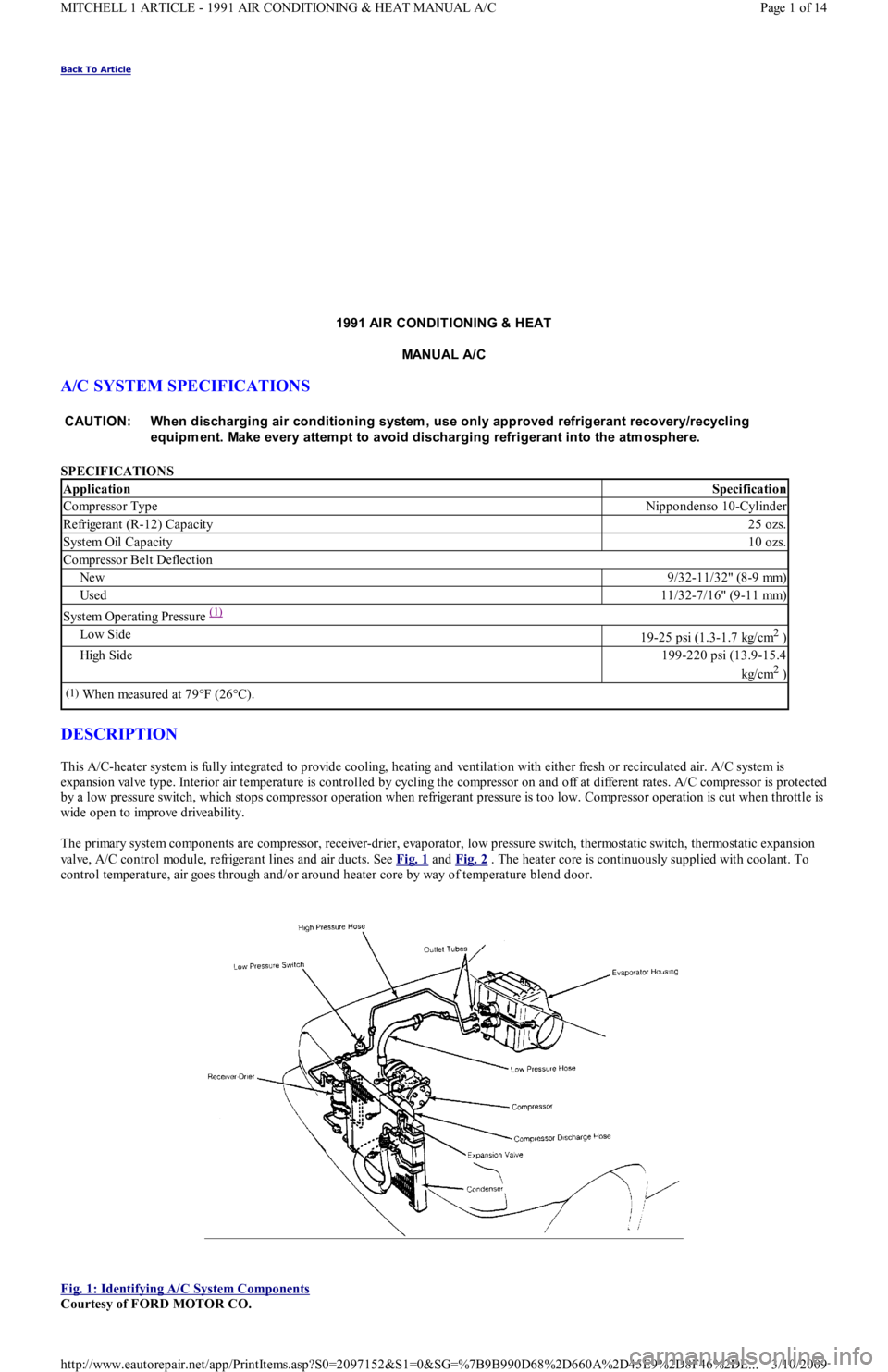
The primary system components are compressor, receiver-drier, evaporator, low pressure switch, thermostatic switch, thermostatic expansion
valve, A/C control module, refrigerant lines and air ducts. See Fig. 1
and Fig. 2 . The heater core is continuously supplied with coolant. To
control temperature, air goes through and/or around heater core by way of temperature blend door.
Fig. 1: Identifying A/C System Components
Courtesy of FORD MOTOR CO. CAUT ION: When discharging air conditioning system , use only approved refrigerant recovery/recycling
equipm ent. Make every attem pt to avoid discharging refrigerant into the atm osphere.
ApplicationSpecification
Compressor TypeNippondenso 10-Cylinder
Refrigerant (R-12) Capacity25 ozs.
System Oil Capacity10 ozs.
Compressor Belt Deflection
New9/32-11/32" (8-9 mm)
Used11/32-7/16" (9-11 mm)
System Operating Pressure (1)
Low Side19-25 psi (1.3-1.7 kg/cm2 )
High Side199-220 psi (13.9-15.4
kg/cm
2 )
(1)When measured at 79°F (26°C).
Page 1 of 14 MITCHELL 1 ARTICLE - 1991 AIR CONDITIONING & HEAT MANUAL A/C
3/10/2009 http://www.eautorepair.net/app/PrintItems.asp?S0=2097152&S1=0&SG=%7B9B990D68%2D660A%2D45E9%2D8F46%2DE
...
Page 350 of 454
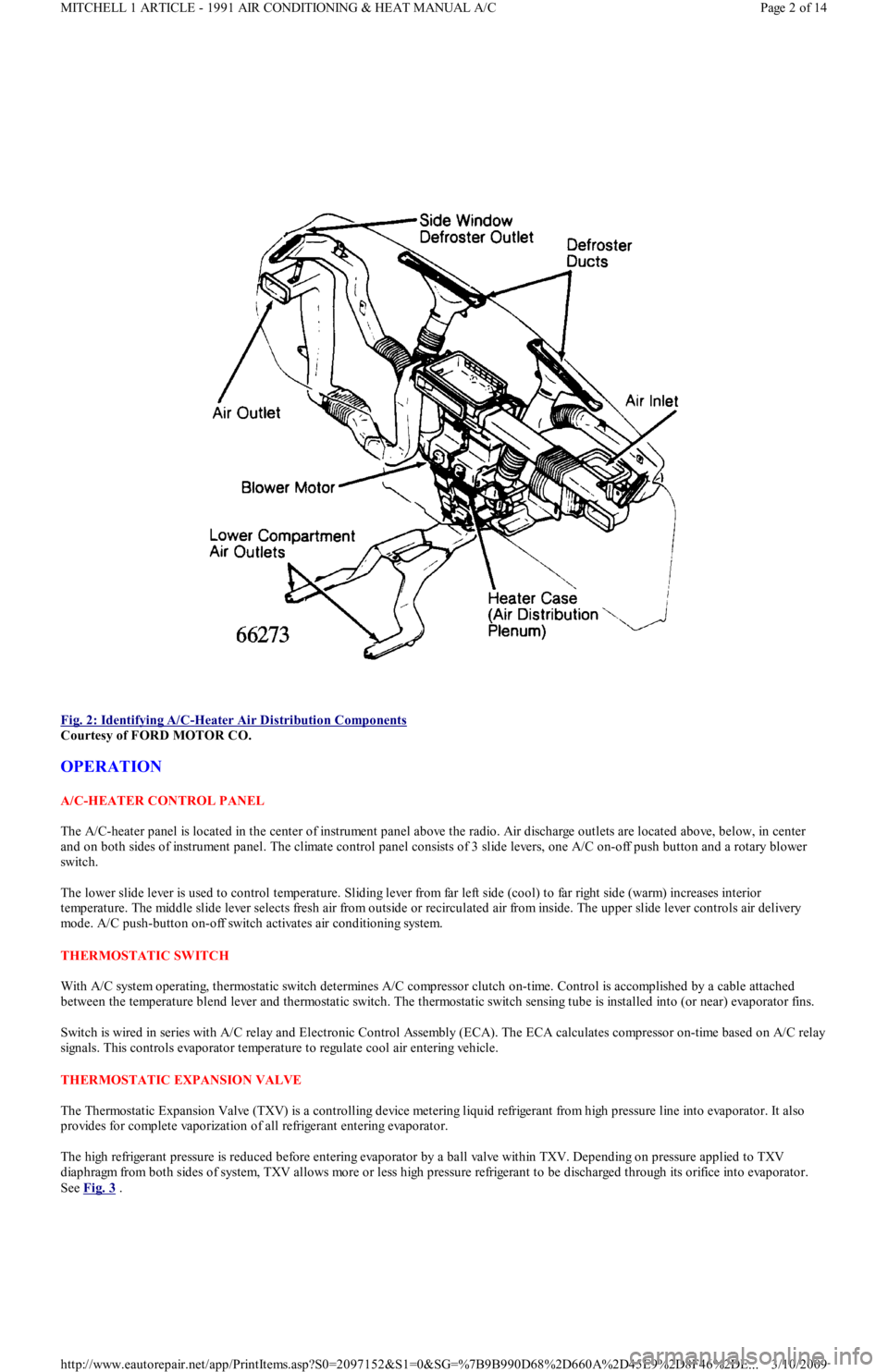
Fig. 2: Identifying A/C
-Heater Air Distribution Components
Courtesy of FORD MOTOR CO.
OPERATION
A/C-HEATER CONTROL PANEL
The A/C-heater panel is located in the center of instrument panel above the radio. Air discharge outlets are located above, below, in center
and on both sides of instrument panel. The climate control panel consists of 3 slide levers, one A/C on-off push button and a rotary blower
switch.
The lower slide lever is used to control temperature. Sliding lever from far left side (cool) to far right side (warm) increases interior
temperature. The middle slide lever selects fresh air from outside or recirculated air from inside. The upper slide lever controls air delivery
mode. A/C push-button on-off switch activates air conditioning system.
THERMOSTATIC SW ITCH
With A/C system operating, thermostatic switch determines A/C compressor clutch on-time. Control is accomplished by a cable attached
between the temperature blend lever and thermostatic switch. The thermostatic switch sensing tube is installed into (or near) evaporator fins.
Switch is wired in series with A/C relay and Electronic Control Assembly (ECA). The ECA calculates compressor on-time based on A/C relay
signals. This controls evaporator temperature to regulate cool air entering vehicle.
THERMOSTATIC EXPANSION VALVE
The Thermostatic Expansion Valve (TXV) is a controlling device metering liquid refrigerant from high pressure line into evaporator. It also
provides for complete vaporization of all refrigerant entering evaporator.
The high refrigerant pressure is reduced before entering evaporator by a ball valve within TXV. Depending on pressure applied to TXV
diaphragm from both sides of system, TXV allows more or less high pressure refrigerant to be discharged through its orifice into evaporator.
See Fig. 3
.
Page 2 of 14 MITCHELL 1 ARTICLE - 1991 AIR CONDITIONING & HEAT MANUAL A/C
3/10/2009 http://www.eautorepair.net/app/PrintItems.asp?S0=2097152&S1=0&SG=%7B9B990D68%2D660A%2D45E9%2D8F46%2DE
...