change time FORD FIESTA 1989 Service User Guide
[x] Cancel search | Manufacturer: FORD, Model Year: 1989, Model line: FIESTA, Model: FORD FIESTA 1989Pages: 296, PDF Size: 10.65 MB
Page 61 of 296
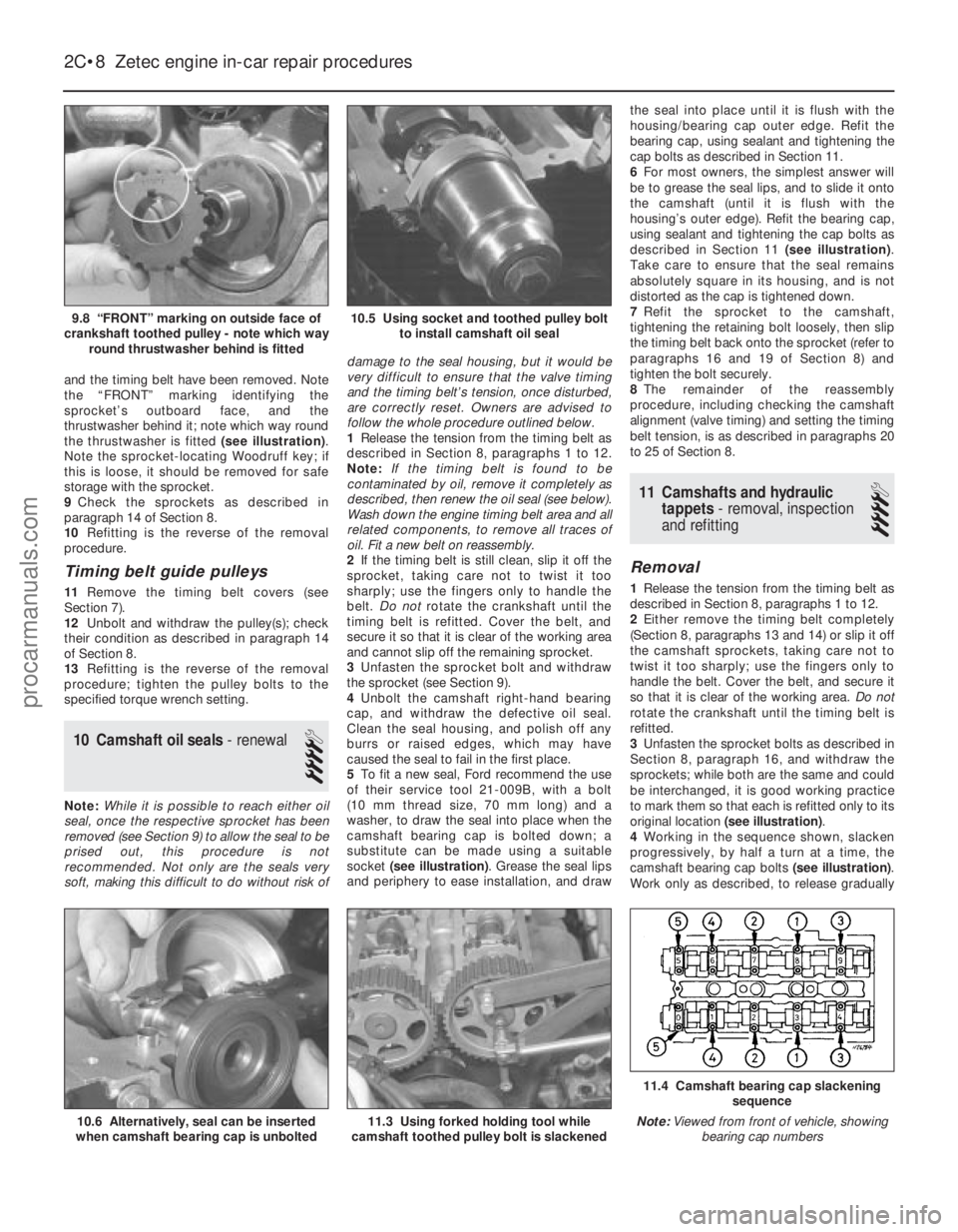
and the timing belt have been removed. Note
the “FRONT” marking identifying the
sprocket’s outboard face, and the
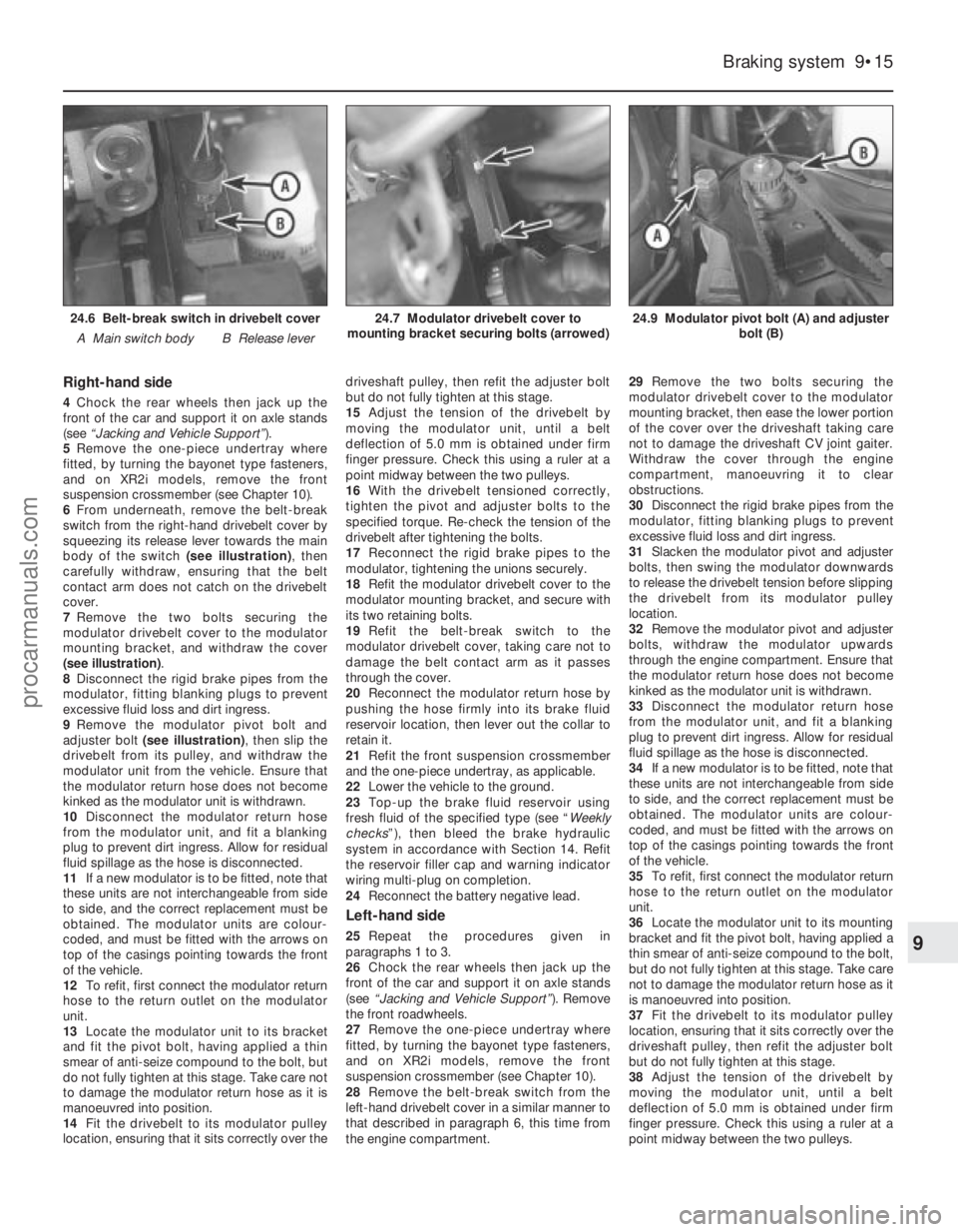
thrustwasher behind it; note which way round
the thrustwasher is fitted (see illustration).
Note the sprocket-locating Woodruff key; if
this is loose, it should be removed for safe
storage with the sprocket.
9 Check the sprockets as described in
paragraph 14 of Section 8.
10 Refitting is the reverse of the removal
procedure.
Timing belt guide pulleys
11 Remove the timing belt covers (see
Section 7).
12 Unbolt and withdraw the pulley(s); check
their condition as described in paragraph 14
of Section 8.
13 Refitting is the reverse of the removal
procedure; tighten the pulley bolts to the
specified torque wrench setting.
10 Camshaft oil seals - renewal
4
Note:While it is possible to reach either oil
seal, once the respective sprocket has been
removed (see Section 9) to allow the seal to be
prised out, this procedure is not
recommended. Not only are the seals very
soft, making this difficult to do without risk of damage to the seal housing, but it would be
very difficult to ensure that the valve timing
and the timing belt’s tension, once disturbed,
are correctly reset. Owners are advised to
follow the whole procedure outlined below.
1
Release the tension from the timing belt as
described in Section 8, paragraphs 1 to 12.
Note: If the timing belt is found to be
contaminated by oil, remove it completely as
described, then renew the oil seal (see below).
Wash down the engine timing belt area and all
related components, to remove all traces of
oil. Fit a new belt on reassembly.
2 If the timing belt is still clean, slip it off the
sprocket, taking care not to twist it too
sharply; use the fingers only to handle the
belt. Do not rotate the crankshaft until the
timing belt is refitted. Cover the belt, and
secure it so that it is clear of the working area
and cannot slip off the remaining sprocket.
3 Unfasten the sprocket bolt and withdraw
the sprocket (see Section 9).
4 Unbolt the camshaft right-hand bearing
cap, and withdraw the defective oil seal.
Clean the seal housing, and polish off any
burrs or raised edges, which may have
caused the seal to fail in the first place.
5 To fit a new seal, Ford recommend the use
of their service tool 21-009B, with a bolt
(10 mm thread size, 70 mm long) and a
washer, to draw the seal into place when the
camshaft bearing cap is bolted down; a
substitute can be made using a suitable
socket (see illustration) . Grease the seal lips
and periphery to ease installation, and draw the seal into place until it is flush with the
housing/bearing cap outer edge. Refit the
bearing cap, using sealant and tightening the
cap bolts as described in Section 11.
6
For most owners, the simplest answer will
be to grease the seal lips, and to slide it onto
the camshaft (until it is flush with the
housing’s outer edge). Refit the bearing cap,
using sealant and tightening the cap bolts as
described in Section 11 (see illustration).
Take care to ensure that the seal remains
absolutely square in its housing, and is not
distorted as the cap is tightened down.
7 Refit the sprocket to the camshaft,
tightening the retaining bolt loosely, then slip
the timing belt back onto the sprocket (refer to
paragraphs 16 and 19 of Section 8) and
tighten the bolt securely.
8 The remainder of the reassembly
procedure, including checking the camshaft
alignment (valve timing) and setting the timing
belt tension, is as described in paragraphs 20
to 25 of Section 8.
11 Camshafts and hydraulic tappets - removal, inspection
and refitting
4
Removal
1 Release the tension from the timing belt as
described in Section 8, paragraphs 1 to 12.
2 Either remove the timing belt completely
(Section 8, paragraphs 13 and 14) or slip it off
the camshaft sprockets, taking care not to
twist it too sharply; use the fingers only to
handle the belt. Cover the belt, and secure it
so that it is clear of the working area. Do not
rotate the crankshaft until the timing belt is
refitted.
3 Unfasten the sprocket bolts as described in
Section 8, paragraph 16, and withdraw the
sprockets; while both are the same and could
be interchanged, it is good working practice
to mark them so that each is refitted only to its
original location (see illustration) .
4 Working in the sequence shown, slacken
progressively, by half a turn at a time, the
camshaft bearing cap bolts (see illustration).
Work only as described, to release gradually
2C•8 Zetec engine in-car repair procedures
11.4 Camshaft bearing cap slackening
sequence
Note: Viewed from front of vehicle, showing
bearing cap numbers
11.3 Using forked holding tool while
camshaft toothed pulley bolt is slackened10.6 Alternatively, seal can be inserted
when camshaft bearing cap is unbolted
10.5 Using socket and toothed pulley bolt to install camshaft oil seal9.8 “FRONT” marking on outside face of
crankshaft toothed pulley - note which way round thrustwasher behind is fitted
1595Ford Fiesta Remakeprocarmanuals.com
http://vnx.su
Page 62 of 296
and evenly the pressure of the valve springs
on the caps.
5Withdraw the caps, noting their markings
and the presence of the locating dowels, then
remove the camshafts and withdraw their oil
seals. The inlet camshaft can be identified by
the reference lobe for the camshaft position
sensor; therefore, there is no need to mark the
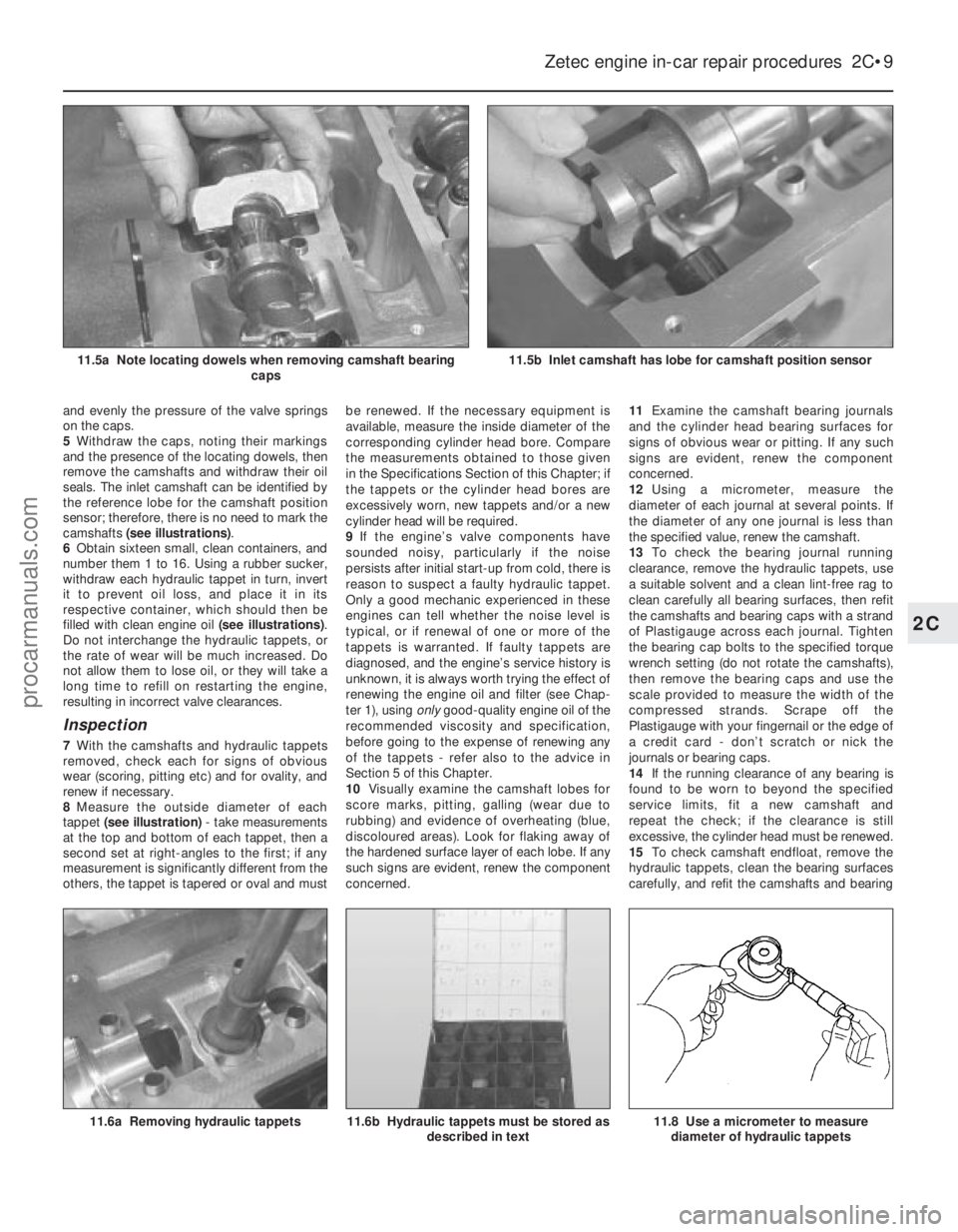
camshafts (see illustrations) .
6 Obtain sixteen small, clean containers, and
number them 1 to 16. Using a rubber sucker,
withdraw each hydraulic tappet in turn, invert
it to prevent oil loss, and place it in its
respective container, which should then be
filled with clean engine oil (see illustrations).
Do not interchange the hydraulic tappets, or
the rate of wear will be much increased. Do
not allow them to lose oil, or they will take a
long time to refill on restarting the engine,
resulting in incorrect valve clearances.
Inspection
7 With the camshafts and hydraulic tappets
removed, check each for signs of obvious
wear (scoring, pitting etc) and for ovality, and
renew if necessary.
8 Measure the outside diameter of each
tappet (see illustration) - take measurements
at the top and bottom of each tappet, then a
second set at right-angles to the first; if any
measurement is significantly different from the
others, the tappet is tapered or oval and must be renewed. If the necessary equipment is
available, measure the inside diameter of the
corresponding cylinder head bore. Compare
the measurements obtained to those given
in the Specifications Section of this Chapter; if
the tappets or the cylinder head bores are
excessively worn, new tappets and/or a new
cylinder head will be required.
9
If the engine’s valve components have
sounded noisy, particularly if the noise
persists after initial start-up from cold, there is
reason to suspect a faulty hydraulic tappet.
Only a good mechanic experienced in these
engines can tell whether the noise level is
typical, or if renewal of one or more of the
tappets is warranted. If faulty tappets are
diagnosed, and the engine’s service history is
unknown, it is always worth trying the effect of
renewing the engine oil and filter (see Chap-
ter 1), using onlygood-quality engine oil of the
recommended viscosity and specification,
before going to the expense of renewing any
of the tappets - refer also to the advice in
Section 5 of this Chapter.
10 Visually examine the camshaft lobes for
score marks, pitting, galling (wear due to
rubbing) and evidence of overheating (blue,
discoloured areas). Look for flaking away of
the hardened surface layer of each lobe. If any
such signs are evident, renew the component
concerned. 11
Examine the camshaft bearing journals
and the cylinder head bearing surfaces for
signs of obvious wear or pitting. If any such
signs are evident, renew the component
concerned.
12 Using a micrometer, measure the
diameter of each journal at several points. If
the diameter of any one journal is less than
the specified value, renew the camshaft.
13 To check the bearing journal running
clearance, remove the hydraulic tappets, use
a suitable solvent and a clean lint-free rag to
clean carefully all bearing surfaces, then refit
the camshafts and bearing caps with a strand
of Plastigauge across each journal. Tighten
the bearing cap bolts to the specified torque
wrench setting (do not rotate the camshafts),
then remove the bearing caps and use the
scale provided to measure the width of the
compressed strands. Scrape off the
Plastigauge with your fingernail or the edge of
a credit card - don’t scratch or nick the
journals or bearing caps.
14 If the running clearance of any bearing is
found to be worn to beyond the specified
service limits, fit a new camshaft and
repeat the check; if the clearance is still
excessive, the cylinder head must be renewed.
15 To check camshaft endfloat, remove the
hydraulic tappets, clean the bearing surfaces
carefully, and refit the camshafts and bearing
Zetec engine in-car repair procedures 2C•9
11.6a Removing hydraulic tappets
11.5b Inlet camshaft has lobe for camshaft position sensor11.5a Note locating dowels when removing camshaft bearing caps
11.8 Use a micrometer to measurediameter of hydraulic tappets11.6b Hydraulic tappets must be stored as described in text
2C
1595Ford Fiesta Remakeprocarmanuals.com
http://vnx.su
Page 90 of 296
diameter from the bore measurement. If the
precision measuring tools shown are not
available, the condition of the pistons and
bores can be assessed, though not quite as
accurately, by using feeler gauges as follows.
Select a feeler gauge of thickness equal to the
specified piston-to-bore clearance, and slip it
into the cylinder along with the matching
piston. The piston must be positioned exactly
as it normally would be. The feeler gauge
must be between the piston and cylinder on
one of the thrust faces (at right-angles to the
gudgeon pin bore). The piston should slip
through the cylinder (with the feeler gauge in
place) with moderate pressure; if it falls
through or slides through easily, the clearance
is excessive, and a new piston will be
required. If the piston binds at the lower end
of the cylinder, and is loose toward the top,
the cylinder is tapered. If tight spots are
encountered as the piston/feeler gauge is
rotated in the cylinder, the cylinder is
out-of-round (oval).15 Repeat these procedures for the
remaining pistons and cylinder bores.
16 Compare the results with the
Specifications at the beginning of this
Chapter; if any measurement is beyond the
dimensions specified for that class (check the
piston crown marking to establish the class
of piston fitted), or if any bore measurement is
significantly different from the others
(indicating that the bore is tapered or oval),
the piston or bore is excessively-worn.
17 Worn pistons must be renewed; on some
engines, the pistons are available as Ford
replacement parts only as part of the
complete piston/connecting rod assembly.
See a Ford dealer or engine reconditioning
specialist for advice.
18 If any of the cylinder bores are badly
scuffed or scored, or if they are excessively-
worn, out-of-round or tapered, the usual
course of action would be to have the cylinder
block/crankcase rebored, and to fit new,
oversized, pistons on reassembly. See a Ford
dealer or engine reconditioning specialist for
advice.
19 If the bores are in reasonably good
condition and not excessively-worn, then it
may only be necessary to renew the piston
rings.
20 If this is the case, the bores should be
honed, to allow the new rings to bed in
correctly and provide the best possible seal.
Honing is an operation that will be carried out
for you by an engine reconditioning specialist.
21 After all the machining operations have
been carried out, the entire block/crankcase
must be washed very thoroughly with warm
soapy water to remove all traces of abrasive
grit produced during the machining
operations. When completely clean, rinse it
thoroughly and dry it, then lightly oil all
exposed machined surfaces to prevent
rusting.
22 The cylinder block/crankcase should now
be completely clean and dry, with all components checked for wear or damage,
and repaired or overhauled as necessary.
Refit as many ancillary components as
possible, for safekeeping. If reassembly is not
to start immediately, cover the block with a
large plastic bag to keep it clean.
14 Main and big-end bearings
-
inspection
4
1 Even though the main and big-end bearing
shells should be renewed during the engine
overhaul, the old shells should be retained for
close examination, as they may reveal
valuable information about the condition of
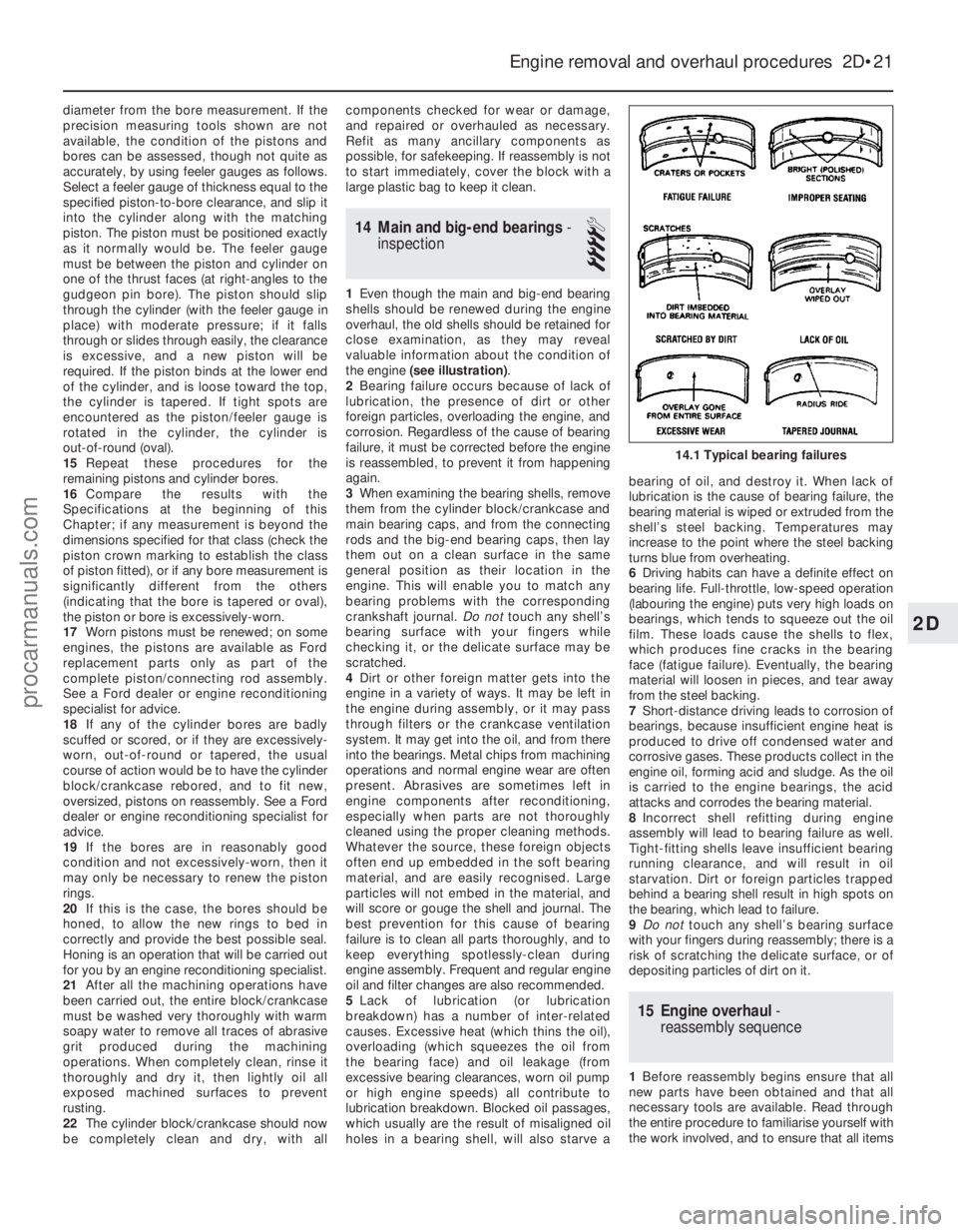
the engine (see illustration) .
2 Bearing failure occurs because of lack of
lubrication, the presence of dirt or other
foreign particles, overloading the engine, and
corrosion. Regardless of the cause of bearing
failure, it must be corrected before the engine
is reassembled, to prevent it from happening
again.
3 When examining the bearing shells, remove
them from the cylinder block/crankcase and
main bearing caps, and from the connecting
rods and the big-end bearing caps, then lay
them out on a clean surface in the same
general position as their location in the
engine. This will enable you to match any
bearing problems with the corresponding
crankshaft journal. Do nottouch any shell’s
bearing surface with your fingers while
checking it, or the delicate surface may be
scratched.
4 Dirt or other foreign matter gets into the
engine in a variety of ways. It may be left in
the engine during assembly, or it may pass
through filters or the crankcase ventilation
system. It may get into the oil, and from there
into the bearings. Metal chips from machining
operations and normal engine wear are often
present. Abrasives are sometimes left in
engine components after reconditioning,
especially when parts are not thoroughly
cleaned using the proper cleaning methods.
Whatever the source, these foreign objects
often end up embedded in the soft bearing
material, and are easily recognised. Large
particles will not embed in the material, and
will score or gouge the shell and journal. The
best prevention for this cause of bearing
failure is to clean all parts thoroughly, and to
keep everything spotlessly-clean during
engine assembly. Frequent and regular engine
oil and filter changes are also recommended.
5 Lack of lubrication (or lubrication
breakdown) has a number of inter-related
causes. Excessive heat (which thins the oil),
overloading (which squeezes the oil from
the bearing face) and oil leakage (from
excessive bearing clearances, worn oil pump
or high engine speeds) all contribute to
lubrication breakdown. Blocked oil passages,
which usually are the result of misaligned oil
holes in a bearing shell, will also starve a bearing of oil, and destroy it. When lack of
lubrication is the cause of bearing failure, the
bearing material is wiped or extruded from the
shell’s steel backing. Temperatures may
increase to the point where the steel backing
turns blue from overheating.
6
Driving habits can have a definite effect on
bearing life. Full-throttle, low-speed operation
(labouring the engine) puts very high loads on
bearings, which tends to squeeze out the oil
film. These loads cause the shells to flex,
which produces fine cracks in the bearing
face (fatigue failure). Eventually, the bearing
material will loosen in pieces, and tear away
from the steel backing.
7 Short-distance driving leads to corrosion of
bearings, because insufficient engine heat is
produced to drive off condensed water and
corrosive gases. These products collect in the
engine oil, forming acid and sludge. As the oil
is carried to the engine bearings, the acid
attacks and corrodes the bearing material.
8 Incorrect shell refitting during engine
assembly will lead to bearing failure as well.
Tight-fitting shells leave insufficient bearing
running clearance, and will result in oil
starvation. Dirt or foreign particles trapped
behind a bearing shell result in high spots on
the bearing, which lead to failure.
9 Do not touch any shell’s bearing surface
with your fingers during reassembly; there is a
risk of scratching the delicate surface, or of
depositing particles of dirt on it.
15 Engine overhaul -
reassembly sequence
1 Before reassembly begins ensure that all
new parts have been obtained and that all
necessary tools are available. Read through
the entire procedure to familiarise yourself with
the work involved, and to ensure that all items
Engine removal and overhaul procedures 2D•21
14.1 Typical bearing failures
2D
1595Ford Fiesta Remakeprocarmanuals.com
http://vnx.su
Page 94 of 296
Plastigauge to the scale printed on the
Plastigauge envelope, to obtain the running
clearance (see illustration 17.15) . Compare it
to the Specifications, to make sure the
clearance is correct.
14 If the clearance is not as specified, seek
the advice of a Ford dealer or similar engine
reconditioning specialist - if the crankshaft
journals are in good condition it may be
possible simply to renew the shells to achieve
the correct clearance. If this is not possible,
the crankshaft must be reground by a
specialist, who can also supply the necessary
undersized shells. First though, make sure
that no dirt or oil was trapped between the
bearing shells and the connecting rod or cap
when the clearance was measured. Also,
recheck the crankpin diameter. If the
Plastigauge was wider at one end than the
other, the crankpin journal may be tapered.
15 Carefully scrape all traces of the
Plastigauge material off the journal and the
bearing surface. Be very careful not to scratch
the bearing - use your fingernail or the edge of a credit card.
Final piston/connecting rod
refitting
16 Make sure the bearing surfaces are
perfectly clean, then apply a uniform layer of
clean molybdenum disulphide-based grease,
engine assembly lubricant, or clean engine oil,
to both of them. You’ll have to push the piston
into the cylinder to expose the bearing surface
of the shell in the connecting rod.
17 Slide the connecting rod back into place
on the crankpin (big-end) journal, refit the big-
end bearing cap, and then tighten the bolts as
described above.
18 Repeat the entire procedure for the
remaining piston/connecting rod assemblies.
19 The important points to remember are:
a) Keep the backs of the bearing shells and the recesses of the connecting rods and
caps perfectly clean when assembling
them.
b) Make sure you have the correct
piston/rod assembly for each cylinder -
use the etched cylinder numbers to
identify the front-facing side of both the
rod and its cap.
c) The arrow on the piston crown must face the timing belt/chain end of the engine.
d) Lubricate the cylinder bores with clean
engine oil.
e) Lubricate the bearing surfaces when refitting the big-end bearing caps after the
running clearance has been checked. 20
After all the piston/connecting rod
assemblies have been properly installed,
rotate the crankshaft a number of times by
hand, to check for any obvious binding.
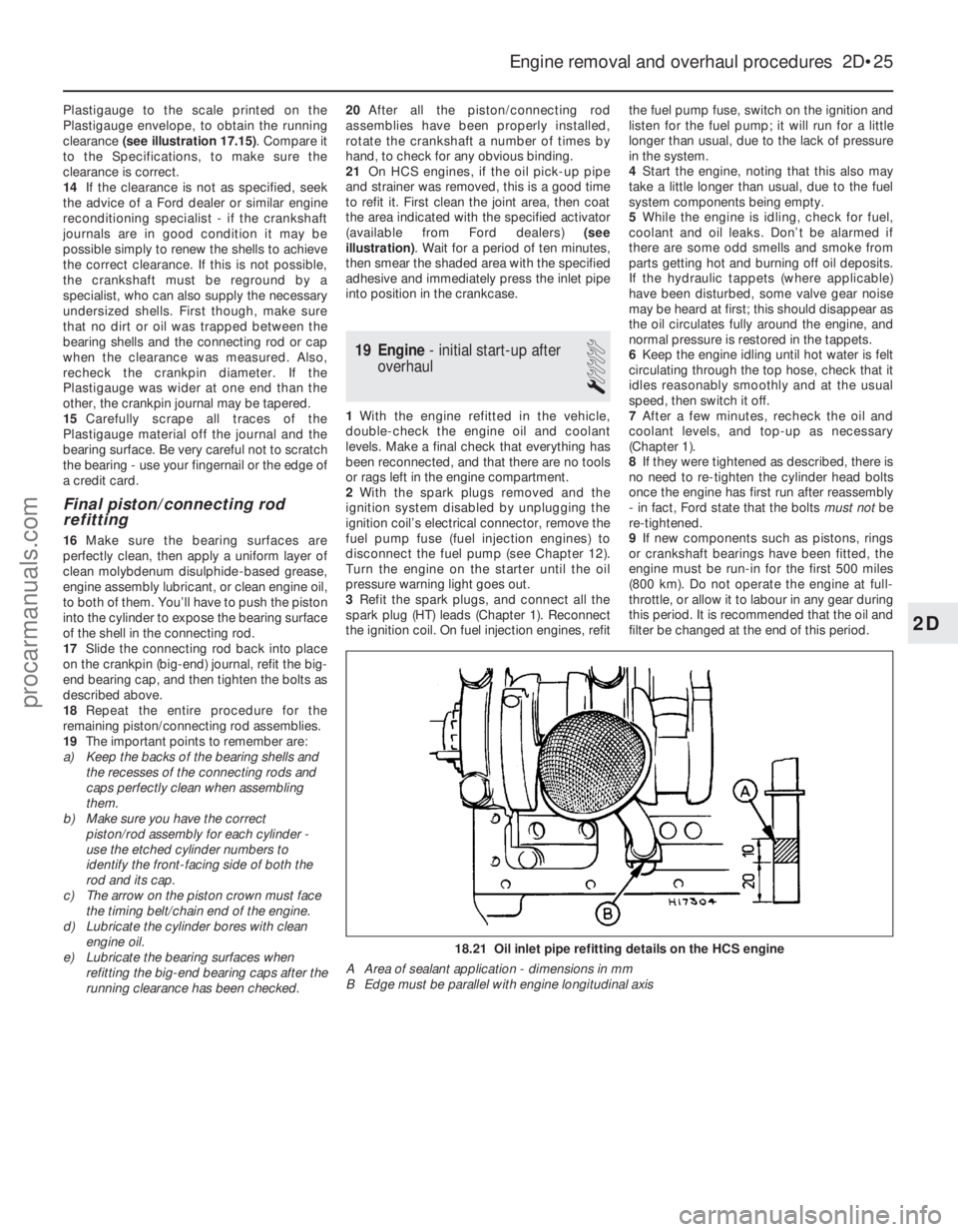
21 On HCS engines, if the oil pick-up pipe
and strainer was removed, this is a good time
to refit it. First clean the joint area, then coat
the area indicated with the specified activator
(available from Ford dealers) (see
illustration) . Wait for a period of ten minutes,
then smear the shaded area with the specified
adhesive and immediately press the inlet pipe
into position in the crankcase.
19 Engine - initial start-up after
overhaul
1
1 With the engine refitted in the vehicle,
double-check the engine oil and coolant
levels. Make a final check that everything has
been reconnected, and that there are no tools
or rags left in the engine compartment.
2 With the spark plugs removed and the
ignition system disabled by unplugging the
ignition coil’s electrical connector, remove the
fuel pump fuse (fuel injection engines) to
disconnect the fuel pump (see Chapter 12).
Turn the engine on the starter until the oil
pressure warning light goes out.
3 Refit the spark plugs, and connect all the
spark plug (HT) leads (Chapter 1). Reconnect
the ignition coil. On fuel injection engines, refit the fuel pump fuse, switch on the ignition and
listen for the fuel pump; it will run for a little
longer than usual, due to the lack of pressure
in the system.
4
Start the engine, noting that this also may
take a little longer than usual, due to the fuel
system components being empty.
5 While the engine is idling, check for fuel,
coolant and oil leaks. Don’t be alarmed if
there are some odd smells and smoke from
parts getting hot and burning off oil deposits.
If the hydraulic tappets (where applicable)
have been disturbed, some valve gear noise
may be heard at first; this should disappear as
the oil circulates fully around the engine, and
normal pressure is restored in the tappets.
6 Keep the engine idling until hot water is felt
circulating through the top hose, check that it
idles reasonably smoothly and at the usual
speed, then switch it off.
7 After a few minutes, recheck the oil and
coolant levels, and top-up as necessary
(Chapter 1).
8 If they were tightened as described, there is
no need to re-tighten the cylinder head bolts
once the engine has first run after reassembly
- in fact, Ford state that the bolts must notbe
re-tightened.
9 If new components such as pistons, rings
or crankshaft bearings have been fitted, the
engine must be run-in for the first 500 miles
(800 km). Do not operate the engine at full-
throttle, or allow it to labour in any gear during
this period. It is recommended that the oil and
filter be changed at the end of this period.
Engine removal and overhaul procedures 2D•25
18.21 Oil inlet pipe refitting details on the HCS engine
A Area of sealant application - dimensions in mm
B Edge must be parallel with engine longitudinal axis
2D
1595Ford Fiesta Remakeprocarmanuals.com
http://vnx.su
Page 153 of 296
into the engine induction system and thence
into the combustion chambers. This
arrangement eliminates any fuel mixture
control problems. The operating principles for
the system used on the Endura-E engine are
basically the same as just described with
revisions to the component locations and
hose arrangement.On CVH and PTE engines, a closed-circuit
type crankcase ventilation system is used, the
function of which is basically the same as that
described for the HCS engine type, but the
breather hose connects directly to the rocker
cover. The oil filler cap incorporates a
separate filter in certain applications. On Zetec engines, the crankcase ventilation
system main components are the oil
separator mounted on the front (radiator) side
of the cylinder block/crankcase, and the
Positive Crankcase Ventilation (PCV) valve set
in a rubber grommet in the separator’s left-
hand upper end. The associated pipework
consists of a crankcase breather pipe and two
flexible hoses connecting the PCV valve to a
union on the left-hand end of the inlet
manifold, and a crankcase breather hose
connecting the cylinder head cover to the air
cleaner assembly. A small foam filter in the air
cleaner prevents dirt from being drawn
directly into the engine.
Evaporative emissions control system
This system is fitted to minimise the escape
of unburned hydrocarbons into the
atmosphere. Fuel evaporative emissions
control systems are limited on vehicles
meeting earlier emissions regulations;
carburettor float chambers are vented
internally, whilst fuel tanks vent to atmosphere
through a combined roll-over/anti-trickle-fill
valve. On vehicles meeting the more stringent
emissions regulations, the fuel tank filler cap
is sealed, and a charcoal canister is used to
collect and store petrol vapours generated in
the tank when the vehicle is parked. When the
engine is running, the vapours are cleared
from the canister (under the control of the
EEC IV engine management module via the
canister-purge solenoid valve) into the inlet
tract, to be burned by the engine during
normal combustion. To ensure that the engine runs correctly
when it is cold and/or idling, and to protect
the catalytic converter from the effects of an
over-rich mixture, the canister-purge solenoid
valve is not opened by the EEC IV module
until the engine is fully warmed-up and
running under part-load; the solenoid valve is
then switched on and off, to allow the stored
vapour to pass into the inlet tract.
Pulse-air system
This system consists of the pulse-air
solenoid valve, the pulse-air valve itself, the
delivery tubing, a pulse-air filter, and on some
models, a check valve. The system injects
filtered air directly into the exhaust ports,
using the pressure variations in the exhaust
gases to draw air through from the filter housing; air will flow into the exhaust only
when its pressure is below atmospheric. The
pulse-air valve can allow gases to flow only
one way, so there is no risk of hot exhaust
gases flowing back into the filter.
The system’s primary function is raise
exhaust gas temperatures on start-up, thus
reducing the amount of time taken for the
catalytic converter to reach operating
temperature. Until this happens, the system
reduces emissions of unburned hydrocarbon
particles (HC) and carbon monoxide (CO) by
ensuring that a considerable proportion of
these substances remaining in the exhaust
gases after combustion are burned up, either
in the manifold itself or in the catalytic
converter.
To ensure that the system does not upset
the smooth running of the engine under
normal driving conditions, it is linked by the
pulse-air solenoid valve to the EEC IV module,
so that it only functions during engine warm-
up, when the oxygen sensor is not influencing
the fuel/air mixture ratio.
Catalytic converter
Catalytic converters have been introduced
progressively on all models in the range, to
meet the various emissions regulations.
The catalytic converter is located in the
exhaust system, and operates in conjunction
with an exhaust gas oxygen sensor to reduce
exhaust gas emissions. The catalytic
converter uses precious metals (platinum and
palladium or rhodium) as catalysts to speed
up the reaction between the pollutants and
the oxygen in the vehicle’s exhaust gases, CO
and HC being oxidised to form H
2O and CO2and (in the three-way type of catalytic
converter) NO
xbeing reduced to N2. Note :
The catalytic converter is not a filter in the
physical sense; its function is to promote a
chemical reaction, but it is not itself affected
by that reaction. The converter consists of an element (or
“substrate”) of ceramic honeycomb, coated
with a combination of precious metals in such
a way as to produce a vast surface area over
which the exhaust gases must flow; the whole
being mounted in a stainless-steel box. A
simple “oxidation” (or “two-way”) catalytic
converter can deal with CO and HC only,
while a “reduction” (or “three-way”) catalytic
converter can deal with CO, HC and NO
x.
Three-way catalytic converters are further
sub-divided into “open-loop” (or
“unregulated”) converters, which can remove
50 to 70% of pollutants and “closed-loop”
(also known as “controlled” or “regulated”)
converters, which can remove over 90% of
pollutants.
In order for a closed-loop catalytic
converter to operate effectively, the air/fuel
mixture must be very accurately controlled,
and this is achieved by measuring the oxygen
content of the exhaust gas. The oxygen
sensor transmits information on the exhaust
gas oxygen content to the EEC IV engine management module, which adjusts the
air/fuel mixture strength accordingly.
The sensor has a built-in heating element
which is controlled by the EEC IV module, in
order to bring the sensor’s tip to an efficient
operating temperature as rapidly as possible.
The sensor’s tip is sensitive to oxygen, and
sends the module a varying voltage
depending on the amount of oxygen in the
exhaust gases; if the inlet air/fuel mixture is
too rich, the sensor sends a high-voltage
signal. The voltage falls as the mixture
weakens. Peak conversion efficiency of all
major pollutants occurs if the inlet air/fuel
mixture is maintained at the chemically-
correct ratio for the complete combustion of
petrol - 14.7 parts (by weight) of air to 1 part
of fuel (the “stoichiometric” ratio). The sensor
output voltage alters in a large step at this
point, the module using the signal change as
a reference point, and correcting the inlet
air/fuel mixture accordingly by altering the fuel
injector pulse width (injector opening time). Removal and refitting procedures for
the oxygen sensor are given in Parts B, C
and D of this Chapter according to fuel
system type.
2 Exhaust system - renewal
2
Warning: Inspection and repair
of exhaust system components
should be done only after
enough time has elapsed after
driving the vehicle to allow the system
components to cool completely. This
applies particularly to the catalytic
converter, which runs at very high
temperatures. Also, when working under
the vehicle, make sure it is securely
supported on axle stands.
If the exhaust system components are
extremely corroded or rusted together, they
will probably have to be cut from the exhaust
system. The most convenient way of
accomplishing this is to have a quick-fit
exhaust repair specialist remove the corroded
sections. Alternatively, you can simply cut off
the old components with a hacksaw. If you do
decide to tackle the job at home, be sure to
wear eye protection, to protect your eyes from
metal chips, and work gloves, to protect your
hands. If the production-fit system is still
fitted, it must be cut for the service-
replacement system sections to fit. The best
way of determining the correct cutting point is
to obtain the new centre or rear section first
then, with the old system removed, lay the
two side by side on the ground. It should now
be relatively easy to determine where the old
system needs to be cut, and it can be marked
accordingly. Remember to allow for the
overlap where the two sections will plug
together.
4E•2 Exhaust and emission control systems
1595Ford Fiesta Remakeprocarmanuals.com
http://vnx.su
Page 169 of 296
Ignition timing
1.4 and 1.6 litre carburettor models with distributor:For use with 4-star leaded petrol (97 RON) . . . . . . . . . . . . . . . . . . . . 12°BTDC at idle speed (vacuum pipe disconnected and plugged)
For use with unleaded petrol (95 or 98 RON) . . . . . . . . . . . . . . . . . . . 8° BTDC at idle speed (vacuum pipe disconnected and plugged)
1.4 litre CFi fuel injection models with distributor (pre-Sept 1990) . . . . 10°BTDC at idle speed (set using STAR test equipment - refer to text)
All other models . . . . . . . . . . . . . . . . . . . . . . . . . . . . . . . . . . . .\
. . . . . . . Totally controlled by ignition module or EEC IV engine management module
Spark plugs . . . . . . . . . . . . . . . . . . . . . . . . . . . . . . . . . . . .\
. . . . . . . See Chapter 1 Specifications
Torque wrench settingsNmlbf ft
Crankshaft position sensor (all engines except Zetec) . . . . . . . . . . . . . . 3 to 4 2 to 3
Crankshaft position sensor to bracket (Zetec engines) . . . . . . . . . . . . . 7 to 9 5 to 7
Crankshaft position sensor bracket to engine (Zetec engines) . . . . . . . 18 to 23 13 to 17
DIS/E-DIS ignition coil to bracket . . . . . . . . . . . . . . . . . . . . . . . . . . . . . . 5 to 7 4 to 5
DIS/E-DIS ignition coil bracket to engine (all engines except Zetec) . . . 9 to 12 7 to 9
DIS/E-DIS ignition coil bracket to engine (Zetec engines) . . . . . . . . . . . 18 to 23 13 to 17
5B•2 Ignition system
1595Ford Fiesta Remake
1 General information and
precautions
General information
The ignition system is responsible for
igniting the air/fuel mixture in each cylinder, at
the correct moment in relation to engine
speed and load, as the electrical spark
generated jumps the spark plug gap. The ignition system is based on feeding low
tension (LT) voltage from the battery to the
ignition coil where it is converted to high
tension (HT) voltage. The high tension voltage
is powerful enough to jump the spark plug
gap in the cylinders many times a second
under high compression pressures, providing
that the system is in good condition. A number of different ignition systems have
been fitted to Fiesta models depending on the
year of manufacture, type of fuel system fitted
and the emission level that the vehicle has
been designed to meet. Broadly speaking the
systems can be sub-divided into two
categories - distributor ignition systems and
distributorless ignition systems. One version of the distributor ignition
system is fitted to all CVH engines with
carburettors. A second (more sophisticated)
version is fitted to pre-September 1990 CVH
engines with CFi fuel injection. Distributorless ignition systems are fitted to
all HCS, PTE and Zetec engines, and to all
CVH engines with fuel injection except pre-
September 1990 CFi versions.
Distributor ignition systems (CVH
engines with carburettor)
The ignition system is divided into two
circuits; low tension (primary) and high
tension (secondary). The low tension circuit
consists of the battery, ignition switch, coil
primary windings, ignition amplifier module
and the signal generating system inside the distributor. The signal generating system
comprises the trigger coil, trigger wheel,
stator, permanent magnet and trigger coil to
ignition amplifier module connector. The high
tension circuit consists of the coil secondary
windings, the HT lead from the coil to the
distributor cap, the distributor cap, the rotor
arm, the HT leads from the distributor cap to
the spark plugs and the spark plugs
themselves.
When the system is in operation, low
tension voltage is changed in the coil into high
tension voltage by the action of the electronic
amplifier module in conjunction with the signal
generating system. Any change in the
magnetic field force (flux), created by the
movement of the trigger wheel relative to the
magnet, induces a voltage in the trigger coil.
This voltage is passed to the ignition amplifier
module which switches off the ignition coil
primary circuit. This results in the collapse of
the magnetic field in the coil which
generates the high tension voltage. The high
tension voltage is then fed, via the coil HT
lead and the carbon brush in the centre of the
distributor cap, to the rotor arm. The voltage
passes across to the appropriate metal
segment in the cap and via the spark plug HT
lead to the spark plug where it finally jumps
the spark plug gap to earth. The distributor is driven by an offset drive
dog locating to a correspondingly offset slot
in the end of the camshaft.
The ignition advance is a function of the
distributor and is controlled both mechanically
and by a vacuum operated system. The
mechanical governor mechanism consists of
two weights which move out from the
distributor shaft as the engine speed rises due
to centrifugal force. As they move outwards,
they rotate the trigger wheel relative to the
distributor shaft and so advance the spark.
The weights are held in position by two light
springs and it is the tension of the springs
which is largely responsible for correct spark
advancement. The vacuum control consists of a
diaphragm, one side of which is connected
via a small bore hose to the carburettor or
throttle housing, and the other side to the
distributor. Depression in the inlet manifold
and/or carburettor, which varies with engine
speed and throttle position, causes the
diaphragm to move, so moving the stator and
advancing or retarding the spark. A fine
degree of control is achieved by a spring in
the diaphragm assembly. Additionally, one or more vacuum valve
may be incorporated in the vacuum line
between the inlet manifold or carburettor and
the distributor. The function of these is to
control the vacuum felt at the distributor and
to prevent fuel entering along the vacuum line
(as applicable).
Distributor ignition systems (pre-
September 1990 CVH engines with
CFi fuel injection)
The ignition system is divided into two
circuits; low tension (primary) and high
tension (secondary). The low tension circuit
consists of the battery, ignition switch, ignition
module, ballast resistor, coil primary windings
and “Hall effect” distributor. The high tension
circuit consists of the coil secondary
windings, coil-to-distributor cap HT lead,
distributor cap, rotor arm, spark plug HT leads
and spark plugs. The system is under the
overall control of the EEC IV engine
management module which also controls the
fuel injection and emission control equipment. When the system is in operation the
distributor supplies the EEC IV module with a
crankshaft position reference signal to enable
an initial ignition timing setting to be
established. This signal is generated by
means of a trigger vane attached to the
distributor shaft and which rotates in the gap
between a permanent magnet and a sensor.
The trigger vane has four cut-outs, one for
each cylinder. When one of the trigger vane
cut-outs is in line with the sensor, magnetic
procarmanuals.com
http://vnx.su
Page 170 of 296
flux can pass between the magnet and the
sensor. When a trigger vane segment is in line
with the sensor, the magnetic flux is diverted
through the trigger vane, away from the
sensor. The sensor detects the change in
magnetic flux and sends an impulse to the
EEC IV module. Additional data is received
from the engine coolant temperature sensor,
manifold absolute pressure sensor, inlet air
temperature sensor, throttle position sensor
and vehicle speed sensor. Using this
information the EEC IV module calculates the
optimum ignition advance setting and
switches off the low tension circuit via the
ignition module. This results in the collapse of
the magnetic field in the coil which generates
the high tension voltage. The high tension
voltage is then fed, via the coil HT lead and
the carbon brush in the centre of the
distributor cap, to the rotor arm. The voltage
passes across to the appropriate metal
segment in the cap and via the spark plug HT
lead to the spark plug where it finally jumps
the spark plug gap to earth. It can be seen
that the ignition module functions basically as
a high current switch by controlling the low
tension supply to the ignition coil primary
windings.In the event of failure of a sensor, the
EEC IV module will substitute a preset value
for that input to allow the system to continue
to function. In the event of failure of the
EEC IV module, a “limited operation strategy”
(LOS) function allows the vehicle to be driven,
albeit at reduced power and efficiency. The
EEC IV module also has a “keep alive
memory” (KAM) function which stores idle and
drive values and codes which can be used to
indicate any system fault which may occur.
Distributorless ignition systems
The main ignition system components
include the ignition switch, the battery, the
crankshaft speed/position sensor, the ignition
module, the coil, the primary (low tension/LT)
and secondary (high tension/HT) wiring
circuits, and the spark plugs. The system used on carburettor models is
termed DIS (Distributorless Ignition System),
and on fuel injection models E-DIS, (Electronic
Distributorless Ignition System). The primary
difference between the two is that the DIS
system is an independent ignition control
system while the E-DIS system operates in
conjunction with the EEC IV engine
management module which also controls the
fuel injection and emission control systems.
With both systems, the main functions of
the distributor are replaced by a computerised
ignition module and a coil unit. The coil unit
combines a double-ended pair of coils - each
time a coil receives an ignition signal, two
sparks are produced, at each end of the
secondary windings. One spark goes to a
cylinder on compression stroke and the other
goes to the corresponding cylinder on its
exhaust stroke. The first will give the correct power stroke, but the second spark will have
no effect (a “wasted spark”), occurring as it
does during exhaust conditions.
The ignition signal is generated by a
crankshaft position sensor which scans a
series of 36 protrusions on the periphery of
the engine flywheel. The inductive head of the
crankshaft position sensor runs just above the
flywheel periphery and as the crankshaft
rotates, the sensor transmits a pulse to the
ignition module every time a protrusion
passes it. There is one missing protrusion in
the flywheel periphery at a point
corresponding to 90° BTDC. The ignition
module recognises the absence of a pulse
from the crankshaft position sensor at this
point to establish a reference mark for
crankshaft position. Similarly, the time interval
between absent pulses is used to determine
engine speed. On carburettor engines, the ignition module
receives signals provided by information
sensors which monitor various engine
functions (such as crankshaft position,
coolant temperature, inlet air temperature,
inlet manifold vacuum etc). This information
allows the ignition module to generate the
optimum ignition timing setting under all
operating conditions.
On fuel injection engines, the ignition
module operates in conjunction with the
EEC IV engine management module, and
together with the various additional
information sensors and emission control
components, provides total control of the fuel
and ignition systems to form a complete
engine management package. The information contained in this Chapter
concentrates on the ignition-related
components of the engine management
system. Information covering the fuel, exhaust
and emission control components can be
found in the applicable Parts of Chapter 4.
Precautions
When working on the ignition system, take
the following precautions:
a) Do not keep the ignition switch on for
more than 10 seconds if the engine will
not start.
b) If a separate tachometer is ever required
for servicing work, consult a dealer
service department before buying a
tachometer for use with this vehicle -
some tachometers may be incompatible
with these types of ignition systems - and
always connect it in accordance with the
equipment manufacturer’s instructions.
c) Never connect the ignition coil terminals to earth. This could result in damage to
the coil and/or the ignition module.
d) Do not disconnect the battery when the
engine is running.
e) Make sure that the ignition module is
properly earthed.
f) Refer to the warning at the beginning of the next Section concerning HT voltage.
2 Ignition system - testing
2
Warning: Voltages produced by
an electronic ignition system are
considerably higher than those
produced by conventional
ignition systems. Extreme care must be
taken when working on the system with
the ignition switched on. Persons with
surgically-implanted cardiac pacemaker
devices should keep well clear of the
ignition circuits, components and test
equipment.
Note: Refer to the precautions given in
Section 1 of Part A of this Chapter before
starting work. Always switch off the ignition
before disconnecting or connecting any
component and when using a multi-meter to
check resistances.
1 If the engine turns over but won’t start,
disconnect the (HT) lead from any spark plug,
and attach it to a calibrated tester (available at
most automotive accessory shops). Connect
the clip on the tester to a good earth - a bolt
or metal bracket on the engine. If you’re
unable to obtain a calibrated ignition tester,
have the check carried out by a Ford dealer
service department or similar. Any other form
of testing (such as jumping a spark from the
end of an HT lead to earth) is not
recommended, because of the risk of
personal injury, or of damage to the ignition
module.
2 Crank the engine, and watch the end of the
tester to see if bright blue, well-defined sparks
occur.
3 If sparks occur, sufficient voltage is
reaching the plug to fire it. Repeat the
check at the remaining plugs, to ensure
that all leads are sound and that the
coil is serviceable. However, the plugs
themselves may be fouled or faulty, so
remove and check them as described in
Chapter 1.
4 If no sparks or intermittent sparks occur,
the spark plug lead(s) may be defective. Also,
on distributor systems, there may be
problems with the rotor arm or distributor cap
- check all these components as described in
Chapter 1.
5 If there’s still no spark, check the coil’s
electrical connector (where applicable), to
make sure it’s clean and tight. Check for full
battery voltage to the coil at the connector’s
centre terminal. Check the coil itself (see
Section 3). Make any necessary repairs, then
repeat the check again.
6 The remainder of the system checks should
be left to a dealer service department
or other qualified repair facility, as there is a
chance that the ignition module may
be damaged if tests are not performed
properly.
Ignition system 5B•3
5B
1595Ford Fiesta Remakeprocarmanuals.com
http://vnx.su
Page 190 of 296
Right-hand side
4Chock the rear wheels then jack up the
front of the car and support it on axle stands
(see “Jacking and Vehicle Support” ).
5 Remove the one-piece undertray where
fitted, by turning the bayonet type fasteners,
and on XR2i models, remove the front
suspension crossmember (see Chapter 10).
6 From underneath, remove the belt-break
switch from the right-hand drivebelt cover by
squeezing its release lever towards the main
body of the switch (see illustration), then
carefully withdraw, ensuring that the belt
contact arm does not catch on the drivebelt
cover.
7 Remove the two bolts securing the
modulator drivebelt cover to the modulator
mounting bracket, and withdraw the cover
(see illustration) .
8 Disconnect the rigid brake pipes from the
modulator, fitting blanking plugs to prevent
excessive fluid loss and dirt ingress.
9 Remove the modulator pivot bolt and
adjuster bolt (see illustration) , then slip the
drivebelt from its pulley, and withdraw the
modulator unit from the vehicle. Ensure that
the modulator return hose does not become
kinked as the modulator unit is withdrawn.
10 Disconnect the modulator return hose
from the modulator unit, and fit a blanking
plug to prevent dirt ingress. Allow for residual
fluid spillage as the hose is disconnected.
11 If a new modulator is to be fitted, note that
these units are not interchangeable from side
to side, and the correct replacement must be
obtained. The modulator units are colour-
coded, and must be fitted with the arrows on
top of the casings pointing towards the front
of the vehicle.
12 To refit, first connect the modulator return
hose to the return outlet on the modulator
unit.
13 Locate the modulator unit to its bracket
and fit the pivot bolt, having applied a thin
smear of anti-seize compound to the bolt, but
do not fully tighten at this stage. Take care not
to damage the modulator return hose as it is
manoeuvred into position.
14 Fit the drivebelt to its modulator pulley
location, ensuring that it sits correctly over the driveshaft pulley, then refit the adjuster bolt
but do not fully tighten at this stage.
15
Adjust the tension of the drivebelt by
moving the modulator unit, until a belt
deflection of 5.0 mm is obtained under firm
finger pressure. Check this using a ruler at a
point midway between the two pulleys.
16 With the drivebelt tensioned correctly,
tighten the pivot and adjuster bolts to the
specified torque. Re-check the tension of the
drivebelt after tightening the bolts.
17 Reconnect the rigid brake pipes to the
modulator, tightening the unions securely.
18 Refit the modulator drivebelt cover to the
modulator mounting bracket, and secure with
its two retaining bolts.
19 Refit the belt-break switch to the
modulator drivebelt cover, taking care not to
damage the belt contact arm as it passes
through the cover.
20 Reconnect the modulator return hose by
pushing the hose firmly into its brake fluid
reservoir location, then lever out the collar to
retain it.
21 Refit the front suspension crossmember
and the one-piece undertray, as applicable.
22 Lower the vehicle to the ground.
23 Top-up the brake fluid reservoir using
fresh fluid of the specified type (see “ Weekly
checks ”), then bleed the brake hydraulic
system in accordance with Section 14. Refit
the reservoir filler cap and warning indicator
wiring multi-plug on completion.
24 Reconnect the battery negative lead.
Left-hand side
25Repeat the procedures given in
paragraphs 1 to 3.
26 Chock the rear wheels then jack up the
front of the car and support it on axle stands
(see “Jacking and Vehicle Support” ). Remove
the front roadwheels.
27 Remove the one-piece undertray where
fitted, by turning the bayonet type fasteners,
and on XR2i models, remove the front
suspension crossmember (see Chapter 10).
28 Remove the belt-break switch from the
left-hand drivebelt cover in a similar manner to
that described in paragraph 6, this time from
the engine compartment. 29
Remove the two bolts securing the
modulator drivebelt cover to the modulator
mounting bracket, then ease the lower portion
of the cover over the driveshaft taking care
not to damage the driveshaft CV joint gaiter.
Withdraw the cover through the engine
compartment, manoeuvring it to clear
obstructions.
30 Disconnect the rigid brake pipes from the
modulator, fitting blanking plugs to prevent
excessive fluid loss and dirt ingress.
31 Slacken the modulator pivot and adjuster
bolts, then swing the modulator downwards
to release the drivebelt tension before slipping
the drivebelt from its modulator pulley
location.
32 Remove the modulator pivot and adjuster
bolts, withdraw the modulator upwards
through the engine compartment. Ensure that
the modulator return hose does not become
kinked as the modulator unit is withdrawn.
33 Disconnect the modulator return hose
from the modulator unit, and fit a blanking
plug to prevent dirt ingress. Allow for residual
fluid spillage as the hose is disconnected.
34 If a new modulator is to be fitted, note that
these units are not interchangeable from side
to side, and the correct replacement must be
obtained. The modulator units are colour-
coded, and must be fitted with the arrows on
top of the casings pointing towards the front
of the vehicle.
35 To refit, first connect the modulator return
hose to the return outlet on the modulator
unit.
36 Locate the modulator unit to its mounting
bracket and fit the pivot bolt, having applied a
thin smear of anti-seize compound to the bolt,
but do not fully tighten at this stage. Take care
not to damage the modulator return hose as it
is manoeuvred into position.
37 Fit the drivebelt to its modulator pulley
location, ensuring that it sits correctly over the
driveshaft pulley, then refit the adjuster bolt
but do not fully tighten at this stage.
38 Adjust the tension of the drivebelt by
moving the modulator unit, until a belt
deflection of 5.0 mm is obtained under firm
finger pressure. Check this using a ruler at a
point midway between the two pulleys.
Braking system 9•15
24.9 Modulator pivot bolt (A) and adjuster bolt (B)24.7 Modulator drivebelt cover to
mounting bracket securing bolts (arrowed)24.6 Belt-break switch in drivebelt cover
A Main switch body B Release lever
9
1595Ford Fiesta Remakeprocarmanuals.com
http://vnx.su
Page 271 of 296
1595 Ford Fiesta Remake
The jack supplied with the vehicle tool kit
should only be used for changing the
roadwheels - see “Wheel changing” at the
front of this manual. When jacking up the
vehicle to carry out repair or maintenance
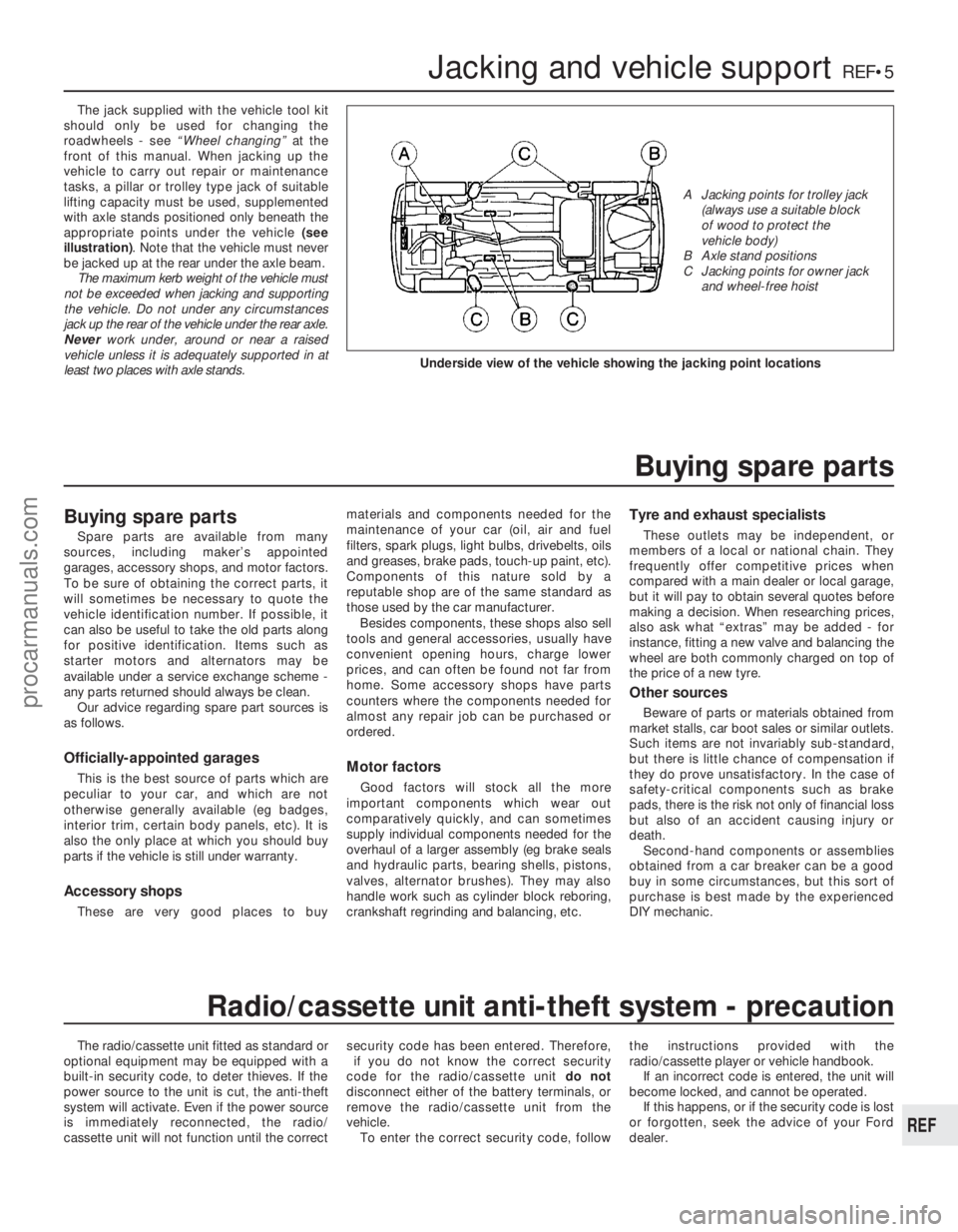
tasks, a pillar or trolley type jack of suitable
lifting capacity must be used, supplemented
with axle stands positioned only beneath the
appropriate points under the vehicle (see
illustration) . Note that the vehicle must never
be jacked up at the rear under the axle beam. The maximum kerb weight of the vehicle must
not be exceeded when jacking and supporting
the vehicle. Do not under any circumstances
jack up the rear of the vehicle under the rear axle.
Never work under, around or near a raised
vehicle unless it is adequately supported in at
least two places with axle stands.
The radio/cassette unit fitted as standard or
optional equipment may be equipped with a
built-in security code, to deter thieves. If the
power source to the unit is cut, the anti-theft
system will activate. Even if the power source
is immediately reconnected, the radio/
cassette unit will not function until the correct security code has been entered. Therefore,
if you do not know the correct security
code for the radio/cassette unit do not
disconnect either of the battery terminals, or
remove the radio/cassette unit from the
vehicle. To enter the correct security code, follow the instructions provided with the
radio/cassette player or vehicle handbook.
If an incorrect code is entered, the unit will
become locked, and cannot be operated.
If this happens, or if the security code is lost
or forgotten, seek the advice of your Ford
dealer.
Jacking and vehicle supportREF•5
REF
Radio/cassette unit anti-theft system - precaution
Underside view of the vehicle showing the jacking point locations
A Jacking points for trolley jack (always use a suitable block
of wood to protect the
vehicle body)
B Axle stand positions
C Jacking points for owner jack and wheel-free hoist
Buying spare parts
Spare parts are available from many
sources, including maker’s appointed
garages, accessory shops, and motor factors.
To be sure of obtaining the correct parts, it
will sometimes be necessary to quote the
vehicle identification number. If possible, it
can also be useful to take the old parts along
for positive identification. Items such as
starter motors and alternators may be
available under a service exchange scheme -
any parts returned should always be clean.
Our advice regarding spare part sources is
as follows.
Officially-appointed garages
This is the best source of parts which are
peculiar to your car, and which are not
otherwise generally available (eg badges,
interior trim, certain body panels, etc). It is
also the only place at which you should buy
parts if the vehicle is still under warranty.
Accessory shops
These are very good places to buy materials and components needed for the
maintenance of your car (oil, air and fuel
filters, spark plugs, light bulbs, drivebelts, oils
and greases, brake pads, touch-up paint, etc).
Components of this nature sold by a
reputable shop are of the same standard as
those used by the car manufacturer.
Besides components, these shops also sell
tools and general accessories, usually have
convenient opening hours, charge lower
prices, and can often be found not far from
home. Some accessory shops have parts
counters where the components needed for
almost any repair job can be purchased or
ordered.
Motor factors
Good factors will stock all the more
important components which wear out
comparatively quickly, and can sometimes
supply individual components needed for the
overhaul of a larger assembly (eg brake seals
and hydraulic parts, bearing shells, pistons,
valves, alternator brushes). They may also
handle work such as cylinder block reboring,
crankshaft regrinding and balancing, etc.
Tyre and exhaust specialists
These outlets may be independent, or
members of a local or national chain. They
frequently offer competitive prices when
compared with a main dealer or local garage,
but it will pay to obtain several quotes before
making a decision. When researching prices,
also ask what “extras” may be added - for
instance, fitting a new valve and balancing the
wheel are both commonly charged on top of
the price of a new tyre.
Other sources
Beware of parts or materials obtained from
market stalls, car boot sales or similar outlets.
Such items are not invariably sub-standard,
but there is little chance of compensation if
they do prove unsatisfactory. In the case of
safety-critical components such as brake
pads, there is the risk not only of financial loss
but also of an accident causing injury or
death. Second-hand components or assemblies
obtained from a car breaker can be a good
buy in some circumstances, but this sort of
purchase is best made by the experienced
DIY mechanic.
Buying spare parts
procarmanuals.com
http://vnx.su
Page 284 of 296
1595 Ford Fiesta Remake
REF•18Fault finding
Braking system
Note:Before assuming that a brake problem exists, make sure that the
tyres are in good condition and correctly inflated, that the front wheel\
alignment is correct, and that the vehicle is not loaded with weight in \
an
unequal manner. Apart from checking the condition of all pipe and
hose connections, any faults occurring on the Anti-lock Braking System
(ABS) should be referred to a Ford dealer for diagnosis.
Vehicle pulls to one side under braking
m m Worn, defective, damaged or contaminated front or rear brake
pads/shoes on one side (Chapter 1).
m m Seized or partially-seized front or rear brake caliper/wheel cylinder
piston (Chapter 9).
m m A mixture of brake pad/shoe lining materials fitted between sides
Chapter 1).
m m Brake caliper mounting bolts loose (Chapter 9).
m
m Rear brake backplate mounting bolts loose (Chapter 9).
m
m Worn or damaged steering or suspension components (Chap-
ter 10).
Noise (grinding or high-pitched squeal) when
brakes applied
m mBrake pad or shoe friction lining material worn down to metal
backing Chapter 1).
m m Excessive corrosion of brake disc or drum (may be apparent after
the vehicle has been standing for some time) (Chapter 1).
Excessive brake pedal travel
m mInoperative rear brake self-adjust mechanism (Chapter 9).
m
m Faulty master cylinder (Chapter 9).
m
m Air in hydraulic system (Chapter 9).
Rear wheels locking under normal braking
m
mRear brake shoe linings contaminated (Chapter 1).
m
m Faulty brake pressure regulator (Chapter 9).
Brake pedal feels spongy when depressed
m
mAir in hydraulic system (Chapter 9).
m
m Deteriorated flexible rubber brake hoses (Chapter 9).
m
m Master cylinder mounting nuts loose (Chapter 9).
m
m Faulty master cylinder (Chapter 9).
Excessive brake pedal effort required to stop
vehicle
m mFaulty vacuum servo unit (Chapter 9).
m
m Disconnected, damaged or insecure brake servo vacuum hose
(Chapter 9).
m m Primary or secondary hydraulic circuit failure (Chapter 9).
m
m Seized brake caliper or wheel cylinder piston(s) (Chapter 9).
m
m Brake pads or brake shoes incorrectly fitted (Chapter 9).
m
m Incorrect grade of brake pads or brake shoes fitted (Chapter 1).
m
m Brake pads or brake shoe linings contaminated (Chapter 1).
Judder felt through brake pedal or steering wheel
when braking
m mExcessive run-out or distortion of front discs or rear drums
Chapter 9).
m m Brake pad or brake shoe linings worn (Chapter 1).
m
m Brake caliper or rear brake backplate mounting bolts loose
(Chapter 9).
m m Wear in suspension or steering components or mountings
(Chapter 10).
Brakes binding
m mSeized brake caliper or wheel cylinder piston(s) (Chapter 9).
m
m Faulty handbrake mechanism (Chapter 9).
m
m Faulty master cylinder (Chapter 9).
Automatic transmission
Note: Due to the complexity of the automatic transmission, it is difficult
for the home mechanic to properly diagnose and service this unit. For
problems other than the following, the vehicle should be taken to a
dealer service department or automatic transmission specialist.
Fluid leakage
m m Automatic transmission fluid is usually deep red in colour. Fluid
leaks should not be confused with engine oil, which can easily be
blown onto the transmission by airflow.
m m To determine the source of a leak, first remove all built-up dirt and
grime from the transmission housing and surrounding areas, using
a degreasing agent, or by steam-cleaning. Drive the vehicle at low
speed, so airflow will not blow the leak far from its source. Raise
and support the vehicle, and determine where the leak is coming
from. The following are common areas of leakage:
a) Transmission fluid sump (Chapters 1 and 7B).
b) Dipstick tube (Chapters 1 and 7B).
c) Transmission-to-fluid cooler pipes/unions (Chapter 7B).
d) Speedometer drive pinion O-ring.
e) Differential output fluid seals (Chapter 7B).
Transmission fluid brown, or has burned smell
m m Transmission fluid level low, or fluid in need of renewal (Chapter 1).\
Engine will not start in any gear, or starts in gears
other than Park or Neutral
m mStarter inhibitor switch faulty (Chapter 7B).
m
m Incorrect selector cable adjustment (Chapter 7B).
General gear selection problems
m
mChapter 7B deals with checking and adjusting the selector cable
on automatic transmissions. The following are common problems
which may be caused by a poorly-adjusted cable:
a) Engine starting in gears other than Park or Neutral.
b) Indicator on gear selector lever pointing to a gear other than the
one actually being used.
c) Vehicle moves when in Park or Neutral.
d) Poor gear shift quality or erratic gear changes.
Refer to Chapter 7B for the selector cable adjustment procedure.
Transmission will not downshift (kickdown) with
accelerator pedal fully depressed
m m Low transmission fluid level (Chapter 1).
m
m Incorrect selector cable adjustment (Chapter 7B).
m
m Engine management system fault (Chapters 1, 4A, 4B, 4C, 4D, 4E
or 5B).
Transmission slips, is noisy, or has no drive in
forward or reverse gears
m mThere are many probable causes for the above problems, but the
home mechanic should be concerned with only one possibility -
fluid level. Before taking the vehicle to a dealer or transmission
specialist, check the fluid level and condition of the fluid as
described in Chapter 1. Correct the fluid level as necessary, or
change the fluid if needed. If the problem persists, professional
help will be necessary.
procarmanuals.com
http://vnx.su