air con FORD FIESTA 2007 Workshop Manual
[x] Cancel search | Manufacturer: FORD, Model Year: 2007, Model line: FIESTA, Model: FORD FIESTA 2007Pages: 1226, PDF Size: 61.26 MB
Page 699 of 1226
303-01 B-77 Engine - 2.OL Duratec-HE (M14) 303-01 B-77
REMOVAL
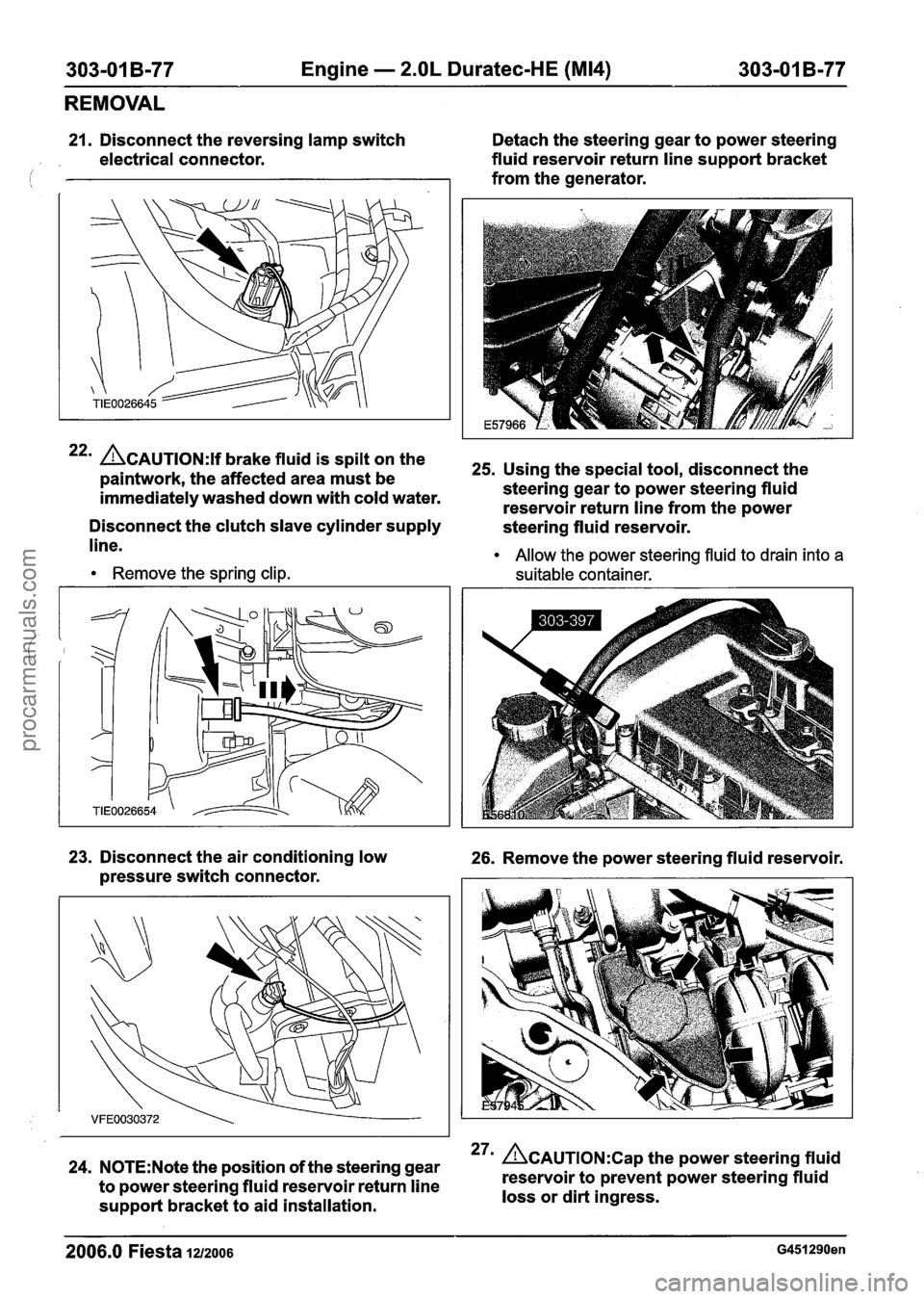
21. Disconnect the reversing lamp switch Detach the steering gear to power steering
electrical connector. fluid
reservoir return line support bracket
from the generator.
22m CAUTION:^^ brake fluid is spilt on the 25s Using the special tool, disconnect the paintwork, the affected area must be
immediately washed down with cold water. steering
gear to power steering fluid
reservoir return line from the power
Disconnect the clutch slave cylinder supply
steering fluid reservoir.
line.
Remove the spring clip. Allow
the power steering fluid to drain into a
suitable container.
23. Disconnect the air conditioning low 26. Remove the power steering fluid reservoir.
pressure switch connector.
24. N0TE:Note the position of the steering gear 27m &AUTION:C~~ the power steering fluid
to power steering fluid reservoir return line reservoir
to prevent power steering fluid
support bracket to aid installation. loss
or dirt ingress.
2006.0 Fiesta 12/2006 G451290en
procarmanuals.com
Page 700 of 1226
303-01 B-78 Engine - 2.OL Duratec-HE (M14) 303-01 B-78
REMOVAL
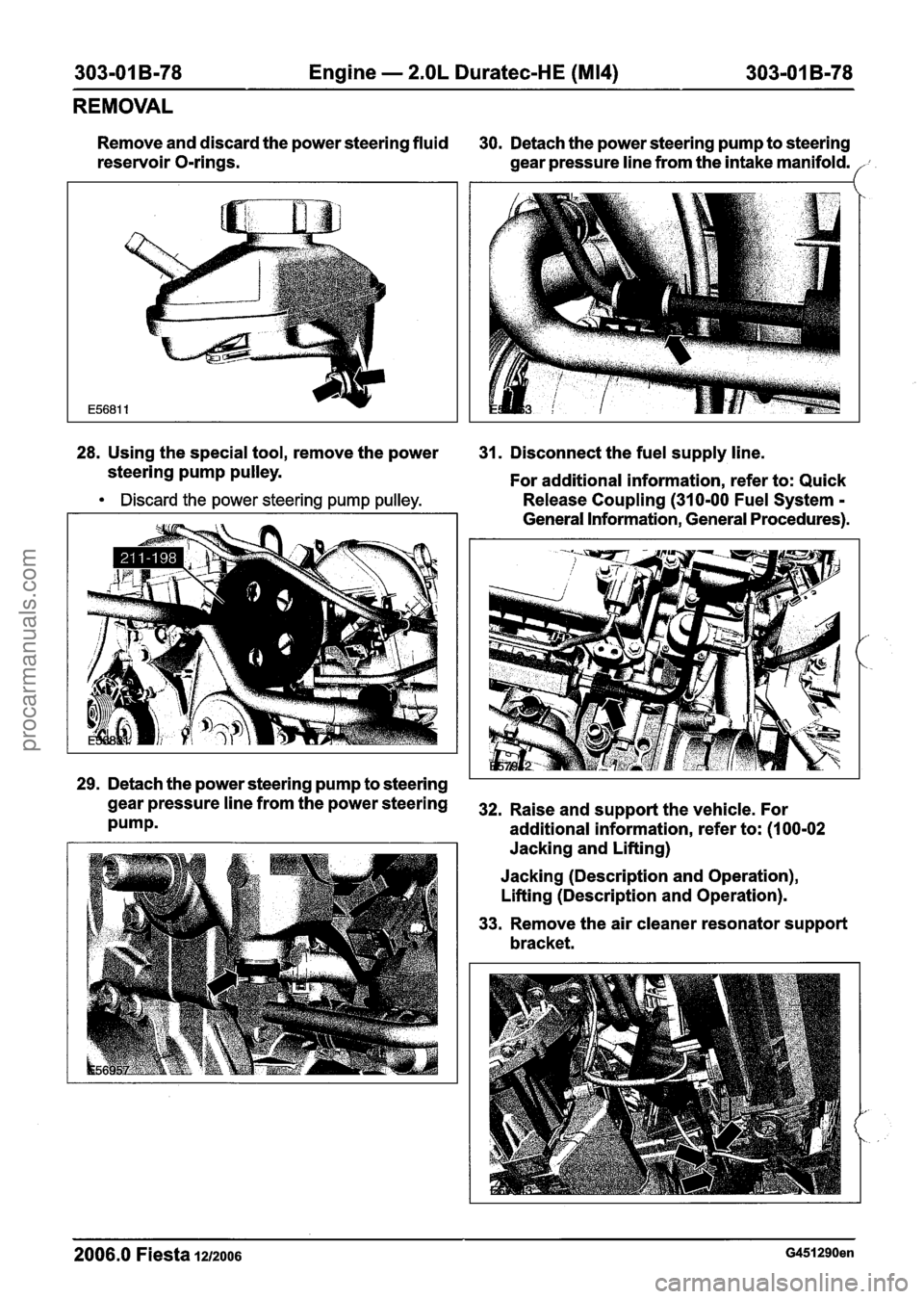
Remove and discard the power steering fluid
30. Detach the power steering pump to steering
reservoir O-rings.
gear pressure line from the intake manifold.
28. Using the special tool, remove the power
31. Disconnect the fuel supply line.
steering pump pulley.
For additional information, refer to: Quick
Discard the power steering pump pulley. Release Coupling (310-00 Fuel System - - - - -
General information, General procedures).
,'-
', .
29. Detach the power steering pump to steering
gearpressurelinefromthepowersteering 32. Raiseands~pportthevehicle~For
Pumpm additional information, refer to: (I 00-02
Jacking and Lifting)
Jacking (Description and Operation),
Lifting (Description and Operation).
33. Remove the air cleaner resonator support
bracket.
2006.0 Fiesta 1212006 G451290en
procarmanuals.com
Page 735 of 1226
303-01 B-I 13 Engine - 2.OL Duratec-HE (M14) 303-01 B-113
INSTALLATION
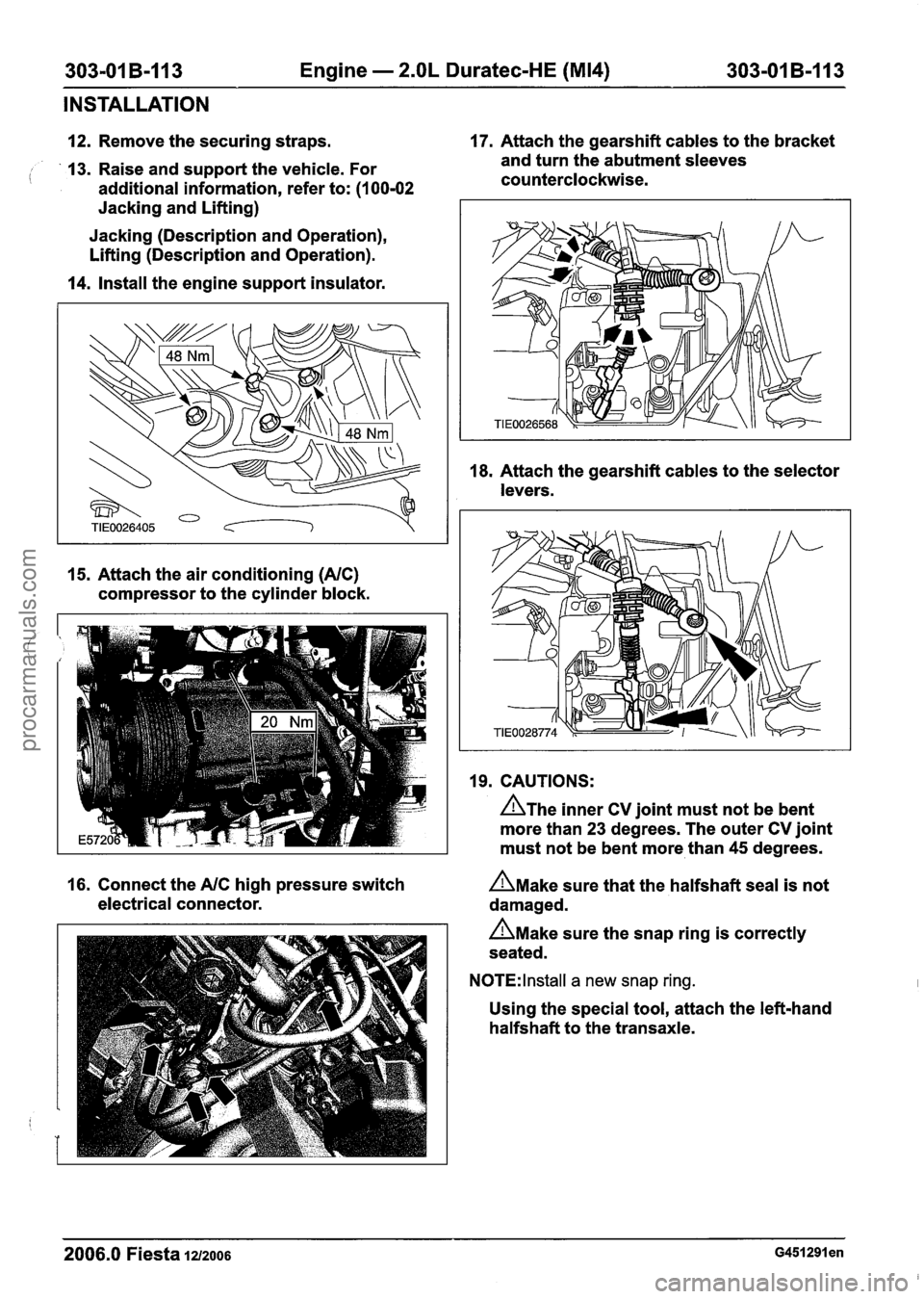
12. Remove the securing straps. 17.
Attach the gearshift cables to the bracket
13. Raise and support the vehicle. For and
turn the abutment sleeves
( additional information, refer to: (I 00-02 counterclockwise.
Jacking and Lifting)
Jacking (Description and Operation),
Lifting (Description and Operation).
14. Install the engine support insulator.
15. Attach the air conditioning (NC)
compressor to the cylinder block. 18.
Attach the gearshift cables to the selector
levers.
19. CAUTIONS:
A~he inner CV joint must not be bent
more than 23 degrees. The outer CV joint
must not be bent more than 45 degrees.
16. Connect the
NC high pressure switch n~ake sure that the halfshaft seal is not
electrical connector. damaged.
n~ake sure the snap ring is correctly
seated.
N0TE:lnstall a new snap ring.
Using the special tool, attach the left-hand
halfshaft to the transaxle.
2006.0 Fiesta 1212006 ~451291 en
procarmanuals.com
Page 737 of 1226
303-01 B-I 15 Engine - 2.OL Duratec-HE (M14) 303-01 B-115
INSTALLATION
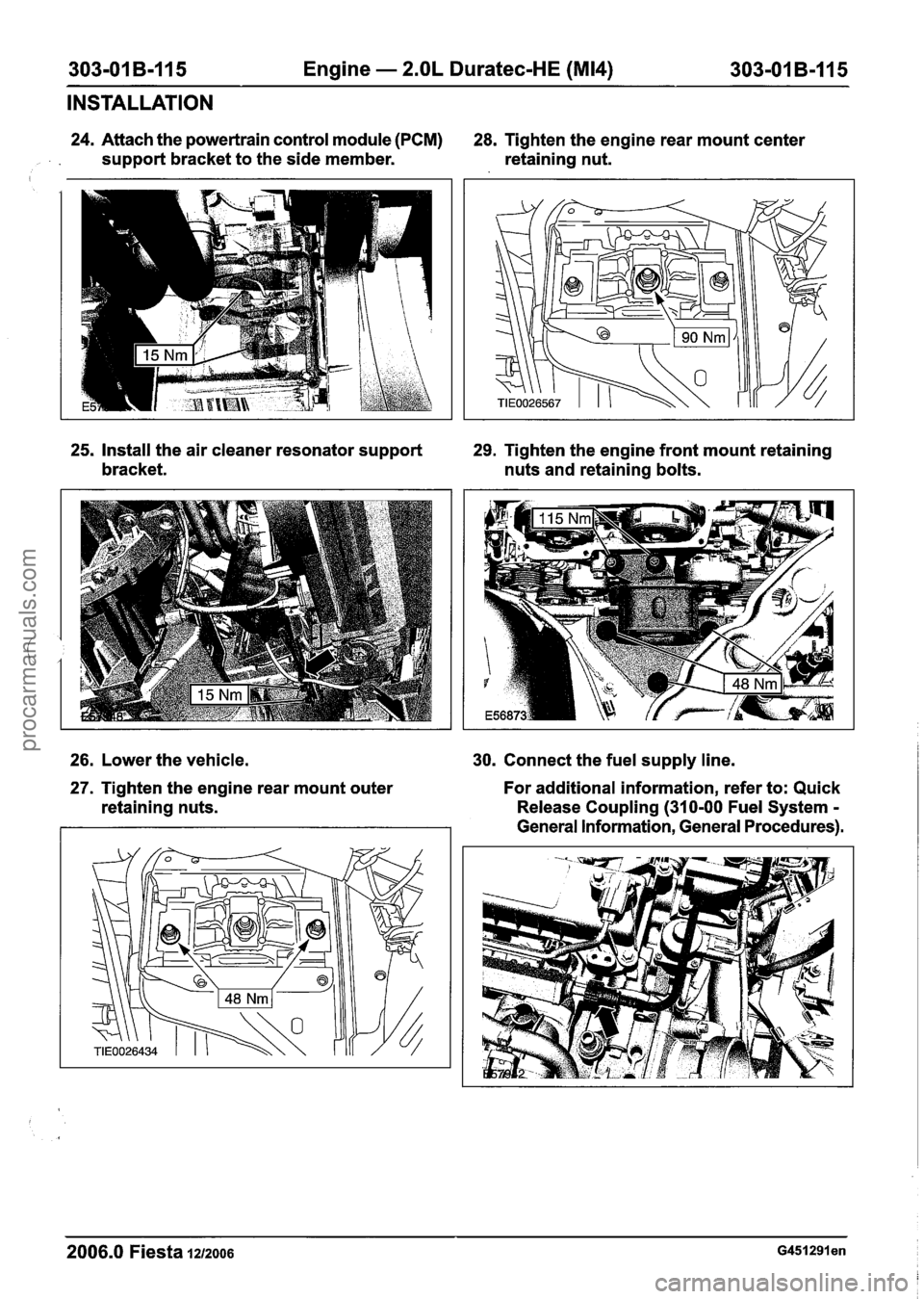
24. Attach the powertrain control module (PCM)
28. Tighten the engine rear mount center
, support bracket to the side member. retaining nut.
25, Install the air cleaner resonator support 29. Tighten the engine front mount retaining
bracket. nuts and retaining bolts.
26. Lower the vehicle.
30. Connect the fuel supply line.
27. Tighten the engine rear mount outer
retaining nuts. For additional information,
refer to: Quick
Release Coupling (310-00 Fuel System
-
General Information, General Procedures).
2006.0 Fiesta 1212006 ~451291 en
procarmanuals.com
Page 742 of 1226
303-01 8-1 20 Engine - 2.OL Duratec-HE (M14) 303-01 B-I 20
INSTALLATION
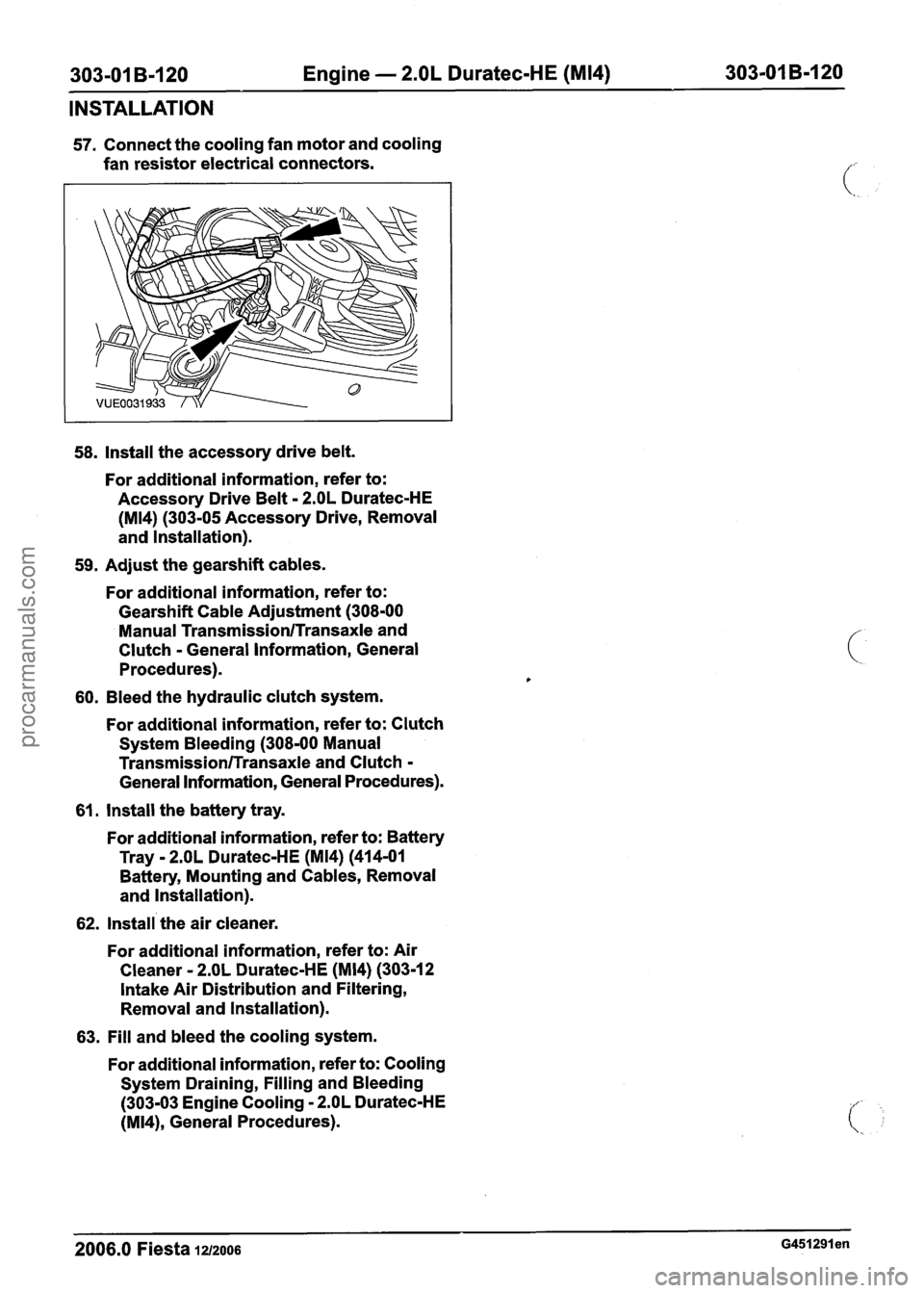
57. Connect the cooling fan motor and cooling
fan resistor electrical connectors.
58. Install the accessory drive belt.
For additional information, refer to:
Accessory Drive Belt
- 2.OL Duratec-HE
(M14) (303-05 Accessory Drive, Removal
and Installation).
59. Adjust the gearshift cables.
For additional information, refer to:
Gearshift Cable Adjustment (308-00
Manual
Transmission/Transaxle and
Clutch
- General Information, General
Procedures).
60. Bleed the hydraulic clutch system.
For additional information, refer to: Clutch
System Bleeding (308-00 Manual
Transmission/Transaxle and Clutch -
General Information, General Procedures).
61. Install the battery tray.
For additional information, refer to: Battery
Tray
- 2.OL Duratec-HE (M14) (414-01
Battery, Mounting and Cables, Removal
and Installation).
62. Install the air cleaner.
For additional information, refer to: Air
Cleaner
- 2.OL Duratec-HE (M14) (3031 2
Intake Air Distribution and Filtering,
Removal and Installation).
63. Fill and bleed the cooling system.
For additional information, refer to: Cooling
System Draining, Filling and Bleeding
(303-03 Engine Cooling - 2.OL Duratec-HE
(M14), General Procedures).
2006.0 Fiesta 1212006 G451291 en
procarmanuals.com
Page 744 of 1226
Engine Cooling - 1.3L Duratec-8V
(Rocam)llI25L Duratec-1 6V (Sigma)ll.4L
Duratec-1 6V (Sigma)ll .6L Duratec-1 6V (Sigma)
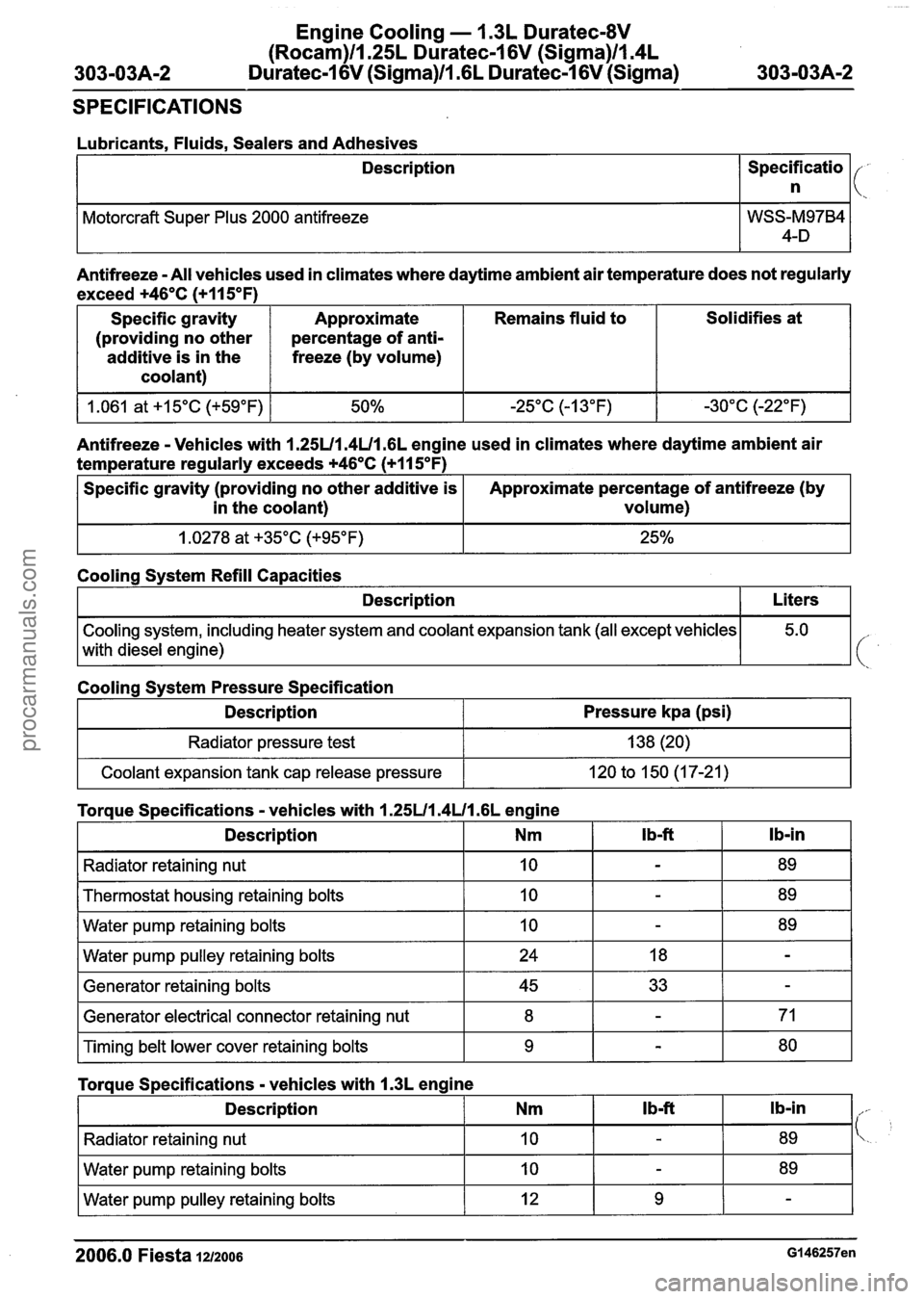
SPECIFICATIONS
Lubricants, Fluids, Sealers and Adhesives
Description
Specificatio 1 (,
I
Motorcraft Super Plus 2000 antifreeze
Antifreeze -All vehicles used in climates where daytime ambient air temperature does not regularly
exceed
+46OC (+I 1 5°F)
Specific gravity
(providing no other
additive is in the
coolant) Solidifies
at
Approximate
percentage of anti-
freeze (by volume) Remains
fluid to
Antifreeze
- Vehicles with 1.25U1.4U1 .6L engine used in climates where daytime ambient air
temperature regularly exceeds
+46OC (+I 15OF)
Cooling system, including heater system and coolant expansion tank (all except vehicles
with diesel engine)
1
Specific gravity (providing no other additive is
in the coolant)
Cooling System Refill Capacities Approximate percentage
of antifreeze (by
volume)
Description
I Radiator pressure test I 138 (20) I
Liters
Cooling System Pressure Specification
I Coolant expansion tank cap release pressure I 120 to 150 (17-21) I
Description Pressure kpa (psi)
I Radiator retaining
nut I 10 I - I 89 1
Torque Specifications - vehicles with 1.25U1.4U1 .6L engine
wrpump pulley retaining bolts I 24 I 18 I - I
Ib-in
Description
Thermostat housing retaining bolts
Water pump retaining bolts
I Generator retaining bolts I 45 I 33 I - I
I Generator electrical connector retaining nut I 8 I - I 71 I
Nm
10
10
I Timing belt lower cover retaining bolts I 9 I - I 80 I
I b-ft
Torque Specifications
- vehicles with I .3L engine 1
-
-
I Description I Nm I Ib-ft I Ib-in I,,.
89
89
I Radiator retaining nut I 10 I - I 89 1 '\..
I Water pump pulley retaining bolts I 12 I 9 I - I
Water pump retaining bolts
2006.0 Fiesta 1212006 Gl46257en
10 - 89
procarmanuals.com
Page 750 of 1226
Engine Cooling - 1.3L Duratec-8V
(Rocam)ll.25L Duratec-1 6V (Sigma)ll.4L
303-03A-8 Duratec-1 6V (Sigma)/l .6L Duratec-1 6V (Sigma) 303-03A-8
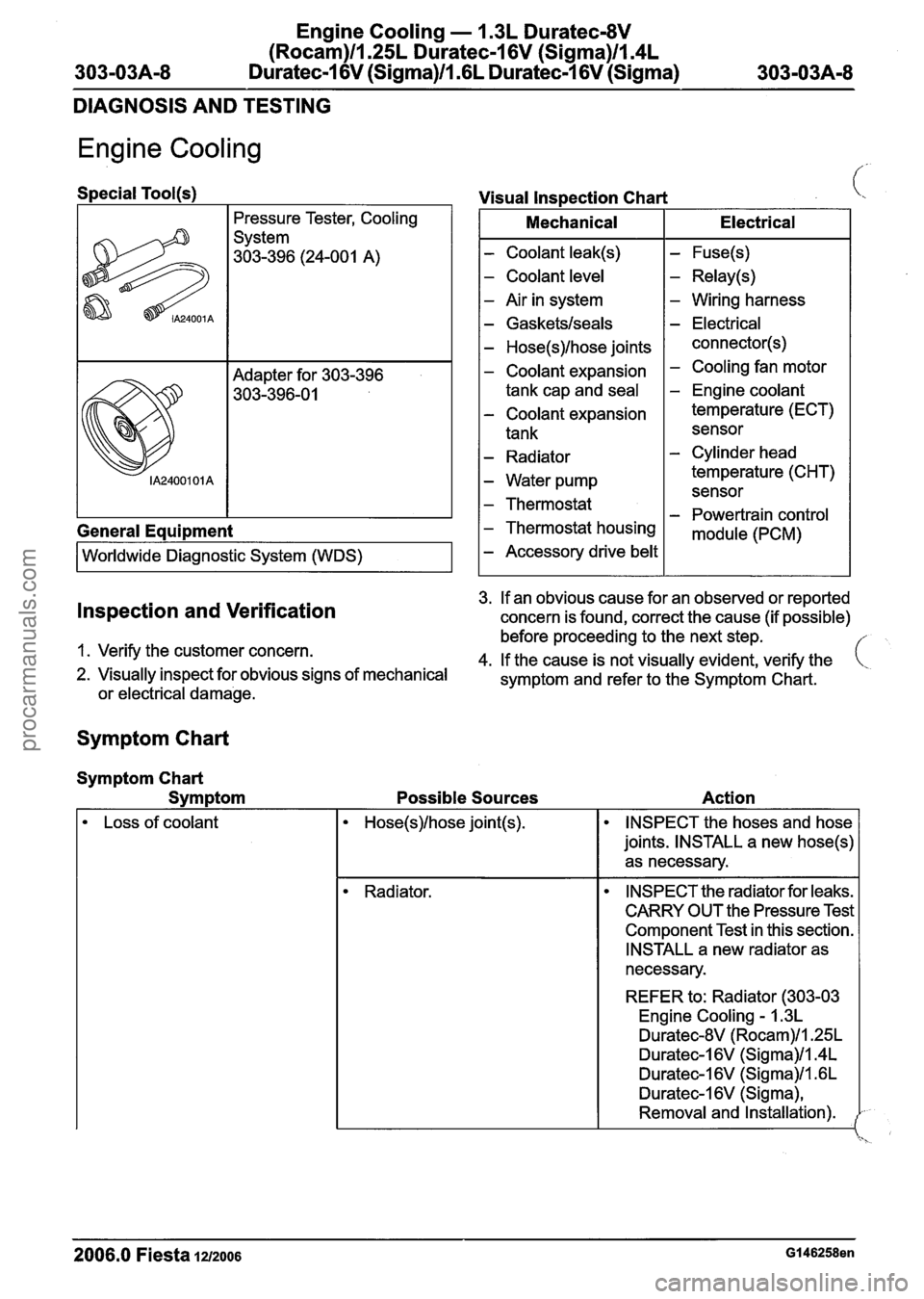
DIAGNOSIS AND TESTING
Engine Cooling
Special Tool(~)
Pressure Tester,
Cooling
System
303-396 (24-001 A)
General
Equipment
I Worldwide Diagnostic System (WDS) I
Visual Inspection Chart i,
I Mechanical I Electrical I
- Coolant leak(s)
- Coolant level
- Air in system
- Gasketslseals
- Hose(s)lhose joints
- Coolant expansion
tank cap and
seal
- Coolant expansion
tank
- Radiator
- Water pump
- Thermostat
- Thermostat housing
- Accessory drive belt
- Fuse(s)
- Relay(s)
- Wiring harness
- Electrical
connector(s)
- Cooling fan motor
- Engine coolant
temperature (ECT)
sensor
- Cylinder head
temperature (CHT) sensor
- Powertrain control
module (PCM)
3.
If an obvious cause for an observed or reported Inspection and Verification concern is found, correct the cause (if possible)
before proceeding to the next step.
1. Verify the customer concern.
4.
If the cause is not visually evident, verify the ( 2. Visually inspect for obvious signs of mechanical
symptom and refer to the Symptom Chart.
or
electrical damage.
Symptom Chart
Symptom Chart
Svm
ptom Possible Sources Action
Loss of
coolant INSPECT the hoses and hose
joints. INSTALL a new
hose(s)
as necessary.
Radiator. INSPECT the radiator for leaks.
CARRY OUT the Pressure Test
Component Test in this section.
INSTALL a new radiator as
necessary.
REFER to: Radiator (303-03 Engine
Cooling - 1.3L
Duratec-8V (Rocam)/l.25L
Duratec-1 6V (Sigma)1ln4L
Duratec-1 6V (Sigma)ll .6L
Duratec-I 6V (Sigma),
Removal and Installation).
2006.0 Fiesta 1212006 GI 46258en
procarmanuals.com
Page 755 of 1226
Engine Cooling - 1.3L Duratec-8V
(Rocam)ll.25L Duratec-1 6V (Sigma)ll.4L
303-03A-I 3 Duratec-1 6V (Sigma)ll.GL Duratec-1 6V (Sigma) 303-03A-I 3
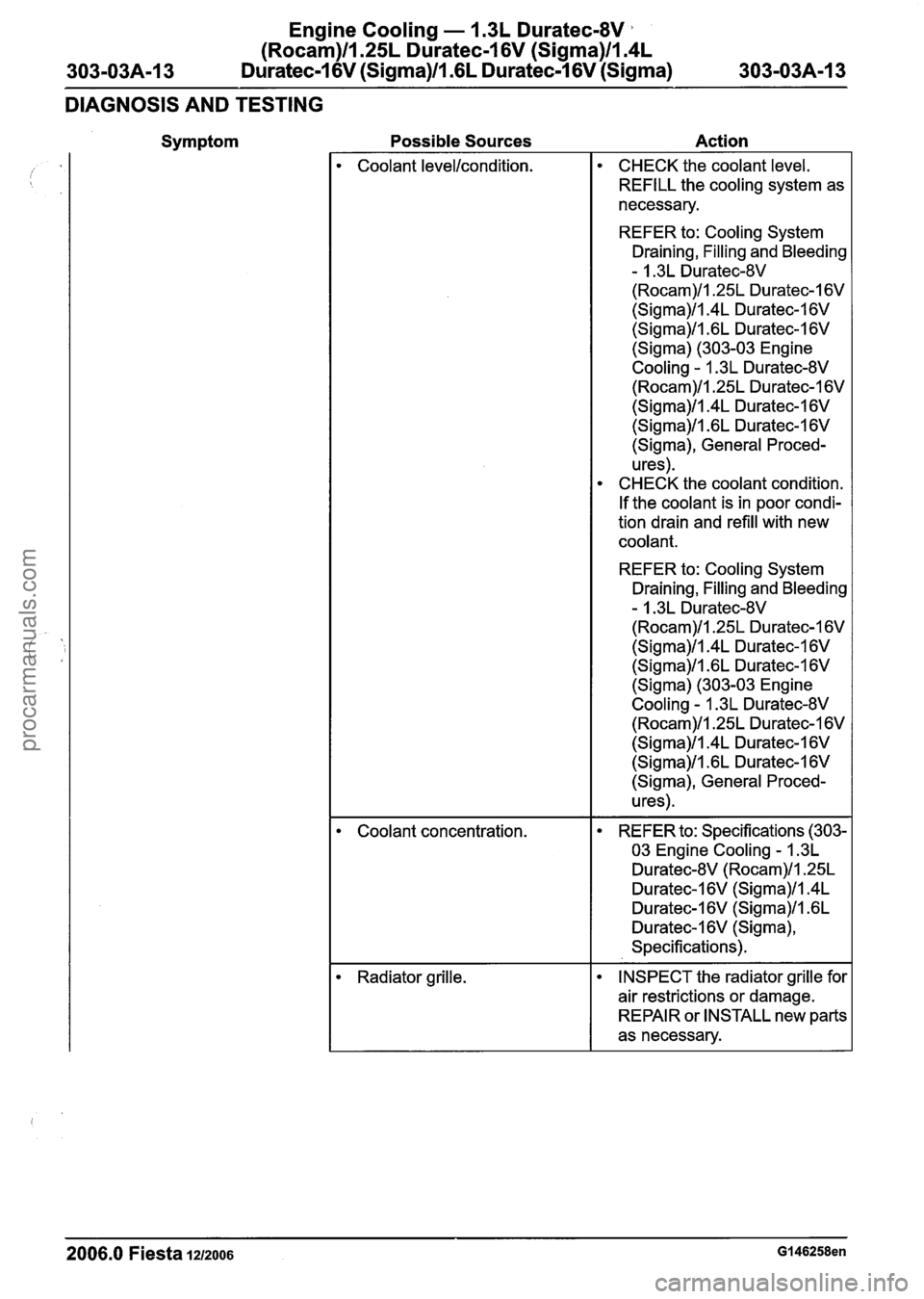
DIAGNOSIS AND TESTING
Symptom Possible Sources Action
2006.0 Fiesta 1212006 GI 46258en
Coolant levellcondition.
Coolant concentration.
Radiator grille. CHECK
the coolant level.
REFILL the cooling system as
necessary.
REFER to: Cooling System
Draining, Filling and Bleeding
- 1.3L Duratec-8V
(Rocam)ll.25L Duratec-1 6V
(Sigma)ll.4L Duratec-1 6V
(Sigma)ll .6L Duratec-1 6V
(Sigma) (303-03 Engine
Cooling
- 1.3L Duratec-8V
(Rocam)/l.25L Duratec-1 6V
(Sigma)ll.4L Duratec-1 6V
(Sigma)ll .6L Duratec-1 6V
(Sigma), General Proced-
u res).
CHECK the coolant condition.
If the coolant is in poor condi-
tion drain and refill with new
coolant.
REFER to: Cooling System
Draining, Filling and Bleeding
- 1.3L Duratec-8V
(Rocam)/l.25L Duratec-1 6V
(Sigma)ll.4L Duratec-1 6V
(Sigma)ll .6L Duratec-1 6V
(Sigma) (303-03 Engine
Cooling
- 1.3L Duratec-8V
(Rocam)ll.25L Duratec-1 6V
(Sigma)ll.4L Duratec-1 6V
(Sigma)/l.6L Duratec-1 6V
(Sigma), General Proced-
u res).
REFER to: Specifications (303-
03 Engine Cooling
- 1.3L
Duratec-8V (Rocam)ll.25L
Duratec-16V (Sigma)ll.4L
Duratec-1 6V (Sigma)/l .6L
Duratec-16V (Sigma),
Specifications).
INSPECT the radiator grille for
air restrictions or damage.
REPAIR or INSTALL new parts
as necessary.
procarmanuals.com
Page 758 of 1226
Engine Cooling - 1.3L Duratec-8V
(Rocam)ll.25L Duratec-I 6V (Sigma)ll.4L
303-03A-16 Duratec-1 6V (Sigma)/l .6L Duratec-1 6V (Sigma) 303-03A-16
DIAGNOSIS AND TESTING
Component Tests
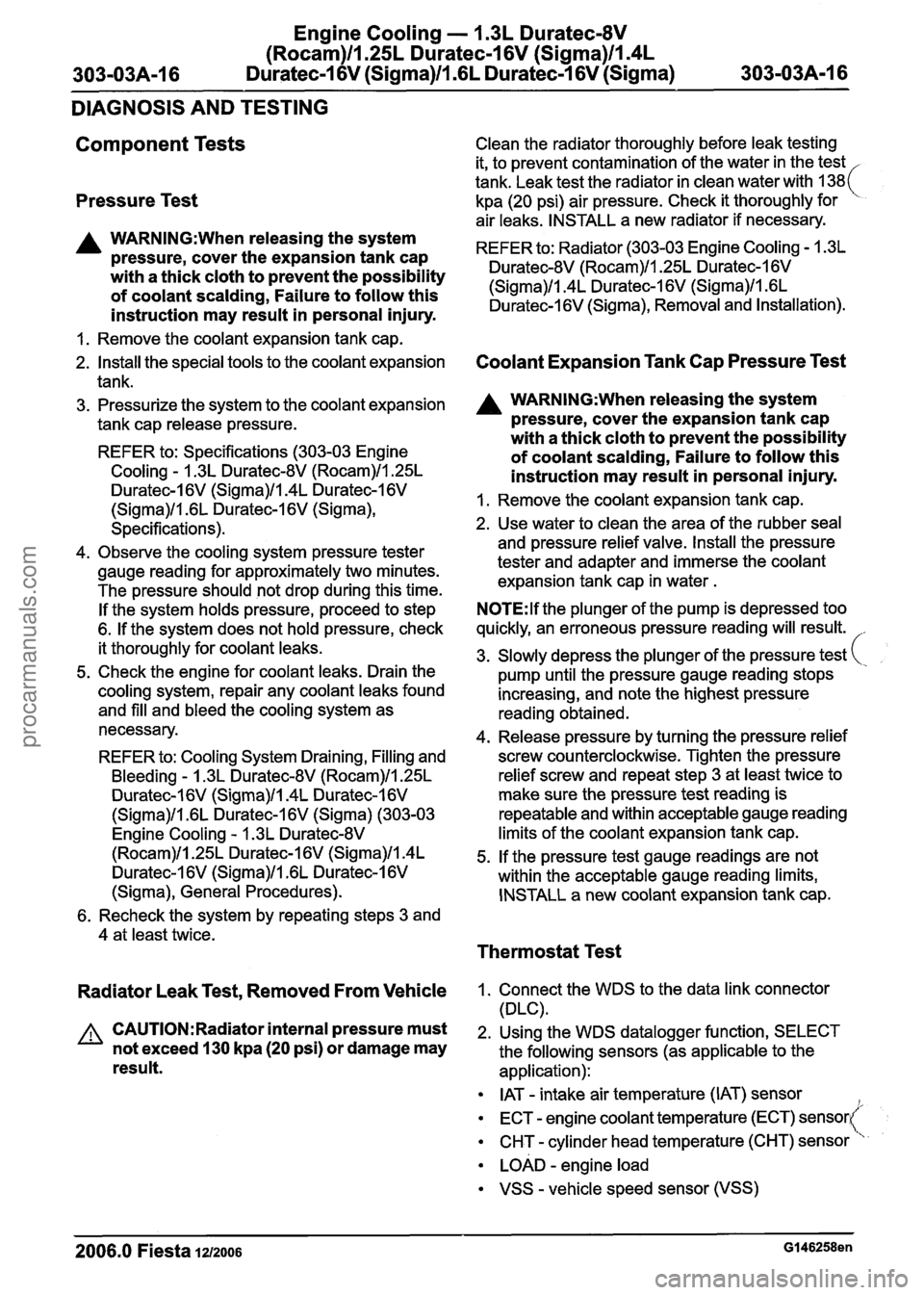
Pressure Test
A WARNING:When releasing the system
pressure, cover the expansion tank cap
with a thick cloth to prevent the possibility
of coolant scalding, Failure to follow this
instruction may result in personal injury.
1. Remove the coolant expansion tank cap.
2.
Install the special tools to the coolant expansion
tank.
3. Pressurize the system to the
coolant expansion
tank cap
release pressure.
REFER to: Specifications (303-03 Engine
Cooling - 1.3L Duratec-8V (Rocam)/l.25L
Duratec-I 6V (Sigma)/l.4L Duratec-1 6V
(Sigma)/l .6L Duratec-1 6V (Sigma),
Specifications).
4. Observe the
cooling system pressure tester
gauge reading for
approximately two minutes.
The pressure
should not drop during this time.
If the system holds pressure, proceed to step
6.
If the system does not hold pressure, check
it
thoroughly for coolant leaks.
5. Check the engine for coolant leaks. Drain the
cooling system, repair any coolant leaks found
and
fill and bleed the cooling system as
necessary.
REFER to:
Cooling System Draining, Filling and
Bleeding - 1.3L Duratec-8V (Rocam)/l.25L
Duratec-I 6V (Sigma)/l.4L Duratec-1 6V
(Sigma)/l .6L Duratec-1 6V (Sigma) (303-03
Engine
Cooling - 1.3L Duratec-8V
(Rocam)/l.25L Duratec-1 6V (Sigma)/l.4L
Duratec-1 6V (Sigma)/l .6L Duratec-1 6V
(Sigma), General Procedures).
Clean the radiator thoroughly before leak testing
it, to prevent contamination of the water in the test
tank. Leak test the radiator in
clean water with 138(
kpa (20 psi) air pressure. Check it thoroughly for
air
leaks. INSTALL a new radiator if necessary.
REFER to: Radiator (303-03 Engine
Cooling - 1.3L
Duratec-8V (Rocam)/l.25L Duratec-I 6V
(Sigma)/l.4L Duratec-I 6V (Sigma)ll .6L
Duratec-I 6V (Sigma), Removal and Installation).
Coolant Expansion Tank Cap Pressure Test
A WARNING:When releasing the system
pressure, cover the expansion tank cap
with a thick cloth to prevent the possibility
of coolant scalding, Failure to follow this
instruction may result in personal injury.
1. Remove the coolant expansion tank cap.
2. Use water to clean the area of the rubber seal
and pressure relief valve. Install the pressure
tester and adapter and immerse the
coolant
expansion tank cap in water .
N0TE:lf the plunger of the pump is depressed too
quickly, an erroneous pressure reading will result. l-
3. Slowly depress the plunger of the pressure test
pump until the pressure gauge reading stops
increasing, and note the highest pressure
reading obtained.
4.
Release pressure by turning the pressure relief
screw counterclockwise. Tighten the pressure
relief screw and repeat step 3 at least twice to
make sure the pressure test reading is
repeatable and within acceptable gauge reading
limits of the coolant expansion tank cap.
5.
If the pressure test gauge readings are not
within the
acceptable gauge reading limits,
INSTALL a new coolant expansion tank cap.
6. Recheck the system by repeating steps 3 and
4 at least twice.
Thermostat Test
Radiator Leak Test, Removed From Vehicle
A CAUTI0N:Radiator internal pressure must
not exceed
130 kpa (20 psi) or damage may
result.
1. Connect the WDS to the data link connector
(DLC).
2. Using the WDS
datalogger function, SELECT
the
following sensors (as applicable to the
application):
IAT - intake air temperature (IAT) sensor
ECT
- engine coolant temperature (ECT) sensort
CHT - cylinder head temperature (CHT) sensori
LOAD - engine load
VSS - vehicle speed sensor (VSS)
2006.0 Fiesta 1212006 GI 46258en
procarmanuals.com
Page 759 of 1226
Engine Cooling - I .3L Duratec-8V
(Rocam)llm25L Duratec-1 6V (Sigma)ll.4L
303-03A-17 Duratec-1 6V (Sigma)/lm6L Duratec-1 6V (Sigma) 303-03A-17
DIAGNOSIS AND TESTING
RPM - engine speed
i DSRPM - desired engine speed
The IAT sensor output is useful if the engine being
tested is cold or after an over-night cold soak. The
ECT sensor or CHT sensor and the IAT sensor
should either indicate the same value or be within
1 to 2 degrees Celsius of each other.
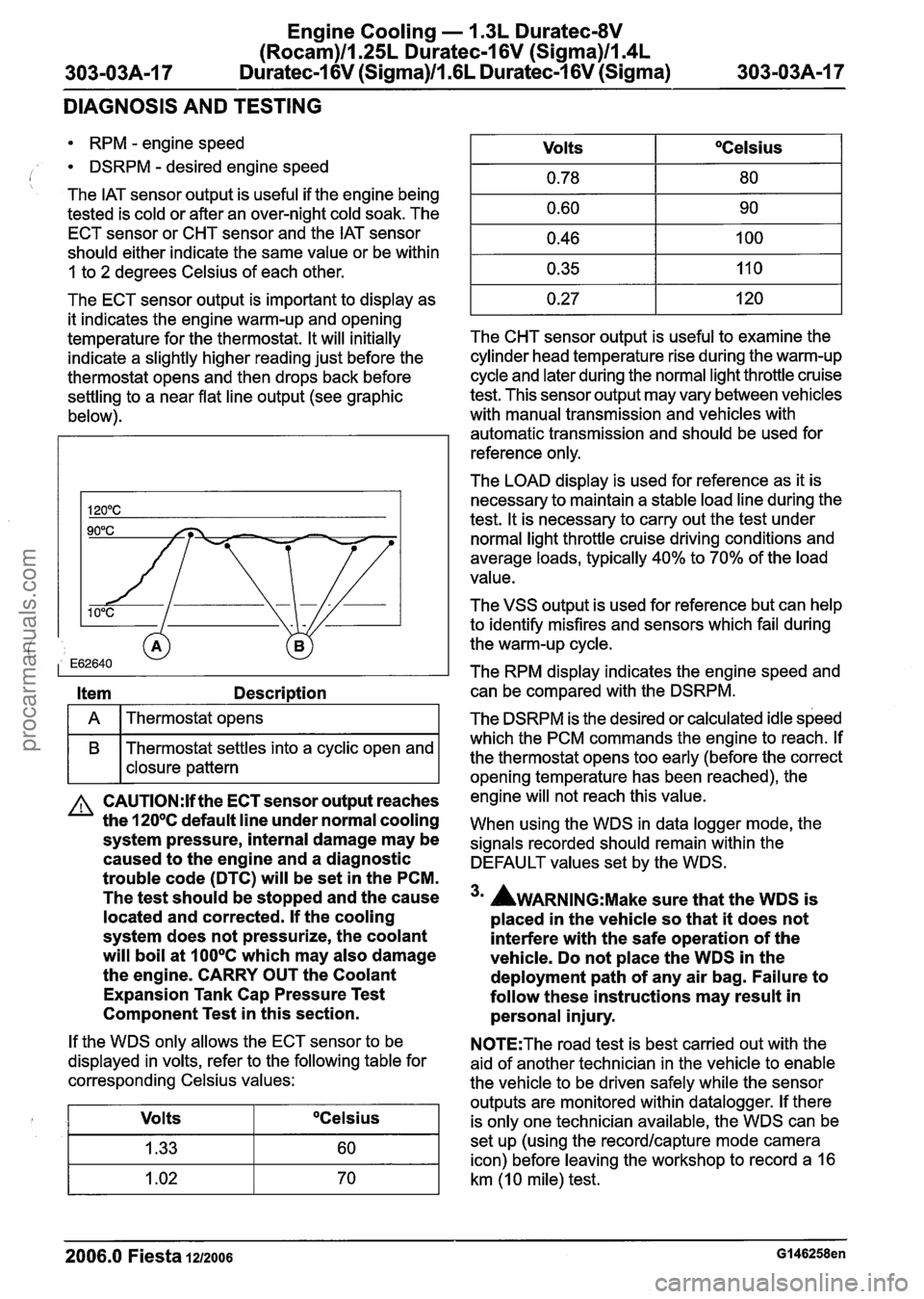
The ECT sensor output is important to display as
it indicates the engine warm-up and opening
temperature for the thermostat. It will initially
indicate a slightly higher reading just before the
thermostat opens and then drops back before
settling to a near flat line output (see graphic
below).
Item Description
I A I Thermostat opens I
B Thermostat settles into a cyclic open and
I I closure pattern
A CAUTI0N:lf the ECT sensor output reaches
the
120°C default line under normal cooling
system pressure, internal damage may be
caused to the engine and a diagnostic
trouble code (DTC) will be set in the PCM.
The test should be stopped and the cause
located and corrected. If the cooling
system does not pressurize, the coolant
will boil at
100°C which may also damage
the engine. CARRY OUT the Coolant
Expansion Tank Cap Pressure Test
Component Test in this section.
If the WDS only allows the ECT sensor to be
displayed in volts, refer to the following table for
corresponding Celsius values:
Volts
OCelsius
The CHT sensor output is useful to examine the
cylinder head temperature rise during the warm-up
cycle and later during the normal light throttle cruise
test. This sensor output may vary between vehicles
with manual transmission and vehicles with
automatic transmission and should be used for
reference only.
Volts
0.78
0.60
0.46
0.35
0.27
The
LOAD display is used for reference as it is
necessary to maintain a stable load line during the
test. It is necessary to carry out the test under
normal light throttle cruise driving conditions and
average loads, typically
40% to 70% of the load
value.
OCelsius
80
90
100
11 0
120
The VSS output is used for reference but can help
to identify misfires and sensors which fail during
the warm-up cycle.
The RPM display indicates the engine speed and can be compared with the DSRPM.
The DSRPM is the desired or calculated idle speed
which the PCM commands the engine to reach. If
the thermostat opens too early (before the correct
opening temperature has been reached), the
engine will not reach this value.
When using the WDS in data logger mode, the
signals recorded should remain within the
DEFAULT values set by the WDS.
3m AWARNING:M~~~ sure that the WDS is
placed in the vehicle so that it does not
interfere with the safe operation of the
vehicle. Do not place the WDS in the
deployment path of any air bag. Failure to
follow these instructions may result in personal injury.
N0TE:The road test is best carried out with the
aid of another technician in the vehicle to enable
the vehicle to be driven safely while the sensor
outputs are monitored within datalogger. If there
is only one technician available, the WDS can be
set up (using the
recordlcapture mode camera
icon) before leaving the workshop to record a
16
km (1 0 mile) test.
2006.0 Fiesta 1212006 GI 46258en
procarmanuals.com