ECO FORD MAVERICK 2023 User Guide
[x] Cancel search | Manufacturer: FORD, Model Year: 2023, Model line: MAVERICK, Model: FORD MAVERICK 2023Pages: 556, PDF Size: 14.79 MB
Page 28 of 556
Note:Event data recorder data is recordedby your vehicle only if a non-trivial crashsituation occurs; no data is recorded by theevent data recorder under normal drivingconditions and no personal data orinformation (for example name, gender,age, and crash location) is recorded.However, parties, such as law enforcement,could combine the event data recorder datawith the type of personally identifying dataroutinely acquired during a crashinvestigation.
To read data recorded by an event datarecorder, special equipment is required,and access to the vehicle or the event datarecorder is needed. In addition to thevehicle manufacturer, other parties, suchas law enforcement, that have such specialequipment, can read the information if theyhave access to the vehicle or the eventdata recorder.
SETTINGS DATA
Your vehicle has electronic control unitsthat have the ability to store data basedon your personalized settings. The data isstored locally in the vehicle or on devicesthat you connect to it, for example, a USBdrive or digital music player. You can deletesome of this data and also choose whetherto share it through the services to whichyou subscribe. See Settings (page 430).
Comfort and Convenience Data
Data recorded includes, for example:
•Seat and steering wheel position.
•Climate control settings.
•Radio presets.
Entertainment Data
Data recorded includes, for example:
•Music, videos or album art.
•Contacts and corresponding addressbook entries.
•Navigation destinations.
CONNECTED VEHICLE DATA
The modem has a SIM. Themodem was enabled when yourvehicle was built and periodicallysends messages to stay connected to thecell phone network, receive automaticsoftware updates and send vehicle-relatedinformation to us, for example diagnosticinformation. These messages couldinclude information that identifies yourvehicle, the SIM and the electronic serialnumber of the modem. Cell phone networkservice providers could have access toadditional information, for example cellphone network tower identification. Foradditional information about our privacypolicy, visit www.FordConnected.com orrefer to your local Ford website.
Note:The modem continues to send thisinformation unless you disable the modemor stop the modem from sharing vehicledata by changing the modem settings. SeeConnected Vehicle (page 377).
Note:The service can be unavailable orinterrupted for a number of reasons, forexample environmental or topographicalconditions and data plan coverage.
Note:To find out if your vehicle has amodem, visit www.FordConnected.com.
24
2023 Maverick (CFE) Canada/United States of America, enUSA, Edition date: 202208, First-PrintingData Privacy
Page 29 of 556

MOBILE DEVICE DATA
If you connect a mobile device to yourvehicle, you can display data from yourdevice on the touchscreen for example,music and album art. You can share yourvehicle data with mobile apps on yourdevice through the system. See Apps(page 428).
The mobile apps function operates by yourconnected device sending data to us in theUnited States. The data is encrypted andincludes, for example, the vehicleidentification number of your vehicle, theSYNC module serial number, odometer,enabled apps, usage statistics anddebugging information. We retain it onlyas long as necessary to provide the service,to troubleshoot, for continuousimprovement and to offer you productsand services that may be of interest to youaccording to your preferences and whereallowed by law.
If you connect a cell phone to the system,the system creates a profile that links tothat cell phone. The cell phone profileenables more mobile features and efficientoperation. The profile contains, forexample data from your phonebook, readand unread text messages and call history,including history of calls when your cellphone was not connected to the system.
If you connect a media device, the systemcreates and retains a media device indexof supported media content. The systemalso records a short diagnostic log ofapproximately 10 minutes of all recentsystem activity.
The cell phone profile, media device indexand diagnostic log remain in your vehicleunless you delete them and are generallyaccessible only in your vehicle when youconnect your cell phone or media device.If you no longer plan to use the system oryour vehicle, we recommend you use themaster reset function to erase the storedinformation. See Settings (page 430).
System data cannot be accessed withoutspecial equipment and access to yourvehicle's module.
For additional information about ourprivacy policy, refer to the local Fordwebsite.
Note:To find out if your vehicle hasconnectivity technology, visitwww.FordConnected.com.
EMERGENCY CALL SYSTEM
DATA
When the emergency call system is active,it may disclose to emergency services thatyour vehicle has been in a crash involvingthe deployment of an airbag or activationof the fuel pump shut-off. Certain versionsor updates to the emergency call systemmay also be capable of electronically orverbally disclosing to emergency servicesoperators your vehicle location or otherdetails about your vehicle or crash to assistemergency services operators to providethe most appropriate emergency services.If you do not want to disclose thisinformation, do not activate the emergencycall system.
Note:You cannot deactivate emergencycall systems that are required by law.
25
2023 Maverick (CFE) Canada/United States of America, enUSA, Edition date: 202208, First-PrintingData Privacy
Page 30 of 556
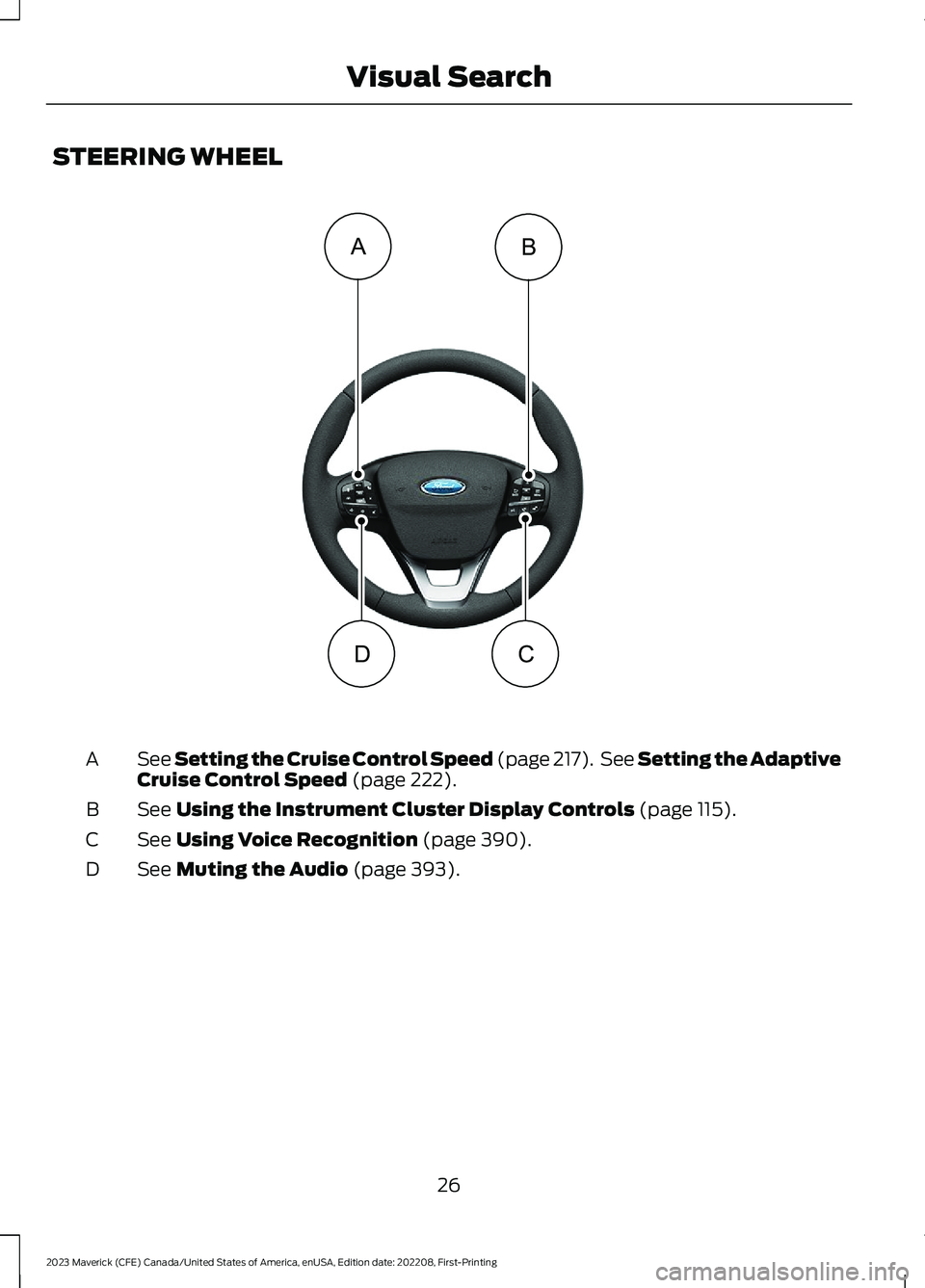
STEERING WHEEL
See Setting the Cruise Control Speed (page 217). See Setting the AdaptiveCruise Control Speed (page 222).A
See Using the Instrument Cluster Display Controls (page 115).B
See Using Voice Recognition (page 390).C
See Muting the Audio (page 393).D
26
2023 Maverick (CFE) Canada/United States of America, enUSA, Edition date: 202208, First-PrintingVisual SearchBADC E358427
Page 35 of 556
CHILD SAFETY PRECAUTIONS
WARNING: Always make sure yourchild is secured properly in a device thatis appropriate for their height, age andweight. Child safety restraints must bebought separately from your vehicle.Failure to follow these instructions andguidelines may result in an increased riskof serious injury or death to your child.
WARNING: All children are shapeddifferently. The National Highway TrafficSafety Administration and other safetyorganizations, base theirrecommendations for child restraints onprobable child height, age and weightthresholds, or on the minimumrequirements of the law. We recommendthat you check with a NHTSA CertifiedChild Passenger Safety Technician(CPST) to make sure that you properlyinstall the child restraint in your vehicleand that you consult your pediatrician tomake sure you have a child restraintappropriate for your child. To locate achild restraint fitting station and CPST,contact NHTSA toll free at1-888-327-4236 or go towww.nhtsa.dot.gov. In Canada, contactTransport Canada toll free at1-800-333-0371 or go to www.tc.gc.cato find a Child Car Seat Clinic in yourarea. Failure to properly restrain childrenin child restraints made especially fortheir height, age and weight, may resultin an increased risk of serious injury ordeath to your child.
WARNING: On hot days, thetemperature inside the vehicle can risevery quickly. Exposure of people oranimals to these high temperatures foreven a short time can cause death orserious heat related injuries, includingbrain damage. Small children areparticularly at risk.
WARNING: Do not place arearward facing child restraint in front ofan active airbag. Failure to follow thisinstruction could result in personal injuryor death.
WARNING: Properly securechildren 12 years old and under in a rearseating position whenever possible. Ifyou are unable to properly secure allchildren in a rear seating position,properly secure the largest child on thefront seat. If you must use a forwardfacing child restraint on the front seat,move the seat as far back as possible.Failure to follow these instructions couldresult in personal injury or death.
WARNING: Always carefully followthe instructions and warnings providedby the manufacturer of any childrestraint to determine if the restraintdevice is appropriate for your child's size,height, weight, or age. Follow the childrestraint manufacturer's instructions andwarnings provided for installation anduse in conjunction with the instructionsand warnings provided by your vehiclemanufacturer. A safety seat that isimproperly installed or utilized, isinappropriate for your child's height, age,or weight or does not properly fit thechild may increase the risk of seriousinjury or death.
31
2023 Maverick (CFE) Canada/United States of America, enUSA, Edition date: 202208, First-PrintingChild Safety
Page 36 of 556
WARNING: Do not allow apassenger to hold a child on their lapwhen your vehicle is moving. Failure tofollow this instruction could result inpersonal injury or death in the event of asudden stop or crash.
WARNING: Do not use pillows,books or towels to boost your child'sheight. Failure to follow this instructioncould result in personal injury or death.
WARNING: Properly secure childrestraints or booster seats when they arenot in use. They could become projectilesin a sudden stop or crash. Failure tofollow this instruction could result inpersonal injury or death.
WARNING: Do not put the shouldersection of the seatbelt or allow the childto put the shoulder section of theseatbelt under their arm or behind theirback. Failure to follow this instructioncould reduce the effectiveness of theseatbelt and increase the risk of injury ordeath in a crash.
WARNING: Do not leave childrenor pets unattended in your vehicle.Failure to follow this instruction couldresult in personal injury or death.
When installing a child restraint withseatbelts:
•Place the vehicle seat in the uprightposition before you install the childrestraint.
•Use the correct seatbelt buckle for thatseating position.
•Insert the belt tongue into the buckle.Make sure the tongue is securelyfastened in the buckle.
•Keep the buckle release buttonpointing up and away from the childrestraint, with the tongue between thechild restraint and the release button,to prevent accidental unbuckling.
•Put the seatbelt in the automaticlocking mode.
CHILD RESTRAINT ANCHOR
POINTS
WHAT ARE THE CHILD RESTRAINTANCHOR POINTS
Anchor points allow you to quickly andsafely install a child restraint.
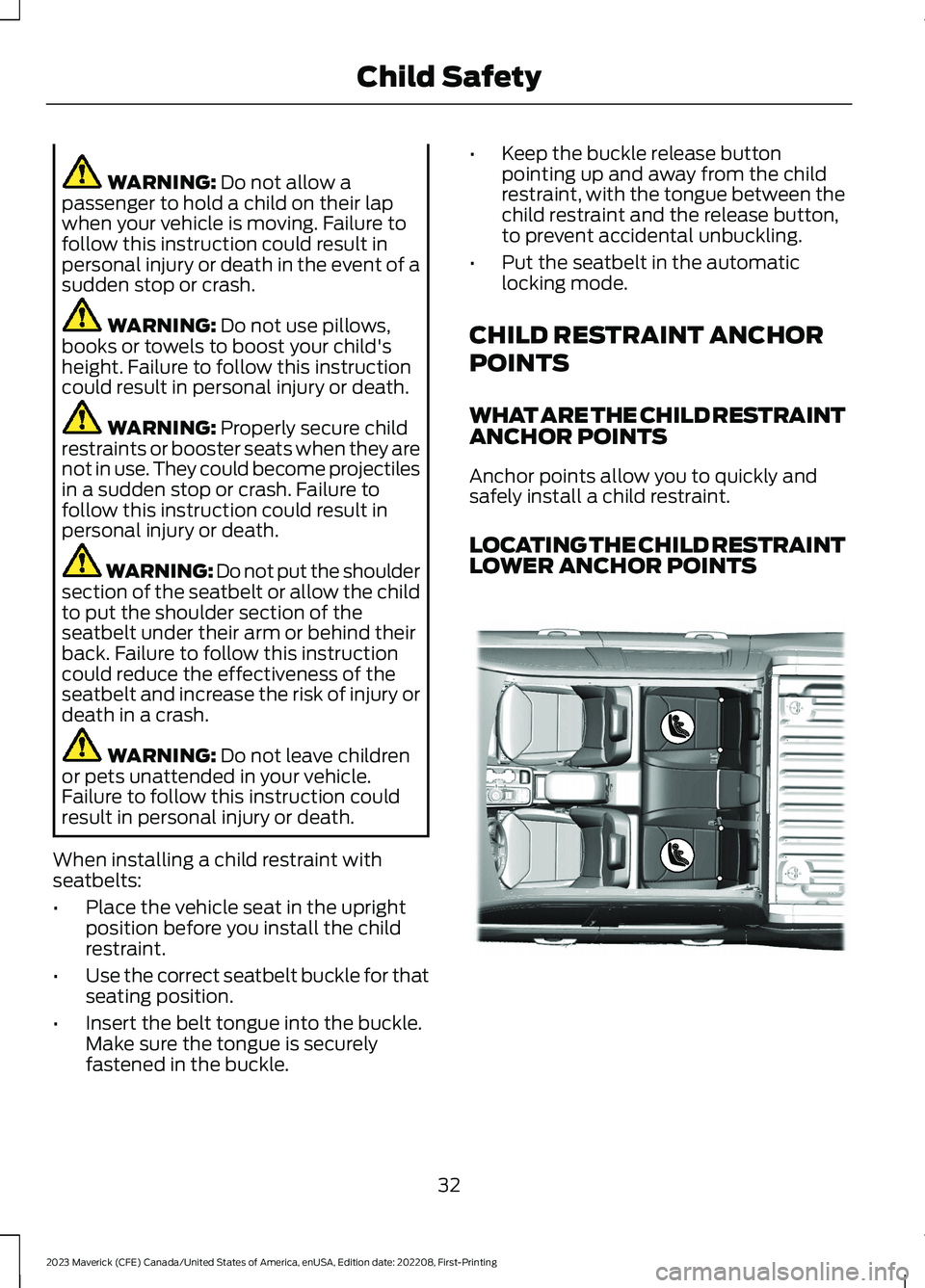
LOCATING THE CHILD RESTRAINTLOWER ANCHOR POINTS
32
2023 Maverick (CFE) Canada/United States of America, enUSA, Edition date: 202208, First-PrintingChild SafetyE356726
Page 38 of 556
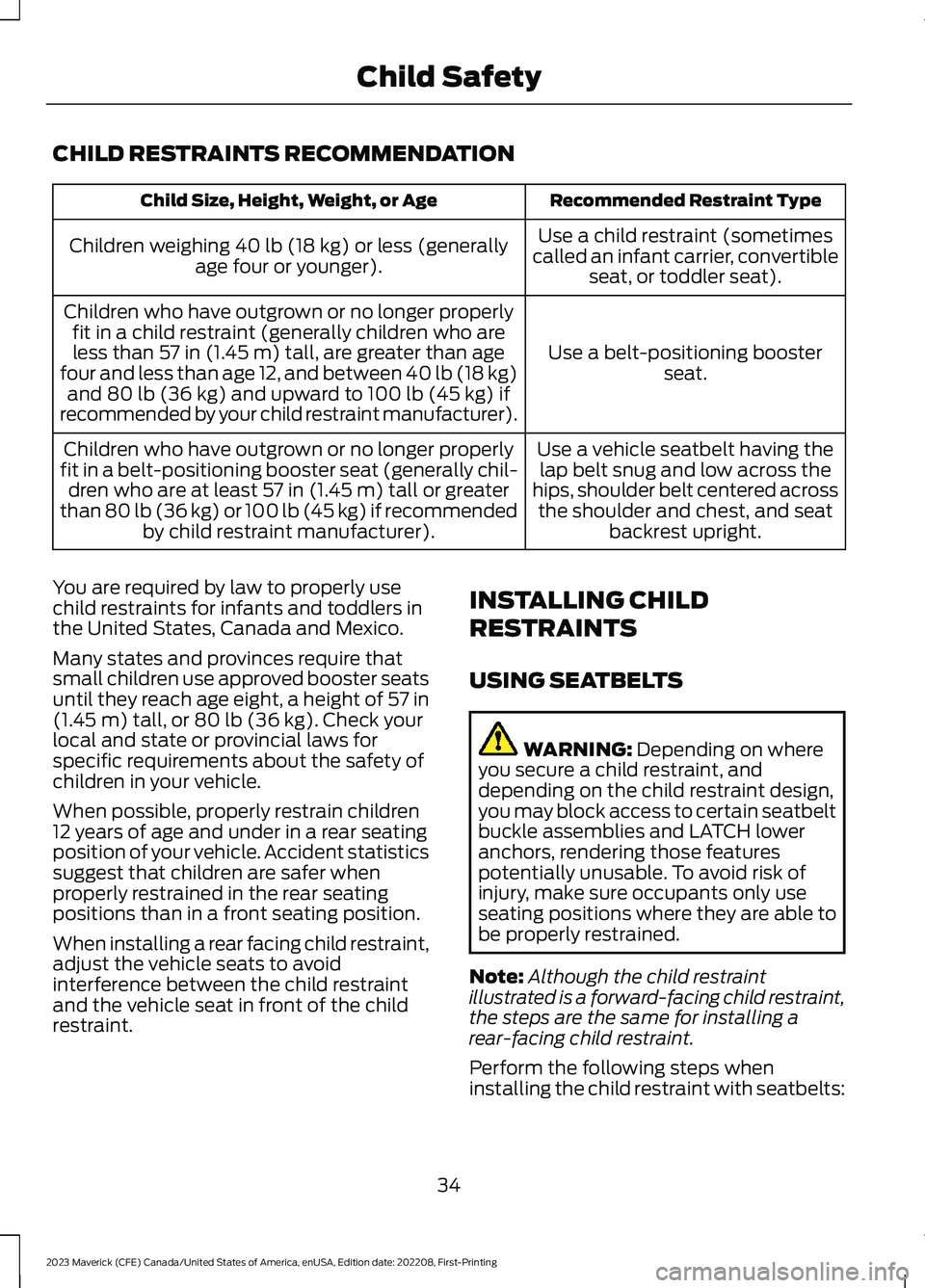
CHILD RESTRAINTS RECOMMENDATION
Recommended Restraint TypeChild Size, Height, Weight, or Age
Use a child restraint (sometimescalled an infant carrier, convertibleseat, or toddler seat).
Children weighing 40 lb (18 kg) or less (generallyage four or younger).
Use a belt-positioning boosterseat.
Children who have outgrown or no longer properlyfit in a child restraint (generally children who areless than 57 in (1.45 m) tall, are greater than agefour and less than age 12, and between 40 lb (18 kg)and 80 lb (36 kg) and upward to 100 lb (45 kg) ifrecommended by your child restraint manufacturer).
Use a vehicle seatbelt having thelap belt snug and low across thehips, shoulder belt centered acrossthe shoulder and chest, and seatbackrest upright.
Children who have outgrown or no longer properlyfit in a belt-positioning booster seat (generally chil-dren who are at least 57 in (1.45 m) tall or greaterthan 80 lb (36 kg) or 100 lb (45 kg) if recommendedby child restraint manufacturer).
You are required by law to properly usechild restraints for infants and toddlers inthe United States, Canada and Mexico.
Many states and provinces require thatsmall children use approved booster seatsuntil they reach age eight, a height of 57 in(1.45 m) tall, or 80 lb (36 kg). Check yourlocal and state or provincial laws forspecific requirements about the safety ofchildren in your vehicle.
When possible, properly restrain children12 years of age and under in a rear seatingposition of your vehicle. Accident statisticssuggest that children are safer whenproperly restrained in the rear seatingpositions than in a front seating position.
When installing a rear facing child restraint,adjust the vehicle seats to avoidinterference between the child restraintand the vehicle seat in front of the childrestraint.
INSTALLING CHILD
RESTRAINTS
USING SEATBELTS
WARNING: Depending on whereyou secure a child restraint, anddepending on the child restraint design,you may block access to certain seatbeltbuckle assemblies and LATCH loweranchors, rendering those featurespotentially unusable. To avoid risk ofinjury, make sure occupants only useseating positions where they are able tobe properly restrained.
Note:Although the child restraintillustrated is a forward-facing child restraint,the steps are the same for installing arear-facing child restraint.
Perform the following steps wheninstalling the child restraint with seatbelts:
34
2023 Maverick (CFE) Canada/United States of America, enUSA, Edition date: 202208, First-PrintingChild Safety
Page 40 of 556
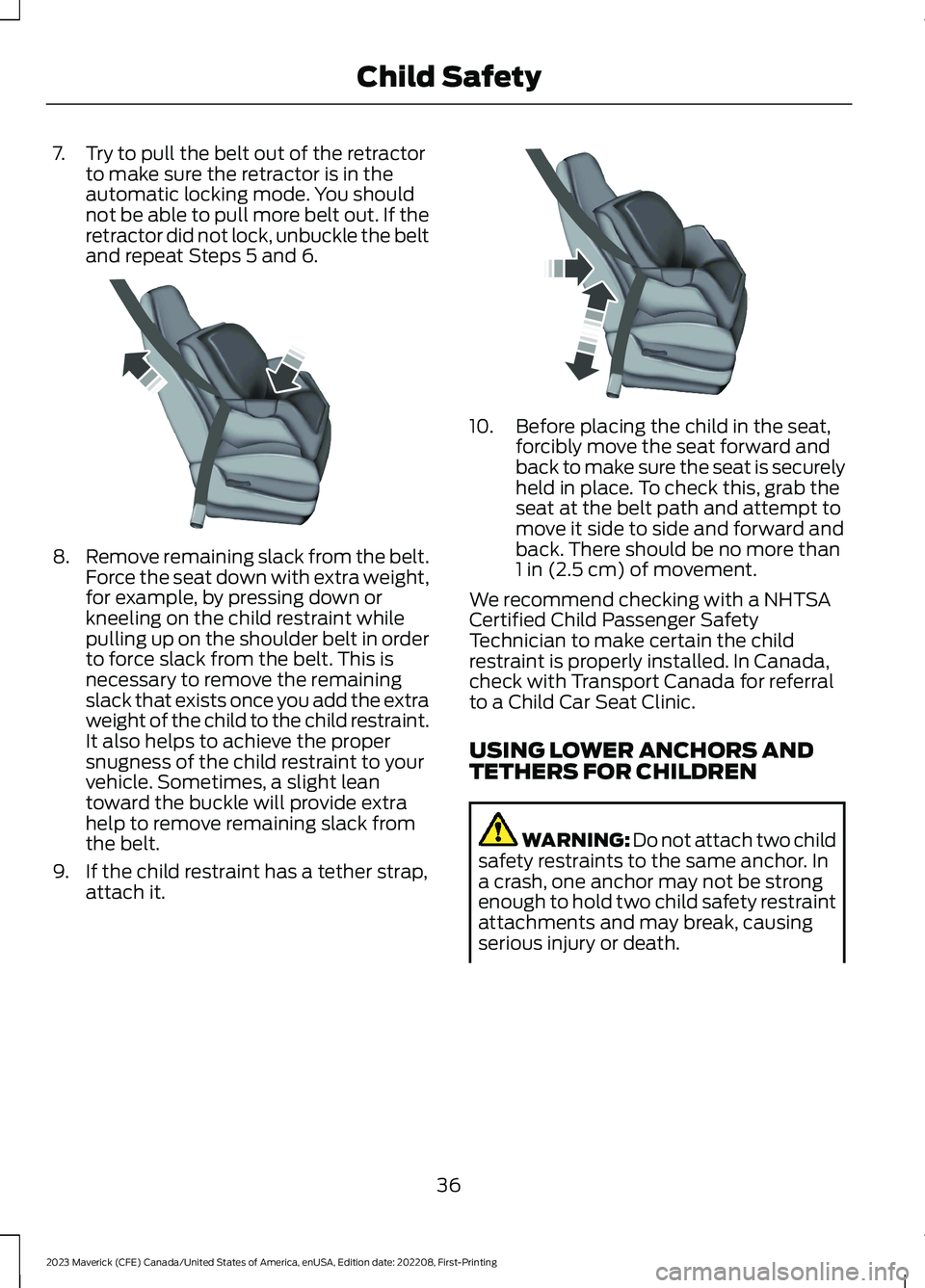
7.Try to pull the belt out of the retractorto make sure the retractor is in theautomatic locking mode. You shouldnot be able to pull more belt out. If theretractor did not lock, unbuckle the beltand repeat Steps 5 and 6.
8.Remove remaining slack from the belt.Force the seat down with extra weight,for example, by pressing down orkneeling on the child restraint whilepulling up on the shoulder belt in orderto force slack from the belt. This isnecessary to remove the remainingslack that exists once you add the extraweight of the child to the child restraint.It also helps to achieve the propersnugness of the child restraint to yourvehicle. Sometimes, a slight leantoward the buckle will provide extrahelp to remove remaining slack fromthe belt.
9.If the child restraint has a tether strap,attach it.
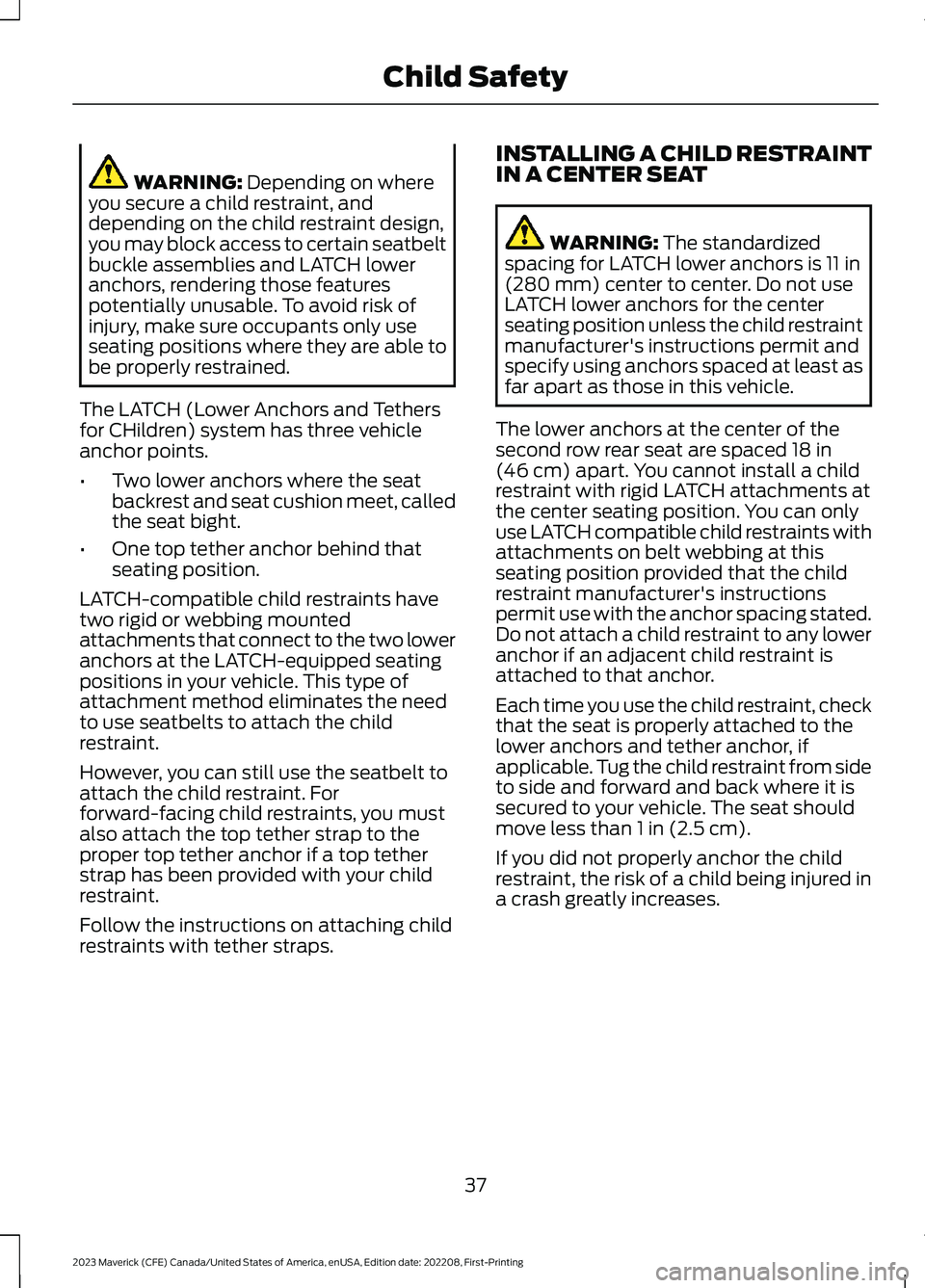
10.Before placing the child in the seat,forcibly move the seat forward andback to make sure the seat is securelyheld in place. To check this, grab theseat at the belt path and attempt tomove it side to side and forward andback. There should be no more than1 in (2.5 cm) of movement.
We recommend checking with a NHTSACertified Child Passenger SafetyTechnician to make certain the childrestraint is properly installed. In Canada,check with Transport Canada for referralto a Child Car Seat Clinic.
USING LOWER ANCHORS ANDTETHERS FOR CHILDREN
WARNING: Do not attach two childsafety restraints to the same anchor. Ina crash, one anchor may not be strongenough to hold two child safety restraintattachments and may break, causingserious injury or death.
36
2023 Maverick (CFE) Canada/United States of America, enUSA, Edition date: 202208, First-PrintingChild SafetyE142533 E142534
Page 41 of 556
WARNING: Depending on whereyou secure a child restraint, anddepending on the child restraint design,you may block access to certain seatbeltbuckle assemblies and LATCH loweranchors, rendering those featurespotentially unusable. To avoid risk ofinjury, make sure occupants only useseating positions where they are able tobe properly restrained.
The LATCH (Lower Anchors and Tethersfor CHildren) system has three vehicleanchor points.
•Two lower anchors where the seatbackrest and seat cushion meet, calledthe seat bight.
•One top tether anchor behind thatseating position.
LATCH-compatible child restraints havetwo rigid or webbing mountedattachments that connect to the two loweranchors at the LATCH-equipped seatingpositions in your vehicle. This type ofattachment method eliminates the needto use seatbelts to attach the childrestraint.
However, you can still use the seatbelt toattach the child restraint. Forforward-facing child restraints, you mustalso attach the top tether strap to theproper top tether anchor if a top tetherstrap has been provided with your childrestraint.
Follow the instructions on attaching childrestraints with tether straps.
INSTALLING A CHILD RESTRAINTIN A CENTER SEAT
WARNING: The standardizedspacing for LATCH lower anchors is 11 in(280 mm) center to center. Do not useLATCH lower anchors for the centerseating position unless the child restraintmanufacturer's instructions permit andspecify using anchors spaced at least asfar apart as those in this vehicle.
The lower anchors at the center of thesecond row rear seat are spaced 18 in(46 cm) apart. You cannot install a childrestraint with rigid LATCH attachments atthe center seating position. You can onlyuse LATCH compatible child restraints withattachments on belt webbing at thisseating position provided that the childrestraint manufacturer's instructionspermit use with the anchor spacing stated.Do not attach a child restraint to any loweranchor if an adjacent child restraint isattached to that anchor.
Each time you use the child restraint, checkthat the seat is properly attached to thelower anchors and tether anchor, ifapplicable. Tug the child restraint from sideto side and forward and back where it issecured to your vehicle. The seat shouldmove less than 1 in (2.5 cm).
If you did not properly anchor the childrestraint, the risk of a child being injured ina crash greatly increases.
37
2023 Maverick (CFE) Canada/United States of America, enUSA, Edition date: 202208, First-PrintingChild Safety
Page 42 of 556

COMBINING THE SEATBELT ANDLOWER ANCHORS FORATTACHING CHILD RESTRAINTS
When used in combination, you may attacheither the seatbelt or the LATCH loweranchors first, provided a proper installationis achieved. Attach the tether strapafterward, if it is included with the childrestraint.
USING TETHER STRAPS
Many forward-facing child restraintsinclude a tether strap which extends fromthe back of the child restraint and hooksto an anchoring point called the top tetheranchor. Tether straps are available as anaccessory for many older child restraints.
Contact the manufacturer of your childrestraint for information about ordering atether strap, or to obtain a longer tetherstrap if the tether strap on your childrestraint does not reach the appropriatetop tether anchor in your vehicle.
Once you install the child restraint usingeither the seatbelt, the lower anchors ofthe LATCH system, or both, you can attachthe top tether strap.
Perform the following steps to install achild restraint with tether anchors.
Note:If you install a child restraint with rigidLATCH attachments, do not tighten thetether strap enough to lift the child restraintoff your vehicle seat cushion when the childis seated in it. Keep the tether strap just snugwithout lifting the front of the child restraint.Keeping the child restraint just touching yourvehicle seat gives the best protection in asevere crash.
1.Route the child restraint tether strapover the back of the seat. For theoutermost seating positions, route thetether strap under the head restraintand between the head restraint posts.For the center seating position, routethe tether strap over the top of thehead restraint.
2.To access the top tether anchors, pullthe strap on the top of the rear seatbackrest and fold the backrest forward.
3.Locate the correct anchor for theselected seating position.
4.Clip the tether strap to the anchor asshown.
5.Tighten the child restraint tether strapaccording to the manufacturer'sinstructions. If your child restraintsystem has a tether strap, and the childrestraint manufacturer recommendsits use, we also recommend its use.
38
2023 Maverick (CFE) Canada/United States of America, enUSA, Edition date: 202208, First-PrintingChild SafetyE356728 E142539
Page 47 of 556
•Seatbelt pretensioners at the frontoutermost and second row outermostseating positions.
•Belt tension sensor at the frontoutermost passenger seating position.
A seatbelt warning light andtone.
Crash sensors and monitoringsystem with readiness indicator.
The seatbelt pretensioners are designedto tighten the seatbelts when activated. Infrontal and near-frontal crashes, theseatbelt pretensioners may be activatedalone or, if the crash is of sufficient severity,together with the front airbags. Thepretensioners may also activate when aSafety Canopy airbag deploys.
FASTENING AND
UNFASTENING THE
SEATBELTS
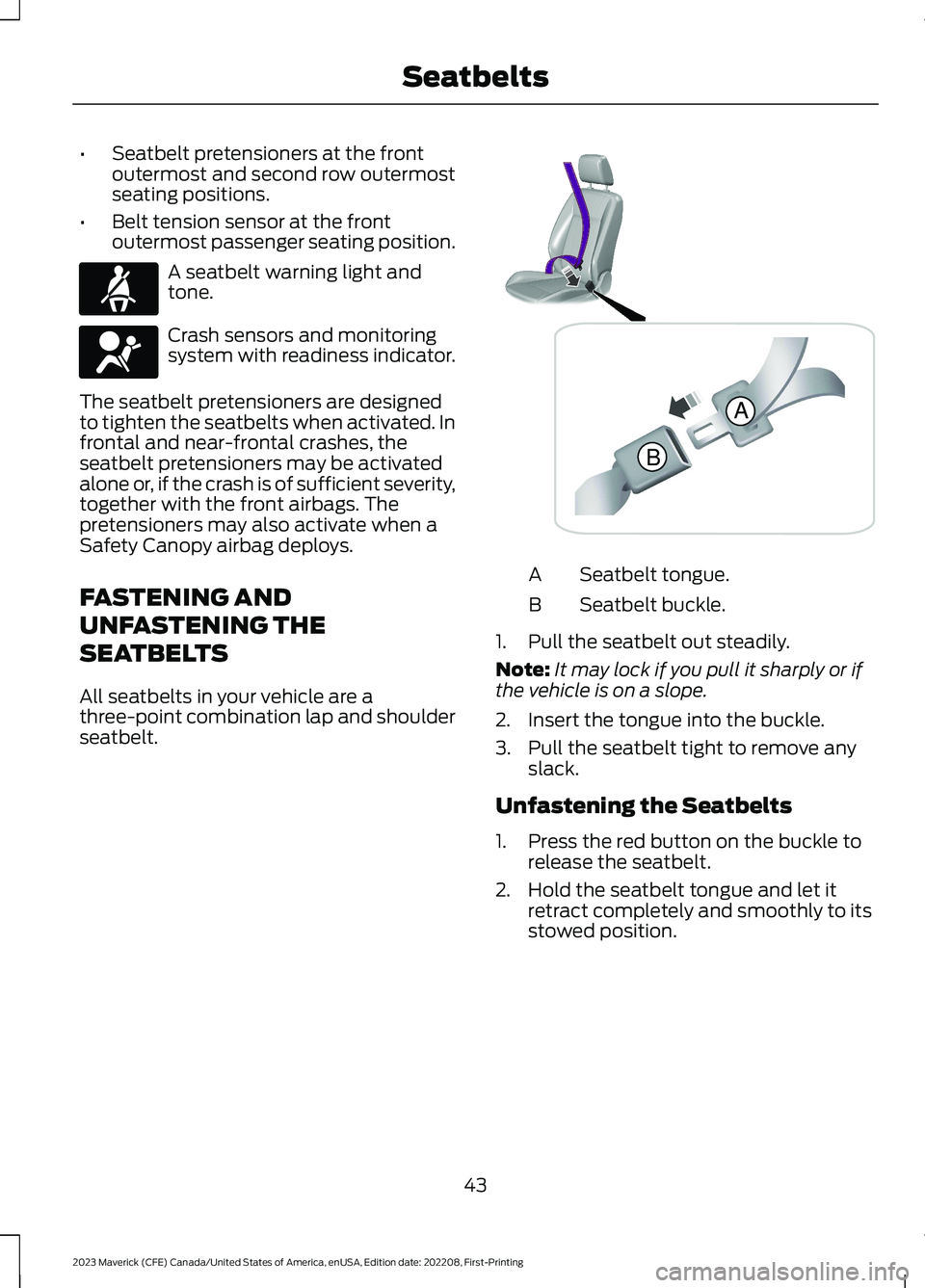
All seatbelts in your vehicle are athree-point combination lap and shoulderseatbelt.
Seatbelt tongue.A
Seatbelt buckle.B
1.Pull the seatbelt out steadily.
Note:It may lock if you pull it sharply or ifthe vehicle is on a slope.
2.Insert the tongue into the buckle.
3.Pull the seatbelt tight to remove anyslack.
Unfastening the Seatbelts
1.Press the red button on the buckle torelease the seatbelt.
2.Hold the seatbelt tongue and let itretract completely and smoothly to itsstowed position.
43
2023 Maverick (CFE) Canada/United States of America, enUSA, Edition date: 202208, First-PrintingSeatbeltsE71880 E67017 BA E338014