light FORD MONDEO 1993 Service Manual PDF
[x] Cancel search | Manufacturer: FORD, Model Year: 1993, Model line: MONDEO, Model: FORD MONDEO 1993Pages: 279, PDF Size: 12.71 MB
Page 123 of 279
5Support the caliper in one hand, and
prevent the hydraulic hose from turning with
the other hand. Unscrew the caliper from the
hose, making sure that the hose is not twisted
unduly or strained. Once the caliper is
detached, plug the open hydraulic unions in
the caliper and hose, to keep out dust and
dirt.
6If required, the caliper carrier bracket can
be unbolted and removed from the steering
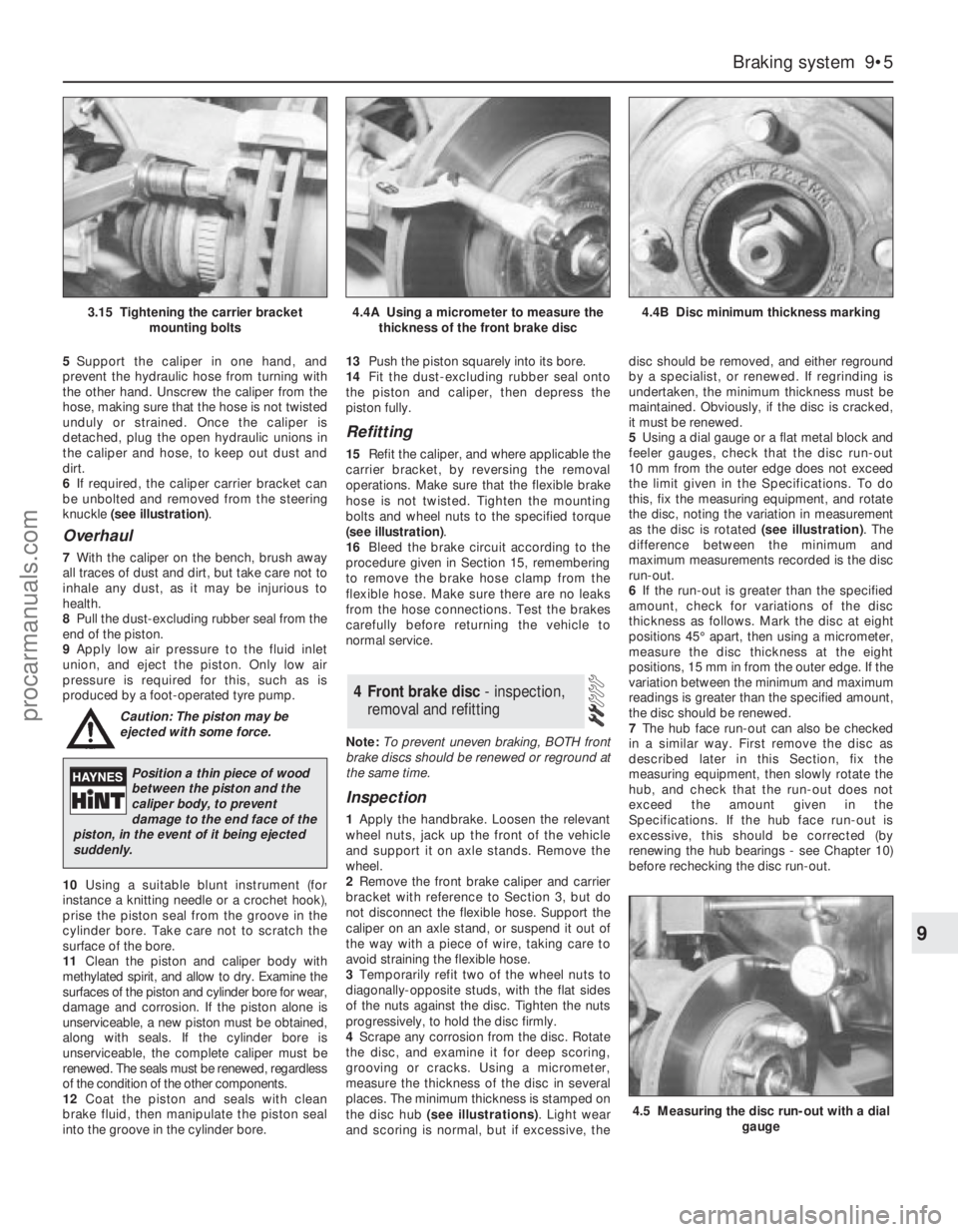
knuckle (see illustration).
Overhaul
7With the caliper on the bench, brush away
all traces of dust and dirt, but take care not to
inhale any dust, as it may be injurious to
health.
8Pull the dust-excluding rubber seal from the
end of the piston.
9Apply low air pressure to the fluid inlet
union, and eject the piston. Only low air
pressure is required for this, such as is
produced by a foot-operated tyre pump.
Caution: The piston may be
ejected with some force.
10Using a suitable blunt instrument (for
instance a knitting needle or a crochet hook),
prise the piston seal from the groove in the
cylinder bore. Take care not to scratch the
surface of the bore.
11Clean the piston and caliper body with
methylated spirit, and allow to dry. Examine the
surfaces of the piston and cylinder bore for wear,
damage and corrosion. If the piston alone is
unserviceable, a new piston must be obtained,
along with seals. If the cylinder bore is
unserviceable, the complete caliper must be
renewed. The seals must be renewed, regardless
of the condition of the other components.
12Coat the piston and seals with clean
brake fluid, then manipulate the piston seal
into the groove in the cylinder bore.13Push the piston squarely into its bore.
14Fit the dust-excluding rubber seal onto
the piston and caliper, then depress the
piston fully.
Refitting
15Refit the caliper, and where applicable the
carrier bracket, by reversing the removal
operations. Make sure that the flexible brake
hose is not twisted. Tighten the mounting
bolts and wheel nuts to the specified torque
(see illustration).
16Bleed the brake circuit according to the
procedure given in Section 15, remembering
to remove the brake hose clamp from the
flexible hose. Make sure there are no leaks
from the hose connections. Test the brakes
carefully before returning the vehicle to
normal service.
Note:To prevent uneven braking, BOTH front
brake discs should be renewed or reground at
the same time.
Inspection
1Apply the handbrake. Loosen the relevant
wheel nuts, jack up the front of the vehicle
and support it on axle stands. Remove the
wheel.
2Remove the front brake caliper and carrier
bracket with reference to Section 3, but do
not disconnect the flexible hose. Support the
caliper on an axle stand, or suspend it out of
the way with a piece of wire, taking care to
avoid straining the flexible hose.
3Temporarily refit two of the wheel nuts to
diagonally-opposite studs, with the flat sides
of the nuts against the disc. Tighten the nuts
progressively, to hold the disc firmly.
4Scrape any corrosion from the disc. Rotate
the disc, and examine it for deep scoring,
grooving or cracks. Using a micrometer,
measure the thickness of the disc in several
places. The minimum thickness is stamped on
the disc hub (see illustrations). Light wear
and scoring is normal, but if excessive, thedisc should be removed, and either reground
by a specialist, or renewed. If regrinding is
undertaken, the minimum thickness must be
maintained. Obviously, if the disc is cracked,
it must be renewed.
5Using a dial gauge or a flat metal block and
feeler gauges, check that the disc run-out
10 mm from the outer edge does not exceed
the limit given in the Specifications. To do
this, fix the measuring equipment, and rotate
the disc, noting the variation in measurement
as the disc is rotated (see illustration). The
difference between the minimum and
maximum measurements recorded is the disc
run-out.
6If the run-out is greater than the specified
amount, check for variations of the disc
thickness as follows. Mark the disc at eight
positions 45° apart, then using a micrometer,
measure the disc thickness at the eight
positions, 15 mm in from the outer edge. If the
variation between the minimum and maximum
readings is greater than the specified amount,
the disc should be renewed.
7The hub face run-out can also be checked
in a similar way. First remove the disc as
described later in this Section, fix the
measuring equipment, then slowly rotate the
hub, and check that the run-out does not
exceed the amount given in the
Specifications. If the hub face run-out is
excessive, this should be corrected (by
renewing the hub bearings - see Chapter 10)
before rechecking the disc run-out.
4 Front brake disc - inspection,
removal and refitting
Braking system 9•5
9
4.5 Measuring the disc run-out with a dial
gauge
3.15 Tightening the carrier bracket
mounting bolts4.4A Using a micrometer to measure the
thickness of the front brake disc4.4B Disc minimum thickness marking
Position a thin piece of wood
between the piston and the
caliper body, to prevent
damage to the end face of the
piston, in the event of it being ejected
suddenly.
procarmanuals.com
Page 126 of 279
6With the drum in position, refit the wheel,
then carry out the renewal procedure on the
remaining rear brake.
7Lower the vehicle to the ground, and
tighten the wheel nuts.
8Depress the brake pedal several times, in
order to operate the self-adjusting mechanism
and set the shoes at their normal operating
position.
9Make several forward and reverse stops,
and operate the handbrake fully two or three
times. Give the vehicle a road test, to make
sure that the brakes are functioning correctly,
and to bed-in the new linings to the contours
of the disc. Remember that the new linings
will not give full braking efficiency until they
have bedded-in.
Note:Before starting work, check on the
availability of parts (overhaul kit of seals). Also
bear in mind that if the brake shoes have been
contaminated by fluid leaking from the wheel
cylinder, they must be renewed. In principle,
the shoes on BOTH sides of the vehicle must
be renewed, even if they are only
contaminated on one side.
Removal
1Remove the brake drum as described in
Section 5.
2Minimise fluid loss either by removing the
master cylinder reservoir cap, and then
tightening it down onto a piece of polythene
to obtain an airtight seal, or by using a brake
hose clamp, a G-clamp, or similar tool, to
clamp the flexible hose at the nearest
convenient point to the wheel cylinder.
3Pull the brake shoes apart at their top ends,
so that they are just clear of the wheel
cylinder. The automatic adjuster will hold the
shoes in this position, so that the cylinder can
be withdrawn.
4Wipe away all traces of dirt around the
hydraulic union at the rear of the wheel
cylinder, then undo the union nut.5Unscrew the two bolts securing the wheel
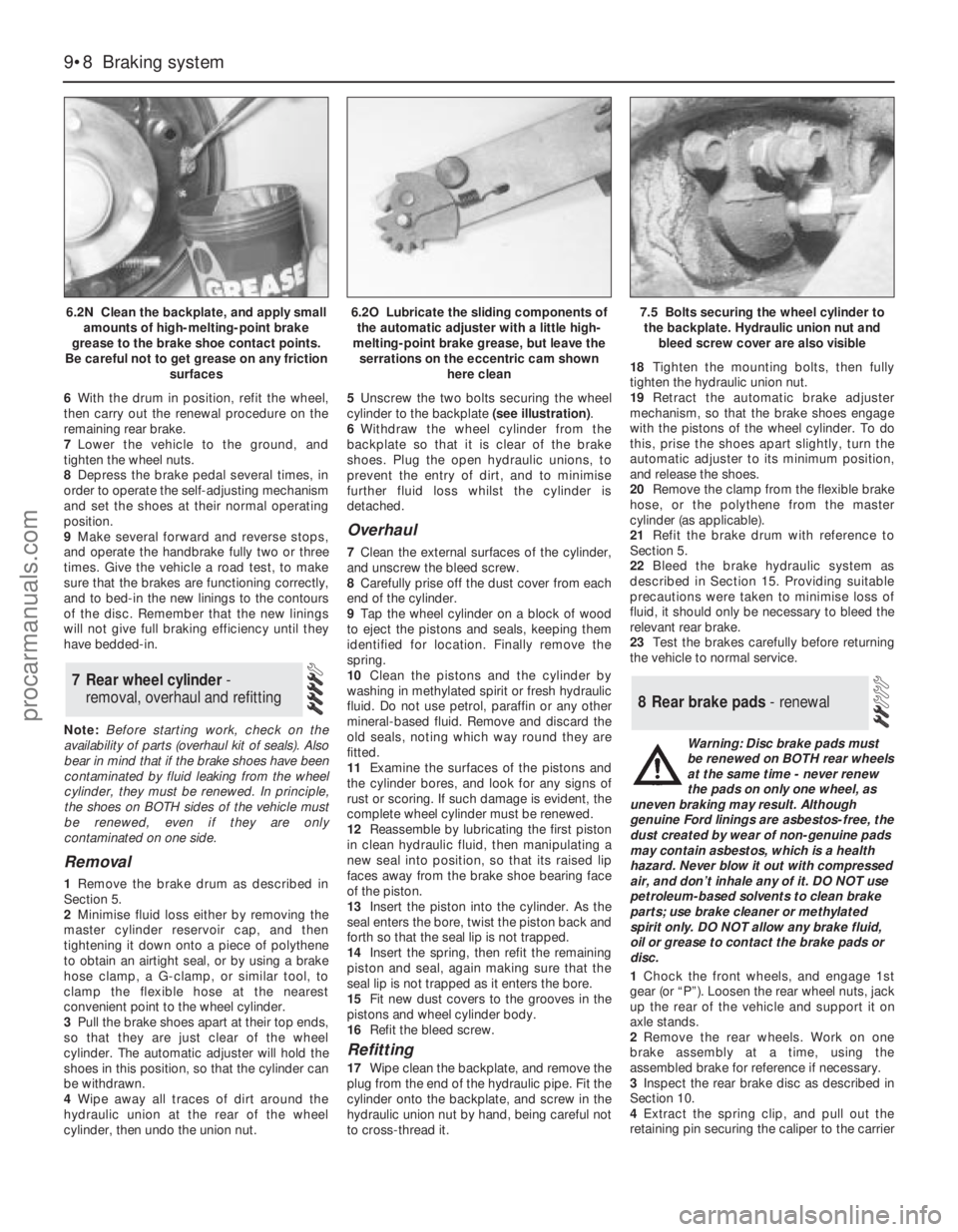
cylinder to the backplate (see illustration).
6Withdraw the wheel cylinder from the
backplate so that it is clear of the brake
shoes. Plug the open hydraulic unions, to
prevent the entry of dirt, and to minimise
further fluid loss whilst the cylinder is
detached.
Overhaul
7Clean the external surfaces of the cylinder,
and unscrew the bleed screw.
8Carefully prise off the dust cover from each
end of the cylinder.
9Tap the wheel cylinder on a block of wood
to eject the pistons and seals, keeping them
identified for location. Finally remove the
spring.
10Clean the pistons and the cylinder by
washing in methylated spirit or fresh hydraulic
fluid. Do not use petrol, paraffin or any other
mineral-based fluid. Remove and discard the
old seals, noting which way round they are
fitted.
11Examine the surfaces of the pistons and
the cylinder bores, and look for any signs of
rust or scoring. If such damage is evident, the
complete wheel cylinder must be renewed.
12Reassemble by lubricating the first piston
in clean hydraulic fluid, then manipulating a
new seal into position, so that its raised lip
faces away from the brake shoe bearing face
of the piston.
13Insert the piston into the cylinder. As the
seal enters the bore, twist the piston back and
forth so that the seal lip is not trapped.
14Insert the spring, then refit the remaining
piston and seal, again making sure that the
seal lip is not trapped as it enters the bore.
15Fit new dust covers to the grooves in the
pistons and wheel cylinder body.
16Refit the bleed screw.
Refitting
17Wipe clean the backplate, and remove the
plug from the end of the hydraulic pipe. Fit the
cylinder onto the backplate, and screw in the
hydraulic union nut by hand, being careful not
to cross-thread it.18Tighten the mounting bolts, then fully
tighten the hydraulic union nut.
19Retract the automatic brake adjuster
mechanism, so that the brake shoes engage
with the pistons of the wheel cylinder. To do
this, prise the shoes apart slightly, turn the
automatic adjuster to its minimum position,
and release the shoes.
20Remove the clamp from the flexible brake
hose, or the polythene from the master
cylinder (as applicable).
21Refit the brake drum with reference to
Section 5.
22Bleed the brake hydraulic system as
described in Section 15. Providing suitable
precautions were taken to minimise loss of
fluid, it should only be necessary to bleed the
relevant rear brake.
23Test the brakes carefully before returning
the vehicle to normal service.
Warning: Disc brake pads must
be renewed on BOTH rear wheels
at the same time - never renew
the pads on only one wheel, as
uneven braking may result. Although
genuine Ford linings are asbestos-free, the
dust created by wear of non-genuine pads
may contain asbestos, which is a health
hazard. Never blow it out with compressed
air, and don’t inhale any of it. DO NOT use
petroleum-based solvents to clean brake
parts; use brake cleaner or methylated
spirit only. DO NOT allow any brake fluid,
oil or grease to contact the brake pads or
disc.
1Chock the front wheels, and engage 1st
gear (or “P”). Loosen the rear wheel nuts, jack
up the rear of the vehicle and support it on
axle stands.
2Remove the rear wheels. Work on one
brake assembly at a time, using the
assembled brake for reference if necessary.
3Inspect the rear brake disc as described in
Section 10.
4Extract the spring clip, and pull out the
retaining pin securing the caliper to the carrier
8 Rear brake pads - renewal
7 Rear wheel cylinder -
removal, overhaul and refitting
9•8 Braking system
6.2N Clean the backplate, and apply small
amounts of high-melting-point brake
grease to the brake shoe contact points.
Be careful not to get grease on any friction
surfaces6.2O Lubricate the sliding components of
the automatic adjuster with a little high-
melting-point brake grease, but leave the
serrations on the eccentric cam shown
here clean7.5 Bolts securing the wheel cylinder to
the backplate. Hydraulic union nut and
bleed screw cover are also visible
procarmanuals.com
Page 127 of 279
bracket. Note that on Saloon and Hatchback
models, the pin is at the bottom of the caliper,
whereas on Estate models, it is at the top.
5Swivel the caliper away from the carrier
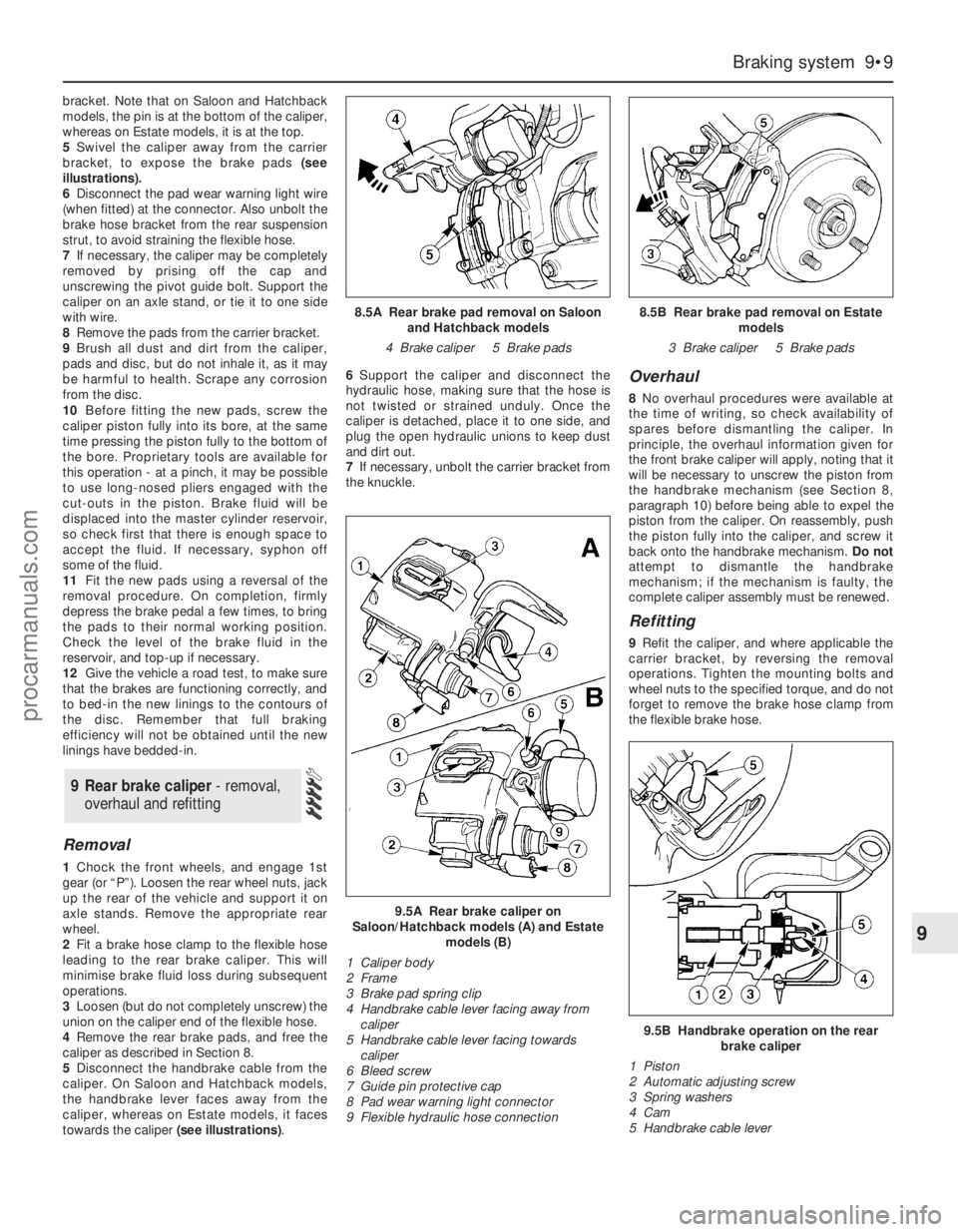
bracket, to expose the brake pads (see
illustrations).
6Disconnect the pad wear warning light wire
(when fitted) at the connector. Also unbolt the
brake hose bracket from the rear suspension
strut, to avoid straining the flexible hose.
7If necessary, the caliper may be completely
removed by prising off the cap and
unscrewing the pivot guide bolt. Support the
caliper on an axle stand, or tie it to one side
with wire.
8Remove the pads from the carrier bracket.
9Brush all dust and dirt from the caliper,
pads and disc, but do not inhale it, as it may
be harmful to health. Scrape any corrosion
from the disc.
10Before fitting the new pads, screw the
caliper piston fully into its bore, at the same
time pressing the piston fully to the bottom of
the bore. Proprietary tools are available for
this operation - at a pinch, it may be possible
to use long-nosed pliers engaged with the
cut-outs in the piston. Brake fluid will be
displaced into the master cylinder reservoir,
so check first that there is enough space to
accept the fluid. If necessary, syphon off
some of the fluid.
11Fit the new pads using a reversal of the
removal procedure. On completion, firmly
depress the brake pedal a few times, to bring
the pads to their normal working position.
Check the level of the brake fluid in the
reservoir, and top-up if necessary.
12Give the vehicle a road test, to make sure
that the brakes are functioning correctly, and
to bed-in the new linings to the contours of
the disc. Remember that full braking
efficiency will not be obtained until the new
linings have bedded-in.
Removal
1Chock the front wheels, and engage 1st
gear (or “P”). Loosen the rear wheel nuts, jack
up the rear of the vehicle and support it on
axle stands. Remove the appropriate rear
wheel.
2Fit a brake hose clamp to the flexible hose
leading to the rear brake caliper. This will
minimise brake fluid loss during subsequent
operations.
3Loosen (but do not completely unscrew) the
union on the caliper end of the flexible hose.
4Remove the rear brake pads, and free the
caliper as described in Section 8.
5Disconnect the handbrake cable from the
caliper. On Saloon and Hatchback models,
the handbrake lever faces away from the
caliper, whereas on Estate models, it faces
towards the caliper (see illustrations).6Support the caliper and disconnect the
hydraulic hose, making sure that the hose is
not twisted or strained unduly. Once the
caliper is detached, place it to one side, and
plug the open hydraulic unions to keep dust
and dirt out.
7If necessary, unbolt the carrier bracket from
the knuckle.
Overhaul
8No overhaul procedures were available at
the time of writing, so check availability of
spares before dismantling the caliper. In
principle, the overhaul information given for
the front brake caliper will apply, noting that it
will be necessary to unscrew the piston from
the handbrake mechanism (see Section 8,
paragraph 10) before being able to expel the
piston from the caliper. On reassembly, push
the piston fully into the caliper, and screw it
back onto the handbrake mechanism. Do not
attempt to dismantle the handbrake
mechanism; if the mechanism is faulty, the
complete caliper assembly must be renewed.
Refitting
9Refit the caliper, and where applicable the
carrier bracket, by reversing the removal
operations. Tighten the mounting bolts and
wheel nuts to the specified torque, and do not
forget to remove the brake hose clamp from
the flexible brake hose.
9 Rear brake caliper - removal,
overhaul and refitting
Braking system 9•9
9
9.5A Rear brake caliper on
Saloon/Hatchback models (A) and Estate
models (B)
1 Caliper body
2 Frame
3 Brake pad spring clip
4 Handbrake cable lever facing away from
caliper
5 Handbrake cable lever facing towards
caliper
6 Bleed screw
7 Guide pin protective cap
8 Pad wear warning light connector
9 Flexible hydraulic hose connection
9.5B Handbrake operation on the rear
brake caliper
1 Piston
2 Automatic adjusting screw
3 Spring washers
4 Cam
5 Handbrake cable lever
8.5A Rear brake pad removal on Saloon
and Hatchback models
4 Brake caliper 5 Brake pads8.5B Rear brake pad removal on Estate
models
3 Brake caliper 5 Brake pads
procarmanuals.com
Page 128 of 279
10Bleed the brake circuit according to the
procedure given in Section 15. Make sure
there are no leaks from the hose connections.
Test the brakes carefully before returning the
vehicle to normal service.
Refer to Section 4 (front disc inspection).
Once the rear caliper is removed, the
procedure is the same.
Removal
1Disconnect the low fluid level warning light
multi-plug from the fluid reservoir filler cap
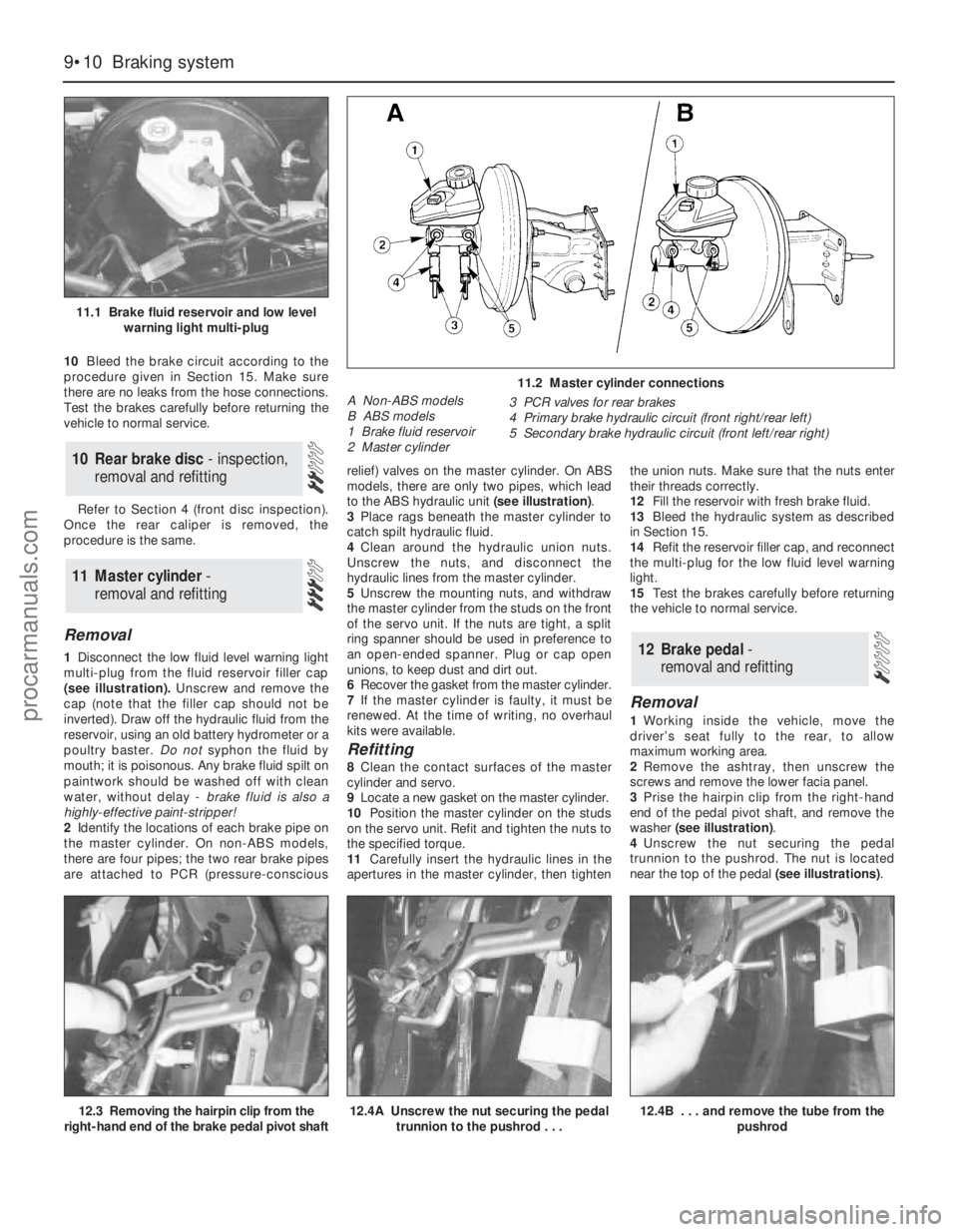
(see illustration).Unscrew and remove the
cap (note that the filler cap should not be
inverted). Draw off the hydraulic fluid from the
reservoir, using an old battery hydrometer or a
poultry baster. Do notsyphon the fluid by
mouth; it is poisonous. Any brake fluid spilt on
paintwork should be washed off with clean
water, without delay - brake fluid is also a
highly-effective paint-stripper!
2Identify the locations of each brake pipe on
the master cylinder. On non-ABS models,
there are four pipes; the two rear brake pipes
are attached to PCR (pressure-consciousrelief) valves on the master cylinder. On ABS
models, there are only two pipes, which lead
to the ABS hydraulic unit (see illustration).
3Place rags beneath the master cylinder to
catch spilt hydraulic fluid.
4Clean around the hydraulic union nuts.
Unscrew the nuts, and disconnect the
hydraulic lines from the master cylinder.
5Unscrew the mounting nuts, and withdraw
the master cylinder from the studs on the front
of the servo unit. If the nuts are tight, a split
ring spanner should be used in preference to
an open-ended spanner. Plug or cap open
unions, to keep dust and dirt out.
6Recover the gasket from the master cylinder.
7If the master cylinder is faulty, it must be
renewed. At the time of writing, no overhaul
kits were available.
Refitting
8Clean the contact surfaces of the master
cylinder and servo.
9Locate a new gasket on the master cylinder.
10Position the master cylinder on the studs
on the servo unit. Refit and tighten the nuts to
the specified torque.
11Carefully insert the hydraulic lines in the
apertures in the master cylinder, then tightenthe union nuts. Make sure that the nuts enter
their threads correctly.
12Fill the reservoir with fresh brake fluid.
13Bleed the hydraulic system as described
in Section 15.
14Refit the reservoir filler cap, and reconnect
the multi-plug for the low fluid level warning
light.
15Test the brakes carefully before returning
the vehicle to normal service.
Removal
1Working inside the vehicle, move the
driver’s seat fully to the rear, to allow
maximum working area.
2Remove the ashtray, then unscrew the
screws and remove the lower facia panel.
3Prise the hairpin clip from the right-hand
end of the pedal pivot shaft, and remove the
washer (see illustration).
4Unscrew the nut securing the pedal
trunnion to the pushrod. The nut is located
near the top of the pedal (see illustrations).
12 Brake pedal-
removal and refitting
11 Master cylinder -
removal and refitting
10 Rear brake disc - inspection,
removal and refitting
9•10 Braking system
11.1 Brake fluid reservoir and low level
warning light multi-plug
11.2 Master cylinder connections
A Non-ABS models
B ABS models
1 Brake fluid reservoir
2 Master cylinder3 PCR valves for rear brakes
4 Primary brake hydraulic circuit (front right/rear left)
5 Secondary brake hydraulic circuit (front left/rear right)
12.3 Removing the hairpin clip from the
right-hand end of the brake pedal pivot shaft12.4A Unscrew the nut securing the pedal
trunnion to the pushrod . . .12.4B . . . and remove the tube from the
pushrod
procarmanuals.com
Page 131 of 279
and remove the clevis pin securing the servo
unit pushrod to the pedal cross-link arm.
7On left-hand drive models, unscrew the nut
securing the pedal trunnion to the servo unit
pushrod inside the passenger compartment.
The nut is located near the top of the pedal,
and is accessible through an access hole. For
improved access, remove the lower facia
panel first.
8Withdraw the servo unit from the bulkhead,
and remove it from the engine compartment.
On left-hand drive models, take care not to
damage the bulkhead rubber grommet as the
pushrod passes through it.
9Note that the servo unit cannot be
dismantled for repair or overhaul and, if faulty,
must be renewed.
Refitting
10Refitting is a reversal of the removal
procedure. Refer to Section 11 for details of
refitting the master cylinder.
Removal
1Depress the brake pedal four or five times,
to dissipate any remaining vacuum from the
servo unit.
2Disconnect the vacuum hose adaptor at the
servo unit, by pulling it free from the rubber
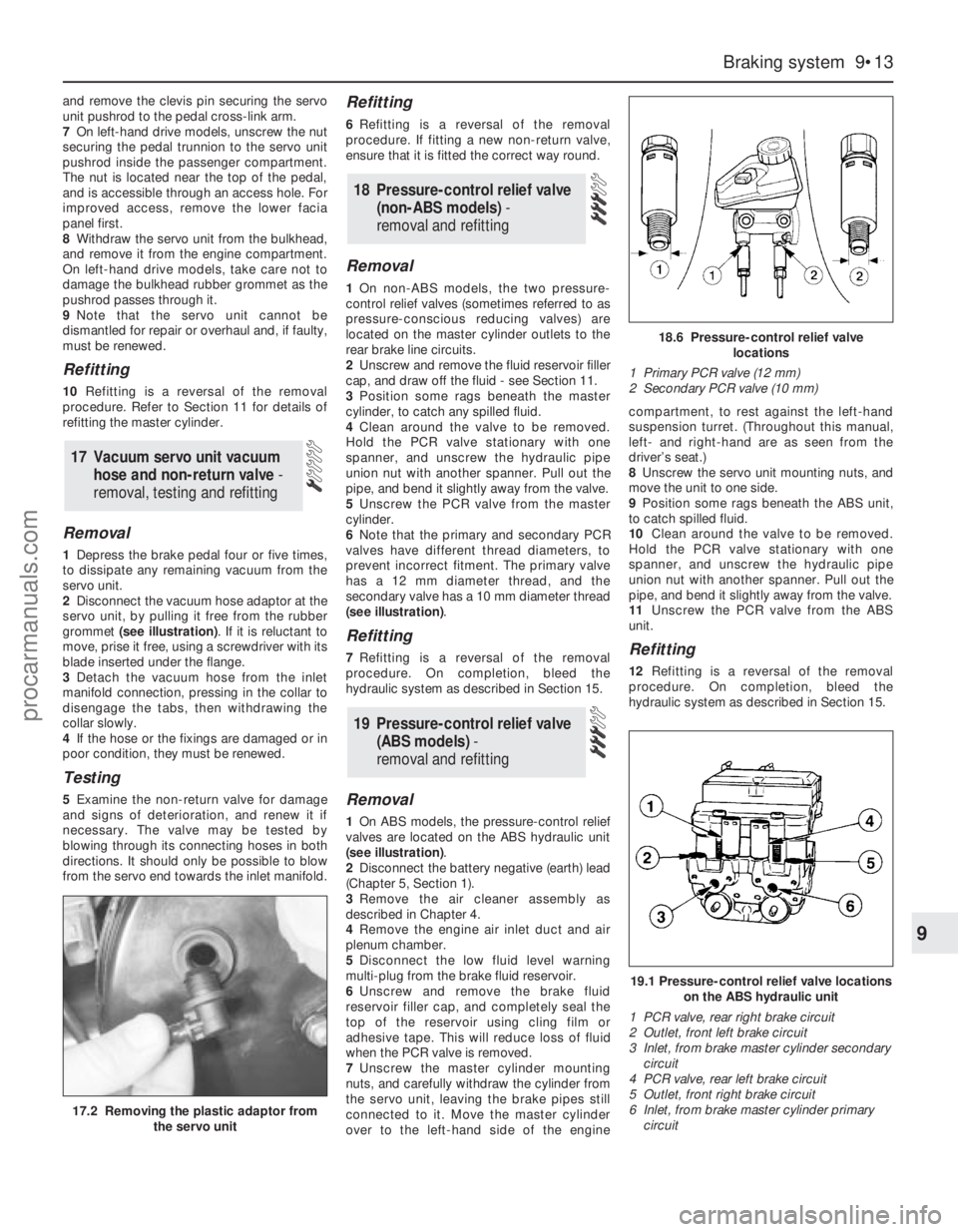
grommet (see illustration). If it is reluctant to
move, prise it free, using a screwdriver with its
blade inserted under the flange.
3Detach the vacuum hose from the inlet
manifold connection, pressing in the collar to
disengage the tabs, then withdrawing the
collar slowly.
4If the hose or the fixings are damaged or in
poor condition, they must be renewed.
Testing
5Examine the non-return valve for damage
and signs of deterioration, and renew it if
necessary. The valve may be tested by
blowing through its connecting hoses in both
directions. It should only be possible to blow
from the servo end towards the inlet manifold.
Refitting
6Refitting is a reversal of the removal
procedure. If fitting a new non-return valve,
ensure that it is fitted the correct way round.
Removal
1On non-ABS models, the two pressure-
control relief valves (sometimes referred to as
pressure-conscious reducing valves) are
located on the master cylinder outlets to the
rear brake line circuits.
2Unscrew and remove the fluid reservoir filler
cap, and draw off the fluid - see Section 11.
3Position some rags beneath the master
cylinder, to catch any spilled fluid.
4Clean around the valve to be removed.
Hold the PCR valve stationary with one
spanner, and unscrew the hydraulic pipe
union nut with another spanner. Pull out the
pipe, and bend it slightly away from the valve.
5Unscrew the PCR valve from the master
cylinder.
6Note that the primary and secondary PCR
valves have different thread diameters, to
prevent incorrect fitment. The primary valve
has a 12 mm diameter thread, and the
secondary valve has a 10 mm diameter thread
(see illustration).
Refitting
7Refitting is a reversal of the removal
procedure. On completion, bleed the
hydraulic system as described in Section 15.
Removal
1On ABS models, the pressure-control relief
valves are located on the ABS hydraulic unit
(see illustration).
2Disconnect the battery negative (earth) lead
(Chapter 5, Section 1).
3Remove the air cleaner assembly as
described in Chapter 4.
4Remove the engine air inlet duct and air
plenum chamber.
5Disconnect the low fluid level warning
multi-plug from the brake fluid reservoir.
6Unscrew and remove the brake fluid
reservoir filler cap, and completely seal the
top of the reservoir using cling film or
adhesive tape. This will reduce loss of fluid
when the PCR valve is removed.
7Unscrew the master cylinder mounting
nuts, and carefully withdraw the cylinder from
the servo unit, leaving the brake pipes still
connected to it. Move the master cylinder
over to the left-hand side of the enginecompartment, to rest against the left-hand
suspension turret. (Throughout this manual,
left- and right-hand are as seen from the
driver’s seat.)
8Unscrew the servo unit mounting nuts, and
move the unit to one side.
9Position some rags beneath the ABS unit,
to catch spilled fluid.
10Clean around the valve to be removed.
Hold the PCR valve stationary with one
spanner, and unscrew the hydraulic pipe
union nut with another spanner. Pull out the
pipe, and bend it slightly away from the valve.
11Unscrew the PCR valve from the ABS
unit.
Refitting
12Refitting is a reversal of the removal
procedure. On completion, bleed the
hydraulic system as described in Section 15.
19 Pressure-control relief valve
(ABS models) -
removal and refitting
18 Pressure-control relief valve
(non-ABS models) -
removal and refitting
17 Vacuum servo unit vacuum
hose and non-return valve -
removal, testing and refitting
Braking system 9•13
9
17.2 Removing the plastic adaptor from
the servo unit
18.6 Pressure-control relief valve
locations
1 Primary PCR valve (12 mm)
2 Secondary PCR valve (10 mm)
19.1 Pressure-control relief valve locations
on the ABS hydraulic unit
1 PCR valve, rear right brake circuit
2 Outlet, front left brake circuit
3 Inlet, from brake master cylinder secondary
circuit
4 PCR valve, rear left brake circuit
5 Outlet, front right brake circuit
6 Inlet, from brake master cylinder primary
circuit
procarmanuals.com
Page 133 of 279
5Slacken and remove the four Torx retaining
screws, and withdraw the relay box from the
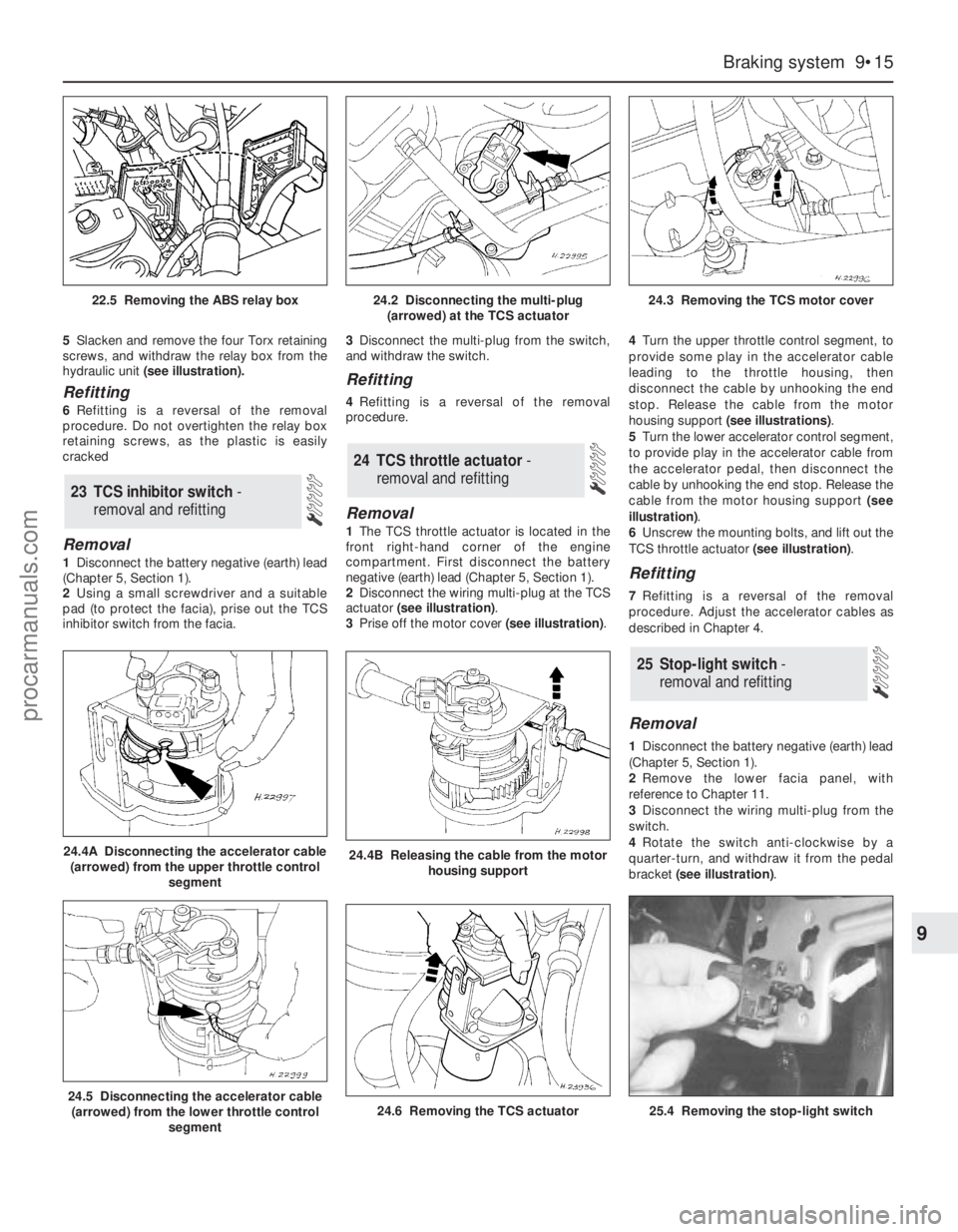
hydraulic unit (see illustration).
Refitting
6Refitting is a reversal of the removal
procedure. Do not overtighten the relay box
retaining screws, as the plastic is easily
cracked
Removal
1Disconnect the battery negative (earth) lead
(Chapter 5, Section 1).
2Using a small screwdriver and a suitable
pad (to protect the facia), prise out the TCS
inhibitor switch from the facia.3Disconnect the multi-plug from the switch,
and withdraw the switch.
Refitting
4Refitting is a reversal of the removal
procedure.
Removal
1The TCS throttle actuator is located in the
front right-hand corner of the engine
compartment. First disconnect the battery
negative (earth) lead (Chapter 5, Section 1).
2Disconnect the wiring multi-plug at the TCS
actuator (see illustration).
3Prise off the motor cover (see illustration).4Turn the upper throttle control segment, to
provide some play in the accelerator cable
leading to the throttle housing, then
disconnect the cable by unhooking the end
stop. Release the cable from the motor
housing support (see illustrations).
5Turn the lower accelerator control segment,
to provide play in the accelerator cable from
the accelerator pedal, then disconnect the
cable by unhooking the end stop. Release the
cable from the motor housing support (see
illustration).
6Unscrew the mounting bolts, and lift out the
TCS throttle actuator (see illustration).
Refitting
7Refitting is a reversal of the removal
procedure. Adjust the accelerator cables as
described in Chapter 4.
Removal
1Disconnect the battery negative (earth) lead
(Chapter 5, Section 1).
2Remove the lower facia panel, with
reference to Chapter 11.
3Disconnect the wiring multi-plug from the
switch.
4Rotate the switch anti-clockwise by a
quarter-turn, and withdraw it from the pedal
bracket (see illustration).
25 Stop-light switch -
removal and refitting
24 TCS throttle actuator -
removal and refitting
23 TCS inhibitor switch -
removal and refitting
Braking system 9•15
9
24.4B Releasing the cable from the motor
housing support24.4A Disconnecting the accelerator cable
(arrowed) from the upper throttle control
segment
24.5 Disconnecting the accelerator cable
(arrowed) from the lower throttle control
segment24.6 Removing the TCS actuator
22.5 Removing the ABS relay box24.2 Disconnecting the multi-plug
(arrowed) at the TCS actuator24.3 Removing the TCS motor cover
25.4 Removing the stop-light switch
procarmanuals.com
Page 134 of 279
Refitting and adjustment
5With the switch removed, reset it by fully
extending its plunger.
6Depress the brake pedal until the distance
between the pedal and mounting bracket is as
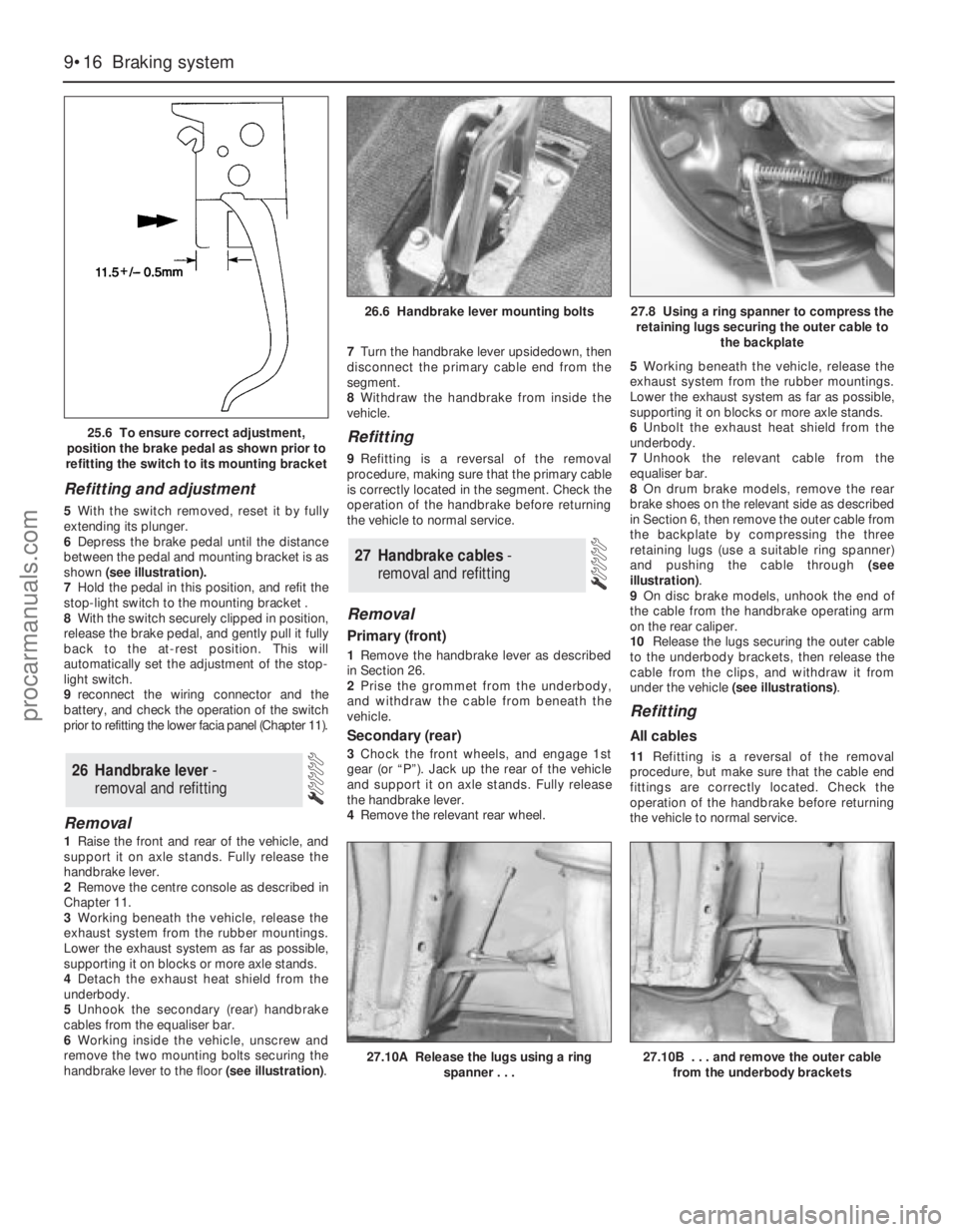
shown (see illustration).
7Hold the pedal in this position, and refit the
stop-light switch to the mounting bracket .
8With the switch securely clipped in position,
release the brake pedal, and gently pull it fully
back to the at-rest position. This will
automatically set the adjustment of the stop-
light switch.
9reconnect the wiring connector and the
battery, and check the operation of the switch
prior to refitting the lower facia panel (Chapter 11).
Removal
1Raise the front and rear of the vehicle, and
support it on axle stands. Fully release the
handbrake lever.
2Remove the centre console as described in
Chapter 11.
3Working beneath the vehicle, release the
exhaust system from the rubber mountings.
Lower the exhaust system as far as possible,
supporting it on blocks or more axle stands.
4Detach the exhaust heat shield from the
underbody.
5Unhook the secondary (rear) handbrake
cables from the equaliser bar.
6Working inside the vehicle, unscrew and
remove the two mounting bolts securing the
handbrake lever to the floor (see illustration).7Turn the handbrake lever upsidedown, then
disconnect the primary cable end from the
segment.
8Withdraw the handbrake from inside the
vehicle.
Refitting
9Refitting is a reversal of the removal
procedure, making sure that the primary cable
is correctly located in the segment. Check the
operation of the handbrake before returning
the vehicle to normal service.
Removal
Primary (front)
1Remove the handbrake lever as described
in Section 26.
2Prise the grommet from the underbody,
and withdraw the cable from beneath the
vehicle.
Secondary (rear)
3Chock the front wheels, and engage 1st
gear (or “P”). Jack up the rear of the vehicle
and support it on axle stands. Fully release
the handbrake lever.
4Remove the relevant rear wheel.5Working beneath the vehicle, release the
exhaust system from the rubber mountings.
Lower the exhaust system as far as possible,
supporting it on blocks or more axle stands.
6Unbolt the exhaust heat shield from the
underbody.
7Unhook the relevant cable from the
equaliser bar.
8On drum brake models, remove the rear
brake shoes on the relevant side as described
in Section 6, then remove the outer cable from
the backplate by compressing the three
retaining lugs (use a suitable ring spanner)
and pushing the cable through (see
illustration).
9On disc brake models, unhook the end of
the cable from the handbrake operating arm
on the rear caliper.
10Release the lugs securing the outer cable
to the underbody brackets, then release the
cable from the clips, and withdraw it from
under the vehicle (see illustrations).
Refitting
All cables
11Refitting is a reversal of the removal
procedure, but make sure that the cable end
fittings are correctly located. Check the
operation of the handbrake before returning
the vehicle to normal service.
27 Handbrake cables -
removal and refitting
26 Handbrake lever -
removal and refitting
9•16 Braking system
25.6 To ensure correct adjustment,
position the brake pedal as shown prior to
refitting the switch to its mounting bracket
26.6 Handbrake lever mounting bolts27.8 Using a ring spanner to compress the
retaining lugs securing the outer cable to
the backplate
27.10A Release the lugs using a ring
spanner . . .27.10B . . . and remove the outer cable
from the underbody brackets
procarmanuals.com
Page 138 of 279
constantly monitors the oxygen content of the
exhaust gas. If the percentage of oxygen in
the exhaust gas is incorrect, an electrical
signal is sent to the ECU. The ECU processes
this information, and then sends a command
to the fuel injection system, telling it to change
the air/fuel mixture; the end result is an air/fuel
mixture ratio which is constantly maintained
at a predetermined ratio, regardless of driving
conditions. This happens in a fraction of a
second, and goes on almost all the time while
the engine is running - the exceptions are that
the ECU cuts out the system and runs the
engine on values pre-programmed
(“mapped”) into its memory both while the
oxygen sensor is reaching its normal
operating temperature after the engine has
been started from cold, and when the throttle
is fully open for full acceleration.
In the event of a sensor malfunction, a
back-up circuit will take over, to provide
driveability until the problem is identified and
fixed.
Precautions
(a) Always disconnect the power by
uncoupling the battery terminals - see
Section 1 of Chapter 5 - before removing
any of the electronic control system’s
electrical connectors.
(b) When installing a battery, be particularly
careful to avoid reversing the positive and
negative battery leads.
(c) Do not subject any components of the
system (especially the ECU) to severe
impact during removal or installation.
(d) Do not be careless during fault diagnosis.
Even slight terminal contact can invalidate
a testing procedure, and damage one of
the numerous transistor circuits.
(e) Never attempt to work on the ECU, to test
it (with any kind of test equipment), or to
open its cover.
(f) If you are inspecting electronic control
system components during rainy weather,
make sure that water does not enter any
part. When washing the engine
compartment, do not spray these parts or
their electrical connectors with water.
General
The various components of the fuel, ignition
and emissions control systems (not forgetting
the same ECU’s control of sub-systems such
as the radiator cooling fan, air conditioning
and automatic transmission, where
appropriate) are so closely interlinked that
diagnosis of a fault in any one component is
virtually impossible using traditional methods.
Working on simpler systems in the past, the
experienced mechanic may well have been
able to use personal skill and knowledge
immediately to pinpoint the cause of a fault, or
quickly to isolate the fault, by elimination;however, with an engine management system
integrated to this degree, this is not likely to
be possible in most instances, because of the
number of symptoms that could arise from
even a minor fault.
So that the causes of faults can be quickly
and accurately traced and rectified, the ECU
is provided with a built-in self-diagnosis
facility, which detects malfunctions in the
system’s components. When a fault occurs,
three things happen: the ECU identifies the
fault, stores a corresponding code in its
memory, and (in most cases) runs the system
using back-up values pre-programmed
(“mapped”) into its memory; some form of
driveability is thus maintained, to enable the
vehicle to be driven to a garage for attention.
Any faults that may have occurred are
indicated in the form of three-digit codes
when the system is connected (via the built-in
diagnosis or self-test connectors, as
appropriate) to special diagnostic equipment -
this points the user in the direction of the
faulty circuit, so that further tests can pinpoint
the exact location of the fault.
Given below is the procedure that would be
followed by a Ford technician to trace a fault
from scratch. Should your vehicle’s engine
management system develop a fault, read
through the procedure and decide how much
you can attempt, depending on your skill and
experience and the equipment available to
you, or whether it would be simpler to have
the vehicle attended to by your local Ford
dealer. If you are concerned about the
apparent complexity of the system, however,
remember the comments made in the fourth
paragraph of Section 1 of this Chapter; the
preliminary checks require nothing but care,
patience and a few minor items of equipment,
and may well eliminate the majority of faults.
(a) Preliminary checks
(b) Fault code read-out *
(c) Check ignition timing and base idle
speed. Recheck fault codes to establish
whether fault has been cured or not *
(d) Carry out basic check of ignition system
components. Recheck fault codes to
establish whether fault has been cured or
not *
(e) Carry out basic check of fuel system
components. Recheck fault codes to
establish whether fault has been cured or
not *
(f) If fault is still not located, carry out system
test *
Note:Operations marked with an asterisk
require special test equipment.
Preliminary checks
Note:When carrying out these checks to
trace a fault, remember that if the fault has
appeared only a short time after any part of
the vehicle has been serviced or overhauled,
the first place to check is where that work was
carried out, however unrelated it may appear,
to ensure that no carelessly-refitted
components are causing the problem.If you are tracing the cause of a “partial”
engine fault, such as lack of performance, in
addition to the checks outlined below, check
the compression pressures (see Part A of
Chapter 2) and bear in mind the possibility
that one of the hydraulic tappets might be
faulty, producing an incorrect valve clearance.
Check also that the fuel filter has been
renewed at the recommended intervals.
If the system appears completely dead,
remember the possibility that the
alarm/inhibitor system may be responsible.
1The first check for anyone without special
test equipment is to switch on the ignition,
and to listen for the fuel pump (the sound of
an electric motor running, audible from
beneath the rear seats); assuming there is
sufficient fuel in the tank, the pump should
start and run for approximately one or two
seconds, then stop, each time the ignition is
switched on. If the pump runs continuously all
the time the ignition is switched on, the
electronic control system is running in the
back-up (or “limp-home”) mode referred to by
Ford as “Limited Operation Strategy” (LOS).
This almost certainly indicates a fault in the
ECU itself, and the vehicle should therefore be
taken to a Ford dealer for a full test of the
complete system using the correct diagnostic
equipment; do not waste time trying to test
the system without such facilities.
2If the fuel pump is working correctly (or not
at all), a considerable amount of fault
diagnosis is still possible without special test
equipment. Start the checking procedure as
follows.
3Open the bonnet and check the condition
of the battery connections - remake the
connections or renew the leads if a fault is
found (Chapter 5). Use the same techniques
to ensure that all earth points in the engine
compartment provide good electrical contact
through clean, metal-to-metal joints, and that
all are securely fastened. (In addition to the
earth connection at the engine lifting eye and
that from the transmission to the
body/battery, there is one earth connection
behind each headlight assembly, and one
below the power steering fluid reservoir.)
4Referring to the information given in
Chapter 12 and in the wiring diagrams at the
back of this manual, check that all fuses
protecting the circuits related to the engine
management system are in good condition.
Fit new fuses if required; while you are there,
check that all relays are securely plugged into
their sockets.
5Next work methodically around the engine
compartment, checking all visible wiring, and
the connections between sections of the
wiring loom. What you are looking for at this
stage is wiring that is obviously damaged by
chafing against sharp edges, or against
moving suspension/transmission components
and/or the auxiliary drivebelt, by being
trapped or crushed between carelessly-
refitted components, or melted by being
forced into contact with hot engine castings,
3 Diagnosis system -
general information
6•4 Emissions control systems
procarmanuals.com
Page 140 of 279
back again, as an assistant depresses the
accelerator pedal. If the valve shows any sign
of stiffness, sticking or otherwise-inhibited
movement (and the accelerator cable is
known from the previous check to be in good
condition), spray the throttle linkage with
penetrating lubricant, allow time for it to work,
and repeat the check; if no improvement is
obtained, the complete throttle housing must
be renewed (Chapter 4).
15Unclip the air cleaner cover, and check
that the air filter element and the crankcase
ventilation system filter are not clogged or
soaked. (A clogged air filter will obstruct the
intake air flow, causing a noticeable effect on
engine performance; a clogged crankcase
ventilation system filter will inhibit crankcase
“breathing”). Renew or clean the filter(s) as
appropriate; refer to the relevant Sections of
Chapter 1 for further information, if required.
Before refitting the air cleaner cover, check
that the air intake (located under the front left-
hand wing, opening behind the direction
indicator/headlight assembly) is clear. It
should be possible to blow through the intake,
or to probe it (carefully) as far as the rear of
the direction indicator light.
16Start the engine and allow it to idle.
Note:Working in the engine compartment
while the engine is running requires great care
if the risk of personal injury is to be avoided;
among the dangers are burns from contact
with hot components, or contact with moving
components such as the radiator cooling fan
or the auxiliary drivebelt. Refer to “Safety
first!” at the front of this manual before
starting, and ensure that your hands, and long
hair or loose clothing, are kept well clear of hot
or moving components at all times.
17Working from the air intake junction at the
inner wing panel, via the air cleaner assembly
and air mass meter, to the resonator, plenum
chamber, throttle housing and inlet manifold
(and including the various vacuum hoses and
pipes connected to these), check for air leaks.
Usually, these will be revealed by sucking or
hissing noises, but minor leaks may be traced
by spraying a solution of soapy water on to
the suspect joint; if a leak exists, it will be
shown by the change in engine note and the
accompanying air bubbles (or sucking-in of
the liquid, depending on the pressure
difference at that point). If a leak is found at
any point, tighten the fastening clamp and/or
renew the faulty components, as applicable.
18Similarly, work from the cylinder head, via
the manifold (and not forgetting the related
EGR and pulse-air system components) to the
tailpipe, to check that the exhaust system is
free from leaks. The simplest way of doing
this, if the vehicle can be raised and
supported safely and with complete security
while the check is made, is to temporarily
block the tailpipe while listening for the sound
of escaping exhaust gases; any leak should
be evident. If a leak is found at any point,
tighten the fastening clamp bolts and/or nuts,
renew the gasket, and/or renew the faultysection of the system, as necessary, to seal
the leak.
19It is possible to make a further check of
the electrical connections by wiggling each
electrical connector of the system in turn as
the engine is idling; a faulty connector will be
immediately evident from the engine’s
response as contact is broken and remade. A
faulty connector should be renewed to ensure
the future reliability of the system; note that
this may mean the renewal of that entire
section of the loom - see your local Ford
dealer for details.
20Switch off the engine. If the fault is not yet
identified, the next step is to check the
ignition voltages, using an engine analyser
with an oscilloscope - without such
equipment, the only tests possible are to
remove and check each spark plug in turn, to
check the spark plug (HT) lead connections
and resistances, and to check the
connections and resistances of the ignition
coil. Refer to the relevant Sections of
Chapters 1 and 5.
21The final step in these preliminary checks
would be to use an exhaust gas analyser to
measure the CO level at the exhaust tailpipe.This check cannot be made without special
test equipment - see your local Ford dealer for
details.
Fault code read-out
22As noted in the general comments at the
beginning of this Section, the preliminary
checks outlined above should eliminate the
majority of faults from the engine
management system. If the fault is not yet
identified, the next step is to connect a fault
code reader to the ECU, so that its self-
diagnosis facility can be used to identify the
faulty part of the system; further tests can
then be made to identify the exact cause of
the fault.
23In their basic form, fault code readers are
simply hand-held electronic devices, which
take data stored within an ECU’s memory and
display it when required as two- or three-digit
fault codes. The more sophisticated versions
now available can also control sensors and
actuators, to provide more effective testing;
some can store information, so that a road
test can be carried out, and any faults
encountered during the test can be displayed
afterwards.
6•6 Emissions control systems
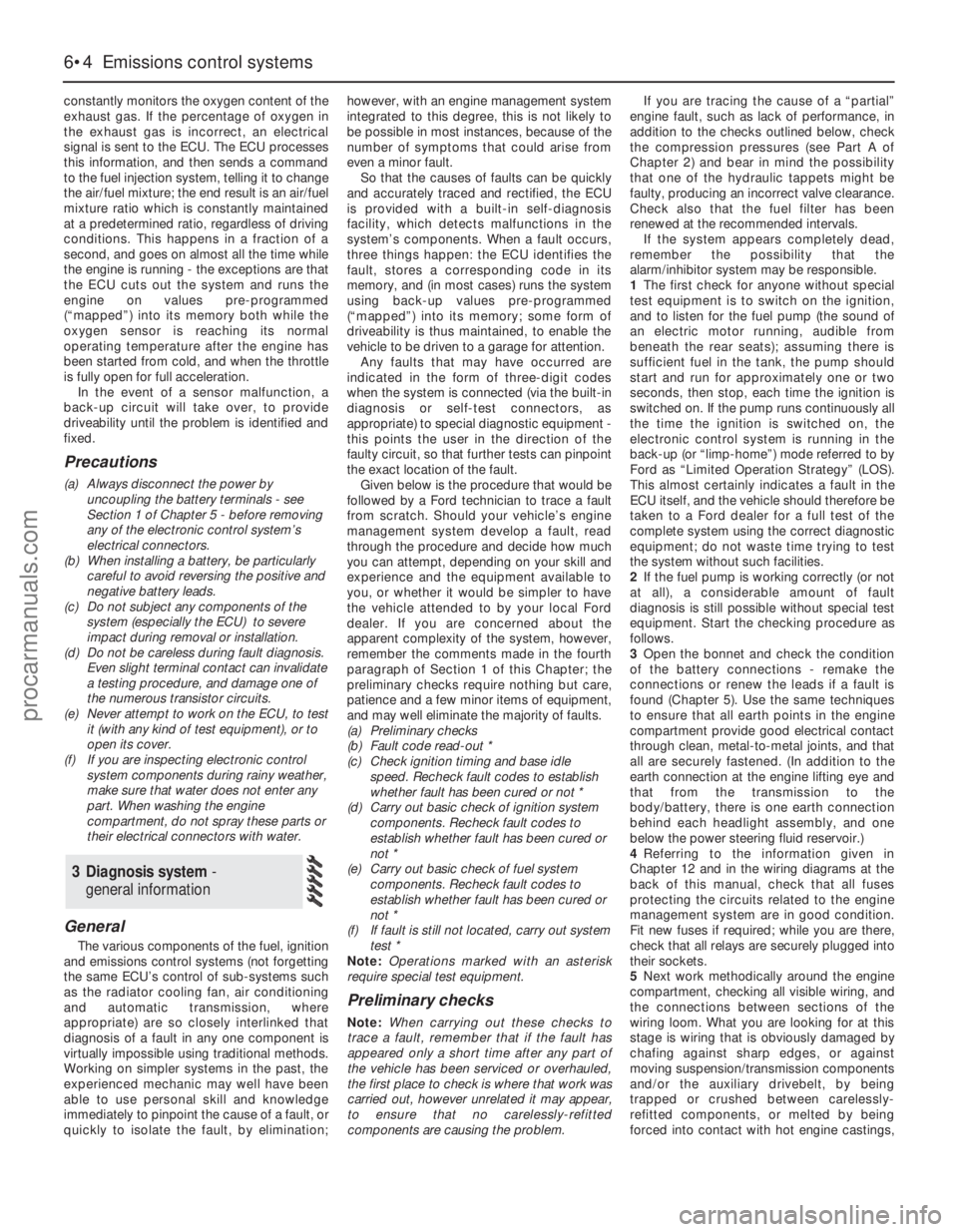
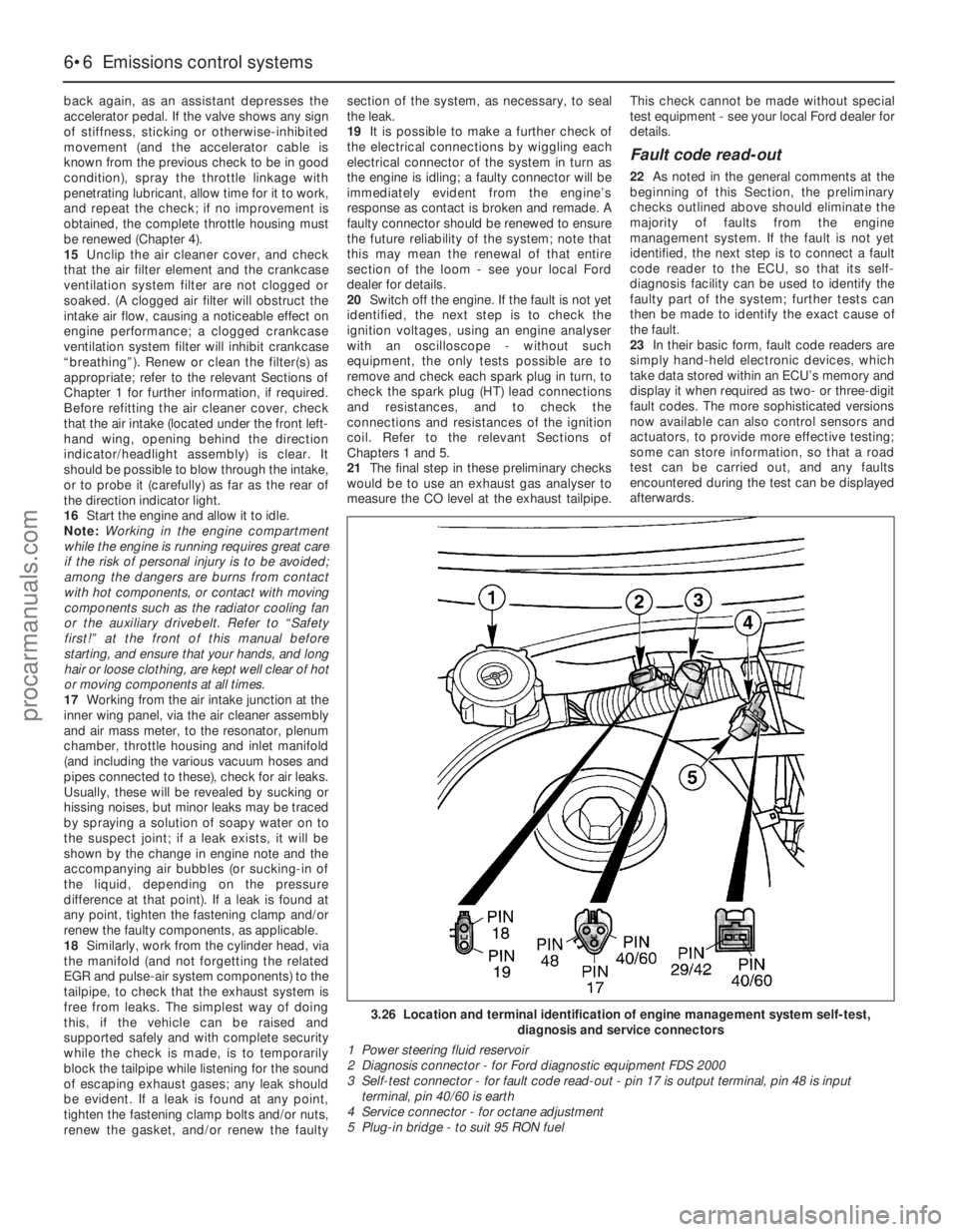
3.26 Location and terminal identification of engine management system self-test,
diagnosis and service connectors
1 Power steering fluid reservoir
2 Diagnosis connector - for Ford diagnostic equipment FDS 2000
3 Self-test connector - for fault code read-out - pin 17 is output terminal, pin 48 is input
terminal, pin 40/60 is earth
4 Service connector - for octane adjustment
5 Plug-in bridge - to suit 95 RON fuel
procarmanuals.com
Page 141 of 279
24Ford specify the use of their STAR (Self-
Test Automatic Readout) tester; most Ford
dealers should have such equipment, and the
staff trained to use it effectively. The only
alternatives are as follows:
(a) To obtain one of those proprietary readers
which can interpret EEC-IV three-digit
codes - at present, such readers are too
expensive for the DIY enthusiast, but are
becoming more popular with smaller
specialist garages.
(b) To use an analogue voltmeter, whereby
the stored codes are displayed as sweeps
of the voltmeter needle. This option limits
the operator to a read-out of any codes
stored - ie, there is no control of sensors
and/or actuators - but can still be useful in
pinpointing the faulty part of the engine
management system. The display is
interpreted as follows. Each code
(whether fault code or
command/separator) is marked by a
three-to-four second pause - code “538”
would therefore be shown as long (3 to
4 seconds) pause, five fast sweeps of the
needle, slight (1 second) pause, three fast
sweeps, slight pause, eight fast sweeps,
long pause.
(c) Owners without access to such
equipment must take the vehicle to a Ford
dealer, or to an expert who has similar
equipment and the skill to use it.
25Because of the variations in the design of
fault code readers, it is not possible to give
exact details of the sequence of tests; the
manufacturer’s instructions must be followed,
in conjunction with the codes given below.
The following ten paragraphs outline the
procedure to be followed using a version of
the Ford STAR tester, to illustrate the general
principles, as well as notes to guide the owner
using only a voltmeter.
26The vehicle must be prepared by applying
the handbrake, switching off the air
conditioning (where fitted) and any other
electrical loads (lights, heated rear window,
etc), then selecting neutral (manual
transmission) or the “P” position (automatic
transmission). Where the engine is required to
be running, it must be fully warmed-up to
normal operating temperature before the test
is started. Using any adaptors required,
connect the fault code reader to the system
via the (triangular, three-pin) self-test
connector on the right-hand end of the engine
compartment bulkhead (see illustration). If a
voltmeter is being used, connect its positive
lead to the battery positive terminal, and its
negative lead to the self-test connector’s
output terminal, pin 17. Have a pen and paper
ready to write down the codes displayed.
27Set the tester in operation. For the Ford
STAR tester, a display check will be carried
out and the test mode requirements must be
entered. If a voltmeter is being used, connect
a spare length of wire to earth the self-test
connector’s input terminal, pin 48. Be very
careful to ensure that you earth the correctterminal - the one with the white/green wire.
The first part of the test starts, with the
ignition switched on, but with the engine off.
On pressing the “Mem/test” button, the tester
displays “TEST” and the ready code “000”,
followed by a command code “010” - the
accelerator pedal must be fully depressed
within 10 seconds of the command code
appearing, or fault codes “576” or “577” will
appear when they are called up later. If a
voltmeter is being used, code “000” will not
appear (except perhaps as a flicker of the
needle) and “010” will appear as a single
sweep - to ensure correct interpretation of the
display, watch carefully for the interval
between the end of one code and the
beginning of the next, otherwise you will
become confused and misinterpret the read-
out.
28The tester will then display the codes for
any faults in the system at the time of the test.
Each code is repeated once; if no faults are
present, code “111” will be displayed. If a
voltmeter is being used, the pause between
repetitions will vary according to the
equipment in use and the number of faults in
the system, but was found to be
approximately 3 to 4 seconds - it may be
necessary to start again, and to repeat the
read-out until you are familiar with what you
are seeing.
29Next the tester will display code “010”
(now acting as a separator), followed by the
codes for any faults stored in the ECU’s
memory; if no faults were stored, code “111”
will be displayed.
30When prompted by the tester, the
operator must next depress the accelerator
pedal fully; the tester then checks several
actuators. Further test modes include a
“wiggle test” facility, whereby the operator
can check the various connectors as
described in paragraph 19 above (in this case,
any fault will be logged and the appropriate
code will be displayed), a facility for recalling
codes displayed, and a means for clearing the
ECU’s memory at the end of the test
procedure when any faults have been
rectified.
31The next step when using the Ford STAR
tester is to conduct a test with the engine
running. With the tester set in operation (see
paragraph 26 above) the engine is started and
allowed to idle. On pressing the “Mem/test”
button, the tester displays “TEST”, followed
by one of two codes, as follows.
32If warning code “998” appears, followed
by the appropriate fault code, switch off and
check as indicated the coolant temperature
sensor, the intake air temperature sensor, the
air mass meter, the throttle potentiometer
and/or their related circuits, then restart the
test procedure.
33If command code “020” appears, carry
out the following procedure within ten
seconds:
(a) Depress the brake pedal fully.
(b) Turn the steering to full-lock (either way)and centre it again, to produce a signal
from the power steering pressure switch -
if no signal is sent, fault code “521” will
be displayed.
(c) If automatic transmission is fitted, switch
the overdrive cancel button on and off,
then do the same for the
“Economy/Sport” mode switch.
(d) Wait for separator code “010” to be
displayed, then within 10 seconds,
depress the accelerator pedal fully,
increasing engine speed rapidly above
3000 rpm - release the pedal.
34Any faults found in the system will be
logged and displayed. Each code is repeated
once; if no faults are present, code “111” will
be displayed.
35When the codes have been displayed for
all faults logged, the ECU enters its “Service
Adjustment Programme”, as follows:
(a) The programme lasts for 2 minutes.
(b) The idle speed control valve is
deactivated, and the idle speed is set to
its pre-programmed (unregulated) value. If
the appropriate equipment is connected,
the base idle speed can be checked
(note, however, that it is not adjustable).
(c) The ignition timing can be checked if a
timing light is connected (note, however,
that it is not adjustable).
(d) Pressing the accelerator pedal fully at any
time during this period will execute a
cylinder balance test. Each injector in turn
is switched off, and the corresponding
decrease in engine speed is logged -
code “090” will be displayed if the test is
successful.
(e) At the end of the 2 minutes, the
completion of the programme is shown
by the engine speed briefly rising, then
returning to normal idling speed as
the idle speed control valve is
reactivated.
36As with the engine-off test, further test
modes include a “wiggle test” facility,
whereby the operator can check the various
connectors as described in paragraph 19
above (in this case, any fault will be logged
and the appropriate code will be displayed), a
facility for recalling codes displayed, and a
means for clearing the ECU’s memory at the
end of the test procedure when any faults
have been rectified. If equipment other than
the Ford STAR tester is used, the ECU’s
memory can be cleared by disconnecting the
battery - if this is not done, the code will
reappear with any other codes in the event of
subsequent trouble, but remember that other
systems with memory (such as the clock and
audio equipment) will also be affected. Should
it become necessary to disconnect the
battery during work on any other part of the
vehicle, first check to see if any fault codes
have been logged.
37Given overleaf are the possible codes,
their meanings, and where relevant, the action
to be taken as a result of a code being
displayed.
Emissions control systems 6•7
6
procarmanuals.com