boot FORD MUSTANG 1969 Volume One Chassis
[x] Cancel search | Manufacturer: FORD, Model Year: 1969, Model line: MUSTANG, Model: FORD MUSTANG 1969Pages: 413, PDF Size: 75.81 MB
Page 60 of 413
02-02-41
Brake System
02-02-41
bolt and G-ring in the bottom of the
master cylinder.
8. Install the bleed screw (if so
equipped). Install the gasket (dia-
phragm) in the master cylinder filler
cover. Position the gasket as shown in
Figs.
40 and 41. Make sure the gasket
is securely seated.
9. Install the cover and gasket on
the master cylinder and secure the
cover into position with the retainer.
DISC BRAKE CALIPER
ALL MODELS EXCEPT
LINCOLN CONTINENTAL
Disassembly
1.
Remove the caliper assembly
from the vehicle as outlined in Section
2.
2.
Remove the caliper locating pins
from the caliper assembly and lift the
anchor plate from the caliper.
3.
Slide the two outer shoe retain-
ing clips off the retaining pins (Fig.
43).
4.
Remove the two retaining pins,
then remove the outer brake shoe
from the caliper.
5.
Slide the inner brake shoe out-
ward until it is free of the hold-down
springs, then remove the brake shoe.
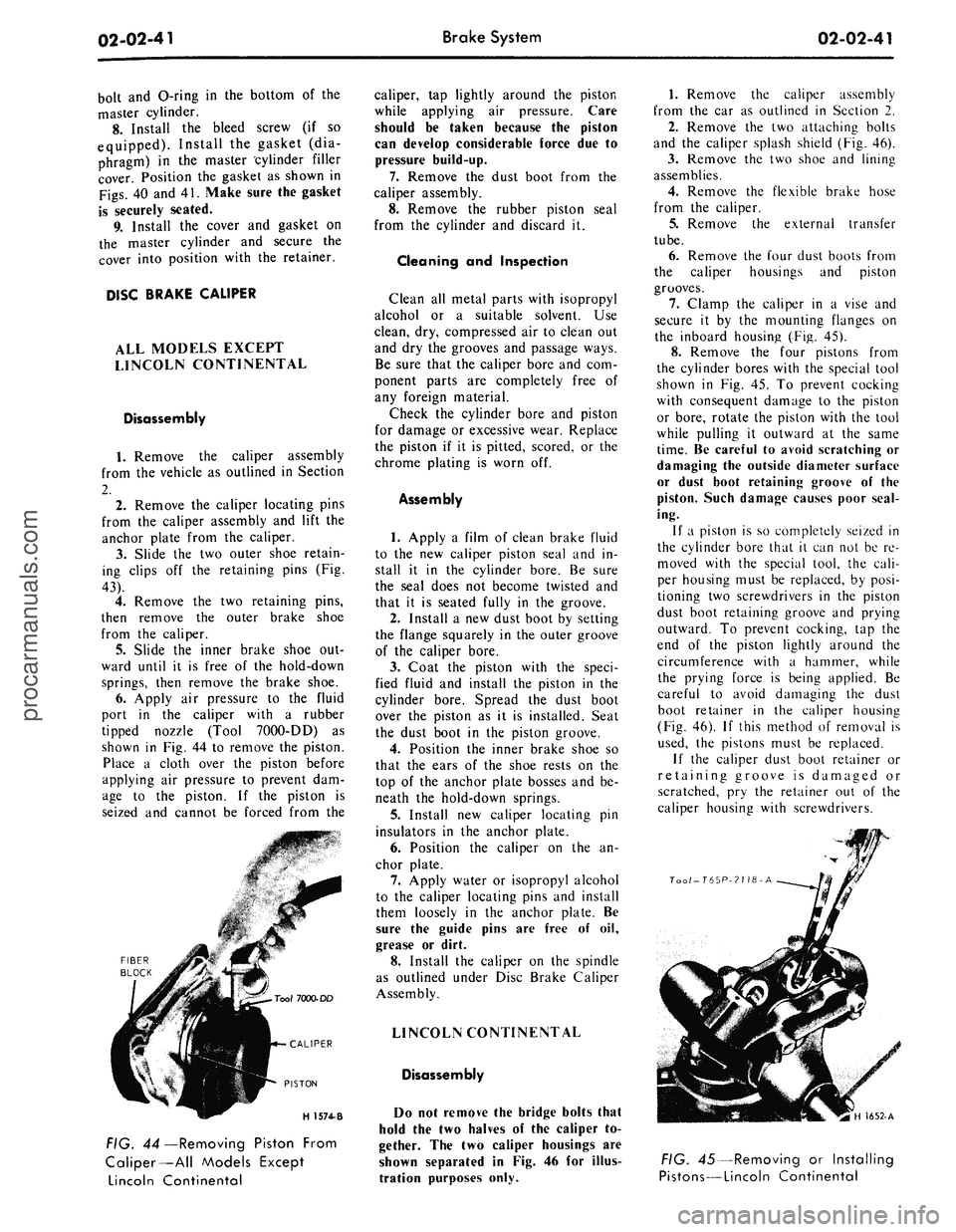
6. Apply air pressure to the fluid
port in the caliper with a rubber
tipped nozzle (Tool 7000-DD) as
shown in Fig. 44 to remove the piston.
Place a cloth over the piston before
applying air pressure to prevent dam-
age to the piston. If the piston is
seized and cannot be forced from the
FIBER
BLOCK
CALIPER
PISTON
H 1574-B
FIG. 44 —Removing Piston From
Caliper —
All
Models Except
Lincoln Continental
caliper, tap lightly around the piston
while applying air pressure. Care
should be taken because the piston
can develop considerable force due to
pressure build-up.
7.
Remove the dust boot from the
caliper assembly.
8. Remove the rubber piston seal
from the cylinder and discard it.
Cleaning and Inspection
Clean all metal parts with isopropyl
alcohol or a suitable solvent. Use
clean, dry, compressed air to clean out
and dry the grooves and passage ways.
Be sure that the caliper bore and com-
ponent parts are completely free of
any foreign material.
Check the cylinder bore and piston
for damage or excessive wear. Replace
the piston if it is pitted, scored, or the
chrome plating is worn off.
Assembly
1.
Apply a film of clean brake fluid
to the new caliper piston seal and in-
stall it in the cylinder bore. Be sure
the seal does not become twisted and
that it is seated fully in the groove.
2.
Install a new dust boot by setting
the flange squarely in the outer groove
of the caliper bore.
3.
Coat the piston with the speci-
fied fluid and install the piston in the
cylinder bore. Spread the dust boot
over the piston as it is installed. Seat
the dust boot in the piston groove.
4.
Position the inner brake shoe so
that the ears of the shoe rests on the
top of the anchor plate bosses and be-
neath the hold-down springs.
5.
Install new caliper locating pin
insulators in the anchor plate.
6. Position the caliper on the an-
chor plate.
7.
Apply water or isopropyl alcohol
to the caliper locating pins and install
them loosely in the anchor plate. Be
sure the guide pins are free of oil,
grease or dirt.
8. Install the caliper on the spindle
as outlined under Disc Brake Caliper
Assembly.
LINCOLN CONTINENTAL
Disassembly
Do not remove the bridge bolts that
hold the two halves of the caliper to-
gether. The two caliper housings are
shown separated in Fig. 46 for illus-
tration purposes only.
1.
Remove the caliper assembly
from the car as outlined in Section 2.
2.
Remove the two attaching bolts
and the caliper splash shield (Fig. 46).
3.
Remove the two shoe and lining
assemblies.
4.
Remove the flexible brake hose
from the caliper.
5.
Remove the external transfer
tube.
6. Remove the four dust boots from
the caliper housings and piston
grooves.
7.
Clamp the caliper in a vise and
secure it by the mounting flanges on
the inboard housing (Fig. 45).
8. Remove the four pistons from
the cylinder bores with the special tool
shown in Fig. 45. To prevent cocking
with consequent damage to the piston
or bore, rotate the piston with the tool
while pulling it outward at the same
time.
Be careful to avoid scratching or
damaging the outside diameter surface
or dust boot retaining groove of the
piston. Such damage causes poor seal-
ing.
If a piston is so completely seized in
the cylinder bore that it can not be re-
moved with the special tool, the cali-
per housing must be replaced, by posi-
tioning two screwdrivers in the piston
dust boot retaining groove and prying
outward. To prevent cocking, tap the
end of the piston lightly around the
circumference with a hammer, while
the prying force is being applied. Be
careful to avoid damaging the dust
boot retainer in the caliper housing
(Fig. 46). If this method of removal is
used, the pistons must be replaced.
If the caliper dust boot retainer or
retaining groove is damaged or
scratched, pry the retainer out of the
caliper housing with screwdrivers.
Too/-T65P-2
J
18- A
H 1652-A
FIG. 45—Removing or Installing
Pistons —
Lincoln
Continentalprocarmanuals.com
Page 61 of 413
02-02-42
Brake System
02-02-42
CALIPER
ABUTMENTS
OUTBOARD
CALIPER HOUSING
DUST
BOOT RETAINING GROOVE
DUST
BOOT (4)
PISTON
SEAL (4)
EXTERNAL
TRANSFER
TUBE
SCREW
INBOARD
CALIPER HOUSING
FLEXIBLE
HOSE-^
H1367-C
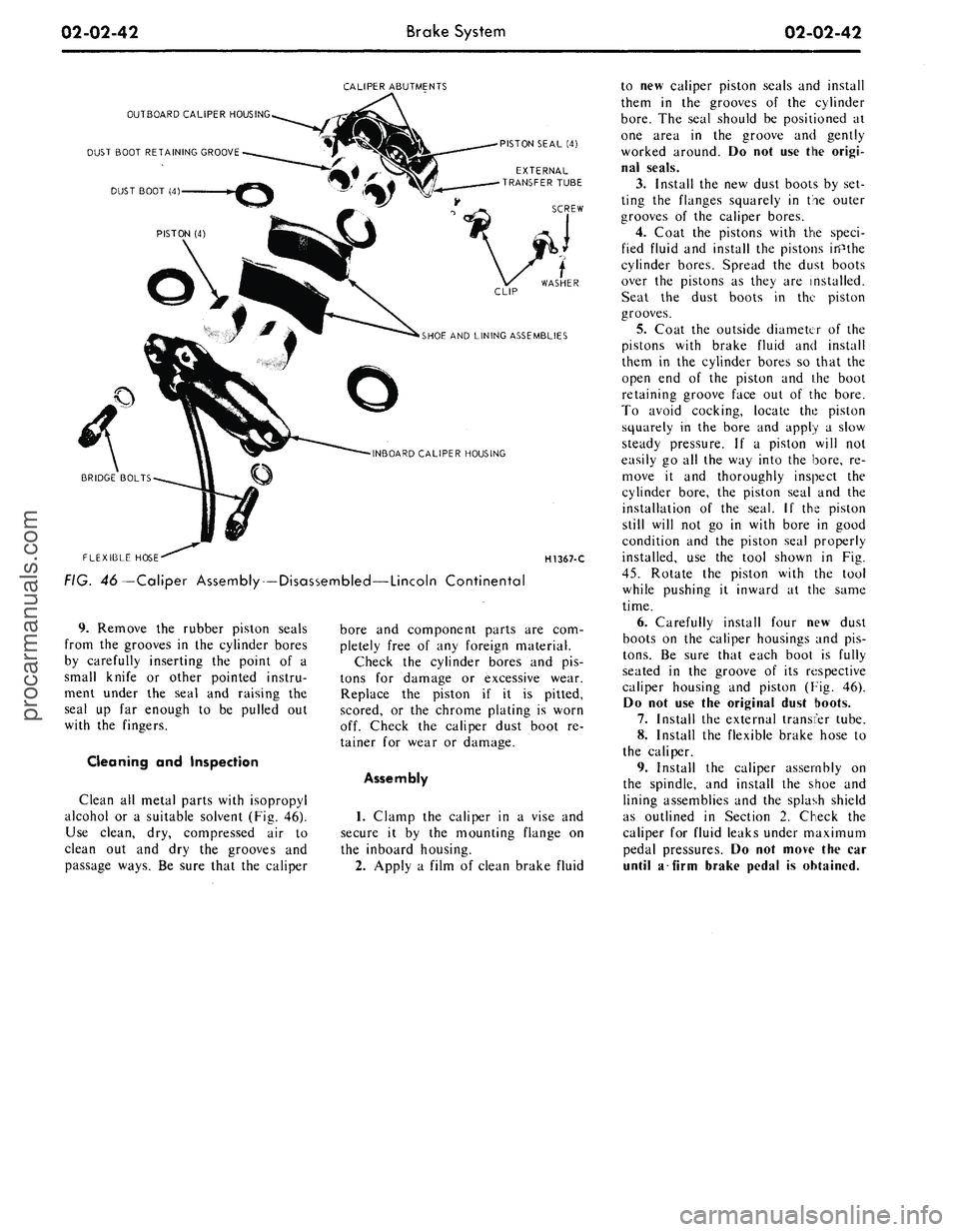
FIG. 46—Caliper Assembly — Disassembled—Lincoln Continental
9. Remove the rubber piston seals
from the grooves in the cylinder bores
by carefully inserting the point of a
small knife or other pointed instru-
ment under the seal and raising the
seal up far enough to be pulled out
with the fingers.
Cleaning and Inspection
Clean all metal parts with isopropyl
alcohol or a suitable solvent (Fig. 46).
Use clean, dry, compressed air to
clean out and dry the grooves and
passage ways. Be sure that the caliper
bore and component parts are com-
pletely free of any foreign material.
Check the cylinder bores and pis-
tons for damage or excessive wear.
Replace the piston if it is pitted,
scored, or the chrome plating is worn
off. Check the caliper dust boot re-
tainer for wear or damage.
Assembly
1.
Clamp the caliper in a vise and
secure it by the mounting flange on
the inboard housing.
2.
Apply a film of clean brake fluid
to new caliper piston seals and install
them in the grooves of the cylinder
bore.
The seal should be positioned at
one area in the groove and gently
worked around. Do not use the origi-
nal seals.
3.
Install the new dust boots by set-
ting the flanges squarely in the outer
grooves of the caliper bores.
4.
Coat the pistons with the speci-
fied fluid and install the pistons inPthe
cylinder bores. Spread the dust boots
over the pistons as they are installed.
Seat the dust boots in the piston
grooves.
5.
Coat the outside diameter of the
pistons with brake fluid and install
them in the cylinder bores so that the
open end of the piston and ihe boot
retaining groove face out of the bore.
To avoid cocking, locate the piston
squarely in the bore and apply a slow
steady pressure. If a piston will not
easily go all the way into the bore, re-
move it and thoroughly inspect the
cylinder bore, the piston seal and the
installation of the seal. If the piston
still will not go in with bore in good
condition and the piston seal properly
installed, use the tool shown in Fig.
45.
Rotate the piston with the tool
while pushing it inward at the same
time.
6. Carefully install four new dust
boots on the caliper housings and pis-
tons.
Be sure that each boot is fully
seated in the groove of its respective
caliper housing and piston (Fig. 46).
Do not use the original dust boots.
7.
Install the external transfer tube.
8. Install the flexible brake hose to
the caliper.
9. Install the caliper assembly on
the spindle, and install the shoe and
lining assemblies and the splash shield
as outlined in Section 2. Check the
caliper for fluid leaks under maximum
pedal pressures. Do not move the car
until a firm brake pedal is obtained.procarmanuals.com
Page 112 of 413
03-04-03
Automatic Air Leveling System — Lincoln Continental
03-04-03
outlet lines to their respective parts.
3.
Adjust the trim height as de-
tailed in Section 4.
4.
Connect the link to the arm.
5.
Remove the jack stands and
lower the vehicle.
SUPER LIFT SHOCK ABSORBER
REMOVAL
1.
Raise the vehicle and place jack
stands under the axle to compress the
super lift.
2.
Loosen the air line or lines (right
super lift) slowly to release the air
from the system. Then, disconnect the
line or lines.
3.
Remove the three mounting plate
attaching screws from the upper end
of the super lift.
4.
Remove the attaching nut and
washer from the lower end of the
super lift and remove it from the vehi-
cle.
5.
Remove the nut, outer washer
and the insulator that attach the super
lift to the mounting plate. Remove the
plate, remaining insulator and washer.
INSTALLATION
1.
Position a washer, insulator,
mounting plate, insulator, washer and
nut on the stud at the upper end of
the super lift. Torque the nut to speci-
fication.
2.
Install the mounting plate, outer
insulator, washer and nut on the stud.
Torque the nut to specification.
3.
Attach the mounting plate and
shock absorber to the crossmember
with the attaching screws to specifica-
tions.
4.
Connect the lower end of the
super lift to the mounting stud with
the washers and attaching nut. Torque
the nut to specification.
5.
Connect the air line or lines
(right super lift) to the super lift.
6. Start the engine and check for
leaks.
3 IN-VEHICLE ADJUSTMENTS AND REPAIRS
REGULATOR ADJUSTMENT HEIGHT CONTROL VALVE
The regulator may be adjusted if
the regulator pressure is under 100 psi
with the reservoir pressure at a mini-
mum of 140 psi. If the regulated pres-
sure exceeds 130 psi, the regulator
must be replaced.
To adjust the regulator, remove the
boot and reposition the sleeve and re-
tainer deeper into the body of the re-
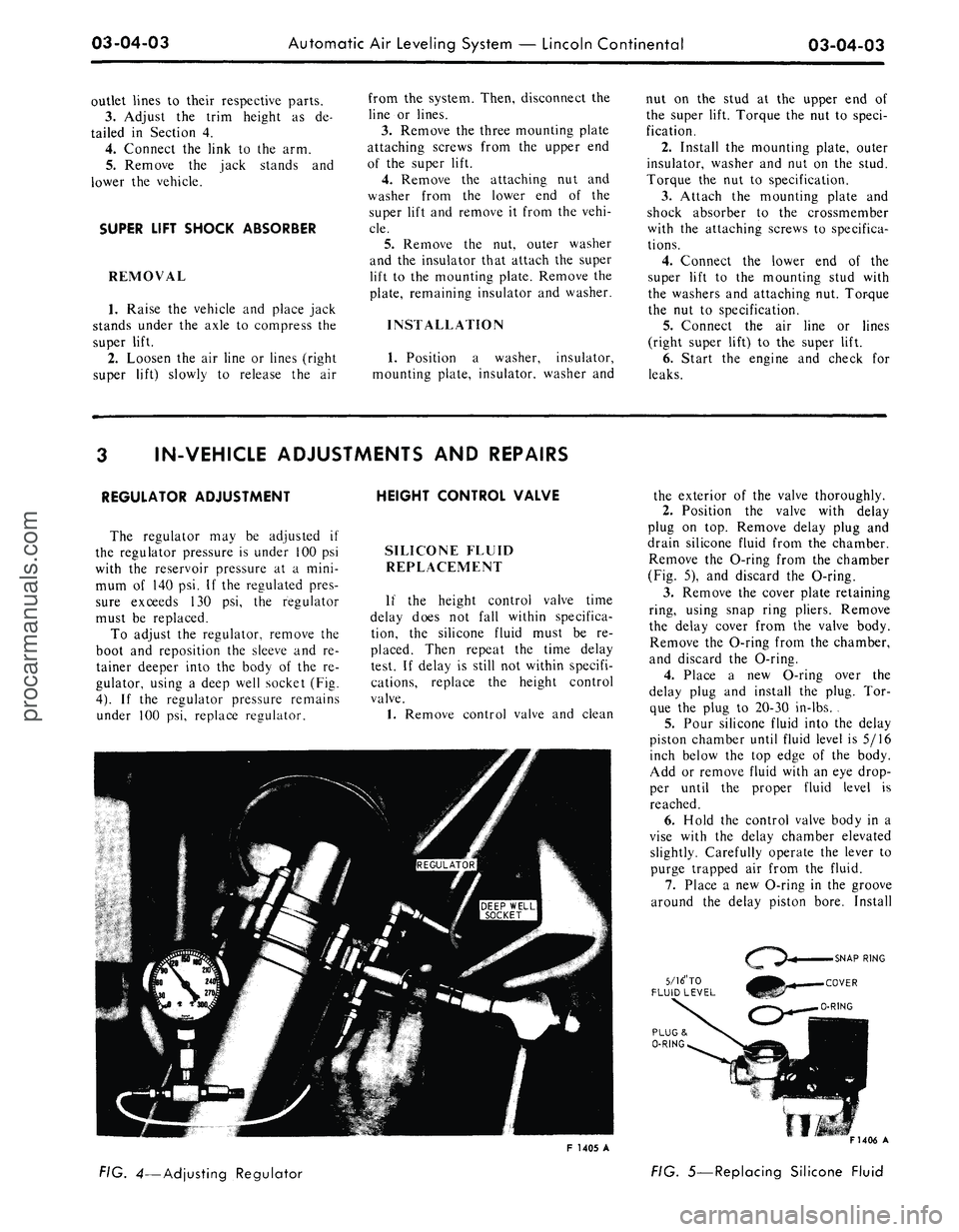
gulator, using a deep well socket (Fig.
4).
If the regulator pressure remains
under 100 psi, replace regulator.
SILICONE FLUID
REPLACEMENT
If the height control valve time
delay does not fall within specifica-
tion, the silicone fluid must be re-
placed. Then repeat the time delay
test. If delay is still not within specifi-
cations, replace the height control
valve.
1.
Remove control valve and clean
the exterior of the valve thoroughly.
2.
Position the valve with delay
plug on top. Remove delay plug and
drain silicone fluid from the chamber.
Remove the O-ring from the chamber
(Fig. 5), and discard the O-ring.
3.
Remove the cover plate retaining
ring, using snap ring pliers. Remove
the delay cover from the valve body.
Remove the O-ring from the chamber,
and discard the O-ring.
4.
Place a new O-ring over the
delay plug and install the plug. Tor-
que the plug to 20-30 in-lbs. .
5.
Pour silicone fluid into the delay
piston chamber until fluid level is 5/16
inch below the top edge of the body.
Add or remove fluid with an eye drop-
per until the proper fluid level is
reached.
6. Hold the control valve body in a
vise with the delay chamber elevated
slightly. Carefully operate the lever to
purge trapped air from the fluid.
7.
Place a new O-ring in the groove
around the delay piston bore. Install
5/16" TO
FLUID LEVEL
F 1405 A
FIG. 4—Adjusting Regulator
F1406 A
FIG. 5—Replacing Silicone Fluidprocarmanuals.com
Page 142 of 413
03-07-04
Ford Design Non-Integral Power Steering System
03-07-04
12.
Stop the engine, and check the
control valve and hose connections for
fluid leaks. Correct the cause of any
leaks.
13.
Check the fluid level, and refill
the reservoir if necessary.
14.
With the engine running check
the position of the steering wheel
when the front wheels are in the
straight-ahead position.Do not make
any adjustments until toe-in is
checked.
15.
Keep the engine running, and
check toe-in. If either toe-in or steer-
ing wheel position is not correct make
all necessary adjustments (Part 3-1) at
the spindle connecting rod sleeves.
16.
Check the effort to turn the
wheels in both directions. The effort
should be about equal in both direc-
tions.
POWER CYLINDER
REMOVAL
1.
Disconnect the two fluid lines
from the power cylinder and allow
them to drain into a container.
CENTER LINK
POWER CYLINDER
Tool- T64P-3590-F
G 1654-A
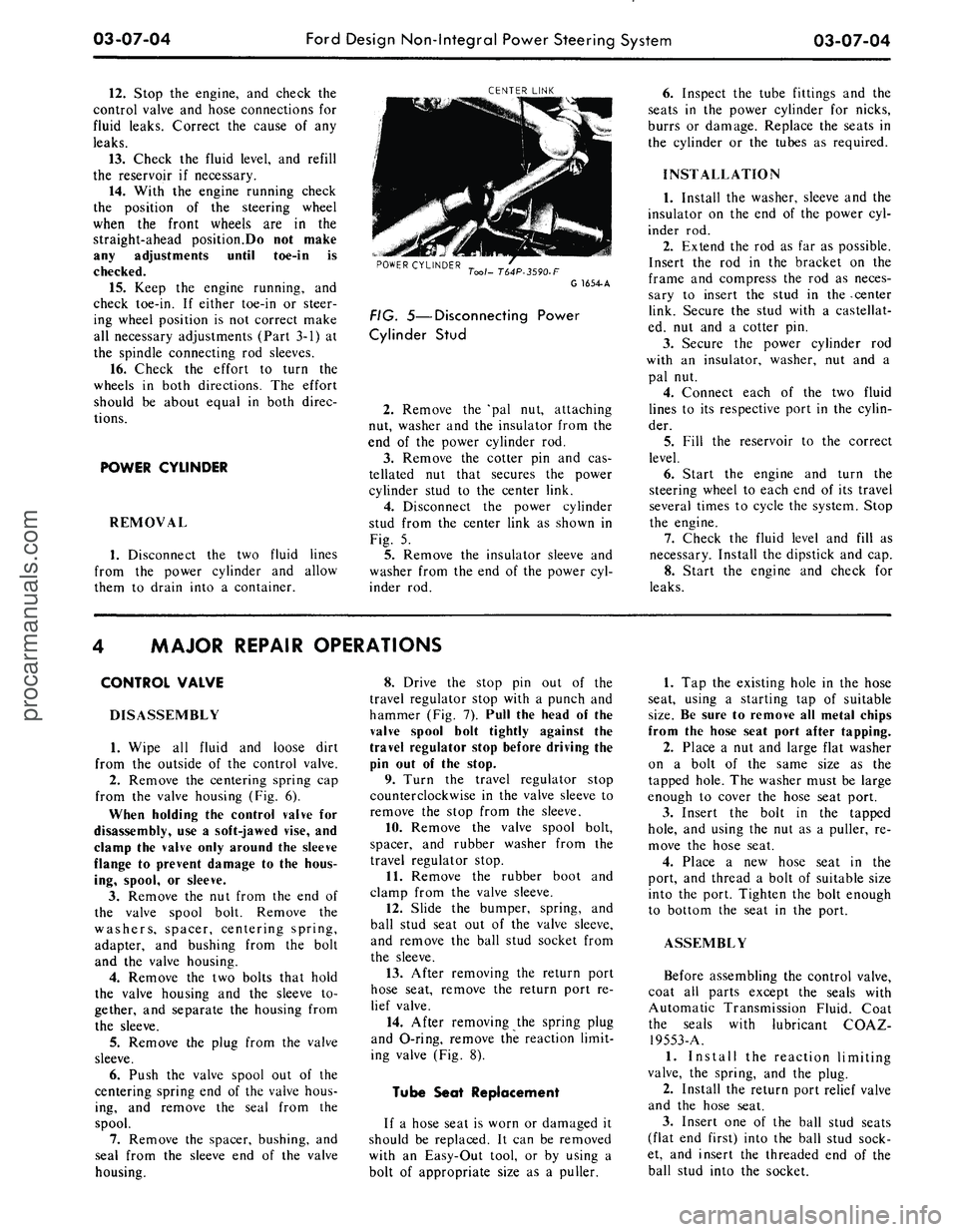
FIG. 5—Disconnecting Power
Cylinder Stud
2.
Remove the 'pal nut, attaching
nut, washer and the insulator from the
end of the power cylinder rod.
3.
Remove the cotter pin and cas-
tellated nut that secures the power
cylinder stud to the center link.
4.
Disconnect the power cylinder
stud from the center link as shown in
Fig. 5.
5.
Remove the insulator sleeve and
washer from the end of the power cyl-
inder rod.
6. Inspect the tube fittings and the
seats in the power cylinder for nicks,
burrs or damage. Replace the seats in
the cylinder or the tubes as required.
INSTALLATION
1.
Install the washer, sleeve and the
insulator on the end of the power cyl-
inder rod.
2.
Extend the rod as far as possible.
Insert the rod in the bracket on the
frame and compress the rod as neces-
sary to insert the stud in the -center
link. Secure the stud with a castellat-
ed, nut and a cotter pin.
3.
Secure the power cylinder rod
with an insulator, washer, nut and a
pal nut.
4.
Connect each of the two fluid
lines to its respective port in the cylin-
der.
5.
Fill the reservoir to the correct
level.
6. Start the engine and turn the
steering wheel to each end of its travel
several times to cycle the system. Stop
the engine.
7.
Check the fluid level and fill as
necessary. Install the dipstick and cap.
8. Start the engine and check for
leaks.
MAJOR REPAIR OPERATIONS
CONTROL VALVE
DISASSEMBLY
1.
Wipe all fluid and loose dirt
from the outside of the control valve.
2.
Remove the centering spring cap
from the valve housing (Fig. 6).
When holding the control valve for
disassembly, use a soft-jawed vise, and
clamp the valve only around the sleeve
flange to prevent damage to the hous-
ing, spool, or sleeve.
3.
Remove the nut from the end of
the valve spool bolt. Remove the
washers, spacer, centering spring,
adapter, and bushing from the bolt
and the valve housing.
4.
Remove the two bolts that hold
the valve housing and the sleeve to-
gether, and separate the housing from
the sleeve.
5.
Remove the plug from the valve
sleeve.
6. Push the valve spool out of the
centering spring end of the valve hous-
ing, and remove the seal from the
spool.
7.
Remove the spacer, bushing, and
seal from the sleeve end of the valve
housing.
8. Drive the stop pin out of the
travel regulator stop with a punch and
hammer (Fig. 7). Pull the head of the
valve spool bolt tightly against the
travel regulator stop before driving the
pin out of the stop.
9. Turn the travel regulator stop
counterclockwise in the valve sleeve to
remove the stop from the sleeve.
10.
Remove the valve spool bolt,
spacer, and rubber washer from the
travel regulator stop.
11.
Remove the rubber boot and
clamp from the valve sleeve.
12.
Slide the bumper, spring, and
ball stud seat out of the valve sleeve,
and remove the ball stud socket from
the sleeve.
13.
After removing the return port
hose seat, remove the return port re-
lief valve.
14.
After removing the spring plug
and O-ring, remove the reaction limit-
ing valve (Fig. 8).
Tube Seat Replacement
If a hose seat is worn or damaged it
should be replaced. It can be removed
with an Easy-Out tool, or by using a
bolt of appropriate size as a puller.
1.
Tap the existing hole in the hose
seat, using a starting tap of suitable
size.
Be sure to remove all metal chips
from the hose seat port after tapping.
2.
Place a nut and large flat washer
on a bolt of the same size as the
tapped hole. The washer must be large
enough to cover the hose seat port.
3.
Insert the bolt in the tapped
hole,
and using the nut as a puller, re-
move the hose seat.
4.
Place a new hose seat in the
port, and thread a bolt of suitable size
into the port. Tighten the bolt enough
to bottom the seat in the port.
ASSEMBLY
Before assembling the control valve,
coat all parts except the seals with
Automatic Transmission Fluid. Coat
the seals with lubricant COAZ-
19553-A.
1.
Install the reaction limiting
valve, the spring, and the plug.
2.
Install the return port relief valve
and the hose seat.
3.
Insert one of the ball stud seats
(flat end first) into the ball stud sock-
et, and insert the threaded end of the
ball stud into the socket.procarmanuals.com
Page 143 of 413

03-07-05
Ford Design Non-Integral Power Steering System
03-07-05
•
SPRING
SEAT
REACTION
SPRING
\
REACTION
\
VALVE
VALVE
HOUSING
SPRING PLUG
AND O-RING SPACER
WASHERX
CUSHION
STOP
PIN
TRAVEL
REGULATOR
CLAMP
FIG. 6—Control Valve Disassembled—Typical
4.
Place
the
socket
in the
control
valve sleeve
so
that
the
threaded
end
of
the
ball stud
can be
pulled
out
through
the
slot
in the
sleeve (Fig.
9).
5.
Place
the
other ball stud seat,
and spring,
and the
bumper (Fig.
6) in
the socket,
and
install
and
securely
tighten
the
travel regulator stop.
6. Loosen
the
stop just enough
to
align
the
nearest hole
in the
stop with
the slot
in the
ball stud socket,
and in-
stall
the
stop
pin in the
ball stud sock-
VAIVE
SPOOL
BOLT
BALL
STUD
SOCKET
TRAVEL
REGULATOR
STOP
G
1656-A
FIG. 7—Removing Stop
Pin
et, travel regulator stop,
and
valve
spool bolt
(Fig. 7).
7.
Install
the
rubber boot, clamp,
and
the
plug
on the
control valve
sleeve. Make sure that
the
lubrication
fitting
is
turned
on
tightly
and
does
not bind
on the
ball stud socket.
8. Insert
the
valve spool
in the
valve
housing. Rotate
the
spool while insert-
ing
it in the
housing
(Fig. 10).
9. Move
the
spool toward
the cen-
tering spring
end of the
housing,
and
place
the
small seal bushing,
and spa-
cer
in the
sleeve
end of the
housing.
10.
Press
the
valve spool against
the inner
lip of the
seal
and, at the
same time, guide
the lip of the
seal
over
the
spool with
a
small screwdriv-
G
1657-A
FIG. 8—Removing Reaction Valve
Plug
er.
Do not
nick
or
scratch
the
seal
or
the spool during installation.
11.
Place
the
sleeve
end of the
housing
on a
flat surface
so
that
the
seal, bushing,
and
spacer
are at the
bottom
end and
push down
the
valve
spool until
it
stops.
12.
Carefully install
the
spool seal
and bushing
in the
centering spring
end
of the
housing. Press
the
seal
against
the end of the
spool., guiding
the seal over
the
spool with
a
small
screwdriver.
Do not
nick
or
scratch
the seal
or the
spool during installa-
tion.
CONTROL
VALVE
SLEEVE
BALL
STUD
SEAT-
BALL
STUD'
BALL
STUD
SOCKET'
G
16
58-A
FIG. 9—Installing Ball Socket,
Seal
and
Bracketprocarmanuals.com
Page 276 of 413
06-02-07
Ford Design Three Speed Transmission
06-02-07
SNAP RINGS
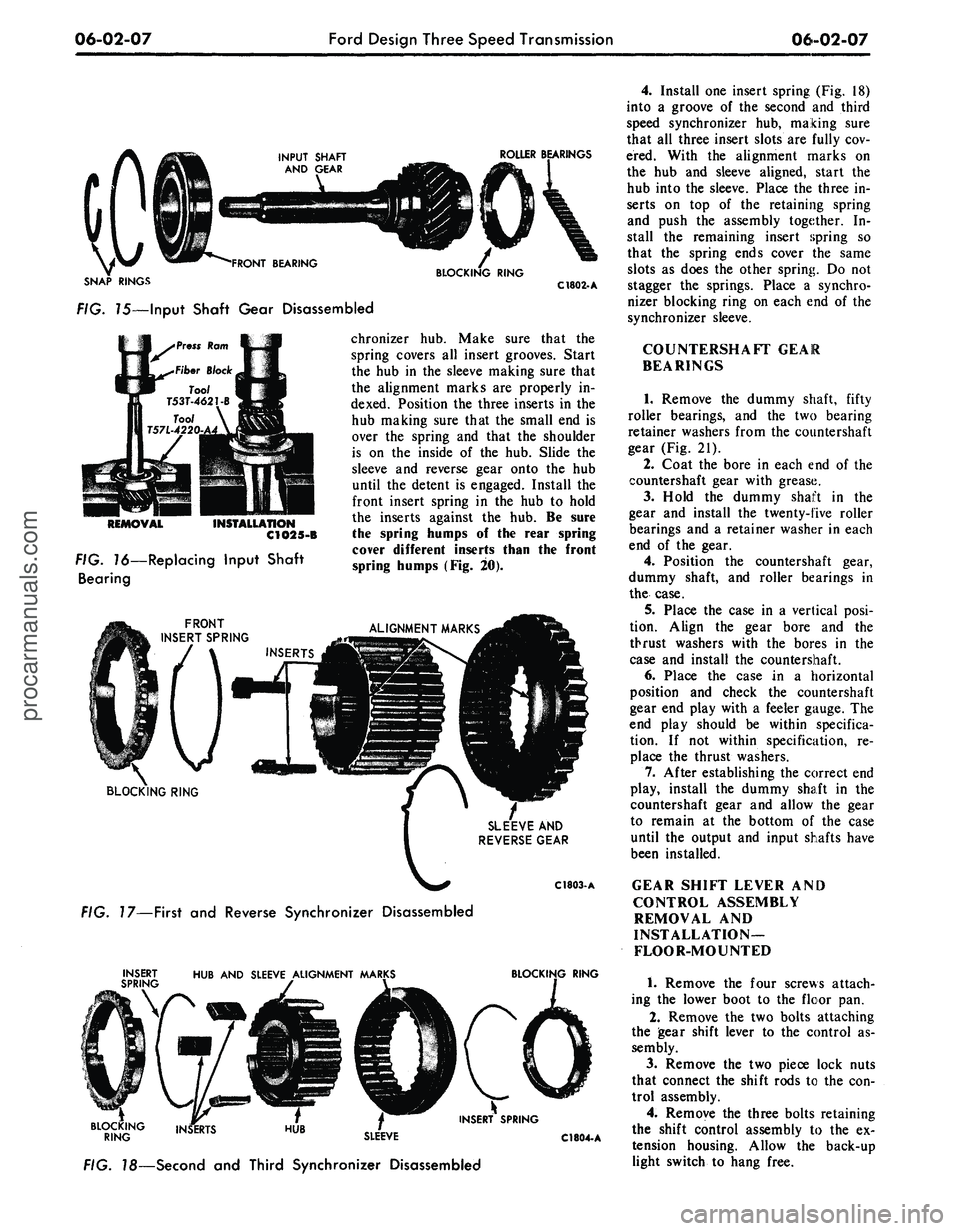
FIG. 15—Input Shaft Gear Disassembled
C1802-
A
REMOVAL
INSTALLATION
C1O25-B
FIG. 76—Replacing Input Shaft
Bearing
chronizer
hub.
Make sure that
the
spring covers
all
insert grooves. Start
the
hub in the
sleeve making sure that
the alignment marks
are
properly
in-
dexed. Position
the
three inserts
in the
hub making sure that
the
small
end is
over
the
spring
and
that
the
shoulder
is
on the
inside
of the hub.
Slide
the
sleeve
and
reverse gear onto
the hub
until
the
detent
is
engaged. Install
the
front insert spring
in the hub to
hold
the inserts against
the hub. Be
sure
the spring humps
of the
rear spring
cover different inserts than
the
front
spring humps (Fig.
20).
BLOCKING RING
SLEEVE
AND
REVERSE GEAR
C1803-
A
FIG. 17—First
and
Reverse Synchronizer Disassembled
INSERT
HUB AND
SLEEVE ALIGNMENT MARKS
SPRING
BLOCKING m$ERTS
RING
INSERT SPRING
C1804-
A
FIG. 18—Second
and
Third Synchronizer Disassembled
4.
Install
one
insert spring (Fig.
18)
into
a
groove
of the
second
and
third
speed synchronizer
hub,
making sure
that
all
three insert slots
are
fully cov-
ered. With
the
alignment marks
on
the
hub and
sleeve aligned, start
the
hub into
the
sleeve. Place
the
three
in-
serts
on top of the
retaining spring
and push
the
assembly together.
In-
stall
the
remaining insert spring
so
that
the
spring ends cover
the
same
slots
as
does
the
other spring.
Do not
stagger
the
springs. Place
a
synchro-
nizer blocking ring
on
each
end of the
synchronizer sleeve.
COUNTERSHAFT GEAR
BEARINGS
1.
Remove
the
dummy shaft, fifty
roller bearings,
and the two
bearing
retainer washers from
the
countershaft
gear (Fig.
21).
2.
Coat
the
bore
in
each
end of the
countershaft gear with grease.
3.
Hold
the
dummy shaft
in the
gear
and
install
the
twenty-live roller
bearings
and a
retainer washer
in
each
end
of the
gear.
4.
Position
the
countershaft gear,
dummy shaft,
and
roller bearings
in
the case.
5.
Place
the
case
in a
vertical posi-
tion. Align
the
gear bore
and the
thrust washers with
the
bores
in the
case
and
install
the
countershaft.
6. Place
the
case
in a
horizontal
position
and
check
the
countershaft
gear
end
play with
a
feeler gauge.
The
end play should
be
within specifica-
tion.
If not
within specification,
re-
place
the
thrust washers.
7.
After establishing
the
correct end
play, install
the
dummy shaft
in the
countershaft gear
and
allow
the
gear
to remain
at the
bottom
of the
case
until
the
output
and
input shafts have
been installed.
GEAR SHIFT LEVER
AND
CONTROL ASSEMBLY
REMOVAL
AND
INSTALLATION—
FLOOR-MOUNTED
1.
Remove
the
four screws attach-
ing
the
lower boot
to the
floor
pan.
2.
Remove
the two
bolts attaching
the gear shift lever
to the
control
as-
sembly.
3.
Remove
the two
piece lock nuts
that connect
the
shift rods
to the con-
trol assembly.
4.
Remove
the
three bolts retaining
the shift control assembly
to the ex-
tension housing. Allow
the
back-up
light switch
to
hang free.procarmanuals.com
Page 277 of 413
06-02-08
Ford Design Three Speed Transmission
06-02-08
FIRST-REVERSE
SELECTOR LEVER
SELECTOR LEVER
SHAFT
SUPPORT BRACKET
SECOND-THIRD
SELECTOR LEVER
C
2053-A
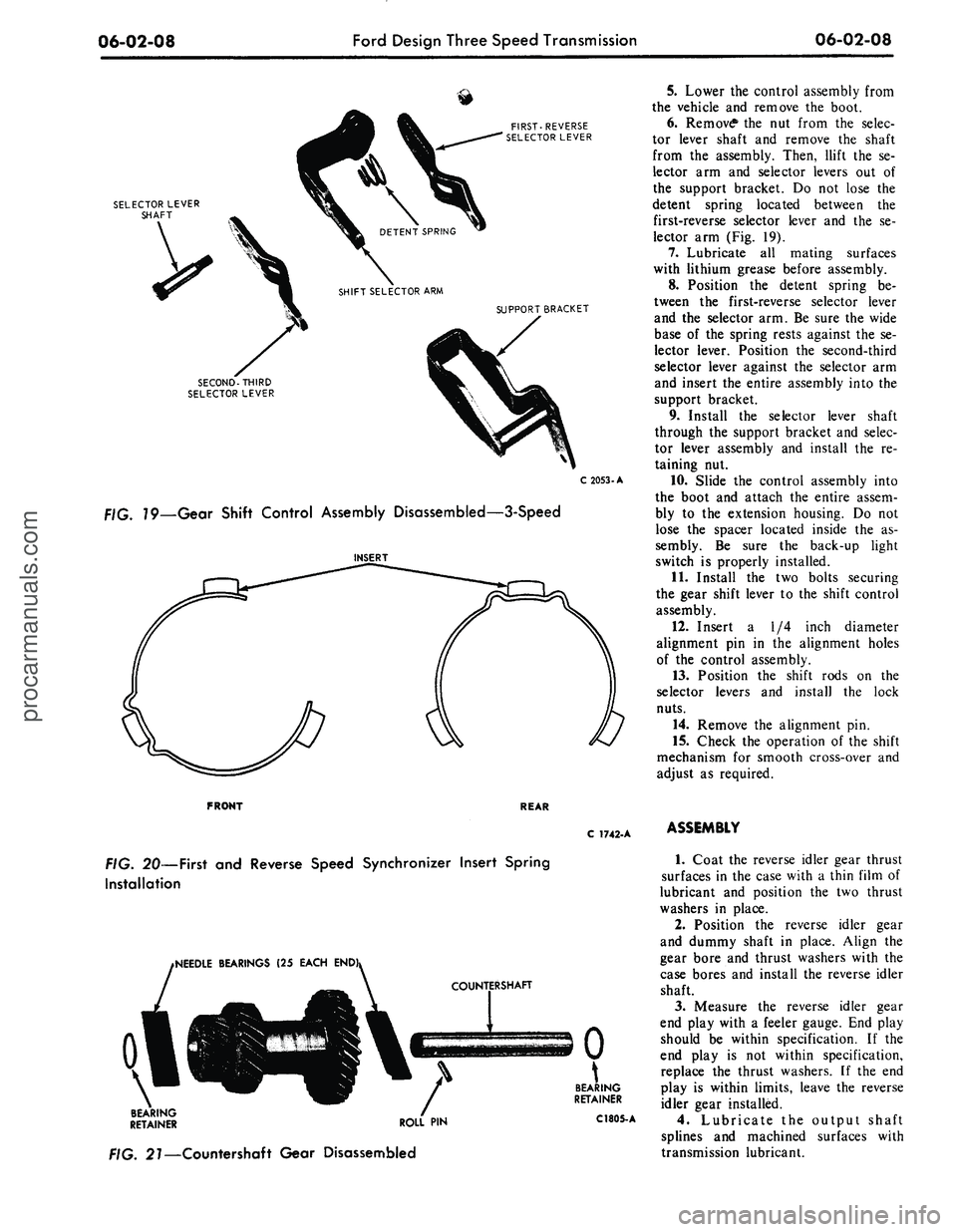
79—Gear Shift Control Assembly Disassembled—3-Speed
5.
Lower the control assembly from
the vehicle and remove the boot.
6. Remove* the nut from the selec-
tor lever shaft and remove the shaft
from the assembly. Then, llift the se-
lector arm and selector levers out of
the support bracket. Do not lose the
detent spring located between the
first-reverse selector lever and the se-
lector arm (Fig. 19).
7.
Lubricate all mating surfaces
with lithium grease before assembly.
8. Position the detent spring be-
tween the first-reverse selector lever
and the selector arm. Be sure the wide
base of the spring rests against the se-
lector lever. Position the second-third
selector lever against the selector arm
and insert the entire assembly into the
support bracket.
9. Install the selector lever shaft
through the support bracket and selec-
tor lever assembly and install the re-
taining nut.
10.
Slide the control assembly into
the boot and attach the entire assem-
bly to the extension housing. Do not
lose the spacer located inside the as-
sembly. Be sure the back-up light
switch is properly installed.
11.
Install the two bolts securing
the gear shift lever to the shift control
assembly.
12.
Insert a 1/4 inch diameter
alignment pin in the alignment holes
of the control assembly.
13.
Position the shift rods on the
selector levers and install the lock
nuts.
14.
Remove the alignment pin.
15.
Check the operation of the shift
mechanism for smooth cross-over and
adjust as required.
FRONT
REAR
C 1742-A
FIG.
20—First
and
Reverse Speed Synchronizer Insert Spring
Installation
iNEEDLE BEARINGS
(25
EACH
END
\
BEARING
RETAINER ROLL
PIN
. 27—Countershaft Gear Disassembled
BEARING
RETAINER
C1805-
A
ASSEMBLY
1.
Coat the reverse idler gear thrust
surfaces in the case with a thin film of
lubricant and position the two thrust
washers in place.
2.
Position the reverse idler gear
and dummy shaft in place. Align the
gear bore and thrust washers with the
case bores and install the reverse idler
shaft.
3.
Measure the reverse idler gear
end play with a feeler gauge. End play
should be within specification. If the
end play is not within specification,
replace the thrust washers. If the end
play is within limits, leave the reverse
idler gear installed.
4.
Lubricate the output shaft
splines and machined surfaces with
transmission lubricant.procarmanuals.com
Page 284 of 413
06-03-05
Ford Design Four-Speed Transmission
06-03-05
DETAIL
4
FORD
AND
MERCURY
DETAIL
5
COUGAR. FAIRLANE,
FALCON,
MONTEGO,
AND MUSTANG
REVERSE SHIFT
RAIL
C1533-B
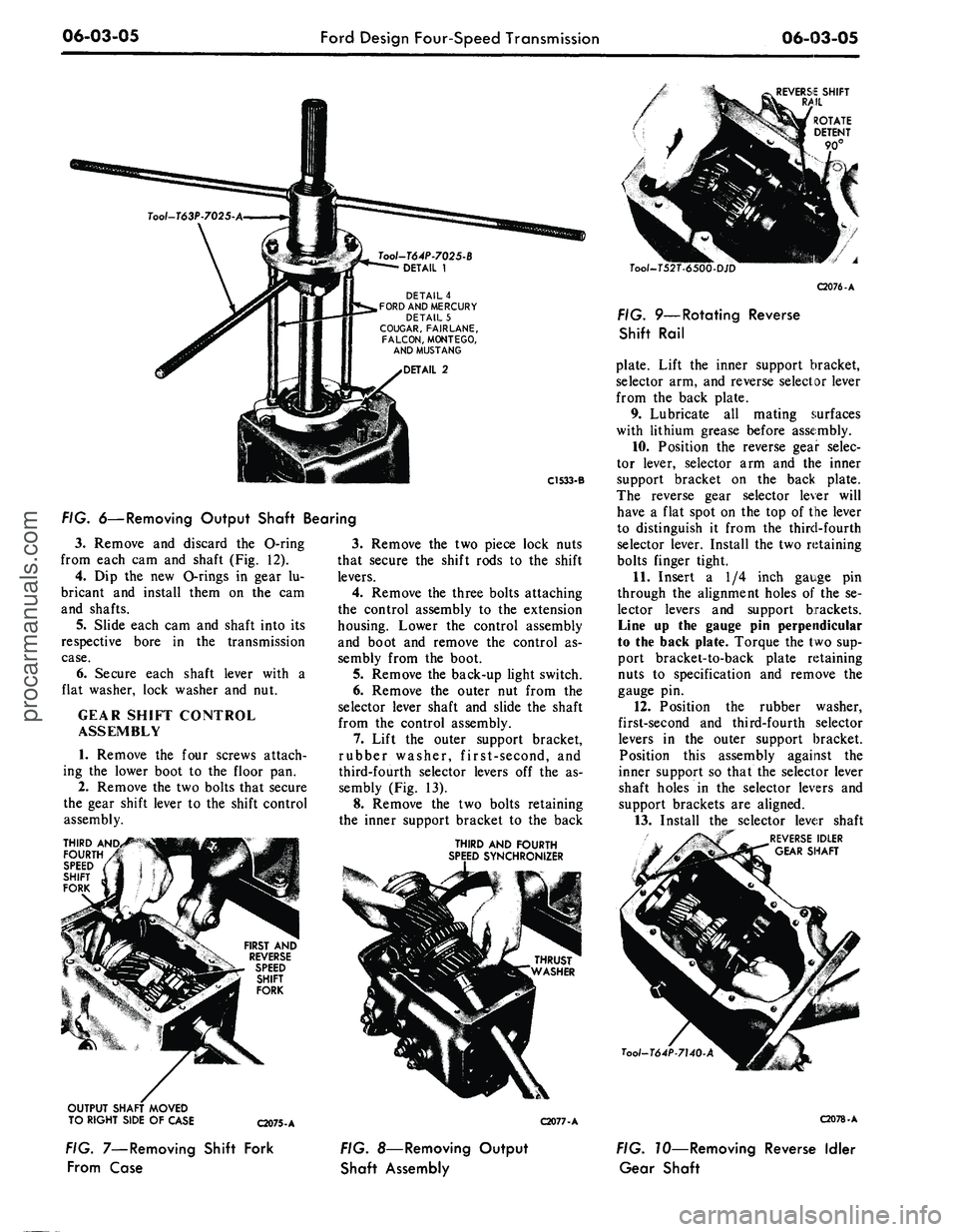
FIG. 6—Removing Output Shaft Bearing
3.
Remove
and
discard
the
O-ring
from each
cam and
shaft (Fig.
12).
4.
Dip the new
Orings
in
gear
lu-
bricant
and
install them
on the cam
and shafts.
5.
Slide each cam
and
shaft into
its
respective bore
in the
transmission
case.
6. Secure each shaft lever with
a
flat washer, lock washer
and nut.
GEAR SHIFT CONTROL
ASSEMBLY
1.
Remove
the
four screws attach-
ing
the
lower boot
to the
floor
pan.
2.
Remove the two bolts that secure
the gear shift lever
to
the shift control
assembly.
THIRD AND,
FOURTH
SPEED
SHIFT
FORK
FIRST
AND
REVERSE
SPEED
SHIFT
FORK
3.
Remove
the two
piece lock nuts
that secure
the
shift rods
to the
shift
levers.
4.
Remove
the
three bolts attaching
the control assembly
to the
extension
housing. Lower
the
control assembly
and boot
and
remove
the
control
as-
sembly from
the
boot.
5.
Remove the back-up light switch.
6. Remove
the
outer
nut
from
the
selector lever shaft
and
slide
the
shaft
from
the
control assembly.
7.
Lift
the
outer support bracket,
rubber washer, first-second,
and
third-fourth selector levers
off the as-
sembly (Fig.
13).
8. Remove
the two
bolts retaining
the inner support bracket
to the
back
THIRD
AND
FOURTH
SPEED SYNCHRONIZER
OUTPUT SHAFT MOVED
TO RIGHT SIDE
OF
CASE
C2075-A
C2077-A
Tool-T52T-
C2076-A
FIG. 9—Rotating Reverse
Shift Rail
plate. Lift
the
inner support bracket,
selector arm, and reverse selector lever
from
the
back plate.
9. Lubricate
all
mating surfaces
with lithium grease before assembly.
10.
Position
the
reverse gear selec-
tor lever, selector
arm and the
inner
support bracket
on the
back plate.
The reverse gear selector lever will
have
a
flat spot
on the
top
of
the lever
to distinguish
it
from
the
third-fourth
selector lever. Install the two retaining
bolts finger tight.
11.
Insert
a 1/4
inch gauge
pin
through
the
alignment holes
of the se-
lector levers
and
support brackets.
Line
up the
gauge
pin
perpendicular
to the back plate. Torque the two sup-
port bracket-to-back plate retaining
nuts
to
specification
and
remove
the
gauge
pin.
12.
Position
the
rubber washer,
first-second
and
third-fourth selector
levers
in the
outer support bracket.
Position this assembly against
the
inner support
so
that the selector lever
shaft holes
in the
selector levers
and
support brackets
are
aligned.
13.
Install
the
selector lever shaft
"~ REVERSE IDLER
GEAR SHAFT
Tool-T64P-7140
C2078-A
FIG. 7—Removing Shift Fork
From Case
FIG. 8—Removing Output
Shaft Assembly
FIG. TO—Removing Reverse Idler
Gear Shaftprocarmanuals.com
Page 285 of 413
06-03-06
Ford Design Four-Speed Transmission
06-03-06
BEARING
7C
SPEEDOMETER
DRIVE GEAR
172
OUTPUT
SHAFT
SEAL
SNAP RING 7Aon
SPEEDOMETER GEAR
DRIVE BALL
353351•S
BLOCKING RING
7107
FIRST AND SECOND
SPEED SYNCHRONIZER
7124
SECOND SPEED GEAR
7102
THIRD AND FOURTH
SPEED SYNCHRONIZER
•7124
SNAP RING - 7109
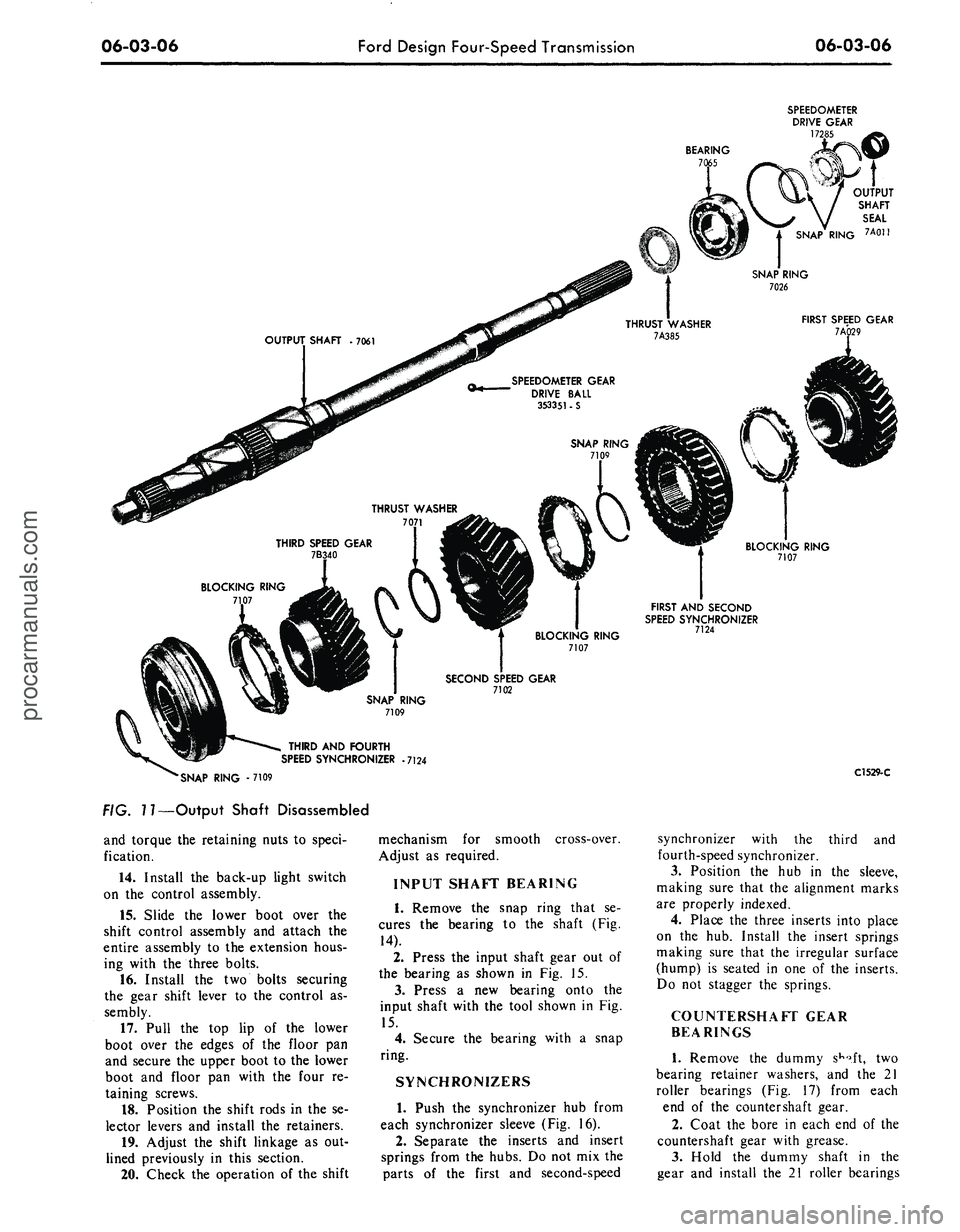
FIG.
7
7—Output Shaft Disassembled
and torque the retaining nuts to speci-
fication.
14.
Install the back-up light switch
on the control assembly.
15.
Slide the lower boot over the
shift control assembly and attach the
entire assembly to the extension hous-
ing with the three bolts.
16.
Install the two bolts securing
the gear shift lever to the control as-
sembly.
17.
Pull the top lip of the lower
boot over the edges of the floor pan
and secure the upper boot to the lower
boot and floor pan with the four re-
taining screws.
18.
Position the shift rods in the se-
lector levers and install the retainers.
19.
Adjust the shift linkage as out-
lined previously in this section.
20.
Check the operation of the shift
mechanism for smooth
Adjust as required.
cross-over.
INPUT SHAFT BEARING
1.
Remove the snap ring that se-
cures the bearing to the shaft (Fig.
14).
2.
Press the input shaft gear out of
the bearing as shown in Fig. 15.
3.
Press a new bearing onto the
input shaft with the tool shown in Fig.
15.
4.
Secure the bearing with a snap
ring.
SYNCHRONIZERS
1.
Push the synchronizer hub from
each synchronizer sleeve (Fig. 16).
2.
Separate the inserts and insert
springs from the hubs. Do not mix the
parts of the first and second-speed
C1529-C
synchronizer with the third and
fourth-speed synchronizer.
3.
Position the hub in the sleeve,
making sure that the alignment marks
are properly indexed.
4.
Place the three inserts into place
on the hub. Install the insert springs
making sure that the irregular surface
(hump) is seated in one of the inserts.
Do not stagger the springs.
COUNTERSHAFT GEAR
BEARINGS
1.
Remove the dummy
sKo.ft,
two
bearing retainer washers, and the 21
roller bearings (Fig. 17) from each
end of the countershaft gear.
2.
Coat the bore in each end of the
countershaft gear with grease.
3.
Hold the dummy shaft in the
gear and install the 21 roller bearingsprocarmanuals.com