height FORD MUSTANG 1969 Volume One Chassis
[x] Cancel search | Manufacturer: FORD, Model Year: 1969, Model line: MUSTANG, Model: FORD MUSTANG 1969Pages: 413, PDF Size: 75.81 MB
Page 104 of 413
03-02-28
Suspension
03-02-28
used, these components should
be re-
placed
on the
bench.
Do not wash the ball joint with sol-
vent.
The
solvent
may
attack parts
within the joint.
BUSHING AND INNER
SHAFT REPLACEMENT
LINCOLN CONTINENTAL
Always replace both upper
arm
bushings,
if
either bushing
is
worn
or
damaged. Install only
new
bushings
when replacing
the
inner shaft. Refer
to Section
3 for
the upper arm remov-
al procedure.
1.
Remove
the
bolts, lock washers,
and flat washers from the ends
of
the
upper arm shaft.
2.
Assemble
the
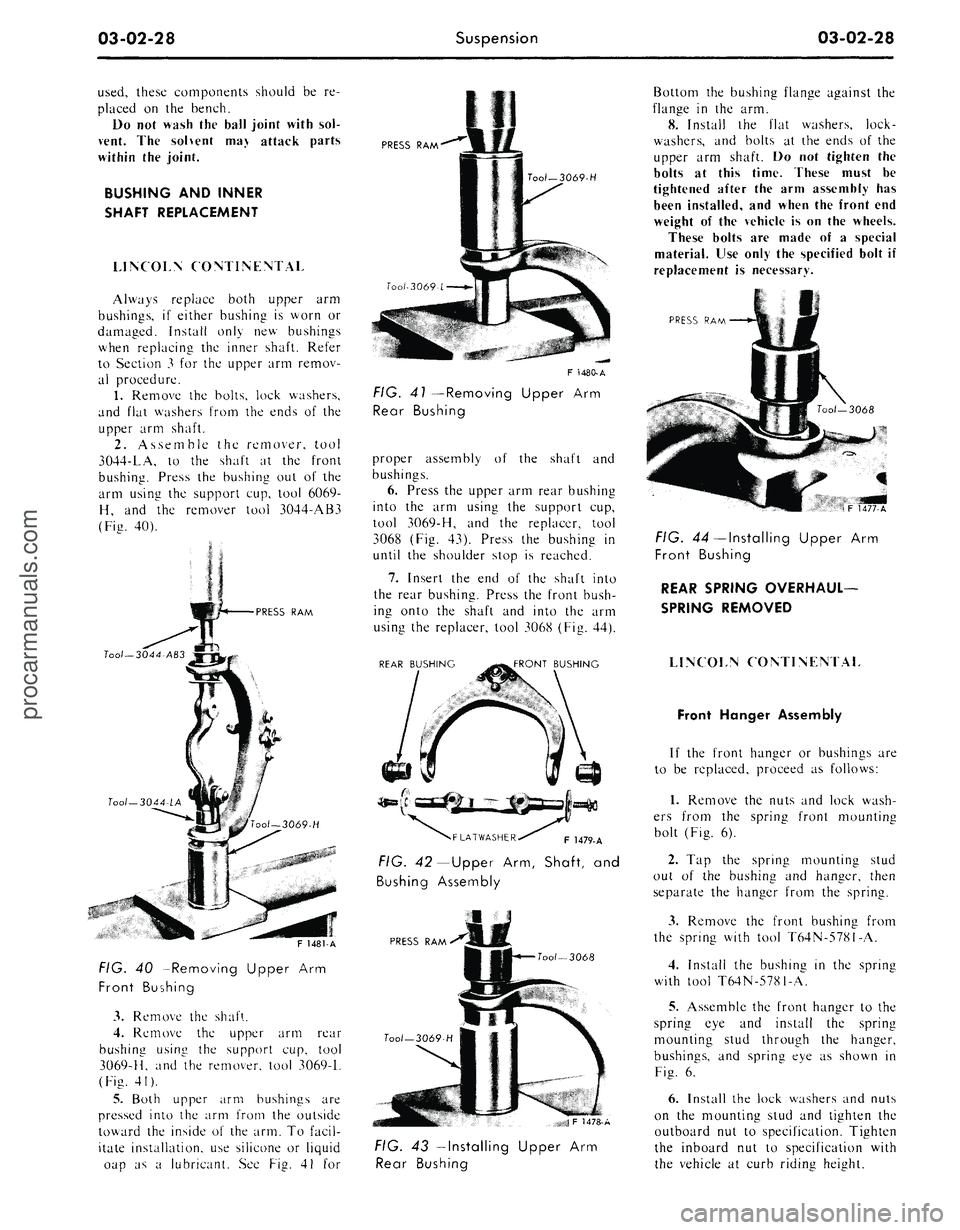
remover, tool
3044-LA,
to the
shaft
at the
front
bushing. Press
the
bushing
out of the
arm using
the
support cup, tool 6069-
H,
and the
remover tool 3044-AB3
(Fig. 40).
PRESS RAM
FIG.
40
—Removing Upper
Arm
Front Bushing
3.
Remove
the
shaft.
4.
Remove
the
upper
arm
rear
bushing using
the
support
cup,
tool
3069-H, and
the
remover, tool 3069-L
(Fig. 41).
5.
Both upper
arm
bushings
are
pressed into the arm from the outside
toward the inside
of
the arm. To facil-
itate installation, use silicone
or
liquid
oap
as a
lubricant.
See
Fig.
41 for
PRESS RAM
Tool-3069-H
F 1480-A
FIG. 41—Removing Upper
Arm
Rear Bushing
proper assembly
of the
shaft
and
bushings.
6. Press the upper arm rear bushing
into
the arm
using
the
support cup,
tool 3069-H,
and the
replacer, tool
3068 (Fig. 43). Press
the
bushing
in
until
the
shoulder stop
is
reached.
7.
Insert
the end of the
shaft into
the rear bushing. Press the front bush-
ing onto
the
shaft
and
into
the arm
using the replacer, tool 3068 (Fig. 44).
REAR BUSHING
FRONT BUSHING
F 1479-A
FIG. 42— Upper Arm, Shaft,
and
Bushing Assembly
PRESS RAM
Tool— 3068
JF 1478-A
Bottom the bushing flange against the
flange
in the
arm.
8. Install
the
flat washers, lock-
washers,
and
bolts
at
the ends
of
the
upper
arm
shaft.
Do not
tighten
the
bolts
at
this time. These must
be
tightened after
the
arm assembly
has
been installed, and when the front end
weight
of
the vehicle
is
on the wheels.
These bolts
are
made
of a
special
material. Use only the specified bolt
if
replacement
is
necessary.
PRESS
RAM
FIG. 43—Installing Upper
Arm
Rear Bushing
FIG. 44—Installing Upper
Arm
Front Bushing
REAR SPRING OVERHAUL-
SPRING REMOVED
LINCOLN CONTINENTAL
Front Hanger Assembly
If
the
front hanger
or
bushings
are
to
be
replaced, proceed
as
follows:
1.
Remove
the
nuts and lock wash-
ers from
the
spring front mounting
bolt (Fig.
6).
2.
Tap the
spring mounting stud
out
of the
bushing
and
hanger, then
separate
the
hanger from
the
spring.
3.
Remove
the
front bushing from
the spring with tool T64N-5781-A.
4.
Install
the
bushing
in the
spring
with tool T64N-5781-A.
5.
Assemble the front hanger
to
the
spring
eye and
install
the
spring
mounting stud through
the
hanger,
bushings,
and
spring eye
as
shown
in
Fig.
6.
6. Install the lock washers and nuts
on
the
mounting stud
and
tighten
the
outboard
nut to
specification. Tighten
the inboard
nut to
specification with
the vehicle
at
curb riding height.procarmanuals.com
Page 106 of 413
03-03-01
Automatic
Air
Leveling System
03-03-01
PART
3-3
Automatic
Air
Leveling System
COMPONENT INDEX
AIR COMPRESSOR
Disassembly
and
Overhaul
Removal
and
Installation
AIR CYLINDER
Removal
and
Installation
DESCRIPTION
HEIGHT CONTROL VALVE
Disassembly
and
Overhaul
Removal
and
Installation
MODEL APPLICATION
All
Models
Ford
03-03
03-02
03-02
03-01
03-03
03-02
Mercury
03-03
03-02
03-02
03-01
03-03
03-02
Meteor
03-03
03-02
03-02
03-01
03-03
03-02
Cougar
N/A
N/A
N/A
N/A
N/A
N/A
Fairlane
N/A
N/A
N/A
N/A
N/A
N/A
A page number indicates that the item
is for the
vehicle listed
at
the head
of
the column.
N/A indicates that
the
item
is not
applicable
to the
vehicle listed.
Falcon
N/A
N/A
N/A
N/A
N/A
N/A
Montego
N/A
N/A
N/A
N/A
N/A
N/A
Mustang
N/A
N/A
N/A
N/A
N/A
N/A
Lincoln-
Continental
N/A
N/A
N/A
N/A
N/A
N/A
Thunderbird
N/A
N/A
N/A
N/A
N/A
N/A
Continental-
Mark III
N/A
N/A
N/A
N/A
N/A
N/A
DESCRIPTION
The automatic level control
is an
accessory item
on the
Ford, Mercury
and Meteor vehicles
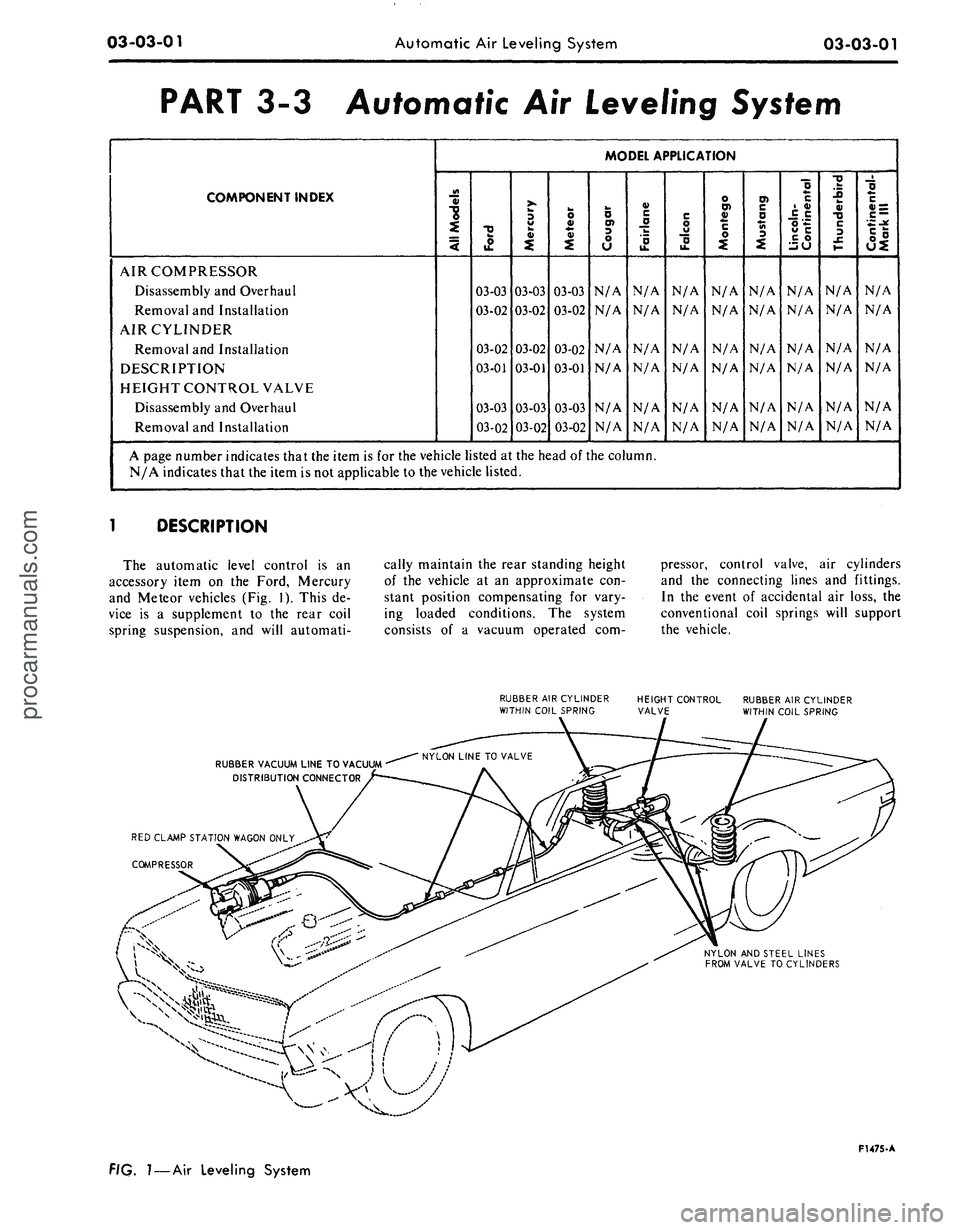
(Fig. 1).
This
de-
vice
is a
supplement
to the
rear coil
spring suspension,
and
will automati-
cally maintain
the
rear standing height
of
the
vehicle
at an
approximate
con-
stant position compensating
for
vary-
ing loaded conditions.
The
system
consists
of a
vacuum operated
com-
pressor, control valve,
air
cylinders
and
the
connecting lines
and
fittings.
In
the
event
of
accidental
air
loss,
the
conventional coil springs will support
the vehicle.
RUBBER
AIR
CYLINDER
WITHIN COIL SPRING
HEIGHT CONTROL
VALVE
RUBBER
AIR
CYLINDER
WITHIN COIL SPRING
RUBBER VACUUM LINE
TO
VACUUM
DISTRIBUTION CONNECTOR
RED CLAMP STATION WAGON ONLY
COMPRESSOR
NYLON
AND
STEEL LINES
FROM VALVE
TO
CYLINDERS
FIG.
1
—
Air Leveling System
FT475-A
procarmanuals.com
Page 107 of 413
03-03-02
Automatic Air Leveling System
03-03-02
REMOVAL AND INSTALLATION
AIR COMPRESSOR
REMOVAL
1.
Slip the vacuum line off the in-
take fitting on the side of the com-
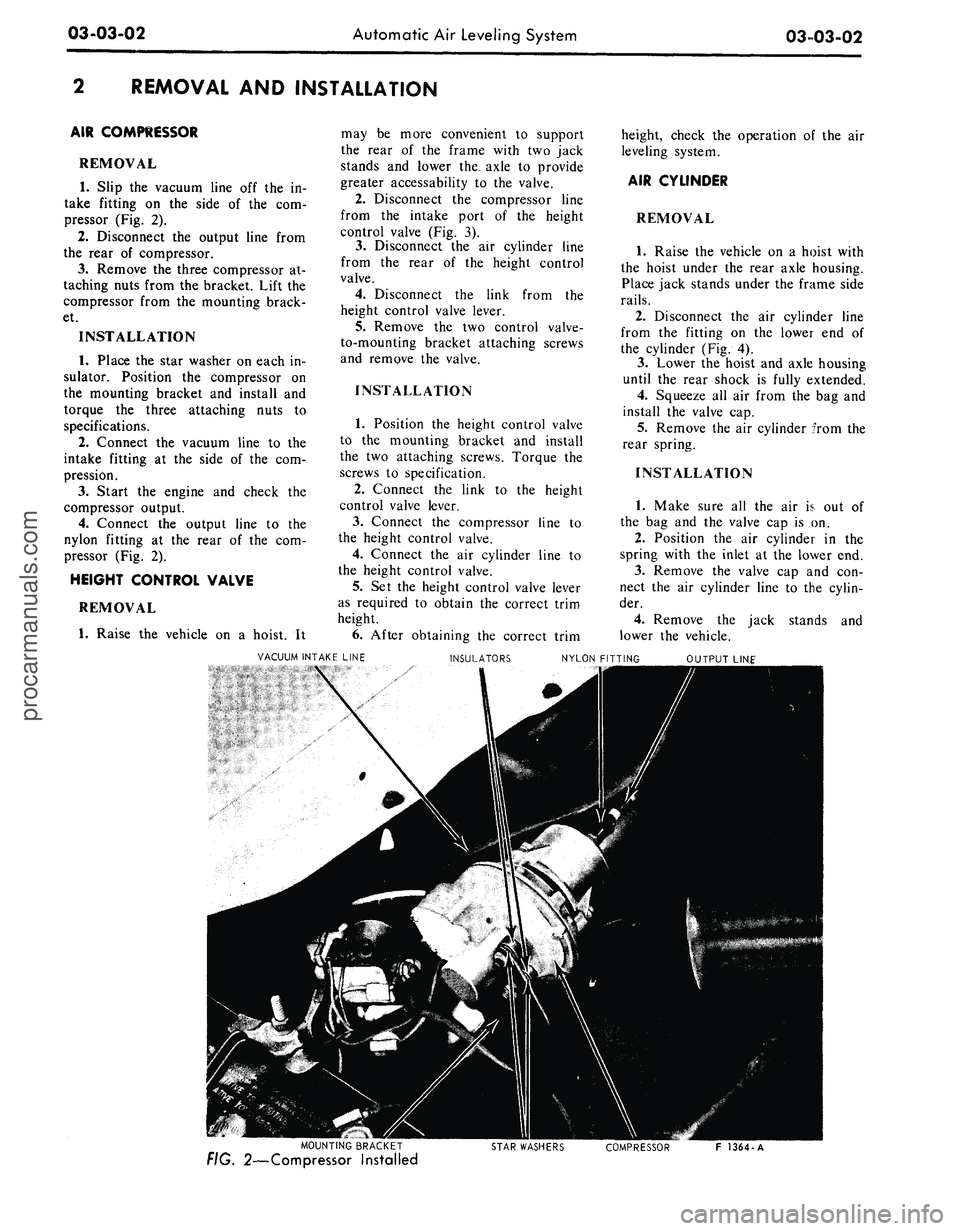
pressor (Fig. 2).
2.
Disconnect the output line from
the rear of compressor.
3.
Remove the three compressor at-
taching nuts from the bracket. Lift the
compressor from the mounting brack-
et.
INSTALLATION
1.
Place the star washer on each in-
sulator. Position the compressor on
the mounting bracket and install and
torque the three attaching nuts to
specifications.
2.
Connect the vacuum line to the
intake fitting at the side of the com-
pression.
3.
Start the engine and check the
compressor output.
4.
Connect the output line to the
nylon fitting at the rear of the com-
pressor (Fig. 2).
HEIGHT CONTROL VALVE
REMOVAL
1.
Raise the vehicle on a hoist. It
may be more convenient to support
the rear of the frame with two jack
stands and lower the, axle to provide
greater accessability to the valve.
2.
Disconnect the compressor line
from the intake port of the height
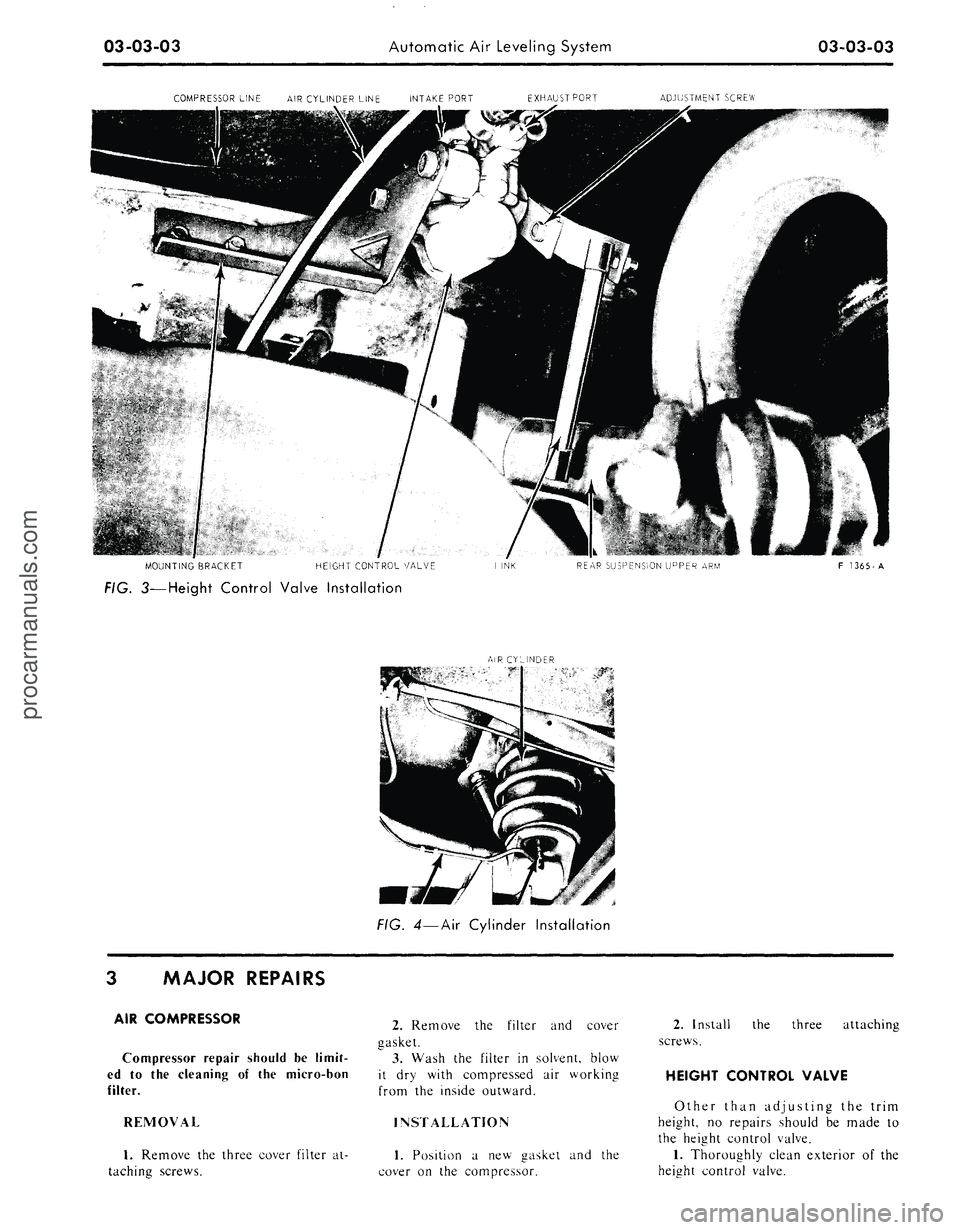
control valve (Fig. 3).
3.
Disconnect the air cylinder line
from the rear of the height control
valve.
4.
Disconnect the link from the
height control valve lever.
5.
Remove the two control valve-
to-mounting bracket attaching screws
and remove the valve.
INSTALLATION
1.
Position the height control valve
to the mounting bracket and install
the two attaching screws. Torque the
screws to specification.
2.
Connect the link to the height
control valve lever.
3.
Connect the compressor line to
the height control valve.
4.
Connect the air cylinder line to
the height control valve.
5.
Set the height control valve lever
as required to obtain the correct trim
height.
6. After obtaining the correct trim
height, check the operation of the air
leveling system.
AIR CYLINDER
REMOVAL
1.
Raise the vehicle on a hoist with
the hoist under the rear axle housing.
Place jack stands under the frame side
rails.
2.
Disconnect the air cylinder line
from the fitting on the lower end of
the cylinder (Fig. 4).
3.
Lower the hoist and axle housing
until the rear shock is fully extended.
4.
Squeeze all air from the bag and
install the valve cap.
5.
Remove the air cylinder from the
rear spring.
INSTALLATION
1.
Make sure all the air is out of
the bag and the valve cap is on.
2.
Position the air cylinder in the
spring with the inlet at the lower end.
3.
Remove the valve cap and con-
nect the air cylinder line to the cylin-
der.
4.
Remove the jack stands and
lower the vehicle.
VACUUM INTAKE LINE
INSULATORS
NYLON FITTING
MOUNTING BRACKET
FIG. 2—Compressor Installed
STAR WASHERS
COMPRESSOR
F 1364-Aprocarmanuals.com
Page 108 of 413
03-03-03
Automatic Air Leveling System
03-03-03
COMPRESSOR LINE
AIR
CYLINDER LINE INTAKE PORT EXHAUSTPORT
ADJUSTMENT SCREW
MOUNTING BRACKET
HEIGHT CONTROL VALVE
REAR SUSPENSION UPPER
ARM
FIG. 3—Height Control Valve Installation
Al R CYLINDER
F 1365-A
FIG. 4—Air Cylinder Installation
3 MAJOR REPAIRS
AIR COMPRESSOR
Compressor repair should
be
limit-
ed
to the
cleaning
of the
micro-bon
filter.
REMOVAL
1.
Remove
the
three cover filter
at-
taching screws.
2.
Remove
the
filter
and
cover
gasket.
3.
Wash
the
filter
in
solvent, blow
it
dry
with compressed
air
working
from
the
inside outward.
INSTALLATION
1.
Position
a new
gasket
and the
cover
on the
compressor.
2.
Install
the
three attaching
screws.
HEIGHT CONTROL VALVE
Other than adjusting
the
trim
height,
no
repairs should
be
made
to
the height control valve.
1.
Thoroughly clean exterior
of the
height control valve.procarmanuals.com
Page 111 of 413
03-04-02
Automatic Air Leveling System — Lincoln Continental
03-04-02
REMOVAL AND INSTALLATION
COMPRESSOR
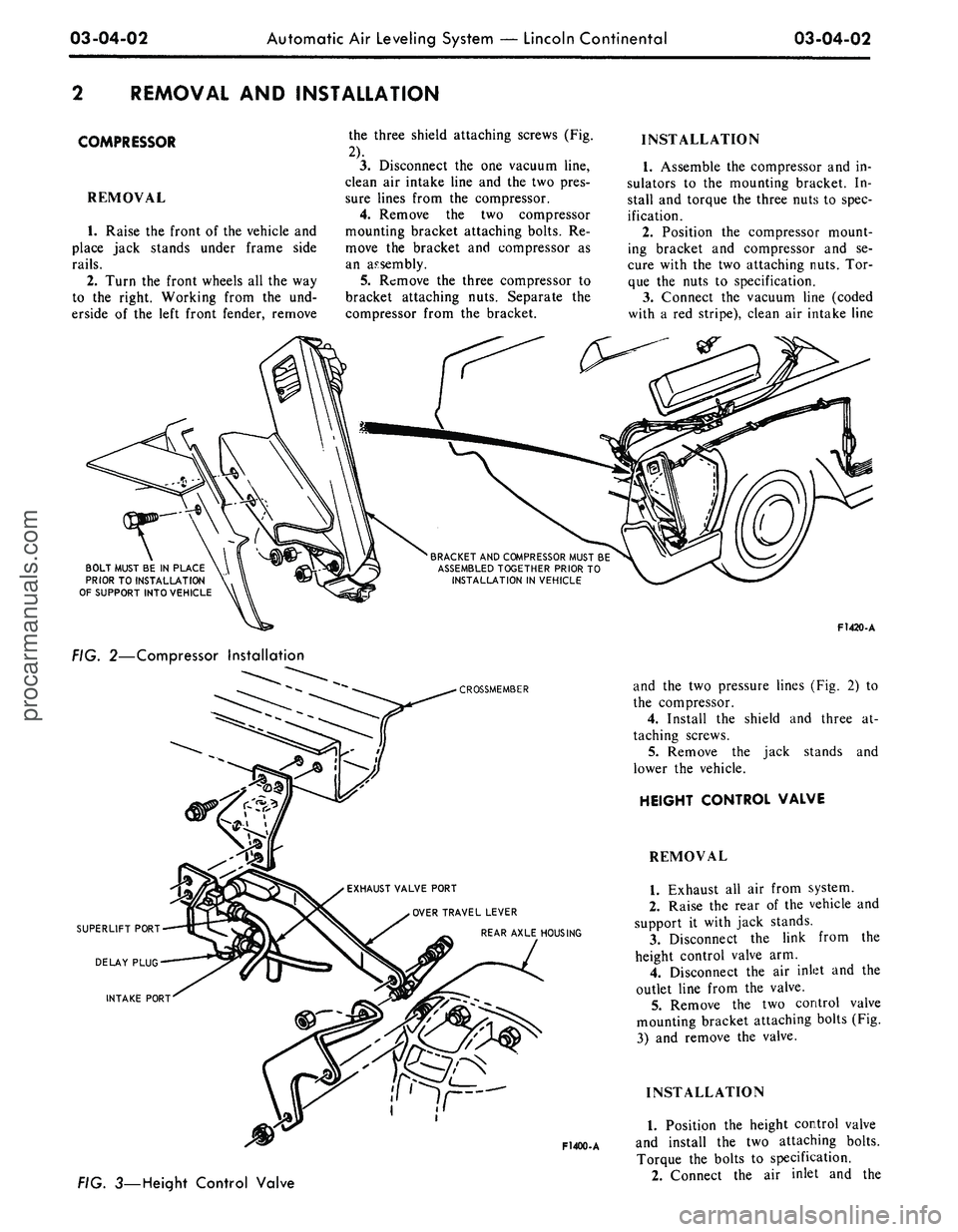
REMOVAL
1.
Raise the front of the vehicle and
place jack stands under frame side
rails.
2.
Turn the front wheels all the way
to the right. Working from the und-
erside of the left front fender, remove
the three shield attaching screws (Fig.
2).
3.
Disconnect the one vacuum line,
clean air intake line and the two pres-
sure lines from the compressor.
4.
Remove the two compressor
mounting bracket attaching bolts. Re-
move the bracket and compressor as
an assembly.
5.
Remove the three compressor to
bracket attaching nuts. Separate the
compressor from the bracket.
INSTALLATION
1.
Assemble the compressor and in-
sulators to the mounting bracket. In-
stall and torque the three nuts to spec-
ification.
2.
Position the compressor mount-
ing bracket and compressor and se-
cure with the two attaching nuts. Tor-
que the nuts to specification.
3.
Connect the vacuum line (coded
with a red stripe), clean air intake line
BRACKET
AND
COMPRESSOR
MUST
BE
ASSEMBLED
TOGETHER
PRIOR
TO
INSTALLATION
IN
VEHICLE
BOLT MUST
BE IN
PLACE
PRIOR
TO
INSTALLATION
OF
SUPPORT
INTO
VEHICLE
FIG. 2—Compressor Installation
CROSSMEMBER
EXHAUST
VALVE PORT
OVER
TRAVEL
LEVER
REAR AXLE
HOUSING
F1400-A
3—Height Control Valve
F1420-A
and the two pressure lines (Fig. 2) to
the compressor.
4.
Install the shield and three at-
taching screws.
5.
Remove the jack stands and
lower the vehicle.
HEIGHT CONTROL VALVE
REMOVAL
1.
Exhaust all air from system.
2.
Raise the rear of the vehicle and
support it with jack stands.
3.
Disconnect the link from the
height control valve arm.
4.
Disconnect the air inlet and the
outlet line from the valve.
5.
Remove the two control valve
mounting bracket attaching bolts (Fig.
3) and remove the valve.
INSTALLATION
1.
Position the height control valve
and install the two attaching bolts.
Torque the bolts to specification.
2.
Connect the air inlet and theprocarmanuals.com
Page 112 of 413
03-04-03
Automatic Air Leveling System — Lincoln Continental
03-04-03
outlet lines to their respective parts.
3.
Adjust the trim height as de-
tailed in Section 4.
4.
Connect the link to the arm.
5.
Remove the jack stands and
lower the vehicle.
SUPER LIFT SHOCK ABSORBER
REMOVAL
1.
Raise the vehicle and place jack
stands under the axle to compress the
super lift.
2.
Loosen the air line or lines (right
super lift) slowly to release the air
from the system. Then, disconnect the
line or lines.
3.
Remove the three mounting plate
attaching screws from the upper end
of the super lift.
4.
Remove the attaching nut and
washer from the lower end of the
super lift and remove it from the vehi-
cle.
5.
Remove the nut, outer washer
and the insulator that attach the super
lift to the mounting plate. Remove the
plate, remaining insulator and washer.
INSTALLATION
1.
Position a washer, insulator,
mounting plate, insulator, washer and
nut on the stud at the upper end of
the super lift. Torque the nut to speci-
fication.
2.
Install the mounting plate, outer
insulator, washer and nut on the stud.
Torque the nut to specification.
3.
Attach the mounting plate and
shock absorber to the crossmember
with the attaching screws to specifica-
tions.
4.
Connect the lower end of the
super lift to the mounting stud with
the washers and attaching nut. Torque
the nut to specification.
5.
Connect the air line or lines
(right super lift) to the super lift.
6. Start the engine and check for
leaks.
3 IN-VEHICLE ADJUSTMENTS AND REPAIRS
REGULATOR ADJUSTMENT HEIGHT CONTROL VALVE
The regulator may be adjusted if
the regulator pressure is under 100 psi
with the reservoir pressure at a mini-
mum of 140 psi. If the regulated pres-
sure exceeds 130 psi, the regulator
must be replaced.
To adjust the regulator, remove the
boot and reposition the sleeve and re-
tainer deeper into the body of the re-
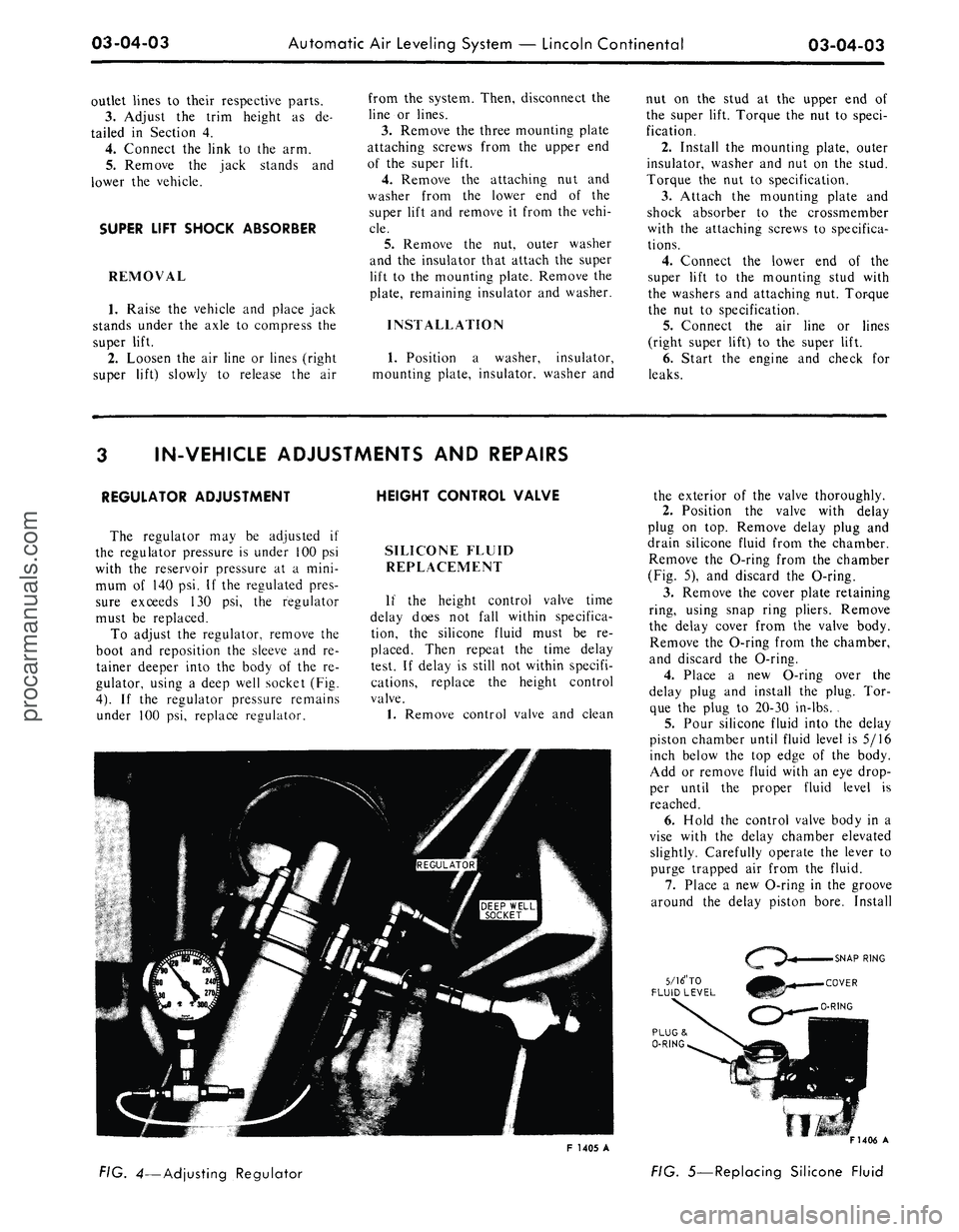
gulator, using a deep well socket (Fig.
4).
If the regulator pressure remains
under 100 psi, replace regulator.
SILICONE FLUID
REPLACEMENT
If the height control valve time
delay does not fall within specifica-
tion, the silicone fluid must be re-
placed. Then repeat the time delay
test. If delay is still not within specifi-
cations, replace the height control
valve.
1.
Remove control valve and clean
the exterior of the valve thoroughly.
2.
Position the valve with delay
plug on top. Remove delay plug and
drain silicone fluid from the chamber.
Remove the O-ring from the chamber
(Fig. 5), and discard the O-ring.
3.
Remove the cover plate retaining
ring, using snap ring pliers. Remove
the delay cover from the valve body.
Remove the O-ring from the chamber,
and discard the O-ring.
4.
Place a new O-ring over the
delay plug and install the plug. Tor-
que the plug to 20-30 in-lbs. .
5.
Pour silicone fluid into the delay
piston chamber until fluid level is 5/16
inch below the top edge of the body.
Add or remove fluid with an eye drop-
per until the proper fluid level is
reached.
6. Hold the control valve body in a
vise with the delay chamber elevated
slightly. Carefully operate the lever to
purge trapped air from the fluid.
7.
Place a new O-ring in the groove
around the delay piston bore. Install
5/16" TO
FLUID LEVEL
F 1405 A
FIG. 4—Adjusting Regulator
F1406 A
FIG. 5—Replacing Silicone Fluidprocarmanuals.com
Page 113 of 413
03-04-04 Automatic Air Leveling System — Lincoln Continental 03-04-04
the cover and secure it with a snap down. Move the overtravel lever up vehicle. If delay is not within 4-18 sec-
ring, using snap ring pliers. and down for one minute to vent air onds, recheck the fluid level in the
8. Place the control valve vertically from the delay piston pin chamber. delay chamber. If the level is within
in a vise with the delay chamber Perform a time delay check off the specifications, replace the valve.
9. Install the height control valve.procarmanuals.com
Page 167 of 413
03-10-06
Ford-Thompson Power Steering Pump
03-10-06
7.
Use one of the slippers to com-
press the spring and install the slipper
with the groove in the slipper facing
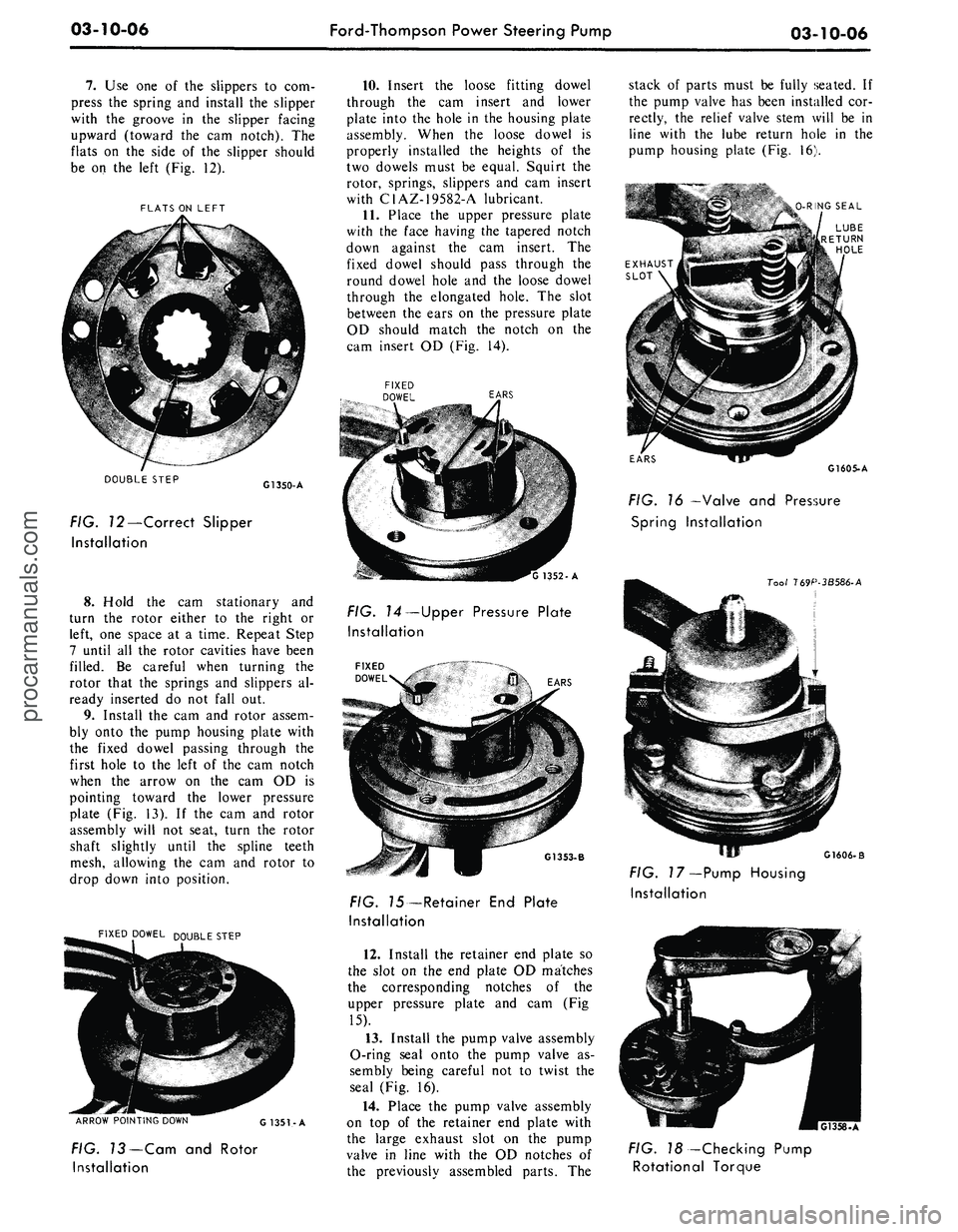
upward (toward the cam notch). The
flats on the side of the slipper should
be on the left (Fig. 12).
FLATS ON LEFT
DOUBLE STEP
G1350-A
FIG. 72—Correct Slipper
Installation
8. Hold the cam stationary and
turn the rotor either to the right or
left, one space at a time. Repeat Step
7 until all the rotor cavities have been
filled. Be careful when turning the
rotor that the springs and slippers al-
ready inserted do not fall out.
9. Install the cam and rotor assem-
bly onto the pump housing plate with
the fixed dowel passing through the
first hole to the left of the cam notch
when the arrow on the cam OD is
pointing toward the lower pressure
plate (Fig. 13). If the cam and rotor
assembly will not seat, turn the rotor
shaft slightly until the spline teeth
mesh, allowing the cam and rotor to
drop down into position.
FIXED DOWEL D0|JBLE STEP
ARROW POINTING DOWN
G 1351-A
FIG. 13—Cam and Rotor
Installation
10.
Insert the loose fitting dowel
through the cam insert and lower
plate into the hole in the housing plate
assembly. When the loose dowel is
properly installed the heights of the
two dowels must be equal. Squirt the
rotor, springs, slippers and cam insert
with C1AZ-19582-A lubricant.
11.
Place the upper pressure plate
with the face having the tapered notch
down against the cam insert. The
fixed dowel should pass through the
round dowel hole and the loose dowel
through the elongated hole. The slot
between the ears on the pressure plate
OD should match the notch on the
cam insert OD (Fig. 14).
EARS
'G 1352-A
FIG. 74—Upper Pressure Plate
Installation
\ EARS
G1353-B
FIG. 75—Retainer End Plate
Installation
12.
Install the retainer end plate so
the slot on the end plate OD matches
the corresponding notches of the
upper pressure plate and cam (Fig
15).
13.
Install the pump valve assembly
O-ring seal onto the pump valve as-
sembly being careful not to twist the
seal (Fig. 16).
14.
Place the pump valve assembly
on top of the retainer end plate with
the large exhaust slot on the pump
valve in line with the OD notches of
the previously assembled parts. The
stack of parts must be fully seated. If
the pump valve has been installed cor-
rectly, the relief valve stem will be in
line with the lube return hole in the
pump housing plate (Fig. 16).
O-RING SEAL
EARS
G1605-A
FIG. 16 —Valve and Pressure
Spring Installation
Tool 169P-3B586-A
G1606-B
FIG. 17—Pump Housing
Installation
FIG. 18 -Checking Pump
Rotational Torqueprocarmanuals.com
Page 185 of 413
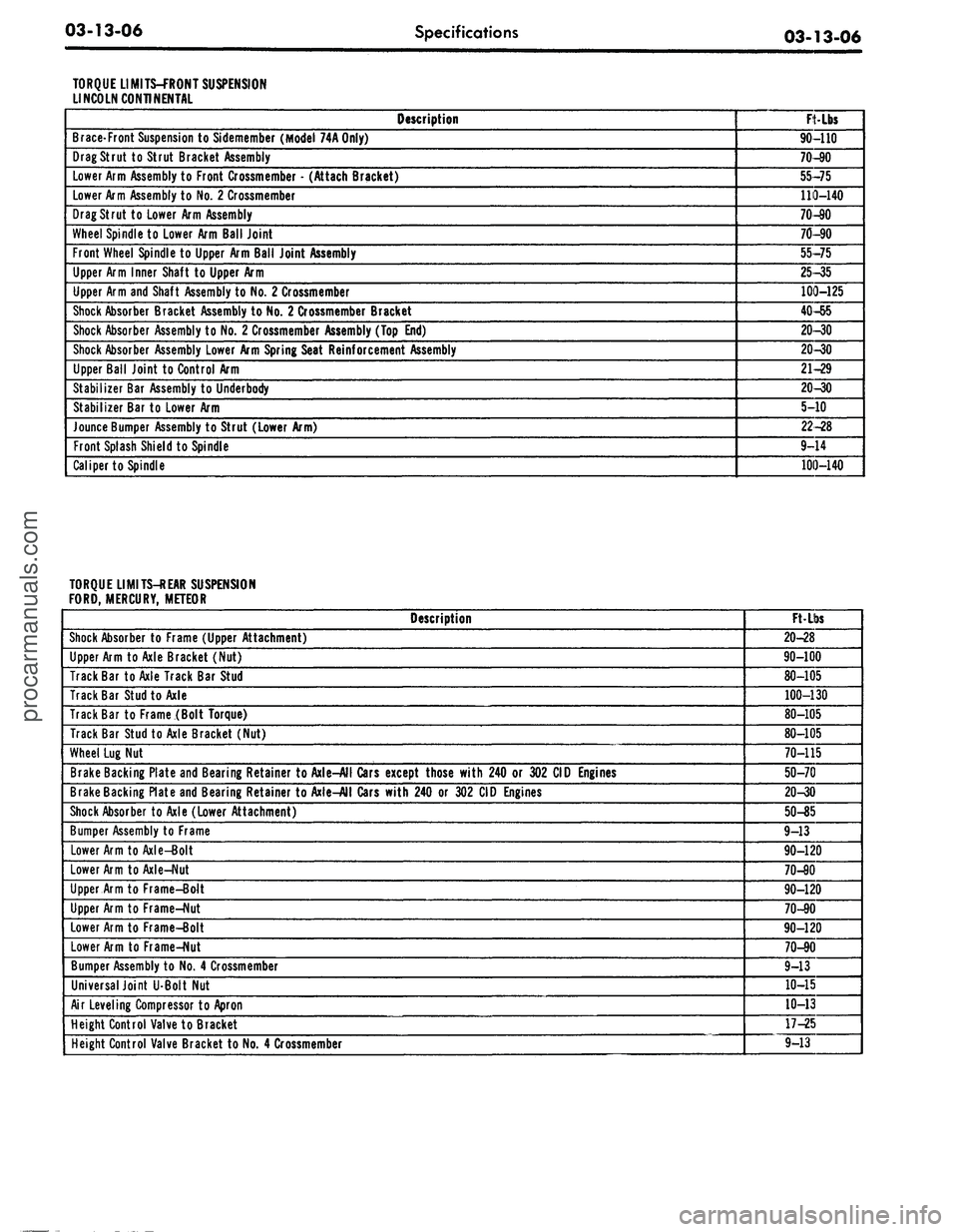
03-13-06
Specifications
03-13-06
TORQUE LIMITS-FRONT SUSPENSION
LINCOLN CONTINENTAL
Description
Brace-Front Suspension to Sidemember (Model 74A Only)
Drag Strut
to
Strut Bracket Assembly
Lower Arm Assembly to Front Crossmember
-
(Attach Bracket)
Lower Arm Assembly to No. 2 Crossmember
Drag Strut
to
Lower Arm Assembly
Wheel Spindle to Lower Arm Ball Joint
Front Wheel Spindle to Upper Arm Ball Joint Assembly
Upper Arm Inner Shaft
to
Upper Arm
Upper Arm and Shaft Assembly to No. 2 Crossmember
Shock Absorber Bracket Assembly to No. 2 Crossmember Bracket
Shock Absorber Assembly to No. 2 Crossmember Assembly (Top End)
Shock Absorber Assembly Lower Arm Spring Seat Reinforcement Assembly
Upper Ball Joint
to
Control Arm
Stabilizer Bar Assembly
to
Underbody
Stabilizer Bar
to
Lower Arm
Jounce Bumper Assembly
to
Strut (Lower Arm)
Front Splash Shield to Spindle
Caliper to Spindle
FtLbs
90-110
70-90
55-75
110-140
70-90
70-90
55-75
25-35
100-125
40-55
20-30
20-30
21-29
20-30
5-10
22-28
9-14
100-140
TORQUE LIMITS-REAR SUSPENSION
FORD, MERCURY, METEOR
Description
Shock Absorber
to
Frame (Upper Attachment)
Upper Arm to Axle Bracket (Nut)
Track Bar to Axle Track Bar Stud
Track Bar Stud to Axle
Track Bar
to
Frame (Bolt Torque)
Track Bar Stud to Axle Bracket (Nut)
Wheel Lug Nut
Brake Backing Plate and Bearing Retainer to Axle-All Cars except those with 240
or
302 CID Engines
Brake Backing Plate and Bearing Retainer to Axle-All Cars with 240
or
302 CID Engines
Shock Absorber to Axle (Lower Attachment)
Bumper Assembly
to
Frame
Lower Arm to Axle-Bolt
Lower Arm to Axle-Nut
Upper Arm
to
Frame-BoU
Upper Arm
to
Frame-Nut
Lower Arm
to
Frame-Bolt
Lower Arm
to
Frame-Nut
Bumper Assembly to No. 4 Crossmember
Universal Joint
U-Bolt
Nut
Air Leveling Compressor
to
Apron
Height Control Valve to Bracket
Height Control Valve Bracket to No. 4 Crossmember
FtLbs
20-28
90-100
80-105
100-130
80-105
80-105
70-115
50-70
20-30
50-35
9-13
90-120
70-90
90-120
70-90
90-120
70-90
9-13
10-15
10-13
17-25
9-13procarmanuals.com
Page 197 of 413
04-01-10
General Axle Service
04-01-10
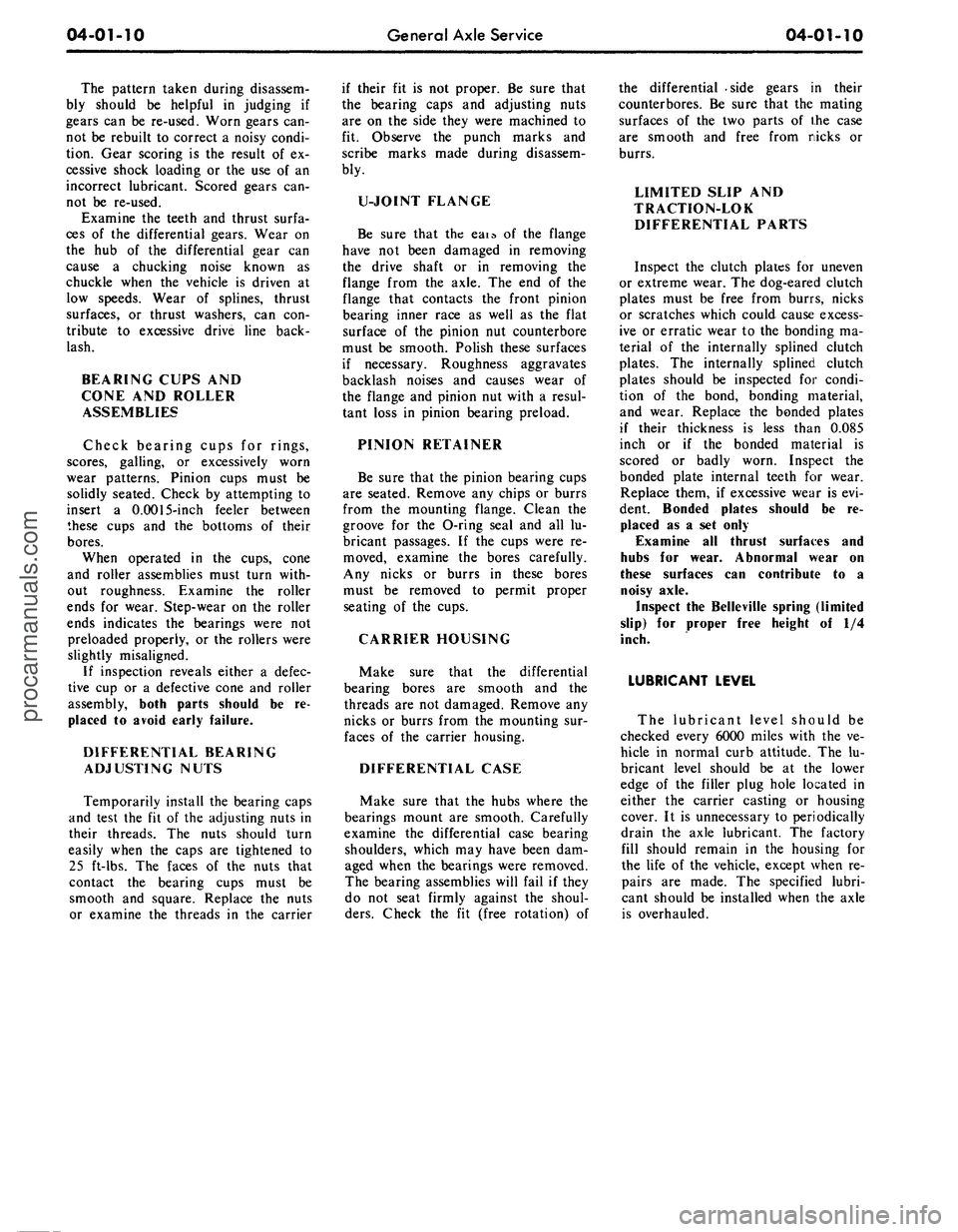
The pattern taken during disassem-
bly should be helpful in judging if
gears can be re-used. Worn gears can-
not be rebuilt to correct a noisy condi-
tion. Gear scoring is the result of ex-
cessive shock loading or the use of an
incorrect lubricant. Scored gears can-
not be re-used.
Examine the teeth and thrust surfa-
ces of the differential gears. Wear on
the hub of the differential gear can
cause a chucking noise known as
chuckle when the vehicle is driven at
low speeds. Wear of splines, thrust
surfaces, or thrust washers, can con-
tribute to excessive drive line back-
lash.
BEARING CUPS AND
CONE AND ROLLER
ASSEMBLIES
Check bearing cups for rings,
scores, galling, or excessively worn
wear patterns. Pinion cups must be
solidly seated. Check by attempting to
insert a 0.0015-inch feeler between
these cups and the bottoms of their
bores.
When operated in the cups, cone
and roller assemblies must turn with-
out roughness. Examine the roller
ends for wear. Step-wear on the roller
ends indicates the bearings were not
preloaded properly, or the rollers were
slightly misaligned.
If inspection reveals either a defec-
tive cup or a defective cone and roller
assembly, both parts should be re-
placed to avoid early failure.
DIFFERENTIAL BEARING
ADJUSTING NUTS
Temporarily install the bearing caps
and test the fit of the adjusting nuts in
their threads. The nuts should turn
easily when the caps are tightened to
25 ft-lbs. The faces of the nuts that
contact the bearing cups must be
smooth and square. Replace the nuts
or examine the threads in the carrier
if their fit is not proper. Be sure that
the bearing caps and adjusting nuts
are on the side they were machined to
fit. Observe the punch marks and
scribe marks made during disassem-
bly.
U-JOINT FLANGE
Be sure that the eai» of the flange
have not been damaged in removing
the drive shaft or in removing the
flange from the axle. The end of the
flange that contacts the front pinion
bearing inner race as well as the flat
surface of the pinion nut counterbore
must be smooth. Polish these surfaces
if necessary. Roughness aggravates
backlash noises and causes wear of
the flange and pinion nut with a resul-
tant loss in pinion bearing preload.
PINION RETAINER
Be sure that the pinion bearing cups
are seated. Remove any chips or burrs
from the mounting flange. Clean the
groove for the O-ring seal and all lu-
bricant passages. If the cups were re-
moved, examine the bores carefully.
Any nicks or burrs in these bores
must be removed to permit proper
seating of the cups.
CARRIER HOUSING
Make sure that the differential
bearing bores are smooth and the
threads are not damaged. Remove any
nicks or burrs from the mounting sur-
faces of the carrier housing.
DIFFERENTIAL CASE
Make sure that the hubs where the
bearings mount are smooth. Carefully
examine the differential case bearing
shoulders, which may have been dam-
aged when the bearings were removed.
The bearing assemblies will fail if they
do not seat firmly against the shoul-
ders.
Check the fit (free rotation) of
the differential side gears in their
counterbores. Be sure that the mating
surfaces of the two parts of the case
are smooth and free from nicks or
burrs.
LIMITED SLIP AND
TRACTION-LOK
DIFFERENTIAL PARTS
Inspect the clutch plates for uneven
or extreme wear. The dog-eared clutch
plates must be free from burrs, nicks
or scratches which could cause excess-
ive or erratic wear to the bonding ma-
terial of the internally splined clutch
plates.
The internally splined clutch
plates should be inspected for condi-
tion of the bond, bonding material,
and wear. Replace the bonded plates
if their thickness is less than 0.085
inch or if the bonded material is
scored or badly worn. Inspect the
bonded plate internal teeth for wear.
Replace them, if excessive wear is evi-
dent. Bonded plates should be re-
placed as a set only
Examine all thrust surfaces and
hubs for wear. Abnormal wear on
these surfaces can contribute to a
noisy axle.
Inspect the Belleville spring (limited
slip) for proper free height of 1/4
inch.
LUBRICANT LEVEL
The lubricant level should be
checked every 6000 miles with the ve-
hicle in normal curb attitude. The lu-
bricant level should be at the lower
edge of the filler plug hole located in
either the carrier casting or housing
cover. It is unnecessary to periodically
drain the axle lubricant. The factory
fill should remain in the housing for
the life of the vehicle, except when re-
pairs are made. The specified lubri-
cant should be installed when the axle
is overhauled.procarmanuals.com