height FORD MUSTANG 1969 Volume One Chassis
[x] Cancel search | Manufacturer: FORD, Model Year: 1969, Model line: MUSTANG, Model: FORD MUSTANG 1969Pages: 413, PDF Size: 75.81 MB
Page 208 of 413
04-02-11
Rear Axle — Removable Carrier Type
04-02-11
If the axle housing is new, install a
new vent. The hose attaching portion
must face toward the front of the ve-
hicle.
2.
If leather-type wheel bearing ser-
vice seals are to be installed, soak the
new rear wheel bearing oil seals in
SAE 10 oil for 1/2 hour before instal-
lation. Wipe a small amount of an oil
resistant sealer on the outer edge of
each seal before it is installed. Do not
put any of the sealer on the sealing
lip.
Install the oil seals in the ends of
the axle housing with one of the tools
shown in Fig. 10 and 12.
3.
Position the replacement axle
housing under the vehicle, and raise
the axle with a hoist or floor jack.
Connect the suspension lower arms to
their mounting brackets on the axle
housing with pivot bolts and nuts. Do
not tighten the bolts and nuts at this
point.
4.
Position the suspension upper
arm in its mounting bracket on the
axle housing, and install the adjusting
bolt, eccentric washers, lock washer
and nut. Leave the bolt and nut loose
at this point.
5.
Position the brake lines to the
axle housing, and secure with the re-
taining clips.
6. Install the brake backing plates
on the axle housing flanges.
7.
Connect the track bar to the
mounting stud, install the washer and
attaching nut, and torque to specifica-
tions.
8. Position the rear coil springs and
insulators in the pockets provided.
9. Connect the lower studs of the
two rear shock absorbers to the
mounting brackets on the axle hous-
ing. Install the attaching nuts, and
torque to specifications.
10.
Connect the vent tube to the
vent on the housing. If axle housing is
new, install a new vent.
11.
Clean the mating surfaces of
the axle housing and differential car-
rier. Position the carrier on the
mounting studs on the housing using a
new gasket between carrier and hous-
ing. Install the copper washers and the
carrier-to-housing attaching nuts, and
torque to specifications.
12.
Make sure that both the front
and rear pivot bolts of the upper and
the two lower arms are loose, and
then raise the axle assembly to con-
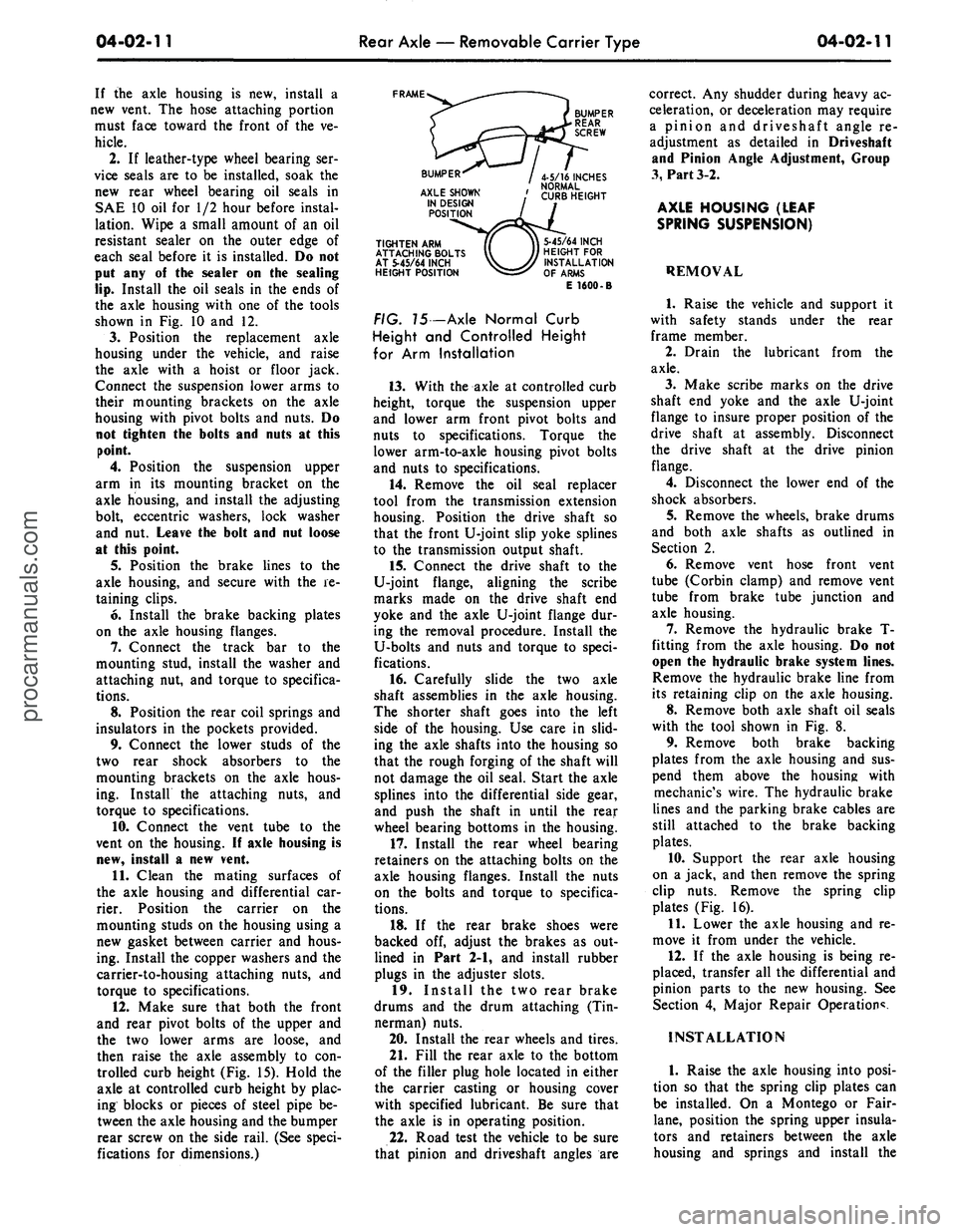
trolled curb height (Fig. 15). Hold the
axle at controlled curb height by plac-
ing blocks or pieces of steel pipe be-
tween the axle housing and the bumper
rear screw on the side rail. (See speci-
fications for dimensions.)
FRAME
TIGHTEN ARM
ATTACHING BOLTS
AT 5-45/64 INCH
HEIGHT POSITION
5-45/64 INCH
HEIGHT FOR
INSTALLATION
OF ARMS
E 1600-B
FIG. 75 -Axle Normal Curb
Height and Controlled Height
for Arm Installation
13.
With the axle at controlled curb
height, torque the suspension upper
and lower arm front pivot bolts and
nuts to specifications. Torque the
lower arm-to-axle housing pivot bolts
and nuts to specifications.
14.
Remove the oil seal replacer
tool from the transmission extension
housing. Position the drive shaft so
that the front U-joint slip yoke splines
to the transmission output shaft.
15.
Connect the drive shaft to the
U-joint flange, aligning the scribe
marks made on the drive shaft end
yoke and the axle U-joint flange dur-
ing the removal procedure. Install the
U-bolts and nuts and torque to speci-
fications.
16.
Carefully slide the two axle
shaft assemblies in the axle housing.
The shorter shaft goes into the left
side of the housing. Use care in slid-
ing the axle shafts into the housing so
that the rough forging of the shaft will
not damage the oil seal. Start the axle
splines into the differential side gear,
and push the shaft in until the rear
wheel bearing bottoms in the housing.
17.
Install the rear wheel bearing
retainers on the attaching bolts on the
axle housing flanges. Install the nuts
on the bolts and torque to specifica-
tions.
18.
If the rear brake shoes were
backed off, adjust the brakes as out-
lined in Part 2-1, and install rubber
plugs in the adjuster slots.
19.
Install the two rear brake
drums and the drum attaching (Tin-
nerman) nuts.
20.
Install the rear wheels and tires.
21.
Fill the rear axle to the bottom
of the filler plug hole located in either
the carrier casting or housing cover
with specified lubricant. Be sure that
the axle is in operating position.
22.
Road test the vehicle to be sure
that pinion and driveshaft angles are
correct. Any shudder during heavy ac-
celeration, or deceleration may require
a pinion and driveshaft angle re-
adjustment as detailed in Driveshaft
and Pinion Angle Adjustment, Group
3,
Part 3-2.
AXLE HOUSING (LEAF
SPRING SUSPENSION)
REMOVAL
1.
Raise the vehicle and support it
with safety stands under the rear
frame member.
2.
Drain the lubricant from the
axle.
3.
Make scribe marks on the drive
shaft end yoke and the axle U-joint
flange to insure proper position of the
drive shaft at assembly. Disconnect
the drive shaft at the drive pinion
flange.
4.
Disconnect the lower end of the
shock absorbers.
5.
Remove the wheels, brake drums
and both axle shafts as outlined in
Section 2.
6. Remove vent hose front vent
tube (Corbin clamp) and remove vent
tube from brake tube junction and
axle housing.
7.
Remove the hydraulic brake T-
fitting from the axle housing. Do not
open the hydraulic brake system lines.
Remove the hydraulic brake line from
its retaining clip on the axle housing.
8. Remove both axle shaft oil seals
with the tool shown in Fig. 8.
9. Remove both brake backing
plates from the axle housing and sus-
pend them above the housing with
mechanic's wire. The hydraulic brake
lines and the parking brake cables are
still attached to the brake backing
plates.
10.
Support the rear axle housing
on a jack, and then remove the spring
clip nuts. Remove the spring clip
plates (Fig. 16).
11.
Lower the axle housing and re-
move it from under the vehicle.
12.
If the axle housing is being re-
placed, transfer all the differential and
pinion parts to the new housing. See
Section 4, Major Repair Operation*.
INSTALLATION
1.
Raise the axle housing into posi-
tion so that the spring clip plates can
be installed. On a Montego or Fair-
lane,
position the spring upper insula-
tors and retainers between the axle
housing and springs and install theprocarmanuals.com
Page 235 of 413
04-04-04
Rear Axle — Ford Light-Duty (WER)
04-04-04
REMOVAL AND INSTALLATION
AXLE HOUSING
Refer to Fig. 7.
REMOVAL
1.
Raise the vehicle on a hoist.
2.
Remove the wheels and tires
from the brake drums.
3.
Position a drain pan and loosen
the rear axle cover to housing attach-
ing bolts. Drain the housing.
4.
Remove the attaching (Tinner-
man) nuts that secure the brake drums
to the axle shaft flanges, and then re-
move the drums (Fig. 7).
5.
Remove the axle housing cover
bolts,
cover and gasket. Discard the
gasket. Remove the drain pan.
6. Disconnect the drive shaft at the
drive pinion companion flange. Re-
move the drive shaft from the trans-
mission extension housing. Install an
oil seal replacer tool in the transmis-
sion housing to prevent leakage. Refer
to the transmission group for the ap-
propriate tool.
7.
Disconnect the lower end of the
shock absorbers at the mounting
brackets.
8. Disconnect the track bar from
the axle housing stud. If the axle
housing is to be replaced, transfer the
stud to the new housing.
9. Position safety stands under the
rear frame members. Lower the vehi-
cle with the hoist and allow the axle
to lower far enough to relieve rear
spring tension.
10.
Remove the pinion shaft lock
bolt and pinion shaft (Fig. 2), differ-
ential pinion gears and thrust washers.
11.
Push the axle shaft(s) inward
toward the center of the axle housing.
Remove the C-locks from the inner
ends of the axles (Fig. 3). Remove the
axle shafts from the housing. Extreme
care must be used to avoid contacting
the axle shaft seal lip with any portion
of the axle shaft other than the seal
journal.
12.
Disconnect the vent hose from
the rear vent tube and remove all
brake lines from the axle housing re-
taining clips.
13.
Remove the brake backing
plate attaching nuts and the plates
from the axle housing. Suspend the
plates above the axle housing with
mechanics wire. The hydraulic brake
lines and the parking brake cables will
remain attached to the brake backing
plates.
14.
Support the rear axle housine
on a jack.
15.
Remove the right and left rear
springs and insulators.
16.
Remove the nuts, washers and
pivot bolts that connect the suspension
lower arms to the axle housing. Dis-
connect both arms from the axle
housing.
17.
Disconnect the upper suspen-
sion arm from the axle housing by re-
moving the pivot bolt, nut, lock wash-
er and two eccentric washers.
18.
Lower the rear axle to the floor
with the jack and remove the axle
from under the vehicle.
19.
Remove the wheel bearings and
oil seals with the tool shown in Fig. 4.
20.
If the axle housing is being re-
placed, transfer all the differential and
pinion parts to the new housing. Refer
to Section 4, Major Repair Operation
for the procedure.
INSTALLATION
1.
Lightly coat the wheel bearing
rollers with axle lubricant. Install
wheel bearings in the axle housing
with the tool shown in Fig. 5. The
bearings should seat firmly against the
shoulder.
2.
Wipe all lubricant from the oil
seal bore before installing the seal. If
axle housing is being replaced, new
seals must be installed.
3.
Inspect the original seal for
nicks,
scuffs or abnormal wear, and
replace if necessary. New seals are
pre-packed with lubricant and do not
require an oil soak.
4.
Install the seal with the tool
shown in Fig. 6. Installation without
the use of the proper tool will distort
the seal and cause leakage.
5. Raise the rear axle into position
under the vehicle with a hoist or floor
jack. Connect the suspension lower
arms to their mounting brackets on
the axle housing with pivot bolts and
nuts.
Do not tighten the mounting
bolts at this point.
6. Position the suspension upper
arm in its mounting bracket on the
axle housing and install the adjusting
bolt, eccentric washers, lock washer
and nut. Do not tighten the mounting
bolt at this point.
7.
Place the rear coil springs and
insulators into position in the pockets
provided.
8. Place the brake backing plates
on the axle housing flanges, install 4
attaching bolts and nuts and torque
them to specifications.
9. Position the brake lines to the
axle housing and secure them with the
retaining clips. If the axle housing is
new, install a new vent. When install-
ing the new axle vent apply a small
amount of Locktite (C5AZ-19554-B)
to prevent oil leakage between vent
and axle housing. Connect the vent
tube to the vent.
10.
Install the pinion side gears and
thrust washer.
11.
Slide the axle shafts into place
in the axle housing. Exercise care that
splines or any portion of the axle
shafts do not damage the oil seals and
that they engage with the splines of
the differential side gears.
12.
Install the axle shaft C-lock O-
ring and C-lock on the inner end of
the shaft and push the shaft outward
so that the shaft lock seats in the
counterbore of the differential side
gear.
13.
Position the pinion differential
gears and thrust washers 180 degrees
apart to the differential side gears.
Revolve the gear assembly until the
holes in the differential case are al-
igned with the pinion gears.
14.
Position the differential pinion
shaft through the case and pinions, al-
igning the hole in the shaft with the
lock bolt hole. Install the lock bolt
and tighten it to specification.
15.
Clean the gasket mounting sur-
face of the rear axle housing and the
cover. Install a new cover gasket,
cover and the attaching bolts. Torque
the bolts to specification.
16.
Raise the rear axle on a hoist
and remove the safety stands.
17.
Connect the track bar to the
mounting stud. Install the washer and
nut. Torque the nut to specification.
18.
Connect the two rear shock ab-
sorbers to the mounting brackets on
the axle housing and torque the at-
taching nuts to specification.
19.
Make sure that both the front
and rear pivot bolts of the upper and
the two lower arms are loose, then
raise the axle assembly to the con-
trolled height (Fig. 8). Hold the axle
at the controlled height by placing
blocks or pieces of steel pipe between
the axle housing and the bumper rear
screw on the side rail.procarmanuals.com
Page 237 of 413
04-04-06
Rear Axle — Ford Light-Duty (WER)
04-04-06
20.
With the axle at controlled
height, torque the suspension upper
and lower arm front pivot bolts and
nuts to specifications. Torque the
lower arm to axle housing pivot bolts
and nuts to specifications.
21.
Remove the oil seal replacer
from the transmission extension hous-
ing. Install the drive shaft in the ex-
tension housing. Align the scribe
marks on the cups, flange and drive
shaft and connect the drive shaft at
the drive pinion flange. Torque the at-
taching bolts to specification
FRAME
TIGHTEN ARM
ATTACHING BOLTS
AT 5-45/64 INCH
HEIGHT POSITION
5-45/64 INCH
HEIGHT FOR
INSTALLATION
OF ARMS
E 1600-B
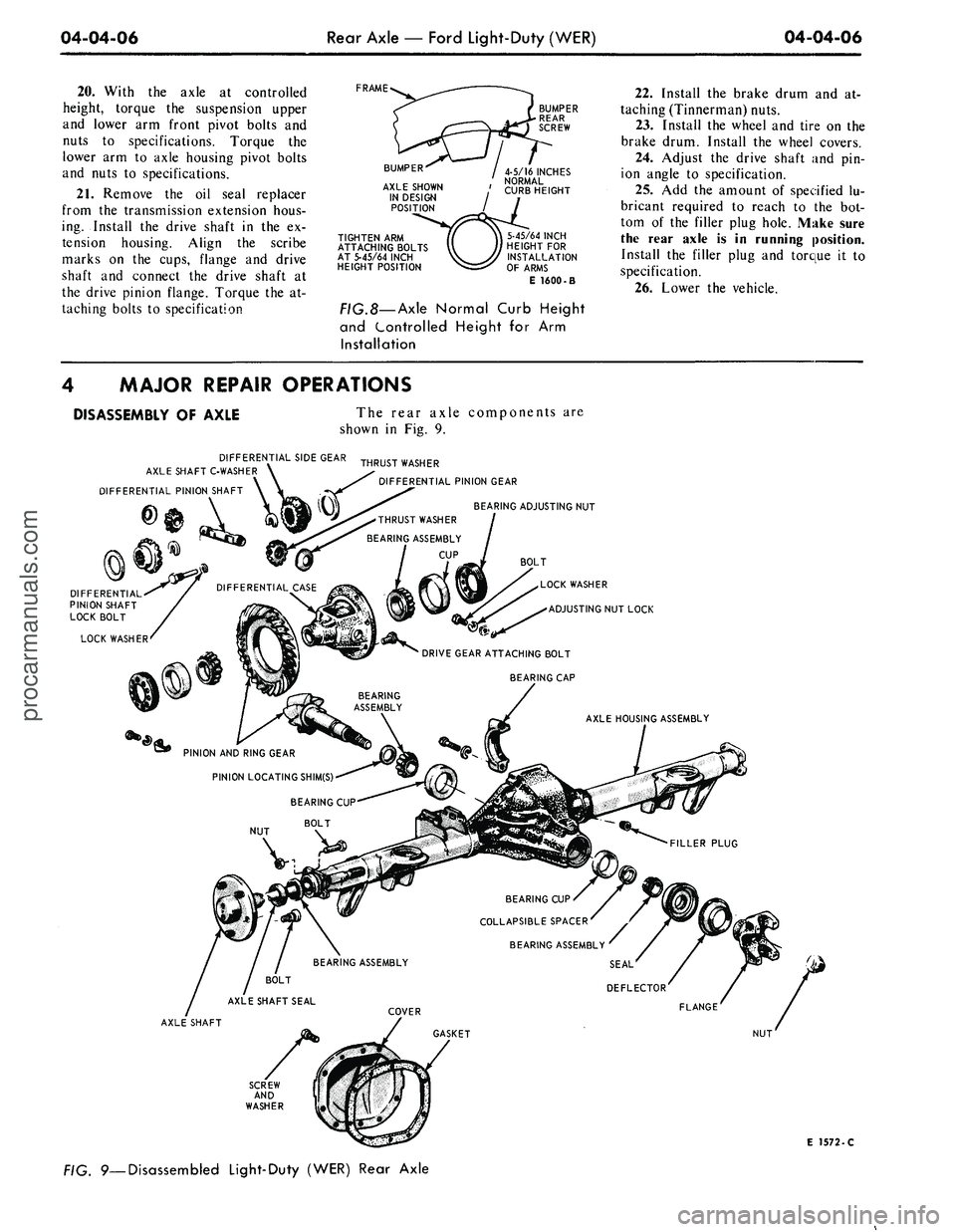
FIG.8—
Axle
Normal Curb Height
and Controlled Height for Arm
Installation
22.
Install the brake drum and at-
taching (Tinnerman) nuts.
23.
Install the wheel and tire on the
brake drum. Install the wheel covers.
24.
Adjust the drive shaft and pin-
ion angle to specification.
25.
Add the amount of specified lu-
bricant required to reach to the bot-
tom of the filler plug hole. Make sure
the rear axle is in running position.
Install the filler plug and torque it to
specification.
26.
Lower the vehicle.
4 MAJOR REPAIR OPERATIONS
DISASSEMBLY OF AXLE
The rear axle components are
shown in Fig. 9.
DIFFERENTIAL SIDE GEAR
AXLE SHAFT C-WASHER \
DIFFERENTIAL PINION SHAFT
THRUST WASHER
BEARING ASSEMBLY
CUP
THRUST WASHER
^^ DIFFERENTIAL PINION GEAR
BEARING ADJUSTING NUT
DIFFERENTIAL
PINION SHAFT
LOCK BOLT
LOCK WASHER
BOLT
LOCK WASHER
ADJUSTING NUT LOCK
DRIVE GEAR ATTACHING BOLT
BEARING CAP
AXLE HOUSING ASSEMBLY
PINION AND RING GEAR
PINION LOCATING SHIM(S)
BEARING CUP
BOLT
NUT
BEARING CUP
COLLAPSIBLE SPACER
AXLE SHAFT
E 1572-C
FIG. 9—Disassembled Light-Duty (WER) Rear Axleprocarmanuals.com
Page 262 of 413
05-03-04
Clutch
05-03-04
bushings, position the clutch pedal and
bushings in the pedal support.
8. Install the retaining ring on the
clutch pedal shaft.
9. Position the assist spring in the
pedal support bracket and the assist
spring bracket. Rotate the assist
spring bracket clockwise until the
upper bolt holes line up and install the
bolt. Torque both the upper and lower
bolts to specification.
10.
Check the clutch pedal free
travel and adjust as required.
MUSTANG, COUGAR
1.
Disconnect the battery ground
cable.
2.
Remove the steering column.
Refer to Group 3 of this manual for
the procedure.
3.
Remove the two capscrews re-
taining the master cylinder or booster
to the dash panel. Then remove the
two capscrews retaining the pedal sup-
port bracket to the dash panel.
4.
Working inside the vehicle, dis-
connect the clutch pedal-to-equalizer
rod at the clutch pedal by removing
the retainer and bushing.
5.
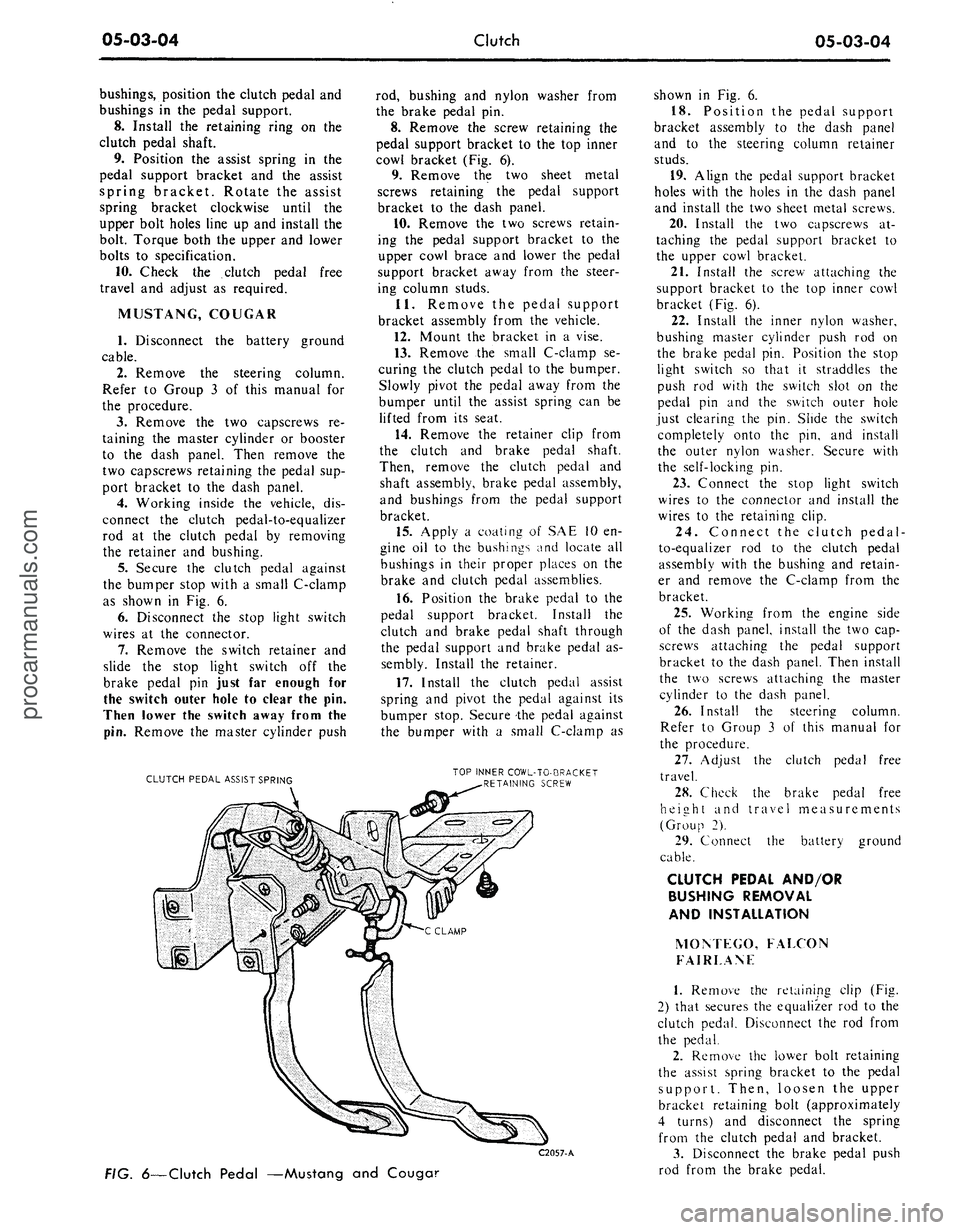
Secure the clutch pedal against
the bumper stop with a small C-clamp
as shown in Fig. 6.
6. Disconnect the stop light switch
wires at the connector.
7.
Remove the switch retainer and
slide the stop light switch off the
brake pedal pin just far enough for
the switch outer hole to clear the pin.
Then lower the switch away from the
pin.
Remove the master cylinder push
CLUTCH PEDAL ASSIST SPRING
rod, bushing and nylon washer from
the brake pedal pin.
8. Remove the screw retaining the
pedal support bracket to the top inner
cowl bracket (Fig. 6).
9. Remove the two sheet metal
screws retaining the pedal support
bracket to the dash panel.
10.
Remove the two screws retain-
ing the pedal support bracket to the
upper cowl brace and lower the pedal
support bracket away from the steer-
ing column studs.
11.
Remove the pedal support
bracket assembly from the vehicle.
12.
Mount the bracket in a vise.
13.
Remove the small C-clamp se-
curing the clutch pedal to the bumper.
Slowly pivot the pedal away from the
bumper until the assist spring can be
lifted from its seat.
14.
Remove the retainer clip from
the clutch and brake pedal shaft.
Then, remove the clutch pedal and
shaft assembly, brake pedal assembly,
and bushings from the pedal support
bracket.
15.
Apply a coating of SAE 10 en-
gine oil to the bushings and locate all
bushings in their proper places on the
brake and clutch pedal assemblies.
16.
Position the brake pedal to the
pedal support bracket. Install the
clutch and brake pedal shaft through
the pedal support and brake pedal as-
sembly. Install the retainer.
17.
Install the clutch pedal assist
spring and pivot the pedal against its
bumper stop. Secure the pedal against
the bumper with a small C-clamp as
TOP INNER COWL-TO-BRACKET
RETAINING SCREW
C2057-A
FIG.
6—Clutch
Pedal —Mustang and Couga?
shown in Fig. 6.
18.
Position the pedal support
bracket assembly to the dash panel
and to the steering column retainer
studs.
19.
Align the pedal support bracket
holes with the holes in the dash panel
and install the two sheet metal screws.
20.
Install the two capscrews at-
taching the pedal support bracket to
the upper cowl bracket.
21.
Install the screw attaching the
support bracket to the top inner cowl
bracket (Fig. 6).
22.
Install the inner nylon washer,
bushing master cylinder push rod on
the brake pedal pin. Position the stop
light switch so that it straddles the
push rod with the switch slot on the
pedal pin and the switch outer hole
just clearing the pin. Slide the switch
completely onto the pin, and install
the outer nylon washer. Secure with
the self-locking pin.
23.
Connect the stop light switch
wires to the connector and install the
wires to the retaining clip.
24.
Connect the clutch pedal-
to-equalizer rod to the clutch pedal
assembly with the bushing and retain-
er and remove the C-clamp from the
bracket.
25.
Working from the engine side
of the dash panel, install the two cap-
screws attaching the pedal support
bracket to the dash panel. Then install
the two screws attaching the master
cylinder to the dash panel.
26.
Install the steering column.
Refer to Group 3 of this manual for
the procedure.
27.
Adjust the clutch pedal free
travel.
28.
Check the brake pedal free
height and travel measurements
(Group 2).
29.
Connect the battery ground
cable.
CLUTCH PEDAL AND/OR
BUSHING REMOVAL
AND INSTALLATION
MOM EGO, FALCON
FAIRLANF
1.
Remove the retaining clip (Fig.
2) that secures the equalizer rod to the
clutch pedal. Disconnect the rod from
the pedal.
2.
Remove the lower bolt retaining
the assist spring bracket to the pedal
support. Then, loosen the upper
bracket retaining bolt (approximately
4 turns) and disconnect the spring
from the clutch pedal and bracket.
3.
Disconnect the brake pedal push
rod from the brake pedal.procarmanuals.com
Page 272 of 413
06-02-03
Ford Design Three Speed Transmission
06-02-03
STOP
PIN
GROMMET
Tool -
T67P.7347.A
GROMMET
LEVER
CONTROL ROD REMOVAL
^S.
GROMMET INSTALLATION
SET STOP PIN SO THAT THE GROMMET
Tool
-
T67P.734LA
AND
SHIFT ROD ARE PROPERLY SEATED
OMMET—^
SEATED
\
CONTROL ROD INSTALLATION
CONTROL ROD
STOP
PIN
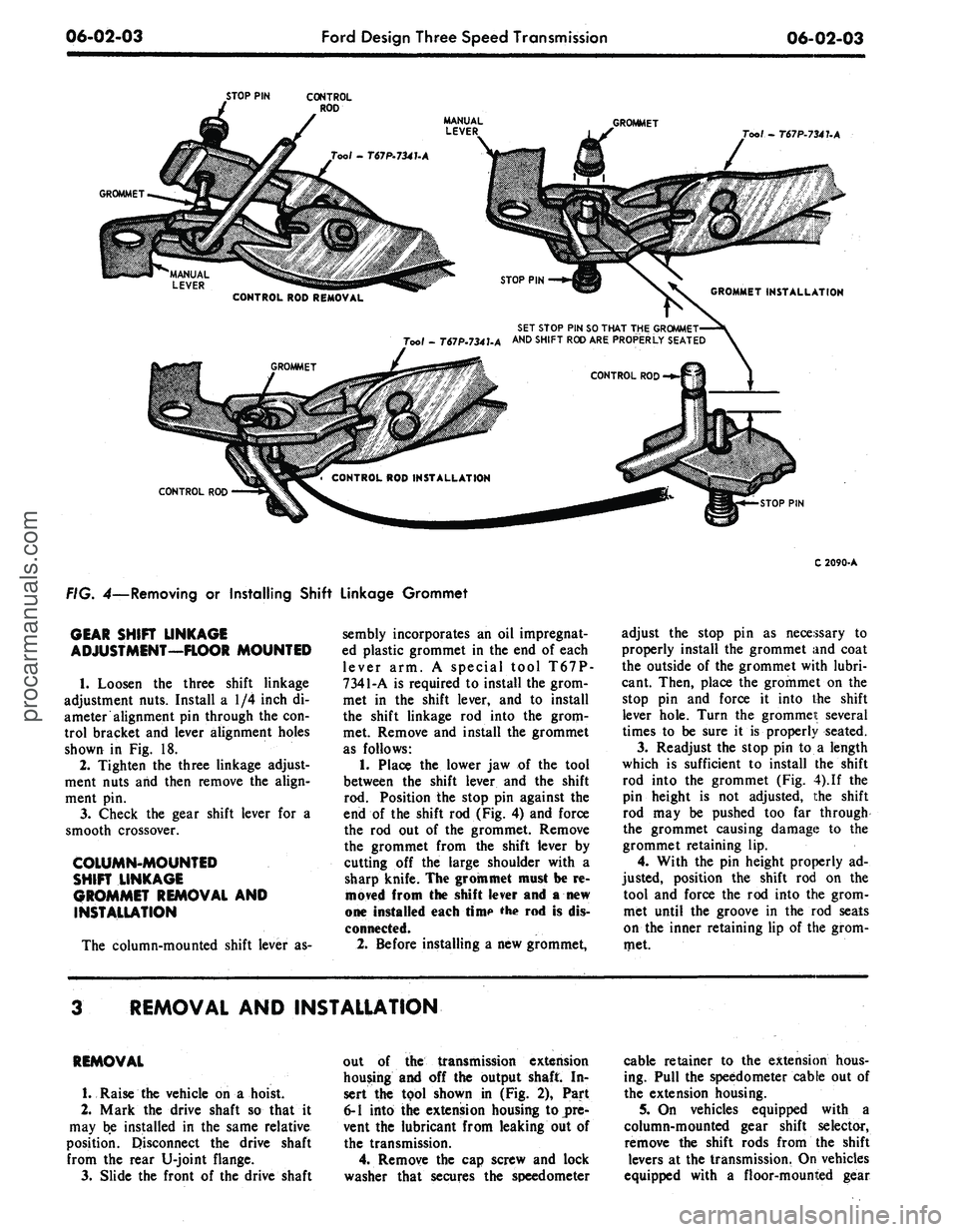
FIG. 4—Removing
or
Installing Shift Linkage Grommet
GEAR SHIFT LINKAGE
ADJUSTMENT—FLOOR MOUNTED
1.
Loosen
the
three shift linkage
adjustment nuts. Install
a 1/4
inch
di-
ameter alignment pin through the con-
trol bracket and lever alignment holes
shown
in Fig. 18.
2.
Tighten
the
three linkage adjust-
ment nuts
and
then remove
the
align-
ment
pin.
3.
Check
the
gear shift lever
for a
smooth crossover.
COLUMN-MOUNTED
SHIFT LINKAGE
GROMMET REMOVAL
AND
INSTALLATION
The column-mounted shift lever
as-
sembly incorporates
an oil
impregnat-
ed plastic grommet
in the
end
of
each
lever
arm. A
special tool T67P-
7341-A
is
required
to
install the grom-
met
in the
shift lever,
and to
install
the shift linkage
rod
into
the
grom-
met. Remove
and
install
the
grommet
as follows:
1.
Place
the
lower
jaw of the
tool
between
the
shift lever
and the
shift
rod.
Position
the
stop
pin
against
the
end
of the
shift
rod
(Fig.
4)
and force
the
rod out of the
grommet. Remove
the grommet from
the
shift lever
by
cutting
off the
large shoulder with
a
sharp knife. The groin met must
be re-
moved from
the
shift lever
and a new
one installed each rime
'he rod is
dis-
connected.
2.
Before installing
a
new grommet,
C 2090-A
adjust
the
stop
pin as
necessary
to
properly install
the
grommet and coat
the outside
of
the grommet with lubri-
cant. Then, place
the
grommet
on the
stop
pin and
force
it
into
the
shift
lever hole. Turn
the
grommeit several
times
to be
sure
it is
properly seated.
3.
Readjust
the
stop
pin to a
length
which
is
sufficient
to
install
the
shift
rod into
the
grommet
(Fig.
4).
If
the
pin height
is not
adjusted,
the
shift
rod
may be
pushed
too far
through
the grommet causing damage
to the
grommet retaining
lip.
4.
With
the pin
height properly
ad-
justed, position
the
shift
rod on the
tool
and
force
the rod
into
the
grom-
met until
the
groove
in the rod
seats
on
the
inner retaining
lip of
the grom-
met.
REMOVAL AND INSTALLATION
REMOVAL
1.
Raise
the
vehicle
on a
hoist.
2.
Mark
the
drive shaft
so
that
it
may
be
installed
in the
same relative
position. Disconnect
the
drive shaft
from
the
rear U-joint flange.
3.
Slide
the
front
of the
drive shaft
out
of the
transmission extension
housing
and off the
output shaft
In-
sert
the
tool shown
in (Fig. 2),
Part
6-1 into the extension housing
to
pre-
vent
the
lubricant from leaking
out of
the transmission.
4.
Remove
the cap
screw
and
lock
washer that secures
the
speedometer
cable retainer
to the
extension hous-
ing. Pull
the
speedometer cable
out of
the extension housing.
5.
On
vehicles equipped with
a
column-mounted gear shift selector,
remove
the
shift rods from
the
shift
levers
at
the transmission. On vehicles
equipped with
a
floor-mounted gearprocarmanuals.com
Page 302 of 413
07-01-11
General Transmission Service
07-01-11
STOP
PIN
GROMMET
Tool - T67P-734LA
GROMMET
LEVER
CONTROL ROD REMOVAL
GROMMET INSTALLATION
Tool - T67P-734LA
r
CONTROL ROD INSTALLATION
3/16"-1/4'
CONTROL ROD
STOP
PIN
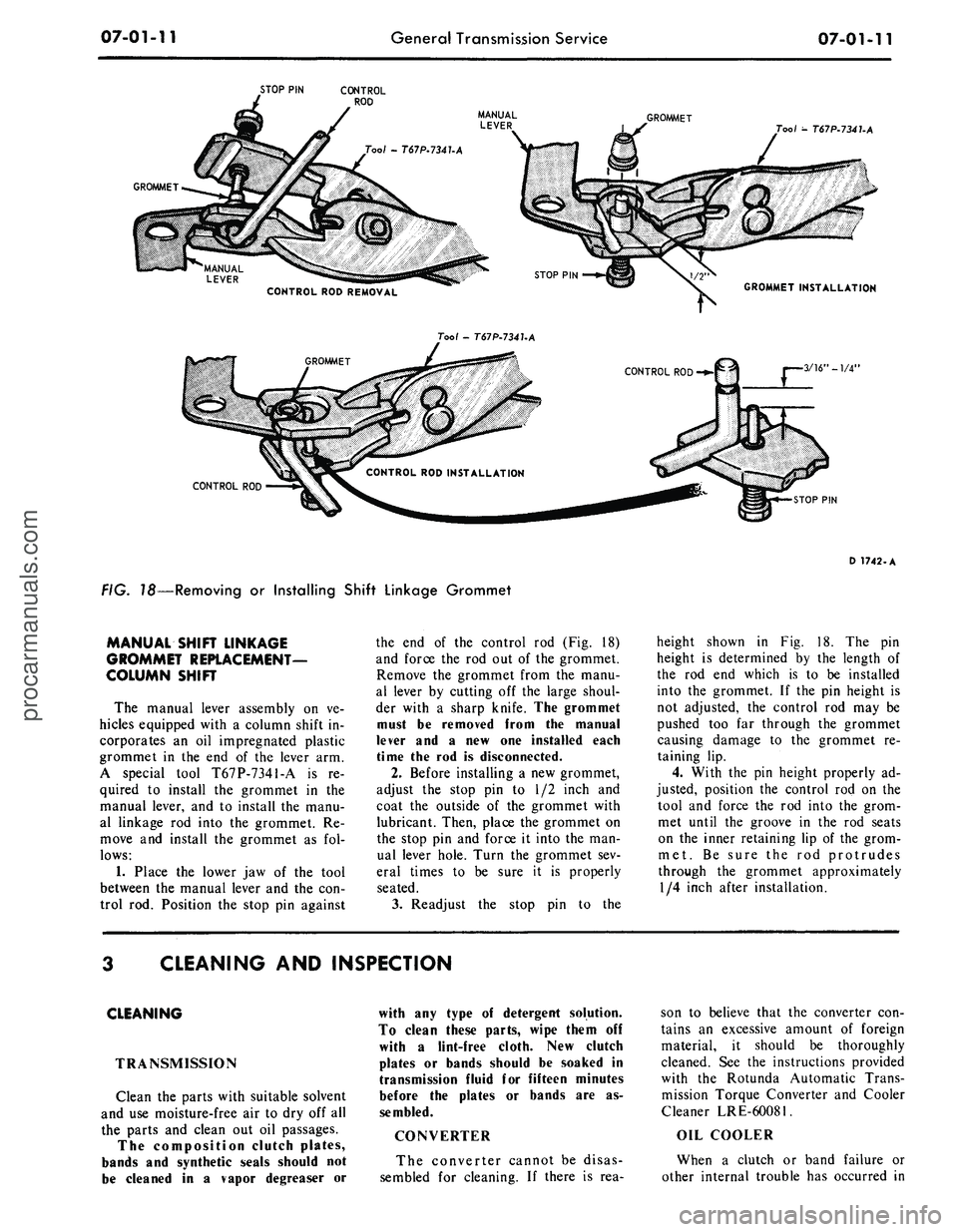
FIG. 18—Removing
or
Installing Shift Linkage Grommet
D 1742-A
MANUAL SHIFT LINKAGE
GROMMET REPLACEMENT-
COLUMN SHIFT
The manual lever assembly
on ve-
hicles equipped with
a
column shift
in-
corporates
an oil
impregnated plastic
grommet
in the end of the
lever
arm.
A special tool T67P-7341-A
is re-
quired
to
install
the
grommet
in the
manual lever,
and to
install
the
manu-
al linkage
rod
into
the
grommet.
Re-
move
and
install
the
grommet
as fol-
lows:
1.
Place
the
lower
jaw of the
tool
between
the
manual lever
and the con-
trol
rod.
Position
the
stop
pin
against
the
end of the
control
rod (Fig. 18)
and force
the rod out of the
grommet.
Remove
the
grommet from
the
manu-
al lever
by
cutting
off the
large shoul-
der with
a
sharp knife.
The
grommet
must
be
removed from
the
manual
lever
and a new one
installed each
time
the rod is
disconnected.
2.
Before installing
a
new grommet,
adjust
the
stop
pin to 1/2
inch
and
coat
the
outside
of the
grommet with
lubricant. Then, place
the
grommet
on
the stop
pin and
force
it
into
the
man-
ual lever hole. Turn
the
grommet
sev-
eral times
to be
sure
it is
properly
seated.
3.
Readjust
the
stop
pin to the
height shown
in Fig. 18. The pin
height
is
determined
by the
length
of
the
rod end
which
is to be
installed
into
the
grommet.
If the pin
height
is
not adjusted,
the
control
rod may be
pushed
too far
through
the
grommet
causing damage
to the
grommet
re-
taining
lip.
4.
With
the pin
height properly
ad-
justed, position
the
control
rod on the
tool
and
force
the rod
into
the
grom-
met until
the
groove
in the rod
seats
on
the
inner retaining
lip of the
grom-
met.
Be
sure
the rod
protrudes
through
the
grommet approximately
1/4 inch after installation.
CLEANING
AND
INSPECTION
CLEANING
TRANSMISSION
Clean
the
parts with suitable solvent
and
use
moisture-free
air to dry off all
the parts
and
clean
out oil
passages.
The composition clutch plates,
bands
and
synthetic seals should
not
be cleaned
in a
vapor degreaser
or
with
any
type
of
detergent solution.
To clean these parts, wipe them
off
with
a
lint-free cloth.
New
clutch
plates
or
bands should
be
soaked
in
transmission fluid
for
fifteen minutes
before
the
plates
or
bands
are as-
sembled.
CONVERTER
The converter cannot
be
disas-
sembled
for
cleaning.
If
there
is rea-
son
to
believe that
the
converter
con-
tains
an
excessive amount
of
foreign
material,
it
should
be
thoroughly
cleaned.
See the
instructions provided
with
the
Rotunda Automatic Trans-
mission Torque Converter
and
Cooler
Cleaner LRE-60081.
OIL COOLER
When
a
clutch
or
band failure
or
other internal trouble
has
occurred
inprocarmanuals.com
Page 316 of 413
07-02-08
C4 Automatic Transmission
07-02-08
8. Install the outer downshift lever
and attaching nut, and torque the nut
to specification. Install the downshift
linkage rod to the downshift lever.
9. Install the switch wires. Connect
the wire multiple connector. Check
the operation of the switch in each de-
tent position. The engine should start
only with the transmission selector
lever in N (neutral) and P (park).
SELECTOR LEVER
REPLACEMENT—CONSOLE SHIFT
FORD-METEOR
1.
Raise the vehicle and disconnect
the link assembly from the selector
lever arm (Fig. 6).
2.
Lower the vehicle. Remove the
four screws and plates securing the se-
lector lever handle to the lever. Re-
move the handle and detent control.
3.
Remove the two screws from the
rear of the console top panel. Pull the
panel back to unhook it from the
front of the console and remove the
panel.
4.
Disconnect the neutral start
switch wires at the plug connector.
Disconnect the bulb socket from the
quadrant.
5.
Remove the four bolts that at-
tach the selector lever housing to the
floor pan and remove the selector
lever and housing.
6. Position the new selector lever
and housing assembly on the floor pan
and install the attaching bolts.
7.
Connect the bulb socket to the
quadrant and the neutral start switch
wires to the plug connector.
8. Raise the vehicle and secure the
link assembly to the selector lever arm
with the bushing, insulator, flat wash-
er and cotter pin (Fig. 6). Lower the
vehicle.
9. Place the console top panel on
the console and install the retaining
screws.
10.
Position the selector lever de-
tr*rtt control and handle on the selector
lever and secure with the four plates
and attaching screws.
FAIRLANE-MONTEGO
1.
Raise the vehicle on a hoist or
jack stands.
2.
Remove the retainer that secures
the manual linkage rod to the lower
end of the manual lever (Fig. 7).
3.
Remove the flat washer and two
insulator washers and disconnect the
rod from the arm.
4.
Working from inside of the vehi-
cle,
remove the selector lever handle
attaching screw. Lift the handle off
the selector lever.
DETENT PAWL
LOCK NUT
DETENT PAWL
ADJUSTMENT SCREW
DETENT PLATE
D 1644-A
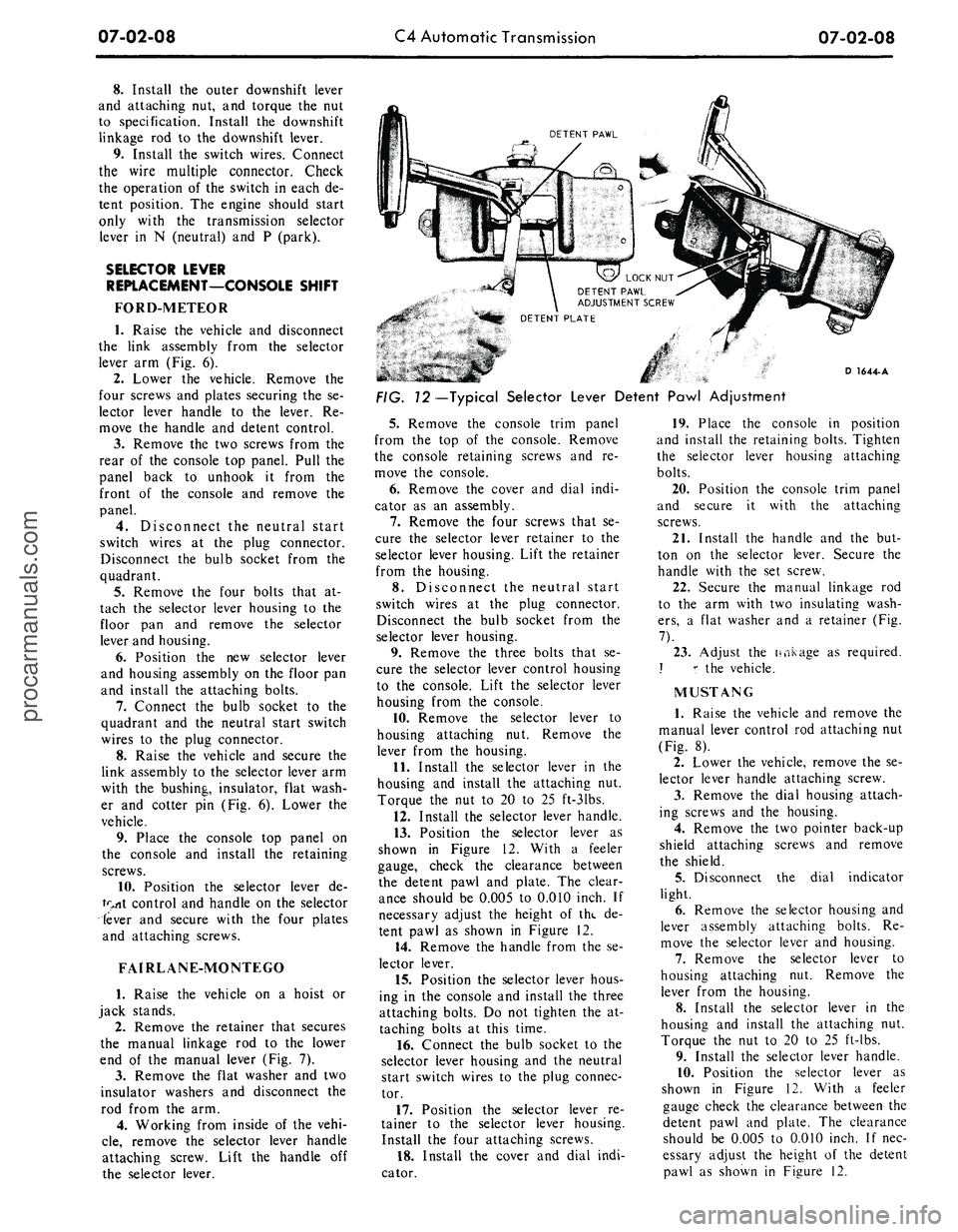
FIG. 72—Typical Selector Lever Detent Pawl Adjustment
5.
Remove the console trim panel
from the top of the console. Remove
the console retaining screws and re-
move the console.
6. Remove the cover and dial indi-
cator as an assembly.
7.
Remove the four screws that se-
cure the selector lever retainer to the
selector lever housing. Lift the retainer
from the housing.
8. Disconnect the neutral start
switch wires at the plug connector.
Disconnect the bulb socket from the
selector lever housing.
9. Remove the three bolts that se-
cure the selector lever control housing
to the console. Lift the selector lever
housing from the console.
10.
Remove the selector lever to
housing attaching nut. Remove the
lever from the housing.
11.
Install the selector lever in the
housing and install the attaching nut.
Torque the nut to 20 to 25 ft-31bs.
12.
Install the selector lever handle.
13.
Position the selector lever as
shown in Figure 12. With a feeler
gauge, check the clearance between
the detent pawl and plate. The clear-
ance should be 0.005 to 0.010 inch. If
necessary adjust the height of the de-
tent pawl as shown in Figure 12.
14.
Remove the handle from the se-
lector lever.
15.
Position the selector lever hous-
ing in the console and install the three
attaching bolts. Do not tighten the at-
taching bolts at this time.
16.
Connect the bulb socket to the
selector lever housing and the neutral
start switch wires to the plug connec-
tor.
17.
Position the selector lever re-
tainer to the selector lever housing.
Install the four attaching screws.
18.
Install the cover and dial indi-
cator.
19.
Place the console in position
and install the retaining bolts. Tighten
the selector lever housing attaching
bolts.
20.
Position the console trim panel
and secure it with the attaching
screws.
21.
Install the handle and the but-
ton on the selector lever. Secure the
handle with the set screw.
22.
Secure the manual linkage rod
to the arm with two insulating wash-
ers,
a flat washer and a retainer (Fig.
7).
23.
Adjust the linkage as required.
J r the vehicle.
MUSTANG
1.
Raise the vehicle and remove the
manual lever control rod attaching nut
(Fig. 8).
2.
Lower the vehicle, remove the se-
lector lever handle attaching screw.
3.
Remove the dial housing attach-
ing screws and the housing.
4.
Remove the two pointer back-up
shield attaching screws and remove
the shield.
5.
Disconnect the dial indicator
light.
6. Remove the selector housing and
lever assembly attaching bolts. Re-
move the selector lever and housing.
7.
Remove the selector lever to
housing attaching nut. Remove the
lever from the housing.
8. Install the selector lever in the
housing and install the attaching nut.
Torque the nut to 20 to 25 ft-lbs.
9. Install the selector lever handle.
10.
Position the selector lever as
shown in Figure 12. With a feeler
gauge check the clearance between the
detent pawl and plate. The clearance
should be 0.005 to 0.010 inch. If nec-
essary adjust the height of the detent
pawl as shown in Figure 12.procarmanuals.com
Page 348 of 413
07-03-08
FAAX Transmission
07-03-08
14.
Install the trim panel on the top
of the console. Install the selector
lever handle.
MUSTANG-COUGAR
1.
Place the transmission selector
lever in the N (Neutral) position.
2.
Raise the vehicle and remove the
manual lever control rod attaching nut
(Fig. 7).
3.
Lower the vehicle and remove
the selector lever handle attaching
screw and the handle.
4.
Remove the dial housing attach-
ing screws and the housing.
5.
Disconnect the dial indicator
light.
6. Disconnect the neutral start
switch and dial indicator light wires
from their connectors at the dash
panel.
7.
Remove the four selector housing
and lever assembly attaching bolts.
Remove the selector lever and housing
assembly.
8. Remove the two pointer back-up
shield attaching screws and remove
the shield.
9. Remove the two screws securing
the neutral start switch to the selector
lever housing. Push the neutral start
switch harness plug inward and re-
move the switch and harness assembly
(Fig. 9).
10.
Before installing the new
switch, hold it with the wires facing
downward and move the actuator
lever all the way to the left. Then, re-
turn the actuator lever to the neutral
position as shown in Figure 9.
11.
Position the harness and neutral
switch assembly in the selector lever
housing. Secure with the two attach-
ing screws.
12.
Install the pointer back-up
shield on the housing and lever assem-
bly.
13.
Position the selector lever and
housing assembly on the console and
install the attaching bolts.
14.
Connect the dial indicator light.
15.
Connect the neutral start switch
and dial indicator light wires to their
respective connectors at the dash
panel.
16.
Install the dial housing on the
selector lever housing assembly.
17.
Install the selector lever handle.
18.
Raise the vehicle and secure the
manual lever control rod to the selec-
tor lever arm.
19.
Lower the vehicle.
20.
Place the selector lever in the
park position and check the operation
of the switch.
DETENT PAWL
LOCK
NUT
DETENT PAWL
ADJUSTMENT SCREW
DETENT PLATE
D 1644-A
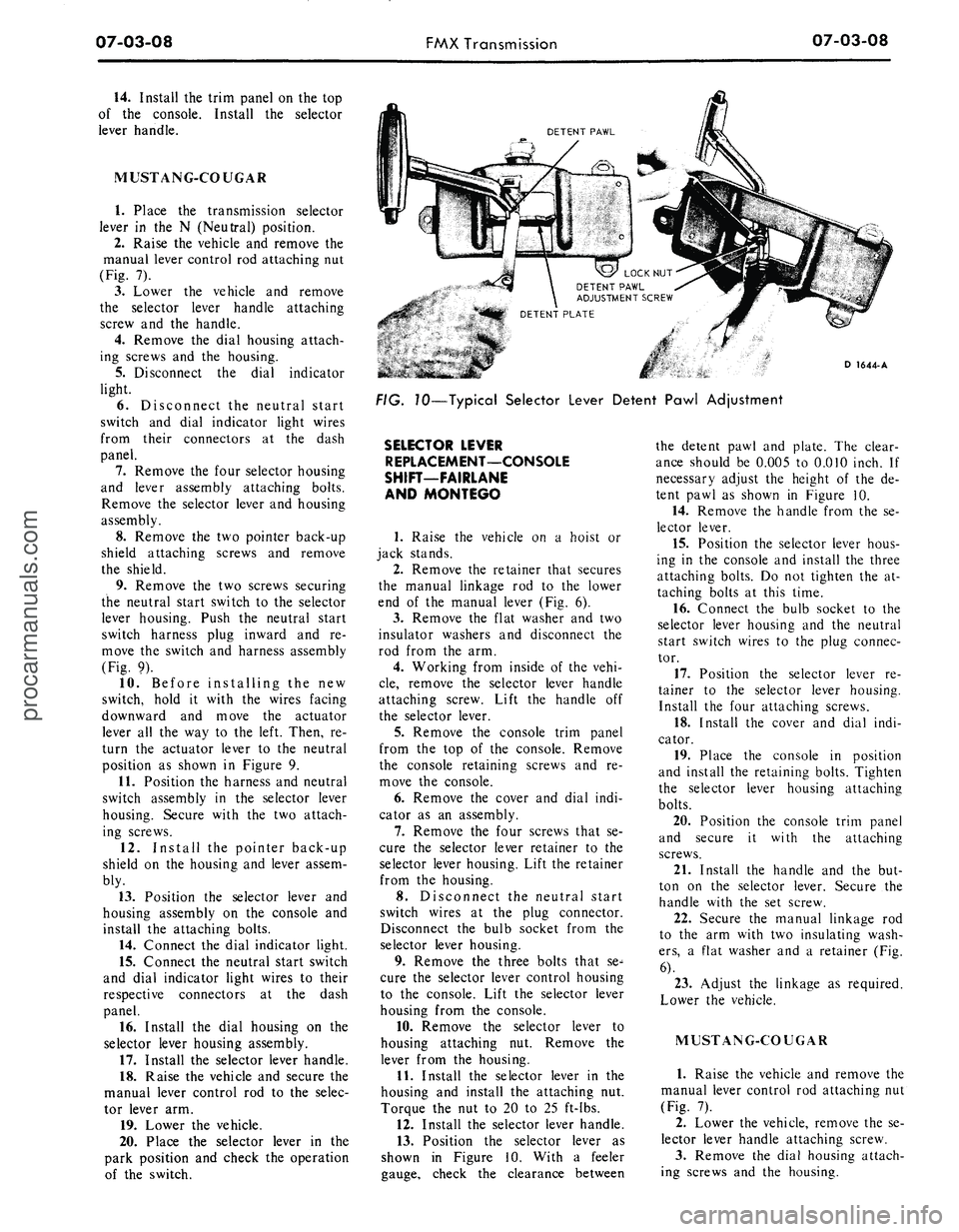
FIG.
10—Typical Selector Lever Detent Pawl Adjustment
SELECTOR LEVER
REPLACEMENT—CONSOLE
SHIFT—FAIRLANE
AND
MONTEGO
1.
Raise the vehicle on a hoist or
jack stands.
2.
Remove the retainer that secures
the manual linkage rod to the lower
end of the manual lever (Fig. 6).
3.
Remove the flat washer and two
insulator washers and disconnect the
rod from the arm.
4.
Working from inside of the vehi-
cle,
remove the selector lever handle
attaching screw. Lift the handle off
the selector lever.
5.
Remove the console trim panel
from the top of the console. Remove
the console retaining screws and re-
move the console.
6. Remove the cover and dial indi-
cator as an assembly.
7.
Remove the four screws that se-
cure the selector lever retainer to the
selector lever housing. Lift the retainer
from the housing.
8. Disconnect the neutral start
switch wires at the plug connector.
Disconnect the bulb socket from the
selector lever housing.
9. Remove the three bolts that se^
cure the selector lever control housing
to the console. Lift the selector lever
housing from the console.
10.
Remove the selector lever to
housing attaching nut. Remove the
lever from the housing.
11.
Install the selector lever in the
housing and install the attaching nut.
Torque the nut to 20 to 25 ft-lbs.
12.
Install the selector lever handle.
13.
Position the selector lever as
shown in Figure 10. With a feeler
gauge,
check the clearance between
the detent pawl and plate. The clear-
ance should be 0.005 to 0.010 inch. If
necessary adjust the height of the de-
tent pawl as shown in Figure 10.
14.
Remove the handle from the se-
lector lever.
15.
Position the selector lever hous-
ing in the console and install the three
attaching bolts. Do not tighten the at-
taching bolts at this time.
16.
Connect the bulb socket to the
selector lever housing and the neutral
start switch wires to the plug connec-
tor.
17.
Position the selector lever re-
tainer to the selector lever housing.
Install the four attaching screws.
18.
Install the cover and dial indi-
cator.
19.
Place the console in position
and install the retaining bolts. Tighten
the selector lever housing attaching
bolts.
20.
Position the console trim panel
and secure it with the attaching
screws.
21.
Install the handle and the but-
ton on the selector lever. Secure the
handle with the set screw.
22.
Secure the manual linkage rod
to the arm with two insulating wash-
ers,
a flat washer and a retainer (Fig.
6).
23.
Adjust the linkage as required.
Lower the vehicle.
MUSTANG-COUGAR
1.
Raise the vehicle and remove the
manual lever control rod attaching nut
(Fig. 7).
2.
Lower the vehicle, remove the se-
lector lever handle attaching screw.
3.
Remove the dial housing attach-
ing screws and the housing.procarmanuals.com
Page 349 of 413
07-03-09
FMX Transmission
07-03-09
4.
Remove the pointer back-up
shield attaching screws and the shield.
5.
Disconnect the dial indicator
light.
6. Disconnect the neutral start
switch and dial indicator light wires
from their connectors at the dash
panel.
7.
Remove the selector housing and
lever assembly attaching bolts. Re-
move the selector lever and housing.
8. Remove the selector lever to
housing attaching nut. Remove the
lever from the housing.
9. Install the selector lever in the
housing and install the attaching nut.
Torque the nut to 20 to 25 ft-lbs.
10.
Install the selector lever handle.
11.
Position the selector lever as
shown in Figure 10. With a feeler
gauge check the clearance between the
detent pawl and plate. The clearince
should be 0.005 to 0.010 inch. If nec-
essary, adjust the height of the detent
pawl as shown in Figure 10.
12.
Remo"~ the handle from tte se-
lector lever.
13.
Install the selector housing and
lever assembly as shown in Figure 4.
Torque the attaching bolts 4-6 ft-lbs.
14.
Connect the dial indicator light.
15.
Connect the neutral start switch
and dial indicator light wires to their
respective connectors at the dash
panel.
16.
Install the pointer back-up
shield and tighten the attaching
screws.
17.
Install the selector lever handle
and tighten the attaching screw.
18.
Position the selector lever in the
D position.
19.
Raise the vehicle. Install the
transmission manual lever rod to the
selector lever. Adjust the manual link-
age.
20.
Lower the vehicle and check the
transmission operation in each selec-
tor lever detent position.
BAND ADJUSTMENTS
FRONT BAND
ADJUSTMENT
1.
Drain the fluid from the trans-
mission by loosening the pan attach-
ing bolts starting at the rear of the
pan and working toward the front.
When most of the fluid has drained
from the pan, remove the remainder
of the attaching bolts. Use a clean
drain can equipped with a 100-mesh
screen if the fluid is to be reused.
Too/—
7225-C-13B
/A
-inch
Spacer
FRONT SERVO
ACTUATING LEVER
D 2048-A
FIG.
7
7—Adjusting Front Band—
Typical
2.
Remove the pan, then remove
the fluid filter and clip from the trans-
mission. Clean the inside of the pan.
Remove all gasket material from the
pan and pan mounting face of the
case.
3.
Loosen the front servo adjusting
screw lock nut.
4.
Pull back on the actuating rod,
and insert the 1/4 inch spacer between
the adjusting screw and servo piston
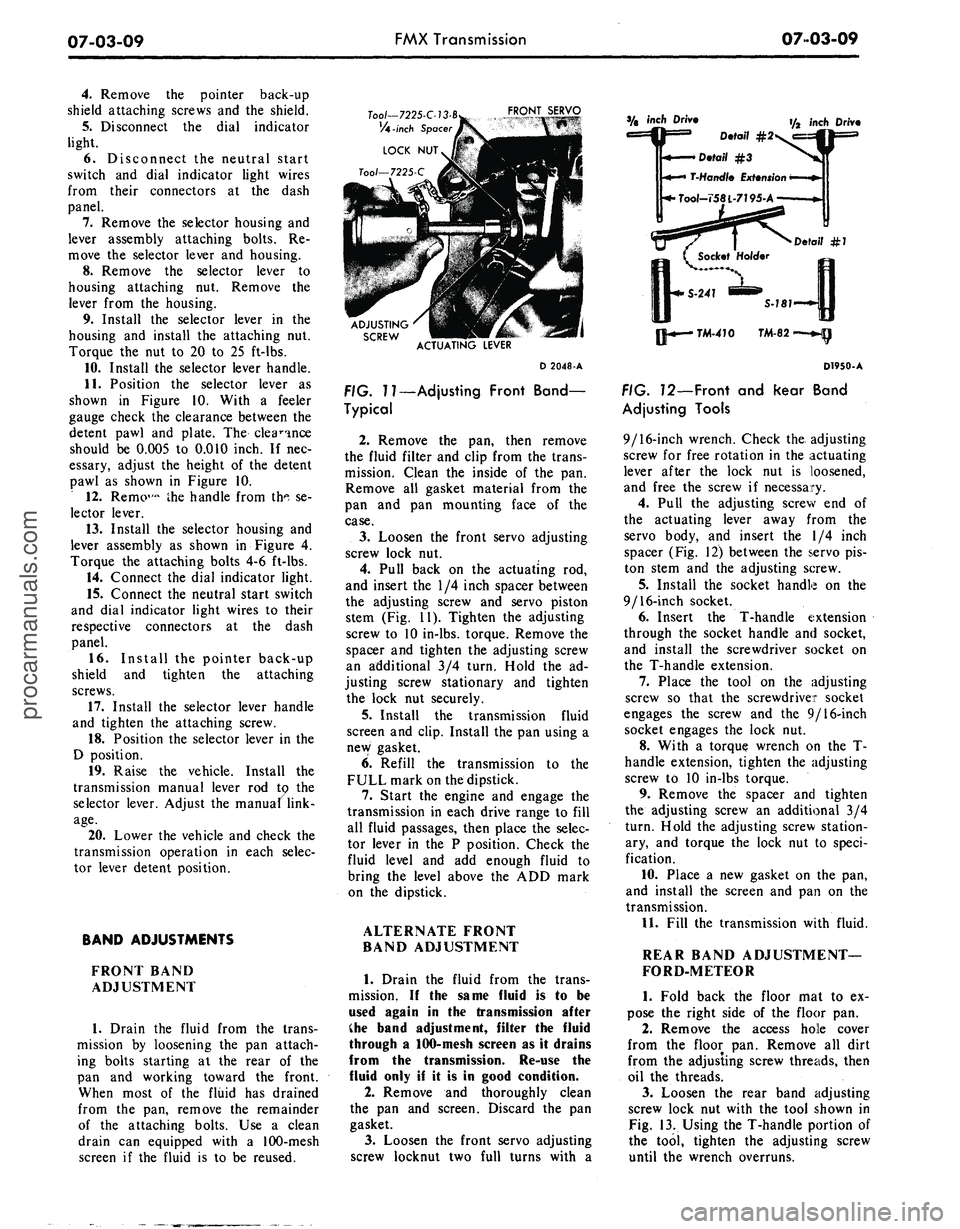
stem (Fig. 11). Tighten the adjusting
screw to 10 in-lbs. torque. Remove the
spacer and tighten the adjusting screw
an additional 3/4 turn. Hold the ad-
justing screw stationary and tighten
the lock nut securely.
5.
Install the transmission fluid
screen and clip. Install the pan using a
new gasket.
6. Refill the transmission to the
FULL mark on the dipstick.
7.
Start the engine and engage the
transmission in each drive range to fill
all fluid passages, then place the selec-
tor lever in the P position. Check the
fluid level and add enough fluid to
bring the level above the ADD mark
on the dipstick.
ALTERNATE FRONT
BAND ADJUSTMENT
1.
Drain the fluid from the trans-
mission. If the same fluid is to be
used again in the transmission after
Che band adjustment, filter the fluid
through a 100-mesh screen as it drains
from the transmission. Re-use the
fluid only if it is in good condition.
2.
Remove and thoroughly clean
the pan and screen. Discard the pan
gasket.
3.
Loosen the front servo adjusting
screw locknut two full turns with a
inch Driv
Detail #2
D.tai\
#3
T-Hond/e
Extension
Tool-758L-7195-A
f/2 inch Driv
Detail
#7
Qj-«—
TM-470 TM-82
D1950-A
FIG. 12—Front and Rear Band
Adjusting Tools
9/16-inch wrench. Check the. adjusting
screw for free rotation in the actuating
lever after the lock nut is loosened,
and free the screw if necessary.
4.
Pull the adjusting screw end of
the actuating lever away from the
servo body, and insert the 1/4 inch
spacer (Fig. 12) between the servo pis-
ton stem and the adjusting screw.
5.
Install the socket handle on the
9/16-inch socket.
6. Insert the T-handle extension
through the socket handle and socket,
and install the screwdriver socket on
the T-handle extension.
7.
Place the tool on the adjusting
screw so that the screwdriver socket
engages the screw and the 9/16-inch
socket engages the lock nut.
8. With a torque wrench on the T-
handle extension, tighten the adjusting
screw to 10 in-lbs torque.
9. Remove the spacer and tighten
the adjusting screw an additional 3/4
turn. Hold the adjusting screw station-
ary, and torque the lock nut to speci-
fication.
10.
Place a new gasket on the pan,
and install the screen and pan on the
transmission.
11.
Fill the transmission with fluid.
REAR BAND ADJUSTMENT—
FORD-METEOR
1.
Fold back the floor mat to ex-
pose the right side of the floor pan.
2.
Remove the access hole cover
from the floor pan. Remove all dirt
from the adjusting screw threads, then
oil the threads.
3.
Loosen the rear band adjusting
screw lock nut with the tool shown in
Fig. 13. Using the T-handle portion of
the tool, tighten the adjusting screw
until the wrench overruns.procarmanuals.com
Page 379 of 413
07-04-10
C-6 Automatic Transmission
07-04-10
5.
Remove the four bolts that at-
tach the selector lever housing to the
floor pan and remove the selector
lever and housing.
6. Position the new selector lever
and housing assembly on the floor pan
and install the attaching bolts.
7.
Connect the bulb socket to the
quadrant and the neutral start switch
wires to the plug connector.
8. Raise the vehicle and secure the
link assembly to the selector lever arm
with the bushing, insulator, flat wash-
er and cotter pin (Fig. 8). Lower the
vehicle.
9. Place the console top panel on
the console and install the retaining
screws.
10.
Position the selector lever de-
tent control and handle on the selector
lever and secure with the four plates
and attaching screws.
FAIRLANE AND MONTEGO
1.
Raise the vehicle on a hoist or
jack stands.
2.
Remove the retainer that secures
the manual linkage rod to the lower
end of the manual lever (Fig. 9).
3.
Remove the flat washer and two
insulator washers and disconnect the
rod from the arm.
4.
Working from inside of the vehi-
cle,
remove the selector lever handle
attaching screw. Lift the handle off
the selector lever.
5.
Remove the console trim panel
from the top of the console. Remove
the console retaining screws and re-
move the console.
6. Remove the cover and dial indi-
cator as an assembly.
7.
Remove the four screws that se-
cure the selector lever retainer to the
selector lever housing. Lift the retainer
from the housing.
8. Disconnect the neutral start
switch wires at the plug connector.
Disconnect the bulb socket from the
selector lever housing.
9. Remove the three bolts that se-
cure the selector lever control housing
to the console. Lift the selector lever
housing from the console.
10.
Remove the selector lever to
housing attaching nut. Remove the
lever from the housing.
11.
Install the selector lever in the
housing and install the attaching nut.
Torque the nut to 20 to 25 ft-lbs.
12.
Install the selector lever handle.
13.
Position the selector lever as
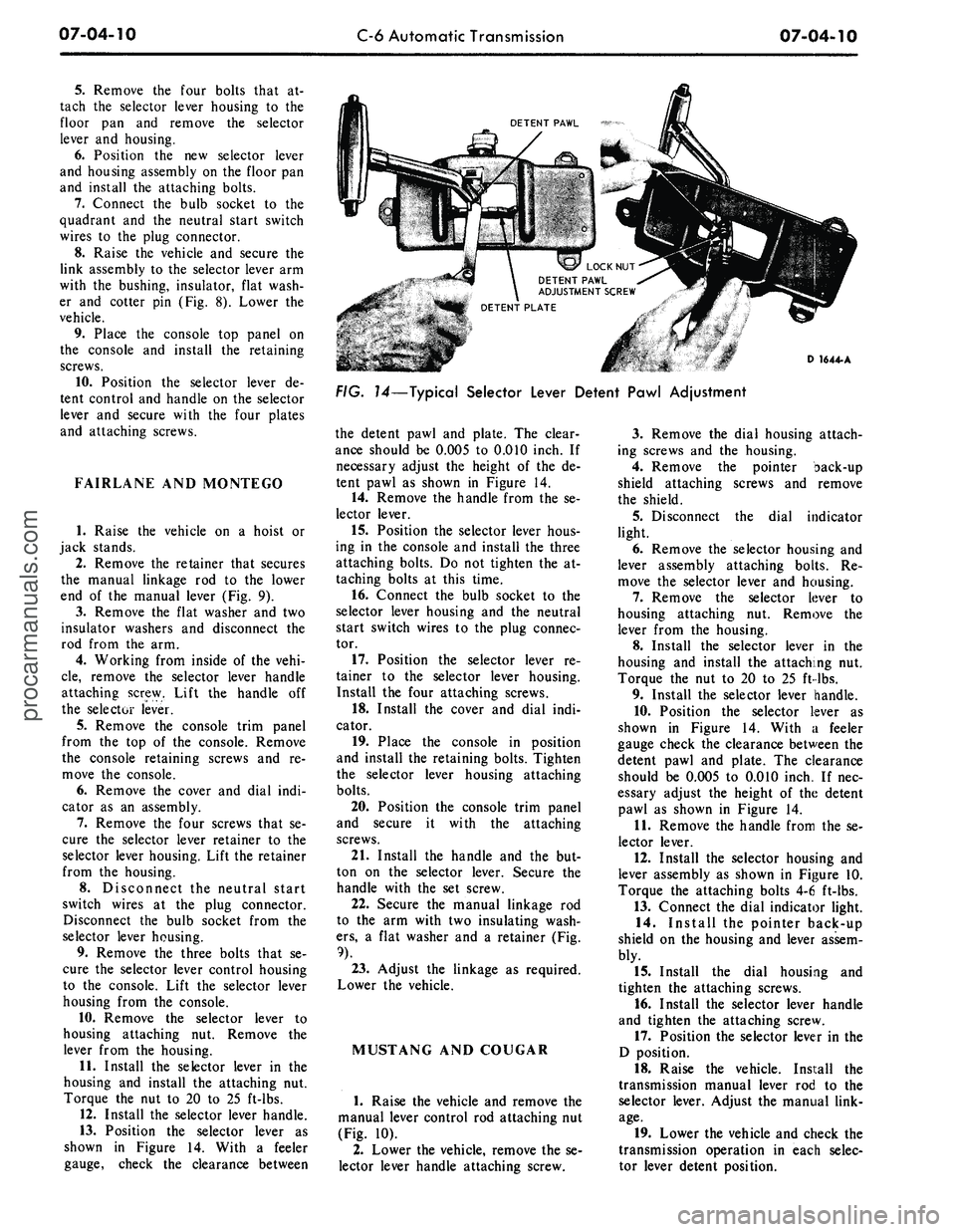
shown in Figure 14. With a feeler
gauge, check the clearance between
DETENT
PAWL
LOCK
NUT
DETENT
PAWL
ADJUSTMENT
SCREW
DETENT
PLATE
D
1644-A
FIG. 14—Typical Selector Lever Detent Pawl Adjustment
the detent pawl and plate. The clear-
ance should be 0.005 to 0.010 inch. If
necessary adjust the height of the de-
tent pawl as shown in Figure 14.
14.
Remove the handle from the se-
lector lever.
15.
Position the selector lever hous-
ing in the console and install the three
attaching bolts. Do not tighten the at-
taching bolts at this time.
16.
Connect the bulb socket to the
selector lever housing and the neutral
start switch wires to the plug connec-
tor.
17.
Position the selector lever re-
tainer to the selector lever housing.
Install the four attaching screws.
18.
Install the cover and dial indi-
cator.
19.
Place the console in position
and install the retaining bolts. Tighten
the selector lever housing attaching
bolts.
20.
Position the console trim panel
and secure it with the attaching
screws.
21.
Install the handle and the but-
ton on the selector lever. Secure the
handle with the set screw.
22.
Secure the manual linkage rod
to the arm with two insulating wash-
ers,
a flat washer and a retainer (Fig.
9).
23.
Adjust the linkage as required.
Lower the vehicle.
MUSTANG AND COUGAR
1.
Raise the vehicle and remove the
manual lever control rod attaching nut
(Fig. 10).
2.
Lower the vehicle, remove the se-
lector lever handle attaching screw.
3.
Remove the dial housing attach-
ing screws and the housing.
4.
Remove the pointer back-up
shield attaching screws and remove
the shield.
5.
Disconnect the dial indicator
light.
6. Remove the selector housing and
lever assembly attaching bolts. Re-
move the selector lever and housing.
7.
Remove the selector lever to
housing attaching nut. Remove the
lever from the housing.
8. Install the selector lever in the
housing and install the attaching nut.
Torque the nut to 20 to 25 ft-lbs.
9. Install the selector lever handle.
10.
Position the selector lever as
shown in Figure 14. With a feeler
gauge check the clearance between the
detent pawl and plate. The clearance
should be 0.005 to 0.010 inch. If nec-
essary adjust the height of the detent
pawl as shown in Figure 14.
11.
Remove the handle from the se-
lector lever.
12.
Install the selector housing and
lever assembly as shown in Figure 10.
Torque the attaching bolts 4-6 ft-lbs.
13.
Connect the dial indicator light.
14.
Install the pointer back-up
shield on the housing and lever assem-
bly.
15.
Install the dial housing and
tighten the attaching screws.
16.
Install the selector lever handle
and tighten the attaching screw.
17.
Position the selector lever in the
D position.
18.
Raise the vehicle. Install the
transmission manual lever rod to the
selector lever. Adjust the manual link-
age.
19.
Lower the vehicle and check the
transmission operation in each selec-
tor lever detent position.procarmanuals.com