length FORD MUSTANG 1969 Volume One Chassis
[x] Cancel search | Manufacturer: FORD, Model Year: 1969, Model line: MUSTANG, Model: FORD MUSTANG 1969Pages: 413, PDF Size: 75.81 MB
Page 201 of 413
04-02-04
Rear Axle — Removable Carrier Type
04-02-04
IN-VEHICLE ADJUSTMENTS AND REPAIRS
REAR AXLE SHAFT, WHEEL
BEARING AND OIL SEAL
REPLACEMENT
The rear axle shafts, wheel bear-
ings,
and oil seal can be replaced
without removing the differential as-
sembly from the axle housing.
REMOVAL OF
AXLE SHAFT
Synthetic wheel bearing seals are
used in production only. Removal and
insertion of rear axle shafts must be
performed with caution. The entire
length of the shaft (including spline)
up to the seal journal must pass
through the seal without cutting of the
seal element during axle removal or
installation will result in early seal fai-
lure.
Leather seals only will be used as
service replacement for synthetic
wheel bearing seals.
1.
Remove the wheel cover, wheel
and tire from the brake drum.
2.
Remove the nuts that secure the
brake drum to the axle shaft flange,
then remove the drum from flange.
3.
Working through the hole pro-
vided in each axle shaft flange, re-
move the nuts that secure the wheel
bearing retainer plate. Then pull the
axle shaft assembly out of the axle
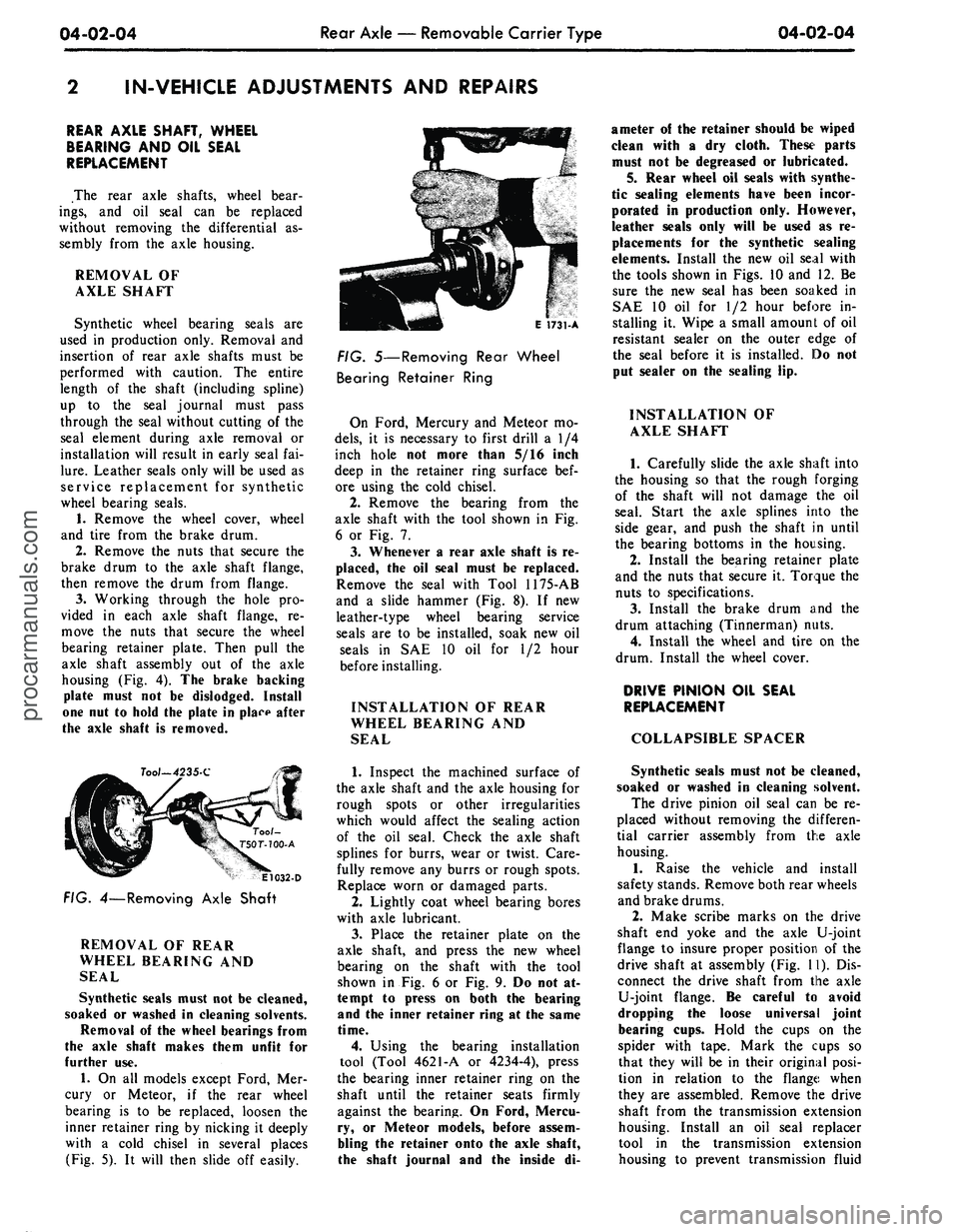
housing (Fig. 4). The brake backing
plate must not be dislodged. Install
one nut to hold the plate in place after
the axle shaft is removed.
Too/-4235-C
E1032-D
FIG. 4—Removing Axle Shaft
REMOVAL OF REAR
WHEEL BEARING AND
SEAL
Synthetic seals must not be cleaned,
soaked or washed in cleaning solvents.
Removal of the wheel bearings from
the axle shaft makes them unfit for
further use.
1.
On all models except Ford, Mer-
cury or Meteor, if the rear wheel
bearing is to be replaced, loosen the
inner retainer ring by nicking it deeply
with a cold chisel in several places
(Fig. 5). It will then slide off easily.
E 1731-A
FIG. 5—Removing Rear Wheel
Bearing Retainer Ring
On Ford, Mercury and Meteor mo-
dels,
it is necessary to first drill a 1/4
inch hole not more than 5/16 inch
deep in the retainer ring surface bef-
ore using the cold chisel.
2.
Remove the bearing from the
axle shaft with the tool shown in Fig.
6 or Fig. 7.
3.
Whenever a rear axle shaft is re-
placed, the oil seal must be replaced.
Remove the seal with Tool 1175-AB
and a slide hammer (Fig. 8). If new
leather-type wheel bearing service
seals are to be installed, soak new oil
seals in SAE 10 oil for 1/2 hour
before installing.
INSTALLATION OF REAR
WHEEL BEARING AND
SEAL
1.
Inspect the machined surface of
the axle shaft and the axle housing for
rough spots or other irregularities
which would affect the sealing action
of the oil seal. Check the axle shaft
splines for burrs, wear or twist. Care-
fully remove any burrs or rough spots.
Replace worn or damaged parts.
2.
Lightly coat wheel bearing bores
with axle lubricant.
3.
Place the retainer plate on the
axle shaft, and press the new wheel
bearing on the shaft with the tool
shown in Fig. 6 or Fig. 9. Do not at-
tempt to press on both the bearing
and the inner retainer ring at the same
time.
4.
Using the bearing installation
tool (Tool 4621-A or 4234-4), press
the bearing inner retainer ring on the
shaft until the retainer seats firmly
against the bearing. On Ford, Mercu-
ry, or Meteor models, before assem-
bling the retainer onto the axle shaft,
the shaft journal and the inside di-
ameter of the retainer should be wiped
clean with a dry cloth. These parts
must not be degreased or lubricated.
5. Rear wheel oil seals with synthe-
tic sealing elements have been incor-
porated in production only. However,
leather seals only will be used as re-
placements for the synthetic sealing
elements. Install the new oil seal with
the tools shown in Figs. 10 and 12. Be
sure the new seal has been soaked in
SAE 10 oil for 1/2 hour before in-
stalling it. Wipe a small amount of oil
resistant sealer on the outer edge of
the seal before it is installed. Do not
put sealer on the sealing lip.
INSTALLATION OF
AXLE SHAFT
1.
Carefully slide the axle shaft into
the housing so that the rough forging
of the shaft will not damage the oil
seal. Start the axle splines into the
side gear, and push the shaft in until
the bearing bottoms in the housing.
2.
Install the bearing retainer plate
and the nuts that secure it. Torque the
nuts to specifications.
3.
Install the brake drum and the
drum attaching (Tinnerman) nuts.
4.
Install the wheel and tire on the
drum. Install the wheel cover.
DRIVE PINION OIL SEAL
REPLACEMENT
COLLAPSIBLE SPACER
Synthetic seals must not be cleaned,
soaked or washed in cleaning solvent.
The drive pinion oil seal can be re-
placed without removing the differen-
tial carrier assembly from the axle
housing.
1.
Raise the vehicle and install
safety stands. Remove both rear wheels
and brake drums.
2.
Make scribe marks on the drive
shaft end yoke and the axle U-joint
flange to insure proper position of the
drive shaft at assembly (Fig. 11). Dis-
connect the drive shaft from the axle
U-joint flange. Be careful to avoid
dropping the loose universal joint
bearing cups. Hold the cups on the
spider with tape. Mark the cups so
that they will be in their original posi-
tion in relation to the flange when
they are assembled. Remove the drive
shaft from the transmission extension
housing. Install an oil seal replacer
tool in the transmission extension
housing to prevent transmission fluidprocarmanuals.com
Page 222 of 413
04-03-02
Rear Axles — Integral Carrier Type
04-03-02
RING GEAR
4209
DRIVE PINION
BEARINGS
4630
4621
FLANGE-4676
E1905A
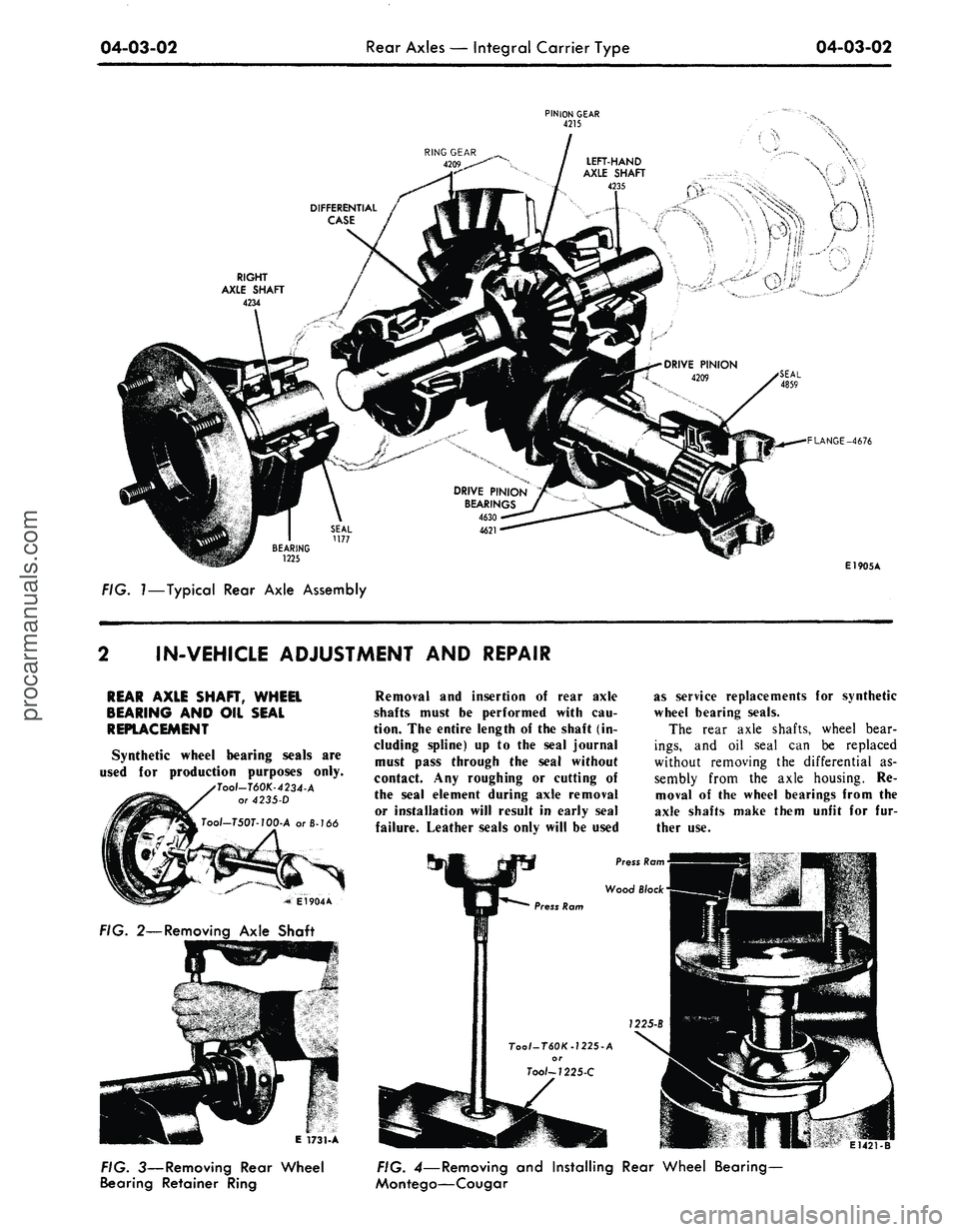
FIG. 7—Typical Rear Axle Assembly
IN-VEHICLE ADJUSTMENT
AND
REPAIR
REAR AXLE SHAFT, WHEEL
BEARING
AND OIL
SEAL
REPLACEMENT
Synthetic wheel bearing seals
are
used
for
production purposes only.
>Tool-T60K-4234-A
or 4235-D
Tool-T50T-W0-A
or 8-/66
* El904A
FIG. 2—Removing Axle Shaft
E 1731-A
FIG. 3—Removing Rear Wheel
Bearing Retainer Ring
Removal
and
insertion
of
rear axle
shafts must
be
performed with
cau-
tion.
The
entire length
of the
shaft
(in-
cluding spline)
up to the
seal journal
must pass through
the
seal without
contact.
Any
roughing
or
cutting
of
the seal element during axle removal
or installation will result
in
early seal
failure. Leather seals only will
be
used
as service replacements
for
synthetic
wheel bearing seals.
The rear axle shafts, wheel bear-
ings,
and oil
seal
can be
replaced
without removing
the
differential
as-
sembly from
the
axle housing.
Re-
moval
of the
wheel bearings from
the
axle shafts make them unfit
for fur-
ther
use.
E1421-B
FIG. 4—Removing and Installing Rear Wheel Bearing—
Montego—Cougarprocarmanuals.com
Page 233 of 413
04-04-02
Rear Axle
—
Ford Light-Duty (WER)
04-04-02
DIFFERENTIAL
PINION-4215
RING GEAR
-
4209
LEFT AXLE
SHAFT
-
4235
1
DRIVE PINION
-
4209
SEAL
-
4676
FLANGE-4851
DEFLECTOR -4859
SEAL-
1177
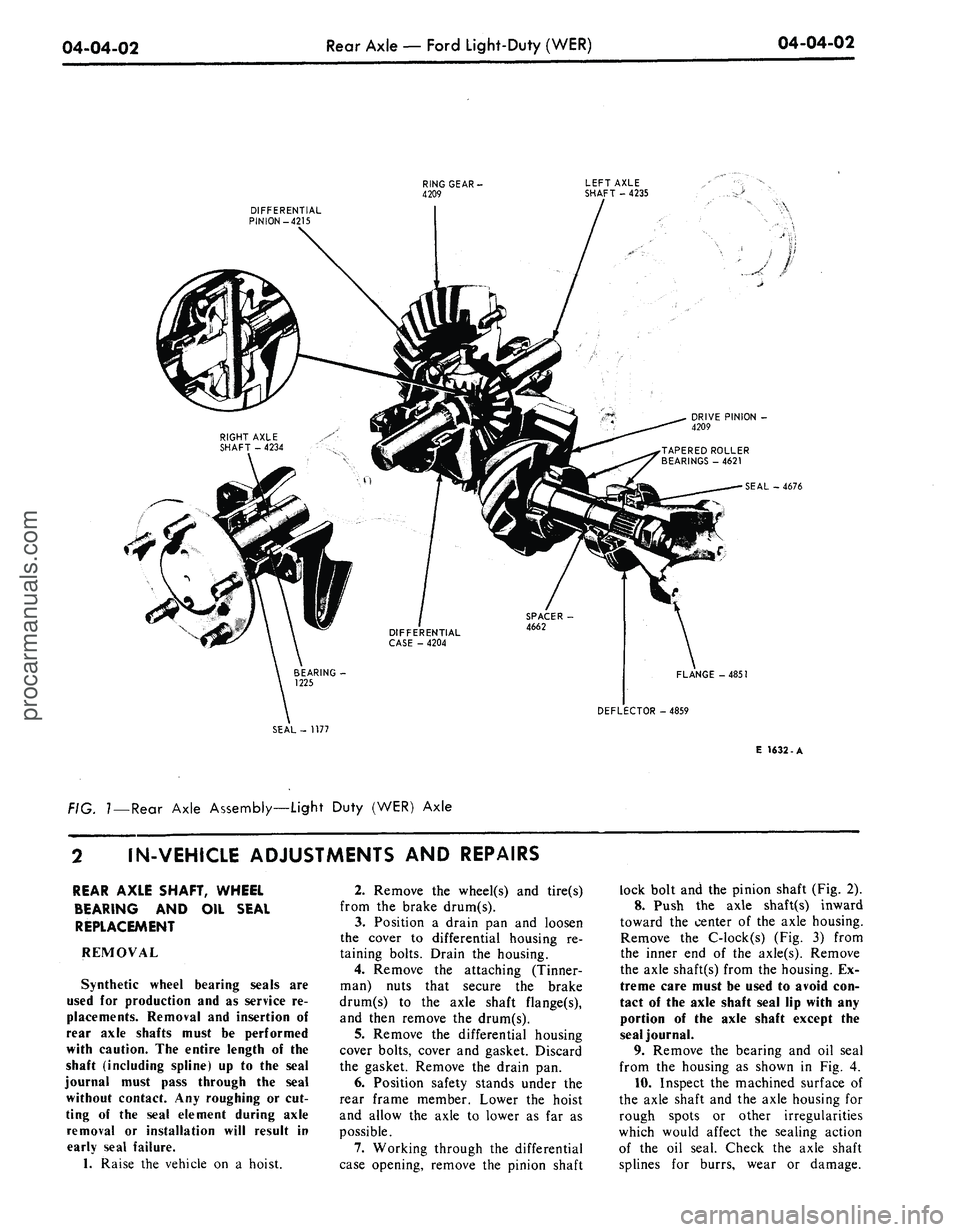
f\G.
7
—Rear Axle Assembly—Light Duty
(WER)
Axle
E 1632-A
IN-VEHICLE ADJUSTMENTS AND REPAIRS
REAR AXLE SHAFT, WHEEL
BEARING
AND OIL
SEAL
REPLACEMENT
REMOVAL
Synthetic wheel bearing seals
are
used
for
production
and as
service
re-
placements. Removal
and
insertion
of
rear axle shafts must
be
performed
with caution.
The
entire length
of the
shaft (including spline)
up to the
seal
journal must pass through
the
seal
without contact.
Any
roughing
or cut-
ting
of the
seal element during axle
removal
or
installation will result
in
early seal failure.
1.
Raise
the
vehicle
on a
hoist.
2.
Remove
the
wheel(s)
and
tire(s)
from
the
brake drum(s).
3.
Position
a
drain
pan and
loosen
the cover
to
differential housing
re-
taining bolts. Drain
the
housing.
4.
Remove
the
attaching (Tinner-
man) nuts that secure
the
brake
drum(s)
to the
axle shaft flange(s),
and then remove
the
drum(s).
5.
Remove
the
differential housing
cover bolts, cover
and
gasket. Discard
the gasket. Remove
the
drain
pan.
6. Position safety stands under
the
rear frame member. Lower
the
hoist
and allow
the
axle
to
lower
as far as
possible.
7.
Working through
the
differential
case opening, remove
the
pinion shaft
lock bolt
and the
pinion shaft
(Fig. 2).
8. Push
the
axle shaft(s) inward
toward
the
center
of the
axle housing.
Remove
the
C-lock(s)
(Fig. 3)
from
the inner
end of the
axle(s). Remove
the axle shaft(s) from
the
housing.
Ex-
treme care must
be
used
to
avoid
con-
tact
of the
axle shaft seal
lip
with
any
portion
of the
axle shaft except
the
seal journal.
9. Remove
the
bearing
and oil
seal
from
the
housing
as
shown
in Fig. 4.
10.
Inspect
the
machined surface
of
the axle shaft
and the
axle housing
for
rough spots
or
other irregularities
which would affect
the
sealing action
of
the oil
seal. Check
the
axle shaft
splines
for
burrs, wear
or
damage.procarmanuals.com
Page 261 of 413
05-03-03
Clutch
05-03-03
CLUTCH PEDAL
ADJUSTMENTS
Adjust
the
clutch pedal free travel
whenever
the
clutch does
not
disen-
gage properly,
or
when
new
clutch
parts
are
installed. Improper adjust-
ment
of the
clutch pedal
is one of the
most frequent causes
of
clutch failure
and
can be a
contributing factor
in
some transmission failures.
FREE TRAVEL
1.
Disconnect
the
clutch return
spring from
the
release lever.
2.
Loosen
the
release lever
rod
locknut
and
adjusting
nut
(Figs.
1, 2
and
3).
3.
Move
the
clutch release lever
rearward until
the
release bearing
lightly contacts
the
clutch pressure
plate release fingers.
4.
Adjust
the rod
length until
the
rod seats
in the
release lever pocket.
5.
Insert
the
specified feeler gauge
between
the
adjusting
nut and the
swivel sleeve. Then tighten
the
adjust-
ing
nut
against
the
gauge finger tight.
6. Tighten
the
locknut against
the
adjusting
nut,
being careful
not to di-
sturb
the
adjustment. Torque
the
lock-
nut
to
specification
and
remove
the
feeler gauge.
7.
Install
the
clutch return spring.
8. Check
the
free travel
at the
pedal
for conformance
to
specification.
Re-
adjust
if
necessary.
9.
As a
final check, measure
the
pedal free travel with
the
transmission
in neutral
and the
engine running
at
about 3000
rpm. If the
pedal free
travel
at
this speed
is not a
minimum
of
1/2
inch, readjust
the
clutch pedal
free travel. Otherwise,
the
release
fin-
gers
may
contact
the
release bearing
continuously, resulting
in
premature
bearing
and
clutch failure. Free travel
must
be
exactly
to
specification.
CLUTCH ASSIST
SPRING REPLACEMENT
(FAIRLANE, FALCON,
MONTEGO)
1.
Remove
the
cotter
pin
from
the
clutch
rod at the
clutch pedal lever
as-
sembly inside
the
passenger compart-
ment.
2.
Grasp
the
clutch pedal lever
firmly
to
prevent slipping
and
remove
the clutch
rod
from
the
lever. Allow
the clutch pedal lever
to
rest
on the
floor panel.
3.
Remove
the
forward bolt secur-
ing
the
assist spring bracket
to the
brake pedal bracket
and
loosen
the
rear bolt
two or
three turns.
Do not
remove
the
rear bolt.
4.
Grasp
the
assist spring bracket
with pliers
and
rotate upward until
the
spring
can be
separated from
the
bracket.
BRAKE PEDAL
BRACKET
CLUTCH ASSIST SPRING
BRACKET
-
7535
CLUTCH PEDAL
7519
5.
Position
the
assist spring
in the
clutch pedal spring bracket
and the
assist spring bracket. Rotate
the
spring bracket downward until
the
forward bolt holes
in the
assist spring
bracket line
up
with
the
holes
in the
brake pedal bracket
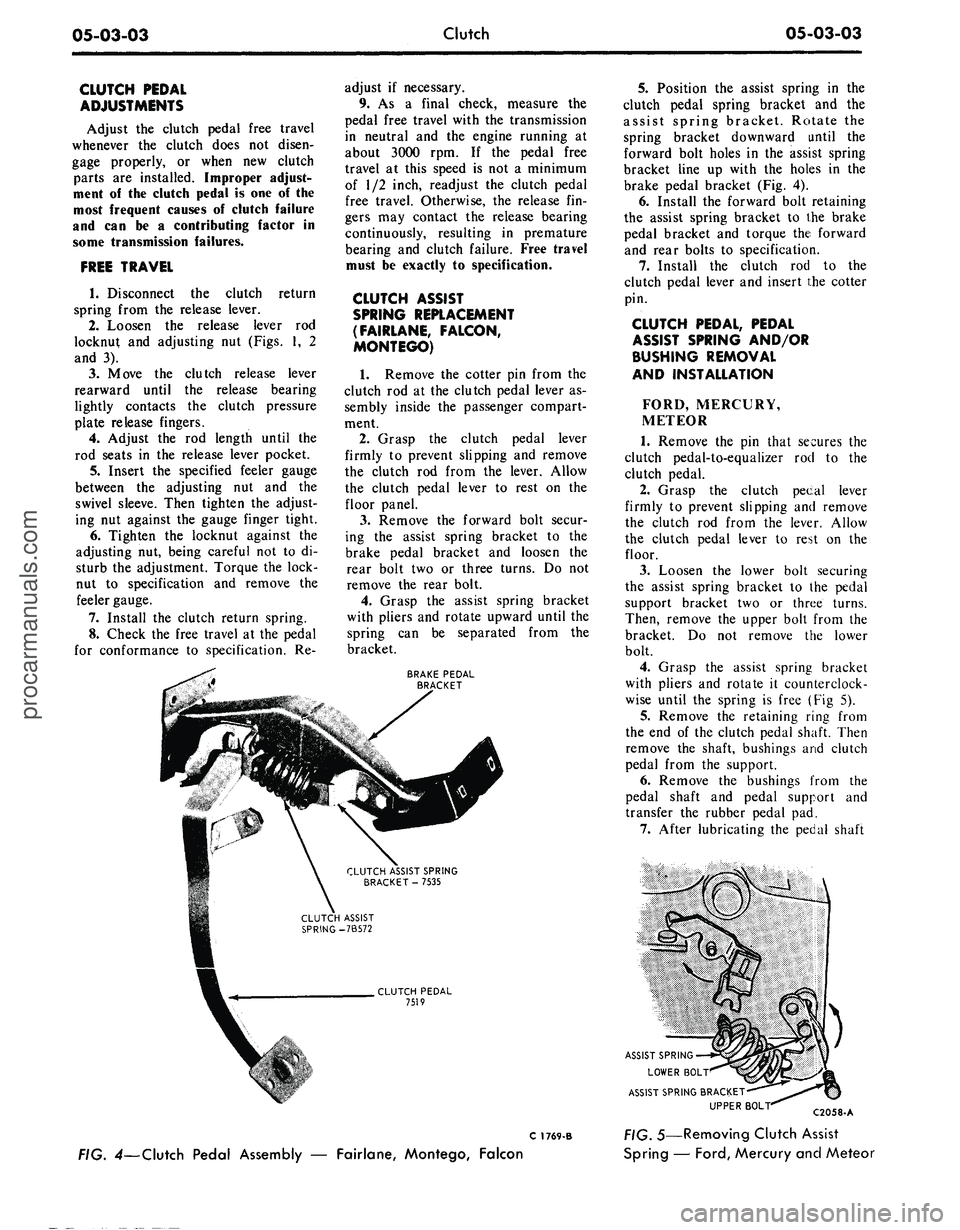
(Fig. 4).
6. Install
the
forward bolt retaining
the assist spring bracket
to the
brake
pedal bracket
and
torque
the
forward
and rear bolts
to
specification.
7.
Install
the
clutch
rod to the
clutch pedal lever
and
insert
the
cotter
pin.
CLUTCH PEDAL, PEDAL
ASSIST SPRING AND/OR
BUSHING REMOVAL
AND INSTALLATION
FORD, MERCURY,
METEOR
1.
Remove
the pin
that secures
the
clutch pedal-to-equalizer
rod to the
clutch pedal.
2.
Grasp
the
clutch pecal lever
firmly
to
prevent slipping
and
remove
the clutch
rod
from
the
lever. Allow
the clutch pedal lever
to
rest
on the
floor.
3.
Loosen
the
lower bolt securing
the assist spring bracket
to the
pedal
support bracket
two or
three turns.
Then, remove
the
upper bolt from
the
bracket.
Do not
remove
the
lower
bolt.
4.
Grasp
the
assist spring bracket
with pliers
and
rotate
it
counterclock-
wise until
the
spring
is
free
(Fig 5).
5.
Remove
the
retaining ring from
the
end of the
clutch pedal shaft. Then
remove
the
shaft, bushings
and
clutch
pedal from
the
support.
6. Remove
the
bushings from
the
pedal shaft
and
pedal support
and
transfer
the
rubber pedal
pad.
7.
After lubricating
the
pedal shaft
ASSIST SPRING
LOWER BOLT
ASSIST SPRING BRACKET-
UPPER
BOL"
C 1769-B
FIG. 4—Clutch Pedal Assembly
—
Fairlane, Montego, Falcon
C2058-A
;. 5—Removing Clutch Assist
Spring
—
Ford,
Mercury and Meteorprocarmanuals.com
Page 272 of 413
06-02-03
Ford Design Three Speed Transmission
06-02-03
STOP
PIN
GROMMET
Tool -
T67P.7347.A
GROMMET
LEVER
CONTROL ROD REMOVAL
^S.
GROMMET INSTALLATION
SET STOP PIN SO THAT THE GROMMET
Tool
-
T67P.734LA
AND
SHIFT ROD ARE PROPERLY SEATED
OMMET—^
SEATED
\
CONTROL ROD INSTALLATION
CONTROL ROD
STOP
PIN
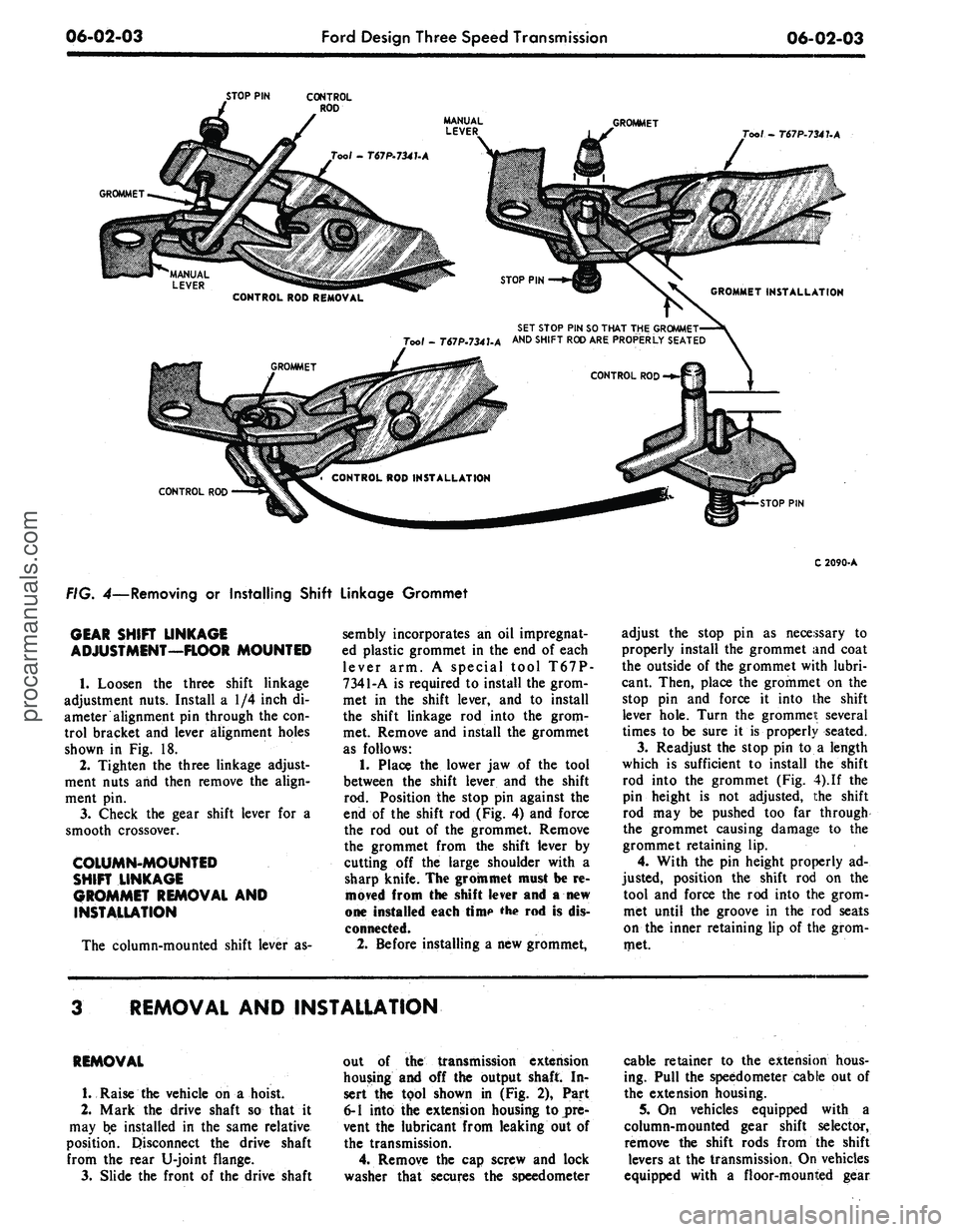
FIG. 4—Removing
or
Installing Shift Linkage Grommet
GEAR SHIFT LINKAGE
ADJUSTMENT—FLOOR MOUNTED
1.
Loosen
the
three shift linkage
adjustment nuts. Install
a 1/4
inch
di-
ameter alignment pin through the con-
trol bracket and lever alignment holes
shown
in Fig. 18.
2.
Tighten
the
three linkage adjust-
ment nuts
and
then remove
the
align-
ment
pin.
3.
Check
the
gear shift lever
for a
smooth crossover.
COLUMN-MOUNTED
SHIFT LINKAGE
GROMMET REMOVAL
AND
INSTALLATION
The column-mounted shift lever
as-
sembly incorporates
an oil
impregnat-
ed plastic grommet
in the
end
of
each
lever
arm. A
special tool T67P-
7341-A
is
required
to
install the grom-
met
in the
shift lever,
and to
install
the shift linkage
rod
into
the
grom-
met. Remove
and
install
the
grommet
as follows:
1.
Place
the
lower
jaw of the
tool
between
the
shift lever
and the
shift
rod.
Position
the
stop
pin
against
the
end
of the
shift
rod
(Fig.
4)
and force
the
rod out of the
grommet. Remove
the grommet from
the
shift lever
by
cutting
off the
large shoulder with
a
sharp knife. The groin met must
be re-
moved from
the
shift lever
and a new
one installed each rime
'he rod is
dis-
connected.
2.
Before installing
a
new grommet,
C 2090-A
adjust
the
stop
pin as
necessary
to
properly install
the
grommet and coat
the outside
of
the grommet with lubri-
cant. Then, place
the
grommet
on the
stop
pin and
force
it
into
the
shift
lever hole. Turn
the
grommeit several
times
to be
sure
it is
properly seated.
3.
Readjust
the
stop
pin to a
length
which
is
sufficient
to
install
the
shift
rod into
the
grommet
(Fig.
4).
If
the
pin height
is not
adjusted,
the
shift
rod
may be
pushed
too far
through
the grommet causing damage
to the
grommet retaining
lip.
4.
With
the pin
height properly
ad-
justed, position
the
shift
rod on the
tool
and
force
the rod
into
the
grom-
met until
the
groove
in the rod
seats
on
the
inner retaining
lip of
the grom-
met.
REMOVAL AND INSTALLATION
REMOVAL
1.
Raise
the
vehicle
on a
hoist.
2.
Mark
the
drive shaft
so
that
it
may
be
installed
in the
same relative
position. Disconnect
the
drive shaft
from
the
rear U-joint flange.
3.
Slide
the
front
of the
drive shaft
out
of the
transmission extension
housing
and off the
output shaft
In-
sert
the
tool shown
in (Fig. 2),
Part
6-1 into the extension housing
to
pre-
vent
the
lubricant from leaking
out of
the transmission.
4.
Remove
the cap
screw
and
lock
washer that secures
the
speedometer
cable retainer
to the
extension hous-
ing. Pull
the
speedometer cable
out of
the extension housing.
5.
On
vehicles equipped with
a
column-mounted gear shift selector,
remove
the
shift rods from
the
shift
levers
at
the transmission. On vehicles
equipped with
a
floor-mounted gearprocarmanuals.com
Page 302 of 413
07-01-11
General Transmission Service
07-01-11
STOP
PIN
GROMMET
Tool - T67P-734LA
GROMMET
LEVER
CONTROL ROD REMOVAL
GROMMET INSTALLATION
Tool - T67P-734LA
r
CONTROL ROD INSTALLATION
3/16"-1/4'
CONTROL ROD
STOP
PIN
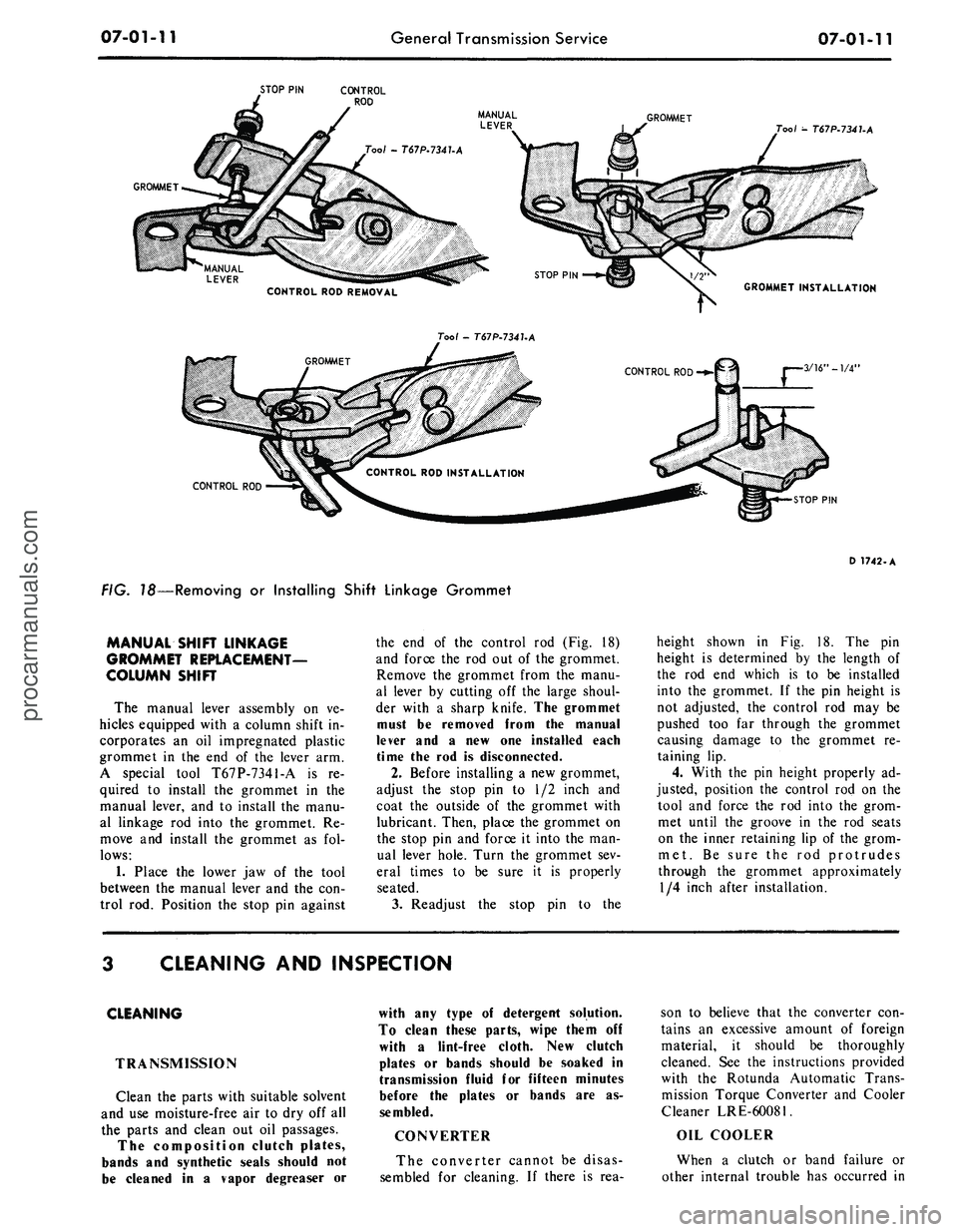
FIG. 18—Removing
or
Installing Shift Linkage Grommet
D 1742-A
MANUAL SHIFT LINKAGE
GROMMET REPLACEMENT-
COLUMN SHIFT
The manual lever assembly
on ve-
hicles equipped with
a
column shift
in-
corporates
an oil
impregnated plastic
grommet
in the end of the
lever
arm.
A special tool T67P-7341-A
is re-
quired
to
install
the
grommet
in the
manual lever,
and to
install
the
manu-
al linkage
rod
into
the
grommet.
Re-
move
and
install
the
grommet
as fol-
lows:
1.
Place
the
lower
jaw of the
tool
between
the
manual lever
and the con-
trol
rod.
Position
the
stop
pin
against
the
end of the
control
rod (Fig. 18)
and force
the rod out of the
grommet.
Remove
the
grommet from
the
manu-
al lever
by
cutting
off the
large shoul-
der with
a
sharp knife.
The
grommet
must
be
removed from
the
manual
lever
and a new one
installed each
time
the rod is
disconnected.
2.
Before installing
a
new grommet,
adjust
the
stop
pin to 1/2
inch
and
coat
the
outside
of the
grommet with
lubricant. Then, place
the
grommet
on
the stop
pin and
force
it
into
the
man-
ual lever hole. Turn
the
grommet
sev-
eral times
to be
sure
it is
properly
seated.
3.
Readjust
the
stop
pin to the
height shown
in Fig. 18. The pin
height
is
determined
by the
length
of
the
rod end
which
is to be
installed
into
the
grommet.
If the pin
height
is
not adjusted,
the
control
rod may be
pushed
too far
through
the
grommet
causing damage
to the
grommet
re-
taining
lip.
4.
With
the pin
height properly
ad-
justed, position
the
control
rod on the
tool
and
force
the rod
into
the
grom-
met until
the
groove
in the rod
seats
on
the
inner retaining
lip of the
grom-
met.
Be
sure
the rod
protrudes
through
the
grommet approximately
1/4 inch after installation.
CLEANING
AND
INSPECTION
CLEANING
TRANSMISSION
Clean
the
parts with suitable solvent
and
use
moisture-free
air to dry off all
the parts
and
clean
out oil
passages.
The composition clutch plates,
bands
and
synthetic seals should
not
be cleaned
in a
vapor degreaser
or
with
any
type
of
detergent solution.
To clean these parts, wipe them
off
with
a
lint-free cloth.
New
clutch
plates
or
bands should
be
soaked
in
transmission fluid
for
fifteen minutes
before
the
plates
or
bands
are as-
sembled.
CONVERTER
The converter cannot
be
disas-
sembled
for
cleaning.
If
there
is rea-
son
to
believe that
the
converter
con-
tains
an
excessive amount
of
foreign
material,
it
should
be
thoroughly
cleaned.
See the
instructions provided
with
the
Rotunda Automatic Trans-
mission Torque Converter
and
Cooler
Cleaner LRE-60081.
OIL COOLER
When
a
clutch
or
band failure
or
other internal trouble
has
occurred
inprocarmanuals.com
Page 325 of 413
07-02-17
C4 Automatic Transmission
07-02-17
Vehicle
Ford,
Meteor
Fairlane,
Montegc,
Falcon,
Mustang
Ford,
Meteor
Fairlane,
Montego,
Mustang
Mustang
Falcon
Engine
302-2V
302-2V
240-IV
250-1V
200-1V
170-1V
200-1V
Transmi ssion
PEA-MI,
Nl
PEE-M,
V, AC
PEA-A2
PEE-AD,
AE,
AF
PEB-B2
PEB-C2
Servo Piston
Dia.
A
3.7875
3.7875
3.3265
Dia.
B
2.8265
2.7065
2.4865
Servo Cover
Dia.
C
None
None
3.340
Dia.
D
2.840
2.975
2.500
Spring
Free Length
(Inches)
2.480
2.480
2.480
Color
Cniif
White
White
White
D 1800-D
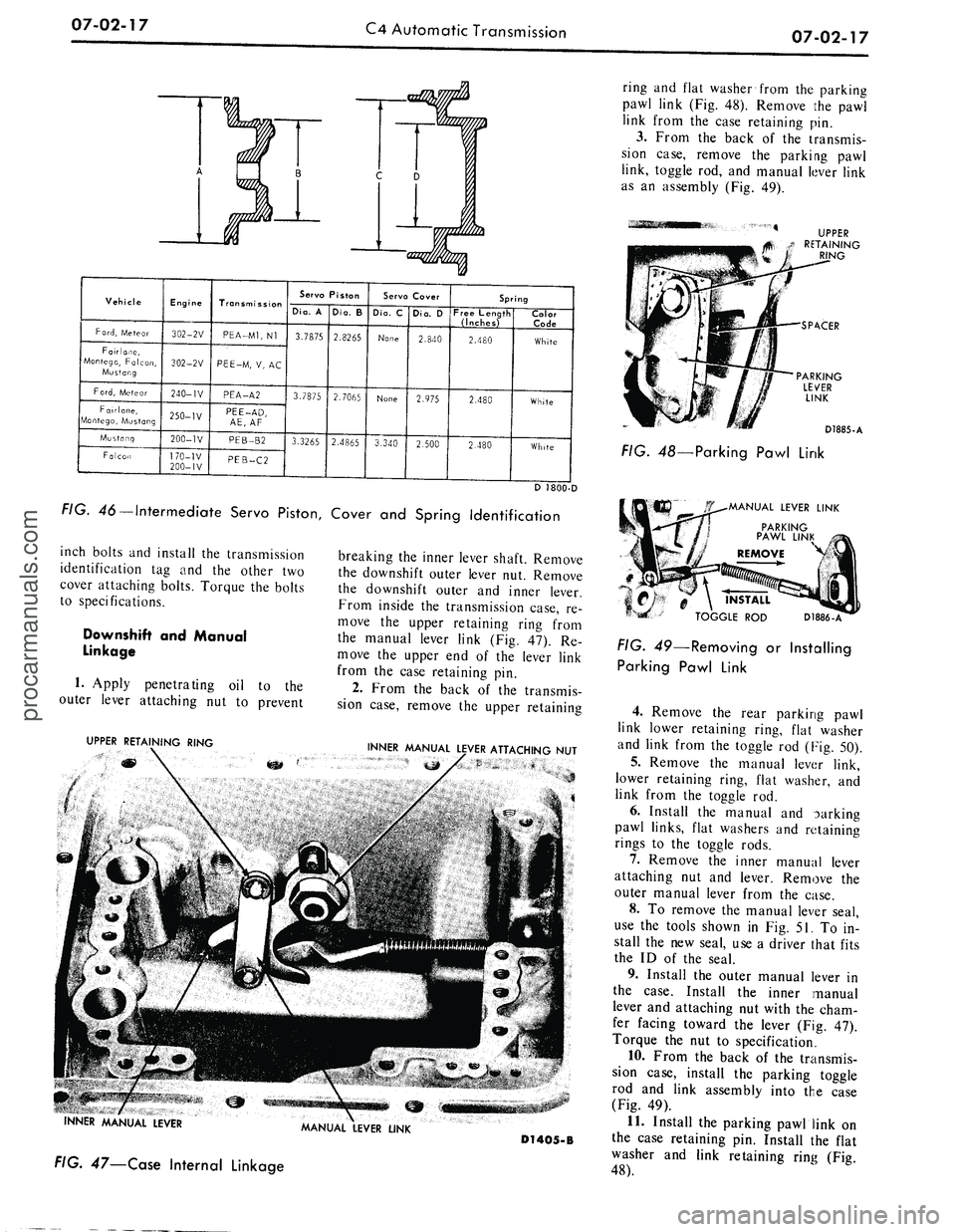
FIG. 46—Intermediate Servo Piston, Cover and Spring Identification
inch bolts and install the transmission
identification tag and the other two
cover attaching bolts. Torque the bolts
to specifications.
Downshift and Manual
Linkage
1.
Apply penetrating oil to the
outer lever attaching nut to prevent
UPPER RETAINING RING
breaking the inner lever shaft. Remove
the downshift outer lever nut. Remove
the downshift outer and inner lever.
From inside the transmission case, re-
move the upper retaining ring from
the manual lever link (Fig. 47). Re-
move the upper end of the lever link
from the case retaining pin.
2.
From the back of the transmis-
sion case, remove the upper retaining
INNER MANUAL
'ER ATTACHING NUT
mmMm
INNER MANUAL LEVER MANUAL LEVER LINK
FIG. 47—Case Internal Linkage
ring and flat washer from the parking
pawl link (Fig. 48). Remove the pawl
link from the case retaining pin.
3.
From the back of the transmis-
sion case, remove the parking pawl
link, toggle rod, and manual lever link
as an assembly (Fig. 49).
UPPER
r RETAINING
RING
D1885-A
FIG. 48—Parking Pawl Link
/7^-MANUAL LEVER LINK
D1405-B
FIG. 49—Removing or Installing
Parking Pawl Link
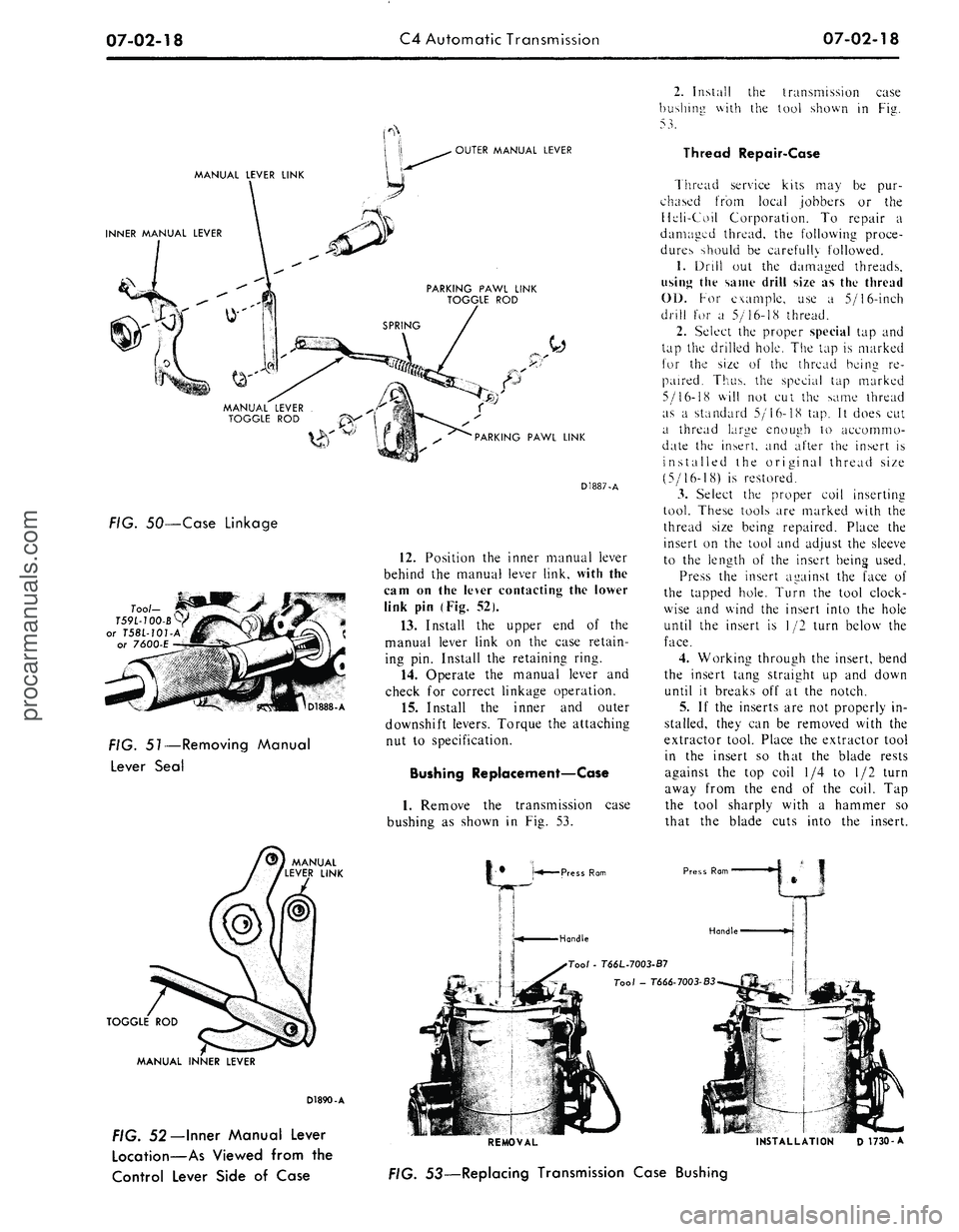
4.
Remove the rear parking pawl
link lower retaining ring, flat washer
and link from the toggle rod (Fig. 50).
5.
Remove the manual lever link,
lower retaining ring, flat washer, and
link from the toggle rod.
6. Install the manual and marking
pawl links, flat washers and retaining
rings to the toggle rods.
7.
Remove the inner manual lever
attaching nut and lever. Remove the
outer manual lever from the case.
8. To remove the manual lever seal,
use the tools shown in Fig. 51. To in-
stall the new seal, use a driver that fits
the ID of the seal.
9. Install the outer manual lever in
the case. Install the inner manual
lever and attaching nut with the cham-
fer facing toward the lever (Fig. 47).
Torque the nut to specification.
10.
From the back of the transmis-
sion case, install the parking toggle
rod and link assembly into the case
(Fig. 49).
11.
Install the parking pawl link on
the case retaining pin. Install the flat
washer and link retaining ring (Fig.
48).procarmanuals.com
Page 326 of 413
07-02-18
C4 Automatic Transmission
07-02-18
OUTER MANUAL LEVER
MANUAL LEVER LINK
INNER MANUAL LEVER
PARKING PAWL LINK
TOGGLE ROD
PARKING PAWL LINK
FIG. 50—Case Linkage
D1888-A
FIG. 51—Removing Manual
Lever Seal
TOGGLE ROD
D1887-A
12.
Position the inner manual lever
behind the manual lever link, with the
cam on the lever contacting the lower
link pin (Fig. 52).
13.
Install the upper end of the
manual lever link on the case retain-
ing pin. Install the retaining ring.
14.
Operate the manual lever and
check for correct linkage operation.
15.
Install the inner and outer
downshift levers. Torque the attaching
nut to specification.
Bushing Replacement—Case
1.
Remove the transmission case
bushing as shown in Fig. 53.
Press Ram
Handle
MANUAL INNER LEVER
D1890-A
FIG. 52— Inner Manual Lever
Location—As Viewed from the
Control Lever Side of Case
2.
Install the transmission case
bushing with the tool shown in Fig.
53.
Thread Repair-Case
Thread service kits may be pur-
chased from local jobbers or the
Heli-Coil Corporation. To repair a
damaged thread, the following proce-
dures should be carefully followed.
1.
Drill out the damaged threads,
using the same drill size as the thread
01).
For example, use a 5/16-inch
drill for a 5/16-18 thread.
2.
Select the proper special tap and
tap the drilled hole. The tap is marked
for the size of the thread being re-
paired. Thus, the special tap marked
5/16-18 will not cut the same thread
as a standard 5/16-18 tap. It does cut
a thread large enough to accommo-
date the insert, and after the insert is
installed the original thread size
(5/16-18) is restored.
3.
Select the proper coil inserting
tool. These tools are marked with the
thread size being repaired. Place the
insert on the tool and adjust the sleeve
to the length of the insert being used.
Press the insert against the face of
the tapped hole. Turn the tool clock-
wise and wind the insert into the hole
until the insert is 1/2 turn below the
face.
4.
Working through the insert, bend
the insert tang straight up and down
until it breaks off at the notch.
5.
If the inserts are not properly in-
stalled, they can be removed with the
extractor tool. Place the extractor tool
in the insert so that the blade rests
against the top coil 1/4 to 1/2 turn
away from the end of the coil. Tap
the tool sharply with a hammer so
that the blade cuts into the insert.
Press Rom
Handle
Too/
- T66L-7003-B7
Tool - T666-7003-B3
REMOVAL INSTALLATION D 1730-A
FIG. 53—Replacing Transmission Case Bushingprocarmanuals.com
Page 330 of 413
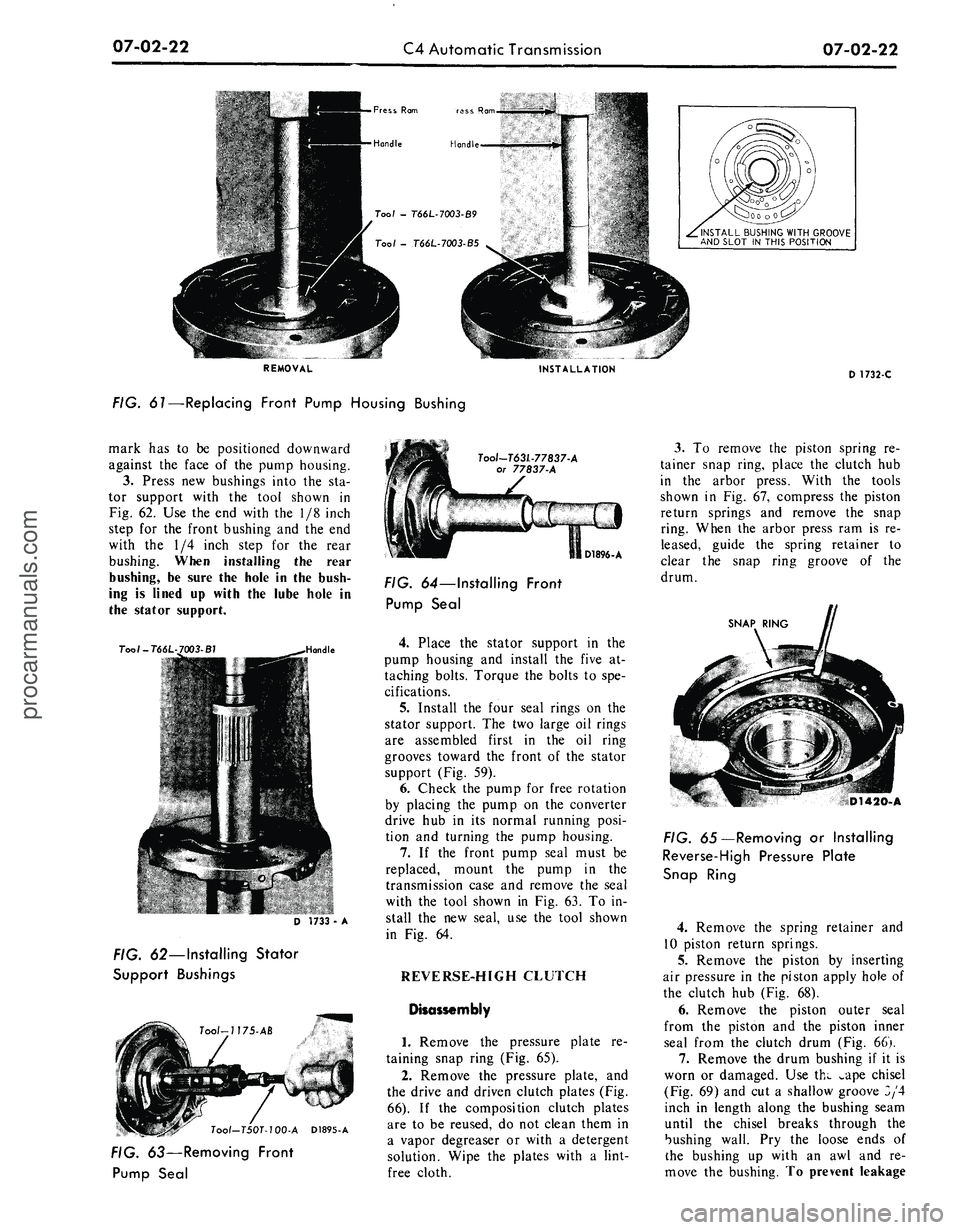
07-02-22
C4 Automatic Transmission
07-02-22
Handle
Fress
Ram
ress
Ram
Hand!
Tool
-
T66L-7003-S9
Too/
-
T66L-7003-B5
INSTALL BUSHING WITH GROOVE
JAND SLOT
IN
THIS POSITION
REMOVAL
INSTALLATION
FIG. 61—Replacing Front Pump Housing Bushing
D 1732-C
mark
has to be
positioned downward
against
the
face
of the
pump housing.
3.
Press
new
bushings into
the sta-
tor support with
the
tool shown
in
Fig. 62.
Use the end
with
the 1/8
inch
step
for the
front bushing
and the end
with
the 1/4
inch step
for the
rear
bushing. When installing
the
rear
bushing,
be
sure
the
hole
in the
bush-
ing
is
lined
up
with
the
lube hole
in
the stator support.
T00I-T66L
Toot-T63L-77837-A
or 77837-A
D 1733
-
A
FIG. 62—Installing Stator
Support Bushings
Tool-T50T-100-A D1895-A
FIG. 63—Removing Front
Pump Seal
D1896-A
FIG. 64—Installing Front
Pump Seal
4.
Place
the
stator support
in the
pump housing
and
install
the
five
at-
taching bolts. Torque
the
bolts
to
spe-
cifications.
5.
Install
the
four seal rings
on the
stator support.
The two
large
oil
rings
are assembled first
in the oil
ring
grooves toward
the
front
of the
stator
support (Fig.
59).
6. Check
the
pump
for
free rotation
by placing
the
pump
on the
converter
drive
hub in its
normal running posi-
tion
and
turning
the
pump housing.
7.
If the
front pump seal must
be
replaced, mount
the
pump
in the
transmission case
and
remove
the
seal
with
the
tool shown
in Fig.
63.
To in-
stall
the new
seal,
use the
tool shown
in
Fig. 64.
REVERSE-HIGH CLUTCH
Disassembly
1.
Remove
the
pressure plate
re-
taining snap ring (Fig.
65).
2.
Remove
the
pressure plate,
and
the drive
and
driven clutch plates (Fig.
66).
If the
composition clutch plates
are
to be
reused,
do not
clean them
in
a vapor degreaser
or
with
a
detergent
solution. Wipe
the
plates with
a
lint-
free cloth.
3.
To
remove
the
piston spring
re-
tainer snap ring, place
the
clutch
hub
in
the
arbor press. With
the
tools
shown
in Fig. 67,
compress
the
piston
return springs
and
remove
the
snap
ring. When
the
arbor press
ram is re-
leased, guide
the
spring retainer
to
clear
the
snap ring groove
of the
drum.
SNAP RING
D1420-A
FIG. 65—Removing
or
Installing
Reverse-High Pressure Plate
Snap Ring
4.
Remove
the
spring retainer
and
10 piston return springs.
5.
Remove
the
piston
by
inserting
air pressure
in the
piston apply hole
of
the clutch
hub
(Fig.
68).
6. Remove
the
piston outer seal
from
the
piston
and the
piston inner
seal from
the
clutch drum (Fig.
66).
7.
Remove
the
drum bushing
if it is
worn
or
damaged.
Use
thw ^ape chisel
(Fig. 69)
and cut a
shallow groove
3/4
inch
in
length along
the
bushing seam
until
the
chisel breaks through
the
bushing wall.
Pry the
loose ends
of
the bushing
up
with
an awl and re-
move
the
bushing.
To
prevent leakageprocarmanuals.com
Page 390 of 413
07-04-21
C-6 Automatic Transmission
07-04-21
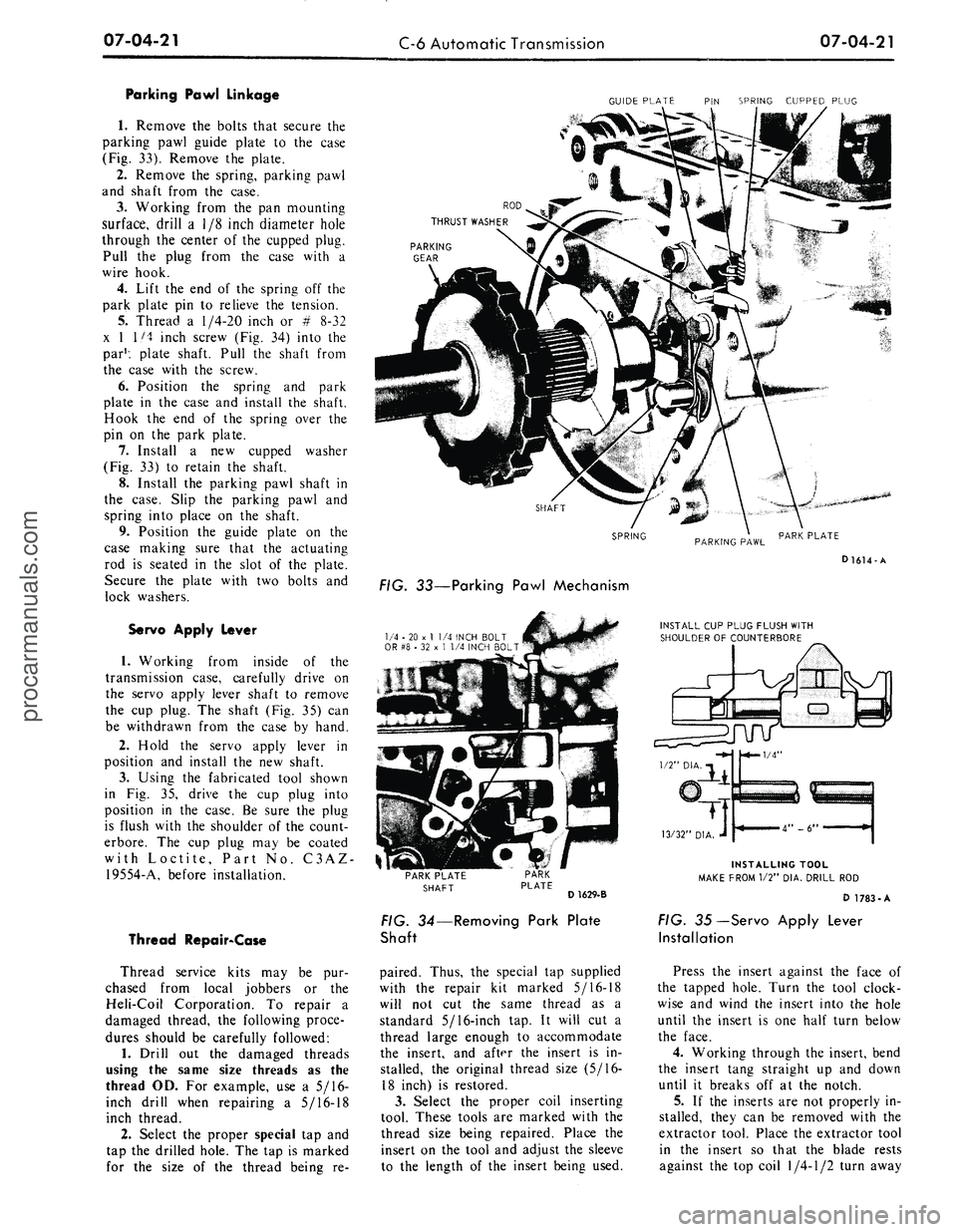
Parking Pawl Linkage
1.
Remove the bolts that secure the
parking pawl guide plate to the case
(Fig. 33). Remove the plate.
2.
Remove the spring, parking pawl
and shaft from the case.
3.
Working from the pan mounting
surface, drill a 1/8 inch diameter hole
through the center of the cupped plug.
Pull the plug from the case with a
wire hook.
4.
Lift the end of the spring off the
park plate pin to relieve the tension.
5.
Thread a
1/4-20
inch or # 8-32
x 1 1/4 inch screw (Fig. 34) into the
par1: plate shaft. Pull the shaft from
the case with the screw.
6. Position the spring and park
plate in the case and install the shaft.
Hook the end of the spring over the
pin on the park plate.
7.
Install a new cupped washer
(Fig. 33) to retain the shaft.
8. Install the parking pawl shaft in
the case. Slip the parking pawl and
spring into place on the shaft.
9. Position the guide plate on the
case making sure that the actuating
rod is seated in the slot of the plate.
Secure the plate with two bolts and
lock washers.
Servo Apply Lever
1.
Working from inside of the
transmission case, carefully drive on
the servo apply lever shaft to remove
the cup plug. The shaft (Fig. 35) can
be withdrawn from the case by hand.
2.
Hold the servo apply lever in
position and install the new shaft.
3.
Using the fabricated tool shown
in Fig. 35, drive the cup plug into
position in the case. Be sure the plug
is flush with the shoulder of the count-
erbore. The cup plug may be coated
with Loctite, Part No. C3AZ-
19554-A, before installation.
Thread Repair-Case
Thread service kits may be pur-
chased from local jobbers or the
Heli-Coil Corporation. To repair a
damaged thread, the following proce-
dures should be carefully followed:
1.
Drill out the damaged threads
using the same size threads as the
thread OD. For example, use a 5/16-
inch drill when repairing a 5/16-18
inch thread.
2.
Select the proper special tap and
tap the drilled hole. The tap is marked
for the size of the thread being re-
GUIDE PLATE PIN SPRING CUPPED PLUG
PARKING
GEAR
SHAFT
SPRING
PARKING PAWL
PARK PLATE
D1614-A
FIG. 33—Parking Pawl Mechanism
1/4 - 20 x
1
1/4 INCH BOLT
OR #8 • 32 x 1 1/4 INCH BOLT
INSTALL CUP PLUG FLUSH WITH
SHOULDER OF COUNTERBORE
PARK PLATE
SHAFT
D 1629-B
FIG. 34—Removing Park Plate
Shaft
paired. Thus, the special tap supplied
with the repair kit marked 5/16-18
will not cut the same thread as a
standard 5/16-inch tap. It will cut a
thread large enough to accommodate
the insert, and after the insert is in-
stalled, the original thread size (5/16-
18 inch) is restored.
3.
Select the proper coil inserting
tool. These tools are marked with the
thread size being repaired. Place the
insert on the tool and adjust the sleeve
to the length of the insert being used.
INSTALLING TOOL
MAKE FROM 1/2" DIA. DRILL ROD
D 1783-A
FIG. 35—Servo Apply Lever
Installation
Press the insert against the face of
the tapped hole. Turn the tool clock-
wise and wind the insert into the hole
until the insert is one half turn below
the face.
4.
Working through the insert, bend
the insert tang straight up and down
until it breaks off at the notch.
5.
If the inserts are not properly in-
stalled, they can be removed with the
extractor tool. Place the extractor tool
in the insert so that the blade rests
against the top coil
1/4-1/2
turn awayprocarmanuals.com