service FORD MUSTANG 1969 Volume One Chassis
[x] Cancel search | Manufacturer: FORD, Model Year: 1969, Model line: MUSTANG, Model: FORD MUSTANG 1969Pages: 413, PDF Size: 75.81 MB
Page 26 of 413
02-02-07
Brake System
02-02-07
ANTI-SKID CONTROL SYSTEM
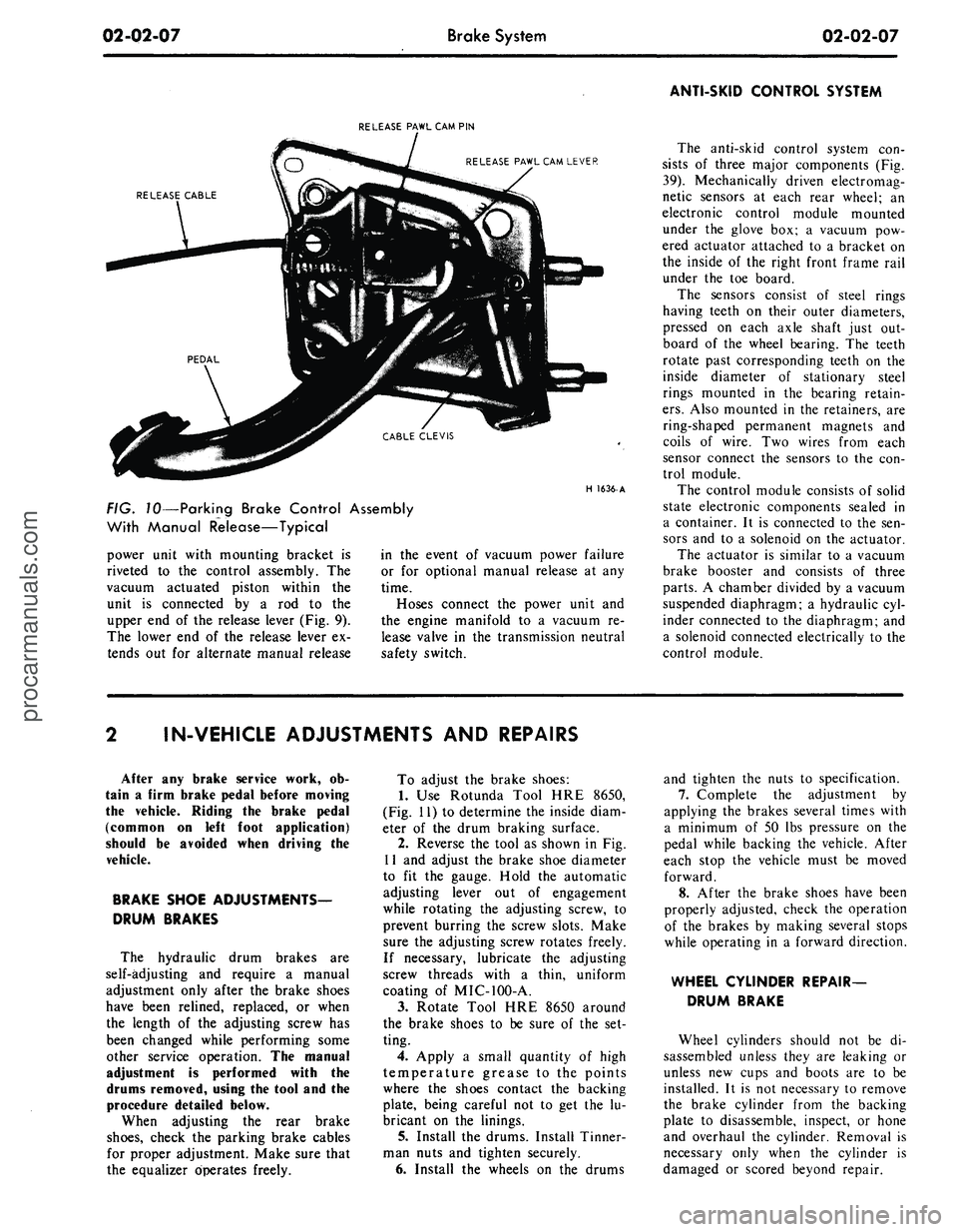
RELEASE PAWL CAM PIN
RELEASE PAWL CAM LEVER
RELEASE CABLE
H
1636-
A
FIG. 10—Parking Brake Control Assembly
With Manual Release—Typical
power unit with mounting bracket is
riveted to the control assembly. The
vacuum actuated piston within the
unit is connected by a rod to the
upper end of the release lever (Fig. 9).
The lower end of the release lever ex-
tends out for alternate manual release
in the event of vacuum power failure
or for optional manual release at any
time.
Hoses connect the power unit and
the engine manifold to a vacuum re-
lease valve in the transmission neutral
safety switch.
The anti-skid control system con-
sists of three major components (Fig.
39).
Mechanically driven electromag-
netic sensors at each rear wheel; an
electronic control module mounted
under the glove box; a vacuum pow-
ered actuator attached to a bracket on
the inside of the right front frame rail
under the toe board.
The sensors consist of steel rings
having teeth on their outer diameters,
pressed on each axle shaft just out-
board of the wheel bearing. The teeth
rotate past corresponding teeth on the
inside diameter of stationary steel
rings mounted in the bearing retain-
ers.
Also mounted in the retainers, are
ring-shaped permanent magnets and
coils of wire. Two wires from each
sensor connect the sensors to the con-
trol module.
The control module consists of solid
state electronic components sealed in
a container. It is connected to the sen-
sors and to a solenoid on the actuator.
The actuator is similar to a vacuum
brake booster and consists of three
parts.
A chamber divided by a vacuum
suspended diaphragm; a hydraulic cyl-
inder connected to the diaphragm; and
a solenoid connected electrically to the
control module.
IN-VEHICLE ADJUSTMENTS AND REPAIRS
After any brake service work, ob-
tain a firm brake pedal before moving
the vehicle. Riding the brake pedal
(common on left foot application)
should be avoided when driving the
vehicle.
BRAKE SHOE ADJUSTMENTS—
DRUM BRAKES
The hydraulic drum brakes are
self-adjusting and require a manual
adjustment only after the brake shoes
have been relined, replaced, or when
the length of the adjusting screw has
been changed while performing some
other service operation. The manual
adjustment is performed with the
drums removed, using the tool and the
procedure detailed below.
When adjusting the rear brake
shoes,
check the parking brake cables
for proper adjustment. Make sure that
the equalizer operates freely.
To adjust the brake shoes:
1.
Use Rotunda Tool HRE 8650,
(Fig. 11) to determine the inside diam-
eter of the drum braking surface.
2.
Reverse the tool as shown in Fig.
11 and adjust the brake shoe diameter
to fit the gauge. Hold the automatic
adjusting lever out of engagement
while rotating the adjusting screw, to
prevent burring the screw slots. Make
sure the adjusting screw rotates freely.
If necessary, lubricate the adjusting
screw threads with a thin, uniform
coating of MIC-100-A.
3.
Rotate Tool HRE 8650 around
the brake shoes to be sure of the set-
ting.
4.
Apply a small quantity of high
temperature grease to the points
where the shoes contact the backing
plate, being careful not to get the lu-
bricant on the linings.
5. Install the drums. Install Tinner-
man nuts and tighten securely.
6. Install the wheels on the drums
and tighten the nuts to specification.
7.
Complete the adjustment by
applying the brakes several times with
a minimum of 50 lbs pressure on the
pedal while backing the vehicle. After
each stop the vehicle must be moved
forward.
8. After the brake shoes have been
properly adjusted, check the operation
of the brakes by making several stops
while operating in a forward direction.
WHEEL CYLINDER REPAIR-
DRUM BRAKE
Wheel cylinders should not be di-
sassembled unless they are leaking or
unless new cups and boots are to be
installed. It is not necessary to remove
the brake cylinder from the backing
plate to disassemble, inspect, or hone
and overhaul the cylinder. Removal is
necessary only when the cylinder is
damaged or scored beyond repair.procarmanuals.com
Page 30 of 413
TUBE 2B253 TUBE 2263
SWITCH 2B264
TUBE 2265
VIEWZ
DRUM BRAKE
VIEWY
DISC BRAKE
VIEW IN CIRCLE M
VIEW Y
TYPICAL 2 PLACES
DRUM BRAKE
VIEW IN CIRCLE K
H 1639-A
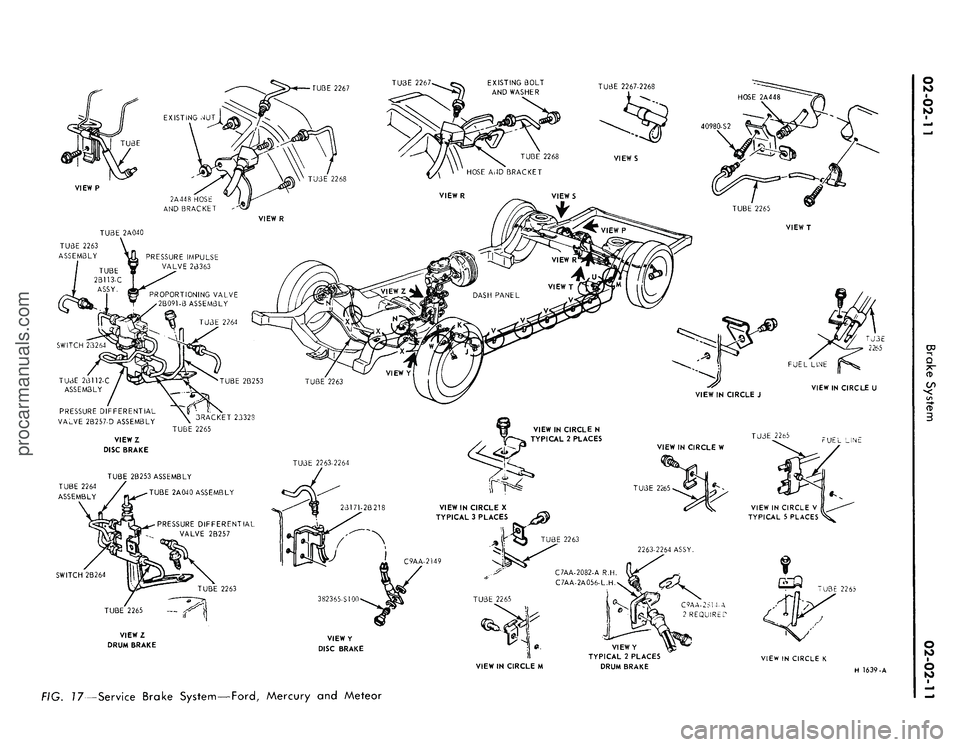
FIG. 17—Service Brake System—Ford, Mercury and Meteorprocarmanuals.com
Page 31 of 413
02-02-12
Brake System
02-02-12
TUBE ASSY. REF.
2 A 040
TUBE ASSY. REF.
2B113-B
PRESSURE
IMPULSE VALVE
PROPORTIONING
TUBE
>Y.
2B253 ASSY REF TUBE
/W W '
Kth#
2263 ASSY. R.H. REF.
TUBE
2B112-E
2264 ASSY. L.H. REF.
2B329
ASSY. REF.
HOSE
C8OA-2B218-C ASSY.L.H.
C80A-26171-D ASSY.R.H.
2B269 ASSY. REF.
VIEWZ
INSTALLATION-DISC BRAKE ONLY
BEND CLIP TO RETAIN
TUBE AS SHOWN
-TUBE
VIEW IN CIRCLE T
382365-S36
WASHER
8M-2149
TUBE-2A040
INSTALLATION-DISC BRAKES SAME AS
DRUM BRAKES AND MAIN VIEW
EXCEPT AS SHOWN
TUBE-2267 R.H.
TUBE-2B253
TUBE 2B329
PRESSURE DIFFERENTIAL
VALVE
TUBE 2B329
VIEW IN
CIRCLE U
TYPICAL ^,
CES^^
CLI
BOLT-
VIEW IN CIRCLE N
WASHER
34808-S8
PART OF AXLE
VENT ON STATION
WAGON ONLY
VENT ASSEMBLY
TUBE ASSEMBLY-2265
STANDARD AND POWER DRUM
3RAKES TUBE ASSEMBLY-2B1T2
POWER DISC BRAKES
MANUAL DISC
TUBE-2263 R.H.
3 REQUIRED
BOLT- 3 REQUIRED
CHECK BRAKE HOSE CLEARANCE „
TO ALL COMPONENTS IN
2A448"
METAL/METAL JOUNCE AND
METAL/METAL REBOUND-
TUBE-2267
ARMOR-390, 428 ENGINES ONLY
8 CYLINDER ENGINE REAR AXLE ONLY
TUBE ASSEMBLY-2268 L.H.
PRESSURE DIFFERENTIAL
VALVE
- GROMMET- 2
jl^REQUIRED
EWYN
TUBE
VIEW P
ROUTING FOR STATION WAGON ONLY
TUBE-22.S5
TUBE-2263 R.H. 2264 L.H.
VIEW IN CIRCLE Y
TYPICAL 2 PLACES
CHECK BRAKE HOSE CLEARANCE TO ALL
COMPONENTS IN METAL/METAL JOUNCE,
METAL/METAL REBOUND AND FULL
INSIDE AND OUTSIDE TURNS
VIEWX
TYPICAL 2 PLACES
DRUM BRAKES
TUBE-2263 R.H
2264 L.H.
VIEW IN CIRCLE U
TYPICAL 4 PLACES
HOSE-2A448
BRAKE HOSE-2078
GASKET-2149 2 REQUIRED
VIEW IN CIRCLE W
TYPICAL 2 PLACES
DRUM BRAKES
LIP
REINFORCEMENT ASSEMBLY-2B222
APPLY ESB-M4632-A SEALER AROUND
STUDS AND SCREW HOLE ON
FLOOR PAN SIDE
TUBE
TUBE ASSEMBLY-226J)
VIEW R
TUBE
VIEW IN CIRCLE M
POWER DISC BRAKES
BRAKE HOSE MUST BE ASSEMBLED
WITH WHEELS STRAIGHT AHEAD.
STRIPE ON HOLE HOSE ASSEMBLY
MUST SHOW NO EVIDENCE OF TWIST.
H 1559-C
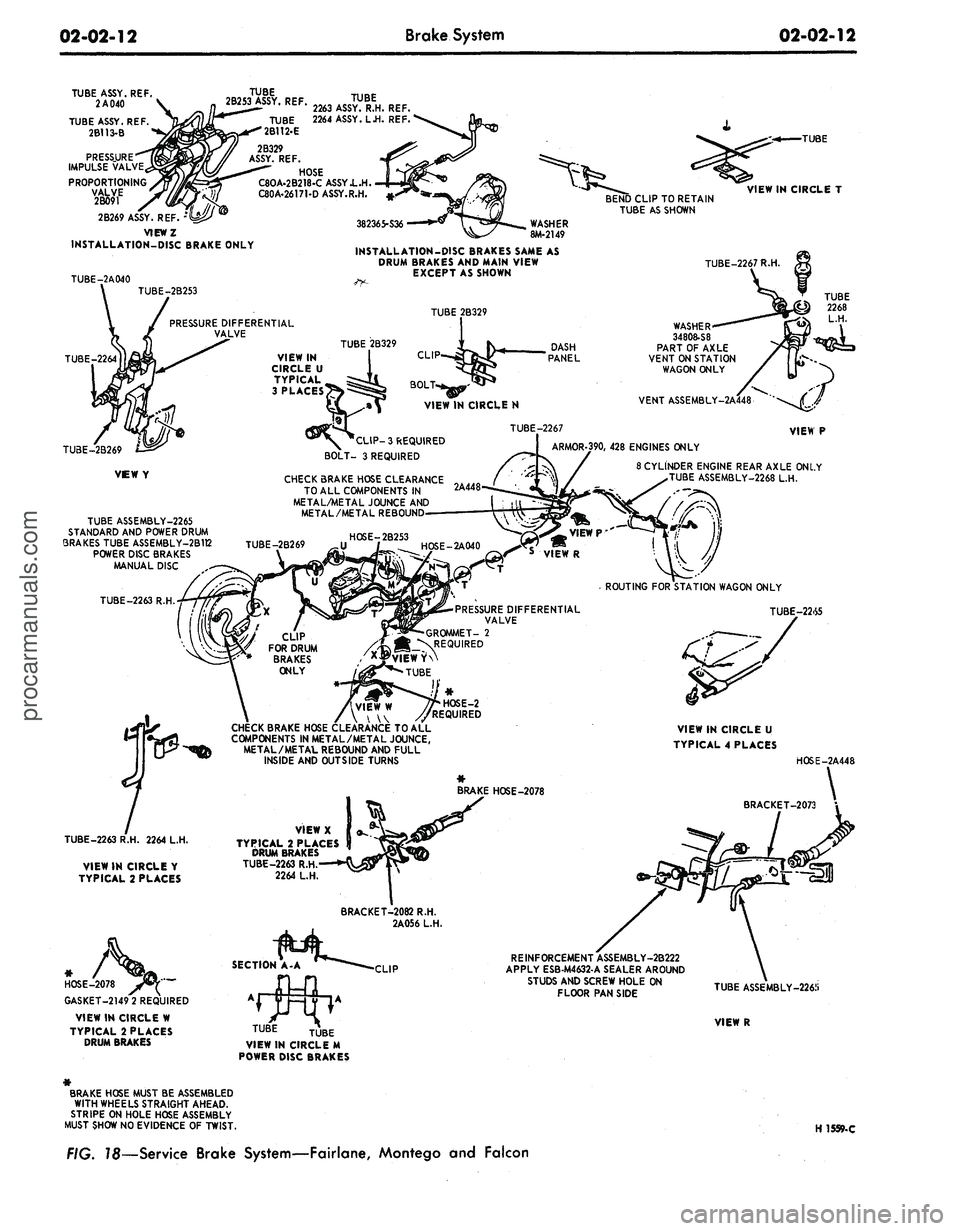
—Service Brake
System—Fairlane,
Montego
and
Falconprocarmanuals.com
Page 32 of 413
PRESSURE IMPULSE
VALVE
TUBE-2A040
TUBE-2B253
TUBE-2263 ASSY R.H.
2264 ASSY L.H.
TUBE-2267
PRESSURE
DIFFERENTIAL
VALVE
TUBE-2265
PROPORTIONING
VALVE
TUBE-2B112 \ TUBE-2263
L.H. FENDER APRON REF.
VIEWP
FOR POWER DISC BRAKES
TUBE-2B253
TUBE-
TUBE-22 64
TUBE-2B269
VIEWX
427 & 428 ENGINES 382410-S2
ALL EXCEPT
200 ENGINE
TUBE-2267
HOSE-2A448
TUBE-2265
TUBJ,-2268
VIEWY
ALL EXCEPT 200 ENGINE
PRESSURE DIFFERENTIAL
VALVE -2B257
VIEWS L&M //
BODY CROSSMEMBER
TUBE-2265
L.H. FENDER APRON REF.
VIEWR
FOR DRUM BRAKES
VIEW IN CIRCLE V
TYPICAL 4 PLACES
HOSE-2A448
VIEW IN CIRCLE U
VIEWW
VIEW IN CIRCLE T
VIEW IN CIRCLE S
TYPICAL 4 PLACES
VIEWN
H1640-A
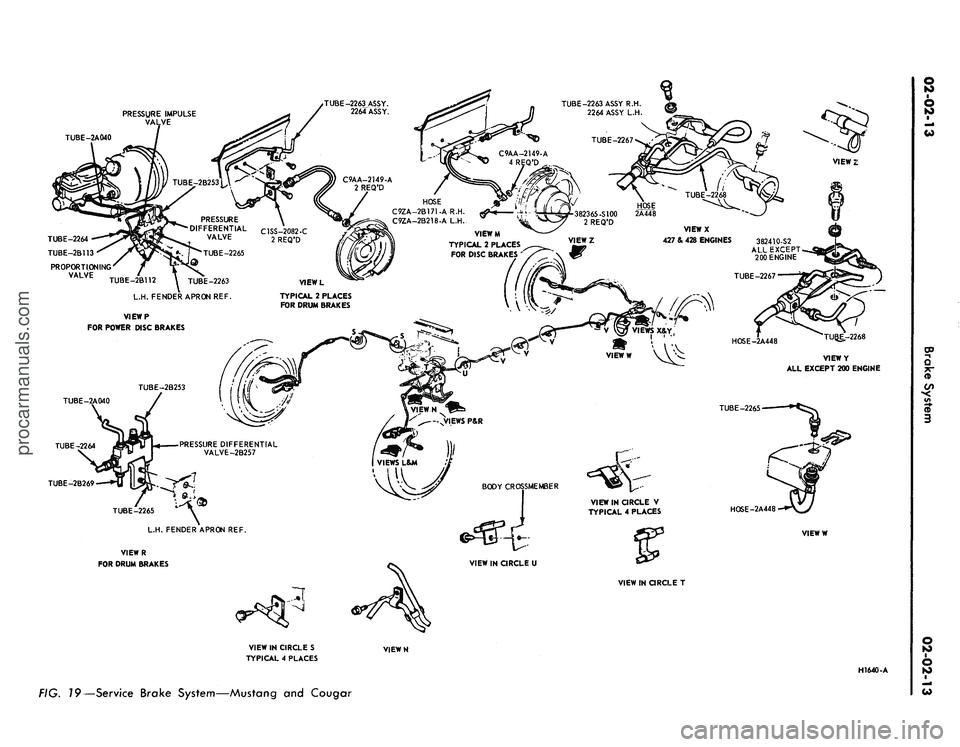
FIG. 19—Service Brake System—Mustang and Cougarprocarmanuals.com
Page 33 of 413
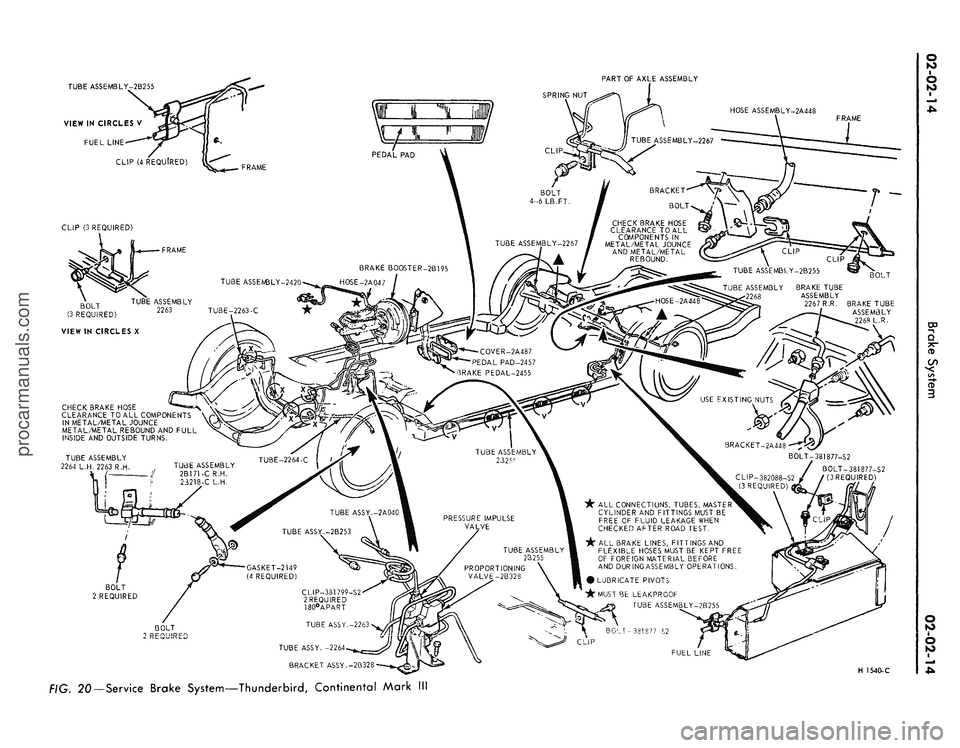
TUBE ASSEMBLY-2B255
VIEW IN CIRCLES V
FUEL LINE
CLIP (4 REQUfRED)
PART OF AXLE ASSEMBLY
HOSE ASSEMBLY-2A448
FRAME
TUBE ASSEMBLY-2267
CHECK BRAKE HOSE
CLEARANCE TO ALL
COMPONENTS IN
METAL/METAL JOUNCE
AND METAL/METAL
REBOUND.
CLIP (3 REQUIRED)
TUBE ASSEMBLY-2267
BRAKE BOOSTER-2B195
HOSE-2A047
TUBE ASSEMBLY-2B255
TUBE ASSEM3LY-2420
[
TUBE-2263-C *
TUBE ASSEMBLY BRAKE TUBE
2268 ASSEMBLY
2267 R.R. BRAKE TUBE
ASSEMBLY
TUBE ASSEMBLY
2263
VIEW IN CIRCLES X
COVER-2A487
PEDAL PAD-2457
BRAKE PEDAL-2455
USE EXISTING NUTS
TUBE ASSEMBLY
2325r
TUBE ASSEMBLY
2264 L.H. 2263 R.H.
TUBE ASSEMBLY
2B171-C R.H.
23218-C L.H.
BOLT-381877-S2
(3REQUIRED)
CLIP-382088-S2
(3 REQUIRED)
ALL CONNECTIONS, TUBES, MASTER
CYLINDER AND FITTINGS MUST BE
FREE OF FLUID LEAKAGE WHEN
CHECKED AFTER ROAD TEST.
TUBE ASSY.-2A040
TUBE ASSY.-2B253
PRESSURE IMPULSE
VALVE
ALL BRAKE LINES, FITTINGS AND
FLEXIBLE HOSES MUST BE KEPT FREE
OF FOREIGN MATERIAL BEFORE
AND DURING ASSEMBLY OPERATIONS.
TUBE ASSEMBLY
2B255
PROPORTIONING
VALVE-2B328
GASKET-2149
(4 REQUIRED)
#LUBRICATE PIVOTS
CLIP-381799-S2
2REQUIRED
180°APART
BE LEAKPROOF
TUBE ASSEMBLY-2B255
6
w
Q
7T
3
CHECK BRAKE HOSE
CLEARANCE TO ALL COMPONENTS
IN METAL/METAL JOUNCE
METAL/METAL REBOUND AND FULL
INSIDE AND OUTSIDE TURNS.
BOLT
2 REQUIRED
TUBE ASSY. -2264
BRACKET ASSY.-2B328
O
6
H 1540-C
FIG. 20—Service Brake System—Thunderbird, Continental Markprocarmanuals.com
Page 34 of 413
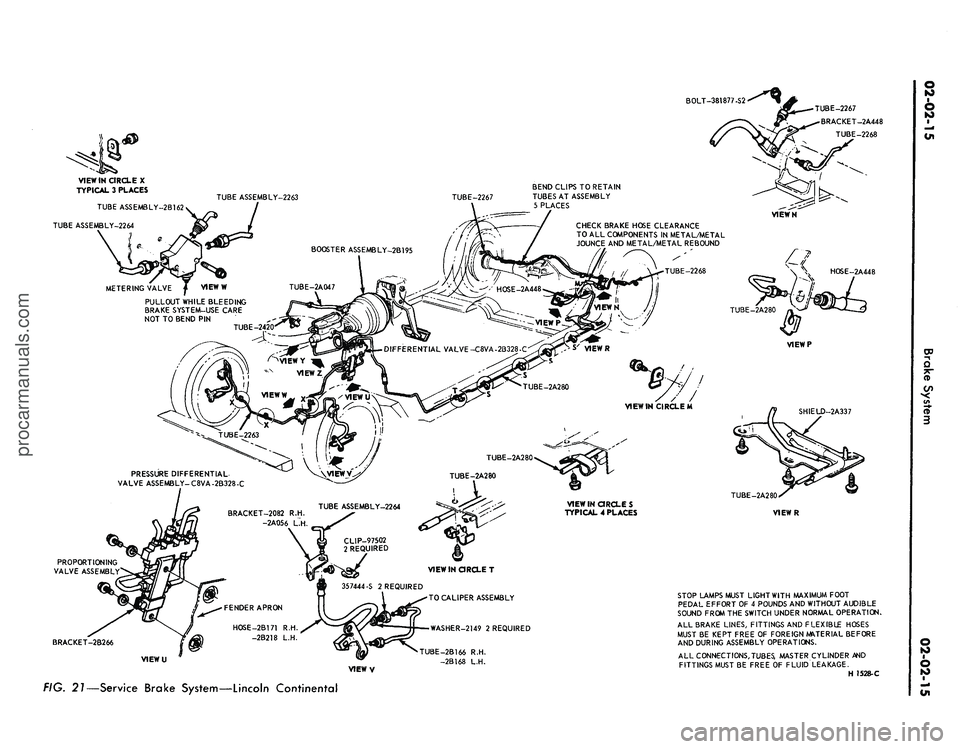
BOLT-381877
TUBE-2267
BRACKET-2A448
TUBE-2268
VIEW IN CIRCLE X
TYPICAL 3 PLACES
TUBE ASSEMBLY-2B162
TUBE ASSEMBLY-2264
TUBE ASSEMBLY-2263
TUBE-2267
BEND CLIPS TO RETAIN
TUBES AT ASSEMBLY
5 PLACES
CHECK BRAKE HOSE CLEARANCE
TO ALL COMPONENTS IN METAL/METAL
JOUNCE AND METAL/METAL REBOUND
TUBE-2268
PROPORTIONING
VALVE ASSEMBLY
BRACKET-2B266
BOOSTER ASSEMBLY-2B195
PULLOUT WHILE BLEEDING
BRAKE SYSTEM-USE CARE
NOT TO BEND PIN
TUBE-2420
DIFFERENTIAL VALVE-C8VA
VIEW IN CIRCLE M
TUBE-2A280
TUBE-2A280
PRESSURE DIFFERENTIAL
VALVE ASSEMBLY-C8VA-2B328-C
TUBE ASSEMBLY-2264
BRACKET-2082 R.H.
-2AO56 L.H.
CLIP-97502
2 REQUIRED
357444-S 2 REQUIRED
TO CALIPER ASSEMBLY
HOSE-2B171 R.H.
-2B218 L.H.
VIEWN
HOSE-2A448
TUBE-2A280
VIEWP
SHIELD-2A337
VIEW IN CIRCLE S
TYPICAL 4 PLACES
TUBE-2A280
VIEWR
V1EWU
VIEWV
WASHER-2149 2 REQUIRED
TUBE-2B166 R.H.
-2B168 L.H.
STOP LAMPS MUST LIGHT WITH MAXIMUM FOOT
PEDAL EFFORT OF 4 POUNDS AND WITHOUT AUDIBLE
SOUND FROM THE SWITCH UNDER NORMAL OPERATION.
ALL BRAKE LINES, FITTINGS AND FLEXIBLE HOSES
MUST BE KEPT FREE OF FOREIGN MATERIAL BEFORE
AND DURING ASSEMBLY OPERATIONS.
ALL CONNECT
IONS,
TUBES,
MASTER CYLINDER AND
FITTINGS MUST BE FREE OF FLUID LEAKAGE.
H 1528-C
FIG. 21—Service Brake System—Lincoln Continentalprocarmanuals.com
Page 41 of 413
02-02-22
Brake System
02-02-22
BRAKE VACUUM BOOSTER -2005
AUTOMATIC I
TRANSMISSION
HAIR PIN RETAINER
330699-S2
SPACER
STOP LIGHT SWITCH-13480
STANDARD
TRANSMISSION
BUSHING
BUSHING
PUSH ROD
BRAKE PEDAL ASSEMBLY
CLUTCH
PEDAL
ASSEMBLY
H 1557-C
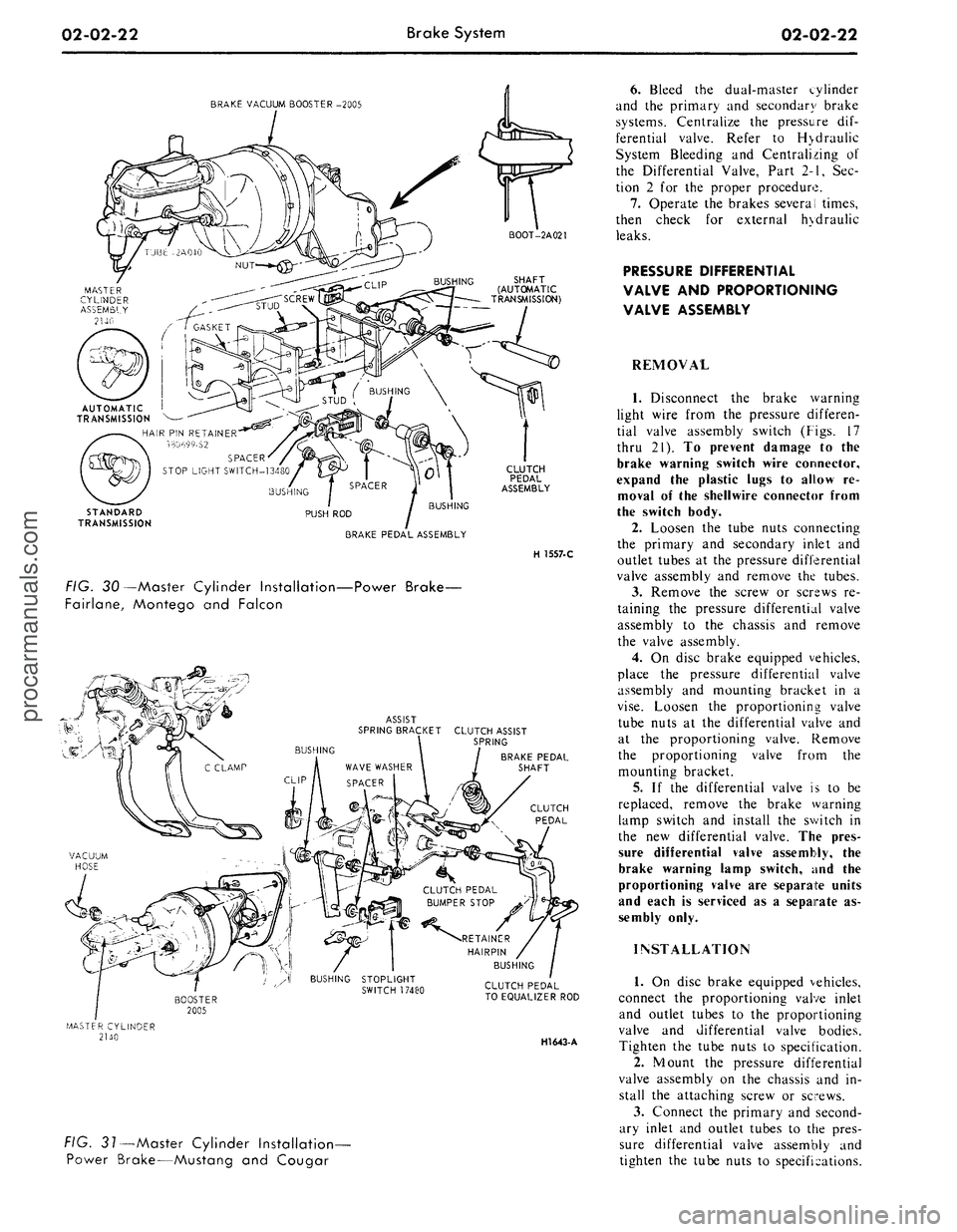
FIG. 30—Master Cylinder Installation—Power Brake-
Fairlane, Montego and Falcon
ASSIST
SPRING BRACKET CLUTCH ASSIST
\ SPRING
BRAKE PEDAL
SHAFT
CLUTCH
PEDAL
CLUTCH PEDAL
TO EQUALIZER ROD
HI643-
A
FIG. 31—Master Cylinder Installation-
Power Brake—Mustang and Cougar
6. Bleed the dual-master cylinder
and the primary and secondary brake
systems. Centralize the pressure dif-
ferential valve. Refer to H>draulic
System Bleeding and Centralizing of
the Differential Valve, Part 2-1, Sec-
tion 2 for the proper procedure.
7.
Operate the brakes several times,
then check for external hydraulic
leaks.
PRESSURE DIFFERENTIAL
VALVE AND PROPORTIONING
VALVE ASSEMBLY
REMOVAL
1.
Disconnect the brake warning
light wire from the pressure differen-
tial valve assembly switch (Figs. 17
thru 21). To prevent damage to the
brake warning switch wire connector,
expand the plastic lugs to allow re-
moval of the shellwire connector from
the switch body.
2.
Loosen the tube nuts connecting
the primary and secondary inlet and
outlet tubes at the pressure differential
valve assembly and remove the tubes.
3.
Remove the screw or screws re-
taining the pressure differential valve
assembly to the chassis and remove
the valve assembly.
4.
On disc brake equipped vehicles,
place the pressure differential valve
assembly and mounting bracket in a
vise.
Loosen the proportioning valve
tube nuts at the differential valve and
at the proportioning valve. Remove
the proportioning valve from the
mounting bracket.
5.
If the differential valve is to be
replaced, remove the brake warning
lamp switch and install the switch in
the new differential valve. The pres-
sure differential valve assembly, the
brake warning lamp switch, and the
proportioning valve are separate units
and each is serviced as a separate as-
sembly only.
INSTALLATION
1.
On disc brake equipped vehicles,
connect the proportioning valve inlet
and outlet tubes to the proportioning
valve and differential valve bodies.
Tighten the tube nuts to specification.
2.
Mount the pressure differential
valve assembly on the chassis and in-
stall the attaching screw or screws.
3.
Connect the primary and second-
ary inlet and outlet tubes to the pres-
sure differential valve assembly and
tighten the tube nuts to specifications.procarmanuals.com
Page 58 of 413
02-02-39
Brake System
02-02-39
MAJOR REPAIR OPERATIONS
BRAKE DRUM REFINISHING
Minor scores on a brake drum can
be removed with sandpaper. A drum
that is excessively scored or shows a
total indicator runout of over 0.007
inch should be turned down. Remove
only enough stock to eliminate the
scores and true up the drum. The refi-
nished diameter must not exceed 0.060
inch oversize.
Check the inside diameter of the
brake drum with a brake drum mi-
crometer (Tool FRE-14^1).
If the drum diameter is less than
0.030 inch oversize after refinishing^
standard lining may be installed. If
the drum diameter is 0.030—0.060
inch oversize after refinishing, oversize
lining must be installed.
After a drum is turned down, wipe
the refinished surface with a cloth
soaked in clean denatured alcohol. If
one drum is turned down, the opposite
drum on the same axle should also be
cut down to the same size.
ROTOR REFINISHING
Rotunda Disc Brake Attachment,
FRE-2249-2, is the only recommended
tool to refinish the disc brake rotors.
The step-by-step resurfacing procedure
provided with the tool must be ad-
hered to.
The finished braking surfaces of the
rotor must be flat and parallel within
0.0007 inch; lateral runout must not
exceed 0.003 inch total indicator read-
ing, and the surface finish of the brak-
ing surfaces are to be 80/15 micro
inches. The minimum limiting dimen-
sions (Figs. 11 and 12, Part 2-1) from
the inboard bearing cup to the out-
board rotor face and from the inboard
bearing cup to the inboard rotor face
must be observed when removing ma-
terial from the rotor braking surfaces.
On all models except Lincoln Con-
tinental, the limiting dimensions are to
be measured with a ball and gage bar
(Rotunda Kit FRE-70160).
BRAKE SHOE RELINING
Brake linings that are worn to with-
in 1/32 inch of the rivet head or are
less than 0.030 inch thick (bonded lin-
ing) or have been contaminated with
brake fluid, grease or oil must be re-
placed. Failure to replace worn linings
will result in a scored drum. When it
is necessary to replace linings, they
must also be replaced on the wheel on
the opposite side of the vehicle.
Inspect brake shoes for distortion,
cracks, or looseness. If this condition
exists,
the shoe must be discarded. Do
not attempt to repair a defective brake
shoe.
1.
Wash the brake shoes thoroughly
in a clean solvent. Remove all burrs
or rough spots from the shoes.
2.
Check the inside diameter of the
brake drum with a brake drum mi-
crometer (tool FRE-1431). If the di-
ameter is less than 0.030 inches over-
size,
standard lining may be installed.
If the diameter is 0.030—0.060 inches
oversize, oversize lining should be in-
stalled.
3.
Position the new lining on the
shoe.
Starting in the center, insert and
secure the rivets, working alternately
towards each end. Replacement lin-
ings are ground and no further grind-
ing is required.
4.
Check the clearance between the
shoe and lining. The lining must seat
tightly against the shoe with not more
than 0.008 inch clearance between any
two rivets.
RETAINER - 2B245
DUAL MASTER CYLINDER
DISASSEMBLY
1.
Clean the outside of the master
cylinder and remove the filler cover
and diaphragm. Pour out any brake
fluid that remains in the cylinder. Dis-
card the old brake fluid.
2.*
Remove the secondary piston
stop bolt from the bottom of the cyl-
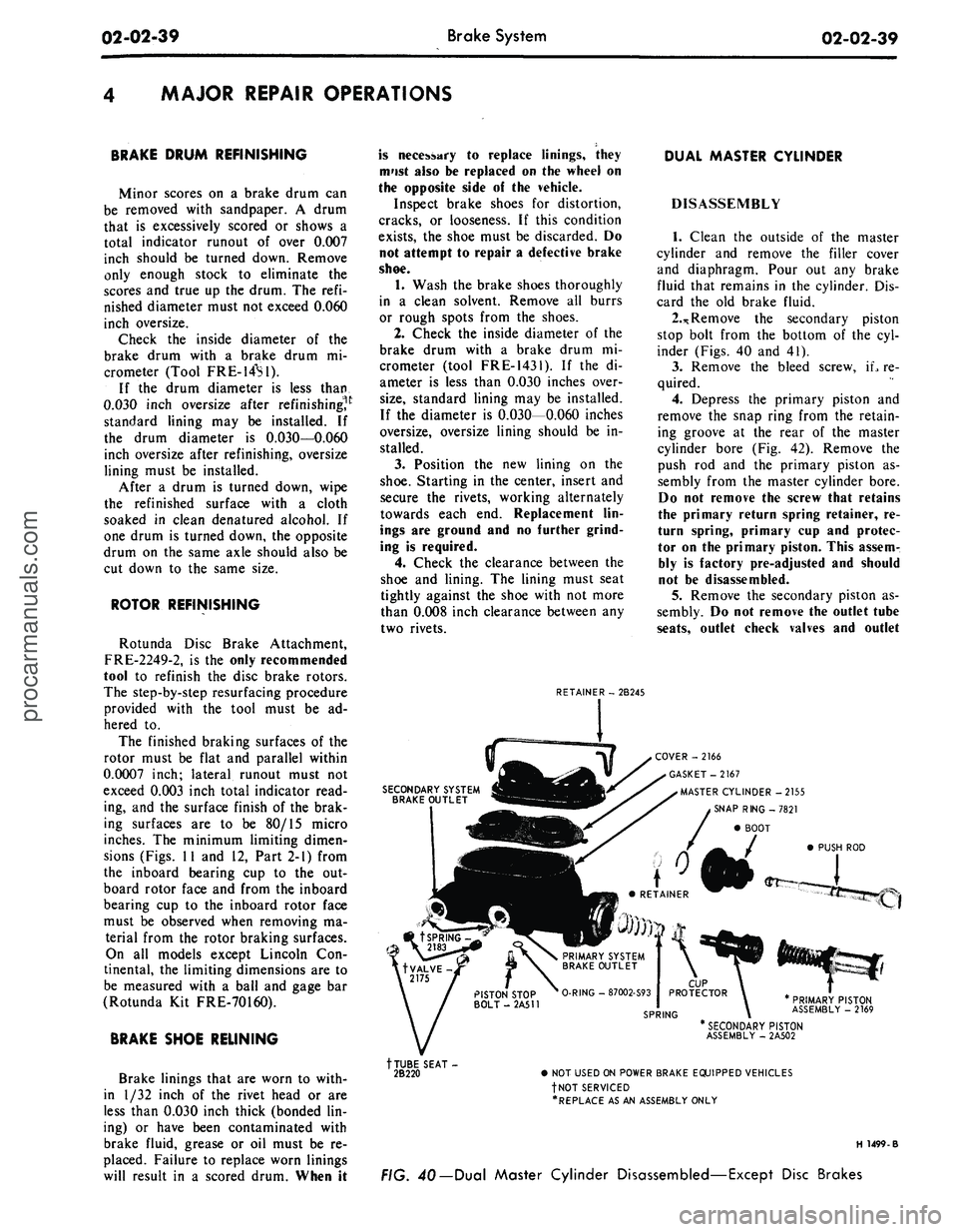
inder (Figs. 40 and 41).
3.
Remove the bleed screw, iL re-
quired.
4.
Depress the primary piston and
remove the snap ring from the retain-
ing groove at the rear of the master
cylinder bore (Fig. 42). Remove the
push rod and the primary piston as-
sembly from the master cylinder bore.
Do not remove the screw that retains
the primary return spring retainer, re-
turn spring, primary cup and protec-
tor on the primary piston. This assem-
bly is factory pre-adjusted and should
not be disassembled.
5.
Remove the secondary piston as-
sembly. Do not remove the outlet tube
seats,
outlet check valves and outlet
SECONDARY SYSTEM
BRAKE OUTLET
COVER -2166
GASKET-2167
MASTER CYLINDER -2155
SNAP RING -7821
BOOT
PUSH ROD
PRIMARY PISTON
ASSEMBLY - 2169
tTUBE SEAT-
2B220
* SECONDARY PISTON
ASSEMBLY - 2A502
• NOT USED ON POWER BRAKE EQUIPPED VEHICLES
fNOT SERVICED
•REPLACE AS AN ASSEMBLY ONLY
H 1499-B
FIG. 40— Dual Master Cylinder Disassembled—Except Disc Brakesprocarmanuals.com
Page 59 of 413
02-02-40
Brake System
02-02-40
RETAINER - 2B245
PRIMARY PISTON
ASSEMBLY-2169
GASKET-2167
RETURN SPRING
RETAINER
\ CUP
\\PROTECTOR
^\i # PISTON
fNOT SERVICED
* REPLACE AS
ASSEMBLY ONLY
*O-RING
PUMPING CUP
tVALVE
2175
SECONDARY
BRAKE SYSTEM
OUTLET
*SECONDARY PISTON
ASSEMBLY-2A502
H 1550-B
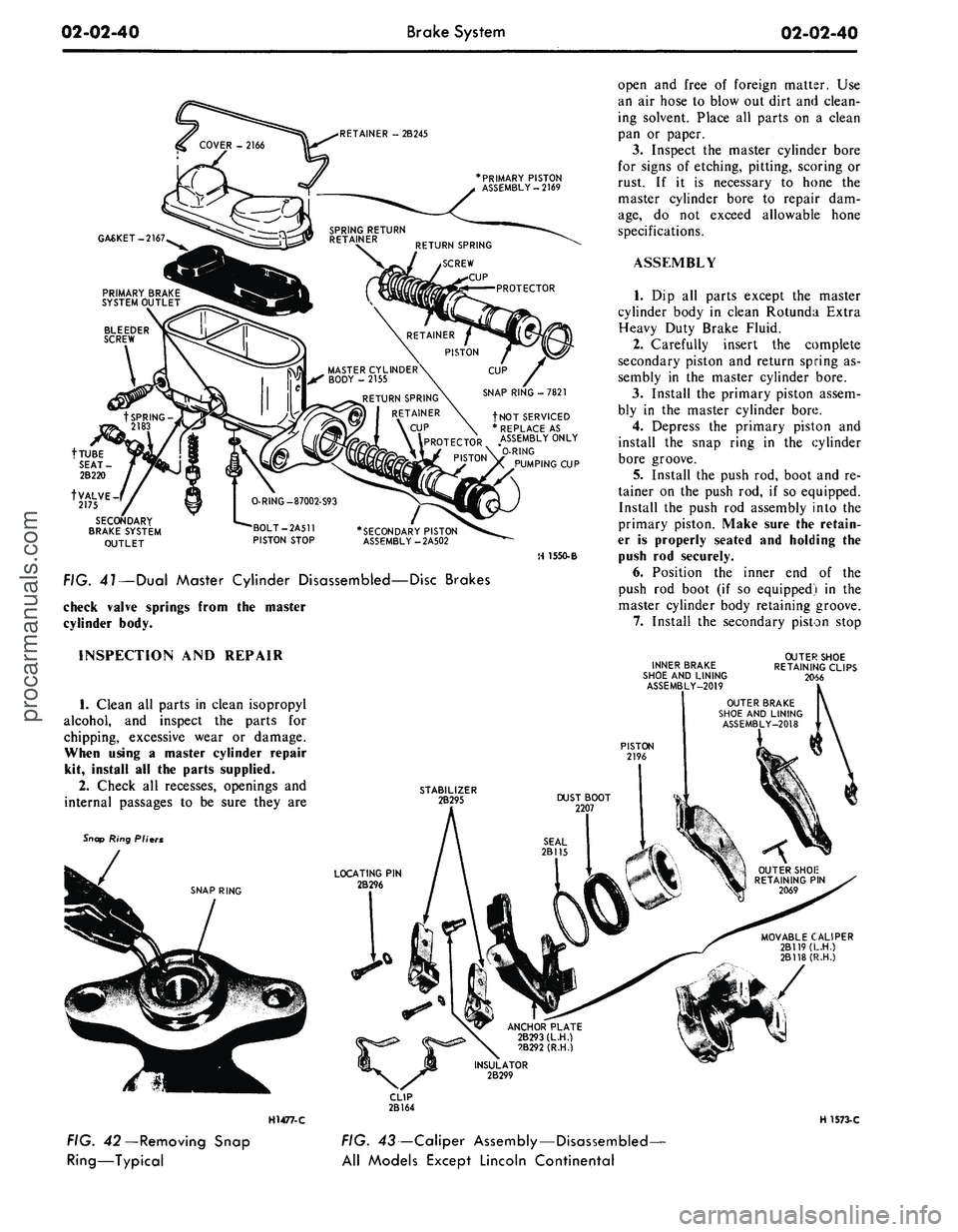
FIG. 41—Dual Master Cylinder Disassembled—Disc Brakes
check valve springs from the master
cylinder body.
open and free of foreign matter. Use
an air hose to blow out dirt and clean-
ing solvent. Place all parts on a clean
pan or paper.
3.
Inspect the master cylinder bore
for signs of etching, pitting, scoring or
rust. If it is necessary to hone the
master cylinder bore to repair dam-
age,
do not exceed allowable hone
specifications.
ASSEMBLY
1.
Dip all parts except the master
cylinder body in clean Rotunda Extra
Heavy Duty Brake Fluid.
2.
Carefully insert the complete
secondary piston and return spring as-
sembly in the master cylinder bore.
3.
Install the primary piston assem-
bly in the master cylinder bore.
4.
Depress the primary piston and
install the snap ring in the cylinder
bore groove.
5.
Install the push rod, boot and re-
tainer on the push rod, if so equipped.
Install the push rod assembly into the
primary piston. Make sure the retain-
er is properly seated and holding the
push rod securely.
6. Position the inner end of the
push rod boot (if so equipped) in the
master cylinder body retaining groove.
7.
Install the secondary piston stop
INSPECTION AND REPAIR
1.
Clean all parts in clean isopropyl
alcohol, and inspect the parts for
chipping, excessive wear or damage.
When using a master cylinder repair
kit, install all the parts supplied.
2.
Check all recesses, openings and
internal passages to be sure they are
Snap Ring Pliers
SNAP RING
H1477-C
FIG. 42—Removing Snap
Ring—Typical
INNER BRAKE
SHOE AND LINING
ASSEMBLY-2019
OUTER SHOE
RETAINING CLIPS
2066
STABILIZER
2B295
LOCATING PIN
2B296
ANCHOR PLATE
2B293(L.H.)
2B292 (R.H.)
MOVABLE CALIPER
2B119(L.H.)
2B118(R.H.)
H 1573-C
FIG. 43—Caliper Assembly—Disassembled-
All Models Except Lincoln Continentalprocarmanuals.com
Page 65 of 413
02-03-04
Specifications
02-03-04
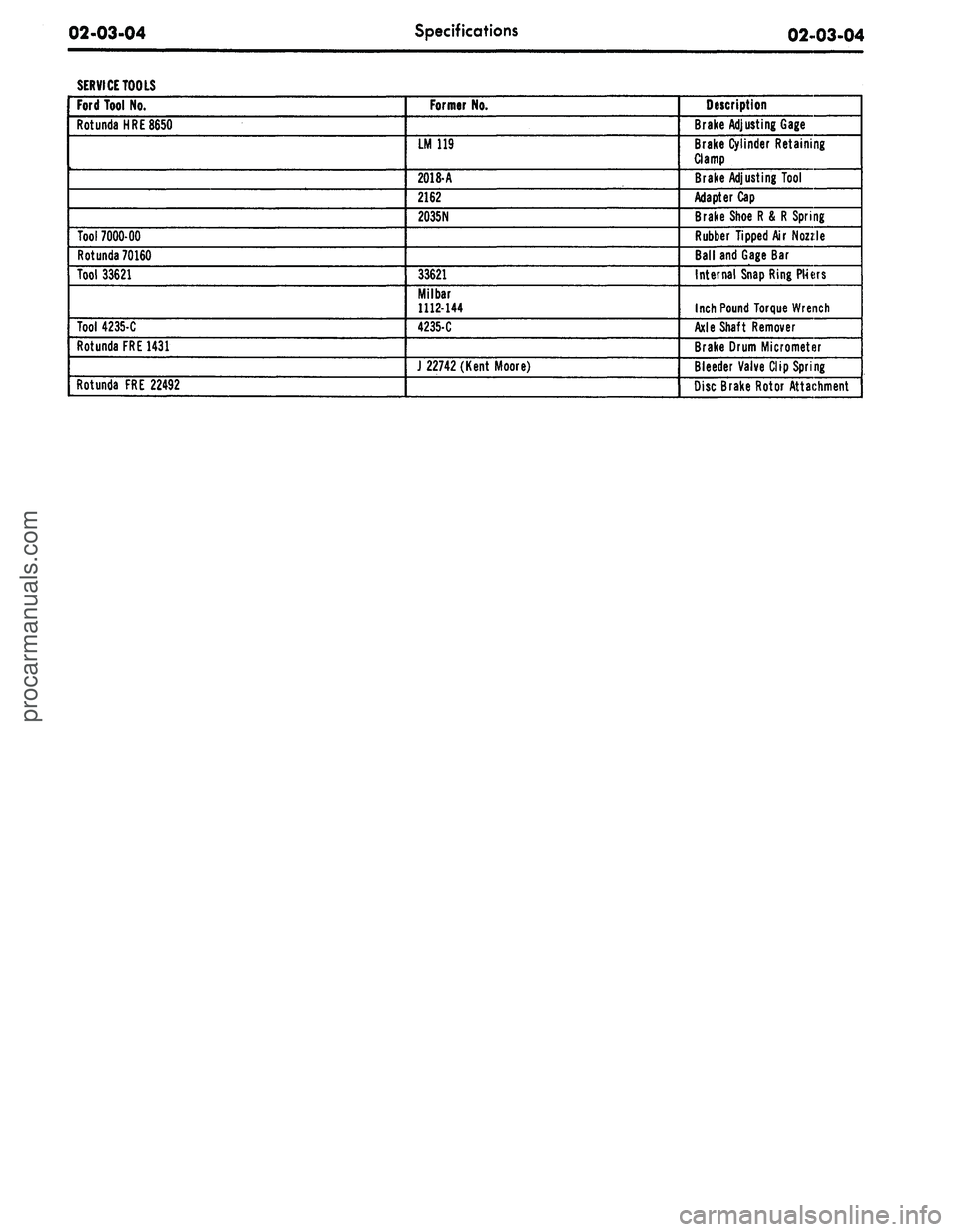
SERVICE TOOLS
Ford Tool
No.
Rotunda
HRE
8650
Tool
7000-00
Rotunda
70160
Tool 33621
Tool 4235-C
Rotunda
FRE 1431
Rotunda
FRE
22492
Former
No.
LM 119
2018-A
2162
2035N
33621
Milbar
1112-144
4235-C
J
22742 (Kent Moore)
Description
Brake
Adjusting
Gage
Brake
Cylinder
Retaining
Clamp
Brake
Adjusting
Tool
Adapter
Cap
Brake Shoe
R
&
R
Spring
Rubber
Tipped
Air
Nozzle
Ball
and
Gage
Bar
Internal
Snap Ring PMers
Inch Pound Torque
Wrench
Axle Shaft
Remover
Brake Drum
Micrometer
Bleeder
Valve Clip Spring
Disc Brake Rotor
Attachmentprocarmanuals.com