tow FORD MUSTANG 1969 Volume One Chassis
[x] Cancel search | Manufacturer: FORD, Model Year: 1969, Model line: MUSTANG, Model: FORD MUSTANG 1969Pages: 413, PDF Size: 75.81 MB
Page 97 of 413
03-02-21
Suspension
03-02-21
8. Place a box wrench over the
lower end of the ball joint remover
tool, and position the tool as in Fig.
13.
The tool should seat firmly against
the ends of both studs, and not
against the stud nuts.
9. Turn the wrench until both studs
are under tension, and then, tap the
spindle with a hammer near the studs
to loosen them from the spindle. Do
not loosen
the
studs with tool pressure
alone.
10.
Place a jack under the outer
end of the lower arm, and raise the
arm several inches. Remove both ball
stud nuts, and remove t^e spindle.
Installation
1.
Position the new spindle onto the
upper and lower ball joint studs, in-
stall the stud nuts and tighten the nuts
to specifications. Continue to tighten
both nuts until the cotter pin holes
line up with the slots, then install new
cotter pines.
2.
Connect the spindle connecting
rod to the spindle arm. Install the re-
taining nut and tighten the nut to
specification. Continue to tighten the
nut until the cotter pin hole lines up
with the slot, then install a new cotter
pin.
3.
Install the gasket and splash
shield on the spindle. Tighten the at-
taching bolts to specifications.
4.
Install the hub and rotor on the
spindle.
5.
Install the caliper to the spindle
and tighten the attaching bolts to spe-
cifications. Check for the correct flex-
ible hose routing (Part 2-2).
6. Install the wheel and tire and ad-
just the wheel bearings (Part 3-12).
7.
Lubricate the steering stop on
the lower arm and the mating flat on
the spindle with the specified lubri-
cant.
8. Remove the safety stands, lower
the car and check camber, caster and
toe-in.
FRONT SHOCK ABSORBER
REPLACEMENT
FORD, MERCURY,
METEOR, THUNDERBIRD,
CONTINENTAL MARK III
1.
Remove the nut, washer, and
bushing from the shock absorber
upper end.
2.
Raise the vehicle on a hoist and
install safety stands.
3.
Remove 2 bolts attaching the
shock absorber to the lower arm and
remove the shock absorber.
4.
Place a washer and bushing on
the shock absorber top stud and posi-
tion the shock absorber inside the
front spring. Install the 2 lower at-
taching bolts and torque them to spe-
cifications.
5.
Remove the safety stands and
lower the vehicle.
6. Place a bushing and washer on
the shock absorber top stud and in-
stall the attaching nut. Torque it to
specification.
COUGAR, FAIRLANE,
FALCON, MONTEGO,
MUSTANG
Removal
1. Raise the hood and remove 3
shock absorber upper mounting
bracket-to-spring tower attaching
nuts.
2.
Raise the front of the vehicle and
place safety stands under the lower
arms.
3.
Remove 2 shock absorber lower
attaching nuts and washers.
4.
Lift the shock absorber and
upper bracket from the spring tower
(Fig. 26) and remove the bracket from
the shock absorber.
Installation
1. Install the upper mounting
bracket on the shock absorber and
torque to specification.
2.
Position the shock absorber and
upper mounting bracket in the spring
tower, making sure the shock absor-
ber lower studs are in the pivot plate
holes.
3.
Install the 2 washers and attach-
ing nuts on the shock absorber lower
studs and torque to specification.
4.
Install the 3 shock absorber
upper mounting bracket-to-spring
tower attaching nuts and torque to
specification. Then, remove the safety
stands and lower the vehicle.
LINCOLN CONTINENTAL
Removal
1.
Remove the stud nut at the
upper eye of the shock absorber. Re-
move the upper eye stud bracket to
crossmember attaching bolt and re-
move the stud bracket. Refer to Fig.
22.
2.
Remove the bolts which attach
the shock absorber to the suspension
lower arm. Lower, and remove the
shock absorber.
3.
Examine the shock absorber unit
and rubber bushings. Replace parts
that are defective, deteriorated, or
worn.
Installation
1. Fully extend the shock absorber
and position it inside the coil spring.
Connect the lower end of the shock
absorber to the suspension lower arm.
Torque the attaching nuts to specifica-
tion.
2.
Insert the upper bracket stud
through the bushing in the shock ab-
sorber upper eye. Install the stud
bracket to crossmember attaching
bolt. Do not tighten the bolt: at this
time.
3.
Install the upper eye bracket
stud nut. Torque the nut to specifica-
tion.
4.
Torque the stud bracket- to-
crossmember attaching bolt to specifi-
cation.
The
shock absorber upper
eye
stud
nut
must
be
tightened
to com-
press
the
rubber bushing before
the
stud bracket
is
bolted
to the
crossmember;
otherwise,
the
upper
at-
tachment could
be
loose
and
noisy.
REAR SHOCK ABSORBER
REPLACEMENT
FORD, MERCURY,
METEOR, THUNDERBIRD,
CONTINENTAL MARK 1(11
1.
Raise the vehicle on a hoist.
2.
Remove the shock absorber at-
taching nut, washer and insulator
from the upper stud at the upper side
of the spring upper seat. Compress the
shock absorber to clear the hole in the
spring seat, and remove the inner in-
sulator and washer from the upper at-
taching stud.
3.
Remove the self-locking attach-
ing nut, and disconnect the shock ab-
sorber lower stud from the mounting
bracket on the rear axle housing (Fig.
4).
4.
Expel all air by performing step
3 On Vehicle Tests in Part 3-1.
5.
Place the inner washer and insu-
lator on the upper attaching stud, and
position the shock absorber so that
the upper attaching stud enters the
hole in the spring upper seat. While
holding the shock absorber in this po-
sition, install the outer insulator andprocarmanuals.com
Page 104 of 413
03-02-28
Suspension
03-02-28
used, these components should
be re-
placed
on the
bench.
Do not wash the ball joint with sol-
vent.
The
solvent
may
attack parts
within the joint.
BUSHING AND INNER
SHAFT REPLACEMENT
LINCOLN CONTINENTAL
Always replace both upper
arm
bushings,
if
either bushing
is
worn
or
damaged. Install only
new
bushings
when replacing
the
inner shaft. Refer
to Section
3 for
the upper arm remov-
al procedure.
1.
Remove
the
bolts, lock washers,
and flat washers from the ends
of
the
upper arm shaft.
2.
Assemble
the
remover, tool
3044-LA,
to the
shaft
at the
front
bushing. Press
the
bushing
out of the
arm using
the
support cup, tool 6069-
H,
and the
remover tool 3044-AB3
(Fig. 40).
PRESS RAM
FIG.
40
—Removing Upper
Arm
Front Bushing
3.
Remove
the
shaft.
4.
Remove
the
upper
arm
rear
bushing using
the
support
cup,
tool
3069-H, and
the
remover, tool 3069-L
(Fig. 41).
5.
Both upper
arm
bushings
are
pressed into the arm from the outside
toward the inside
of
the arm. To facil-
itate installation, use silicone
or
liquid
oap
as a
lubricant.
See
Fig.
41 for
PRESS RAM
Tool-3069-H
F 1480-A
FIG. 41—Removing Upper
Arm
Rear Bushing
proper assembly
of the
shaft
and
bushings.
6. Press the upper arm rear bushing
into
the arm
using
the
support cup,
tool 3069-H,
and the
replacer, tool
3068 (Fig. 43). Press
the
bushing
in
until
the
shoulder stop
is
reached.
7.
Insert
the end of the
shaft into
the rear bushing. Press the front bush-
ing onto
the
shaft
and
into
the arm
using the replacer, tool 3068 (Fig. 44).
REAR BUSHING
FRONT BUSHING
F 1479-A
FIG. 42— Upper Arm, Shaft,
and
Bushing Assembly
PRESS RAM
Tool— 3068
JF 1478-A
Bottom the bushing flange against the
flange
in the
arm.
8. Install
the
flat washers, lock-
washers,
and
bolts
at
the ends
of
the
upper
arm
shaft.
Do not
tighten
the
bolts
at
this time. These must
be
tightened after
the
arm assembly
has
been installed, and when the front end
weight
of
the vehicle
is
on the wheels.
These bolts
are
made
of a
special
material. Use only the specified bolt
if
replacement
is
necessary.
PRESS
RAM
FIG. 43—Installing Upper
Arm
Rear Bushing
FIG. 44—Installing Upper
Arm
Front Bushing
REAR SPRING OVERHAUL-
SPRING REMOVED
LINCOLN CONTINENTAL
Front Hanger Assembly
If
the
front hanger
or
bushings
are
to
be
replaced, proceed
as
follows:
1.
Remove
the
nuts and lock wash-
ers from
the
spring front mounting
bolt (Fig.
6).
2.
Tap the
spring mounting stud
out
of the
bushing
and
hanger, then
separate
the
hanger from
the
spring.
3.
Remove
the
front bushing from
the spring with tool T64N-5781-A.
4.
Install
the
bushing
in the
spring
with tool T64N-5781-A.
5.
Assemble the front hanger
to
the
spring
eye and
install
the
spring
mounting stud through
the
hanger,
bushings,
and
spring eye
as
shown
in
Fig.
6.
6. Install the lock washers and nuts
on
the
mounting stud
and
tighten
the
outboard
nut to
specification. Tighten
the inboard
nut to
specification with
the vehicle
at
curb riding height.procarmanuals.com
Page 117 of 413
03-05-04
Steering Columns And Linkage
03-05-04
Shipping Spacer
(3/4 X 1-1/3 inch
Pipe)
TURN SIGNAL SWITCH
Too/-T65P-3D739-A
G 1468-3
FIG. 4—Removing Pivot
Pin
cer and spring from the steering shaft.
12.
With
the
steering column lock-
ing clamp still compressed, lift
the
upper flange from
the
column
by
working against
the
lower bearing
inner race.
13.
Place
the
flange
on the
bench
with
the
smaller bearing toward
the
bench (Fig.
5).
Drive lightly
on the
outer race
at
each slot with
a
small
pick.
To
remove the upper bearing in-
vert
the
flange
and
remove
the
larger
bearing
in the
same manner. Never
drive
or
apply pressure
to the
inner
race.
Installation
1.
Select
a
socket wrench that
is
the same diameter
of
each bearing
outer race. Position the bearing on the
upper flange with the open side facing
inward. Place
the
socket
on the
outer
race
and tap the
bearing into place.
Be careful not
to
contact
the
bearing
inner race
as
damage will result.
2.
Compress
the
column release
lever with vise grips
to
place the lock-
ing levers
in the
release position.
3.
Position
the
flange
on the
upper
end
of
the shaft being careful
to
apply
pressure only
on the
upper bearing
inner race
to
prevent bearing damage.
4.
Install new pivot pins
to
assure
a
satisfactory press-fit
as
shown
in Fig.
6 with
a
C-clamp.
The
pivot pins
should have
a
clearance
of
0.005 inch
between
the
shoulder
and
casting
when properly installed.
A
clearance
of less than 0.005 inch may create
a
bind
in the
tilt mechanism.
If
one pin
presses
in
before
the
other, place
a
spacer washer over the head
of
the pin
that has already positioned
to
prevent
over pressing while still pressing
the
other one into position.
5.
Move
the
tilt mechanism
to the
uppermost position
and
remove
the
vise grip pliers
to
lock
it in
place.
6. Position
the
release spring
rod
and hold
it
up
as
high
as
possible with
vise grip pliers. Place
the
spring
and
cover
in
place
on the
upper flange.
Compress
the
spring
and
install
the
retainer. Remove the vise grip pliers.
7.
Depress
the
column release lever
with pliers
and
place
the
tilt mecha-
nism
in the
center position.
8. Position
the
turn signal switch
and install
the
two attaching screws.
9. Pull
the
wires into place and
in-
stall
the
plastic retaining clip.
10.
Slide the lower cover into place.
Tighten
the
screw attaching the lower
cover
to the
column. Make sure
the
rotating socket casting does
not rub
on
the
lower cover.
(On
Ford
and
Mercury models, replace
the
shroud.)
11.
Position the upper cover
on the
column
and
install
the
two attaching
screws.
12.
Install
the
combination turn
signal
and
tilt mechanism lever.
13.
Install
the
steering v/heel
and
the crash pad.
14.
Connect
the
negative cable
to
the battery. Check the turn signal and
tilt mechanism
for
proper operation.
BEARING OUTER
RACE
SLOT
G 1448-A
FIG. 5—Removing Ball Bearingsprocarmanuals.com
Page 120 of 413
03-05-07
Steering Columns And Linkage
03-05-07
the steering column
(F in Fig. 8).
7.
Disconnect
the
transmission shift
rod
at the
shift tube.
8. Working under
the
hood, install
the aligning spacer (Fig.
9)
around
the
visible portion
of the
steering shaft
and slide
it up the
shaft into
the
steer-
ing column.
It may be
necessary
to
move
the
shaft back
and
forth
to
com-
pletely install
the
spacer.
9.
At
this point
the
steering column
assembly, being loose,
may
have
dropped toward
the
steering gear
grounding
the
steering shaft
on the
steering gear input shaft.
To
properly
establish
the
steering shaft
to
steering
gear clearance, insert
a 1/8
diameter
rod
or
drill through
the
opening
in the
upper half
of the
flex coupling.
10.
Tighten
to a
snug
fit
(approxi-
mately
2-3
ft-lb)
the
nuts retaining
the
toe plates
to the
dash panel
(B in Fig.
8).
11.
If the
aligning spacer cannot
be
rotated freely,
the
dash panel holes
must
be
filed
or
reamed
for
greater
travel
(as
mentioned
in the
second
paragraph
at the
beginning
of
this
procedure).
12.
Tighten
all
nuts
and
bolts
(noted
as C, D and E in
Fig.
8) in the
passenger compartment
to a
snug
fit
(approximately 2-3 ft-lb). Again check
aligning spacer
for
looseness. Perform
these tightening operations
in
alpha-
betical order.
13.
Tighten
the
lateral adjustment
bolt
(F in Fig. 8) to
snug
fit.
Again
check
the
aligning spacer
for
loose-
ness.
14.
Tighten
all
bolts and nuts
to the
proper torque value (listed
in Fig. 8)
in alphabetical order.
15.
Remove
the
steering shaft
al-
igning spacer.
16.
Remove
the 1/8
diameter
rod or
drill previously inserted
in the
flex
coupling.
17.
Reinstall
the
trim
at the
instru-
ment panel
to
steering column mount-
ing.
LINCOLN CONTINENTAL
If
a
condition
of
high shift
or
steer-
ing effort
is
experienced
it may be
caused
by
improper alignment
of the
energy absorbing steering column.
The
following procedures outline
the
steps
necessary
to
correctly realign either
fixed
or
tilt columns:
1.
Disconnect
the
battery.
2.
Loosen four
toe
plate attaching
nuts (Fig.
10).
3.
Loosen
one toe
plate
to
steering
column clamp bolt
and nut.
Check
alignment
of
steering shaft
to
shift
-HANDLE PORTION
2-3/4"
-*- 3/4"
BEND AROUND
STEERING SHAFT
DIMENSION
A:
STANDARD COLUMN 7/16"
TILT WHEEL COLUMN
1-1/8"
•2-3/4
FABRICATE ALIGNING SPACER OUT OF
PLASTIC SHIPPING COLLAR PROVIDED
ON SERVICE DRIVESHAFTS, OR OUT
OF
1/32"—1/16" CARDBOARD
STEERING SHAFT
ALIGNMENT SPACER-BEND AROUND
STEERING SHAFT (DIMENSION
A)
AND
SLIDE UP THE SHAFT INTO COLUMN
G1537-A
FIG. 9—Aligning Spacer Fabrication
and
Insertion
BRAKE PEDAL
SUPPORT BRACKET
PART
A-TOE PLATE
B-CLAMP
C-C0LUMN BRACKET
D-BRAKE PEDAL
SUPPORT BRACKET
TORQUE VALUE
8-12 FT. LB.
3-5 FT. LB.
10-15
FT.
LB.
8-12 FT. LB.
G1541-A
FIG. 10—Steering Column Alignment Locations
and
Torque
Specifications—Lincoln Continentalprocarmanuals.com
Page 127 of 413
03-05-14
Steering Columns And Linkage
03-05-14
8. Connect the turn signal and
emergency flasher switch wires at the
multiple connectors. Connect the wires
to the neutral start switch. Adjust-
ments for the neutral start switch are
detailed in Group 7 of this manual.
9. Connect the tilt-column control
cable to the release cable retainer and
vacuum motor (if so equipped). To re-
move cable slack, loosen the bracket
attaching screw and pull it slightly
toward the column, then tighten the
screw. If difficulty in adjusting this
control is experienced, the retainer
slot may be filed to gain additional
travel.
10.
Install the instrument panel
steering column plate and cover and
the instrument panel lower outer fin-
ish panel.
11.
Connect the negative cable to
the battery.
12.
Start the engine and check the
operation of the steering column and
switches.
LINCOLN CONTINENTAL
Removal
1.
Disconnect the battery.
2.
Disconnect the rod from the
lever at the lower end of the selector
tube.
Loosen the clamp bolt that locks
the flexible coupling to the steering
shaft.
3.
Working from the underside of
the steering wheel spoke, remove the
two screws that secure the crash pad.
Remove the pad. Do not use a ham-
mer or knock-off type wheel puller.
Striking the puller or shaft may cause
damage to the bearings and/or col-
lapsible column. Remove the steering
wheel as shown in Fig. 15.
4.
Remove the instrument panel
steering column finish plate.
5.
Remove the four screws that at-
tach the lower retainer to the dash
panel.
6. Disconnect the turn signal switch
and emergency flasher wires at the
connectors. Disconnect the wires from
the neutral start switch.
7.
While supporting the steering
column, remove the bolts that attach
the lower clamp to the upper bracket
(Fig. 15). Lift the column from the ve-
hicle.
Installation
1.
Position the column in the vehi-
cle,
making sure that the steering
shaft engages the flex coupling.
2.
Install the column retainer-
to-dash panel attaching screws, but do
not tighten them.
3.
Install the lower clamp and the
attaching nuts. Tighten the nuts fing-
ertight.
4.
Move the lower flange as re-
quired to center the steering shaft in
the tube. Aligning procedures are de-
tailed in Part 3-1. Tighten the lower
flange attaching nuts when the shaft is
centered.
5.
Connect the shift rod to the shift
lever at the lower end of the column.
6. Install and tighten the flex cou-
pling attaching bolt.
7.
Tighten the instrument panel-
to-clamp attaching nuts.
8. Connect the turn signal and
emergency flasher switch wirss at the
multiple connectors. Connect the wires
to the neutral start switch. Adjust-
ments for the neutral start switch are
detailed in Group 7 of this manual.
9. Install the instrument panel
steering column finish plate.
10.
Install the steering wheel and
crash pad.
MAJOR REPAIR OPERATIONS
STEERING COLUMN
SHIFT TUBE REPLACEMENT
STATIONARY COLUMN
WITH STANDARD
TRANSMISSION
Removal
1.
Working from the underside of
the steering wheel spoke, remove the
two screws that secure the crash pad.
Remove the pad. (On Continental
Mark III models, pry out the crash
pad insert and remove the two screws
that secure the crash pad. Remove the
crash pad. On models equipped with
steering wheel mounted speed con-
trols,
refer to Group 16 for removal
instructions).
2.
Remove the steering wheel from
the steering shaft with tool T67L-
3600-A (Fig. 1). Then, remove the
tool from the steering wheel. Do not
use a knock-off type steering Wheel
puller or strike the end of the steering
shaft with a hammer. Striking the
puller or shaft will damage the bear-
ing or the collapsible column.
3.
Remove the steering column
from the vehicle.
4.
Remove the selector lever from
the hub (Fig. 16).
5.
Remove the bearing upper snap
ring. It may be necessary to pull the
turn signal switch out to remove the
snap ring.
6. Remove the screws that attach
the shift tube bearing, shift arms, and
shift tube to the lower end of the
steering column.
7.
Slip the shift tube and steering
shaft from the lower end of the steer-
ing column tube. The upper bearing
has a slight press fit on the steering
shaft.
8. Remove the C-washer from the
upper end of the steering shaft, and
pull the shift tube from the steering
shaft.
9. Remove the shift tube bearing
from the lower end of the tube
Installation
1.
Position the shift tube bearing
(Fig. 16) on the tube and insert the
steering shaft in the shift tube.
2.
Install the C-washer on the
upper end of the steering shaft.
3.
Insert the shift tube and steering
shaft into the steerint column tube
and install the three attaching screws
at the lower end of the steering col-
umn tube.
4.
Position the bearing and insula-
tor on the shaft if it was disturbed
during removal. Work it down onto
the shaft as far as possible, then place
a piece of 3/4 ID x 2 1/8 inch pipe
over the end of shaft and install the
steering wheel attaching nut (Fig. 2).
5.
Tighten the nut until the bearing
is seated in the flange, then remove
the nut and pipe from the shaft.
6. Position the turn signal switch
on the flange and install the three at-
taching screws. Install the upper snap
ring.
7.
Install the selector lever and the
turn signal lever in the column.
8. Adjust and install the neutral
start switch as detailed in Group 7.
9. Install the steering column in the
vehicle.procarmanuals.com
Page 138 of 413
03-06-04
Manual Steering
03-06-04
adjuster and the adjuster nut and
bearing cup. Leave the nut loose.
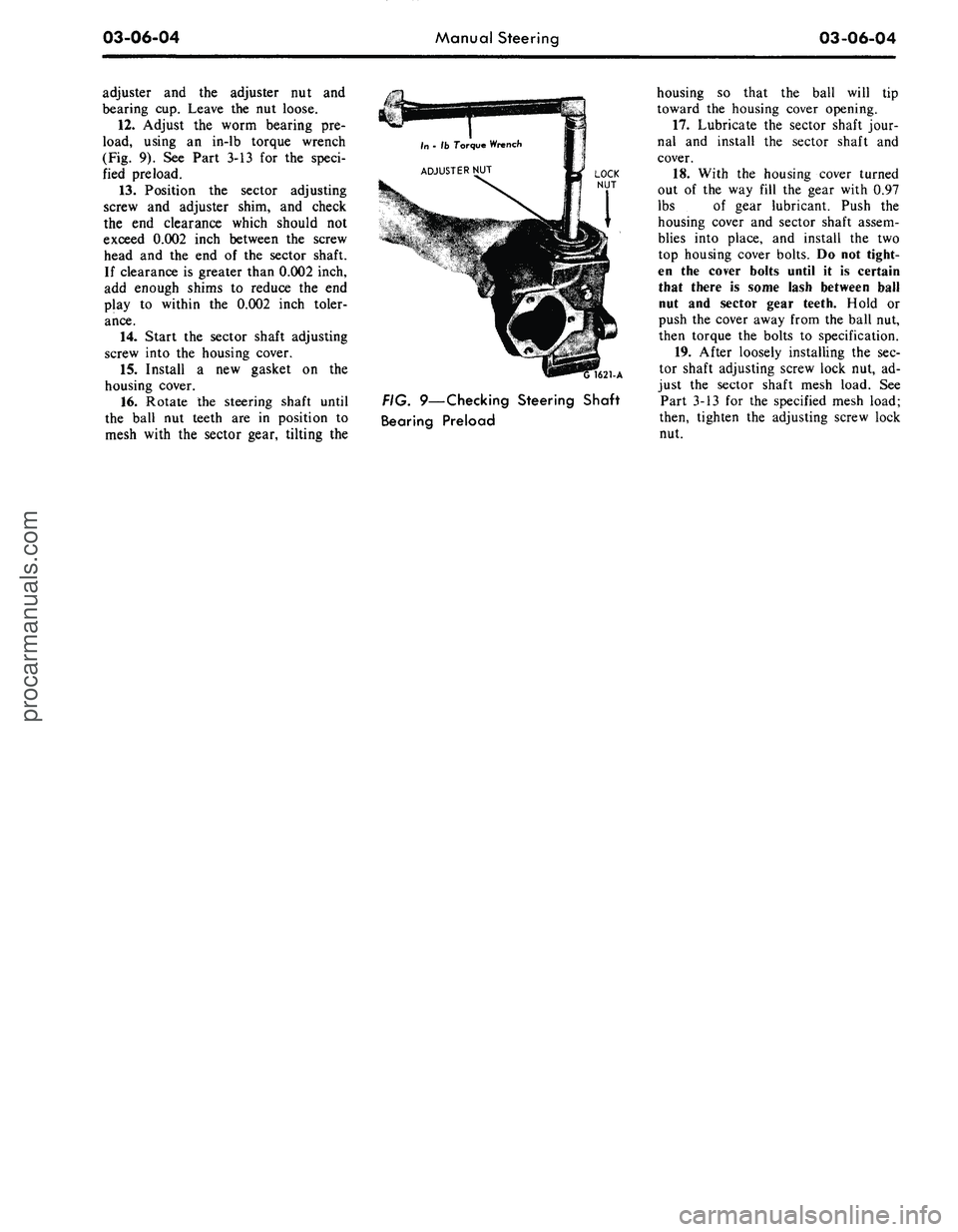
12.
Adjust the worm bearing pre-
load, using an in-lb torque wrench
(Fig. 9). See Part 3-13 for the speci-
fied preload.
13.
Position the sector adjusting
screw and adjuster shim, and check
the end clearance which should not
exceed 0.002 inch between the screw
head and the end of the sector shaft.
If clearance is greater than 0.002 inch,
add enough shims to reduce the end
play to within the 0.002 inch toler-
ance.
14.
Start the sector shaft adjusting
screw into the housing cover.
15.
Install a new gasket on the
housing cover.
16.
Rotate the steering shaft until
the ball nut teeth are in position to
mesh with the sector gear, tilting the
In - /b Torque Wrench
ADJUSTER NUT
21-A
FIG. 9—Checking Steering Shaft
Bearing Preload
housing so that the ball will tip
toward the housing cover opening.
17.
Lubricate the sector shaft jour-
nal and install the sector shaft and
cover.
18.
With the housing cover turned
out of the way fill the gear with 0.97
lbs of gear lubricant. Push the
housing cover and sector shaft assem-
blies into place, and install the two
top housing cover bolts. Do not tight-
en the cover bolts until it is certain
that there is some lash between ball
nut and sector gear teeth. Hold or
push the cover away from the ball nut,
then torque the bolts to specification.
19.
After loosely installing the sec-
tor shaft adjusting screw lock nut, ad-
just the sector shaft mesh load. See
Part 3-13 for the specified mesh load;
then, tighten the adjusting screw lock
nut.procarmanuals.com
Page 143 of 413

03-07-05
Ford Design Non-Integral Power Steering System
03-07-05
•
SPRING
SEAT
REACTION
SPRING
\
REACTION
\
VALVE
VALVE
HOUSING
SPRING PLUG
AND O-RING SPACER
WASHERX
CUSHION
STOP
PIN
TRAVEL
REGULATOR
CLAMP
FIG. 6—Control Valve Disassembled—Typical
4.
Place
the
socket
in the
control
valve sleeve
so
that
the
threaded
end
of
the
ball stud
can be
pulled
out
through
the
slot
in the
sleeve (Fig.
9).
5.
Place
the
other ball stud seat,
and spring,
and the
bumper (Fig.
6) in
the socket,
and
install
and
securely
tighten
the
travel regulator stop.
6. Loosen
the
stop just enough
to
align
the
nearest hole
in the
stop with
the slot
in the
ball stud socket,
and in-
stall
the
stop
pin in the
ball stud sock-
VAIVE
SPOOL
BOLT
BALL
STUD
SOCKET
TRAVEL
REGULATOR
STOP
G
1656-A
FIG. 7—Removing Stop
Pin
et, travel regulator stop,
and
valve
spool bolt
(Fig. 7).
7.
Install
the
rubber boot, clamp,
and
the
plug
on the
control valve
sleeve. Make sure that
the
lubrication
fitting
is
turned
on
tightly
and
does
not bind
on the
ball stud socket.
8. Insert
the
valve spool
in the
valve
housing. Rotate
the
spool while insert-
ing
it in the
housing
(Fig. 10).
9. Move
the
spool toward
the cen-
tering spring
end of the
housing,
and
place
the
small seal bushing,
and spa-
cer
in the
sleeve
end of the
housing.
10.
Press
the
valve spool against
the inner
lip of the
seal
and, at the
same time, guide
the lip of the
seal
over
the
spool with
a
small screwdriv-
G
1657-A
FIG. 8—Removing Reaction Valve
Plug
er.
Do not
nick
or
scratch
the
seal
or
the spool during installation.
11.
Place
the
sleeve
end of the
housing
on a
flat surface
so
that
the
seal, bushing,
and
spacer
are at the
bottom
end and
push down
the
valve
spool until
it
stops.
12.
Carefully install
the
spool seal
and bushing
in the
centering spring
end
of the
housing. Press
the
seal
against
the end of the
spool., guiding
the seal over
the
spool with
a
small
screwdriver.
Do not
nick
or
scratch
the seal
or the
spool during installa-
tion.
CONTROL
VALVE
SLEEVE
BALL
STUD
SEAT-
BALL
STUD'
BALL
STUD
SOCKET'
G
16
58-A
FIG. 9—Installing Ball Socket,
Seal
and
Bracketprocarmanuals.com
Page 151 of 413
03-08-07
Ford Design Integral Power Steering Gear
03-08-07
Press Ram
Tool-
T65P.3524-A1
G1362-A
FIG.
17—Installing
Oil Seal in
Valve Housing
11.
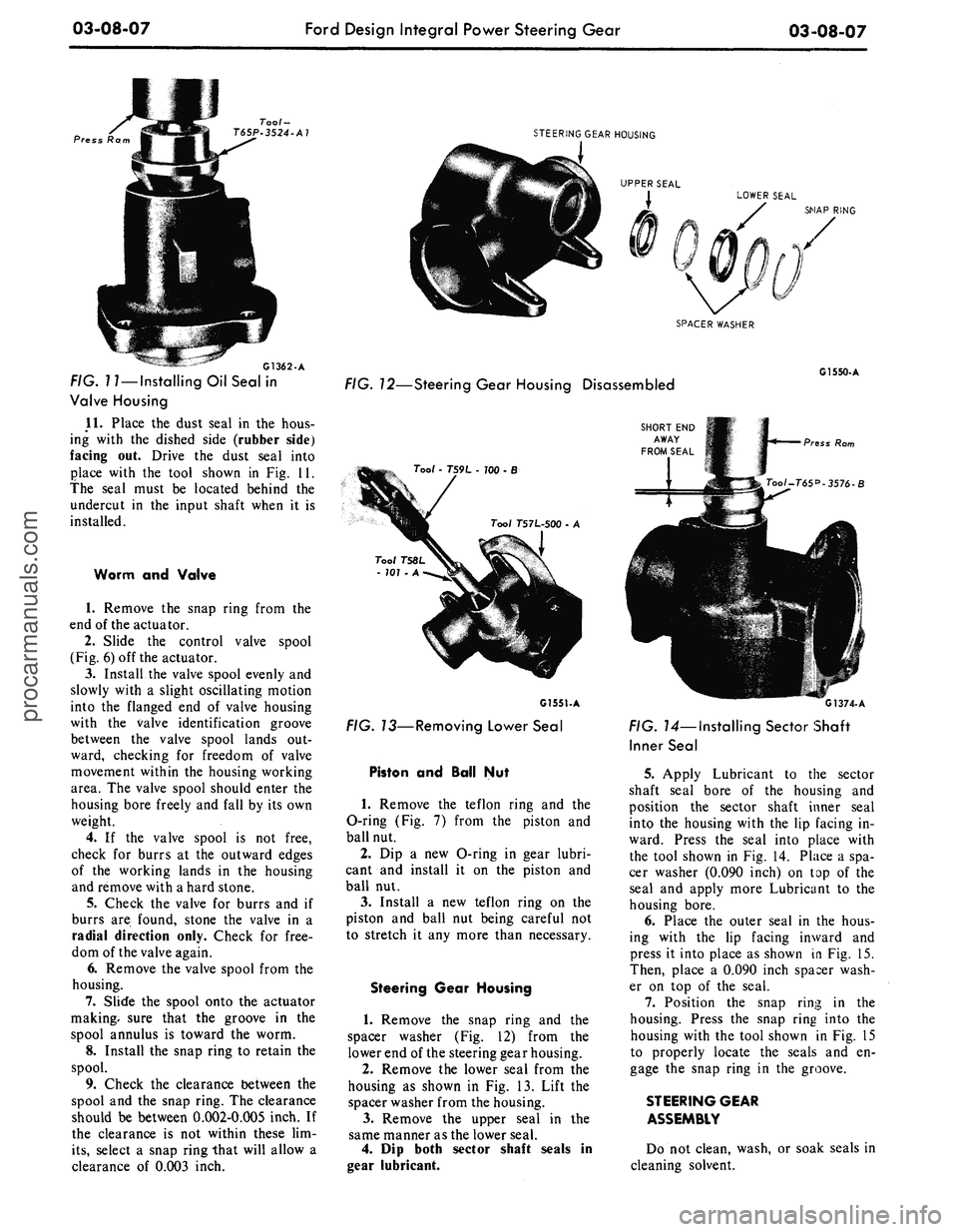
Place the dust seal in the hous-
ing with the dished side (rubber side)
facing out. Drive the dust seal into
place with the tool shown in Fig. 11.
the seal must be located behind the
undercut in the input shaft when it is
installed.
Worm and Valve
1.
Remove the snap ring from the
end of the actuator.
2.
Slide the control valve spool
(Fig. 6) off the actuator.
3.
Install the valve spool evenly and
slowly with a slight oscillating motion
into the flanged end of valve housing
with the Valve identification groove
between the valve spool lands out-
ward, checking for freedom of valve
movement within the housing working
area. The valve spool should enter the
housing bore freely and fall by its own
weight.
4.
If the valve spool is not free,
check for burrs at the outward edges
of the working lands in the housing
and remove with a hard stone.
5.
Check the valve for burrs and if
burrs are found, stone the valve in a
radial direction only. Check for free-
dom of the valve again.
6. Remove the valve spool from the
housing.
7.
Slide the spool onto the actuator
making, sure that the groove in the
spool annulus is toward the worm.
8. Install the snap ring to retain the
spool.
9. Check the clearance between the
spool and the snap ring. The clearance
should be between 0.002-0.005 inch. If
the clearance is not within these lim-
its,
select a snap ring that will allow a
clearance of 0.003 inch.
STEERING GEAR HOUSING
J
UPPER SEAL
I LOWER SEAL
SNAP RING
SPACER WASHER
FIG. 12—Steering Gear Housing Disassembled
Tool - T59L - 100-B
Tool T57L-500 - A
G1551-A
FIG. 13—Removing Lower Seal
Piston and Ball Nut
1.
Remove the teflon ring and the
O-ring (Fig. 7) from the piston and
ball nut.
2.
Dip a new O-ring in gear lubri-
cant and install it on the piston and
ball nut.
3.
Install a new teflon ring on the
piston and ball nut being careful not
to stretch it any more than necessary.
Steering Gear Housing
1.
Remove the snap ring and the
spacer washer (Fig. 12) from the
lower end of the steering gear housing.
2.
Remove the lower seal from the
housing as shown in Fig. 13. Lift the
spacer washer from the housing.
3.
Remove the upper seal in the
same manner as the lower seal.
4.
Dip both sector shaft seals in
gear lubricant.
SHORT END
AWAY
FROM SEAL
G1550-A
Press Rom
G1374-A
FIG. 14—Installing Sector Shaft
Inner Seal
5. Apply Lubricant to the sector
shaft seal bore of the housing and
position the sector shaft inner seal
into the housing with the lip facing in-
ward. Press the seal into place with
the tool shown in Fig. 14. Place a spa-
cer washer (0.090 inch) on top of the
seal and apply more Lubricant to the
housing bore.
6. Place the outer seal in the hous-
ing with the lip facing inward and
press it into place as shown in Fig. 15.
Then, place a 0.090 inch spacer wash-
er on top of the seal.
7.
Position the snap ring in the
housing. Press the snap ring into the
housing with the tool shown in Fig. 15
to properly locate the seals and en-
gage the snap ring in the groove.
STEERING GEAR
ASSEMBLY
Do not clean, wash, or soak seals in
cleaning solvent.procarmanuals.com
Page 157 of 413
03-09-05
Saginaw Design Integral Power Steering Gear
03-09-05
Tool . T59L -100S
FIG. 8—Removing Sector
Shaft Seals
Too/
-
T65P -3576-C
G 1641-A
FIG. 9—Removing Sector
Shaft Bearings
4.
Working from
the
upper
end of
the housing, press
in a new
bearing
until
the
upper
end
is
0.030 inch below
the housing bore. When installing
the
bearing, make sure
it is
pressed
in
from
the
identification
end
(stamped
end).
5.
Lubricate
new
sector shaft seals
(Fig.
7) in
C1AZ-19582-A hydraulic
fluid. Install
the
single
lip
seal first,
then
a
back-up washer. Using special
tool
(Fig. 10),
drive
the
seal
and
wash-
er
in far
enough
to
provide clearance
for
the
other seal
and
back-up washer
and
the
retaining ring.
The
seal must
not bottom
on the end of
the
counter-
bore.
Install
the
double
lip
seal
and
the second back-up washer. Again using
the special tool, drive
the
seal
and
back-up washer
in
only
far
enough
to
provide clearance
for the
retaining
ring. Install
the
sector shaft seal
re-
taining ring with snap ring pliers,
making certian that
the
ring
is
seated
properly.
6.
To
remove
a
damaged port seat,
use
a
5/16-18 inch
U.S.
thread
(coarse)
tap and
turn
it
two
turns into
the seat.
7.
Thread
a
bolt
and nut
with
a
flat
washer into
the
tapped hole
(Fig.
11).
8. Hold
the
bolt from turning
and
tighten
the nut to
extract
the
seat.
Discard
the
seat.
9. Remove
the
check valve
and
spring from
the
inlet port.
10.
Blow
all
chips from
the
hous-
ing.
11.
Position
the
spring, check valve
and
new
seat
in the
inlet port.
12.
Use the
tool shown
in Fig. 12
and drive
the
seat into place.
.
T65P-3D642-A
G1287-
A
FIG.
10
— Installing Sector
Shaft Seal
5/16
•
16x2"
BOLT
13.
Install
the
outlet port seat
in
the same manner.
ADJUSTER PLUG
1.
Lift
the
adjuster plug
off
the
stub
shaft
(Fig.
4).
2.
Pry the
thrust bearing retainer
off
the
adjuster plug
as
shown
in Fig.
13.
Be
careful
not to
score
the
needle
bearing bore. Discard
the
retainer.
3.
Lift
the
spacer, thrust bearing,
races
and the
O-ring, from
the
plug
(Fig.
14).
Discard
the
O-ring.
4.
If
necessary
to
replace
the
roller
bearing, remove
the
dust seal retaining
ring. Working from
the
spacer
end of
the adjuster plug, remove
the
roller
bearing,
oil
seal
and the
dust seal
as
shown
in Fig. 15.
G1639-A
FIG.
12
-Installing Inlet Port
BEARING RETAINER
G1640-A
FIG. 11 —Removing Port Seat
C1638-A
FIG. 73—Removing Thrust
Bearing Retainer
If
the
roller bearing does
not
need
replacing
do not
remove
it. Pry the
dust seal
and the oil
seal from
the ad-
juster plug with
a
screwdriver.
5.
Place
a new
roller bearing
on the
tool shown
in Fig.
15
with
the
bearing
manufacturer's identification facing
toward
the
tool.
6. Position
the
bearing
and
tool
in
the bore. Drive
the
bearing into
the
plug until
it is
flush with
the
bottom
surface
of the
stub shaft seal bore.
7.
Lubricate
a new oil
seal with
C1AZ-19582-A. Install
the
seal with
Tool T65P-3D536-A pressing
it
intoprocarmanuals.com
Page 159 of 413
03-09-07
Saginaw Design Integral Power Steering Gear
03-09-07
VALVE SPOOL
DAMP EN
ERO-RING
TORSION BAR
G 1633-A
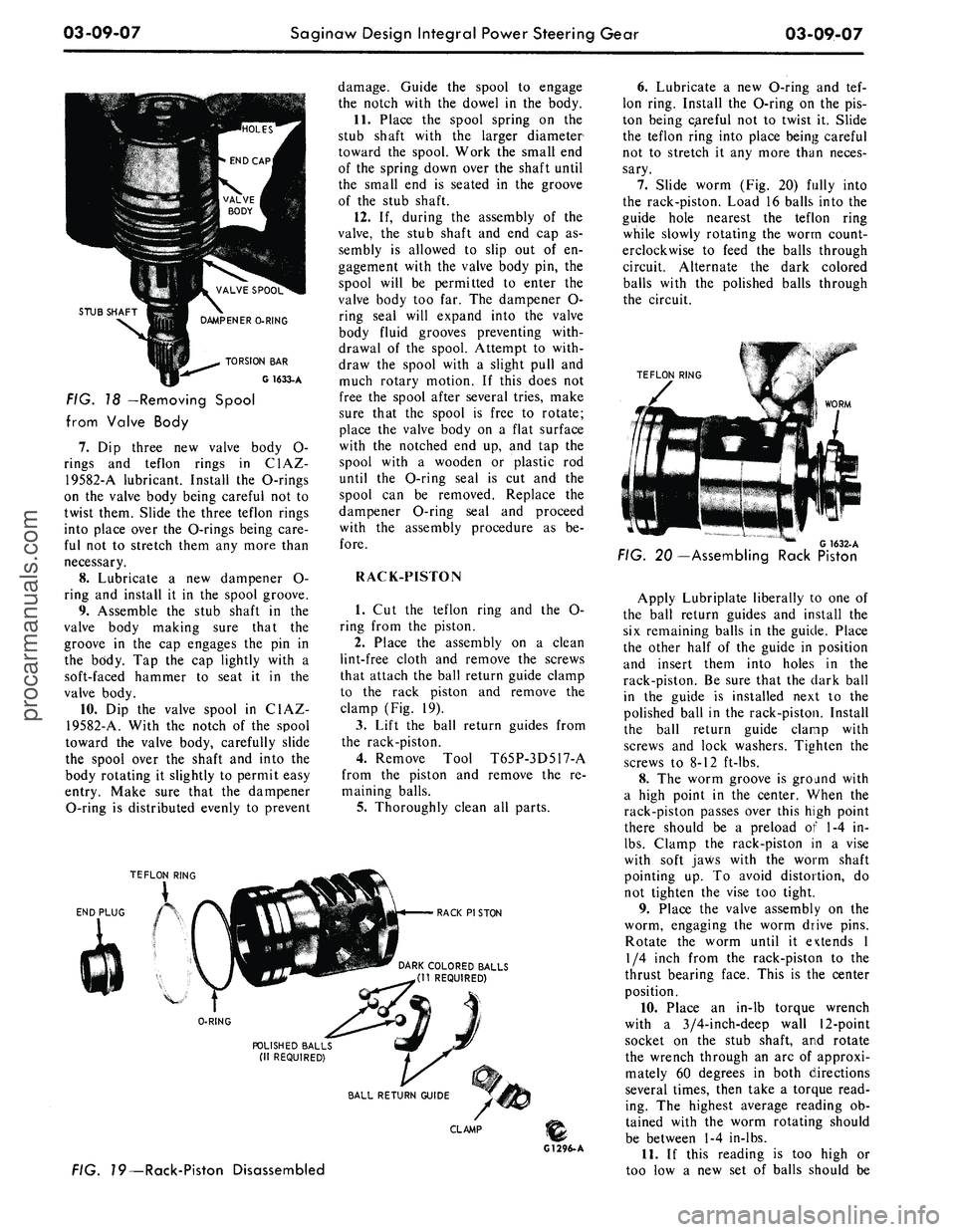
FIG. 18 —Removing Spool
from Valve Body
7.
Dip three new valve body O-
rings and teflon rings in C1AZ-
19582-A lubricant. Install the O-rings
on the valve body being careful not to
twist them. Slide the three teflon rings
into place over the O-rings being care-
ful not to stretch them any more than
necessary.
8. Lubricate a new dampener O-
ring and install it in the spool groove.
9. Assemble the stub shaft in the
valve body making sure that the
groove in the cap engages the pin in
the body. Tap the cap lightly with a
soft-faced hammer to seat it in the
valve body.
10.
Dip the valve spool in C1AZ-
19582-A. With the notch of the spool
toward the valve body, carefully slide
the spooi over the shaft and into the
body rotating it slightly to permit easy
entry. Make sure that the dampener
O-ring is distributed evenly to prevent
TEFLON RING
damage. Guide the spool to engage
the notch with the dowel in the body.
11.
Place the spool spring on the
stub shaft with the larger diameter
toward the spool. Work the small end
of the spring down over the shaft until
the small end is seated in the groove
of the stub shaft.
12.
If, during the assembly of the
valve, the stub shaft and end cap as-
sembly is allowed to slip out of en-
gagement with the valve body pin, the
spool will be permitted to enter the
valve body too far. The dampener O-
ring seal will expand into the valve
body fluid grooves preventing with-
drawal of the spool. Attempt to with-
draw the spool with a slight pull and
much rotary motion. If this does not
free the spool after several tries, make
sure that the spool is free to rotate;
place the valve body on a flat surface
with the notched end up, and tap the
spool with a wooden or plastic rod
until the O-ring seal is cut and the
spool can be removed. Replace the
dampener O-ring seal and proceed
with the assembly procedure as be-
fore.
RACK-PISTON
1.
Cut the teflon ring and the O-
ring from the piston.
2.
Place the assembly on a clean
lint-free cloth and remove the screws
that attach the ball return guide clamp
to the rack piston and remove the
clamp (Fig. 19).
3.
Lift the ball return guides from
the rack-piston.
4.
Remove Tool T65P-3D517-A
from the piston and remove the re-
maining balls.
5.
Thoroughly clean all parts.
END PLUG
RACK PI STON
DARK COLORED BALLS
(11 REQUIRED)
V
0-RING
POLISHED BALLS
(II REQUIRED)
BALL RETURN GUIDE
CLAMP
B
G1296. A
6. Lubricate a new O-ring and tef-
lon ring. Install the O-ring on the pis-
ton being qareful not to twist it. Slide
the teflon ring into place being careful
not to stretch it any more than neces-
sary.
7.
Slide worm (Fig. 20) fully into
the rack-piston. Load 16 balls into the
guide hole nearest the teflon ring
while slowly rotating the worm count-
erclockwise to feed the balls through
circuit. Alternate the dark colored
balls with the polished balls through
the circuit.
TEFLON RING
FIG. 19—Rack-Piston Disassembled
G 1632-A
FIG. 20—Assembling Rack Piston
Apply Lubriplate liberally to one of
the ball return guides and install the
six remaining balls in the guide. Place
the other half of the guide in position
and insert them into holes in the
rack-piston. Be sure that the dark ball
in the guide is installed next to the
polished ball in the rack-piston. Install
the ball return guide clamp with
screws and lock washers. Tighten the
screws to 8-12 ft-lbs.
8. The worm groove is ground with
a high point in the center. V/hen the
rack-piston passes over this high point
there should be a preload of 1-4 in-
lbs.
Clamp the rack-piston in a vise
with soft jaws with the worm shaft
pointing up. To avoid distortion, do
not tighten the vise too tight.
9. Place the valve assembly on the
worm, engaging the worm drive pins.
Rotate the worm until it extends 1
1/4 inch from the rack-piston to the
thrust bearing face. This is the center
position.
10.
Place an in-lb torque wrench
with a 3/4-inch-deep wall 12-point
socket on the stub shaft, and rotate
the wrench through an arc of approxi-
mately 60 degrees in both directions
several times, then take a torque read-
ing. The highest average reading ob-
tained with the worm rotating should
be between 1-4 in-lbs.
11.
If this reading is too high or
too low a new set of balls should beprocarmanuals.com