check engine light FORD MUSTANG 1969 Volume One Chassis
[x] Cancel search | Manufacturer: FORD, Model Year: 1969, Model line: MUSTANG, Model: FORD MUSTANG 1969Pages: 413, PDF Size: 75.81 MB
Page 349 of 413
07-03-09
FMX Transmission
07-03-09
4.
Remove the pointer back-up
shield attaching screws and the shield.
5.
Disconnect the dial indicator
light.
6. Disconnect the neutral start
switch and dial indicator light wires
from their connectors at the dash
panel.
7.
Remove the selector housing and
lever assembly attaching bolts. Re-
move the selector lever and housing.
8. Remove the selector lever to
housing attaching nut. Remove the
lever from the housing.
9. Install the selector lever in the
housing and install the attaching nut.
Torque the nut to 20 to 25 ft-lbs.
10.
Install the selector lever handle.
11.
Position the selector lever as
shown in Figure 10. With a feeler
gauge check the clearance between the
detent pawl and plate. The clearince
should be 0.005 to 0.010 inch. If nec-
essary, adjust the height of the detent
pawl as shown in Figure 10.
12.
Remo"~ the handle from tte se-
lector lever.
13.
Install the selector housing and
lever assembly as shown in Figure 4.
Torque the attaching bolts 4-6 ft-lbs.
14.
Connect the dial indicator light.
15.
Connect the neutral start switch
and dial indicator light wires to their
respective connectors at the dash
panel.
16.
Install the pointer back-up
shield and tighten the attaching
screws.
17.
Install the selector lever handle
and tighten the attaching screw.
18.
Position the selector lever in the
D position.
19.
Raise the vehicle. Install the
transmission manual lever rod to the
selector lever. Adjust the manual link-
age.
20.
Lower the vehicle and check the
transmission operation in each selec-
tor lever detent position.
BAND ADJUSTMENTS
FRONT BAND
ADJUSTMENT
1.
Drain the fluid from the trans-
mission by loosening the pan attach-
ing bolts starting at the rear of the
pan and working toward the front.
When most of the fluid has drained
from the pan, remove the remainder
of the attaching bolts. Use a clean
drain can equipped with a 100-mesh
screen if the fluid is to be reused.
Too/—
7225-C-13B
/A
-inch
Spacer
FRONT SERVO
ACTUATING LEVER
D 2048-A
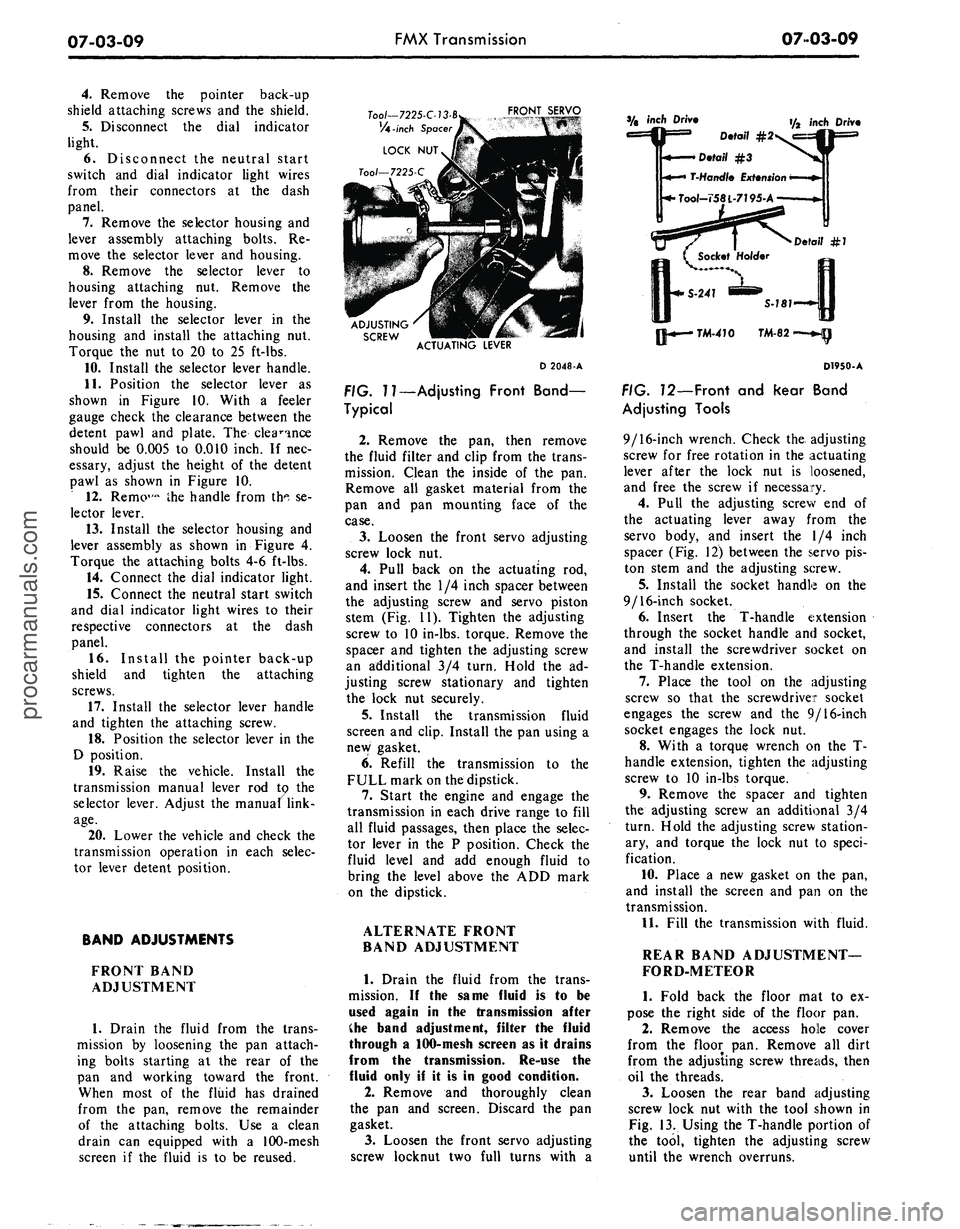
FIG.
7
7—Adjusting Front Band—
Typical
2.
Remove the pan, then remove
the fluid filter and clip from the trans-
mission. Clean the inside of the pan.
Remove all gasket material from the
pan and pan mounting face of the
case.
3.
Loosen the front servo adjusting
screw lock nut.
4.
Pull back on the actuating rod,
and insert the 1/4 inch spacer between
the adjusting screw and servo piston
stem (Fig. 11). Tighten the adjusting
screw to 10 in-lbs. torque. Remove the
spacer and tighten the adjusting screw
an additional 3/4 turn. Hold the ad-
justing screw stationary and tighten
the lock nut securely.
5.
Install the transmission fluid
screen and clip. Install the pan using a
new gasket.
6. Refill the transmission to the
FULL mark on the dipstick.
7.
Start the engine and engage the
transmission in each drive range to fill
all fluid passages, then place the selec-
tor lever in the P position. Check the
fluid level and add enough fluid to
bring the level above the ADD mark
on the dipstick.
ALTERNATE FRONT
BAND ADJUSTMENT
1.
Drain the fluid from the trans-
mission. If the same fluid is to be
used again in the transmission after
Che band adjustment, filter the fluid
through a 100-mesh screen as it drains
from the transmission. Re-use the
fluid only if it is in good condition.
2.
Remove and thoroughly clean
the pan and screen. Discard the pan
gasket.
3.
Loosen the front servo adjusting
screw locknut two full turns with a
inch Driv
Detail #2
D.tai\
#3
T-Hond/e
Extension
Tool-758L-7195-A
f/2 inch Driv
Detail
#7
Qj-«—
TM-470 TM-82
D1950-A
FIG. 12—Front and Rear Band
Adjusting Tools
9/16-inch wrench. Check the. adjusting
screw for free rotation in the actuating
lever after the lock nut is loosened,
and free the screw if necessary.
4.
Pull the adjusting screw end of
the actuating lever away from the
servo body, and insert the 1/4 inch
spacer (Fig. 12) between the servo pis-
ton stem and the adjusting screw.
5.
Install the socket handle on the
9/16-inch socket.
6. Insert the T-handle extension
through the socket handle and socket,
and install the screwdriver socket on
the T-handle extension.
7.
Place the tool on the adjusting
screw so that the screwdriver socket
engages the screw and the 9/16-inch
socket engages the lock nut.
8. With a torque wrench on the T-
handle extension, tighten the adjusting
screw to 10 in-lbs torque.
9. Remove the spacer and tighten
the adjusting screw an additional 3/4
turn. Hold the adjusting screw station-
ary, and torque the lock nut to speci-
fication.
10.
Place a new gasket on the pan,
and install the screen and pan on the
transmission.
11.
Fill the transmission with fluid.
REAR BAND ADJUSTMENT—
FORD-METEOR
1.
Fold back the floor mat to ex-
pose the right side of the floor pan.
2.
Remove the access hole cover
from the floor pan. Remove all dirt
from the adjusting screw threads, then
oil the threads.
3.
Loosen the rear band adjusting
screw lock nut with the tool shown in
Fig. 13. Using the T-handle portion of
the tool, tighten the adjusting screw
until the wrench overruns.procarmanuals.com
Page 354 of 413
07-03-14
FMX Transmission
07-03-14
REMOVAL AND INSTALLATION
An oil impregnated plastic grommet
is incorporated in the end of the man-
ual shift linkage lever arm on all col-
umn shift vehicles. A special tool
T67P-7341-A is required to install the
grommet in the manual lever, and to
install the manual linkage rod into the
grommet. Refer to Part 7-1, Section
2,
for the grommet replacement pro-
cedures.
TRANSMISSION AND
CONVERTER REPLACEMENT—
FORD-METEOR
REMOVAL
1.
Drive the vehicle on a hoist, but
do not raise at this time.
2.
Remove the two upper bolts and
lock washers which attach the con-
verter housing to the engine.
3.
Raise the vehicle and remove the
cover from the lower front side of the
converter housing. Drain the fluid
from the transmission.
4.
Remove one of the converter
drain plugs. Then rotate the converter
180 degrees and remove the other
plug. Do not attempt to turn the con-
verter with a wrench on the converter
stud nuts. If desired, the converter
may be drained after the unit has been
removed from the vehicle.
5.
Disconnect the fluid filler tube
from the transmission case. Discon-
nect the vacuum hose from the vacu-
um diaphragm unit and the tube from
the extension housing clip.
6. When the fluid has stopped
draining from the transmission and
converter, remove the flywheel to con-
verter nuts and flat washers. Install
the drain plugs in the converter and
torque to specifications. Install the
converter housing front plate to hold
the converter in place when the trans-
mission is removed.
7.
Disconnect the starter cables
from the starter and remove the start-
er.
8. Disconnect the oil cooler lines
from the transmission. Remove the
transmission vent tube.
9. Disconnect the downshift linkage
from the transmission.
10.
Disconnect the selector rod from
the transmission manual lever with
T67P-7341-A.
11.
Disconnect the speedometer
cable from the extension housing, and
remove the driveshaft.
12.
Support the transmission on a
stand. Remove the engine rear support
to transmission bolts, and raise the
transmission slightly to take the
weight off the cross member. Remove
the cross member. Support the rear
part of the engine.
13.
Remove the remaining convert-
er housing to engine attaching bolts.
Move the assembly to the rear and
down to remove it.
INSTALLATION
1.
If the converter has been re-
moved from the converter housing,
carefully position the converter in the
housing, and then install the housing
lower front cover plate to prevent the
converter from slipping out of the
housing.
2.
Install the transmission vent
tube.
Rotate the converter until the
studs adjacent to the drain plugs are
in a vertical position.
3.
Rotate the flywheel as required
to align the drain plug holes with the
drain plugs in the converter. With the
transmission mounted on a support
stand, move the converter and trans-
mission assembly forward into posi-
tion, using care not to damage the fly-
wheel and the converter pilot.
4.
Install the converter lower
housing-to-engine bolts, then torque
the bolts to specification.
5.
Install the cross member.
6. Lower the transmission until the
extension housing rests on the cross
member, and then install the extension
housing-to-cross member bolts.
7.
The converter must rest squarely
against the flywheel. This indicates
that the converter pilot is not binding
in the engine crankshaft.
8. Install the converter attaching
nuts and flat washers. Install the ac-
cess plates.
9. Connect the oil cooler inlet and
outlet lines to the transmission case.
10.
Coat the front universal joint
yoke seal and spline with B8A-
19589-A lubricant, and install the
drive shaft.
11.
Connect the speedometer cable
at the transmission.
12.
Using tool T67P-7341-A install
a new grommet in the manual lever.
Then secure the manual selector rod
to the lever.
13.
Connect the downshift linkage
and bushing at the transmission
throttle lever.
14.
Install the starter motor.
15.
Connect the fluid filter tube to
the transmission case. Connect the
vacuum hose to the vacuum dia-
phragm unit and the tube to its clip.
16.
Lower the transmission support
stand. Then install the upper two con-
verter housing-to-engine bolts and
tighten them to specification.
17.
Lower the vehicle and fill the
transmission with transmission fluid,
following the recommended procedure.
18.
Check the transmission, con-
verter assembly, and fluid cooler lines
for fluid leaks, and then adjust the
manual and downshift linkages.
TRANSMISSION REPLACEMENT
WITHOUT CONVERTER—
FORD-METEOR
The frame construction of the con-
vertible will not permit the transmis-
sion to be moved rearward enough to
clear the turbine shaft from the con-
verter. For this reason, the converter
and transmission must be removed as
a unit from this model.
REMOVAL
1.
Raise the vehicle on a hoist.
2.
Drain the fluid from the trans-
mission.
3.
Disconnect the hose from the
vacuum diaphragm unit and the tube
from its clip. Disconnect the fluid fill-
er tube from the case.
4.
Remove the cover from the lower
front side of the converter housing.
5.
Remove one of the converter
drain plugs. Then rotate the converter
180 degrees and remove the other
plug. Do not attempt to turn the con-
verter with a wrench on the converter
stud nuts.
6. Disconnect the drive shaft from
the rear axle, and remove the drive
shaft.
7.
Disconnect the fluid cooler lines
from the transmission. Remove the
vent tube.
8. Disconnect the downshift linkage
at the transmission.
9. Disconnect the selector rod from
the transmission manual lever with
tool T67P-7341-A.
10.
Disconnect the speedometer
cable at the extension housing.
11.
Remove the two engine rear
support to transmission bolts.
12.
Position a transmission jack
under the transmission and raise it
slightly to take the weight off the
cross member.procarmanuals.com
Page 378 of 413
07-04-09
C-6 Automatic Transmission
07-04-09
MUSTANG AND COUGAR
1.
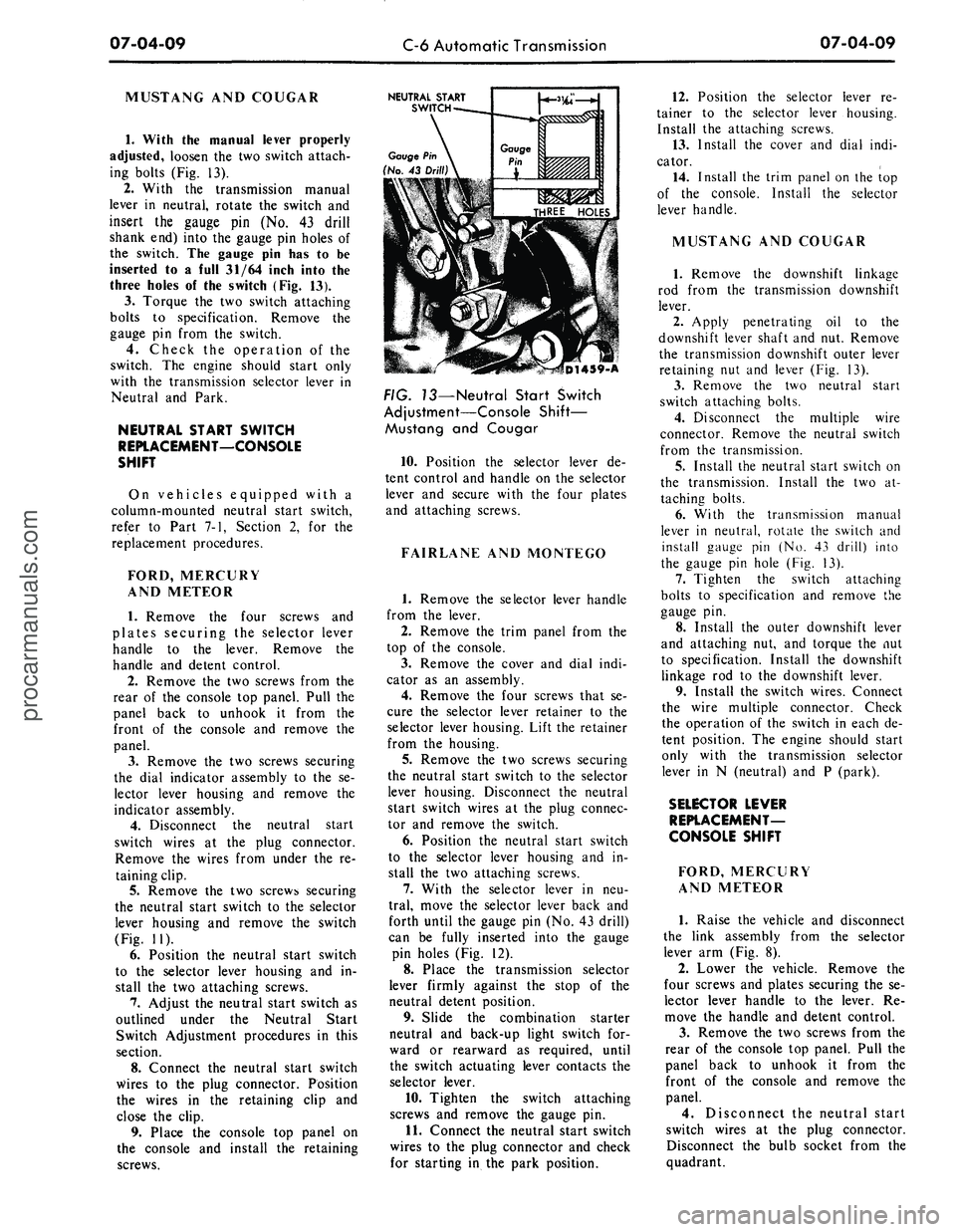
With the manual lever properly
adjusted, loosen the two switch attach-
ing bolts (Fig. 13).
2.
With the transmission manual
lever in neutral, rotate the switch and
insert the gauge pin (No. 43 drill
shank end) into the gauge pin holes of
the switch. The gauge pin has to be
inserted to a full 31/64 inch into the
three holes of the switch (Fig. 13).
3.
Torque the two switch attaching
bolts to specification. Remove the
gauge pin from the switch.
4.
Check the operation of the
switch. The engine should start only
with the transmission selector lever in
Neutral and Park.
NEUTRAL START SWITCH
REPLACEMENT—CONSOLE
SHIFT
On vehicles equipped with a
column-mounted neutral start switch,
refer to Part 7-1, Section 2, for the
replacement procedures.
FORD, MERCURY
AND METEOR
1.
Remove the four screws and
plates securing the selector lever
handle to the lever. Remove the
handle and detent control.
2.
Remove the two screws from the
rear of the console top panel. Pull the
panel back to unhook it from the
front of the console and remove the
panel.
3.
Remove the two screws securing
the dial indicator assembly to the se-
lector lever housing and remove the
indicator assembly.
4.
Disconnect the neutral start
switch wires at the plug connector.
Remove the wires from under the re-
taining clip.
5.
Remove the two screws securing
the neutral start switch to the selector
lever housing and remove the switch
(Fig. 11).
6. Position the neutral start switch
to the selector lever housing and in-
stall the two attaching screws.
7.
Adjust the neutral start switch as
outlined under the Neutral Start
Switch Adjustment procedures in this
section.
8. Connect the neutral start switch
Wires to the plug connector. Position
the wires in the retaining clip and
close the clip.
9. Place the console top panel on
the console and install the retaining
screws.
NEUTRAL START
SWITCH
D1459-A
FIG. 73—Neutral Start Switch
Adjustment—Console Shift—
Mustang and Cougar
10.
Position the selector lever de-
tent control and handle on the selector
lever and secure with the four plates
and attaching screws.
FAIRLANE AND MONTEGO
1.
Remove the selector lever handle
from the lever.
2.
Remove the trim panel from the
top of the console.
3.
Remove the cover and dial indi-
cator as an assembly.
4.
Remove the four screws that se-
cure the selector lever retainer to the
selector lever housing. Lift the retainer
from the housing.
5.
Remove the two screws securing
the neutral start switch to the selector
lever housing. Disconnect the neutral
start switch wires at the plug connec-
tor and remove the switch.
6. Position the neutral start switch
to the selector lever housing and in-
stall the two attaching screws.
7.
With the selector lever in neu-
tral,
move the selector lever back and
forth until the gauge pin (No. 43 drill)
can be fully inserted into the gauge
pin holes (Fig. 12).
8. Place the transmission selector
lever firmly against the stop of the
neutral detent position.
9. Slide the combination starter
neutral and back-up light switch for-
ward or rearward as required, until
the switch actuating lever contacts the
selector lever.
10.
Tighten the switch attaching
screws and remove the gauge pin.
11.
Connect the neutral start switch
wires to the plug connector and check
for starting in the park position.
12.
Position the selector lever re-
tainer to the selector lever housing.
Install the attaching screws.
13.
Install the cover and dial indi-
cator.
14.
Install the trim panel on the top
of the console. Install the selector
lever handle.
MUSTANG AND COUGAR
1.
Remove the downshift linkage
rod from the transmission downshift
lever.
2.
Apply penetrating oil to the
downshift lever shaft and nut. Remove
the transmission downshift outer lever
retaining nut and lever (Fig. 13).
3.
Remove the two neutral start
switch attaching bolts.
4.
Disconnect the multiple wire
connector. Remove the neutral switch
from the transmission.
5.
Install the neutral start switch on
the transmission. Install the two at-
taching bolts.
6. With the transmission manual
lever in neutral, rotate the switch and
install gauge pin (No. 43 drill) into
the gauge pin hole (Fig. 13).
7.
Tighten the switch attaching
bolts to specification and remove the
gauge pin.
8. Install the outer downshift lever
and attaching nut, and torque the nut
to specification. Install the downshift
linkage rod to the downshift lever.
9. Install the switch wires. Connect
the wire multiple connector. Check
the operation of the switch in each de-
tent position. The engine should start
only with the transmission selector
lever in N (neutral) and P (park).
SELECTOR LEVER
REPLACEMENT-
CONSOLE SHIFT
FORD, MERCURY
AND METEOR
1.
Raise the vehicle and disconnect
the link assembly from the selector
lever arm (Fig. 8).
2.
Lower the vehicle. Remove the
four screws and plates securing the se-
lector lever handle to the lever. Re-
move the handle and detent control.
3.
Remove the two screws from the
rear of the console top panel. Pull the
panel back to unhook it from the
front of the console and remove the
panel.
4.
Disconnect the neutral start
switch wires at the plug connector.
Disconnect the bulb socket from the
quadrant.procarmanuals.com