tire pressure FORD MUSTANG 1969 Volume One Chassis
[x] Cancel search | Manufacturer: FORD, Model Year: 1969, Model line: MUSTANG, Model: FORD MUSTANG 1969Pages: 413, PDF Size: 75.81 MB
Page 14 of 413
02-01-03
Brakes
02-01-03
vacuum system is operating, the pedal
will tend to fall away under foot pres-
sure and less pressure will be required
to hold the pedal in the applied posi-
tion. If no action is felt, the vacuum
booster system is not functioning.
If the brake pedal movement feels
spongy, bleed the hydraulic system to
remove air from the system. Refer to
Hydraulic System Bleeding, Part 1,
Section 2.
VACUUM TESTS—VACUUM
RELEASE PARKING BRAKES
Visually check the operation of the
brake linkage as the brake pedal is
depressed. Then, check the operation
of the brake linkage when the manual
release lever is activiated. These
checks should indicate whether the
manual parking brake control linkage
is operating properly or requires re-
pair or adjustment due to inability of
the parking brake to hold against
moderate vehicle movement. Perform
tests of the parking brake system and
controls after making certain the link-
age and manual controls operate
properly.
When testing a parking brake vacu-
um release system, a minimum of 10
inches of vacuum (Hg.) should be
available at all points where vacuum is
applied. This can be checked with a
Rotunda Fuel Pump Tester Gauge
(ARE345) and two Distributor Tester
hose adapters (Marked Q) connected
together with a coupling. This allows
the Fuel Pump Tester Gauge hose to
be adapted to any other vacuum hose
or rubber connector in the vacuum
systems.
Failure to maintain 10 inches of
vacuum (Hg.) during vacuum system
tests could be caused by a loose hose
connection, resulting in a vacuum
leak. When checking for vacuum be-
tween two points, trace the hose along
the entire routing to be sure it is not
crossed with another hose and con-
nected to the wrong connection.
All of the vacuum parking brake
control checks are to be performed
with the engine running at idle speed.
Leaks in the parking brake hoses or
a disconnected or improperly con-
nected hose can usually be found by
listening for a hissing sound along the
hose routings. Under no circumstances
should air pressure be applied to the
vacuum system as the actuator dia-
phragm in the parking brake vacuum
motor may be damaged.
1.
Start the engine and run it at
idle speed. With the transmission shift
control in neutral, depress the parking
brake pedal to apply the parking
brake. Move the transmission shift
control to D range and observe the
parking brake pedal to see that the
pedal moves upward and the parking
brake releases. If the parking brake
releases, the parking brake vacuum
control is working properly.
2.
If the parking brake does not re-
lease, test for vacuum at the steering
column neutral switch port in the
junction block, vacuum lines and the
parking brake release vacuum motor.
Use the Rotunda Vacuum and Fuel
Pump Tester 345. This can be accom-
plished by removing the hose from
each component and attaching it to
the vacuum gauge. Connect two dis-
tributor tester vacuum hose adapters
together with a coupling as a connec-
tor to attach the gauge. A minimum
of ten inches of vacuum is required to
actuate the parking brake vacuum
motor. Do not remove any of the vac-
uum hoses from the junction block
unless the junction block is being re-
placed, as the plastic nipples are thin
and very brittle and damage may re-
sult. If a minimum reading is not
present when checking each of the
aforementioned components, they
must be replaced.
ROAD TEST
A road test should be conducted
only when the operator is sure the
brakes will stop the vehicle.
If the road test reveals one or more
problem conditions, correct all mal-
functions of the vacuum system, brake
booster and hydraulic system prior to
removing brake drums, brake calipers,
brake shoes and linings or backing
plates.
ANTI-SKID CONTROL
SYSTEM TESTS
No adjustments or repairs are to be
performed on the skid control system.
Damaged or worn parts are to be re-
placed.
Refer to Ford Car and Truck Diag-
nosis Manual for Testing procedures.
COMMON ADJUSTMENTS AND REPAIRS
PARKING BRAKE LINKAGE
ADJUSTMENT
FORD, MERCURY, METEOR,
FAIRLANE, MONTEGO,
FALCON, MUSTANG
AND COUGAR
Check the parking brake cables
when the brakes are fully released. If1
the cables are loose, adjust them as
follows:
1.
Fully release the parking brake
pedal by pulling the release lever.
2.
Depress the parking brake pedal
until it is engaged in the first notch of
the control. On a vacuum release
brake, the first notch will be approxi-
mately two inches of pedal travel.
3.
Raise the vehicle. With the
transmission in neutral, turn the ad-
justing nut forward against the equal-
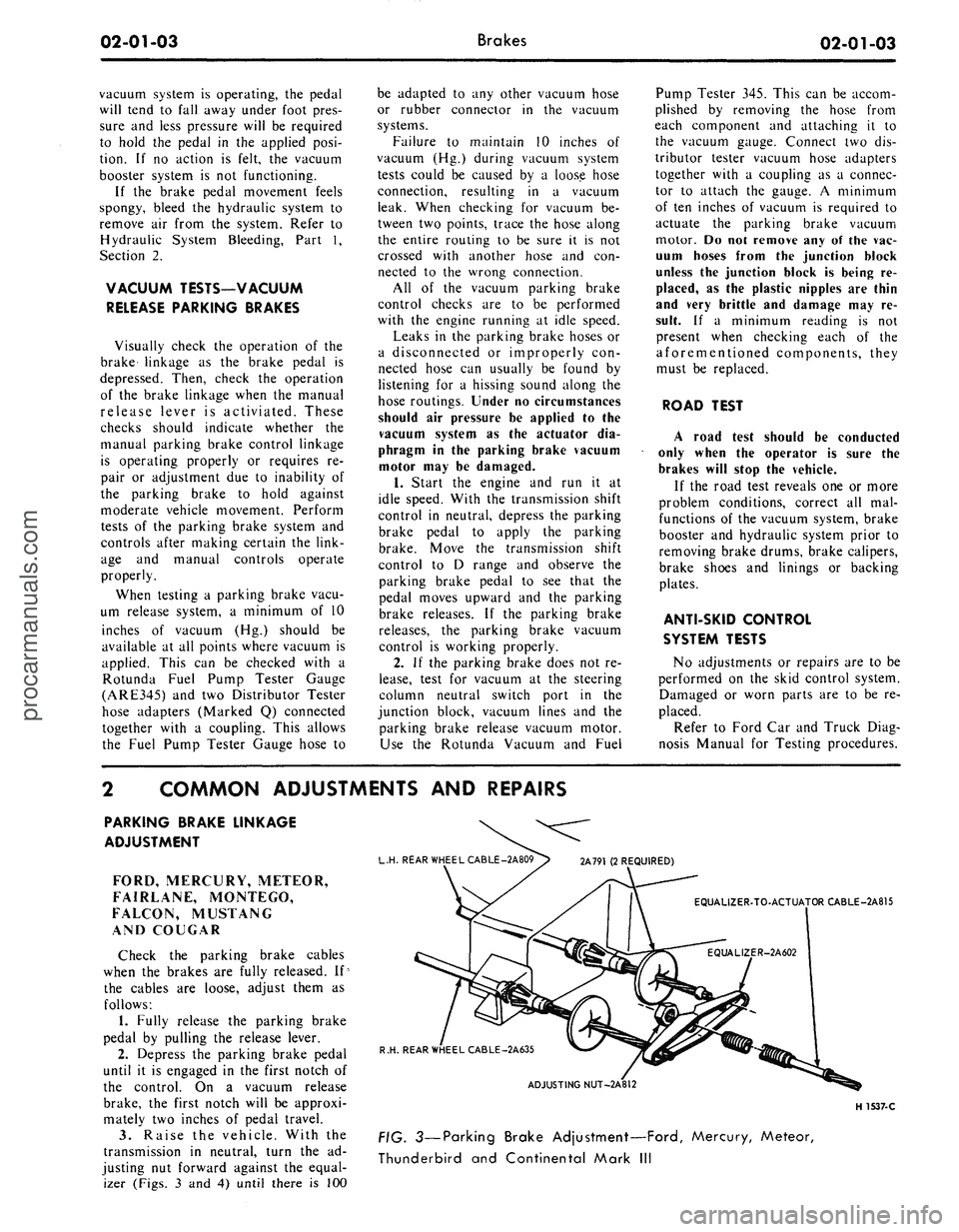
izer (Figs. 3 and 4) until there is 100
L.H. REAR WHEEL CABLE -2A809> 2A791 (2 REQUIRED)
EQUALIZER-TO-ACTUATOR CABLE-2A815
R.H. REAR WHEEL CABLE-2A635
ADJUSTING NUT-2A812
H 1537-C
FIG. 3—Parking Brake Adjustment—Ford, Mercury, Meteor,
Thunderbird and Continental Mark IIIprocarmanuals.com
Page 17 of 413
02-01-06
Brakes
02-01-06
side.
Refill the master cylinder reser-
voir after each wheel cylinder is bled
and install the master cylinder cover
and gasket. Be sure the diaphragm
type gasket is properly positioned in
the master cylinder cover. When the
bleeding operation is completed, the
fluid level should be filled to within
1/4 inch of the top of the reservoirs.
7. If the primary (front brake) sys-
tem is to be bled. Repeat steps 2
through 6 at the right front brake cal-
iper or cylinder and ending at the left
front brake caliper or cylinder.
8. On disc brake equipped models
be sure that the front brake pistons
are returned to their normal positions
and that the shoe and lining assem-
blies are properly seated by depressing
the brake pedal several times until
normal pedal travel is established.
9. Centralize the pressure differen-
tial valve. Refer to the Centralizing
the Pressure Differential Valve proce-
dures which follow.
PRESSURE BLEEDING
The Lincoln Continental hydraulic
brake system is to be bled only with
pressure bleeding equipment.
Bleed the longest lines first. The
bleeder tank should contain enough
new Ford Brake Fluid to complete the
bleeding operation. Use Ford Brake
Fluid — Extra Heavy Duty — Part
Number C6AZ-19542-A (ESA-
M6C25-A) or equivalent for all brake
applications. The brake fluid is col-
ored blue for identification purposes.
Do not mix low temperature brake
fluid with the specified brake fluid
during the bleeding operations. Never
re-use brake fluid that has been
drained from the hydraulic system.
The tank should be charged with ap-
proximately 10 to 30 pounds of air
pressure. Never exceed 50 pounds
pressure.
1.
Clean all dirt from the master
cylinder reservoir cover.
2.
Remove the master cylinder res-
ervoir cover and rubber gasket, and
fill the master cylinder reservoir with
the specified brake fluid. Install the
pressure bleeder adapter tool to the
master cylinder, and attach the bleed-
er tank hose to the fittng on the
adapter.
Master cylinder pressure bleeder
adapter tools can be obtained from
the various manufacturers of pressure
bleeding equipment. Follow the in-
structions of the manufacturer when
installing the adapter.
3.
If the master cylinder is
equipped with a bleed screw, loosen
the bleed screw and bleed the master
cylinder until the fluid is free of air
bubbles; then, tighten the bleed screw.
Do not use the secondary piston stop
screw, located on the bottom of the
master cylinder, to bleed the master
cylinder.
4.
If the rear wheel cylinders, the
secondary brake system, are to be
bled, position a 3/8 inch box wrench
(Fig. 9) on the bleeder fitting on the
right rear brake wheel cylinder. At-
tach a bleeder tube to the bleeder fit-
ting. The end of the tube should fit
snugly around the bleeder fitting.
5. Open the valve on the bleeder
tank to admit pressurized brake fluid
to the master cylinder reservoir.
6. Submerge the free end of the
tube in a container partially filled with
clean brake fluid, and loosen the
bleeder fitting.
7.
When air bubbles cease to ap-
pear in the fluid at the submerged end
of the bleeder tube, close the bleeder
fitting and remove the tube.
8. Repeat steps 3 through 7 at the
left rear wheel cylinder.
9. If the vehicle is equipped with
disc brakes, repeat steps 4 through 7,
starting at the right front disc caliper
and ending at the left front disc cali-
per.
On Lincoln Continental models the
front wheel and tire assemblies must
be removed to gain access to the
bleeder fittings on the calipers. Also
on Lincoln Continental models the
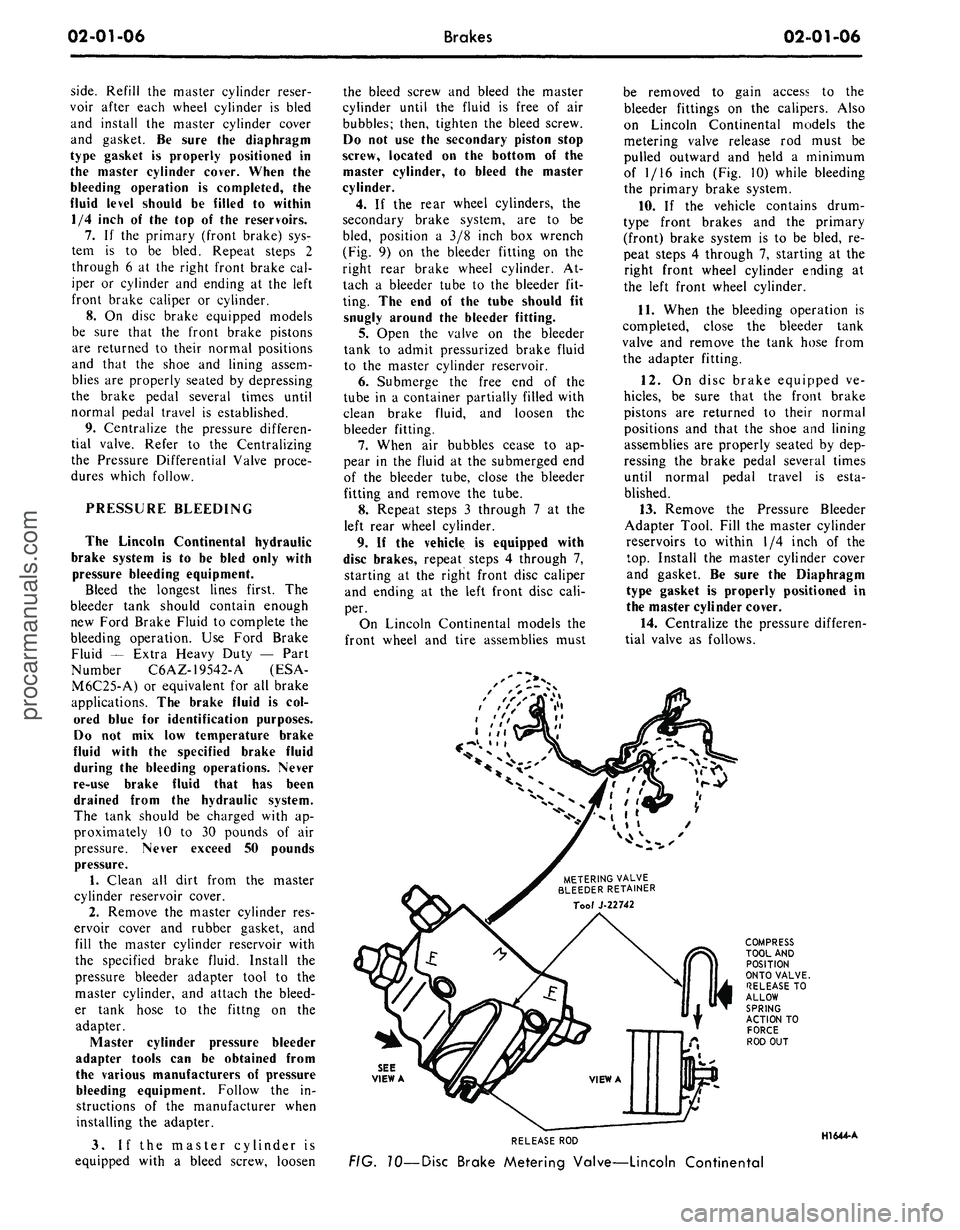
metering valve release rod must be
pulled outward and held a minimum
of 1/16 inch (Fig. 10) while bleeding
the primary brake system.
10.
If the vehicle contains drum-
type front brakes and the primary
(front) brake system is to be bled, re-
peat steps 4 through 7, starting at the
right front wheel cylinder ending at
the left front wheel cylinder.
11.
When the bleeding operation is
completed, close the bleeder tank
valve and remove the tank hose from
the adapter fitting.
12.
On disc brake equipped ve-
hicles,
be sure that the front brake
pistons are returned to their normal
positions and that the shoe and lining
assemblies are properly seated by dep-
ressing the brake pedal several times
until normal pedal travel is esta-
blished.
13.
Remove the Pressure Bleeder
Adapter Tool. Fill the master cylinder
reservoirs to within 1/4 inch of the
top.
Install the master cylinder cover
and gasket. Be sure the Diaphragm
type gasket is properly positioned in
the master cylinder cover.
14.
Centralize the pressure differen-
tial valve as follows.
METERING VALVE
BLEEDER RETAINER
SEE
VIEW A
RELEASE ROD
FIG. 10—Disc Brake Metering Valve—Lincoln Continental
HI 644-Aprocarmanuals.com
Page 18 of 413
02-01-07
Brakes
02-01-07
CENTRALIZING THE
PRESSURE DIFFERENTIAL
VALVE
After a failure of the primary (front
brake) or secondary (rear brake) sys-
tem has been repaired and bled, the
dual-brake warning light will usually
continue to be illuminated due to the
pressure differential valve remaining in
the off-center position.
To centralize the pressure differen-
tial valve and turn off the warning
light after a repair operation, a pres-
sure differential or unbalance condi-
tion must be created in the opposite
brake system from the one that was
repaired or bled last.
1.
Turn the ignition switch to the
ACC or ON position. Loosen the dif-
ferential valve assembly brake tube
nut at the outlet port on the opposite
side of the brake system that was
wheel balanced, repaired and/or bled
last. Depress the brake pedal slowly to
build line pressure until the pressure
differential valve is moved to a cen-
tralized position and the brake warn-
ing light goes out; then, immediately
tighten the outlet port tube nut.
2.
Check the fluid level in the mas-
ter cylinder reservoirs and fill them to
within 1/4 inch of the top with the
specified brake fluid, if necessary.
3.
Turn the ignition switch to the
OFF position.
4.
Before driving the vehicle, check
the operation of the brakes and be
sure that a firm pedal is obtained.
CLEANING AND INSPECTION
DISC BRAKES
1.
Remove the wheel and tire and
the shoe and lining assemblies as out-
lined in Part 2-2, Section 2.
2.
On all models except Lincoln
Continental, make thickness measure-
ments with a micrometer across the
thinnest section of the shoe and lining.
If the assembly has worn to a thick-
ness of 0.230-inch (shoe and lining to-
gether) or 0.030-inch (lining material
only) at any one of three measuring
locations or if there is more than
0.125 taper from end to end or if lin-
ing shows evidence of brake fluid con-
tamination, replace all (4) shoe and
lining assemblies on both front wheels.
On Lincoln Continental brakes
make three thickness measurements
with a micrometer across the middle
section of the shoe and lining. Take
one reading at each side and one in
the center. If the assembly has worn
to a thickness of 0.231 inch (shoe and
lining together) or 0.066 inch (lining
material only) at any one of the three
measuring locations, replace all (4)
shoe and lining assemblies on both
front wheels.
3.
Check the caliper to spindle at-
taching bolts torque. Torque them to
specification, if required.
4.
To check rotor runout, first
eliminate the wheel bearing end play
by tightening the adjusting nut. After
tightening the nut, check to see that
the rotor can still be rotated.
5.
Clamp a dial indicator to the
caliper housing so that the stylus con-
tact the rotor at a point approximate-
ly 1 inch from the outer edge. Rotate
the rotor and take an indicator read-
ing. If the reading exceeds 0.003 inch
total lateral runout on the indicator,
replace or resurface the disc brake
rotor. The following requirement must
be met when resurfacing disc brake
rotors:
Rotunda Disc Brake Attachment
FRE-2249-2 is the only approved tool
to be used to refinish the disc brake
rotors.
The step-by-step resurfacing
procedure provided with the tool must
be adhered to.
The finished braking surface of the
rotor must be flat and parallel within
0.0007 inch; lateral runout must not
exceed 0.003 inch total indicator
reading, braking surface are to be 80/15
micro inches.
On all models except Lincoln Con-
tinental the minimum limiting dimen-
sion from the inboard bearing cup to
the inboard rotor face and the mini-
mum rotor thickness dimension, must
be observed when removing material
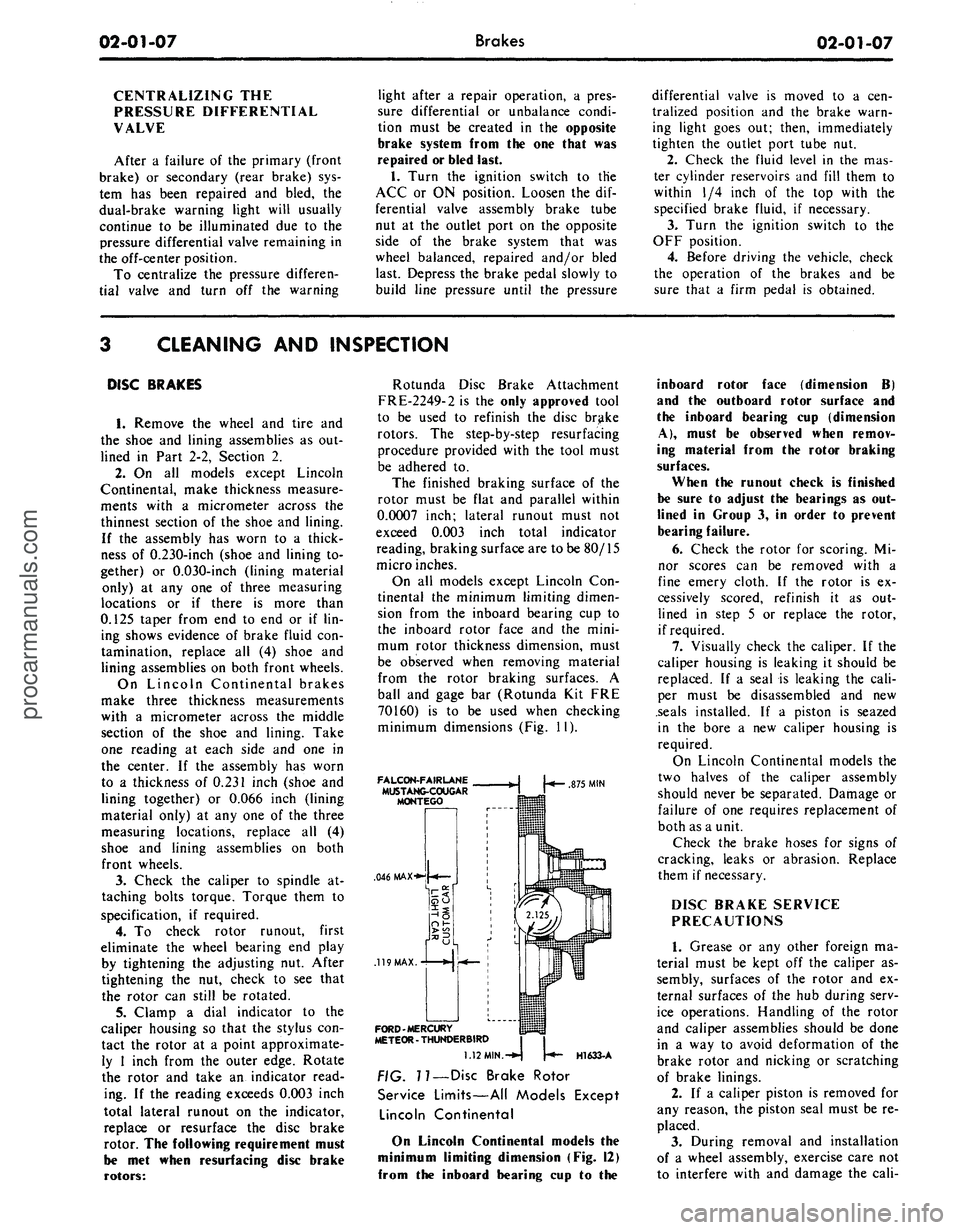
from the rotor braking surfaces. A
ball and gage bar (Rotunda Kit FRE
70160) is to be used when checking
minimum dimensions (Fig. 11).
FALCON-FAIRLANE
MUSTANG-COUGAR
MONTEGO
.046 MAX-**
.119
MAX.
FORD-MERCURY
METEOR - THUNDERBIRD
875
MIN
H1633-A
1.12
MIN.-^
??
— Disc Brake Rotor
Service Limits—All Models Except
Lincoln Continental
On Lincoln Continental models the
minimum limiting dimension (Fig. 12)
from the inboard bearing cup to the
inboard rotor face (dimension B)
and the outboard rotor surface and
the inboard bearing cup (dimension
A),
must be observed when remov-
ing material from the rotor braking
surfaces.
When the runout check is finished
be sure to adjust the bearings as out-
lined in Group 3, in order to prevent
bearing failure.
6. Check the rotor for scoring. Mi-
nor scores can be removed with a
fine emery cloth. If the rotor is ex-
cessively scored, refinish it as out-
lined in step 5 or replace the rotor,
if required.
7.
Visually check the caliper. If the
caliper housing is leaking it should be
replaced. If a seal is leaking the cali-
per must be disassembled and new
.seals installed. If a piston is seazed
in the bore a new caliper housing is
required.
On Lincoln Continental models the
two halves of the caliper assembly
should never be separated. Damage or
failure of one requires replacement of
both as a unit.
Check the brake hoses for signs of
cracking, leaks or abrasion. Replace
them if necessary.
DISC BRAKE SERVICE
PRECAUTIONS
1.
Grease or any other foreign ma-
terial must be kept off the caliper as-
sembly, surfaces of the rotor and ex-
ternal surfaces of the hub during serv-
ice operations. Handling of the rotor
and caliper assemblies should be done
in a way to avoid deformation of the
brake rotor and nicking or scratching
of brake linings.
2.
If a caliper piston is removed for
any reason, the piston seal must be re-
placed.
3.
During removal and installation
of a wheel assembly, exercise care not
to interfere with and damage the cali-procarmanuals.com
Page 27 of 413
02-02-08
Brake System
02-02-08
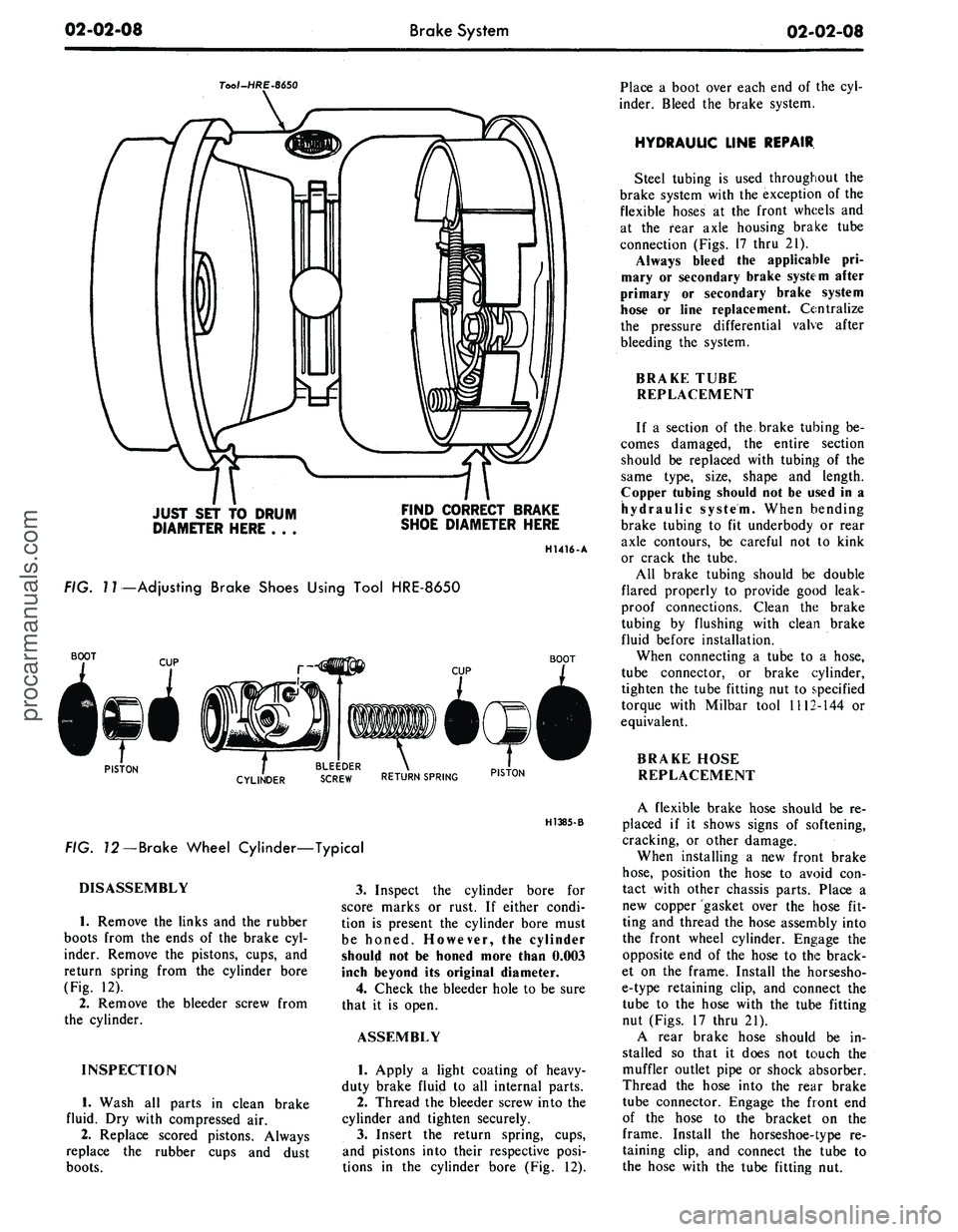
Tool-HRE-8650
JUST SET TO DRUM
DIAMETER HERE . . .
FIND CORRECT BRAKE
SHOE DIAMETER HERE
H1416-A
FIG.
7
7—Adjusting Brake Shoes Using Tool HRE-8650
BOOT
BOOT
PISTON
. BLEEDER .
CYLINDER
SCREW RETURN SPRING PIST0N
H1385-B
FIG. 72—Brake Wheel Cylinder—Typical
DISASSEMBLY
1.
Remove the links and the rubber
boots from the ends of the brake cyl-
inder. Remove the pistons, cups, and
return spring from the cylinder bore
(Fig. 12).
2.
Remove the bleeder screw from
the cylinder.
INSPECTION
1.
Wash all parts in clean brake
fluid. Dry with compressed air.
2.
Replace scored pistons. Always
replace the rubber cups and dust
boots.
3.
Inspect the cylinder bore for
score marks or rust. If either condi-
tion is present the cylinder bore must
be honed. However, the cylinder
should not be honed more than 0.003
inch beyond its original diameter.
4.
Check the bleeder hole to be sure
that it is open.
ASSEMBLY
1.
Apply a light coating of heavy-
duty brake fluip! to all internal parts.
2.
Thread the bleeder screw into the
cylinder and tighten securely.
3.
Insert the return spring, cups,
and pistons into their respective posi-
tions in the cylinder bore (Fig. 12).
Place a boot over each end of the cyl-
inder. Bleed the brake system.
HYDRAULIC LINE REPAIR
Steel tubing is used throughout the
brake system with the exception of the
flexible hoses at the front wheels and
at the fear axle housing brake tube
connection (Figs. 17 thru 21).
Always bleed the applicable pri-
mary or secondary brake system after
primary or secondary brake system
hose or line replacement. Centralize
the pressure differential valve after
bleeding the system.
BRAKE TUBE
REPLACEMENT
If a section of the brake tubing be-
comes damaged, the entire section
should be replaced with tubing of the
same type, size, shape and length.
Copper tubing should not be used in a
hydraulic system. When bending
brake tubing to fit underbody or rear
axle contours, be careful not to kink
or crack the tube.
All brake tubing should be double
flared properly to provide good leak-
proof connections. Clean the brake
tubing by flushing with clean brake
fluid before installation.
When connecting a tube to a hose,
tube connector, or brake cylinder,
tighten the tube fitting nut to specified
torque with Milbar tool 1112-144 or
equivalent.
BRAKE HOSE
REPLACEMENT
A flexible brake hose should be re-
placed if it shows signs of softening,
cracking, or other damage.
When installing a new front brake
hose,
position the hose to avoid con-
tact with other chassis parts. Place a
new copper gasket over the hose fit-
ting and thread the hose assembly into
the front wheel cylinder. Engage the
opposite end of the hose to the brack-
et on the frame. Install the horsesho-
e-type retaining clip, and connect the
tube to the hose with the tube fitting
nut (Figs. 17 thru 21).
A rear brake hose should be in-
stalled so that it does not touch the
muffler outlet pipe or shock absorber.
Thread the hose into the rear brake
tube connector. Engage the front end
of the hose to the bracket on the
frame. Install the horseshoe-type re-
taining clip, and connect the tube to
the hose with the tube fitting nut.procarmanuals.com
Page 37 of 413
02-02-18
Brake System
02-02-18
the brake hose connector
and
bracket
assembly.
3.
Remove
the two
bolts retaining
the brake hose bracket
and
caliper
as-
sembly
to the
spindle. Take care
to
avoid loosening
the
bridge bolts that
hold
the two
halves
of the
caliper
to-
gether.
4.
Lift
the
caliper assembly
off the
rotor
and
place
it on the
bench.
Installation
1.
If the
caliper assembly
is to be
replaced, transfer
the
steel tubing
and
the bleeder screw
to the new
caliper.
2.
Position
the
caliper assembly
on
the rotor,
and
mate
the
mounting bolt
holes
in the
caliper with those
in the
spindle.
It may be
necessary
to
push
the caliper pistons into
the
cylinder
bores
to
obtain clearance between
the
shoe
and
lining assembly
and the
rotor.
The
shoe
and
lining assemblies
should
be
seated properly
on the
bridges.
3.
Install
the
caliper
to
spindle
re-
taining bolts
and
torque them
to
spec-
ification. Check
to
insure that
the
rotor runs squarely
and
centrally
be-
tween
the two
halves
of the
caliper.
These should
be
approximately 0.090-
0.120 inch clearance between
the
cali-
per
and the
rotor outside diameter
(Fig.
6).
4.
Position
the
steel transfer tube
brake hose bracket
and
caliper assem-
bly
to the
spindle. Install
the
retaining
bolts then torque them
to
specifica-
tion.
5.
Connect
the
front wheel steel
transfer tube from
the
caliper
to the
front brake hose connector. Check
the
hose
for
proper installation
(Fig. 21).
6. Bleed
the
brake system
and cen-
tralize
the
differential valve
as out-
lined
in
Part
2-1.
Check
the
master
cylinder fluid level
and add the
speci-
fied fluid,
as
required. Pump
the
brake pedal several times
to
actuate
the piston seals
and to
position
the
shoe
and
lining assemblies.
7.
Install
the
wheel
and
tire assem-
bly
and the
wheel cover.
8. Road test
the
vehicle.
DISC BRAKE SHOE
AND
LINING
ALL MODELS EXCEPT
LINCOLN CONTINENTAL
Removal
1.
Remove
the
wheel
and
tire from
the
hub and
rotor assembly.
2.
Remove
the
caliper from
the ve-
hicle following
the
procedures outlined
under Disc Brake Caliper Assembly.
3.
To
facilitate removal
of the
cali-
per assemblies,
the
piston
may
have
to
be pushed into
its
bore. Apply
a
steady inward pressure against
the
inner shoe
and
lining assembly. Main-
tain
the
pressure
for at
least
a
minute.
4.
Slide
the two
outer shoe retain-
ing clips
off the
retaining pins
(Fig.
23).
5.
Remove
the two
retaining pins
from
the
outer shoe, then remove
the
shoe from
the
stationary caliper.
6. Slide
the
inner brake shoe
out-
ward until
it is
free
of the
hold-down
springs, then remove
the
brake shoe.
7.
Remove
the
caliper locating pins
and stabilizer attaching bolts, then
re-
move
and
discard
the
stabilizer
or sta-
bilizers.
8. Remove
the
locating
pin
insula-
tors from
the
anchor plate.
Installation
When installing
new
shoes
and lin-
ings
it
will
be
necessary
to
force
the
piston
to the
bottom
of its
bore.
Apply sufficient pressure
to
overcome
the grip
of the
piston seal
on the pis-
ton.
1.
Install
new
caliper locating
pin
insulators
in the
anchor plate.
2.
Position
the
caliper assembly
in
the anchor plate.
3.
Position
the new
stabilizer
or
stabilizers
and
install
the
caliper locat-
ing pins
to
engage approximately four
threads.
If
the
caliper locating pins
are
rust-
ed
or
corroded they should
be re-
placed.
Apply water
or
isopropyl alcohol
to
the caliper locating pins before instal-
lation.
Oil or
grease must
not be
used
on
the
locating pins.
4.
Position
the
outer brake shoe
on
the caliper
and
install
the two
retain-
ing pins
and
clips.
5.
Install
the
inner brake shoe
so
that
the
ears
of
shoe
are on top of the
anchor plate bosses
and
under
the
shoe hold-down springs.
6. Position
the
shoe
and
lining
assemblies
so
that
the
caliper assem-
bly
can be
placed over
the
rotor.
Ro-
tate
a
hammer handle between
the lin-
ings
to
reset
the
stabilizers.
7.
Install
the
caliper assembly over
the rotor
and on the
spindle. Install
the
two
caliper attaching bolts,
and
torque them
to
specifications.
The
upper bolt must
be
tightened first.
In-
stall
the
safety wire
and
twist
the
ends
at least five turns. Push
the
wire ends
against
the
spindle
to
avoid interfer-
ence with
the
brake hose
and the
steering stop.
8. With moderate pressure applied
to
the
brake pedal, torque
the
stabiliz-
er attaching screws
and
caliper locat-
ing pins
to
specification.
LINCOLN CONTINENTAL
Removal
1.
Remove
the
wheel
and
tire
as-
sembly from
the hub and
rotor assem-
bly.
Be
careful
to
avoid damage
or in-
terference with
the
caliper splash
shield, bleeder screw fitting
or
transfer
tube.
2.
Remove
the two
bolts that retain
the caliper splash shield,
and
remove
the shield
(Fig. 4).
3.
To
facilitate removal
and
instal-
lation
of the
shoe
and
lining assem-
blies,
the
pistons must
be
pushed into
their bores. Apply
a
steady inward
pressure against each shoe
and
lining
assembly toward
its
respective caliper
housing
on
each side
of the
rotor
(Fig.
6).
Maintain
the
pressure
for at
least
a minute.
If the
pistons will
not go ifi
easily, force them
in
with water pump
pliers.
4.
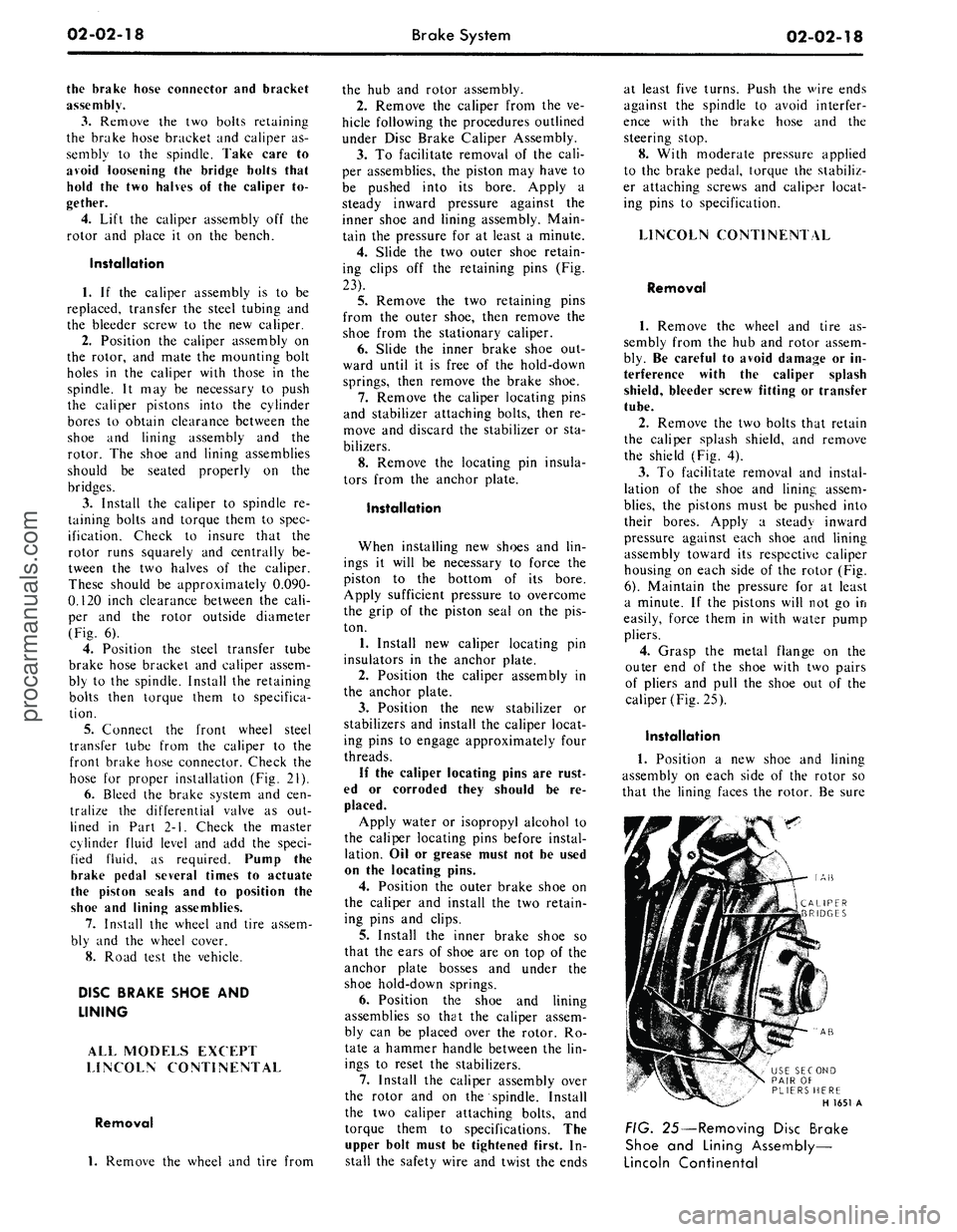
Grasp
the
metal flange
on the
outer
end of the
shoe with
two
pairs
of pliers
and
pull
the
shoe
out of the
caliper (Fig.
25).
Installation
1.
Position
a new
shoe
and
lining
assembly
on
each side
of the
rotor
so
that
the
lining faces
the
rotor.
Be
sure
AB
AB
USE SECOND
PAIR
OF
PLIERS HERE
H 1651
A
FIG. 25—Removing Disc Brake
Shoe
and
Lining Assembly—
Lincoln Continentalprocarmanuals.com
Page 57 of 413
02-02-38
Brake System
02-02-38
2.
Disconnect the actuator solenoid
and warning switch harness connectors
from the control module.
3.
Remove the two wiring harness
grommets from the dash panel and
push the wiring harness and connec-
tors through the openings in the dash
panel.
4.
Working in the engine compart-
ment loosen the hose clamp and re-
move the air hose from the air filter.
5.
Remove the engine air cleaner-
Loosen the hose clamp and remove
the vacuum hose from the vacuum
manifold fitting.
6. Raise the vehicle on a hoist.
7.
Disconnect the exhaust pipes
from the exhaust manifold and sup-
port with wire to provide access to the
actuator assembly.
8. Remove the bolt retaining the
actuator ground wire to the rear outer
corner of the engine right bank.
9. Loosen the tube nuts and discon-
nect the brake system hydraulic tubes
from the hydraulic valve housing.
10.
Remove the three nuts retaining
the actuator assembly to the actuator
support bracket.
11.
Remove the three bolts that re-
tain the actuator mounting bracket to
the side rail and remove the mounting
bracket.
12.
Remove the actuator assembly
from the vehicle and place it on a
bench.
13.
Remove the air and vacuum
hoses from the actuator.
INSTALLATION
1.
Install the air and vacuum hoses
on the new actuator.
2.
Place the actuator assembly into
position under the vehicle, routing the
air and vacuum hoses up between the
engine and fender apron and inserting
the solenoid leads through the holes in
the firewall.
3.
Position the ground wire to the
rear of the engine block and install re-
taining bolt.
4.
Position the actuator mounting
bracket to the frame side rail and in-
stall the three retaining bolts.
5.
Position the actuator assembly
to the mounting bracket and install
the three retaining nuts.
6. Connect the hydraulic tubes to
the hydraulic valve assembly and
tighten the tube nuts to specifications.
7.
Connect the exhaust pipes to the
exhaust manifolds.
8. Lower the vehicle.
9. Pull the actuator solenoid and
brake warning switch wiring harness
through the two holes in the dash
panel from inside the car. Seat the
wiring harness grommets in the dash
panel.
10.
Connect the actuator solenoid
and brake warning switch wiring har-
ness connectors to the control mo-
dules.
'
11.
Position the control module in
the bracket under the glove box and
install the retaining screw.
12.
In the engine compartment con-
nect the air hose to the air filter and
position the hose clamp.
13.
Connect the vacuum hose to the
engine vacuum manifold fitting. In-
stall the engine air cleaner.
14.
Bleed the rear brake system and
centralize the pressure differential
valve.
15.
Raise the rear wheels. Apply
the brakes with the rear wheels turn-
ing to verify proper operation of the
anti-skid control system.
ANTI-SKID CONTROL MODULE
REMOVAL
Refer to Fig. 39.
1.
Remove the retaining strap hold-
ing the harnesses.
2.
Remove the screw that attaches
the forward end of the control module
retainer to the support assembly.
3.
Lower the forward end of the
control module and retainer from the
support assembly; move the module
and retainer forward slightly until the
flange clears the slot in the support
assembly.
4.
Disconnect the five wiring har-
ness plugs from the control module.
5.
Remove the control module from
the vehicle.
INSTALLATION
1.
Connect the five wiring harness
plugs to the control module. Only one
arrangement is possible.
2.
Position the control module in
the retainer, orienting the module per
the markings on it, and insert the re-
tainer flange into the slot at the rear
of the support assembly.
3.
Pivot the retainer and control
module upward and align the screw
hole in the forward end of the retainer
with the hole in the support bracket
assembly. Install the retaining screw.
4.
Test the vehicle on the hoist to
verify correct operation of the skid
control system.
5.-
Secure the wiring to the module
support extension with the retaining
strap.
ANTI-SKID CONTROL SENSOR
REMOVAL
Refer to Fig. 39.
1.
Raise the vehicle on a hoist.
2.
Remove the rear wheel and tire
assembly.
3.
Remove the three Tinnerman
nuts (3) and remove the brake drum.
4.
Disconnect the sensor lead from
the rear wiring harness.
5.
Unseat the sensor lead grommet
pushing it to the inside of the brake
assembly.
6. Remove the four nuts that retain
the sensor to the backing plate and
pull the axle shaft, sensor assembly
and wheel bearing assembly from the
axle housing.
7.
Press the wheel bearing retainer
and wheel bearing off the axle shaft
(Refer to Part 4-2).
8. Remove the sensor assembly and
press the rotor off the shaft with tool
T69P-2B384-A Detail 2 and TOOL
1225-DA.
INSTALLATION
1.
Press a new rotor onto the axle
shaft. Install a new sensor assembly
on the shaft with tool T69P-
2B384-ADetail 1 and TOOL 1225-
DA, and press the bearing and bear-
ing retainer onto the shaft (Refer to
Part 4-2).
2.
Insert the axle shaft assembly in
the rear axle housing onto the four
backing plate retaining bolts, feeding
the sensor lead through the hole in the
backing plate.
3.
Seat the sensor lead grommet in
the backing plate.
4.
Install the four nuts on the re-
taining bolts and tighten to specifica-
tions.
5.
Connect the sensor lead to the
rear wiring harness and install two re-
taining straps.
6. Install the rear brake drum and
retain with the Tinnerrhan drum re-
taining nuts.
7.
Install the rear wheel and tire as-
sembly and tighten the wheel nuts to
specifications.
8. Test the vehicle on the hoist to
verify proper operation of the skid
control system.procarmanuals.com
Page 66 of 413
03-01-01
PART
3-1
PAGE
Suspension,
Steering, Wheels and
Tires,
General Service 03-01-01
PART
3-2
Suspension 03-02-01
PART
3-3
Automatic
Air
Leveling System ....03-03-01
PART
3-4
Automatic
Air
Leveling System
Lincoln Continental 03-04-01
PART
3-5
Steering Columns and Linkage ... 03-05-01
PART
3-6
Manual Steering 03-06-01
PART
3-7
Ford Design Non-Integral Power
Steering System
03-07-01
PART
3-8
PAGE
Ford Design Integral Power
Steering Gear 03-08-01
PART
3-9
Saginaw Design Integral Power
Steering Gear 03-09-01
PART
3-10
Ford-Thompson Power Steering
Pump 03-10-01
PART
3-11
Eaton Power Steering Pump 03-1
1-01
PART 3-12
Wheels and Tires 03-1 2-01
PART
3-13
Specifications
03-13-01
PART
3-1
Suspension,Steering, Wheels
and
Tires—General Service
COMPONENT INDEX
CASTER AND CAMBER ADJUSTMENTS
FRONT
END
INSPECTION
FRONT WHEEL ALIGNMENT CHECKS
LUBRICANT CHECKING PROCEDURE
POWER STEERING GEAR CLEANING
AND INSPECTION
POWER STEERING PRELIMINARY TESTS
POWER STEERING PUMP
Cleaning
and
Inspection
Flow
and
Pressure Tests
POWER STEERING SYSTEM FLUSHING
SHOCK ABSORBER CHECKS
STEERING WHEEL SPOKE POSITION
Adjustment
TOE-IN ADJUSTMENT
WHEEL BALANCING
MODEL APPLICATION
All
Models
01-08
01-03
01-07
01-09
01-02
01-11
01-07
01-07
01-07
Ford
01-05
01-09
01-02
01-09
Mercury
01-05
01-09
01-02
01-09
Meteor
01-05
01-09
01-02
01-09
Cougar
01-06
01-09
01-02
01-09
Fairlane
01-06
01-09
01-02
01-09
Falcon
01-06
01-09
01-02
01-09
Montego
01-06
01-09
01-02
Gl-09
Mustang
01-06
01-09
01-02
01-09
Lincoln-
Continental
01-06
01-09
01-03
N/A
Thunderbird
01-05
01-09
01-02
01-09
Continental-
Mark
III
01-05
01-10
01-03
N/A
A page number indicates that
the
item
is for the
vehicle listed
at the
head
of the
column.
N/A indicates that
the
item
is not
applicable
to the
vehicle listed.
procarmanuals.com
Page 67 of 413
03-01-02
Suspension — Steering, Wheels And Tires — General Service
03-01-02
1 TESTING
POWER STEERING-
PRELIMINARY TESTS
The following preliminary checks
should always be made before per-
forming any operations.
AIR BLEEDING
Air in the power steering system
(shown by bubbles in the fluid) should
be bled. After making sure that the
reservoir is filled to specification (the
fluid must be at normal operating
temperature when the check is made),
turn the steering wheel through its full
travel three or four times. Do not hold
the wheels against their stops. Re-
check the fluid level.
CHECK FLUID LEVEL
Run the engine until the fluid is at
normal operating temperature. Then
turn the steering wheel all the way to
the left and right several times, and
shut off the engine.
Check the fluid level in the power
steering reservoir. The level must show
on the cross hatching between the bot-
tom of the dipstick and the full mark
(Fig. 1). If the level is low, add
enough automatic transmission fluid
C1AZ-19582-A to raise the level to
the F mark on the dipstick. Do not
overfill the reservoir.
CHECK PUMP BELT
If the pump belt is broken, glazed,
or worn, replace it with a new belt.
Use only the specified type of belt.
Refer to Part 3-13 for belt adjustment
procedure.
CHECK FOR FLUID
LEAKS
With the engine idling, turn the
steering wheel from stop to stop sever-
al times. Check all possible leakage
points. Tighten all loose fittings, and
replace any damaged lines or defective
seats.
CHECK TURNING EFFORT
With the front wheels properly al-
igned and tire pressures correct, check
the effort required to turn the steering
wheel.
G 1508- A
FIG.
1—Power
Steering Pump
Dipstick
1.
With the vehicle on dry concrete,
set the parking brakes.
2.
With the engine warmed up and
running at idle speed, turn the steering
wheel to the left and right several
times to warm the fluid.
3.
Attach a pull scale to the rim of
the steering wheel. Measure the pull
required to turn the wheel one com-
plete revolution in each direction. The
effort required to rotate the steering
wheel should not exceed specifications
given in Part 3-13.
POWER STEERING PUMP FLOW
AND PRESSURE TESTS—
EXCEPT LINCOLN CONTINENTAL
AND CONTINENTAL MARK III
The power steering flow and pres-
sure tests will show whether the pump,
steering gear or power assist control
RETURN LINE
POWER
STEERING PUMP
Sr
valve is causing the trouble. Steps out-
lined below should be followed to de-
termine the cause of the trouble.
PUMP FLOW TEST
1.
Depending on the equipment
present on the vehicle (air condition-
ing, power brakes, standard transmis-
sion),
one of the following options
may be used to connect the pump
pressure and return hoses to the test
tool (T56L-3361O-D and T68L-
33610-A):
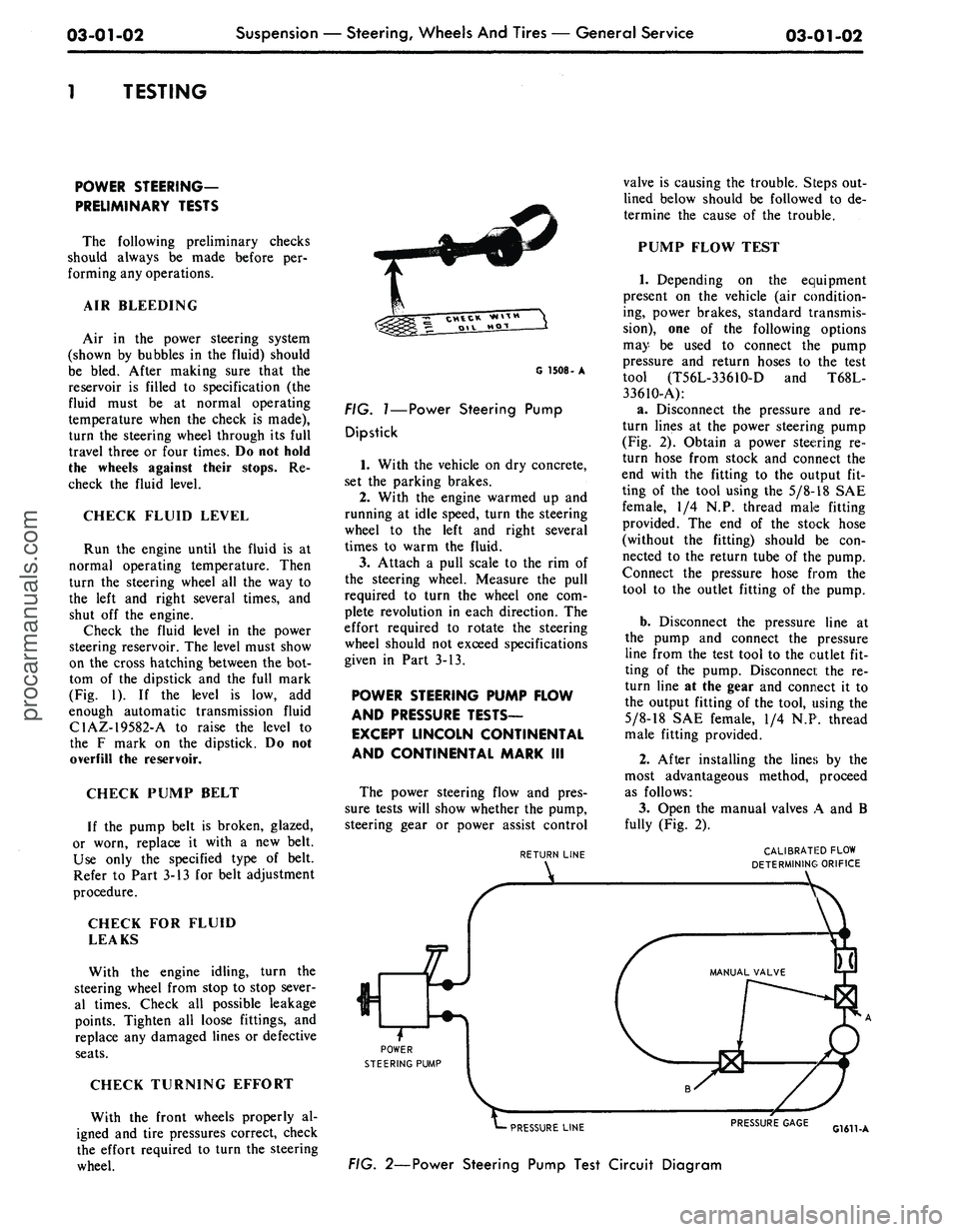
a. Disconnect the pressure and re-
turn lines at the power steering pump
(Fig. 2). Obtain a power steering re-
turn hose from stock and connect the
end with the fitting to the output fit-
ting of the tool using the
5/8-18
SAE
female, 1/4 N.P. thread male fitting
provided. The end of the stock hose
(without the fitting) should be con-
nected to the return tube of the pump.
Connect the pressure hose from the
tool to the outlet fitting of the pump.
b.
Disconnect the pressure line at
the pump and connect the pressure
line from the test tool to the outlet fit-
ting of the pump. Disconnect the re-
turn line at the gear and connect it to
the output fitting of the tool, using the
5/8-18
SAE female, 1/4 N.P. thread
male fitting provided.
2.
After installing the lines by the
most advantageous method, proceed
as follows:
3.
Open the manual valves A and B
fully (Fig. 2).
CALIBRATED FLOW
DETERMINING ORIFICE
PRESSURE LINE
FIG. 2—Power Steering Pump Test Circuit Diagram
PRESSURE GAGE
G1611-Aprocarmanuals.com
Page 68 of 413
03-01-03
Suspension — Steering, Wheels And Tires — General Service
03-01-03
4.
Connect a tachometer, start the
engine and operate it at idle speed
until the reservoir fluid temperature
reaches 165 to 175. This temperature
must be maintained throughout the
test. Valve B may be partially closed
to create a back pressure up to 350
psi to hasten the temperature rise. The
reservoir fluid must be at the proper
level.
5.
With the engine operating at rec-
ommended idle rpm and fluid temper-
ature noted in Step 4, close the manu-
al valve B. The minimum acceptable
pressure reading is 620 psi.
6. If the pressure gauge reading is
below the minimum specification, the
pump is at fault and should be re-
paired with necessary parts.
7.
If the reading is at or above the
minimum specification, the pump flow
is normal. Open manual valve B and
proceed to the Pump Fluid Pressure
Test.
PUMP FLUID
PRESSURE TEST
1.
Keep the lines and tools con-
nected as in the Pump Flow Test.
2.
With manual valves A and B
opened fully, operate the engine at
recommended idle speed (Fig. 2).
Close manual valve A, then manual
valve B. Do not keep both valves
closed for more than 5 seconds as this
would abnormally increase the fluid
temperature and cause undue pump
and/or gear wear.
3.
With the valves fully closed, the
pressure gauge should read 1000 psi
minimum for Ford, Mercury, Meteor
or Thunderbird and 750 psi minimum
for Cougar, Fairlane, Falcon, Monte-
go or Mustang.
4.
If the pressure gauge reading is
below the minimum specification, the
pump is at fault and should be re-
paired with necessary parts.
5.
If the pressure gauge reading is
at or above the minimum specifica-
tions,
the pump is normal and the
power steering gear or power assist
control valve is at fault.
FLUID PRESSURE TEST-
LINCOLN CONTINENTAL AND
CONTINENTAL MARK III
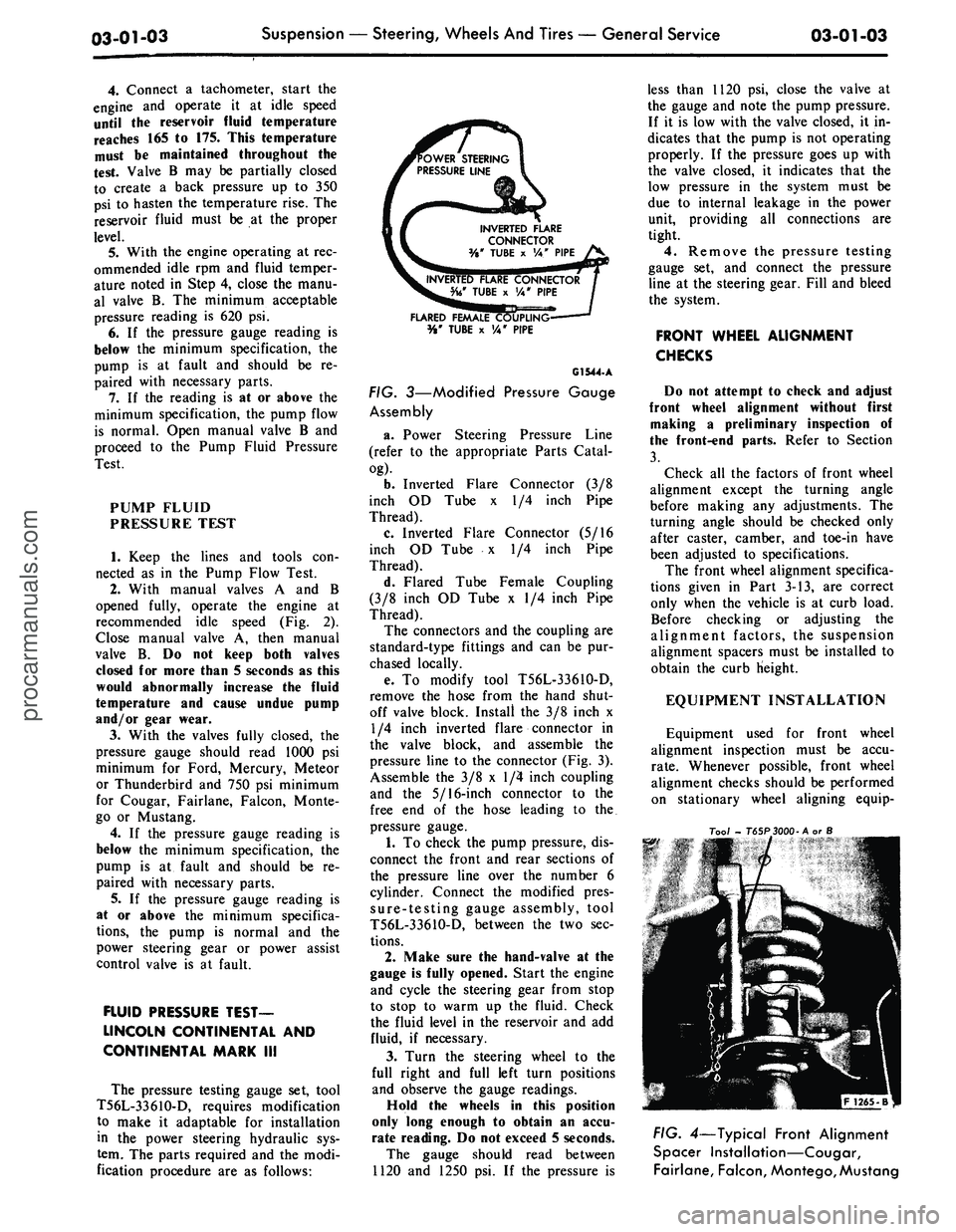
The pressure testing gauge set, tool
T56L-33610-D, requires modification
to make it adaptable for installation
in the power steering hydraulic sys-
tem. The parts required and the modi-
fication procedure are as follows:
OWER STEERING
PRESSURE LINE
INVERTED FLARE
CONNECTOR
%* TUBE x VA" PIPE
FLARED FEMALE COUPW
%' TUBE x VA" PIPE
G1544.A
FIG. 3—Modified Pressure Gauge
Assembly
a. Power Steering Pressure Line
(refer to the appropriate Parts Catal-
og).
b.
Inverted Flare Connector (3/8
inch OD Tube x 1/4 inch Pipe
Thread).
c. Inverted Flare Connector (5/16
inch OD Tube x 1/4 inch Pipe
Thread).
d. Flared Tube Female Coupling
(3/8 inch OD Tube x 1/4 inch Pipe
Thread).
The connectors and the coupling are
standard-type fittings and can be pur-
chased locally.
e. To modify tool T56L-33610-D,
remove the hose from the hand shut-
off valve block. Install the 3/8 inch x
1/4 inch inverted flare connector in
the valve block, and assemble the
pressure line to the connector (Fig. 3).
Assemble the 3/8 x 1/4 inch coupling
and the 5/16-inch connector to the
free end of the hose leading to the.
pressure gauge.
1.
To check the pump pressure, dis-
connect the front and rear sections of
the pressure line over the number 6
cylinder. Connect the modified pres-
sure-testing gauge assembly, tool
T56L-3361O-D, between the two sec-
tions.
2.
Make sure the hand-valve at the
gauge is fully opened. Start the engine
and cycle the steering gear from stop
to stop to warm up the fluid. Check
the fluid level in the reservoir and add
fluid, if necessary.
3.
Turn the steering wheel to the
full right and full left turn positions
and observe the gauge readings.
Hold the wheels in this position
only long enough to obtain an accu-
rate reading. Do not exceed 5 seconds.
The gauge should read between
1120 and 1250 psi. If the pressure is
less than 1120 psi, close the valve at
the gauge and note the pump pressure.
If it is low with the valve closed, it in-
dicates that the pump is not operating
properly. If the pressure goes up with
the valve closed, it indicates that the
low pressure in the system must be
due to internal leakage in the power
unit, providing all connections are
tight.
4.
Remove the pressure testing
gauge set, and connect the pressure
line at the steering gear. Fill and bleed
the system.
FRONT WHEEL ALIGNMENT
CHECKS
Do not attempt to check and adjust
front wheel alignment without first
making a preliminary inspection of
the front-end parts. Refer to Section
3.
Check all the factors of front wheel
alignment except the turning angle
before making any adjustments. The
turning angle should be checked only
after caster, camber, and toe-in have
been adjusted to specifications.
The front wheel alignment specifica-
tions given in Part 3-13, are correct
only when the vehicle is at curb load.
Before checking or adjusting the
alignment factors, the suspension
alignment spacers must be installed to
obtain the curb Height.
EQUIPMENT INSTALLATION
Equipment used for front wheel
alignment inspection must be accu-
rate.
Whenever possible, front wheel
alignment checks should be performed
on stationary wheel aligning equip-
Too/
- T65P3000-A or S
FIG. 4—Typical Front Alignment
Spacer Installation—Cougar,
Fairlane, Falcon,
Montego,
Mustangprocarmanuals.com
Page 73 of 413
03-01-08
Suspension
—
Steering,
Wheels
And
Tires
—
General Service
03-01-08
3.
Remove the lower (upper on
Mustang and Cougar) cover- to-
housing attaching bolt.
4.
With a clean punch or like in-
strument, clean out or push inward
the loose lubricant in the filler plug
hole and cover to housing attaching
bolt hole.
5.
Slowly turn the steering wheel to
the left stop, lubricant should rise
within the lower cover bolt hole; then
slowly turn the steering wheel to the
right stop, lubricant should rise within
the filler plug hole. If lubricant does
not rise in both the cover bolt hole
and the filler plug hole, add lubricant
until it comes out both holes during
this check.
6. Install the lower (upper on
Mustang and Cougar) cover- to-
housing attaching bolt and the filler
plug.
CLEANING
AND
INSPECTION
FRONT
END
GENERAL
INSPECTION
Do not check and adjust front
wheel alignment without first making
the following inspection for front-end
damage, or wear.
1.
Check for specified air pressures
in all four tires.
2.
Raise the front of the vehicle off
the floor. Shake each front wheel
grasping the upper and lower surfaces
of the tire. Check the front suspension
ball joints and mountings for loose-
ness,
wear, and damage. Check the
brake backing plate mountings. Tor-
que all loose nuts and bolts to specifi-
cation. Replace all worn parts as out-
lined in Part 3-2.
3.
Check the steering gear mount-
ings and all steering linkage connec-
tions for looseness. Torque all mount-
ings to specifications. If any of the
linkage is worn or bent, replace the
parts as outlined in Part 3-5.
4.
Check the front wheel bearings.
If any in-and-out free play is noticed,
adjust the bearings to specifications.
Replace worn or damaged bearings as
outlined in Part 3-12.
5.
Spin each front wheel with a
wheel spinner, and check and balance
each wheel as required.
6. Check the action of the shock
absorbers. If the shock absorbers are
not in good condition, the vehicle may
not settle in a normal, level position,
and front wheel alignment may be af-
fected.
WHEEL INSPECTION
Wheel hub nuts should be inspected
and tightened to specification at pre-
delivery. Loose wheel hub nuts may
cause shimmy and vibration. Elongat-
ed stud holes in the wheels may also
result from loose hub nuts.
Keep the wheels and hubs clean.
Stones wedged between the wheel and
drum and lumps of mud or grease can
unbalance a wheel and tire.
Check for damage that would affect
the runout of the wheels. Wobble or
shimmy caused by a damaged wheel
will eventually damage the wheel bear-
ings.
Inspect the wheel rims for dents
that could permit air to leak from the
tires.
UPPER BALL JOINT
INSPECTION
Ford,
Mercury,
Meteor,
Thunderbird,
Lincoln Continental
and
Continental Mark
III
1.
Raise the vehicle and place floor
jacks beneath the lower arms.
2.
Ask an assistant to grasp the
lower edge of the tire and move the
wheel in and out.
3.
As the wheel is being moved in
and out, observe the upper end of the
spindle and the upper arm.
4.
Any movement between the
upper end of the spindle and the upper
arm indicates ball joint wear and loss
of preload. If any such movement is
observed, replace the upper ball joint.
During
the
foregoing
check,
the
lower ball joint will
be
unloaded
and
may
move.
Disregard
all
such
move-
ment
of the
lower ball
joint.
Also,
do
not mistake loose wheel bearings
for a
worn ball
joint.
Cougar,
Fairlane,
Falcon,
Montego
and
Mustang
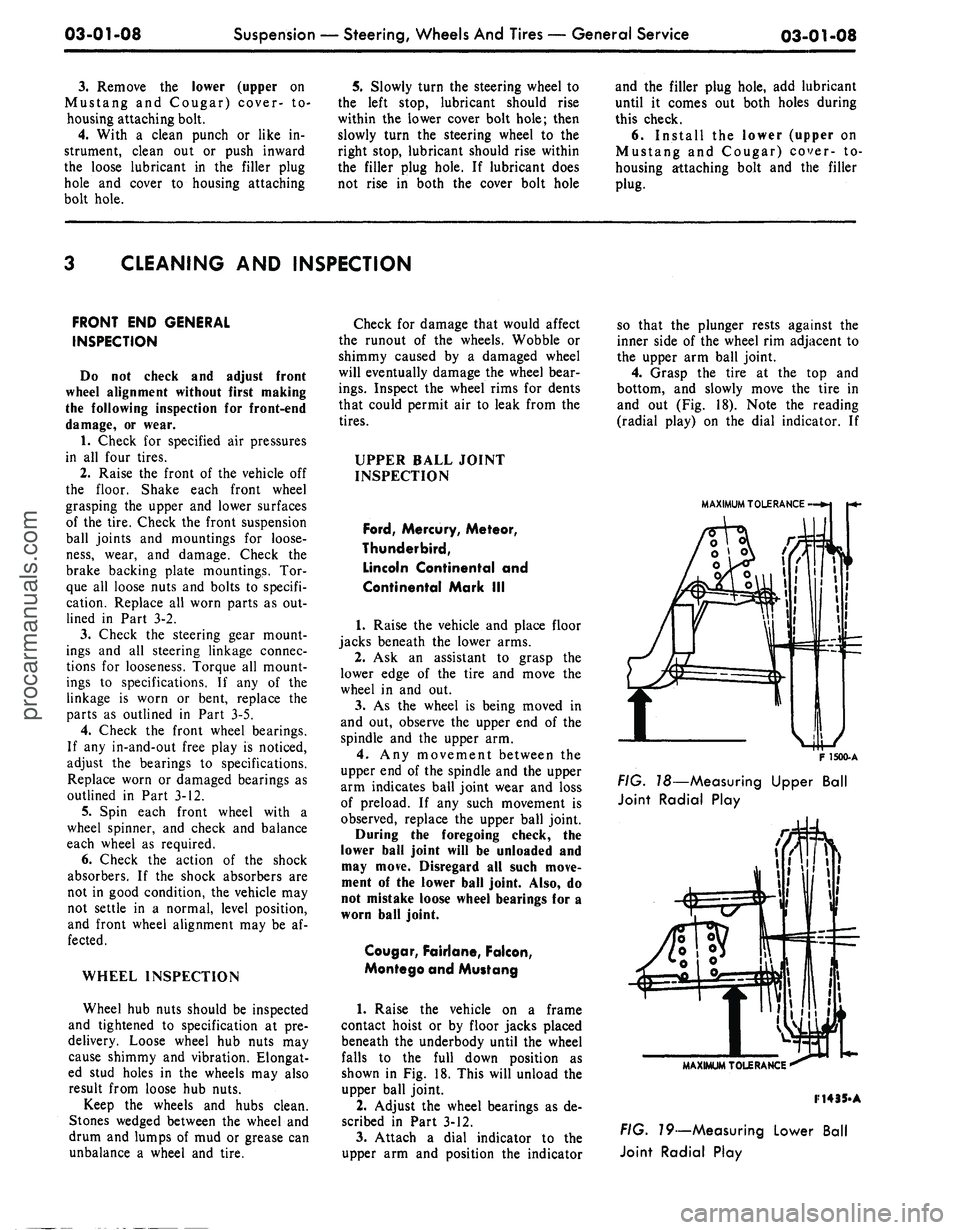
1.
Raise the vehicle on a frame
contact hoist or by floor jacks placed
beneath the underbody until the wheel
falls to the full down position as
shown in Fig. 18. This will unload the
upper ball joint.
2.
Adjust the wheel bearings as de-
scribed in Part 3-12.
3.
Attach a dial indicator to the
upper arm and position the indicator
so that the plunger rests against the
inner side of the wheel rim adjacent to
the upper arm ball joint.
4.
Grasp the tire at the top and
bottom, and slowly move the tire in
and out (Fig. 18). Note the reading
(radial play) on the dial indicator. If
MAXIMUM TOLERANCE
F
1500-A
FIG.
T8—Measuring Upper Ball
Joint Radial Play
MAXIMUM TOLERANCE
F14
35-A
FIG.
79—Measuring Lower Ball
Joint Radial Playprocarmanuals.com